
Yo!Kart allowed us to create the multi-vendor marketplace we needed for our company. Yo!kart was the only solution with all the features we needed for our multi-vendor marketplace.
In contemporary times, tech-forward customers appreciate convenience as a core offering rather than a mere add-on; hence, addressing problems with modern and digitalised solutions in a high-demand industry is fully embraced by targeted consumers. As a result, in the pharmaceutical industry, traditional pharmacy operations, hindered by inefficient manual prescription invoicing, poor inventory management, limited physical access, and more, are now replaced by an integrated digital pharmacy marketplace app. This app automates workflows, ensures secure data privacy, and provides on-demand access to pharmaceutical care to improve health outcomes.
This shift toward digital health has turned on-demand medicine into a booming global industry. Therefore, for entrepreneurs, diving into pharmacy marketplace app development isn't just about joining a trend; it has become about capitalizing on a massive and highly lucrative industry. Business owners can now invest in online pharmacy app development, which is witnessing high market growth, at a CAGR of 17.28%, estimated to make USD 185.17 billion in 2034.
Now, tapping your phone and having essential medications and wellness products delivered to your door in minutes has become a popular and successful business venture. Hence, this guide is aimed at assisting potential business owners with proven and well-researched strategies for converting their offline venture into a highly profitable pharmaceuticals marketplace app.
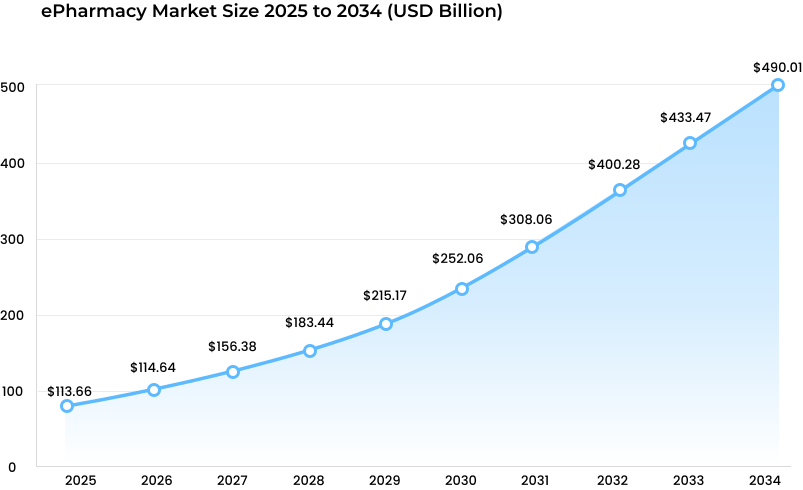
A pharmaceutical marketplace is an online e-commerce app marketplace that has transformed the way modern customers acquire their medicines and allows business owners with an offline infrastructure to expand their operations with an online marketplace that enhances business visibility.
The pharma app marketplace industry is witnessing a rise in the adult segment, holding a market share of 62.91% with increasing participation in specialist therapies, lifestyle-based treatments, long-term treatment, and more.
These pharmacy marketplace apps can also supplement their platform with additional service add-ons, which increases the earning potential of enterprises leveraging a conglomerate diversification strategy.
Three of the most prominent models that improve access, efficiency, and patient adherence, and drive profitability and scaling operations in the digital pharma space include the following.
The pharmacy marketplace apps with a procurement business model streamline the overall bulk buying and selling of medical drugs, active pharmaceutical ingredients (APIs), and medical devices. This B2B model assists in easy negotiation and business among manufacturers, distributors, and pharmacies with proper licensing.
Workflow: This marketplace app connects verified suppliers, manufacturers with other wholesalers, and licensed pharmacies with advanced functionalities like comprehensive compliance documents and procurement into the digital portal. Examples: Pharmint, GXgate, iSupply, etc.Business owners interested in pharmaceutical marketplace app development that connects multi-industry functionality can leverage this business model. It includes seamless partnering with licensed medical providers for online consultations, e-prescriptions, and direct home delivery of medications can choose this model.
Workflow: This business model replaces traditional brick-and-mortar clinic visits with detailed questionnaires or video calls offering Telehealth and e-prescriptions, linking the patient directly to medication fulfillment. Examples: LillyDirect, PfizerForAll, Ro, etc.The aggregate pharmacy app marketplace aggregates multiple independent pharmacy businesses directly with customers. It can also integrate both the above-mentioned business models in a single unified customer-facing pharmacy app.
Workflow: Patients upload prescriptions or search for items, and the app displays the nearest participating pharmacy for delivery. Examples: Capsule Pharmacy, Pharmeasy, 6amMartThese business models are some of the popular types of marketplaces that are prevalent in contemporary times. A business owner must invest after adequate market research to effectively capitalise on the competitive industry. Henceforth, the next section presents popular trends that can be catered to for launching a successful pharmaceutical marketplace.
Leading pharmaceutical marketplace apps and digital health apps have been driven by the latest technologies, affecting their high profitability capabilities. Therefore, new entrants in the industry must incorporate these business trends into their marketplace app.
The digital ecosystem is in a constant state of change and has encountered advancements in the form of AI-powered discovery features for personalised listings, analysing real-world data (RWD) to predict warehouse shortages, and end-to-end telemedicine consultation, item traceability, and more. Furthermore, these tech advancements assist in easy scheduling, transparent pricing, and offer the best digital front door, ensuring a seamless pharmacy experience.
Creating an omnichannel ecosystem has become non-negotiable in the present-day scenario; it may include a direct-to-customer delivery model, curbside pickup, physical consultation, refil scheduling, or more. A new business owner must invest in pharmaceutical marketplace development that supports segmenting healthcare professionals (HCPs) and patients based on behavioural patterns, and in refining platform strategies based on consumer engagement across the marketplace. Overall, this enhances the marketplace experience, leading to larger customer acquisition and retention.
To gain a competitive edge in the industry, a business owner must invest in effective marketing and increased customer satisfaction. Similarly, a growth strategy should offer targeted customer acquisition, in addition to pharmacy software development. An ambitious pharmaceutical marketplace indulges in new and capable partnerships with enterprises such as pharmacy development industry giants and academic institutions investing in innovation, adaptations, and scaling. These strategic partnerships may even assist with telehealth consultations, an integrated direct-to-customer business model, and the seamless integration of cross-border digital pharmacies.
Vertical marketplace integration has been a popular choice over the years, but with the horizontal business model, the pharmacy business owners can reengineer the market, with unified commercial and patient support and experience over the pharmaceutical marketpace. Invest in the future, as the modern platforms are integrating strategic partnerships, cross-sector ecosystem connectivity, horizontal interconnectivity, and more.
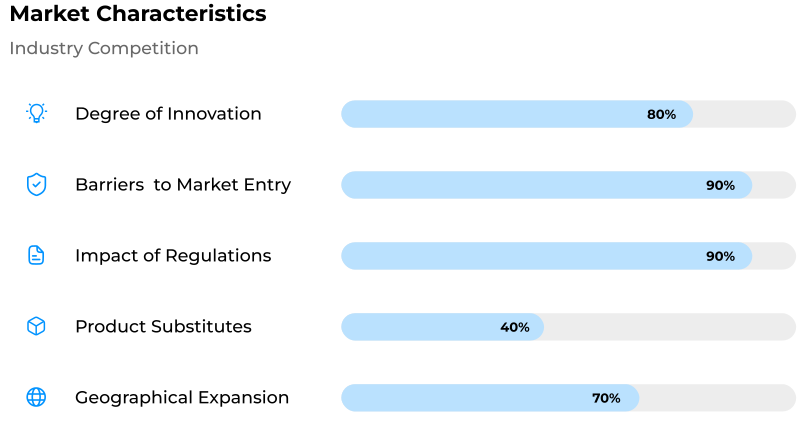
The pharmaceutical marketplace is a niche industry that is notably heavily regulated, and a pharmacy marketplace owner needs to comply with regulations to ensure the longevity of the business. This list contains the five non-negotiable regulations in multiple parts of the world.
HIPAA:Health Insurance Portability and Accountability Act, which restricts the sharing of sensitive data regarding substances and reproductive care. Updates mandate multi-factor authentication and data encryption.
HITECH:Health Information Technology for Economic and Clinical Health Act, focusing on expanding HIPAA enforcement, with penalties for digital data breaches, implementing stringent security measures.
DSCSA:Drug Supply Chain Security Act, is an essential compliance requirement for pharmacies dealing with prescription drugs. It aims to ensure efficient inventory management, traceability, and serialised data formats that authenticate the supply chain.
NIST:National Institute of Standards and Technology, provides a robust cybersecurity framework. Marketplaces adopt NIST standards to mitigate software security risks.
Other Significant Laws (GDPR, FDA, CCPA):These are local laws that protect users from any malicious software activity. These modernized rules are GDPR, General Data Protection Regulation; FDA, Food and Drug Administration, and CCPA, California Consumer Privacy Act, to streamline manufacturing networks under a single establishment.
A pharmacy marketplace app is a digital platform that connects patients with pharmacies and manufacturers with distributors on one unified platform. The marketplace is adept at providing value features such as inventory handling, regulatory compliance, prescription invoicing, and more that offer convenient platform operations.
| Business Model | User Types |
|---|---|
| B2B Model | Manufacturers, Distributors with Wholesalers & Pharmacies |
| B2C/ D2C Model | Doctors & Caregivers with Patients |
| Aggregate Model | Local Niche-based Pharmacies with Target Consumers |
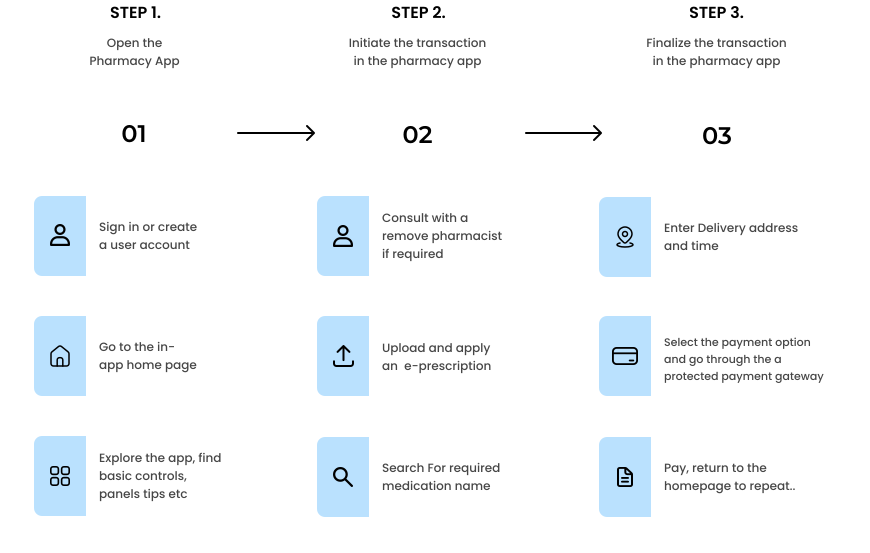
Launching a pharmaceutical marketplace requires specialized target validation, strict legal compliance, and robust technical infrastructure. Therefore, a pharmaceutical marketplace owner must invest in a high-quality app development company that has launched multiple, global industry-specific marketplaces. But before investing, there are detailed steps to simplify the overall cumbersome process.
A business owner looking to start their pharmacy marketplace app in this continuously evolving digital landscape must conduct thorough market research to attain market validation and launch a website and app that stands out in the competitive market.
Therefore, an aspiring entrepreneur should research industry demand, customer pain points, and understand the market by adopting research methodologies such as Porter's Five Forces for meticulous competitive analysis, PESTLE analysis for analysing external environmental factors, SWOT analysis for strategic planning for the organisation framework, and more.
These frameworks assist the business owner in determining the unique selling point for the pharmacy marketplace app. It may be determined and implemented, catering to customer feedback and aligning with industry trends to remain competitive and relevant in the market. Identify market gaps and offer products and services that solve a lack or a problem, and capitalise on a highly lucrative and profitable industry.
| Business Models | Supported Niches |
|---|---|
| B2B Pharmacy Marketplace App |
|
| B2C Pharmacy Marketplace App |
|
| Industry-Based Aggregator Pharmacy Marketplace App |
|
The features and functionality of a marketplace app add to its popularity, determine customer acquisition and retention rate, while also determining the marketplace app's relevance in the industry. Additionally, deciding features for a multi-vendor pharmaceutical marketplace app requires balancing user convenience, vendor management, and strict regulatory compliance.
A business owner must invest in high-return revenue models that assist in launching a pharmacy marketplace app aimed at integrating high-return monetisation channels for the future that supports endless scaling. Selecting revenue streams for a pharmaceutical marketplace requires a mix of transaction fees, recurring subscriptions, and value-added operational charges.
Service Commissions:The service commission revenue channel allows the admin to charge a commission fee for every transaction made through the marketplace. The buyers (pharmacies, hospitals, patients) pay these percentage fees.
Subscription Packages:These are monthly fees that are charged for add-on services and tiered packages for additional features. This revenue stream creates a sustained income for the pharmacy marketplace app admin.
Featured Listing:The featured listing allows pharmacies, stores, manufacturers, and sellers to get featured with top placements in search results and category pages for promotions and increased sales.
Third-party Advertisement:The third-party advertisement feature is leveraged for paid promotion through the targeted banner space or sponsored content on the pharmacy marketplace app. These third-party partners can be equipment vendors, insurance networks, or other related businesses.
Request for Quotation: Charge suppliers a small fee to submit bids on high-value bulk buyer requests or priority sourcing leads.
Procurement Handling Fees:Businesses can easily add a flat administrative fee to manage complex institutional orders, regulatory documentation, or compliance checks.
The technological stack for a robust pharmacy marketplace app development should be carefully curated to launch a platform with high scalability capabilities that supports a seamless interface without hindering the platform performance.
| Classification | Tech Stack |
|---|---|
| Mobile App | React Native, Flutter |
| Frontend | React, Angular |
| Backend | Node.js, Django |
| Database Framework | PostgreSQL, MongoDB |
The cost of pharmaceutical marketplace app development is highly dictated by whether one chooses custom development, a ready-made solution, or a hybrid approach. Primarily, these are the three most sought-after approaches, and detailed insight into the approaches is given below.
Custom DevelopmentThe custom development approach enables the business to tailor, design, and develop their pharmacy marketplace from scratch, offering full architectural control, and can be built and launched in around 6-12 months at an hourly cost.
Customisable Ready-made SolutionThe white-label ready-made solutions enable business owners to deploy a pre-built software solution after making certain customisations, according to business requirements. Moreover, self-hosted marketplaces are also scalable solutions that allow high-quality platform performance.
Tailored Hybrid Marketplace DevelopmentThe hybrid approach is a framework that blends pre-built, ready-made software with high custom development abilities. This model enables the business owner to incorporate their unique business ideas and models into the existing versatile architecture of a ready-made solution with industry-specific pre-integrated third-party APIs and a feature list. Comprehensive strategies for building these systems are outlined in Pharmacy Marketplace App Development Guides.
The last step to launch your pharmaceutical marketplace is to test it thoroughly, and testing, launching, and marketing a pharmaceutical marketplace app requires rigorous quality assurance, a localized soft launch, and targeted digital acquisition channels. A business owner must launch and deploy their website or app after thorough quality and load testing. Furthermore, initially, it is advised to launch an MVP to monitor live operation, gather customer feedback, and implement the response.
Additionally, for successful marketing of your pharmaceutical marketplace app, a business owner can leverage effective marketing methods such as social media marketing, hyperlocal search engine optimization, email marketing, content marketing, strategic partnerships, and affiliate or influencer marketing.
Now that a business is acquainted with end-to-end steps to successful pharmaceutical marketplace app development, business owners need to familiarize themselves with the common industry challenges. The next section presents common challenges with their proven solutions, so that you can easily launch a success-oriented pharmacy marketplace app.
Navigating the pharmaceutical app marketplace requires overcoming strict laws, user trust hurdles, and supply chain limits. Listed are the most common challenges faced by teh business owners.
The pharmaceutical industry is constantly changing; therefore, in the present-day scenario, and as a result, different countries and regions have unique pharmaceutical regulations regarding drug sales, prescriptions, licensing, and user data, making compliance difficult for marketplace apps.
Solution:The business owner must evolve constantly with changing times and integrate their marketplace with geographic compliance and inventory management. A business can build region-specific compliance modules and have verified pharmacy licences and certifications. Moreover, automated tracking tools, regulatory updates, supply chain management, and secure & compliant digital tools built into the software assist in efficient workflow.
For an offline pharmaceutical marketplace store, operational bottlenecks are significant and need to be addressed to prevent sales of improper or expired batches and inaccurate inventory estimates, which may pose various health risks. Moreover, maintaining accurate stock levels, preventing medicine shortages, and ensuring timely deliveries across multiple pharmacies can be complex.
Solution:The online pharmacy marketplace app enables business owners to monitor their inventory with real-time systems built into the software, which also offers smooth, safe, and robust logistics. Businesses can integrate AI-based demand forecasting and enable automated stock replenishment to cater to this industry challenge. Further, tracking shipments with GPS and logistics integrations assists in streamlining this process manifold.
There is a noticeable preference for offline pharmacy, with increased personalisation, high credibility, trust factor, immediate availability, and personal interaction. Hence, it is a challenge for new online pharmacy marketplaces to expand and create credibility, as many customers still prefer purchasing medicines from local pharmacies.
Solution:This industry challenge needs redressal; therefore, creating a USP (unique selling point), offering fast delivery, with a choice of click-and-collect, along with connecting patients with certified pharmacist consultations online, are some of the effective solutions. Also, businesses can build customer trust through authentic reviews, certified verification badges, exclusive discounts, and more.
Suggested Read: Challenges Faced while Building a B2B Vertical Marketplace and Their SolutionThe pharmacy marketplace is saturated with multiple offline stores, along with upcoming online pharmacy marketplace apps; hence, it is a highly competitive industry, making it difficult for new apps to attract and retain users.
Solution:New pharmacy marketplace app business owners can navigate this industry challenge by offering value-added services and a seamless user experience with personalized recommendations. Additionally, to stand out, a business must focus on offering competitive pricing and subscription benefits, such as ePrescription, medicine reminders, and more. A competitive edge over the industry can also be gained through building strategic partnerships.
User data sensitivity is essential to maintain steady growth that succeeds over time, providing effective customer acquisition and retention capabilities. The data security and trust factor is of extreme importance, as it handles sensitive health records, prescriptions, and payment information, making them prime targets for cyber threats.
Solution:A pharmaceutical marketplace app admin must implement end-to-end encryption and secure two-factor authentication, while also complying with data privacy regulations, such as HIPAA, GDPR, and others as mentioned above. Additionally, business owners can conduct regular security audits and vulnerability testing, and build user trust by clearly communicate privacy policies and data protection measures to build user trust.
A proven technological solution to the pharmaceutical marketplace app industry is Yo!Kart designed and developed by an experienced and reliable team to counter eCommerce industry challenges. The software offers built-in industry-specific features that effectively cater to challenges, in addition to reducing launch time and cost of investment. Know more.
Powered by FATbit Technologies with over 20 years of experience and industry-specific expertise, Yo!Kart is the development company's flagship product that has supported multiple global eCommerce businesses to deploy their marketplace apps.
Yo!Kart is purpose-built to scale, combining operational efficiency and streamlining business models, and built on a robust tech stack that can accommodate enterprise-grade scalability.
More reasons to choose the solution are listed below:
UNI DiamondsEnterprise-Grade Diamond Trading Marketplace App
TajerMulti-Category Retail eCommerce Marketplace App
ProcurenetB2B Medical Supply Chain Marketplace Platform
The digital health landscape is receptive to online transformation and expanding their offline businesses, along with enabling business owners to experience high operational convenience. This is a lucrative industry, and right now, it is an opportune time to enter the market and launch a competitive pharmacy marketplace app.
Developing a pharmaceutical marketplace app with strict adherence to regulatory compliance, prioritized user experience, and platform scalability for long-term growth enables deploying a secure, efficient platform that bridges the gap between buyers and vendors in this evolving digital health landscape. know more.
The cost of pharmacy marketplace app development depends on the method chosen by the aspiring business model. As discussed before, there are three approaches to deploy your marketplace app, and here are their approximate cost.
The pharmaceutical marketplace app must be integrated with the latest industry-aligning revenue streams to generate a sustained revenue stream that offers a large return on investment. The following are the popular channels,
Yo!Kart, is one such eCommerce marketplace app software that has pre-integrated revenue channels in its versatile architecture with high customisability, which enables businesses to get personalised integrations according to the business requirements.
What is the best business model to launch your pharmacy marketplace app?The best business model for your pharmacy marketplace out of B2B, B2C, and D2C depends on several factors, such as
Yes, a pharmacy app developed by Yo!Kart can easily support cross-border buying and selling, supported by app features such as multilingual, multicurrency, regional compliance adherence, and more.
What sets Yo!Kart apart from others in pharmacy marketplace app development?Yo!Kart is a white-label solution built to support diversified business models, with its versatile and flexible architecture that accommodates thorough customisation and scalability capabilities. The software also supports multi-vendor marketplaces and is equipped with features such as RFQ, tiered pricing, and dedicated dashboards for streamlined business operations.
