
Published date 02 Dec, 2025
The demand for online medical supplies and healthcare equipment has surged rapidly in the last few years. Key contributing factors include the rise of telehealth services, aging populations, the digitization of hospital procurement, and increased global accessibility needs. From PPE kits and diagnostic devices to hospital beds, laboratory equipment, and rehabilitation aids, institutional and individual buyers increasingly prefer centralized purchasing systems over fragmented offline vendors.
A medical supplies & healthcare equipment marketplace brings multiple verified vendors together on a single platform, allowing buyers to compare prices, access compliant medical products, track availability, and procure products from trusted suppliers. Thus, it presents a lucrative business opportunity. However, success depends on building a platform that prioritizes regulatory compliance, supply chain transparency, and seamless procurement experiences for hospitals, clinics, laboratories, pharmacies, and individual buyers.
Table of Contents
- What is a Healthcare Equipment Marketplace?
- Understanding the Medical Supplies & Healthcare Equipment Marketplace Model
- Key Features Required in a Medical Supplies Marketplace
- User-Type Wise Features for a Medical Supplies & Healthcare Equipment Marketplace
- Business Model: How a Medical Supplies Marketplace Works
- Revenue Model: How a Medical Supplies Marketplace Makes Money
- Steps to Build a Medical Supplies & Healthcare Equipment Marketplace
- Which Marketplace Software Works Best To Build a Medical Supplies Marketplace?
- Conclusion
- FAQs
What is a Healthcare Equipment Marketplace?
A healthcare equipment marketplace is an online platform where multiple certified sellers list medical supplies, equipment, and healthcare products while hospitals, clinics, laboratories, pharmacies, and individual buyers purchase them from one centralized portal.
Unlike a single-vendor medical eCommerce store, a marketplace aggregates many suppliers, helping buyers access a wide catalogue of verified medical products, compare prices, check certifications, and source equipment efficiently.
We can say a healthcare equipment marketplace bridges critical gaps in medical procurement by providing:
- A trusted network of verified suppliers
- Transparent pricing across brands and vendors
- Centralized procurement workflows for healthcare institutions
- Compliance-driven product listings with regulatory documentation
- Streamlined logistics for sensitive medical equipment
In simple words, it allows buyers to source healthcare products online, bringing safety, convenience, and accountability to medical purchases while eliminating the fragmentation and delays associated with traditional offline procurement.
Understanding the Medical Supplies & Healthcare Equipment Marketplace Model
Unlike regular eCommerce, healthcare commerce operates in a controlled and regulated environment. Therefore, the marketplace must support specialized workflows. Key requirements include:
- License and certification verification for sellers
- Product authenticity and traceability
- Controlled and restricted products management
- Bulk/B2B order and quote management
- Region-specific medical regulatory compliance
A successful healthcare marketplace must build trust above everything else, ensuring all products listed on the platform are safe, authorized, and capable of meeting medical usage standards.
Key Features Required in a Medical Supplies Marketplace
To make the platform reliable, scalable, and compliant, the following features must be integrated into the system. Moreover, the features integrated into the platform not only determine reliability and efficiency but also strengthen trust for all healthcare buyers. Below are the essential features that ensure smooth operations, safety, and long-term scalability for a medical supplies marketplace:
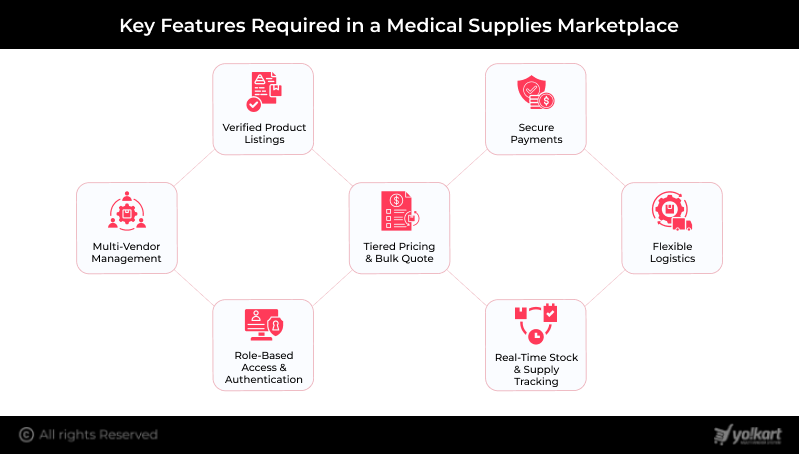
1. Multi-Vendor Management: Enables multiple suppliers to register, list, and manage their inventory independently. Moreover, vendors can efficiently manage their orders through vendor dashboards.
2. Verified Product Listings: Your platform must support digital verification for certifications, approvals, and regulatory documents, including FDA approval, CE marking, ISO certificates, and batch details, to ensure the credibility of the products listed.
3. Role-Based Access & Authentication: Provide separate access levels for hospitals, procurement teams, clinics, laboratories, distributors, and individual buyers to maintain secure and compliant workflows.
4. Tiered Pricing & Bulk Quote Requests: Enables institutional buyers to request quotes, negotiate pricing, and place bulk procurement orders with a flexible pricing structure.
5. Real-Time Stock & Supply Chain Tracking: Offers transparent visibility into stock availability, delivery timelines, batch numbers, and expiry dates for informed purchasing.
6. Secure & Compliant Payments: Support multiple business and payment models, including prepaid, purchase orders, escrow, and milestone-based payments. Other than that, your platform must be integrated with international payment gateways to seamlessly manage payments.
7. Flexible Logistics Integrations: Offer logistics options for multi-location deliveries, cold chain shipping, and specialized courier services for sensitive medical equipment.
Create a Feature-Rich Marketplace For Medical Supplies and Healthcare Equipment
User-Type Wise Features for a Medical Supplies & Healthcare Equipment Marketplace
Different user roles interact with the platform differently. To ensure smooth procurement and compliance workflows, your marketplace should offer tailored capabilities for each role. Therefore, user-specific features are given below:
|
Buyers (Hospitals, Clinics, Labs, Pharmacies & Individuals) |
Sellers (Medical Equipment Suppliers, Manufacturers & Distributors) |
|---|---|
|
|
|
Marketplace Admin |
Logistics Partners/Courier Providers |
|---|---|
|
|
Business Model: How a Medical Supplies Marketplace Works
A medical supplies & healthcare equipment marketplace acts as a digital procurement bridge between certified medical suppliers and healthcare buyers. Instead of maintaining inventory like a traditional reseller, the marketplace provides a platform where:

1. Medical suppliers register and get verified
- They upload certifications, business licenses, and product compliance documents.
2. Sellers list medical equipment and supplies
- PPE, surgical instruments, lab equipment, hospital furniture, rehabilitation devices, etc.
3. Buyers browse and compare products
- Based on price, brand, seller reputation, and availability.
4. Orders or RFQs (Requests for Quotes) are placed.
- Institutions can negotiate pricing for bulk purchases or subscribe to recurring orders.
5. Logistics & delivery are executed.d
- Either by the seller or through marketplace-integrated logistics providers.
6. Payments are processed securely.y
- Standard payments, purchase orders, escrow, milestone payments, or B2B credit.
7. Sellers receive payouts
- After commission/charges are deducted according to the marketplace policy.
In summary, the marketplace connects buyers and certified medical suppliers, governs compliance, manages procurement workflows, and facilitates transactions and delivery. It is a low-inventory, high-scalability digital business model based on transparency and trust.
Revenue Model: How a Medical Supplies Marketplace Makes Money
A healthcare marketplace can adopt one or multiple monetization models. However, the most commonly successful revenue streams include:
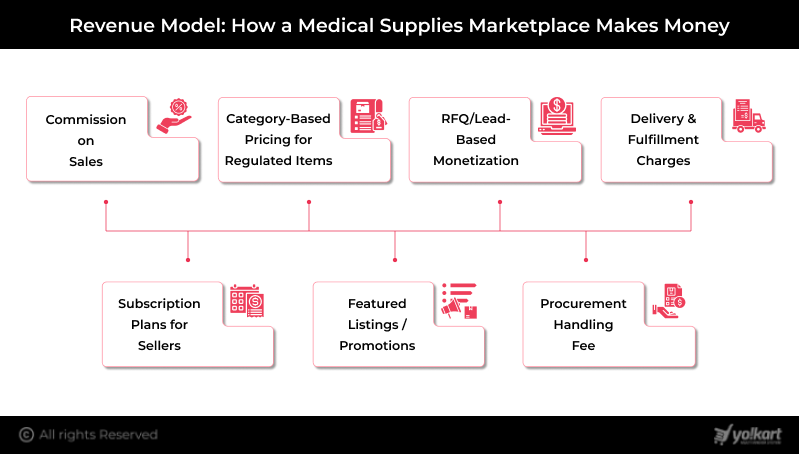
- Commission on Sales: A percentage is charged on every successful order placed through the marketplace.
- Subscription Plans for Sellers: Suppliers pay for monthly/annual plans to access premium features, additional listings, or more RFQs.
- Category-Based Pricing for Regulated Items: Higher listing or transaction pricing may apply to specialized or highly regulated product categories.
- Featured Listings / Promotions: Sellers pay to promote the following on the platform:
- Specific products
- Sponsored listings
- Homepage or category page placement
- RFQ/Lead-Based Monetization: Manufacturers and OEMs (Original Equipment Manufacturers) can be charged for:
- Providing buyer leads
- Access to large institutional procurement requests
- Procurement Handling Fee: A service fee added to large institutional purchases, PO processing, or negotiated deals.
- Delivery & Fulfillment Charges: Applicable when the platform provides in-house courier management or negotiated shipping rates.
By combining these revenue streams, the platform can maintain profitability while offering value to both buyers and sellers. Moreover, a balanced monetization strategy ensures long-term sustainability and supports continuous improvements in procurement efficiency and compliance.
Steps to Build a Medical Supplies & Healthcare Equipment Marketplace
Launching a medical supplies & healthcare equipment marketplace requires a strategic blend of business planning, regulatory compliance, technology selection, and supplier onboarding. Here’s a refined step-by-step roadmap:
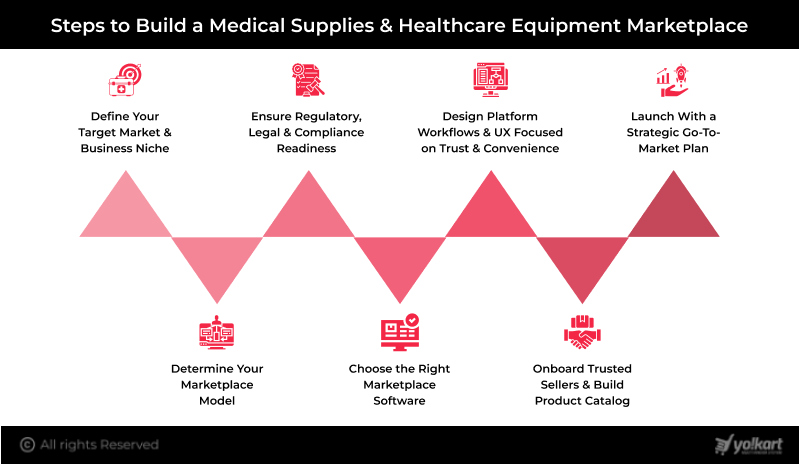
Step 1: Define Your Target Market & Business Niche
Instead of trying to serve every medical segment on day one, identify your core focus and begin with a clearly defined niche. This could include:
- Hospital supplies & consumables
- Laboratory & diagnostic equipment
- Surgical instruments and kits
- Home healthcare and mobility aids
- Dental/veterinary/physiotherapy equipment
Starting with a targeted segment allows you to understand its procurement needs deeply, optimize compliance workflows, and tailor the platform experience. This specialization helps build industry credibility, attract the right suppliers, and improve marketplace positioning for long-term growth.
Step 2: Determine Your Marketplace Model
After deciding on the niche, the next crucial step is to select the marketplace model. Thus, choose how transactions and relationships between buyers and sellers are structured:
- B2B Marketplace: For hospitals, clinics & labs to procure in bulk
- B2C Marketplace: For end-users needing home healthcare products
- Hybrid Model: Supports both retail & institutional buyers
You may also integrate auction models, RFQ (Request for Quote), volume pricing, and subscription-based supply chains, depending on your audience.
Step 3: Ensure Regulatory, Legal & Compliance Readiness
Healthcare eCommerce is regulation-intensive, making compliance a critical foundation for your marketplace. Therefore, make sure to:
- Verify manufacturers, dealers, and distributors
- Capture mandatory certifications (ISO, CE, FDA, CDSCO, NABL, etc.)
- Define selling eligibility for restricted medical products
- Implement documentation for warranties, expiry, recalls & safety guidelines
Further, strong compliance builds trust and protects your marketplace from legal and operational risks.
Step 4: Choose the Right Marketplace Software
Technology is the backbone of the platform. Thus, you should select a solution that supports:
- Multi-vendor capabilities
- Compliance-driven product listings
- Inventory, logistics & warehouse management
- Bulk orders & RFQ management
- Secure payments and split settlements
One such solution is Yo!Kart, which is a reliable software to build a medical supplies marketplace. Moreover, it offers:
- Multi-vendor architecture
- Subscription & commission revenue models
- Product compliance fields (certifications, licenses, documents)
- B2B order workflows (RFQ, negotiated pricing, repeat orders)
- Robust vendor onboarding and catalog management dashboard
- Readymade + Highly customizable solution
Choosing an industry-ready solution like Yo!Kart reduces time to market and launch cost while ensuring scalability.
Step 5: Design Platform Workflows & UX Focused on Trust & Convenience
A healthcare procurement platform must be easy to use and transparent. Thus, it should have:
- Dedicated dashboards for vendors, buyers, and admins
- Advanced catalog filtering by brand, category, clinical use & certifications
- Real-time stock visibility
- Price comparison & vendor comparison
- Bulk quote request and re-order options
Smart UX delivers efficiency for buyers and improves conversion rates.
Step 6: Onboard Trusted Sellers & Build Product Catalog
After selecting the technology, gather a strong network of verified suppliers before launch. You can target:
- Manufacturers & authorized distributors
- Third-party logistics partners for sensitive medical shipping
- Service partners for installation and maintenance (if applicable)
Further, ensure detailed product listings with:
- Regulatory certifications
- Technical specifications
- Warranty information
- Product demonstration videos
Step 7: Launch With a Strategic Go-To-Market Plan
Build credibility from day one by focusing on:
- Buyer outreach – hospitals, labs, pharmacies, NGOs, distributors
- Vendor partnerships – through incentives & onboarding training
- Digital campaigns – SEO, paid ads, LinkedIn, medical associations
- Participation in medical expos & industry events
Which Marketplace Software Works Best To Build a Medical Supplies Marketplace?
Building a medical supplies marketplace requires technology that can support multi-vendor commerce, sensitive product compliance, and institutional B2B purchasing workflows. Unlike regular eCommerce platforms that focus mainly on catalog listings and retail transactions, healthcare procurement demands additional layers of security, document governance, pricing rules, and logistics coordination. Therefore, choosing the right marketplace software is not just about selecting an online selling solution; it’s about ensuring regulatory safety, procurement efficiency, and long-term scalability.
However, many entrepreneurs evaluate different approaches, including custom development, SaaS marketplace tools, or readymade multi-vendor platforms. A widely adopted option among healthcare commerce founders is Yo!Kart, not because it is the only tool available, but because its built-in modules align closely with the real-world needs of medical product buying and selling. Moreover, it supports multi-vendor onboarding with document verification, compliance-driven product listings, B2B workflows like RFQ and negotiated pricing, and automated vendor payouts, all of which are essential for marketplaces that deal with regulated equipment and bulk institutional orders. Since Yo!Kart is self-hosted, and it also offers full control over data security and compliance, which is highly valuable in the healthcare sector.
Overall, Yo!Kart enables medical marketplace startups to launch quickly while still allowing deep customization for regional regulations, supplier workflows, logistics requirements, and future scaling. Hence, businesses can focus on acquiring suppliers and institutional buyers instead of investing months into core system development.
Key Considerations When Choosing Marketplace Software
Your medical supplies marketplace software should ideally support:
- Multi-vendor catalog management and onboarding checks
- RFQ & B2B purchase workflows
- Tiered and negotiated pricing structures
- Controlled product and restricted category management
- Automated and secure vendor payouts
How Yo!Kart Aligns With These Requirements
Yo!Kart addresses the majority of healthcare marketplace needs, such as:
- Built-in multi-vendor architecture with vendor identity verification
- RFQ, quote negotiation, and bulk procurement features
- Tiered pricing and purchase order system for hospitals and labs
- Automated commission calculations and vendor settlements
- Self-hosted ownership, ensuring full control of compliance and data security
Explore Cutting-edge Capabilities of Yo!Kart
Conclusion
The digital transformation of the healthcare sector has created a massive opportunity for entrepreneurs to launch medical supplies and equipment marketplaces that improve procurement efficiency, accessibility, and price transparency. By connecting verified medical suppliers with hospitals, clinics, laboratories, pharmacies, retailers, and individual buyers, a marketplace not only simplifies purchasing but also strengthens trust in product authenticity and compliance.
However, the success of such a platform relies heavily on building a system that supports regulatory approval workflows, B2B buying flows, secure transactions, logistics flexibility, and scalable vendor management. Instead of developing every functionality from scratch, using a robust and customizable marketplace software like Yo!Kart enables faster go-to-market while ensuring enterprise-grade performance and compliance control, two pillars critical in medical commerce.
In essence, the right business model, reliable suppliers, strategic marketing, and a strong technology foundation can position your healthcare marketplace for long-term growth in a sector that continues to evolve rapidly and globally.
Frequently Asked Questions (FAQs)
Q 1. What is a medical supplies & healthcare equipment marketplace?
Ans. A medical supplies & healthcare equipment marketplace is an online platform where multiple verified suppliers list and sell medical products, including PPE, diagnostic devices, surgical tools, mobility aids, and hospital equipment, to healthcare institutions and buyers through a centralized portal.
Q 2. Which features are most important for a medical supplies marketplace?
Ans. Critical features include:
- Multi-vendor management
- Document verification for products and sellers
- RFQ and bulk order workflows
- Tiered pricing
- Logistics integrations
- Secure payments
- Vendor settlement automation.
Q 3. Who can sell on a medical equipment marketplace?
Ans. Authorized manufacturers, distributors, OEMs, and certified medical suppliers can register themselves as sellers on a medical equipment marketplace. However, the platform should verify licences, compliance documents, and product certifications before listing the products.
Q 4. Who are the potential buyers on such a platform?
Ans. Hospitals, clinics, diagnostic labs, pharmacies, medical colleges, rehabilitation centers, corporate healthcare departments, B2B distributors, and individual customers are the potential buyers on such a platform.
Q 5. What business models can a medical supplies marketplace use?
Ans. It can generate revenue through:
- Commissions
- Vendor subscriptions
- Featured listings
- Procurement handling fees
- RFQ charges
- Tender management fees
- Advertising.
Q 6. How long does it take to launch a medical supplies marketplace?
Ans. The timeline to launch a medical supplies marketplace varies based on platform selection. Building from scratch may take 6-12 months or even more, whereas launching with readymade customizable software like Yo!Kart can reduce the timeline significantly and allow rapid market entry.
Q 7. Can the platform support cross-border buying and selling?
Ans. Yes, the platform can support cross-border buying and selling. However, for that it should include features like multi-currency support, regional compliance documentation, freight logistics integrations, and product approval workflows based on destination regions.
Q 8. Is Yo!Kart the only software option available?
Ans. No, Yo!Kart is not the only software option available. But it is widely preferred because it comes equipped with multi-vendor architecture, compliance workflows, B2B procurement features (RFQ, bulk quotes), and self-hosted control, making it a practical option for healthcare marketplaces.
Q 9. Can the system scale as more suppliers and buyers join?
Ans. Yes, the system can scale as more suppliers and buyers join. Moreover, with the right technology stack and modular platform, scaling is seamless. Yo!Kart allows customization and feature expansion as the marketplace grows, making it suitable for long-term scalability.
Ready to Build a Medical Supplies & Healthcare Equipment Marketplace
Get In TouchPopular Posts