

Over the past decade, the European B2B commerce landscape has undergone a massive digital transformation. Once driven by trade fairs, physical distributors, printed catalogs, and relationship-based sourcing has now moved toward structured, data-driven online B2B marketplaces. Today, businesses across Europe prefer digital platforms that offer speed, transparency, scalability, and cross-border transactions.
From industrial machinery in Germany to wholesale fashion in Italy, construction materials in France, automotive components in Poland, and medical supplies across the Nordic region, European B2B marketplaces are redefining how enterprises buy and sell. These platforms empower manufacturers, wholesalers, distributors, and suppliers to connect with verified buyers across multiple markets, automate procurement and order management, negotiate bulk deals efficiently, reduce operational costs, and scale beyond geographic constraints.
The expansion of cross-border EU trade, digital procurement systems, and supply chain diversification has further accelerated the adoption of B2B marketplace models. Businesses are no longer confined to local supplier networks; they can now access thousands of vendors across Europe within minutes. In this comprehensive guide, you will explore the top B2B marketplaces in Europe, analyze what makes them successful, and uncover the strategic advantages they offer to modern enterprises. More importantly, we’ll show you how to capitalize on this booming ecosystem by launching your own B2B marketplace using Yo!Kart is a powerful, scalable, and fully customizable B2B marketplace software.
Table of Contents
- What is a B2B Marketplace?
- Why B2B Marketplaces are Flourishing in Europe
- Key Features of Successful B2B Marketplaces
- Top 10 B2B Marketplaces in Europe
- Key Observations from Leading European B2B Marketplaces
- Common Challenges in B2B Marketplaces and How to Overcome Them
- How to Build Your Own B2B Marketplace in Europe
- Why Yo!Kart is the Ideal B2B Marketplace Software for Europe
- Case Studies: Real Marketplaces Built with Yo!Kart
- Conclusion
- FAQs
What is a B2B Marketplace?
A B2B marketplace (Business-to-Business marketplace) is a digital commerce platform that connects businesses, such as manufacturers, wholesalers, distributors, suppliers, and service providers, with other businesses that purchase goods or services in bulk. These platforms are designed to facilitate large-scale trade by bringing multiple buyers and sellers into a single, structured environment.
Unlike traditional B2C eCommerce platforms that cater to individual consumers with fixed pricing and simple checkout processes, B2B marketplaces are designed to support high-volume transactions, complex pricing structures, negotiated contracts, recurring orders, and long-term trade relationships. They function as intermediaries that streamline procurement while enabling transparency and efficiency across the supply chain.
In a B2B marketplace ecosystem, the platform facilitates:
- Product discovery
- Supplier verification
- Pricing negotiations
- Order management
- Secure transactions
- Logistics coordination
These platforms create a centralized digital environment where buyers can compare multiple suppliers, request custom quotations, and place large-volume orders, all within a structured procurement workflow.
How B2B Marketplaces Differ from B2C Platforms
| B2C eCommerce | B2B Marketplace |
| Fixed pricing | Negotiated & tiered pricing |
| Single buyer per order | Corporate accounts & buyer teams |
| Small order volumes | Bulk and recurring orders |
| Immediate checkout | RFQ & approval workflows |
| Minimal integration | ERP, CRM & supply chain integrations |
B2B marketplaces are not simply eCommerce websites adapted for businesses. They are complete procurement ecosystems built for enterprise-grade trade operations, supporting complex commercial transactions, operational coordination, and long-term trading partnerships at scale.
Why B2B Marketplaces Are Flourishing in Europe
Europe’s B2B commerce landscape is undergoing a rapid digital shift, with marketplaces emerging as critical infrastructure for modern trade. Businesses across the region are moving away from fragmented offline procurement toward centralized platforms that offer speed, transparency, and cross-border reach. This momentum is fueling the rise of specialized B2B marketplaces across industries.
Given below are some reasons for the growth of B2B marketplaces in Europe:
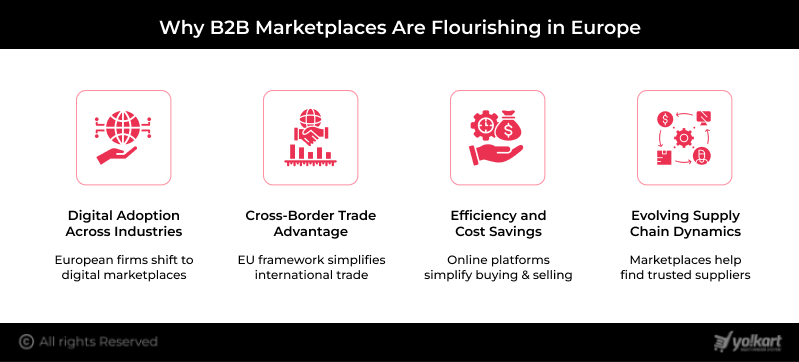
1. Digital Adoption Across Industries
European businesses are increasingly embracing digital transformation, making online platforms a preferred channel for procurement and sales. From SMEs in Germany to importers in Spain and distributors in Italy, businesses are relying on digital marketplaces to streamline procurement and expand market access.
2. Cross-Border Trade Advantage
The EU’s single market framework enables the relatively free movement of products and services across borders. B2B marketplaces are leveraging this advantage to connect buyers and sellers across 27+ nations, unlocking large customer bases and simplifying international trade operations.
3. Efficiency and Cost Savings
Online marketplaces reduce dependency on middlemen, streamline negotiations, and cut procurement costs. For buyers, this means transparent pricing and access to multiple vendors while sellers benefit from broader market reach, lower customer acquisition costs, and improved sales efficiency.
4. Evolving Supply Chain Dynamics
Businesses today are focusing on diversifying sourcing strategies and reducing supplier risk. B2B marketplaces allow companies to discover, evaluate, and onboard new suppliers quickly, often supported by performance ratings and verified reviews that build trust in digital transactions.
Suggested Read: Best B2B eCommerce Platforms in 2026
Key Features of Successful B2B Marketplaces
Building a B2B marketplace is significantly more complex than launching a standard eCommerce store. Enterprise buyers have higher expectations, more structured procurement processes, and stricter compliance requirements. The most successful B2B marketplaces in Europe share a core set of advanced capabilities that support large-scale trade operations while maintaining performance, trust, and efficiency.
Below are the essential features that define a high-performing B2B marketplace:
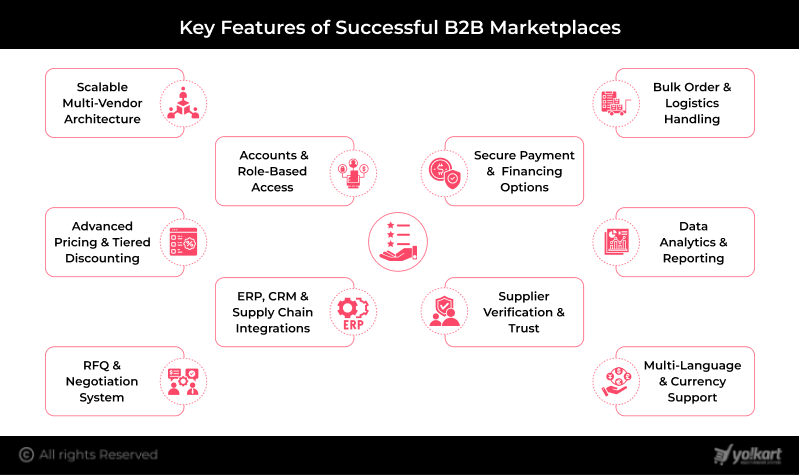
1. Scalable Multi-Vendor Architecture
A robust B2B marketplace must support hundreds or even thousands of suppliers, extensive product catalogs with large SKU counts, high transaction volumes, and simultaneous buyer activity. Scalable infrastructure, including load balancing, optimized databases, and cloud-ready deployment, ensures the platform performs reliably as it grows. Without this foundation, expansion quickly becomes a technical constraint.
2. Advanced Pricing & Tiered Discounting
Unlike B2C platforms with fixed pricing, B2B marketplaces require flexible pricing models such as volume-based pricing, tiered discounts, buyer group pricing, contract-specific rates, and region-based pricing. Automated pricing rules ensure accuracy and efficiency, allowing businesses to offer competitive deals while improving conversions and long-term buyer retention.
3. RFQ (Request for Quote) & Negotiation System
One of the most critical features in B2B commerce is negotiation capability. Effective marketplaces enable buyers to submit RFQs, negotiate pricing and terms, request custom shipping arrangements, and finalize agreements directly on the platform. Integrated negotiation workflows provide transparency, maintain audit trails, and reduce reliance on fragmented offline communication.
4. Corporate Accounts & Role-Based Access
In enterprise procurement, multiple stakeholders are involved. A credible B2B marketplace supports multi-user business accounts, role-based permissions, approval workflows, budget controls, and departmental spending limits. This structure mirrors real corporate procurement processes and increases trust among enterprise clients.
5. ERP, CRM & Supply Chain Integrations
Modern European businesses rely heavily on ERP and CRM systems for operations. A successful B2B marketplace should integrate with ERP systems, accounting tools, CRM platforms, and logistics providers enable real-time inventory synchronization, automated invoicing, relationship management, and shipment tracking. These integrations reduce manual work and improve operational accuracy.
6. Secure Payment & Flexible Financing Options
B2B transactions often involve high-value orders. Therefore, the marketplace must support multiple payment gateways, invoice-based transactions, credit terms, escrow services, multi-currency processing, and automated VAT calculations. Built-in compliance with European regulations, including GDPR and cross-border tax rules, is essential for trust and legal adherence.
7. Supplier Verification & Trust Mechanisms
Trust is the backbone of B2B commerce. Leading marketplaces incorporate supplier verification processes, business credential validation, performance ratings, transaction histories, and customer reviews. These mechanisms reduce buyer risk and encourage confident purchasing decisions.
8. Bulk Order Management & Logistics Handling
B2B buyers frequently place large and recurring orders. Features such as bulk uploads, quick reordering, shipment scheduling, warehouse coordination, and real-time tracking streamline procurement and fulfillment. Furthermore, efficient bulk management improves buyer satisfaction and retention.
9. Data Analytics & Reporting
Data-driven insights help both marketplace operators and sellers optimize performance. Advanced analytics transform marketplaces into strategic decision-making tools. Comprehensive dashboards provide insights into sales performance, procurement trends, buyer behavior, inventory levels, and commission tracking. These insights help operators and sellers optimize operations and identify growth opportunities.
10. Multi-Language & Multi-Currency Support
Since Europe consists of diverse linguistic and economic regions, successful B2B marketplaces must offer multilingual interfaces, localized tax configurations, multi-currency transactions, and region-specific compliance settings. Strong localization capabilities enable seamless expansion across European markets.
Launch Your Own Feature-Rich B2B Marketplace
Top 10 B2B Marketplaces in Europe
Europe’s B2B eCommerce ecosystem is one of the most mature and competitive in the world. With strong cross-border trade policies, high SME density, and rapid digital transformation, the region has become a powerhouse for B2B marketplaces.
Below is a carefully curated list of the Top 10 B2B Marketplaces in Europe, selected based on market influence, cross-border reach, industry specialization, digital innovation, and enterprise adoption.
1. Mercateo
Mercateo is one of Europe’s most established B2B procurement platforms, particularly dominant in Germany and Central Europe. Unlike open retail-style marketplaces, Mercateo focuses on structured purchasing processes for enterprises and public sector institutions.
Moreover, the platform is deeply integrated into corporate procurement systems, allowing businesses to centralize supplier management, automate purchase orders, and maintain compliance standards.
Why It Leads the Market:
- Advanced ERP and punch-out catalog integrations
- Centralized procurement dashboards
- Strong compliance and audit capabilities
- Focus on enterprise and government buyers
Mercateo’s strength lies in its ability to digitize indirect procurement at scale, making it highly attractive to large corporations.
2. Europages
Europages functions as a powerful hybrid between a B2B directory and a digital marketplace. It connects European manufacturers, exporters, and service providers with global buyers.
With a strong SEO footprint and multi-language accessibility, Europages helps businesses improve discoverability across multiple European markets.
Key Strengths:
- Multi-language support across European countries
- Strong exporter network
- High search engine visibility
- Broad industry coverage
Europages plays a crucial role in cross-border trade by helping European suppliers gain international exposure.
3. Alibaba.com (European Buyer Base)
Although headquartered outside Europe, Alibaba.com has a significant footprint among European SMEs and importers. Many European businesses use the platform to source electronics, machinery, and raw materials at competitive prices.
Why European Buyers Use It:
- Massive global supplier network
- Trade assurance programs
- Bulk pricing flexibility
- Supplier comparison tools
While not Europe-centric, its accessibility and pricing advantages make it highly influential in European B2B sourcing.
4. Zentrada
Zentrada is a European wholesale marketplace connecting retailers with suppliers of consumer goods, seasonal products, and retail inventory across EU markets.
Why It’s a Strong Choice:
- Retail supply specialization
- Cross-border European seller network
- Bulk purchasing focus
- SME-friendly platform
Zentrada serves as a practical sourcing hub for retailers aiming to access diverse wholesale inventory across Europe from a single platform.
5. Stocklots24
Stocklots24 specializes in liquidation goods, surplus inventory, and wholesale clearance stock. It connects manufacturers and distributors with retailers looking for discounted bulk purchases.
Ideal For:
- Discount retail chains
- Overstock buyers
- High-volume clearance deals
The platform thrives on competitive pricing and fast inventory turnover, making it popular in value-driven B2B segments.
6. Ankorstore
Ankorstore has rapidly emerged as a leading wholesale marketplace for independent retailers across Europe. It focuses on connecting curated European brands with boutique shops.
The platform modernizes traditional retail supply chains by offering flexible payment options and simplified ordering processes.
Why It’s Growing Fast:
- Retail-focused B2B model
- Flexible net payment terms
- Curated product selection
- Strong presence in France, Germany, and Spain
Ankorstore’s UX-driven approach has made wholesale buying more accessible for small retailers.
7. GRIFFATI
GRIFFATI is a niche B2B marketplace specializing in wholesale fashion and designer apparel. Based in Italy, it connects European retailers with premium fashion brands.
Strong Points:
- Focus on designer and branded fashion
- Cross-border European shipping
- High-margin product categories
Its specialization allows it to dominate a niche vertical rather than compete broadly.
8. Visable
Visable operates major European B2B sourcing platforms and focuses heavily on industrial and manufacturing sectors. It connects buyers with verified suppliers across Europe.
Why It’s a Strong Choice:
- Industrial sourcing specialization
- Strong presence in German manufacturing
- Verified supplier ecosystem
- Cross-border trade enablement
Visable is particularly influential in Europe’s industrial procurement landscape, making it a key gateway for manufacturers and suppliers seeking qualified business buyers.
9. Wer Liefert Was (WLW)
Wer Liefert Was (WLW) is one of the most prominent German B2B supplier directories. It is particularly strong in industrial manufacturing, machinery, and technical components.
Best For:
- Industrial procurement
- Engineering suppliers
- DACH region buyers
WLW maintains strong credibility within German-speaking markets and is widely used for industrial sourcing.
10. Faire (European Retail Segment)
Faire operates extensively across the UK and European retail sector. It connects independent retailers with wholesale brands through a modern digital platform.
Why It’s Influential:
- Retail-focused wholesale model
- Flexible financing and payment options
- Intuitive, modern interface
- Rapid European expansion
Faire has significantly digitized boutique retail sourcing across Europe.
Suggested Read: Top B2B eCommerce Platforms to Launch Multi-vendor Marketplaces
Key Observations from Leading European B2B Marketplaces
An in-depth analysis of the top B2B marketplaces operating across Europe reveals clear patterns behind their success. These are not just surface-level trends but structural foundations that define how modern B2B platforms grow, compete, and retain enterprise users.
Understanding these trends is essential if you’re planning to enter the European B2B ecosystem.
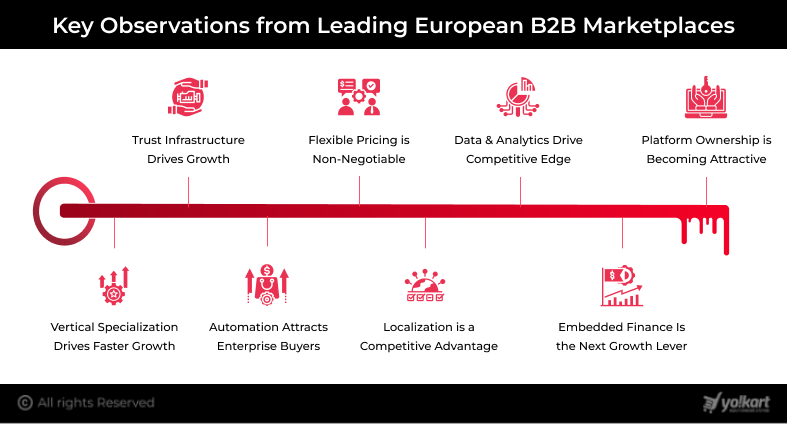
1. Vertical Specialization Drives Faster Growth
One of the clearest patterns is that niche-focused marketplaces consistently outperform broad, generic platforms. Marketplaces specializing in sectors such as fashion wholesale, industrial components, retail supply, liquidation inventory, or medical equipment scale faster because they align closely with industry-specific procurement processes. Moreover, specialization enables tailored search filters, customized pricing models, stronger supplier networks, and clear category authority, making the platform more relevant to professional buyers.
2. Trust Infrastructure is the Core Growth Engine
Unlike B2C eCommerce, B2B transactions often involve large order values and long-term contracts. Therefore, trust is foundational. Leading European marketplaces invest heavily in supplier verification, business credential validation, transparent transaction histories, ratings, secure payments, and GDPR compliance. Platforms that reduce perceived risk see higher buyer confidence, repeat purchases, and long-term retention.
3. Procurement Automation Attracts Enterprise Buyers
Enterprise-level adoption happens when marketplaces integrate seamlessly into existing procurement systems. Features such as ERP integrations, punch-out catalogs, automated invoicing, approval workflows, budget controls, and reporting dashboards transform marketplaces into extensions of corporate procurement infrastructure. Reduced friction leads to higher adoption among large organizations.
4. Flexible Pricing is Non-Negotiable
European B2B marketplaces that thrive offer dynamic pricing models rather than static rates. They offer tiered pricing, volume discounts, contract-specific pricing, buyer group catalogs, and RFQ-based negotiations, which allow sellers to accommodate complex purchasing scenarios. Flexible pricing directly influences conversion rates and strengthens long-term buyer relationships.
5. Localization is a Competitive Advantage
Europe is not a single uniform market. It is a collection of languages, tax systems, compliance frameworks, and business cultures. Leading platforms support multilingual interfaces, region-specific VAT calculations, multi-currency payments, localized tax handling, and integration with regional logistics providers. Effective localization enables faster expansion across EU markets.
6. Data & Analytics Are Becoming Strategic Differentiators
The most advanced marketplaces go beyond transactions and offer data-driven insights. Procurement analytics, demand forecasting, inventory insights, sales performance tracking, and revenue dashboards help businesses make informed decisions. This positions the marketplace as a strategic partner rather than just a trading platform.
7. Embedded Finance Is the Next Growth Lever
Embedded financial services are emerging as a powerful growth driver. Features such as trade credit, invoice-based payments, deferred billing, and financing options improve affordability for buyers and increase conversion rates for high-value transactions. Flexible payment structures are becoming a competitive necessity.
8. Platform Ownership is Becoming Attractive
Another interesting observation: many businesses are realizing that instead of relying solely on third-party marketplaces, launching their own niche B2B platform offers greater long-term value. Operating a proprietary marketplace allows companies to control commissions, own customer data, strengthen brand authority, build dedicated supplier ecosystems, and generate recurring revenue streams. This shift creates significant opportunities for entrepreneurs across Europe.
Leverage These Insights to Launch Your Own B2B Marketplace
Common Challenges in B2B Marketplaces and How to Overcome Them
While B2B marketplaces present immense opportunities in Europe, building and scaling one is significantly more complex than launching a standard eCommerce platform. B2B commerce involves higher transaction values, longer sales cycles, regulatory complexity, and sophisticated buyer expectations. Understanding these challenges early and addressing them strategically can determine whether your marketplace will thrive or struggle.
Below are the most common challenges faced by B2B marketplaces in Europe, along with practical solutions to overcome them.
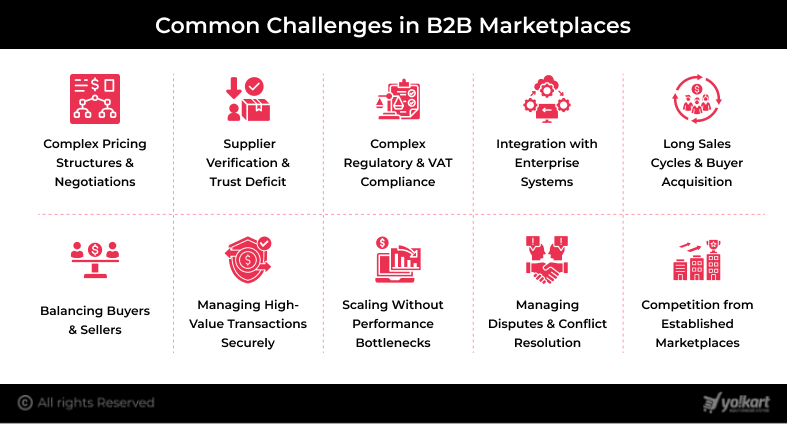
1. Complex Pricing Structures & Negotiations
Unlike B2C eCommerce, where pricing is fixed, B2B pricing is highly dynamic. Businesses expect tiered pricing based on quantity, contract-specific rates, volume discounts, minimum order rules, custom quotations, and long-term negotiated agreements. Without automation, managing these variables becomes inefficient and error-prone.
The Solution:
Use robust technology that supports automated tiered pricing, RFQ systems, buyer group pricing, custom catalogs, and built-in negotiation workflows. This keeps pricing structured, transparent, and manageable without relying on fragmented offline communication.
2. Supplier Verification & Trust Deficit
In cross-border European trade, trust is critical, especially for high-value orders. Buyers may hesitate due to risks such as fraudulent listings, inconsistent product quality, compliance issues, or unreliable delivery.
The Solution:
Build a strong trust framework that includes verified supplier credentials, business registration checks, VAT validation, transparent ratings and reviews, secure payment mechanisms, and clear dispute and return policies. Strong verification processes significantly increase buyer confidence.
3. Complex Regulatory & VAT Compliance
Europe is a unified market, but taxation and compliance can vary by country. Managing cross-border VAT, GDPR obligations, invoicing standards, and data protection rules can be challenging.
The Solution:
Choose marketplace technology with built-in compliance capabilities, including automated VAT calculations by region, multi-currency support, configurable tax settings, GDPR-ready infrastructure, and country-specific shipping rules.
4. Integration with Enterprise Systems
Enterprise buyers rely on ERP, CRM, accounting, and inventory systems. If your marketplace does not integrate with these tools, adoption becomes difficult, and manual processes increase operational friction.
The Solution:
Ensure your platform supports API-based integrations, ERP synchronization, automated invoicing exports, inventory syncing, and punch-out catalog functionality. Seamless integration into existing procurement workflows accelerates enterprise adoption.
5. Long Sales Cycles & Buyer Acquisition
B2B sales cycles are significantly longer than B2C. Decisions often involve multiple stakeholders, including procurement teams, finance departments, operational leaders, and legal reviewers. This extends the sales cycle and increases acquisition complexity.
The Solution:
Adopt long-term acquisition strategies such as content marketing, SEO, industry reports, LinkedIn campaigns, account-based marketing, webinars, and trade event participation. Providing dedicated onboarding support for large buyers can also reduce entry barriers.
6. Balancing Buyers & Sellers
Marketplaces often face the classic chicken-and-egg problem: sellers need buyers, and buyers need product variety. Without sufficient activity on both sides, growth stalls.
The Solution:
Start with a focused strategy, onboard anchor suppliers first, incentivize early participants, and generate buyer demand through pre-launch campaigns. A targeted launch approach helps establish early momentum.
7. Managing High-Value Transactions Securely
B2B transactions often involve large order values. Payment security and risk management become critical. Large order values increase concerns around payment defaults, credit risk, disputes, and fraud. Financial security becomes a top priority for enterprise participants.
The Solution:
Implement escrow systems, credit approval mechanisms, milestone-based payments, verified corporate accounts, and transaction monitoring tools. Secure financial processes build trust and encourage larger transactions.
8. Scaling Without Performance Bottlenecks
As supplier catalogs grow and traffic increases, poor architecture can cause low performance, checkout failures, or downtime. These issues directly impact revenue and reputation.
The Solution:
Invest in scalable cloud infrastructure, optimized databases, load balancing, and performance monitoring from the outset. Planning scalability early prevents costly technical limitations later.
9. Managing Disputes & Conflict Resolution
In B2B transactions, disputes over product specifications, delivery timelines, or payment terms are common. Without a structured resolution process, trust deteriorates quickly.
The Solution:
Establish clear dispute resolution workflows, escalation procedures, documentation trails, and transparent refund policies. A structured process protects both buyers and sellers and maintains platform credibility.
10. Competition from Established Marketplaces
Large B2B marketplaces already dominate certain categories. Competing head-on without differentiation is risky.
The Solution
Focus on vertical specialization, industry-specific features, superior user experience, strong regional positioning, and personalized onboarding. Instead of competing broadly, aim to become the leading platform within a specific niche.
Suggested Read: B2B Marketplace Development: Everything You Need to Know
How to Build Your Own B2B Marketplace in Europe
Launching a B2B marketplace in Europe is a strategic business initiative. It requires careful planning, strong industry positioning, scalable technology infrastructure, and a clear monetization roadmap. With European B2B commerce rapidly digitizing, building your own marketplace can position you at the center of industry trade, but only if executed correctly.
Below is a step-by-step strategic framework to build a successful B2B marketplace in Europe.
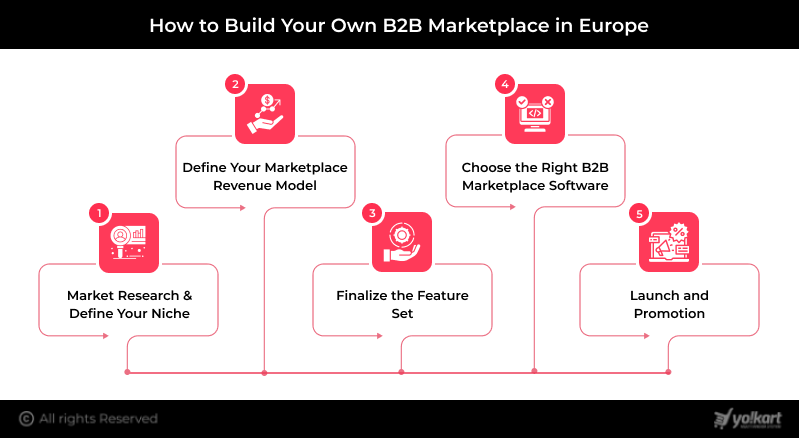
Step 1: Do Market Research and Identify a Profitable Niche or Industry Vertical
Start with market research to understand the European B2B ecosystem. Instead of launching a generic “all-category” marketplace, focus on a specific vertical such as:
- Industrial components
- Automotive spare parts
- Construction materials
- Renewable energy equipment
- Wholesale fashion
- Medical supplies
- Agricultural machinery
- Electronics components
A niche approach allows you to tailor features to industry-specific procurement workflows, establish category authority, attract highly relevant buyers, reduce competitive pressure, and build strong supplier relationships. Vertical marketplaces consistently scale faster because they solve precise problems for a defined audience.
Step 2: Define Your Marketplace Revenue Model
Before development begins, clarify your revenue model. A well-defined monetization strategy ensures financial sustainability and guides platform decisions.
Common B2B marketplace monetization strategies include:
- Commission per transaction
- Subscription plans for suppliers
- Featured listings & promotional slots
- Lead generation fees
- Advertising revenue
- Value-added services (logistics, financing, analytics)
Many European B2B marketplaces often combine multiple revenue streams for scalability. Additionally, clearly defining your model ensures sustainable long-term growth.
Step 3: Finalize the Feature Set
B2B marketplaces involve complex operational requirements that must be planned beforehand. Your platform must support:
- Multi-vendor management
- Tiered & volume-based pricing
- RFQ (Request for Quote) systems
- Corporate buyer accounts
- Role-based permissions
- VAT and cross-border compliance
- Multi-currency transactions
- Bulk order management
Attempting to build these systems from scratch can take years and significantly increase costs.
Thus, choosing the right technology foundation is critical.
Step 4: Choose the Right B2B Marketplace Software
Building from scratch is expensive, risky, and time-consuming. Instead, most successful marketplace founders choose a ready-made, customizable B2B marketplace solution that alreadyincludese essential B2B capabilities.
A strong B2B marketplace software should offer:
- Advanced pricing logic
- Negotiation workflows
- Supplier management tools
- ERP & API integration capability
- Scalability for high transaction volumes
- GDPR-compliant architecture
- Multi-language support
This is where solutions like Yo!Kart becomes highly relevant for European B2B marketplace builders.
Yo!Kart provides a ready-to-deploy multi-vendor architecture with built-in B2B capabilities, allowing businesses to reduce time-to-market and launch confidently.
Looking for a Robust Readymade Solution for Your B2B Marketplace?
Step 5: Launch and Promote Your Marketplace
A successful launch requires more than going live. You need a strategic go-to-market plan to attract both suppliers and buyers. Focus on onboarding anchor sellers, running targeted digital campaigns, leveraging industry networks, participating in trade events, and producing educational content that establishes credibility.
Early traction is critical for solving the marketplace liquidity challenge. By prioritizing a specific niche and delivering value to both sides of the platform, you can build momentum, encourage repeat usage, and position your marketplace as a trusted hub for B2B trade in Europe.
Why Yo!Kart is the Ideal B2B Marketplace Software for Europe?
Launching a B2B marketplace in Europe demands more than a basic eCommerce platform. Businesses need technology built for complexity, pricing flexibility, negotiation systems, enterprise workflows, compliance modules, and scalable architecture. Most off-the-shelf marketplace builders lack these capabilities, often leading companies to costly custom development and delayed time-to-market.
That is where Yo!Kart stands apart.
Yo!Kart is not just another marketplace builder; it is an enterprise-grade, ready-to-deploy B2B marketplace solution trusted by businesses globally to launch sophisticated digital trade ecosystems. It is designed specifically for B2B commerce, combining robust features with the flexibility required to adapt across industries and the European market. Moreover, it offers:
1. Built-in B2B Capabilities
Yo!Kart comes equipped with essential B2B functionality from the start, including volume-based pricing, tiered buyer groups, complex RFQ workflows, and negotiation engines. These features drastically reduce development complexity and eensureyour marketplace meets business buyer expectations from day one.
2. Enterprise-Level Customization
European markets are highly diverse, with each industry, region, and buyer segment presenting unique requirements. Yo!Kart offers modular architecture and deep customization, letting you tailor features like pricing logic, workflows, and compliance settings.
3. Scalability & Performance
Built to support thousands of vendors and high-volume transactions, Yo!Kart scales seamlessly as your marketplace grows. Whether you serve local SME clusters or cross-border enterprise buyers across multiple countries, it maintains performance, reliability, and operational efficiency.
4. Compliance & Localization
Operating across Europe requires adherence to varied tax structures, VAT rules, and regulatory frameworks. Yo!Kart supports multi-currency transactions, regional tax configurations, GDPR-ready architecture, and multi-language interfaces, making it well-suited for pan-European marketplace operations.
5. Rapid Deployment
With Yo!Kart, you can go from concept to live marketplace significantly faster than building from scratch. Its readymade architecture reduces time-to-market, lowers costs, and enables you to capture niche opportunities before competitors.
In essence, Yo!Kart transforms a complex B2B marketplace vision into a scalable, future-ready, business-centric platform designed for long-term success.
Case Studies: Real Marketplaces Built with Yo!Kart
Below are outstanding examples of diverse marketplaces across industries and regions that have successfully launched using Yo!Kart. These real-world examples demonstrate its flexibility, scalability, and ability to solve complex operational challenges for both product and service-based marketplace models:
1. UNI Diamonds: B2B Diamond Trading Marketplace
- Industry: Diamond Trading (B2B)
- Region: Global
UNI Diamonds is an enterprise marketplace connecting professional diamantaires, manufacturers, and buyers in a secure digital trading environment.
Challenges Addressed:
- Lack of transparency and traceability in diamond pricing
- Manual and fragmented procurement processes
- Technical complexity in displaying diamond attributes
Yo!Kart Solution Highlights:
- AI-powered diamond price calculator for accurate valuation
- 360° diamond viewing and advanced comparison tools
- Online auctions, bidding, and negotiation modules
- Integration with shipment and certification service APIs
Results Achieved:
UNI Diamonds transformed offline diamond trades into a transparent digital marketplace, empowering users to search, compare, bid, and transact with high industry confidence, an industry first of its kind.
2. Watersorted: B2B Water Industry Marketplace
- Industry: Water Management & Procurement
- Region: New Zealand (Applicable as a B2B model globally)
The platform centralizes suppliers and buyers, simplifying procurement through structured RFQs, bulk purchasing, and transparent price discovery.
Challenges Addressed:
- Fragmented supplier networks
- Manual RFQ processes
- Limited visibility of procurement options
Yo!Kart Solution:
- Multi-tier RFQ capabilities supporting private & global requests
- Bulk order purchasing
- Responsive design and advanced search filters
- Stripe Connect multi-vendor payments and real-time inventory
Result Achieved:
- Watersorted streamlined procurement workflows by connecting buyers and suppliers on a single platform, reducing administrative overhead, improving sourcing transparency, accelerating negotiations, and enabling scalable expansion of the water industry marketplace with more efficient purchasing decisions.
3. Tajer: Multi-Category Marketplace (Qatar)
- Industry: Multi-Category eCommerce
- Region: Qatar
While not a traditional B2B marketplace, Tajer consolidates diverse product categories into a unified digital marketplace with robust operational capabilities.
Challenges Addressed:
- Managing diverse product catalogs across categories
- Coordinating logistics and inventory in real time
- Supporting regional language and currency needs
Yo!Kart Solutions:
- Barcode synchronization for catalog management
- Pre-order and inventory handling systems
- Advanced search with real-time logistics integration
- Multi-lingual and multi-currency support
Result Achieved:
Tajer unified multiple retail categories into a seamless marketplace experience, improving catalog management, operational coordination, and customer accessibility while supporting high transaction volumes, regional scalability, and efficient inventory handling across diverse product segments.
4. Voyij: Tours & Activities Marketplace
- Industry: Tours & Activities (Experience Marketplace)
- Region: Alaska, USA
Voyij is an experience marketplace connecting travelers with tour operators and activity providers.
Challenges:
- Managing time-based inventory and availability
- Coordinating schedules across multiple vendors
- Handling location-specific offerings
Yo!Kart Solutions:
- Tiered pricing and time-slot management
- Multi-vendor scheduling & booking systems
- Activity availability and location-based inventory
Result Achieved:
Voyij enabled tour operators to digitize bookings and availability management, delivering a smooth discovery and reservation experience for travelers while improving vendor coordination, optimizing time-slot utilization, and supporting scalable growth in the experience marketplace sector.
See Yo!Kart in Action
Conclusion
The European B2B marketplace revolution is underway, rewarding platforms that are industry-specific, trust-centric, enterprise-ready, and scalable. Whether you aim to build the next industrial supplies hub, a specialized procurement portal, or a vertical marketplace for your sector, choosing the right technology stack is a critical decision that will determine the performance, compliance, and long-term growth of your platform.
With Yo!Kart, you get a tested, customizable, and scalable foundation that supports advanced B2B features, rapid deployment, and cross-border expansion. Its robust architecture and enterprise-grade feature set equip you to compete effectively in Europe’s evolving digital commerce landscape and beyond.
FAQs
Q 1. What is a B2B marketplace?
Ans. A B2B marketplace is a digital platform where businesses (suppliers, manufacturers, distributors) trade products or services with other businesses. Unlike retail platforms, transactions typically involve bulk purchases, negotiated pricing, and enterprise workflows. It streamlines sourcing, procurement, supplier discovery, and long-term trading relationships.
Q 2. Why is the European market attractive for B2B marketplaces?
Ans. Europe offers a highly favorable environment for B2B marketplaces due to its unified trade policies, digital procurement adoption, cross-border accessibility, and rapid digital adoption among SMEs. Cross-border commerce within the EU is relatively seamless, allowing platforms to scale across multiple countries while serving diverse industries through a single digital ecosystem.
Q 3. Do I need marketplace software like Yo!Kart to build a B2B platform?
Ans. You can build a B2B platform using custom development, but it requires significant time, investment, and technical expertise. Ready-made solutions like Yo!Kart simplifies the process by offering pre-built B2B features, reducing time-to-market, development risk, and cost, enabling you to focus on growth and operations.
Q 4. Can Yo!Kart handle complex pricing and negotiation features?
Ans. Yes Yo!Kart can handle complex pricing and negotiation features. It supports tiered pricing, volume discounts, RFQ workflows, buyer groups, and other advanced B2B pricing and negotiation features. These capabilities allow sellers to efficiently manage large orders while giving buyers flexibility to secure competitive deals tailored to their needs.
Q 5. Is Yo!Kart scalable for large enterprise marketplaces?
Ans. Yes, Yo!Kart is built with scalability in mind, making it suitable for both emerging platforms and large enterprise marketplaces. Its architecture can handle growing vendor networks, large catalog volumes, and high-traffic marketplaces with optimized performance.
Ready to Enter Europe’s B2B Marketplace Landscape?
Contact UsPopular Posts