
Published Date 23rd Jun, 2026
Choosing marketplace software shouldn’t feel like navigating a maze of biased reviews and conflicting claims, yet that’s exactly what most business owners face.
Every platform promises to be “the best.” Every comparison seems designed to favor the company behind it. Meanwhile, the factors that truly determine your success often get buried beneath marketing buzzwords.
The reality is simple. Whether you’re launching a niche marketplace, building a B2B procurement platform, or creating the next industry-leading multi-vendor business, your technology foundation will influence how quickly you can launch, how efficiently you can scale, and how easily you can adapt to changing customer expectations.
In short, the software you choose today determines the future of your marketplace. Hence, don’t make your decision in a hurry until you are satisfied. Otherwise, rushing into a free trial or booking the first demo you see can be an expensive mistake.
At the same time, if you think you can switch solutions later. It’s not that easy, it looks. Migrating vendors and data, rebuilding integrations, and retraining your team may break the momentum and cause a big threat to your business.
Don’t worry, this guide will help you understand what truly matters so you can choose marketplace software that supports your vision today and your growth tomorrow without any significant knock to your business.
Table of Contents
- What Is Marketplace Software?
- Key Features of a Marketplace Software
- Why Choosing the Right Marketplace Software Matters More Than You Think
- Types of Marketplaces
- Common Mistakes Business Owners Make When Choosing Marketplace Software
- Key Factors to Consider Before Choosing Marketplace Software
- Different Approaches to Build Your Marketplace?
- Top 5 Marketplace Software Solutions Compared
- A Quick Marketplace Software Comparison Table
- Why More Businesses Are Choosing Self-Hosted Marketplace Software
- Why Yo!Kart Stands Out for Business Owners
- Yo!Kart Success Stories
- Conclusion
- FAQs
What Is Marketplace Software?
Marketplace software is a type of eCommerce solution designed to help businesses build and manage a multi-vendor marketplace. It enables multiple sellers to list and operate their businesses on a single platform.
Unlike an online store, where one business sells its own products, a multi-vendor marketplace allows many independent vendors to create their own stores, list products, set prices, and manage orders all from a centralized platform.
Think of a marketplace like Amazon, Etsy, or Airbnb. The marketplace owner doesn’t sell everything directly. Instead, they connect buyers and sellers while earning revenue through commissions, subscription fees, listing charges, or advertising.
What are the Key Features of a Marketplace Software
Marketplace software includes features that standard eCommerce platforms typically don’t offer. And understanding these capabilities is essential because they directly influence your marketplace’s operational efficiency, vendor experience, and long-term growth potential. Let’s look at the features you can look for primarily in a multi-vendor marketplace software.
- Vendor onboarding: Allow sellers to register, submit documents, get approved, and access their own dashboards.
- Product management: Enable multiple vendors to add, edit, and manage their listings independently.
- Commission management: Automatically calculate platform commissions based on sales, categories, or vendor plans.
- Order management: Handle orders that may include products from different vendors in a single checkout.
- Payment splitting and vendor payouts: Distribute payments between the marketplace owner and vendors securely and efficiently.
- Mobile apps: Support seamless buying and selling experiences on smartphones.
- Analytics and reporting: Provide valuable insights for both marketplace administrators and vendors.
Highlight:- While some eCommerce platforms offer marketplace functionality through third-party plugins. On the other hand, solutions built specifically for multi-vendor operations typically provide all necessary features and functionality built in, ensuring better scalability, streamlined vendor management, and greater flexibility as your business grows.
Why Choosing the Right Marketplace Software Matters More Than You Think
Choosing marketplace software may seem like a straightforward feature comparison.
Does it support vendor onboarding? Can it process payments? Is there a mobile app?
While these capabilities are important, focusing only on features is one of the biggest mistakes founders and business owners make.
The real decision is about control, total cost of ownership, and long-term scalability. The platform you choose today will determine how quickly you can launch, how efficiently you can grow, and how easily you can adapt your business as customer expectations evolve.
And the opportunity is too significant to get wrong.
Online marketplaces now account for 63.5% of global ecommerce sales, making them the dominant force in digital commerce. At the same time, the projected growth rate is also on the higher side, creating enormous opportunities for businesses adopting marketplace models. Above all, choosing the right solution is critical to establish, operate and grow your marketplace in today’s competitive world.
Types of Marketplaces
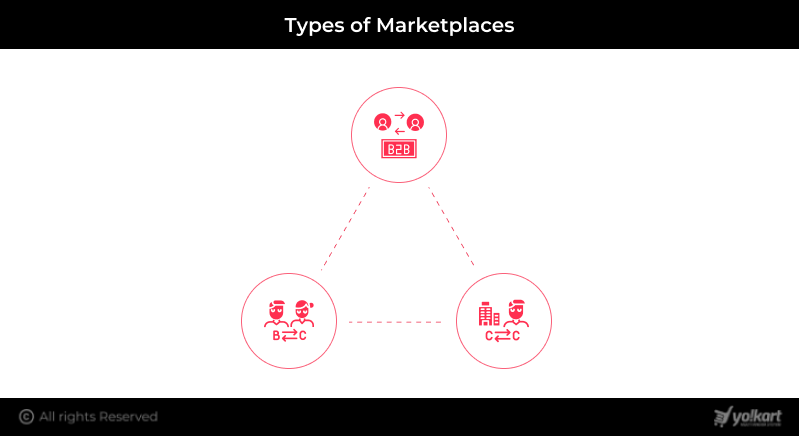
Each marketplace is unique and operates differently. Hence, they require distinct features and functionality that you need to be mindful of when selecting a multi-vendor marketplace software. Let’s understand what the primary marketplace types are:
1. B2B Marketplaces
B2B ecommerce marketplaces such as Alibaba, Amazon Business and Faire connect businesses with suppliers, wholesalers, and manufacturers. These platforms typically require advanced capabilities like request-for-quote (RFQ) workflows, bulk ordering, negotiated pricing, account hierarchies, approval processes, and flexible payment terms.
2. B2C Marketplaces
B2C marketplaces, including Amazon and Walmart Marketplace, focus on delivering seamless shopping experiences for end consumers. Success depends on intuitive search and navigation, personalized recommendations, streamlined checkout, loyalty programs, and efficient order fulfillment.
3. C2C Marketplaces
C2C platforms such as Etsy, Vinted and eBay enable transactions between individuals. These marketplaces rely heavily on trust-building features like identity verification, ratings and reviews, secure payments, messaging, dispute resolution, and booking management.
Highlight:- Each model serves different users, follows different workflows, and generates revenue differently. A platform built for B2C commerce may struggle to support the complex purchasing requirements of B2B buyers, while a B2B-focused solution may lack the trust and community features essential for C2C transactions.
This is why there is no universal “best” marketplace software, only the solution that best aligns with your business model, operational requirements, and long-term growth strategy.
At the same time, choose software not just for the marketplace you’re launching today, but for the business you plan to build over the next five to ten years.
Common Mistakes Business Owners Make When Choosing Marketplace Software
Even after defining your requirements and understanding the core capabilities of marketplace software, many businesses make avoidable mistakes during the evaluation process. These oversights often lead to unexpected costs, operational challenges, and costly platform migrations in the future.
The following mistakes are among the most common reasons marketplace businesses struggle to achieve long-term success.
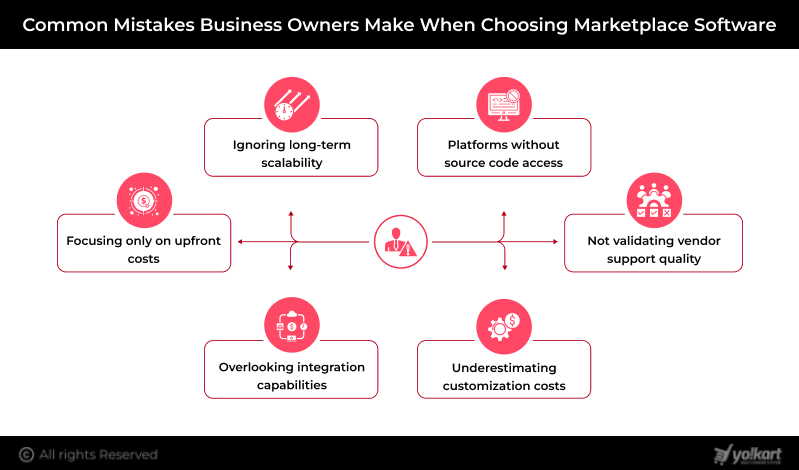
1. Focusing only on upfront costs
A low monthly subscription fee or attractive one-time pricing can seem like the most economical option at first. However, the initial cost rarely reflects the true investment required to build and operate a marketplace over time.
Always evaluate the total cost of ownership (TCO) by considering implementation expenses, customization fees, third-party integrations, transaction charges, ongoing maintenance, upgrades, and support costs. A platform that appears affordable today may become significantly more expensive over a multi-year period.
2. Ignoring long-term scalability
A platform that works well for 20 vendors and a few hundred monthly orders may perform very differently when your marketplace grows to hundreds of vendors and thousands of transactions.
Ask software providers how their platform is scalable, handles larger product catalogs, increases traffic, and handles higher order volumes. Request case studies, customer references, or performance benchmarks from businesses with similar growth goals to ensure the platform can support your future needs.
3. Overlooking integration capabilities
Your marketplace software must connect seamlessly with the tools your business relies on, including payment gateways, shipping providers, tax solutions, marketing platforms, and customer relationship management systems.
Discovering integration limitations after launch often leads to additional development costs, operational inefficiencies, and project delays. Before committing, verify which integrations are available out of the box and whether robust APIs are provided for future requirements.
4. Choosing platforms without source code access, without understanding the tradeoff
Not having source code access is not necessarily a drawback. Many businesses successfully operate on SaaS-based marketplace platforms because they offer faster deployment, lower technical complexity, and managed infrastructure.
However, it’s important to understand the trade-offs involved. Limited control over customization, recurring subscription costs, dependency on the software provider, and potential migration challenges can impact your business as it grows. Evaluate these factors carefully before deciding which ownership model best aligns with your long-term strategy.
5. Underestimating customization costs
The phrase “fully customizable” can mean very different things across software providers. Some platforms offer extensive configuration options, while others require custom development for even minor changes.
Clearly define your required features and workflows before selecting a solution. Ask vendors which modifications can be handled through built-in settings, which require custom coding, and request detailed estimates for any customizations you anticipate needing.
6. Not validating vendor support quality before committing
Reliable support becomes critical when managing integrations, troubleshooting issues, or scaling your marketplace.
Don’t rely solely on marketing materials or testimonials featured on a vendor’s website. Read recent customer reviews, ask about average response and resolution times, and, if possible, speak directly with existing customers about their support experience. The quality of ongoing assistance can have a significant impact on your marketplace’s long-term success.
Seeking Assistance on Selecting the Right Marketplace Software
Key Factors to Consider Before Choosing Marketplace Software
Before comparing specific marketplace platforms, it’s important to establish a clear evaluation framework. Marketplace software is a long-term investment that affects your operating costs, vendor experience, scalability, and ability to adapt as your business evolves. Use the following factors as a practical checklist to identify solutions that align with your business model and long-term goals.
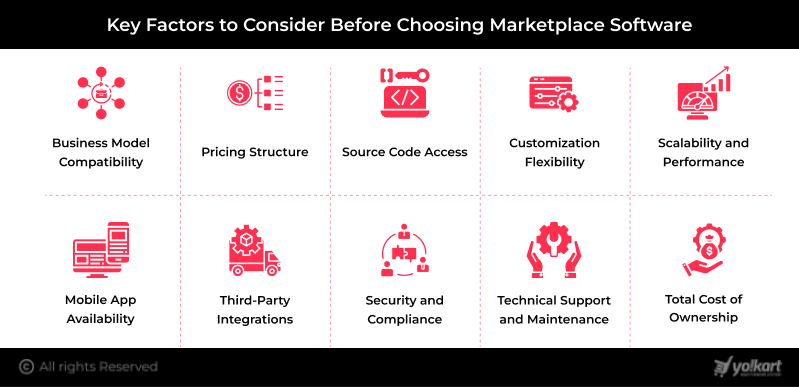
1. Business Model Compatibility
Not all marketplaces operate the same way, which means your software must support the unique requirements of your business model, such as B2B, B2C, C2C or any other.
Some marketplace platforms are designed to support multiple business models, while others are optimized for a specific use case. Choosing software that aligns with your operational requirements from the beginning reduces the need for costly customizations later.
If you plan to expand into additional revenue streams or support multiple marketplace models in the future, verify whether the platform can accommodate that growth without major redevelopment.
2. Pricing Structure
Pricing models can significantly influence your profitability over time. What appears affordable during the launch phase may become expensive as vendor activity and order volumes increase.
Request a complete breakdown of all costs, including implementation fees, transaction charges, support plans, upgrade costs, and add-on services, before making a decision.
Marketplace software pricing usually follows one or more of the following models:
- One-time license fee: You pay once for the software license, while hosting, maintenance, and upgrades may involve separate costs.
- Monthly subscription: Recurring payments provide ongoing access to the platform, often with pricing tiers based on transaction volume, vendor count, or feature availability.
- Commission-based pricing: The software provider earns a percentage of each transaction, causing costs to increase as your marketplace grows.
- Custom development costs: Additional expenses incurred when building a marketplace from scratch or extensively modifying an existing platform.
3. Source Code Access
Source code access is one of the most important and often overlooked considerations when selecting marketplace software. Owning the source code provides greater flexibility and control over your platform’s future. It enables deeper customization, easier migration, and more predictable long-term costs.
However, if you don’t get access to the source code, you’re effectively renting your marketplace infrastructure. It usually means:
- You cannot move the platform to another hosting environment without the provider’s approval.
- You’re dependent on the vendor’s pricing structure, product roadmap, and long-term viability.
- Customization options are limited to available APIs, integrations, and approved extensions.
4. Customization Flexibility
Every marketplace has unique workflows, branding requirements, and operational processes. Some software providers advertise their platforms as “fully customizable,” but the level of flexibility can vary significantly. In some cases, customization means selecting from pre-built themes and plugins, while others provide full access to the codebase.
Assess how easily you can modify user journeys, commission structures, workflows, design elements, and business logic without extensive development work. The more specialized your marketplace model is, particularly in B2B or niche industries, the more important customization flexibility becomes.
5. Scalability and Performance
Your marketplace software should support not only your current business requirements but also your future growth ambitions.
Ask providers how their platform performs with larger product catalogs, increased traffic, higher order volumes, and expanding vendor networks. A solution that works well for 20 vendors may struggle with 500 vendors and tens of thousands of monthly transactions.
Moreover, scalability should be evaluated from both technical and financial perspectives. Some platforms can handle increased demand technically, but become expensive due to transaction fees or vendor-based pricing models.
Request performance benchmarks, infrastructure details, and customer success stories from businesses with similar growth trajectories.
6. Mobile App Availability
Mobile commerce continues to grow across industries, making mobile accessibility a key consideration when choosing marketplace software. For marketplaces with frequent interactions, mobile apps are often a necessity rather than an added feature. Dedicated buyer and seller apps can improve engagement, increase repeat purchases, and simplify order management for all users.
.However, before making a decision, verify whether mobile apps require separate development, assess whether the apps are native, customizable, regularly updated, and support the features you need and more
7. Third-Party Integrations
Modern marketplaces rely on a wide range of tools and services to operate efficiently. Payment gateways, shipping providers, tax solutions, CRM systems, analytics platforms, and marketing tools all need to integrate seamlessly with your marketplace software.
Undoubtedly, a strong integration ecosystem reduces manual work, minimizes errors, and helps streamline daily operations. It also gives businesses the flexibility to adopt new technologies and expand into new markets without extensive redevelopment.
Before selecting a platform, review its available integrations, API capabilities, and developer documentation. Confirm whether essential integrations are already supported or if custom development will be required to meet your business needs.
8. Security and Compliance
Marketplaces handle sensitive information such as customer data, payment details, vendor documents, and transaction records, making security a top priority.
Evaluate how the platform manages data encryption, user authentication, access controls, backups, and fraud prevention. Strong security measures not only protect your business but also help build trust among buyers and sellers.
Ensure that the platform complies with industry standards such as PCI DSS for payment processing and supports regional regulations like GDPR if you operate internationally. Choosing software with robust security and compliance capabilities can help reduce risks and avoid costly legal issues.
9. Technical Support and Maintenance
Even the most reliable marketplace software requires ongoing support and maintenance to ensure smooth performance and long-term stability. Reliable support can minimize downtime, accelerate issue resolution, and help your marketplace scale more effectively.
Understand who is responsible for software updates, bug fixes, security patches, server management, and performance monitoring.
Ask providers about support channels, response times, onboarding assistance, training resources, and service-level agreements (SLAs).
10. Total Cost of Ownership (TCO)
Total cost of ownership (TCO) is the factor that brings all other considerations together.
TCO includes far more than the initial license fee or subscription cost. Several SaaS-based solutions available in the market initially seem cost-effective to get started. However, in the longer duration, it costs more. It also incurs several hidden additional charges as transaction fees, support fees, scalability charges and more.
Industry experts recommend evaluating marketplace software costs over a three- to five-year period rather than focusing solely on upfront pricing. A platform with a higher initial investment may prove more cost-effective over time than a low-cost solution with recurring fees and expensive add-ons.
Before making a final decision, create realistic cost projections based on your expected vendor count, transaction volume, and growth plans. This approach provides a clearer picture of long-term affordability and helps prevent costly surprises after launch.
Looking for an Affordable and Flexible Marketplace Software?
Different Approaches to Build Your Marketplace?
You can build a marketplace primarily through four popular approaches. Each offers a different balance of speed, control, and scalability.
The right choice depends on how fast you want to launch and how much flexibility you need for future growth. At the same time, cost is another key factor to be considered.
Some options are quick to set up and cost-efficient, while others offer full customization and long-term control but are expensive.
However, understanding these differences helps businesses choose the best marketplace solution for their goals. Explore the approaches to build a marketplace in the table below and decide on the right approach to build, launch and operate your marketplace.
| Solutions/Approaches | Best For | Advantages | Limitations |
| SaaS Marketplace Platforms | Startups and MVPs | Fast launch, low setup effort | Recurring costs, limited control, and hidden charges |
| Self-Hosted Marketplace Software | Suitable for businesses of all sizes | Offers complete control and scalability | Hosting and technical expertise will be needed |
| Plugins & Extensions | Existing store owners | Lower initial investment | Dependency on the parent platform |
| Custom Development | Enterprises with unique needs | Maximum flexibility | High cost and longer timelines |
- SaaS marketplace platforms: They are the fastest way to get a working marketplace live. You sign up, configure settings, and launch within days. The tradeoff is that you’re paying indefinitely for access, and customization is limited by what the provider allows. And in the long run, it can be expensive.
- Self-hosted marketplace software: With a self-hosted marketplace software, you typically pay once in a lifetime for a license) and then host the software yourself. It provides more flexibility, control and ownership than the SaaS one. Moreover, it enables deep customization ability without the multi-year cost of a custom build. The responsibility and cost of hosting and server management shifts to you.
- Plugins and extensions: Choosing plugins and extensions makes sense if you already have an established single-vendor store (on Shopify, WooCommerce, etc.) and want to add marketplace functionality without switching platforms entirely. The advantage is a lower initial investment and staying within a familiar ecosystem; the limitation is that you’re still bound by the rules and constraints of the parent platform. At the same time, platform compatibility is also a concern.
- Custom development: It is the most flexible approach to building a marketplace. You can literally build anything, but it comes with the highest cost, longest timeline, and the most risk, since you’re essentially building and maintaining proprietary software from scratch.
Highlight:- For businesses that have validated their marketplace concept and are preparing for long-term growth, self-hosted marketplace software often provides the ideal balance of flexibility, control, and cost efficiency. With a self-hosted solution, you gain ownership over your platform infrastructure and source code, giving you the freedom to customize features, choose your preferred hosting environment, and integrate third-party tools without being restricted by a provider’s roadmap or limitations.
Top 5 Marketplace Software Solutions Compared
Looking for the best marketplace software for your idea? Let’s take a closer look at the top 5 marketplace software startups, entrepreneurs and business owners often consider while exploring solutions in this space and decide on the best one to launch your marketplace.
1. Yo!Kart
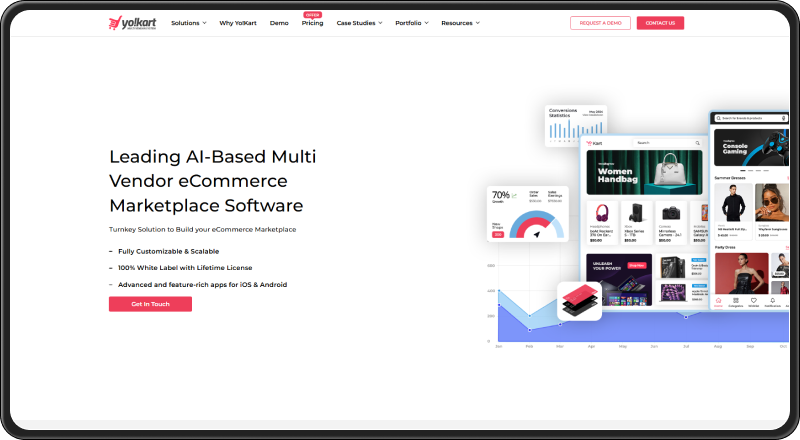
Yo!Kart is one of the best multi-vendor marketplace software helping global businesses build and empower their marketplaces. It is a purpose-built, self-hosted solution that offers complete control over data and the platform. Yo!Kart is available at a one-time license fee rather than a recurring monthly or yearly subscription.
The solution comes with the features and functionality required for vendor management, commission handling, and order coordination built in natively, eliminating the need for third-party add-ons to get core marketplace functionality.
In short, for businesses that want true control and flexibility, saving money in the long run, Yo!Kart is the right fit they can get started with.
Best for: Businesses seeking complete control, access, long-term cost efficiency, and a platform that’s built for marketplaces from the ground up rather than adapted into one.
Pros:
- One-time license fee, no recurring subscription eating into margins month after month
- Source code access, giving genuine long-term control over the business’s core technology
- Purpose-built for multi-vendor marketplace operations from day one, not bolted on
- Native mobile apps are included for both buyers and sellers out of the box
- Supports both B2B and B2C marketplace models on the same platform
- Multi-language and multi-currency support built in for international growth
- Enable in-depth customization. The architecture is designed to be extended, not just tweaked
- 12 months of free dedicated technical support
Cons:
- As a self-hosted platform, you’ll need to manage hosting and server maintenance
- For highly advanced or unique customizations, you may need developer assistance. However, Yo!Kart team also assist with custom development services,
Launch a Thriving Multi-Vendor Marketplace with Yo!Kart
2. Sharetribe
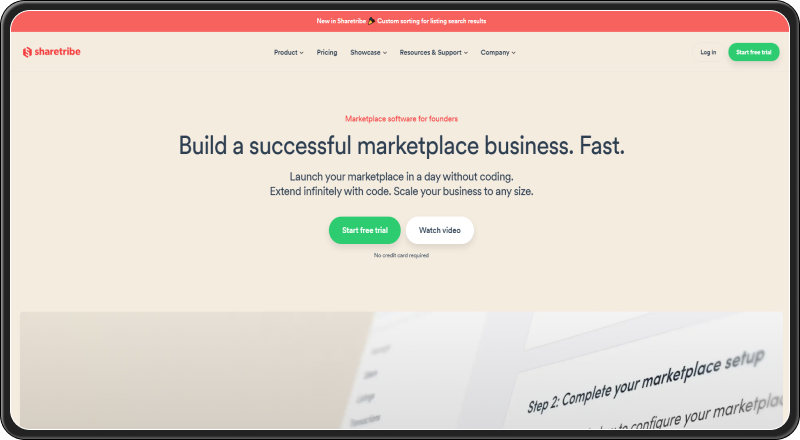
Sharetribe is a SaaS marketplace builder aimed at founders who want to test a marketplace idea quickly without managing servers or infrastructure. It’s especially popular for peer-to-peer and service-based marketplace concepts where speed to launch matters more than deep customization. The platform trades long-term ownership for short-term simplicity.
Pros:
- Fast to launch with minimal technical setup
- No infrastructure to manage
- Good fit for validating an early-stage concept
Cons:
- No source code access— you’re building on rented infrastructure
- Entry-level plans are limited in customization; real flexibility requires Sharetribe Flex, which adds development cost and complexity
- Ongoing monthly subscription cost that continues indefinitely, regardless of how much the business grows
3. Shopify + Multi-Vendor Apps
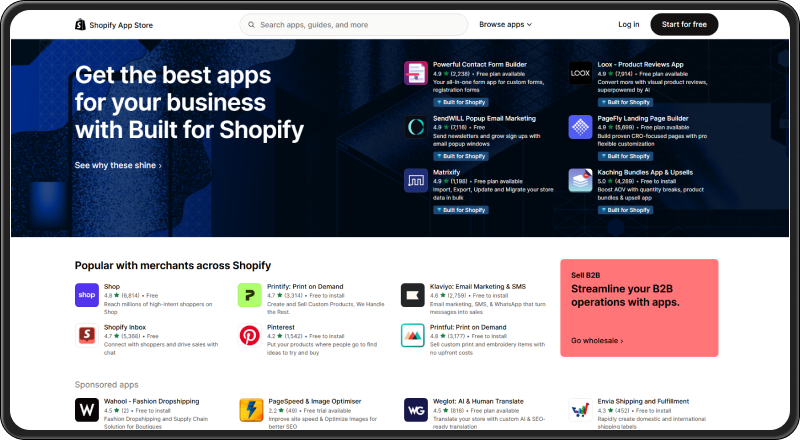
Shopify is fundamentally a single-vendor eCommerce platform, not marketplace software. However, the multi-vendor capability only exists because of third-party apps layered on top. It can work for merchants who are already deep in the Shopify ecosystem and want to experiment with a marketplace model without switching platforms. But the marketplace functionality itself is fundamentally a workaround, not a native capability.
Pros:
- Familiar interface for merchants already on Shopify
- Large app marketplace for extending functionality
Cons:
- Marketplace functionality isn’t native; it depends entirely on third-party apps of varying quality and reliability
- Costs can be higher. Shopify’s subscription, plus the app costs You’re dependent on app developers continuing to maintain and support a feature that Shopify itself was never designed around, including commission splitting, a core marketplace need
- Platform rules weren’t built with multi-vendor operations in mind, which can create friction as the business scales
4. Arcadier
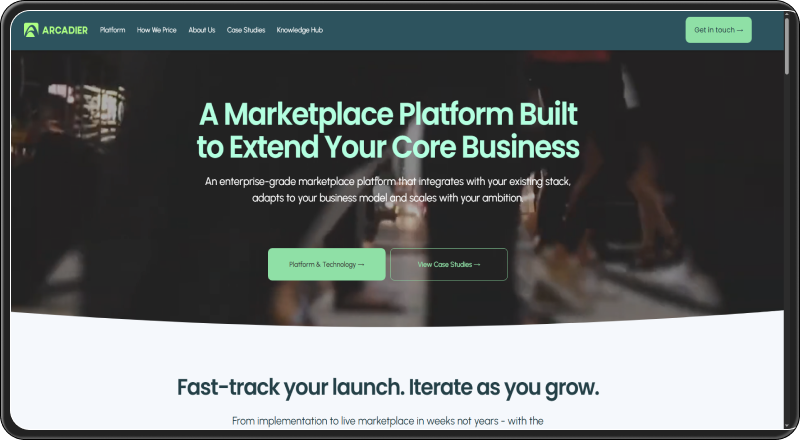
Arcadier is a cloud-based marketplace platform built around getting a marketplace live as fast as possible. It prioritizes speed of deployment over depth of customization or long-term ownership, making it more of a launchpad than a long-term foundation. Like other SaaS options, it’s well-suited to testing an idea but less suited to building a platform meant to scale and evolve indefinitely under the business’s own control.
Pros:
- Generally faster to deploy than self-hosted alternatives
- Cloud-based, so no server management
Cons:
- Limited control— the business never actually owns its platform
- Customization options are more limited than self-hosted alternatives
- Recurring subscription cost with the same long-term tradeoffs as other SaaS platforms: speed now, less control later
- Can cost more in the long run
5. Dokan (WooCommerce)
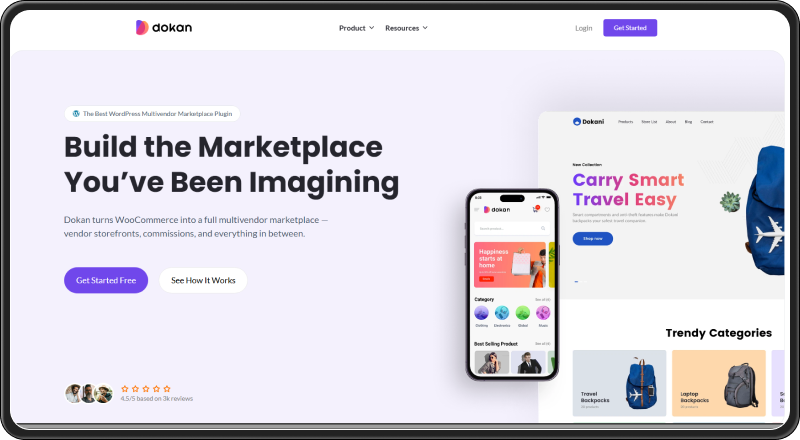
Dokan is a plugin that adds multi-vendor marketplace functionality on top of WooCommerce, which itself runs on WordPress. It can be a reasonable extension for businesses already comfortable managing a WordPress site, but it’s fundamentally a plugin stacked on a plugin stacked on a CMS not a platform built for marketplaces from the ground up.
Pros:
- Natural extension for teams already comfortable with WordPress/WooCommerce
- Lower barrier to entry if that ecosystem is already familiar
Cons:
- Plugin-based architecture, not a standalone purpose-built platform, inherits all the constraints of WordPress and WooCommerce, along with their strengths
- Advanced functionality often requires stacking multiple additional plugins, each a potential point of failure
- Ongoing maintenance burden of keeping WordPress, WooCommerce, and Dokan simultaneously updated and compatible is a burden that compounds over time and with scale
A Quick Marketplace Software Comparison Table
| Criteria | Yo!Kart | Sharetribe | Shopify + Apps | Arcadier | Dokan |
| Pricing Model | One-time license | Monthly subscription | Monthly + app fees | Monthly subscription | Annual subscription |
| Source Code Access | Yes | Limited | No | No | Partial |
| Built for Multi-Vendor | Native | Native | Plugin-based | Native | Plugin-based |
| Customization | High | Medium | Medium | Medium | Medium |
| Mobile Apps | Native | Add-on | Third-party | Limited | Third-party |
| B2B Support | Yes | Limited | Add-ons required | Limited | Plugin dependent |
| Time to Launch | Fast | Fast | Moderate | Fast | Moderate |
| Long-Term Cost | Lower | Higher | Higher | Higher | Moderate |
Why More Businesses Are Choosing Self-Hosted Marketplace Software
As marketplace businesses grow beyond the initial launch stage, many founders begin to prioritize long-term control, flexibility, and cost efficiency. This shift has led to increased demand for self-hosted marketplace solutions.
Unlike subscription-based platforms, self-hosted software gives businesses greater control over their technology stack and the freedom to scale without recurring platform limitations.
1. Greater Control Over Data and Operations
With a self-hosted platform, you have full control over where your data is stored, how it is backed up, and the security measures used to protect it. This level of ownership is particularly valuable for businesses handling large volumes of customer, vendor, and transaction data.
Instead of relying entirely on a third-party provider’s infrastructure and policies, you can manage your marketplace according to your own operational and compliance requirements.
2. No Recurring Platform Fees
Subscription and commission-based pricing models can become expensive as your marketplace grows. As transaction volume increases, so do your software costs, which can reduce profit margins over time.
However, the self-hosted solutions typically operate on a one-time license model, allowing you to separate software costs from business growth. This creates greater cost predictability and helps you retain more revenue as your marketplace scales.
3. Scalability on Your Terms
As your vendor network, product catalog, and order volume expand, your infrastructure requirements will evolve. SaaS-based solutions pose several restrictions and often cost extra.
With self-hosted software, you can upgrade your hosting resources whenever needed without being restricted by platform tiers or usage limits. This flexibility allows you to scale your marketplace based on your business needs rather than your software provider’s pricing structure.
4. Flexible Customization
Every marketplace has unique workflows, branding requirements, and business goals. Customization flexibility becomes increasingly important as your marketplace differentiates itself in a competitive market. Access to the source code enables you to customize features, integrate third-party tools, and create tailored user experiences without being limited by predefined templates or plugin ecosystems.
5. Reduced Dependency on Third-Party Apps
Many marketplace platforms rely heavily on multiple plugins and extensions to deliver essential functionality. Managing these tools can increase costs, create compatibility issues, and complicate software updates.
Self-hosted marketplace solutions often include core multi-vendor features out of the box, reducing the need for third-party applications and simplifying long-term maintenance.
A platform like Yo!Kart demonstrates the advantages of this approach by combining source code access, built-in multi-vendor functionality, and a one-time license model. For businesses that have validated their concept and are focused on sustainable growth, self-hosted marketplace software offers a practical path to greater control, scalability, and long-term value.
Why Yo!Kart Stands Out for Business Owners
For entrepreneurs and businesses looking to build a scalable multi-vendor marketplace, choosing the right software often comes down to balancing cost, ownership, flexibility, and speed to launch. This is where Yo!Kart differentiates itself from many subscription-based marketplace platforms.
One of Yo!Kart’s biggest advantage is its one-time license model, which helps businesses avoid recurring platform fees and revenue-sharing commissions. As your marketplace grows and transaction volumes increase, your software costs remain predictable, helping you maintain healthier profit margins and achieve a lower total cost of ownership over time.
Key Advantages of Yo!Kart
- Lifetime license with no recurring platform fees: Pay once for the software and continue using the core platform without monthly subscription charges or commission-based fees.
- Source code access: Gain complete control over your marketplace infrastructure, including the ability to customize features, choose your hosting provider, and scale on your own terms.
- Lower total cost of ownership: Eliminate ongoing platform fees and keep long-term costs manageable with predictable expenses such as hosting and optional custom development.
- Ready-to-use B2B and B2C functionality: Support multiple business models with built-in features designed for both wholesale and consumer-focused marketplaces.
- Native buyer and seller mobile apps: Deliver seamless experiences across devices without investing in separate mobile app development.
- Scalable architecture: Grow from a startup marketplace to an enterprise-level platform without the need for costly migrations or major system overhauls.
- Faster time-to-market: Launch quickly with pre-built marketplace features while retaining the flexibility to customize and expand as your business evolves.
- Dedicated support and customization services: Access expert assistance for implementation, integrations, and advanced customizations when needed.
Highlight:- Unlike SaaS solutions, Yo!Kart provides complete control, allowing you to adapt your platform as your business requirements change. This flexibility is especially valuable for businesses planning long-term growth or operating in niche industries with unique workflows.
By combining enterprise-grade functionality with a self-hosted, source-code-owned model, Yo!Kart offers a practical alternative to both subscription-based software and expensive custom development. For businesses seeking greater control, scalability, and long-term value, it provides a strong foundation for sustainable marketplace growth
By combining enterprise-grade functionality with a self-hosted, source-code-owned model, Yo!Kart offers a practical alternative to both subscription-based software and expensive custom development. For businesses seeking greater control, scalability, and long-term value, it provides a strong foundation for sustainable marketplace growth
Yo!Kart Success Stories: Real-World Marketplace Projects
Yo!Kart has empowered entrepreneurs and enterprises to launch scalable B2B, B2C, and C2C marketplaces tailored to their unique business models. From diamond trading and tourism to industrial procurement, these success stories demonstrate how Yo!Kart’s customizable architecture, robust feature set, and flexibility help businesses solve industry-specific challenges, streamline operations, and create engaging user experiences.
1. UNI Diamonds: Modernizing Global Diamond Trading with Yo!Kart
- Industry: Diamond Trading & Jewelry
- Business Model: B2B Marketplace
UNI Diamonds partnered with Yo!Kart to digitize the traditionally offline diamond trading ecosystem by creating a centralized marketplace.
Built on Yo!Kart’s customizable multi-vendor framework features 360-degree diamond visualization, certification integrations, auction capabilities, real-time pricing insights, and advanced inventory management. Secure logistics and shipment tracking further improve trust and operational efficiency.
Following a successful MVP launch, UNI Diamonds expanded into a comprehensive digital ecosystem with dedicated mobile applications and white-label retail solutions.
2. Voyij: Revolutionizing Alaska’s Tours and Activities Market with Yo!Kart
- Industry: Travel & Tourism
- Business Model: Multi-Vendor Booking Marketplace
Voyij is designed to simplify travel planning in Alaska by bringing tours, local products, and destination information together on a single platform.
Powered by Yo!Kart, the marketplace offers specialized features such as activity availability calendars, time-slot bookings, tiered pricing, multiple pickup locations, confirmation codes, and integrations with booking and analytics tools.
Today, Voyij serves more than 10 regions across Alaska, supports over 100 local businesses, and features over 5,000 activities and products, helping the company secure additional funding for growth.
3. Watersorted: Digitizing Water Industry Procurement with Yo!Kart
- Industry: Water Infrastructure & Management
- Business Model: B2B Procurement Marketplace
Watersorted was launched to modernize procurement processes within New Zealand’s water industry by connecting buyers and suppliers through a centralized digital marketplace. The platform aimed to eliminate manual workflows, improve supplier visibility, and simplify communication across the sector.
Built on Yo!Kart’s flexible multi-vendor architecture, Watersorted introduced industry-specific features such as public and private Request for Quote (RFQ) modules, supplier storefronts, advanced search filters, real-time inventory tracking, subscription-based seller plans, and secure payments through Stripe Connect.
Want to Explore Out-of-Box Features of Yo!Kart
Conclusion
Choosing the right marketplace software is more than a feature comparison. It’s a long-term business decision that affects your costs, scalability, operational flexibility, and ability to adapt as your marketplace grows.
Between SaaS and self-hosted, the right choice ultimately depends on your business model, growth plans, technical requirements, and budget. You need to evaluate factors such as source code access, total cost of ownership, customization capabilities, integrations, and scalability
SaaS platforms can help entrepreneurs launch quickly, but recurring fees, limited customization, and restricted ownership may create challenges as your business scales. On the other hand, self-hosted marketplace solutions provide greater control, predictable long-term costs, and the flexibility to evolve your platform according to your unique business needs.
In conclusion, businesses seeking a balance between rapid deployment, complete control, and long-term cost efficiency, self-hosted solutions like Yo!Kart offers a compelling alternative to recurring subscription-based platforms and expensive custom development.
FAQs
1. What makes Yo!Kart different from other marketplace software solutions?
Unlike many SaaS marketplace platforms that charge recurring subscription or transaction fees, Yo!Kart offers a one-time license model with full source code access. It is purpose-built for multi-vendor marketplaces, providing native features such as vendor management, commission handling, payment splitting, and mobile apps without relying heavily on third-party plugins.
2. Is Yo!Kart suitable for both B2B and B2C marketplaces?
Yes. Yo!Kart supports both B2B and B2C business models out of the box. It includes features such as bulk ordering, request-for-quote (RFQ) functionality, custom pricing, minimum order quantities, and account-based purchasing for B2B operations, while also delivering a seamless shopping experience for B2C customers.
3. Does Yo!Kart provide source code access?
Yes. With Yo!Kart, businesses receive full access to the source code, enabling complete control over customization, hosting, integrations, and future development. This helps reduce vendor lock-in and provides greater flexibility as your marketplace evolves.
4. How does Yo!Kart help reduce the total cost of ownership?
Yo!Kart’s one-time license model eliminates recurring platform fees and revenue-sharing commissions. As your marketplace grows, your software costs remain predictable, allowing you to invest more in marketing, customer acquisition, and business expansion rather than ongoing software subscriptions.
5. Can Yo!Kart be customized for unique marketplace requirements?
Absolutely. Yo!Kart is designed with customization in mind. Businesses can modify workflows, user experiences, commission structures, branding elements, and integrations to meet their specific requirements. For advanced customizations, they can either access the source code and implement or choose our dedicated development support.
6. Does Yo!Kart include mobile apps?
Yes. Yo!Kart offers native mobile apps for both buyers, helping businesses deliver seamless experiences across devices while improving customer engagement and vendor productivity.
7. How quickly can I launch a marketplace with Yo!Kart?
Since Yo!Kart comes with pre-built multi-vendor features, and businesses can significantly reduce development time compared to custom-built solutions. Depending on customization requirements, many marketplaces can launch within weeks rather than months.
8. Is Yo!Kart scalable for growing marketplaces?
Yes. Yo!Kart is built to support marketplace growth from the startup stage to the enterprise level. Its architecture can handle increasing vendor numbers, larger product catalogs, higher traffic volumes, and expanding transaction loads without requiring a platform migration.
9. What support does Yo!Kart provide after launch?
Yo!Kart includes dedicated technical support to assist with installation, onboarding, troubleshooting, and any unexpected bugs or errors associated with the system.. Businesses can also access customization and integration services to extend functionality as their needs evolve.
10. Is Yo!Kart a better alternative to custom marketplace development?
Yes, in many cases. Yo!Kart offers enterprise-grade marketplace functionality at a fraction of the cost and development time required for custom-built platforms. It provides the flexibility of source code access, enabling businesses to implement code-level changes and businesses avoid lengthy development cycles and high maintenance costs.