

For decades, many successful businesses have relied on offline operations such as retail stores, wholesale networks, and distributor partnerships to drive revenue. However, the way people buy and sell products has changed dramatically. Today’s customers expect convenience, wider choices, and the ability to shop anytime, anywhere. This shift in buying behavior has pushed many traditional businesses to explore new ways of reaching customers beyond their physical locations.
As a result, companies that once depended solely on brick-and-mortar channels are increasingly embracing digital commerce to expand their market reach. One of the most effective ways to make this transition is by transforming an offline business into a digital commerce marketplace. Instead of selling only your own products, a marketplace allows multiple vendors or suppliers to sell through your platform, enabling businesses to expand their product catalog while generating additional revenue streams.
Industry giants such as Amazon and Alibaba Group have demonstrated how powerful the marketplace model can be. Inspired by their success, many traditional businesses and regional retailers are now adopting this approach to digitize their operations and stay competitive in an increasingly digital commerce landscape. In this blog, we’ll explore how offline businesses can successfully transition into digital marketplaces and the key steps involved in building a scalable platform.
Table of Contents
- Why Offline Businesses Should Consider Launching a Marketplace?
- Steps to Convert an Offline Business into a Digital Marketplace
- Challenges Offline Businesses May Face During Digital Transformation
- How Yo!Kart Empowers Offline Businesses to Launch and Scale Digital Marketplaces
- Real-World Success: Businesses That Launched Marketplaces with Yo!Kart
- Conclusion
- FAQs
Why Offline Businesses Should Consider Launching a Marketplace?
For businesses that already operate through physical channels, launching a digital marketplace offers several strategic advantages. A marketplace model allows businesses to leverage their existing networks while creating a scalable digital platform that supports long-term growth. These advantages become even more evident when we look at the key benefits that marketplaces offer to traditional offline businesses.
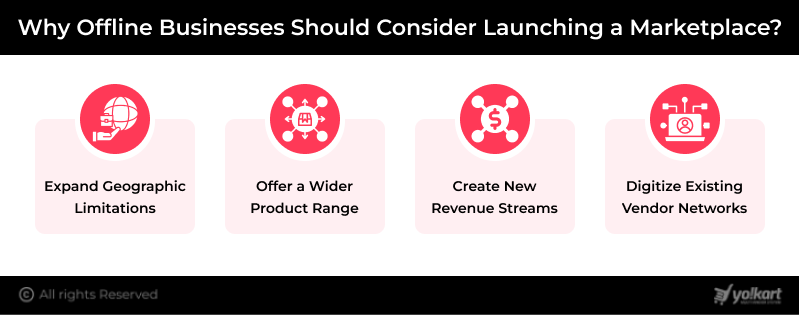
1. Expand Beyond Geographic Limitations
Offline businesses are often restricted by location. A physical store or regional distribution network can only serve customers within a limited area. By launching an online marketplace, businesses can break these geographic barriers and reach customers across cities, regions, or even globally. This significantly broadens the potential customer base and allows businesses to grow beyond the constraints of physical storefronts.
2. Offer a Wider Product Range
Traditional retail businesses typically sell products sourced from selected suppliers. Moreover, inventory limitations often restrict the number of products they can offer. A marketplace, on the other hand, allows multiple vendors to list their products on the same platform, enabling businesses to provide a much wider catalog without managing all the inventory themselves.
3. Create New Revenue Streams
Unlike traditional retail models that depend primarily on product sales, marketplaces generate revenue through multiple channels. It includes commissions on vendor sales, subscription fees for sellers, featured product listings, advertising placements, and transaction fees. This diversified revenue structure allows businesses to generate consistent income while reducing the financial risk associated with holding large inventories.
4. Digitize Existing Vendor Networks
Many offline businesses already work closely with suppliers, distributors, or partner retailers. A digital marketplace allows these businesses to bring their existing vendor network onto a single online platform. Instead of managing partnerships through offline transactions, companies can create a digital ecosystem where vendors can list products, manage orders, and interact with customers more efficiently. This approach strengthens collaboration while making the entire supply network more organized and scalable.
Build a Digital Marketplace and Expand Your Product Catalog
Steps to Convert an Offline Business into a Digital Marketplace
For many traditional businesses, transitioning from an offline model to a digital marketplace may feel complex initially. But companies that already have supplier networks, loyal customers, and established brand trust are actually in a strong position to build successful online platforms.
By strategically leveraging existing resources and adopting the right technology, businesses can gradually transform their operations into a scalable digital marketplace. Below are the key steps involved in turning an offline business into a successful digital marketplace:
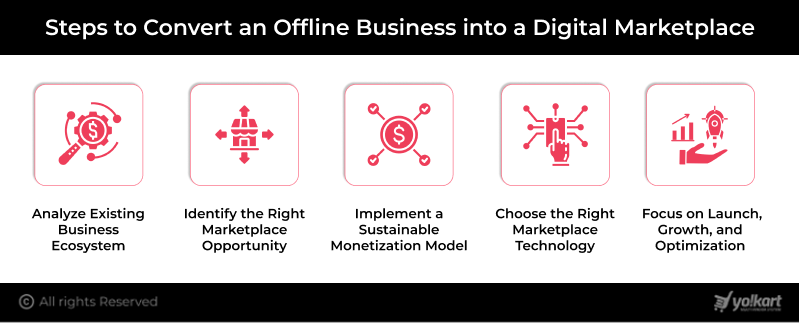
Step 1: Analyze Your Existing Business Ecosystem
The first step in launching a digital marketplace is gaining a clear understanding of the resources and relationships your business already has. Unlike startups, established offline businesses have several advantages that can accelerate marketplace growth. Typically, these valuable advantages are:
- A network of trusted suppliers or distributors
- Strong relationships with partner brands
- A loyal customer base
- Market credibility within a specific industry
These existing relationships can play a crucial role in the early stages of launch and become the foundation of your marketplace. Suppliers and partners who already trust your business are often more willing to join your platform as vendors. This makes the initial vendor acquisition process significantly easier and helps ensure that the marketplace launches with a reliable group of sellers and products.
Step 2: Identify the Right Marketplace Opportunity
After evaluating existing resources, the next step is to determine the type of marketplace that best aligns with your business model and industry. Not every marketplace follows the same structure, and selecting the right approach is essential for long-term success.
Common marketplace opportunities include:
- Retail marketplaces where multiple sellers offer products to consumers
- Wholesale or B2B marketplaces connecting manufacturers, distributors, and retailers
- Industry-specific marketplaces focused on niche sectors such as electronics, fashion, or construction supplies.
By choosing the right model, businesses can create a platform that delivers value to both vendors and customers while maintaining their industry expertise.
Step 3: Implement a Sustainable Monetization Model
Once the marketplace structure is defined, the next step is to establish a monetization model that ensures long-term financial sustainability. Unlike traditional retail businesses that rely primarily on direct product sales, marketplace platforms offer multiple ways to generate revenue. This flexibility allows businesses to build a steady income stream while supporting vendor growth.
Common monetization strategies include:
- Commission on each vendor sale
- Vendor subscription plans
- Featured product listings and promotions
- Advertising placements on the platform
Choosing the right model from the beginning helps ensure that the marketplace remains profitable while continuing to deliver value to sellers and customers.
Step 4: Choose the Right Marketplace Technology
After defining the revenue model, selecting the right technology becomes a critical step in building the marketplace. A digital marketplace must support multiple vendors, product listings, transactions, and customer interactions, which requires a robust and reliable technical infrastructure. Developing such a platform from scratch can be costly and time-consuming, often requiring extensive development resources.
To simplify this process, many businesses choose specialized marketplace software such as Yo!Kart. These solutions come equipped with built-in marketplace functionalities, allowing businesses to launch their platform faster and focus on vendor and customer growth rather than technical development.
A comprehensive marketplace solution should include features like:
- Vendor onboarding and management tools
- Multi-vendor storefronts
- Product catalog management
- Commission and revenue tracking
- Order and payment management
- Marketplace analytics and reporting
Moreover, using a dedicated solution significantly reduces the complexity of marketplace development and ensures smoother operations.
Suggested Read: How to Choose the Right eCommerce Marketplace Platform
Step 5: Focus on Marketplace Launch, Growth, and Optimization
Launching a marketplace is only the beginning. To ensure long-term success, businesses must continuously optimize their platform to improve vendor participation, customer experience, and operational efficiency. A marketplace thrives when both sellers and buyers find consistent value in using the platform, which requires ongoing optimization and strategic growth efforts.
Key growth strategies include:
- Expanding the vendor network
- Improving search and product discovery
- Offering marketing tools for sellers
- Enhancing customer support and trust mechanisms
Solutions like Yo!Kart are built with scalability in mind, allowing businesses to grow their marketplace without facing technical limitations as vendor and product volumes increase.
Challenges Offline Businesses May Face During Digital Transformation
While transforming an offline business into a digital marketplace can unlock significant growth opportunities, the transition is not always straightforward. Businesses that have operated successfully in traditional environments may encounter several challenges when moving toward a digital ecosystem.
Understanding these potential obstacles in advance helps businesses prepare better strategies and adopt the right technology to ensure a smooth transformation.
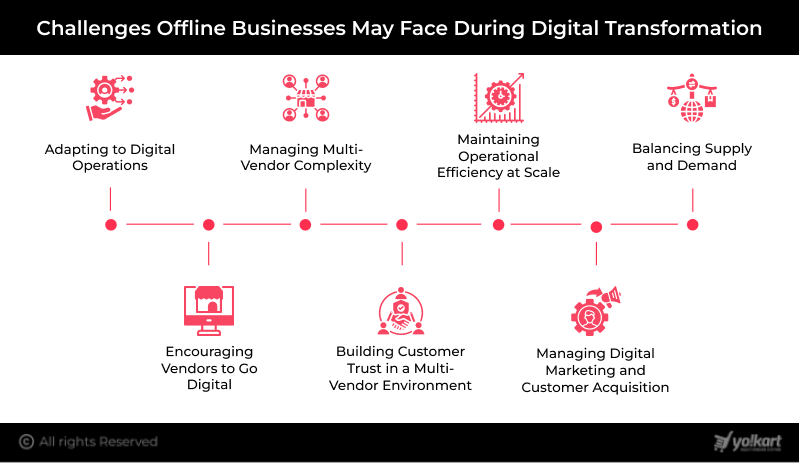
1. Adapting to Digital Operations
One of the biggest challenges for offline businesses is adapting existing processes to digital workflows. Traditional operations often rely on manual processes, personal relationships, and offline communication.
When transitioning to a marketplace model, businesses must adopt systems that support:
- Digital product catalog management
- Automated order processing
- Online payment management
- Vendor and customer communication tools
Adapting teams and processes to these new systems can require time, training, and operational adjustments.
2. Encouraging Vendors to Go Digital
Many offline businesses work with suppliers or partners who are accustomed to traditional selling methods. Convincing these vendors to adopt a digital platform may initially be challenging.
Vendors may hesitate due to concerns such as:
- Lack of familiarity with online selling
- Managing digital product listings
- Handling online orders and customer interactions
Providing vendors with simple onboarding processes, training resources, and easy-to-use dashboards can help overcome this barrier and encourage participation.
3. Managing Multi-Vendor Complexity
Unlike traditional eCommerce stores, where a business manages its own inventory, marketplaces involve multiple independent vendors selling through a single platform.
This creates additional operational responsibilities such as:
- Monitoring vendor product listings
- Managing commissions and payouts
- Handling order disputes and customer support
- Ensuring consistent product quality and delivery standards
Managing these complexities requires strong administrative tools and clearly defined marketplace policies.
Platforms like Yo!Kart includes built-in vendor management and order management capabilities that help streamline these operations.
Simplify Multi-Vendor Management with Readymade Marketplace Solution
4. Building Customer Trust in a Multi-Vendor Environment
Customers who are familiar with purchasing directly from a single brand may initially hesitate to buy from multiple vendors within one marketplace.
To maintain trust, businesses must implement mechanisms that ensure transparency and reliability, including:
- Vendor verification processes
- Customer ratings and reviews
- Clear return and refund policies
- Secure payment systems
These elements help create a trustworthy environment where customers feel confident purchasing from different sellers on the platform.
5. Maintaining Operational Efficiency at Scale
As the marketplace grows, the number of vendors, products, and transactions increases rapidly. Without scalable systems in place, businesses may struggle to maintain smooth operations.
Key challenges may include:
- Managing large product catalogs
- Handling high volumes of orders
- Monitoring vendor performance
- Processing vendor payouts efficiently
Using scalable marketplace technology from the beginning can prevent operational bottlenecks and support long-term growth.
6. Balancing Supply and Demand
Successful marketplaces must maintain a healthy balance between vendors and customers. If there are too many vendors but insufficient buyers, sellers may become inactive. Conversely, if customers cannot find enough product variety, they may leave the platform.
To address this challenge, businesses should initially focus on onboarding a select group of reliable vendors while simultaneously promoting the marketplace to their existing customer base.
7. Managing Digital Marketing and Customer Acquisition
Offline businesses often rely on physical presence, local reputation, and word-of-mouth marketing. However, online marketplaces require businesses to adopt digital marketing strategies to attract and retain customers.
This may involve investing in:
- Search engine optimization (SEO)
- Social media marketing
- Paid advertising campaigns
- Email marketing and customer retention strategies
Developing these capabilities is essential for driving consistent traffic to the marketplace platform.
By recognizing these challenges early, businesses can prepare the right strategies and technological infrastructure to support their digital transformation journey. With proper planning and scalable solutions such as Yo!Kart, offline businesses can overcome these hurdles and successfully build a thriving digital marketplace ecosystem.
How Yo!Kart Empowers Offline Businesses to Launch and Scale Digital Marketplaces
For many traditional businesses, the biggest challenge in launching a digital marketplace is technology complexity. Building a multi-vendor platform from scratch often requires significant time, technical expertise, and development investment. As a result, many businesses hesitate to take the first step toward digital transformation.
This is where specialized marketplace solutions like Yo!Kart plays a crucial role. It is designed specifically to help businesses transition from traditional operations to fully functional online marketplaces with minimal technical challenges. Instead of spending months or even years developing marketplace features from the ground up, businesses can leverage a ready-to-deploy solution equipped with the essential tools needed to manage vendors, products, transactions, and customer interactions efficiently.
Below are some of the key ways Yo!Kart supports businesses in launching and managing their own digital marketplace:
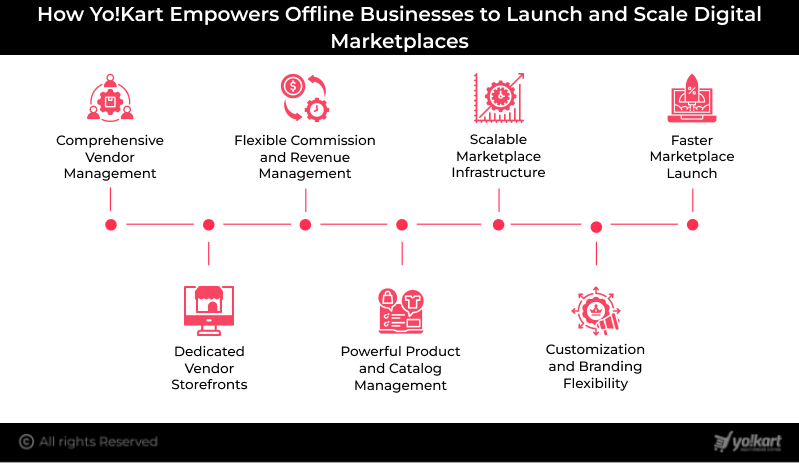
1. Comprehensive Vendor Management
Managing multiple sellers is one of the most critical aspects of operating a marketplace. The solution provides an advanced vendor management system that allows administrators to efficiently onboard, monitor, and manage vendors from a centralized dashboard.
Businesses can:
- Register and approve new vendors
- Track vendor performance and sales
- Manage vendor product listings.
- Monitor marketplace activity through a centralized dashboard.
This streamlined vendor management system enables businesses to build and maintain a strong seller ecosystem.
2. Dedicated Vendor Storefronts
Each vendor on the marketplace receives their own storefront where it can showcase products, manage orders, and interact with customers. These dedicated storefronts allow sellers to operate independently while remaining part of the broader marketplace ecosystem.
These vendor storefronts allow sellers to:
- Create and manage product catalogs
- Track orders and fulfillment status
- Access sales reports and analytics
- Manage inventory and pricing.
Providing vendors with their own independent storefronts improves the seller experience and encourages long-term participation on the platform.
3. Flexible Commission and Revenue Management
One of the biggest advantages of marketplace solutions is the ability to generate revenue through multiple streams. Yo!Kart allows marketplace owners to define flexible monetization models tailored to their business strategy, including:
- Commission on vendor sales
- Vendor subscription plans
- Featured product listings
- Promotional placements and advertising
With built-in commission management tools, businesses can easily track revenue and manage vendor payouts.
4. Powerful Product and Catalog Management
As marketplaces grow, they often include thousands of products listed by multiple vendors. Managing such large catalogs manually can quickly become complex. Yo!Kart includes advanced catalog management tools that allow administrators and vendors to efficiently organize product listings, categories, pricing, and inventory. This ensures customers can easily browse and discover products while vendors can manage their catalogs without technical difficulty.
5. Scalable Marketplace Infrastructure
As the marketplace expands, the number of vendors, products, and transactions will grow significantly. Businesses need a platform capable of supporting this growth without performance issues. The scalable architecture of Yo!Kart enables businesses to handle increasing marketplace activity while maintaining a smooth user experience for both vendors and customers.
6. Customization and Branding Flexibility
Every business has unique operational requirements and branding needs. The platform offers customization capabilities that allow businesses to adapt the marketplace according to their business model.
This includes:
- Custom design and branding
- Feature customization
- Workflow modifications
- Third-party integrations
Such flexibility ensures that the marketplace aligns with the company’s vision and long-term growth strategy.
7. Faster Marketplace Launch
One of the most important advantages of using a specialized marketplace solution is the ability to launch quickly. Businesses can significantly reduce development timelines and focus their efforts on vendor acquisition, marketing, and platform growth.
By using a readymade marketplace software like Yo!Kart, companies can accelerate their digital transformation and begin building a thriving vendor ecosystem much faster than traditional development approaches.
Get a Personalized Demo of Yo!Kart
Real-World Success: Businesses That Launched Marketplaces with Yo!Kart
One of the most effective ways to understand the potential of a marketplace solution is by looking at businesses that have successfully transformed their ideas into digital marketplaces.
Across different industries, including B2B trading, travel, retail, and specialized marketplaces, businesses have leveraged Yo!Kart to launch scalable platforms that connect vendors and buyers globally.
Below are a few examples of marketplaces built using Yo!Kart:
- Uni Diamonds: B2B Diamond Trading Marketplace
The diamond trading industry traditionally operates through offline networks and personal relationships. Uni Diamonds aimed to modernize this process by creating a B2B marketplace for diamond traders and buyers. With the help of Yo!Kart, the platform, enabled multiple vendors to showcase their diamond inventory online, allowing buyers to explore and purchase from a centralized marketplace. This digital approach streamlined trading operations and expanded market access for vendors in the diamond industry.
- Voyij: Travel Activity Marketplace
Voyij is an online marketplace that connects travelers with local tours, activities, and experiences in Alaska. The platform allows multiple tour operators to list their offerings, while customers can discover and book activities through a single platform. Using Yo!Kart, Voyij created a digital ecosystem where local businesses can promote their services and reach a broader audience.
- WaterSorted: B2B Water Industry Marketplace
WaterSorted was developed as a specialized B2B marketplace for the water industry, connecting suppliers, manufacturers, and buyers on a single platform. Businesses can list their products, connect with industry buyers, and manage transactions through a centralized marketplace environment powered by Yo!Kart, making industry sourcing and trading more efficient.
- Tajer: Qatar Multi-Vendor eCommerce Platform
Tajer Qatar is a multi-vendor eCommerce marketplace designed to bring together multiple sellers on one platform. The marketplace enables vendors to manage product listings, track orders, and interact with customers through a unified system. By leveraging Yo!Kart, the platform successfully created a digital shopping ecosystem serving customers in Qatar.
- Tana: Albania Online Marketplace
Tana Albania was built as a regional online marketplace connecting multiple sellers with local buyers. The platform focuses on offering diverse product categories while enabling vendors to manage their stores efficiently. With the support of Yo!Kart, the marketplace, was able to digitize retail operations and provide a centralized platform for vendors and consumers.
Explore More Marketplace Platforms
In addition to these case studies, numerous businesses across industries have successfully launched marketplaces using Yo!Kart. You can explore more marketplace implementations and success stories in the Yo!Kart Portfolio, which highlights platforms built for different industries and business models.
Customer Reviews and Testimonials
When selecting a marketplace platform, businesses often evaluate feedback from other companies that have already used the solution.
The Yo!Kart Reviews and Testimonials page showcases experiences shared by clients who have used the platform to build and scale their marketplaces. These insights provide a better understanding of how businesses across industries have benefited from the platform’s capabilities.
Conclusion
The shift from traditional offline business models to digital marketplaces is no longer just an option; it has become a strategic move for businesses looking to expand their reach and stay competitive in today’s evolving commerce landscape. As more customers prefer the convenience of online shopping, businesses that adapt to digital platforms are better positioned to grow and serve a wider audience.
Launching a digital marketplace allows businesses to connect vendors, suppliers, and customers on a single platform. This not only helps expand product offerings but also opens the door to multiple revenue streams. However, building and managing a marketplace requires careful planning, strong vendor ecosystems, and the right technology infrastructure.
Solutions like Yo!Kart simplify this process by providing ready-to-use tools for vendor management, product listings, order processing, and marketplace administration. With the right strategy and marketplace technology, offline businesses can successfully transform into scalable digital platforms and unlock new growth opportunities.
FAQs
Q 1. What is a digital eCommerce marketplace?
Ans. A digital eCommerce marketplace is an online platform where multiple vendors can sell products or services through a single website managed by a marketplace owner. The platform facilitates product listings, transactions, and payments, while allowing customers to browse and purchase from different sellers in one convenient place.
Q 2. Can traditional offline businesses successfully build online marketplaces?
Ans. Yes, traditional offline businesses often have advantages such as established supplier networks, an existing customer base, and industry expertise. These strengths make it easier to onboard vendors, attract buyers, and create a trusted platform compared to starting a marketplace from scratch.
Q 3. What are the benefits of turning an offline business into a marketplace?
Ans. Turning an offline business into a marketplace helps expand its product offerings, reach new customers, and create multiple revenue streams. It also allows businesses to build stronger vendor partnerships while creating a scalable platform that supports long-term growth and diversification.
Q 4. How long does it take to launch a marketplace platform?
Ans. The timeline to launch a marketplace platform depends on factors such as the level of customization, features required, and development approach. Building from scratch may take several months, while using ready-made marketplace software like Yo!Kart can significantly reduce development time and help businesses launch their platform much faster.
Q 5. How do businesses onboard vendors to their marketplace?
Businesses can onboard vendors by inviting existing suppliers, distributors, or partners to join the platform. Offering attractive commission structures, easy product listing tools, and a user-friendly dashboard encourages participation. Providing onboarding guidance, training resources, and support also helps vendors quickly adapt to selling on the marketplace.
Q 6. What features are essential for a multi-vendor marketplace platform?
Ans. A multi-vendor marketplace platform should include features such as:
- Vendor management
- Product catalog management
- Commission tracking
- Order processing
- Vendor storefronts
- Analytics tools
- Secure payment integrations
Transform Your Offline Business into a Multi-Vendor Marketplace
Get In TouchPopular Posts