

The global eCommerce industry is growing at an unprecedented pace. According to Statista, global eCommerce sales are expected to surpass $8 trillion by 2028, with over 72% of digital purchases happening through mobile devices. Additionally, online marketplaces account for more than 60% of global online sales, demonstrating the dominance of the multi-vendor marketplace model.
In today’s competitive digital commerce landscape, time-to-market and operational efficiency are no longer optional. Organizations must balance innovation with cost control while ensuring their technology infrastructure can grow alongside business growth. Developing a marketplace app from scratch often requires extensive technical expertise, significant capital investment, and long development timelines, which can delay market entry and increase project risk.
As a result, many startups, SMBs, and enterprises are turning to white-label marketplace app software. A white-label marketplace app software enables businesses to launch a fully branded, multi-vendor marketplace app with pre-built infrastructure while maintaining customization and control. In this comprehensive blog, you will explore what white-label marketplace app software is, why it’s gaining traction, and learn about the top 10 white-label marketplace app software in 2026.
Table of Contents
What is a White-Label Marketplace App Software?
A white-label marketplace app software is a ready-made, multi-vendor eCommerce solution that business can rebrand and launch as their own. Instead of investing months in development and assembling large technical teams, businesses license an existing solution and customize it according to their brand, workflow, and operational needs.
In simple terms, it allows organizations to skip the complex build phase and move straight to market execution. The core technology is already developed, tested, and optimized. Businesses only need to customize the design, configure features, and align the system with their operational requirements.
Most white-label marketplace apps typically include:
- Vendor onboarding and management tools
- Commission and revenue management systems
- Product catalog management
- Secure payment gateway integrations
- Order tracking and reporting
- Multi-language and multi-currency support
- Native Android and iOS applications
This model significantly reduces development time and lowers development risks. More importantly, it allows businesses to focus on strategic priorities such as vendor acquisition, customer engagement, partnerships, and revenue growth rather than technical complexities.
Why eCommerce Businesses Choose White-Label Marketplace App Software
In today’s competitive digital economy, speed and smart investment decisions define success, which is why eCommerce businesses are under constant pressure to innovate quickly while keeping costs under control. Hence, many organizations are turning to white-label marketplace app software as a practical and growth-oriented solution. It offers a ready-made, dependable foundation that allows businesses to focus on strategy rather than technical complexity.
Below are the key reasons driving this shift:
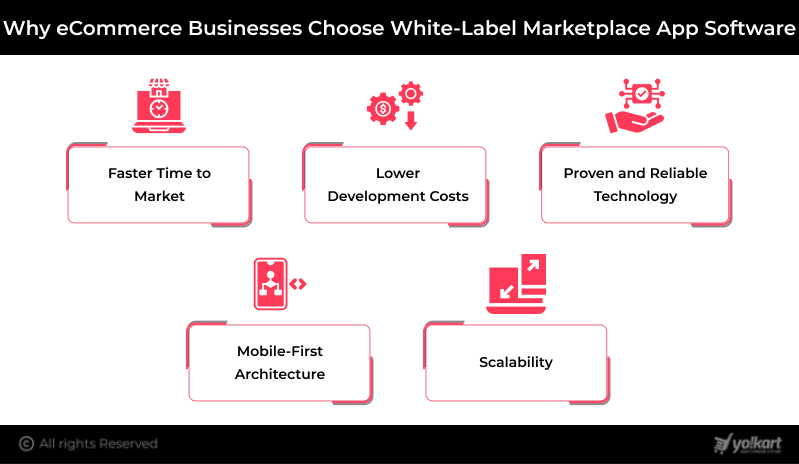
1. Faster Time to Market
Building a marketplace app from scratch can take 6-12 months due to design, development, and testing. In contrast, white-label marketplace app software are pre-built and market-ready, allowing businesses to launch within weeks, saving valuable time.
2. Lower Development Costs
Custom development requires a team of developers, UI/UX designers, QA engineers, and infrastructure experts, which adds up to the cost. White-label solutions, on the other hand, provide built-in features and tested frameworks, significantly reducing upfront and ongoing costs significantly.
3. Proven and Reliable Technology
White-label marketplace software has already been tested across various industries and business models, ensuring stability, security, and optimal performance, which reduces the risk of technical issues.
4. Mobile-First Architecture
Today’s consumers expect seamless mobile experiences. With most commerce happening through smartphones, having a mobile-ready solution is essential. White-label apps typically include native Android and iOS applications, offering a seamless mobile experience to customers from day one.
5. Scalability
Modern white-label marketplace software is built on robust, scalable technology stacks that support increasing users, vendors, and transactions. As the business expands, new features and integrations can be added without disrupting existing operations.
Top 10 White-Label Marketplace App Software in 2026
The marketplace economy is expanding rapidly, and choosing the right white-label marketplace app software can offer you a competitive edge. Whether you are a startup validating an idea or an enterprise scaling globally, it is critical to select a reliable software from the beginning.
Below is a list of the top 10 white-label marketplace app software solutions in 2026:
1. Yo!Kart
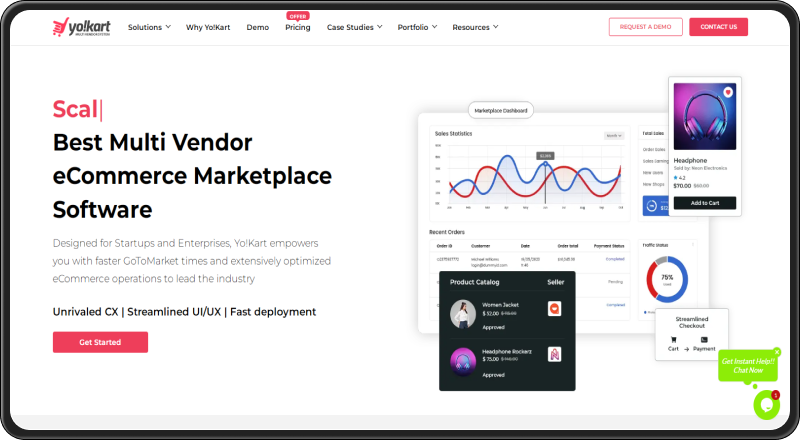
Yo!Kart is a robust white-label marketplace app software designed for entrepreneurs and enterprises looking to build scalable multi-vendor platforms. It offers a self-hosted solution with customizable source code ownership, making it highly customizable.
Yo!Kart provides fully branded native Android and iOS marketplace apps that synchronize seamlessly with the web platform. The software supports multiple business models, including B2C, B2B, rental marketplaces, and more. Additionally, it comes integrated with advanced vendor dashboards, commission management tools, tax settings, multilingual functionality, and multi-currency support. Yo!Kart also provides technical support and deployment assistance, ensuring smooth onboarding.
Pros:
- One-time license fee with lifetime ownership
- Fully customizable source code
- Native Android and iOS white-label apps
- Scalable for startups and enterprises
Cons:
- You need to meet the minimum server requirements
Best For: Businesses seeking complete ownership, deep customization, and long-term scalability without recurring SaaS fees.
Get a Personalized Yo!Kart Demo
2. Sharetribe
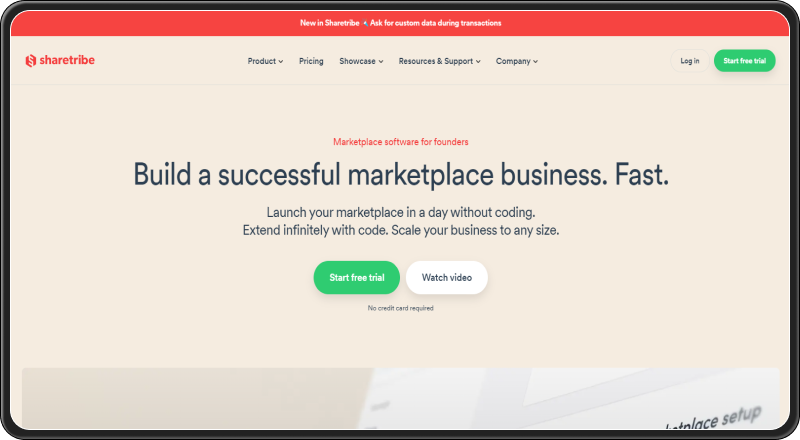
Sharetribe is a popular white-label marketplace app software known for its flexibility and ease of use. It offers both no-code marketplace builders and API-based customization options for developers. Businesses can quickly launch service-based, rental, or product marketplaces using its intuitive interface. However, it does not provide built-in native mobile apps. Thus, businesses must develop separate mobile applications using Sharetribe’s API framework.
Pros:
- Quick marketplace launch
- Developer-friendly APIs
- Flexible customization options
Cons:
- Recurring monthly subscription fees
- Advanced customization requires developers
- Limited built-in enterprise features
Best For: Startups and entrepreneurs launching MVP marketplaces with future scalability in mind.
3. CS-Cart Multi-Vendor
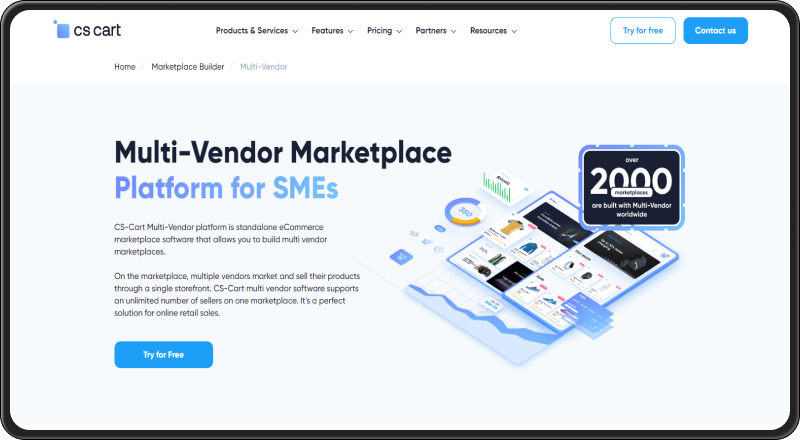
CS-Cart Multi-Vendor is a feature-rich white-label marketplace software designed for businesses seeking control and flexibility. It supports a large number of vendors, customizable commission structures, and offers backend management tools.
The platform includes a responsive design and offers mobile app add-ons for Android and iOS. It also provides extensive add-ons and themes to enhance functionality and user experience. Further, SEO optimization and marketing tools help marketplace owners drive traffic and growth.
Pros:
- Extensive add-ons marketplace
- Vendor management features
- SEO-friendly architecture
Cons:
- Paid upgrades for advanced features
- Requires technical expertise for customization
- Additional cost for mobile apps
Best For: SMBs and mid-sized businesses needing feature-rich marketplace software with customization flexibility.
4. Arcadier

Arcadier is a cloud-based white-label marketplace app software offering industry-specific marketplace templates. It supports product, service, and rental marketplace models, making it versatile for different industries.
It operates on a hosted SaaS model and provides mobile app extensions as optional add-ons, typically available at higher-tier plans or additional fees. Its modular architecture allows businesses to enable features as needed, while API integrations support advanced customization.
Pros:
- Industry-specific templates
- Cloud hosting included
- Modular feature architecture
Cons:
- Subscription-based pricing
- Custom features may require additional costs
- Limited backend control compared to self-hosted solutions
Best For: Entrepreneurs seeking a hosted, ready-to-launch white-label marketplace solution.
5. Magento with Multi-Vendor Extension
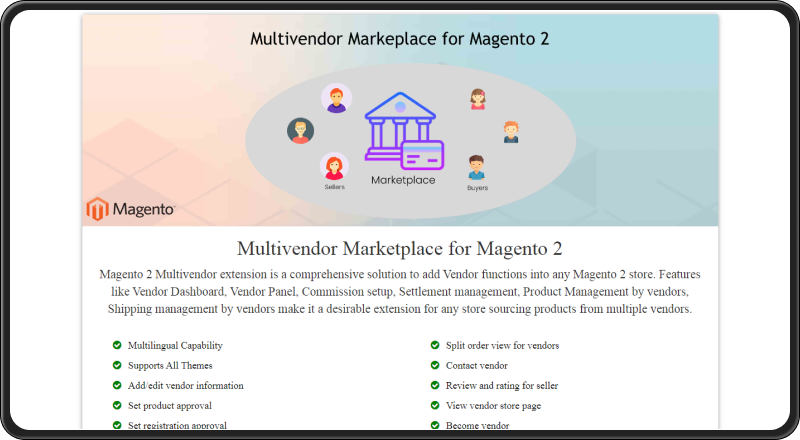
Magento (Adobe Commerce) can be transformed into a powerful white-label marketplace app using third-party multi-vendor extensions. While it offers enterprise-grade scalability and extensive customization options, it does not include native marketplace mobile apps.
Magento’s ecosystem allows integration with ERP systems, advanced analytics tools, and global payment gateways. While not a plug-and-play marketplace solution, it provides flexibility for businesses with technical resources.
Pros:
- Highly scalable
- Enterprise-level customization
- Large developer community
Cons:
- High development cost
- Complex setup process
- Requires ongoing technical maintenance
Best For: Large enterprises with in-house development teams seeking advanced marketplace functionality.
6. Shopify with Multi-Vendor Apps
Shopify can be converted into a white-label marketplace using third-party multi-vendor apps. It provides a user-friendly interface and reliable cloud hosting.
While Shopify is primarily designed for single-vendor stores, marketplace plugins enable vendor onboarding, commission management, and product management. However, it does not provide a built-in native multi-vendor mobile app. Businesses must rely on third-party mobile app builders or custom development.
Pros:
- Easy setup and management
- Secure cloud hosting
- Large plugin ecosystem
Cons:
- Recurring monthly fees
- Limited deep customization
- Dependency on third-party apps
Best For: Small businesses wanting to experiment with marketplace models quickly.
Suggested Read: Best Alternative to a Shopify Multivendor Marketplace
7. Marketplacer
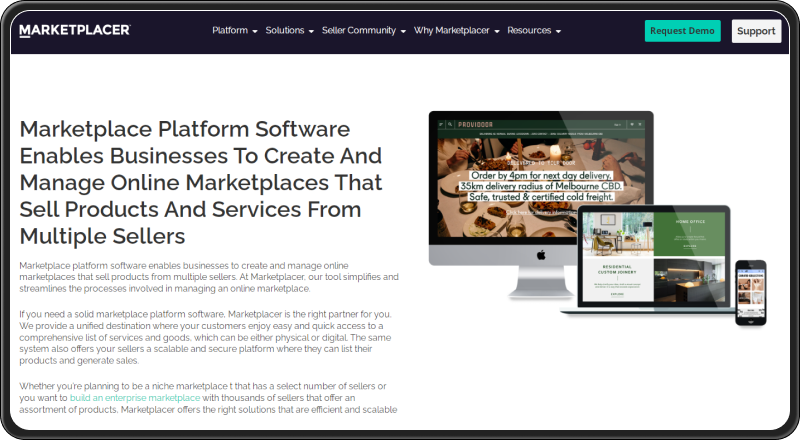
Marketplacer is an enterprise-focused white-label marketplace software designed for large-scale operations. It enables businesses to connect sellers, manage complex catalogs, and automate workflows.
The platform supports API integrations, vendor onboarding automation, and enterprise-grade reporting tools. It is widely used by retailers expanding into marketplace ecosystems. While it does not offer native mobile apps, businesses can typically build them using API infrastructure.
Pros:
- Enterprise-ready architecture
- Strong automation capabilities
- Scalable infrastructure
Cons:
- Premium pricing
- Complex onboarding
- Not ideal for startups
Best For: Large retailers and enterprises building extensive marketplace ecosystems.
8. Mirakl

Mirakl is a leading enterprise marketplace SaaS solution designed for B2B and retail marketplaces. It provides automation tools, supplier onboarding, and advanced analytics.
Mirakl integrates seamlessly with enterprise ERP systems and supports global expansion strategies. Its scalable infrastructure ensures high performance for large marketplaces. Additionally, it is important to note that mobile apps must be developed separately using APIs.
Pros:
- Enterprise-grade security
- Advanced automation features
- Global scalability
Cons:
- Expensive subscription plans
- Not suitable for small businesses
- Implementation complexity
Best For: Global enterprises launching large-scale B2B or retail marketplaces.
9. Kreezalid
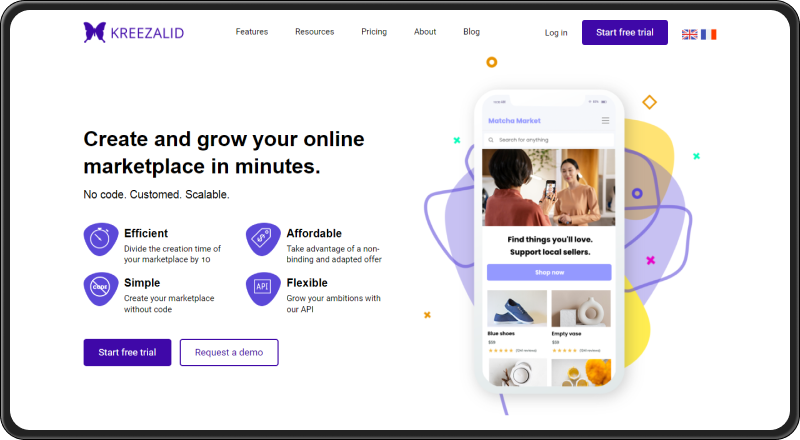
Kreezalid offers an all-in-one white-label marketplace app software solution with hosting and maintenance included. It enables quick marketplace deployment without heavy technical requirements.
The platform supports vendor dashboards, payment integrations, and provides responsive, mobile-friendly design. It may offer mobile app options depending on the subscription plan, but native apps are not always included by default.
Pros:
- Fast deployment
- Hosted infrastructure included
- User-friendly interface
Cons:
- Subscription-based pricing
- Limited backend customization
- Transaction fees on some plans
Best For: Startups seeking a managed SaaS marketplace solution with minimal technical involvement.
Find the Best Marketplace Software for Your Business
10. Nautical Commerce
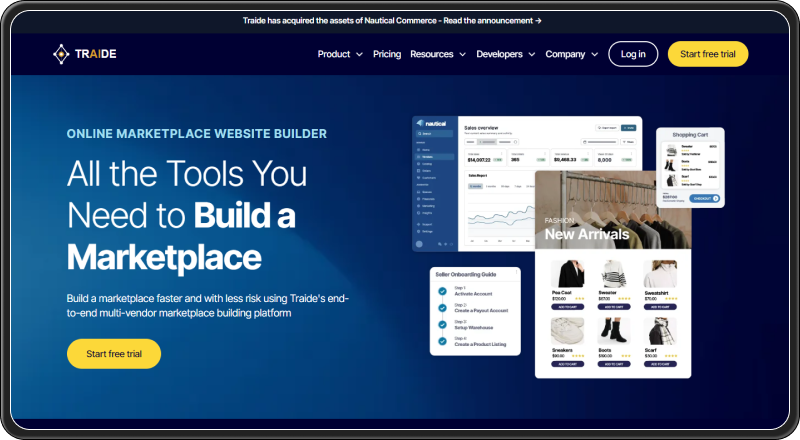
Nautical Commerce is a modern, headless white-label marketplace software designed for flexibility and composable commerce strategies. It allows businesses to build highly customized frontends using API-driven architecture.
The platform supports advanced integrations, scalable infrastructure, and custom workflows. It is ideal for brands wanting full control over user experience. However, native mobile apps are not included and must be developed separately using their API framework.
Pros:
- Headless architecture flexibility
- Developer-friendly APIs
- Scalable cloud infrastructure
Cons:
- Requires technical expertise
- Higher development investment
- Not beginner-friendly
Best For: Tech-savvy companies seeking headless marketplace architecture and advanced customization.
Top White-Label Marketplace App Software in a Glance
Choosing the right white-label marketplace app software often comes down to five critical factors: hosting flexibility, pricing model, scalability potential, and customizable source code control. The table below provides a clear side-by-side comparison to help you quickly evaluate which solution aligns with your business strategy.
| Software | Hosting Type | Pricing Structure | Scalability | Customizable Source Code Ownership |
| Yo!Kart | Self-hosted | One-time license | High, growth-ready | Yes |
| Sharetribe | Cloud-based (SaaS) | Monthly subscription | Moderate to High | No |
| CS-Cart Multi-Vendor | Self-hosted | One-time license + paid add-ons | Moderate | Yes |
| Arcadier | Cloud-based (SaaS) | Subscription-based | Moderate | No |
| Magento + Extensions | Self-hosted | License + development cost | High | Yes |
| Shopify + Apps | Cloud-based (SaaS) | Monthly subscription + app fees | Moderate | No |
| Marketplacer | Cloud-based (Enterprise SaaS) | Custom enterprise pricing | High | No |
| Mirakl | Cloud-based (Enterprise SaaS) | Enterprise subscription | High | No |
| Kreezalid | Cloud-based (SaaS) | Subscription-based | Moderate | No |
| Nautical Commerce | Cloud-based (Headless SaaS) | Custom pricing | High | No |
Take the First Step Toward Launching Your Marketplace
What Makes Yo!Kart a Leading Marketplace App Software?
In a crowded marketplace app software landscape, Yo!Kart differentiates itself by delivering purpose-built technology tailored specifically for multi-vendor commerce. It is not a modified eCommerce tool but engineered to power structured digital marketplaces from day one.
This specialized foundation provides businesses with a competitive advantage, enabling faster launches, smoother operations, and scalable expansion strategies that align with long-term digital transformation goals.
Key Highlights:
- Purpose-built for multi-vendor marketplaces
- Flexible architecture adaptable to various industries
- Optimized performance for high traffic and large product catalogs
- Smooth integration with payment gateways, shipping providers, and analytics tools
- Strong security standards and data protection mechanisms
- Strategic consultation and technical guidance for faster deployment
Real Marketplace Success Stories Powered by Yo!Kart
The true measure of any marketplace software lies in the success of businesses built on it. Yo!Kart has powered numerous marketplaces across industries and regions, proving its adaptability and performance in real-world scenarios. Let’s have a look at some of them:
1. UNI Diamonds: B2B Diamond Trading Marketplace
UNI Diamonds launched a specialized B2B diamond trading marketplace using Yo!Kart, supported by a dedicated mobile app to enhance accessibility for global traders. The platform required advanced search filters, secure transaction processes, and high-level data protection due to the sensitive nature of the industry. With Yo!Kart’s customizable framework, UNI Diamonds, successfully built a streamlined marketplace that connects diamond suppliers and buyers globally.
2. Tajer: Qatar-Based eCommerce Marketplace
Tajer is a fast-growing eCommerce marketplace in Qatar powered by Yo!Kart. It is launched with a user-friendly mobile app that supports modern shopping behavior. Powered by Yo!Kart, Tajer provides a multi-vendor environment where local businesses can showcase and sell products efficiently. The platform leverages Yo!Kart’s scalable architecture, vendor management tools, and payment integrations to support seamless transactions and user-friendly experiences.
3. A1vendor: Multi-Vendor Online Marketplace
A1vendor utilized Yo!Kart to create a versatile multi-vendor ecommerce marketplace along with a mobile app. With features such as commission management, seller dashboards, and integrated shipping modules, A1vendor streamlined vendor onboarding and order management. The result is a scalable platform capable of handling diverse product categories while maintaining operational efficiency.
4. 4GoodVibes: Handmade and Custom Products Marketplace
4GoodVibes focuses on handmade and customized products, connecting artisans with buyers seeking unique items through a feature-rich mobile app. Using Yo!Kart’s flexible customization capabilities, the marketplace was designed to highlight product personalization features while ensuring smooth checkout and vendor coordination.
These real-world implementations demonstrate how Yo!Kart adapts to different industries, from luxury B2B sectors to local eCommerce and creative product marketplaces. The software’s flexibility, performance, and ownership model make it a reliable foundation for businesses aiming to build sustainable and scalable online marketplaces.
Explore Successful Marketplaces Built With Yo!Kart
Conclusion
The marketplace economy is no longer an emerging trend. It has become the core of modern digital commerce. As competition intensifies and consumer expectations shift toward mobile-first, on-demand experiences, businesses must adopt solutions that combine speed, scalability, and operational efficiency. This is precisely why white-label marketplace app software has become a strategic investment in 2026.
However, for selecting the right software, you must assess the total cost of ownership, level of customization, scalability to suport future-growth, integration capabilities, and much more. Aligning these factors with long-term strategic goals ensures that the selected solution supports both immediate launch needs and sustained expansion.
A well-chosen white-label marketplace app software not only accelerates launch timelines but also provides a robust technological foundation for expansion, innovation, and sustained competitive advantage. In an evolving digital economy where agility defines success, investing in the right marketplace technology positions businesses for measurable growth and long-term resilience.
FAQs
Q 1. How long does it take to launch a white-label marketplace app?
Ans. The launch timeline of a white-lable marketplace app depends on the software and level of customization required. In most cases, a basic white-label marketplace can be deployed within 2 to 6 weeks.
However, if extensive customization, third-party integrations, custom feature development, or native mobile app modifications are required, the timeline may extend to a few months.
Q 2. Is white-label marketplace software suitable for startups?
Ans. Yes, white-label marketplace software is particularly suitable for startups. It allows new businesses to validate their marketplace idea without heavy investment. Many software offer scalable pricing plans, enabling startups to begin with essential features and upgrade as they grow.
Additionally, white-label solutions reduce technical complexity, allowing founders to focus on vendor acquisition, marketing strategies, customer experience, and revenue generation rather than backend development challenges.
Q 3. Can I scale my white-label marketplace later?
Ans. Yes, you can scale your white-label marketplace later. Most modern white-label marketplace app solutions are built with scalability in mind. They support increasing traffic, expanding vendor networks, multi-country operations, and additional product categories as your business grows.
However, scalability depends on factors such as hosting infrastructure, code flexibility, API integrations, and system architecture. Enterprise-ready solutions and self-hosted platforms often provide greater control for scaling, while SaaS platforms offer structured growth plans. Thus, choose a platform with strong performance optimization and integration capabilities to ensure smooth expansion over time.
Q 4. Which is the best White-Label Marketplace App Software in 2026?
Ans. There is no universal best solution, as the ideal software depends on your specific business requirements. However, for entrepreneurs who prioritize is full ownership, deep customization, and long-term cost efficiency, software like Yo!Kart is ideal. Its extensive built-in features and customization capabilities make it well-suited for launching and expanding a future-ready marketplace.
Looking for a Reliable White-Label Marketplace App Software?
Contact UsPopular Posts