

The UAE has emerged as one of the fastest-growing digital commerce hubs in the Middle East, anticipated to reach an impressive $21.01 billion by 2031 at a CAGR of 11.29% from 2026 to 2031—as reported by Mordor Intelligence. The country’s high internet penetration, tech-savvy population, and business-friendly regulations have created fertile ground for online marketplaces. The UAE is witnessing a boom in multi-vendor eCommerce marketplaces that bring sellers and buyers together under one digital roof.
A multi-vendor marketplace platform allows multiple independent vendors to sell products or services on a single platform, giving businesses the opportunity to expand their reach without the overhead of managing individual stores. Giants like Amazon, Noon, and Talabat have demonstrated the potential of this model, showing that marketplaces are not just a trend but the future of ecommerce in the region.
However, launching a successful multi-vendor marketplace requires more than just an idea. The right marketplace platform solution can make or break the business. Startups and enterprises need solutions that are scalable, customizable, cost-effective, and technologically robust to handle high traffic, multiple vendors, and diverse business models.
Hence, this blog uncovers the top multi-vendor marketplace platform solutions in the UAE, providing strategic insights on the best solution.
Table of Contents
- What is a Multi-Vendor Marketplace Platform?
- How Does a Multi-Vendor Marketplace Work?
- Monetization Strategies of a Multi-Vendor Marketplace Platform
- Choosing the Right Marketplace Platform Solution—Features and Benefits Explained
- List of Top Multi-Vendor Marketplace Platform Solutions in the UAE
- Comparison Table: Top Multi-Vendor Marketplace Platforms
- Conclusion
- FAQs
What is a Multi-Vendor Marketplace Platform?
A multi-vendor marketplace platform is a digital ecosystem that enables multiple sellers to register, list, manage, and sell products or services through a single online marketplace.
Unlike a traditional ecommerce store, where a single business handles all sales, a multi-vendor platform acts as a facilitator, connecting sellers with buyers while handling critical operational functions such as payments, shipping, and customer support. This model thus integrates a more comprehensive product range by consolidating a vast inventory from multiple sellers, expanding market reach, and customer appeal. While the marketplace admin manages the technology, branding, and platform policies, sellers maintain autonomy over their product offerings, inventory, pricing, and fulfillment operations.
This structure makes multi-vendor marketplaces highly scalable, as the platform grows not just through marketing to customers, but also by onboarding more vendors.
How Does a Multi-Vendor Marketplace Work?
The multi-vendor eCommerce marketplace business model revolves around three primary stakeholders:
1. Marketplace Owner (Admin): Oversees the platform, sets rules, manages vendors, and earns revenue.
2. Vendors: List products or services, manage inventory, and fulfill orders.
3. Customers: Browse offerings, place orders, and provide feedback.
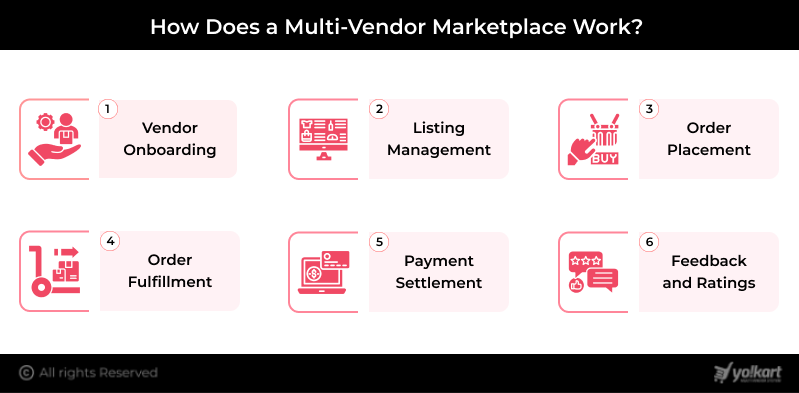
Step-by-Step Workflow
- Vendor Onboarding: Vendors create accounts and submit business details for approval.
- Listing Management: Vendors list products, define prices, inventory, and descriptions.
- Order Placement: Buyers browse the marketplace, add items to the cart, and make payments.
- Order Fulfillment: Orders are routed to the respective vendors for delivery or service execution.
- Payment Settlement: Payments are collected by the platform, which are sent to the seller’s wallet upon commission deduction.
- Feedback and Ratings: Buyers leave reviews and ratings to maintain platform quality.
Monetization Strategies of a Multi-Vendor Marketplace Platform
Structuring your monetization strategy to align with core business goals is crucial for long-term sustainability and growth. Choosing a model that matches customer buying behavior and value delivery ensures both user adoption and profitability. Most common revenue models include:
- Commissions: The platform charges a percentage for each successful transaction made through the platform as commissions.
- Subscription Plans: Implement a tiered membership model that grants exclusive, recurring access to premium tools or benefits to sellers or customers.
- Featured Listings: Enable sponsored listings, providing sellers with added visibility.
- Advertising: Drive additional income by enabling third-party businesses to display ads on your platform.
- Value-Added Services: Boost revenue through value-added services like prioritized delivery services, analytics, enhanced add-ons, and more—increasing overall cart value
This model is flexible and can adapt to B2C, B2B, or service-based eCommerce marketplaces.
Choosing the Right Marketplace Platform Solution—Features and Benefits Explained
Selecting the right multi-vendor marketplace platform solution is a critical decision that can determine the long-term success of your business. Hence, businesses must thoroughly weigh the features and business benefits the marketplace platform solutions offer before making a commitment.
Beyond just offering sophisticated features and tools, a premier solution must convert its technical capabilities into measurable ROI—driving faster growth, improved operational efficiency, and higher stakeholder satisfaction.
Must-Have Features of a Multi-Vendor Marketplace Platform Solution
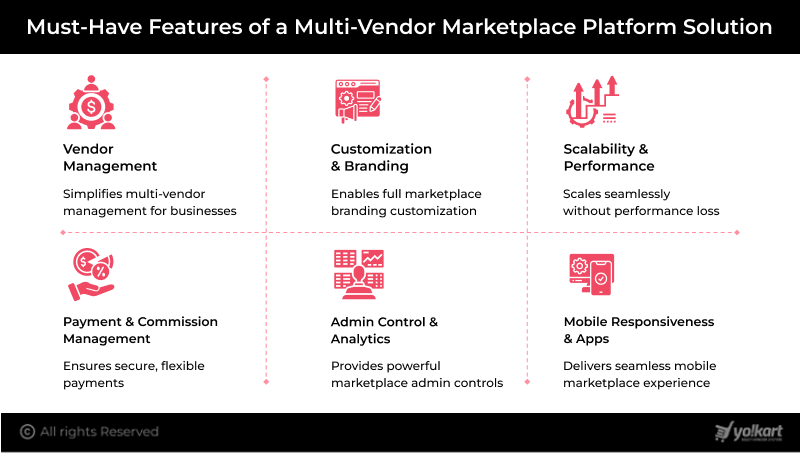
1. Vendor Management: An effective multi-vendor marketplace platform solution streamlines vendor management, allowing businesses to effortlessly oversee numerous sellers.
- Individual Vendor Dashboards: Each vendor should have a dedicated interface to manage their listings, inventory, and orders. This simplifies operations and reduces administrative burden.
- Commission Structures and Automated Settlements: The solution should allow the admin to define flexible commission rates and automatically settle payments with vendors, reducing manual accounting errors.
- Vendor Approval and Verification: A quality control mechanism ensures that only verified, trustworthy vendors can sell their products or services on the platform, maintaining marketplace credibility.
2. Customization & Branding: Every marketplace has unique branding requirements to create differentiation. A flexible multi-vendor marketplace platform solution should allow businesses to fully customize their user experience.
- Customizable User Interface and Workflow: From homepage design to checkout flow, the platform should support branding and UX tailored to your business needs and branding goals.
- Support for Niche Business Models: Some marketplaces focus on fashion, furniture, electronics, medicines, or B2B trade. Hence, the multi-vendor marketplace platform solution should accommodate these variations without major redevelopment.
- Multi-Language and Multi-Currency Capabilities: Essential for UAE businesses targeting a diverse population or planning regional expansion, providing a sense of inclusivity among users.
3. Scalability & Performance: A marketplace platform solution must handle growth without compromising performance.
- High Traffic & Multiple Vendors: Solutions should manage thousands of vendors and users simultaneously.
- Modular Architecture: Enables easy scaling and integration with third-party tools.
- Regional Expansion Capabilities: Multi-region support enables businesses to grow seamlessly across the UAE and other countries.
4. Payment & Commission Management: Secure and flexible payment systems are vital for marketplaces.
- Multiple Payment Gateway Integration: The solution must support diverse payment methods preferred by customers and vendors.
- Automated Commission & Subscription Handling: Ensure it reduces administrative effort and ensures timely revenue flow.
- Secure and Fast Transactions: Make sure it enhances trust among users and vendors.
5. Admin Control & Analytics: Strong administrative tools are essential for monitoring and optimizing eCommerce marketplace operations.
- Comprehensive Reporting: Track revenue, orders, and vendor performance in real time.
- Customer Analytics: Gain insights into buyer behavior for marketing, upselling, and retention strategies.
- Inventory & Order Tracking: Helps prevent stockouts and ensures smooth fulfillment.
6. Mobile Responsiveness & Apps: With mobile commerce growing rapidly, your multi-vendor marketplace platform solution must offer excellent mobile usability.
- Mobile-Friendly Web Experience: Buyers and vendors can use the platform seamlessly on smartphones and tablets.
- Optional Android and iOS Apps: Enhance accessibility and engagement for both customers and vendors.
Launch a Multi-Vendor eCommerce Marketplace Equipped with Unparalleled
Business Benefits of Choosing a Multi-vendor Marketplace Platform Solution
Adopting a multi-vendor marketplace platform solution is a strategic decision that bypasses the development time and risks associated with custom marketplace development. The following are the key benefits of choosing a multi-vendor marketplace platform solution for business owners:
- Faster Time-to-Market: The multi-vendor marketplace platform solution enables businesses to build a marketplace quickly without building from scratch, enabling faster revenue generation.
- Lower Operational Overhead: Automated vendor management, payments, and analytics reduce administrative work and costs.
- Better Vendor and Customer Retention: Advanced features like dashboards, commission management, and mobile apps improve customer satisfaction and loyalty.
- Improved ROI Through Efficient Operations: Streamlined processes and data insights allow smarter decision-making and higher profitability.
- Long-Term Ownership and Flexibility: Solutions that offer customizable source code access and customization allow businesses to adapt and scale without dependency on third parties.
List of Top Multi-Vendor Marketplace Platform Solutions in the UAE
Here is a curated list of the top multi-vendor marketplace platform solutions, with features, benefits, and suitability for UAE businesses.
1. Yo!Kart
Yo!Kart is a purpose-built, self-hosted multi-vendor marketplace platform solution designed for startups and enterprises seeking full ownership, flexibility, and scalability. The software provides a robust framework to manage multiple vendors, products, and services seamlessly, making it ideal for B2B, B2C, service-based, and niche-specific eCommerce marketplaces.
With fully customizable workflows, multi-currency and multi-language support, and native buyer mobile apps, Yo!Kart enables businesses to create a personalized, branded eCommerce marketplace experience. Its modular architecture ensures easy integration with third-party tools, while advanced analytics and reporting empower data-driven decision-making. The software also offers customizable source code, allowing businesses to scale without vendor or platform restrictions, making it a future-ready solution for the UAE and global markets.
Key Features:
- Advanced multi-vendor management system
- Fully customizable storefront and workflows
- Multi-language & multi-currency support
- Commission and subscription models
- Native buyer mobile apps (iOS & Android)
- API-driven architecture for integrations
Benefits:
- One-time payment, no recurring commissions
- Highly scalable for the UAE and global markets
- Customizable source code at an affordable price
- Fully customizable, 100% white-label, and adaptable
- Suitable for dynamic business models
- Free instant and scheduled demo sessions
- 1 year of free technical support post-purchase
Software Ratings: 4.8/5 ⭐
Schedule a Free Personalized Demo to Explore Yo!Kart
2. Sharetribe
Sharetribe is a cloud-based, SaaS multi-vendor marketplace platform designed for startups and entrepreneurs looking to quickly launch a minimal viable product (MVP) or niche marketplace.
It provides essential tools for vendor and operations management without requiring coding knowledge. The hosted model allows for rapid deployment and low maintenance but offers limited customization and control over the platform’s Customizable source code. Sharetribe is ideal for small-scale marketplaces or service-based platforms aiming to test ideas quickly.
Key Features:
- Quick setup for MVP marketplaces
- Vendor dashboards and product/service listings
- Basic payment processing and commission handling
- Customizable templates (limited)
- Mobile-friendly interface
Benefits:
- Launch marketplaces quickly with minimal technical expertise
- Low upfront costs and reduced operational overhead
- Easy vendor onboarding and management
- Ideal for testing business concepts rapidly
Software Ratings: 4.5/5 ⭐
3. Magento (Adobe Commerce) with Multi-Vendor Extensions
Magento is an open-source ecommerce platform that can be converted into a multi-vendor marketplace using extensions. It is highly flexible and scalable, making it suitable for large, ecommerce-focused marketplaces with complex business requirements.
Magento allows full control over the customizable source code and supports integrations with multiple third-party tools, but development and maintenance costs can be high. This solution is ideal for enterprises seeking a robust, fully customizable marketplace.
Key Features:
- Full control over customizable source code and backend
- Flexible multi-vendor extensions, but necessitates high technical expertise
- Customizable storefronts and workflows
- Supports large-scale product catalogs and traffic
- Integration with third-party payment gateways and analytics
Benefits:
- Complete flexibility for marketplace customization
- Scalable architecture for large enterprise marketplaces
- Full control of branding and user experience
- Advanced analytics for data-driven decision-making
Software Ratings: 4.0/5 ⭐
4. CS-Cart Multi-Vendor
CS-Cart Multi-Vendor is a self-hosted platform designed for small to mid-scale eCommerce marketplaces. It comes with built-in multi-vendor features, including vendor dashboards, commission management, and product catalog handling.
While it offers more customization than hosted SaaS solutions, it is limited compared to fully custom-built platforms like Yo!Kart. CS-Cart is ideal for businesses seeking a ready-made, cost-effective solution without extensive development requirements.
Key Features:
- Vendor dashboards and storefronts
- Commission and payout management
- Product catalog and inventory management
- Built-in SEO and marketing tools
- Mobile-responsive design
Benefits:
- Faster deployment for small to mid-scale marketplaces
- Affordable licensing compared to fully custom solutions
- Simplifies vendor management and operations
- Built-in tools for marketing and analytics
Software Ratings: 4.6/5 ⭐
5. Dokan (WordPress)
Dokan is a WordPress plugin that enables multi-vendor marketplace functionality on existing WordPress websites. It is ideal for budget-conscious startups or small businesses already familiar with WordPress.
Dokan provides essential vendor management tools but has limitations in scalability and performance for large marketplaces. It is best suited for small product-focused marketplaces with a focus on low-cost deployment.
Key Features:
- Vendor dashboards and product management
- Commission management and payouts
- Frontend store management for vendors
- Integration with WooCommerce and WordPress themes
- Mobile-friendly interface
Benefits:
- Low-cost solution for small marketplaces
- Quick deployment with WordPress familiarity
- Simplified vendor onboarding and store management
- Flexible plugin ecosystem for additional features
Software Ratings: 4.2/5 ⭐
6. Mirakl
Mirakl is an SaaS marketplace solution for businesses. It provides advanced multi-vendor features, comprehensive analytics, and robust integrations, making it suitable for B2B and B2C marketplaces at enterprise scale.
Mirakl’s subscription-based model and hosted architecture reduce operational overhead, but the platform comes at a high cost and provides limited control over the customizable source code.
Key Features:
- Enterprise-level vendor and product management
- Advanced analytics and reporting
- Integration with ERP, CRM, and payment gateways
- Scalable infrastructure for global marketplaces
- Automated commission and subscription management
Benefits:
- Rapid deployment of enterprise marketplaces
- Scalable and robust platform for high-volume operations
- Minimal IT maintenance required
- Data-driven insights for better business decisions
Software Ratings: 4.5/5 ⭐
7. Arcadier
Arcadier is a cloud-based SaaS marketplace platform that allows businesses to quickly create multi-vendor marketplaces. It is ideal for small to medium-sized marketplaces requiring fast deployment without complex technical setups. While Arcadier offers templates and basic customization, the subscription-based model and limited control over customizable source code may restrict advanced marketplace requirements.
Key Features:
- Pre-built marketplace templates
- Vendor and product management
- Payment integration and commission handling
- Mobile-responsive design
- Multi-category support
Benefits:
- Launch marketplaces quickly without technical expertise
- Affordable subscription pricing for startups
- Streamlined vendor management and payment processing
- Ideal for validating a business idea or small-scale operations
Software Ratings: 4.3/5 ⭐
Adopt a Scalable Multi-Vendor Marketplace Solution
8. Marketplacer
Marketplacer is a SaaS platform tailored for retail brands and B2B marketplaces. It provides enterprise-grade features, including vendor onboarding, product catalog management, analytics, and scalable infrastructure. While powerful, it comes with a high cost and limited flexibility in customizable source code ownership, making it more suitable for large enterprises rather than startups.
Key Features:
- Enterprise-level vendor and product management
- Scalable architecture for high-traffic marketplaces
- Comprehensive analytics and reporting
- Payment and commission management
- Integration with enterprise tools
Benefits:
- Ideal for large-scale, high-volume marketplaces
- Enterprise-level features and robust support
- Streamlined vendor onboarding and operations
- Scalable and reliable infrastructure
Software Ratings: 4.8/5 ⭐
9. Shopify with Multi-Vendor Apps
Shopify is primarily an eCommerce SaaS platform that can be extended into a multi-vendor marketplace using third-party apps. It is best suited for product-focused marketplaces with small to medium vendor bases. Shopify offers ease of use and fast deployment, but app dependency, transaction fees, and limited customizable source code control are key constraints for growing marketplaces.
Key Features:
- Multi-vendor support through apps
- Payment gateway integration
- Mobile-responsive design and apps
- Pre-built ecommerce templates
- SEO and marketing tools
Benefits:
- Quick deployment for product marketplaces
- Familiar ecommerce ecosystem for small businesses
- Easy vendor onboarding and store management
- Integrated marketing and analytics tools
Software Ratings: 4.5/5 ⭐
10. OpenCart Multi-Vendor
OpenCart Multi-Vendor is an open-source ecommerce platform that can be configured as a multi-vendor marketplace using extensions. It is ideal for small marketplaces that require a low-cost, customizable solution. While flexible, setting up and scaling OpenCart for large marketplaces requires technical expertise and significant customization.
Key Features:
- Open-source multi-vendor marketplace capabilities
- Vendor dashboards and product management
- Payment and commission handling
- Customizable storefronts
- Mobile-responsive design
Benefits:
- Cost-effective and flexible solution
- Full control over customizable source code and customization
- Suitable for small-scale marketplaces
- Scalable with technical development
Software Ratings: 4.3/5 ⭐
Comparison Table: Top Multi-Vendor Marketplace Platforms
| Platform | Software Type | Pricing Model | Customizable Source Code | Multi-Vendor Capabilities | Technical Support |
| Yo!Kart | Self-hosted | One-time cost, lifetime access | Yes | Advanced | Dedicated 1 year free |
| Sharetribe | SaaS | Subscription | No | Moderate | Limited |
| Magento | Open-source | Development cost | Yes | Yes | Community-based |
| CS-Cart | Self-hosted | License | Partial | Good | Standard |
| Dokan | Plugin | Subscription | Partial | Basic | Community |
| Mirakl | SaaS | Enterprise | No | Advanced | Limited |
| Arcadier | SaaS | Subscription | No | Moderate | Limited |
| Marketplacer | SaaS | Enterprise | No | Advanced | Enterprise |
| Shopify | SaaS | Subscription | No | Basic | Standard |
| OpenCart | Open-source | Free/Dev | Yes | Basic | Community-based |
While the comparison highlights various options, Yo!Kart stands as a turnkey, cost-effective multi-vendor marketplace platform solution, bridging the gap between essential functionality and advanced bespoke customizations. Thus, making it an ideal, long-term solution for scaling your marketplace.
With over 10 years of industry experience and more than 5,000 projects delivered worldwide, Yo!Kart empowers businesses to build marketplaces across diverse niches, including ecommerce, B2B, services, rentals, and digital products. Its fully customizable and scalable architecture supports high traffic, multi-currency transactions, and regional payment gateways, making it UAE-ready and globally competitive.
Why Businesses Prefer Yo!Kart:
- Full control over customizable source code and data, ensuring long-term flexibility
- Adaptable for ecommerce, services, B2C, and B2B marketplaces
- Handles large vendor ecosystems and high traffic effortlessly
- One-time licensing with no recurring fees, reducing long-term costs
- Multi-currency, multi-language, and regional payment gateway support
- Launch your marketplace quickly without technical expertise
- Up to 12 months of free support and installation included
- Vendor dashboards, inventory management, and analytics tools included
Enterprise-grade Marketplaces Powered by Yo!Kart:
- UNI Diamonds – Online B2B Diamond Trading Marketplace
- Voyij – Tour and Activities Marketplace Based in Alaska
- Mining Watchdog – B2B Mining Equipment Trade eCommerce Marketplace
- Bozinga – An American Online B2B Wholesale Marketplace
- Regake – Global Digital Products Marketplace for Video Games & Related Products
Build a Multi-vendor Marketplace tailored to Your Distinct Business Requirements
Conclusion
The UAE offers immense potential for digital marketplace ventures, but achieving success requires selecting the right multi-vendor marketplace platform solution—one that is scalable, highly customizable, and provides full ownership and control.
Among the many options available, Yo!Kart emerges as the premier choice for businesses of all sizes. Its comprehensive feature set, flexible architecture, and cost-effective licensing make it ideal for startups and enterprises aiming to launch or scale their marketplace operations. With Yo!Kart, businesses gain a future-ready, scalable, and fully controllable platform that supports innovation, growth, and long-term operational efficiency in the competitive UAE marketplace.
FAQs
Q 1. How do I choose the best multi-vendor marketplace platform solution for my business?
Ans. When selecting the best multi-vendor marketplace platform solution, you should consider factors such as scalability, customizability, and cost-efficiency. Start by evaluating whether the solution allows you to manage vendors easily, supports multi-currency and multi-language capabilities, and integrates with the payment gateways commonly used in your target region. Additionally, ensure that the solution can grow with your business and supports your specific business model, whether it’s B2C, B2B, or service-based. Solutions like Yo!Kart offer a good balance of flexibility, control, features, and scalability.
Q 2. What are the key challenges in running a multi-vendor marketplace in the UAE?
Ans. Running a multi-vendor marketplace in the UAE comes with unique challenges, including cultural diversity, regional regulations, and payment processing. You must cater to a varied consumer base with different language and currency preferences, making a multi-language and multi-currency platform essential. Additionally, understanding local eCommerce laws, including VAT requirements, and providing reliable payment gateway solutions that work in the region are crucial for success. Platforms like Yo!Kart are equipped with features that simplify regional expansion.
Q 3. What are the advantages of using a self-hosted multi-vendor marketplace platform solution?
Ans. A self-hosted solution like Yo!Kart provides you with complete control over your marketplace, including data ownership, customization, and flexibility. You can tailor the platform to your business needs and integrate it with third-party tools to align the platform with your business needs and long-term growth goals. Self-hosted solutions are particularly advantageous for businesses aiming for long-term scalability and those who want to avoid subscription fees or limitations imposed by hosted solutions.
Q 4. Can I scale my multi-vendor marketplace across multiple countries with a single platform?
Ans. Yes, most modern multi-vendor platform solutions, especially self-hosted solutions like Yo!Kart, are designed to scale across multiple regions. They support multi-language and multi-currency features, allowing you to cater to a global audience. You can also integrate regional payment gateways, manage local vendors, and adjust pricing to suit different markets. This makes it easy to expand your business to other countries and manage a diverse seller base and buyer preferences from a single platform.
Q 5. What type of marketplace business models can I implement using multi-vendor marketplace platform solutions?
Ans. Multi-vendor marketplace solutions are versatile and can support various business models, including:
- B2C (Business to Consumer): Retailers or service providers sell directly to consumers.
- B2B (Business to Business): Businesses sell goods or services to other businesses, such as in wholesale marketplaces.
- Service-based Marketplaces: Vendors offer dynamic services to customers.
- Niche Marketplaces: Platforms focused on specific products or industries like fashion, electronics, or even handmade goods.
Yo!Kart, for instance, offers a customizable solution that can easily support any of these models, making it suitable for a wide range of industries.
Leverage an Ultimate Multi-vendor Marketplace Solution
Consult ExpertsPopular Posts