
In recent years, digital marketplaces have grown at a remarkable pace, reshaping how products and services are bought and sold. The multi-vendor marketplace model, in particular, has gained significant attention due to its ability to scale quickly, provide a broad product selection, and optimize revenue opportunities for both vendors and platform owners. By bringing multiple independent vendors together on a single platform it delivers convenience, variety, and competitive pricing for customers in one place.
As businesses increasingly shift towards online commerce, building a multi-vendor marketplace platform has become an appealing solution for entrepreneurs, enterprises, and startups alike. The demand for solutions that can support multiple vendors, manage diverse products and services, and support long-term growth has resulted in the emergence of several multi-vendor marketplace platform solutions.
This blog dives into the top multi-vendor marketplace software solutions in the Australia, highlighting their features, benefits, and what makes them suitable for building scalable and profitable online marketplaces.
Table of Contents
What is a Multi-Vendor Marketplace Platform?
A multi-vendor marketplace platform is an eCommerce solution that enables multiple independent sellers or vendors to sell their products or services under one central platform. Generally, it offers features like product listings, order management, payment processing, and customer support.
Unlike traditional eCommerce websites, where a single company sells all products, a multi-vendor marketplace operates as an intermediary between the vendor and the consumer, providing a platform for various sellers to market and sell their goods. The marketplace owner (admin) typically takes a commission on each transaction, while vendors maintain control over their inventory, pricing, and fulfillment processes.
These platforms differ in terms of functionality, scalability, and ease of use, and they offer flexibility for businesses aiming to host a wide variety of vendors, from small startups to large enterprises.
How Does a Multi-Vendor Marketplace Work?
The business model of a multi-vendor marketplace revolves around three main stakeholders:
- The Marketplace Owner (Admin): The platform owner is responsible for managing the platform’s infrastructure, policies, branding, and user experience. They onboard vendors, oversee transactions, handle disputes when necessary, and earn revenue through commissions, subscriptions, or service fees.
- Vendors: Sellers on the platform can list their products or services, set their prices, and manage their inventory. Additionally, they manage inventory, shipping, and customer interactions related to their offerings.
- Customers: Shoppers browse through the marketplace, place orders, and interact with the marketplace’s support team if needed. Customers can choose from a variety of vendors and enjoy the convenience of shopping in one place.
Suggested Read: Top 30 Multi-Vendor eCommerce Marketplaces to Watch in 2026
The workflow of a typical multi-vendor marketplace includes the following steps:
- Vendor Registration: Vendors create accounts and submit product details.
- Product Listings: Vendors list products, set prices, and manage stock levels.
- Order Placement: Customers browse the platform, select products, and make purchases.
- Order Fulfillment: The vendor handles shipping or delivery of the product.
- Payment Settlement: The platform collects payments and transfers the revenue to the vendor after deducting a commission.
- Feedback and Ratings: After receiving the product, customers leave reviews and ratings, which help maintain the quality of the platform.
This model creates a centralized ecosystem where multiple sellers can reach a broader audience while customers benefit from variety, competitive pricing, and convenience.
Top Multi-Vendor Marketplace Platforms
Choosing the right multi-vendor marketplace platform solution can significantly influence the trajectory of your eCommerce venture. The ideal solution should align with your business model, technical capabilities, growth plans, and budget while offering the flexibility to adapt as your marketplace evolves.
Below is a curated list of the top platforms that offer great flexibility, scalability, and advanced features to help you launch and manage a multi-vendor marketplace:
1. Yo!Kart
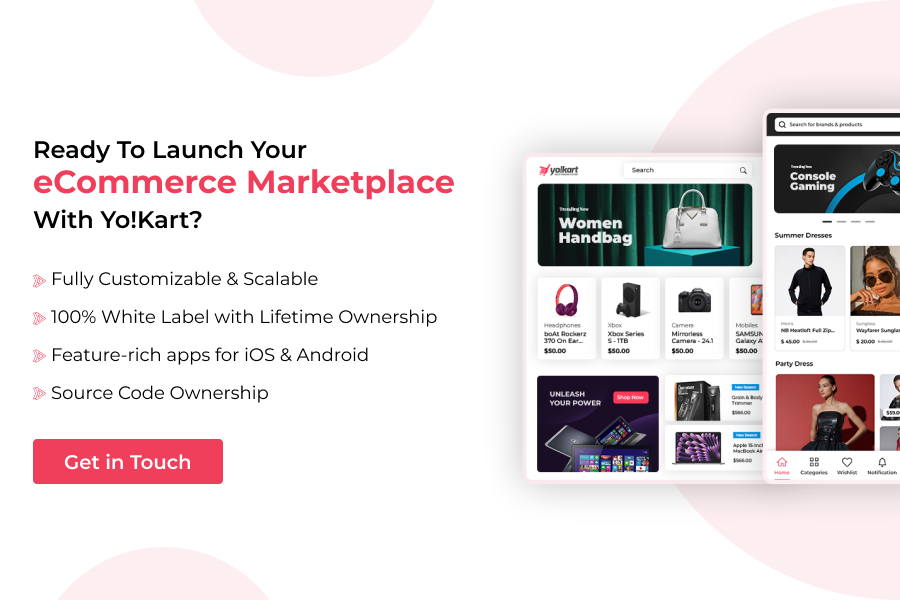
Yo!Kart is a highly customizable and scalable multi-vendor marketplace platform, built specifically for entrepreneurs, startups, and enterprises looking to build a feature-rich marketplace. Its user-friendly interface combined with powerful back-end capabilities make it easy for marketplace owners to manage multiple vendors, products, and customers in a seamless manner. Yo!Kart offers robust vendor management tools, customizable storefronts, and a comprehensive set of analytics to track the growth and performance of the marketplace.
Key Features:
- Seamless Vendor Management: Allows easy onboarding and management of multiple vendors.
- Advanced Reporting Tools: Provides detailed analytics and business insights, helping you make data-driven decisions.
- Mobile Apps for iOS and Android: Ensures an excellent user experience on mobile, crucial in today’s mobile-first world.
- Customizable Themes and Design: Tailor the look and feel of the marketplace to suit your brand.
- Flexible Commission Structure: Provides customizable commission models to suit your business needs.
- SEO Optimized: Built-in SEO tools help your marketplace rank better on search engines, improving visibility and driving traffic.
Limitations:
- Self-hosted deployment may need dedicated server management. However, it provides full control over server management, allowing businesses to customize performance, security, and infrastructure according to their specific needs.
Schedule a Personalized Demo to See Yo!Kart in Action
2. Sharetribe
Sharetribe is a cloud-based, SaaS marketplace platform that allows businesses to easily create a multi-vendor marketplace without needing coding expertise. It is designed to be simple to set up, offering essential features such as vendor management, payment processing, and product listings.
Sharetribe is known for its fast deployment, ideal for businesses looking to test their marketplace ideas quickly and with low upfront costs.
Key Features:
- Quick Setup: Get your marketplace up and running in no time without the need for coding skills.
- Integrated Payment Processing: Secure and easy-to-use payment system to handle transactions on the platform.
- Vendor Management Tools: Allows vendors to easily manage their products, orders, and sales.
- Mobile-Responsive: The platform is optimized for mobile devices, ensuring a smooth experience for users on any device.
Limitations:
- Limited deep customization compared to open-source platforms.
- Transaction fees can increase operational costs over time.
- Advanced features may require migrating to higher plans.
3. Magento (Adobe Commerce)
Magento, now Adobe Commerce, is an open-source eCommerce platform that offers a robust foundation for building large-scale multi-vendor marketplaces. It provides complete flexibility and control over customization, which makes it ideal for businesses with unique or complex requirements.
Known for its scalability, Magento allows businesses to handle vast product catalogs and high-traffic volumes.
Key Features:
- Customizable: Magento offers full control over every aspect of your platform, from the design to the functionality.
- SEO Tools: Magento’s built-in SEO capabilities help improve the visibility of your marketplace in search engines.
- Supports Multiple Payment Gateways: A wide range of integrations for secure payment processing.
- Enterprise-Level Features: Advanced tools for inventory management, customer segmentation, and reporting.
- Third-Party Integrations: Can be integrated with ERP, CRM, and other business tools.
Limitations:
- High development and maintenance costs.
- Requires experienced technical teams.
- Longer deployment timeline compared to SaaS platforms.
4. CS-Cart Multi-Vendor
CS-Cart Multi-Vendor is a self-hosted solution designed for small and medium-sized businesses that need an affordable but functional multi-vendor marketplace. It offers an easy-to-use interface and includes key features like vendor dashboards, commission management, and product catalog handling.
CS-Cart is known for its balance between customization options and ease of use, making it ideal for those who don’t have extensive technical expertise.
Key Features:
- Vendor Dashboards: A comprehensive backend for vendors to manage their stores, products, and orders.
- Commission Management: Allows admins to set and manage commission structures for vendors.
- Built-in Marketing Tools: Offers tools to help marketplace owners and vendors drive traffic and sales.
- Mobile-Responsive Design: Ensures your marketplace works seamlessly across all devices.
- Simple Setup: Easy to install and configure, perfect for businesses looking for an out-of-the-box solution.
Limitations:
- Limited scalability for very large marketplaces.
- Additional costs for premium add-ons.
- Smaller developer ecosystem compared to major platforms.
5. Dokan (WordPress)
Dokan is a popular WordPress plugin that allows you to convert your WordPress website into a fully functional multi-vendor marketplace. It integrates seamlessly with WooCommerce, enabling you to add features like vendor management, product listings, and commission structures with minimal development effort. It is an affordable solution for small businesses and startups looking to leverage the power of WordPress to run a marketplace.
Key Features:
- Vendor Frontend Management: Vendors can manage their products, orders, and sales directly from the frontend.
- Integration with WooCommerce: Fully integrates with WooCommerce, one of the most popular eCommerce platforms on WordPress.
- Commission Management: Easy configuration for commission structures, allowing the marketplace owner to set fees for each vendor.
- Mobile-Responsive: The platform is optimized for mobile devices, providing a seamless shopping experience for users.
- Affordable Solution: Compared to other marketplace platforms, Dokan is a budget-friendly option for small businesses.
Limitations:
- Performance depends on hosting quality.
- Limited scalability for high-traffic marketplaces.
- Requires multiple plugins for advanced features.
6. Mirakl
Mirakl is an enterprise-grade SaaS multi-vendor marketplace platform designed to handle high-volume, complex marketplaces. It is widely used by large businesses, both in B2B and B2C markets. Additionally, Mirakl offers a robust set of features and powerful integrations that enable businesses to manage their marketplace operations at scale, from vendor onboarding to payment management.
Key Features:
- Enterprise-Level Tools: Built with advanced tools for managing large vendor networks and high-volume transactions.
- Comprehensive Reporting and Analytics: Provides real-time data on sales, vendors, and products to drive better decision-making.
- Integrations with ERP/CRM Systems: Seamlessly integrates with your existing business tools, making it easy to streamline operations.
- Scalable Infrastructure: Designed to handle the needs of large businesses with global operations.
- Vendor Onboarding and Management: Simplifies the process of onboarding new vendors and managing their product listings.
Limitations:
- Enterprise pricing may be prohibitive for startups.
- Implementation requires significant planning.
- Less suitable for small or niche marketplaces.
7. Arcadier
Arcadier is a cloud-based SaaS marketplace platform that offers a ready-to-deploy solution for small to medium-sized businesses. It features pre-built templates that make it easy for users to create a marketplace with minimal effort. While Arcadier provides a wide array of features, it is particularly useful for businesses looking to deploy quickly without extensive custom development.
Key Features:
- Pre-Built Templates: Start your marketplace with one of the pre-designed templates, which can be customized to suit your needs.
- Multi-Category Support: Supports various types of marketplaces such as products, services, and rentals.
- Quick Deployment: The platform is designed to be set up and deployed quickly, reducing time to market.
- Mobile-Responsive Design: Offers a seamless experience for both buyers and sellers on any device.
- Customizable Design and Features: While the platform is ready-to-go, it still offers flexibility in customization.
Limitations:
- Limited flexibility for complex custom features.
- Transaction fees on certain plans.
- May require upgrades for scaling.
8. Marketplacer
Marketplacer is a SaaS platform designed for large-scale enterprises and retailers. It offers extensive functionality for managing vendors, products, and orders, as well as comprehensive reporting and analytics tools. Marketplacer is a great choice for businesses that need to handle a high volume of transactions and operate at an enterprise level.
Key Features:
- Robust Management: Designed for large-scale marketplaces with complex needs, offering powerful vendor management tools.
- Comprehensive Analytics: Provides deep insights into vendor performance, customer behavior, and sales metrics.
- Multi-Currency and Multi-Language Support: Ideal for global marketplaces, with built-in support for different currencies and languages.
- Scalable Infrastructure: Designed to grow with your business, providing the flexibility to expand as needed.
- Easy Vendor Onboarding: A streamlined process for onboarding new vendors and managing their product listings.
Limitations:
- Complex for small businesses and startups.
- Higher implementation costs.
- Requires integration with existing systems.
9. Shopify with Multi-Vendor Apps
Shopify is one of the most popular eCommerce platforms globally, and it can be enhanced with third-party apps to create a multi-vendor marketplace. While Shopify is not a multi-vendor marketplace, the addition of apps like Multi-Vendor Marketplace allows business owners to transform their Shopify store into a marketplace with minimal effort.
Key Features:
- Easy Setup: Shopify’s intuitive interface makes it easy for users to set up and manage their marketplace.
- Integrated Payment Gateways: Shopify supports a wide variety of payment options, making transactions smooth and secure.
- Marketing and SEO Tools: Built-in tools for marketing, SEO, and sales optimization.
- App Integrations: Shopify’s vast app ecosystem allows you to add additional features to enhance your marketplace.
- Mobile-Responsive Design: Optimized for use across all devices, ensuring a seamless experience for both customers and vendors.
Limitations:
- Multi-vendor functionality depends on third-party apps.
- Monthly subscription and app fees can add up.
- Limited deep customization.
10. OpenCart Multi-Vendor
OpenCart is an open-source eCommerce platform that can be customized with extensions to support multi-vendor functionality. While it’s not as robust as other platforms in terms of native features, it offers full control over customization, making it a good option for small businesses that require a low-cost, customizable solution.
Key Features:
- Open-Source Platform: Offers complete flexibility to modify the platform according to your needs.
- Multi-Vendor Support: Add multi-vendor functionality via extensions for a truly customizable marketplace.
- Payment Gateway Integration: Supports a wide variety of payment methods, making it suitable for global markets.
- SEO Tools: Built-in SEO capabilities to help your marketplace rank on search engines.
- Mobile-Responsive: Optimized for mobile use, ensuring a smooth experience for users on all devices.
Limitations:
- Requires technical expertise for setup.
- Fewer native features compared to dedicated solutions.
- Performance optimization may be needed for scaling.
These platforms collectively address a wide spectrum of marketplace needs, from quick-launch MVPs to enterprise-grade ecosystems. The optimal choice depends on your target market, technical capacity, budget, and long-term vision for growth.
Ready to Launch Your Own Multi-Vendor Marketplace?
Comparison Table: Multi-Vendor Marketplace Platform Solutions
| Platform | Software Type | Pricing Model | Source Code Ownership | Customization | Scalability | Multi-Vendor Capabilities |
| Yo!Kart | Self-hosted | One-time payment | Yes | Advanced | Very High | Excellent |
| Sharetribe | SaaS | Subscription | No | Moderate | Moderate | Basic |
| Magento | Open-source | Development cost | Yes | Moderate | High | Good |
| CS-Cart | Self-hosted | License | Partial | Good | Moderate | Good |
| Dokan | Plugin | Subscription | Partial | Basic | Low | Basic |
| Mirakl | SaaS | Enterprise pricing | No | Moderate | High | Good |
| Arcadier | SaaS | Subscription | No | Moderate | Moderate | Good |
| Marketplacer | SaaS | Enterprise pricing | No | Moderate | High | Good |
| Shopify + Apps | SaaS | Subscription | No | Limited | Moderate | Basic |
| OpenCart | Open-source | Free/Development | Yes | Moderate | Low | Basic |
Suggested Read: Best Marketplace Software Compared for 2026
Why Startups Are Choosing Yo!Kart
Yo!Kart has become a highly preferred choice for startups and growing businesses looking to build scalable, customizable, and feature-rich multi-vendor marketplaces. Designed to support both emerging ventures and established enterprises, it offers a comprehensive solution for building, managing, and expanding an online marketplace efficiently. Here are some key reasons why startups are opting for Yo!Kart:
1. Full Ownership of Source Code
One of the standout features of Yo!Kart is that it provides businesses with complete ownership of the source code. This means that startups can customize the platform to their unique requirements without being restricted by vendor constraints. This ownership also ensures long-term flexibility for upgrades and integrations.
2. Scalability
Yo!Kart is built with scalability in mind. Its modular architecture allows businesses to scale effortlessly as their marketplace grows. Whether you’re handling hundreds of vendors or thousands, Yo!Kart can support large traffic volumes, expand product listings, and add new features with ease.
3. Advanced Customizability
Yo!Kart allows businesses to fully tailor the marketplace’s design, features, and functionality. It is flexible enough to cater to different business models, whether it’s a B2B, B2C, or service-based marketplace. This customization helps businesses reflect their unique brand identity and market needs while offering a personalized experience for both vendors and customers.
4. One-Time Payment Structure
Unlike many SaaS solutions that require ongoing subscription fees, Yo!Kart operates on a one-time payment model, which significantly reduces long-term costs for startups. Moreover, there are no hidden fees or recurring charges, which allows businesses to focus their budget on required areas, such as marketing and customer acquisition.
5. Comprehensive Support
From onboarding to post-launch maintenance, Yo!Kart offers dedicated technical support throughout the journey. Startups can take advantage of free demo sessions to get familiar with the platform, as well as 24/7 support to resolve any technical issues or questions.
6. SEO-Friendly
Yo!Kart is built with SEO-friendly features, ensuring that your marketplace ranks well on search engines like Google. Additionally, it includes optimized URL structures, SEO-friendly product pages, and automatic meta-tagging, which collectively boost the visibility of your marketplace and improve its discoverability.
7. Secure Payment Integration
Yo!Kart is integrated with multiple payment gateways, providing a secure environment for both customers and vendors. It supports global payment methods, ensuring that businesses can cater to a diverse customer base, whether they’re located in the same region or abroad.
8. Vendor Management Tools
Yo!Kart offers advanced vendor management features to ensure smooth operations across the marketplace. It allows vendors to manage their inventory, view real-time order tracking, and receive automatic updates regarding their sales. Admins can also configure commission structures tailored to different categories or vendor tiers.
9. Multi-Language & Multi-Currency Support
As businesses look to expand beyond local borders, having multi-language and multi-currency support is essential for reaching a global audience. Yo!Kart comes equipped with these capabilities, ensuring that customers and vendors can operate in their preferred language and currency.
10. Mobile Applications for iOS and Android
In today’s mobile-first world, a native mobile app can significantly enhance the user experience. Yo!Kart provides native mobile apps for both iOS and Android, ensuring that customers and vendors can access the marketplace easily. Moreover, the mobile apps offer the same functionality as the web platform, making it easy for users to browse products, place orders, and manage their stores from their smartphones.
11. Analytics and Business Insights
Yo!Kart includes advanced reporting and analytics tools, providing marketplace owners with in-depth insights into vendor performance, sales trends, customer behavior, and more. By leveraging these insights, businesses can identify growth opportunities and scale their marketplace more effectively.
12. Security and Compliance
Yo!Kart takes security seriously, ensuring that both marketplace owners and users can transact safely. The platform complies with global security standards and implements SSL encryption, PCI DSS compliance, and regular security patches to protect sensitive data. These security features help foster trust among vendors and customers, making it a reliable choice for startups.
Multi-Vendor Marketplaces Powered by Yo!Kart
Several successful businesses across industries have already trusted Yo!Kart to build and scale their multi-vendor marketplaces, leveraging its flexibility, scalability, and rich feature set. Here are a few notable examples:
1. UNI Diamonds: A specialized B2B online marketplace for diamond trading, UNI Diamonds leveraged Yo!Kart to connect buyers and sellers in the diamond industry. It enables professionals in the diamond industry to search, compare, bid, and trade efficiently in one centralized environment.
2. Tajer: A multi-category online marketplace based in Qatar that brings together local and global brands across fashion, beauty, electronics, and home goods. The platform focuses on delivering a high-quality shopping experience while supporting regional businesses.
3. Voyij: A travel experiences marketplace designed to connect travelers with local activity providers in Alaska. Using Yo!Kart platform included tailored features such as tiered pricing, time-slot bookings, and multiple pickup options to deliver a seamless booking experience.
4. Water Sorted: A B2B marketplace built to simplify sourcing for water management solutions in New Zealand. It serves as a centralized hub for businesses to procure products related to drinking water, wastewater, and stormwater systems efficiently.
These examples demonstrate the platform’s versatility across B2B, B2C, services, travel, and niche industry marketplaces, showing how it can be adapted to different business models and regional markets.
Planning to build your own multi-vendor marketplace?
Conclusion
The multi-vendor marketplace model is transforming the eCommerce landscape by offering businesses a flexible and scalable way to reach wider audiences, diversify product offerings, and increase revenue streams. By choosing the right multi-vendor marketplace platform, businesses can streamline operations, enhance customer experiences, and build successful online marketplaces that grow sustainably over time.
Among the many options available, Yo!Kart stands out as the best multi-vendor marketplace platform solution due to its scalability, customizability, and affordability. With a rich feature set, powerful tools, and robust support, Yo!Kart offers a comprehensive solution for startups and enterprises looking to make their mark in the competitive and future-ready eCommerce world.
Kickstart Your eCommerce Marketplace Journey
Get In TouchPopular Posts