Published Date 08th Jan 2026
In 2026, online marketplaces are no longer experimental business models. They have become core digital infrastructures powering global eCommerce. From vertical SaaS marketplaces and B2B procurement hubs to hyperlocal service platforms, the multi-vendor eCommerce marketplace model has matured into a proven, repeatable growth engine. However, with maturity comes added complexity.
Founders today are not just asking how to build a multi-vendor marketplace, but how to build one that scales profitably, adapts to changing market demands, and avoids long-term technical debt. The marketplace software you choose determines your cost structure, speed to market, vendor adoption, SEO visibility, and long-term competitive advantage.
This blog analyzes marketplace platforms based on architecture, ownership, scalability, flexibility, and real-world viability in 2026. The goal is simple: help you select a platform that will still make sense three to five years after launch.
Table of Contents
- What is a Marketplace Platform?
- Best Marketplace Platform by Use Case
- Marketplace Platform Software Comparison Table
- How to Choose the Right Marketplace Platform
- Top Marketplace Software in 2026
- Comparison Table
- Build vs Buy Marketplace Software: Which Approach is Best?
- Yo!Kart – Readymade Marketplace Software to Launch Your Marketplace
- Conclusion
- FAQs
What is a Marketplace Platform?
A marketplace platform is a transaction-driven system that connects multiple independent sellers or service providers with buyers through a centralized digital interface. Unlike a conventional eCommerce website, a marketplace must balance the needs of three stakeholders simultaneously: buyers, sellers, and the marketplace operator.
In 2026, a modern marketplace platform is expected to handle:
- Seller onboarding, verification, and lifecycle management
- Product or service listings with flexible pricing logic
- Commission structures, subscriptions, and mixed revenue models
- Automated order routing and payout workflows
- Role-based dashboards for admins, sellers, and buyers
- Performance, SEO, and analytics at scale
In essence, a marketplace platform is not just software. It functions as the operating system that runs and scales your entire business model.
Best Marketplace Platform by Use Case
Choosing the best marketplace platform in 2026 is less about feature checklists and more about software ownership, flexibility, and long-term business control and growth. Today’s marketplace solutions fall into clear software categories, each serving a different stage and ambition level.
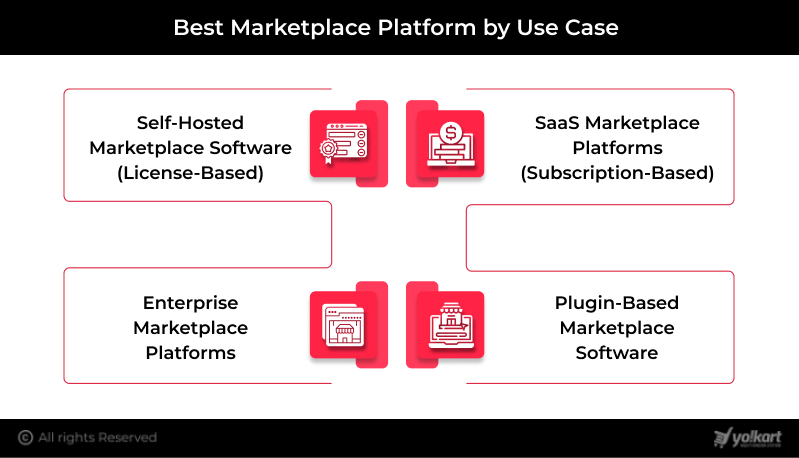
1. Self-Hosted Marketplace Software (License-Based)
Self-hosted readymade eCommerce solutions give businesses full control over the marketplace’s codebase, infrastructure, and roadmap. They are ideal for founders who view their marketplace as a core business asset rather than a rented tool.
Best suited for
- Long-term marketplace businesses
- Funded startups and SMEs
- Businesses avoiding recurring SaaS fees
Software characteristics
- One-time or annual license cost
- Full data and IP ownership
- High customization and scalability
Platform examples
- Yo!Kart
- CS-Cart Multi-Vendor
Suggested Read: Best Marketplace Software Compared for 2026
2. SaaS Marketplace Platforms (Subscription-Based)
SaaS marketplace platforms focus on speed and simplicity. They manage hosting, updates, and security, making them easy to launch, but often limit customization and long-term control.
Best suited for
- MVPs and early validation
- Non-technical founders
- Short-term experiments
Software characteristics
- Monthly or annual subscription
- Limited backend access
- Platform-controlled feature roadmap
Platform examples
- Sharetribe
- Arcadier
3. Enterprise Marketplace Platforms
Enterprise marketplace software is built for large, complex ecosystems with high transaction volumes and deep system integrations. These platforms prioritize operational stability, compliance, and scale over rapid iteration.
Best suited for
- Large enterprises
- B2B procurement marketplaces
- Retailers onboarding third-party sellers
Software characteristics
- High implementation and licensing costs
- Enterprise-grade integrations
- Long onboarding cycles
Platform examples
- Yo!Kart
- Marketplacer (Enterprise tier)
4. Plugin-Based Marketplace Software
Plugin-based marketplace solutions extend existing eCommerce platforms into multi-vendor marketplaces. While they are cost-effective initially, they often face limitations in performance, scalability, and long-term stability.
Best suited for
- Small businesses
- WordPress or Shopify users
- Testing vendor-based selling
Software characteristics
- Dependent on the base eCommerce platform
- Limited scalability
- Plugin conflicts at scale
Platform examples
- WooCommerce + Dokan
- Shopify multi-vendor apps
Looking for a Marketplace Platform Built for Long-Term Growth?
Marketplace Platform Software Comparison Table
Choosing the right marketplace platform is a strategic decision that directly impacts ownership, scalability, and long-term costs. The table below presents a clear, side-by-side comparison to help you quickly assess which approach aligns best with your business goals in 2026.
| Criteria | Self-Hosted (License-Based) | SaaS Marketplace | Enterprise Platform | Plugin-Based Marketplace |
| Ownership Level | Full ownership | Limited ownership | Partial ownership | Partial ownership |
| Customization | Very high | Low to medium | Medium to high | Low |
| Scalability | High | Medium | Very high | Low to medium |
| Cost Model | One-time license | Monthly or annual subscription | Custom enterprise pricing | Plugin fees plus hosting |
| Example Platforms | Yo!Kart, CS-Cart | Sharetribe, Arcadier | Mirakl | Dokan, Shopify marketplace apps |
How to Choose the Right Marketplace Platform
There’s no single “best” marketplace software that fits every business. The right choice depends on how well the platform aligns with your business model, growth ambitions, and technical capabilities. Given below are the factors that you must consider while selecting the marketplace platform:
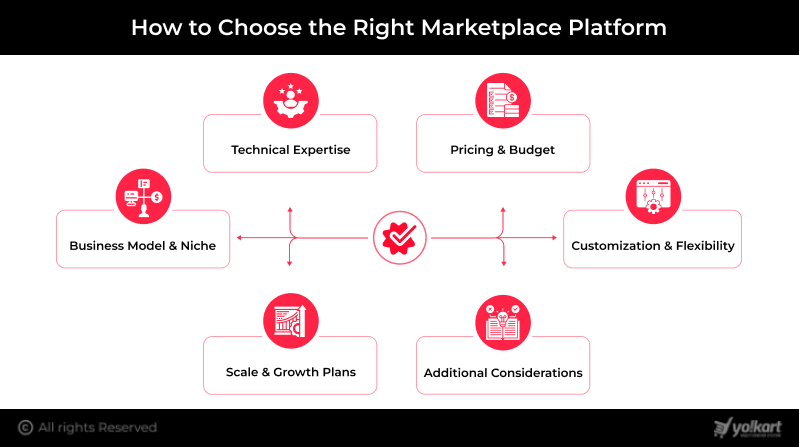
1. Business Model and Niche
Identify the type of marketplace you want to build, whether B2C, B2B, services, rentals, or digital products. Different platforms are optimized for different use cases. For example, service marketplaces need scheduling and booking capabilities, while product marketplaces prioritize catalog scalability and inventory management.
2. Technical Expertise
Assess your team’s technical capacity. No-code or low-code platforms enable rapid deployment without developers, making them ideal for MVPs. Self-hosted or open-source solutions offer full control and customizability but require technical expertise for setup, maintenance, and feature extensions.
3. Scale and Growth Plans
Think beyond the initial launch. While SaaS platforms support small marketplaces, scaling rapidly demands advanced vendor management, analytics, custom integrations, and performance optimization. Choose a platform that can support growth without major migrations or rebuilds.
4. Pricing and Budget
Compare both upfront and recurring costs. Most self-hosted platforms offer a one-time license, while SaaS models charge monthly or yearly fees. Consider the total cost of ownership (TCO) over 3-5 years, including hosting, plugins, transaction fees, customization, and maintenance.
5. Customization and Flexibility
If your marketplace requires unique workflows, branding, or user experiences, ensure the platform supports deep customization. Look for robust API support, source code access, or modular architectures that let you tailor features according to your business needs.
6. Additional Considerations
- User Experience: Ensure the platform provides intuitive dashboards for buyers, sellers, and admins.
- Analytics & Reporting: Access to detailed operational and financial data is critical for decision-making.
- Security & Compliance: Verify adherence to data privacy regulations and secure payment processing.
- Ecosystem & Support: Platforms with active communities, documentation, and ongoing updates reduce long-term risk.
Choosing the right marketplace platform is a strategic decision. By carefully evaluating these aspects, you ensure a foundation that can grow, adapt, and support your business objectives for years to come.
Top Marketplace Software in 2026
Below are the leading marketplace platform software solutions in 2026, evaluated based on architecture strength, flexibility, scalability, pricing model, and real-world adoption. These platforms are ranked by long-term strategic value, not just popularity. Let’s have a look at them:
1. Yo!Kart
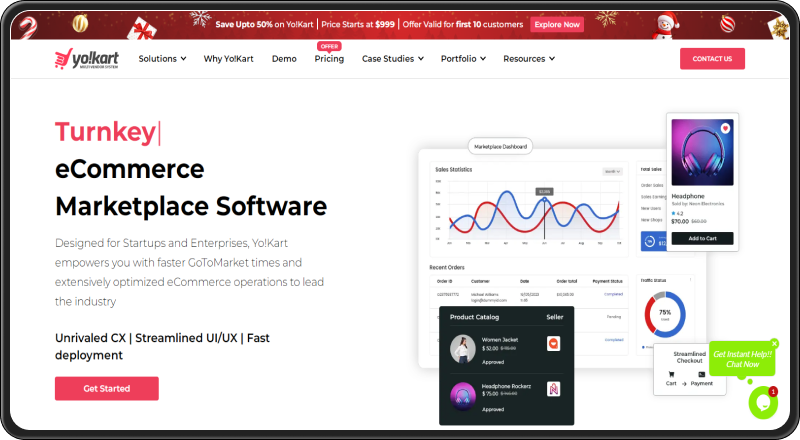
Yo!Kart is a purpose-built, self-hosted marketplace software designed for businesses that want to fully own and control their marketplace. It is built specifically for multi-vendor marketplaces, supporting product, service, digital, and hybrid business models. Unlike SaaS platforms that limit flexibility over time, Yo!Kart enables marketplaces to evolve without platform dependency.
It supports product, service, digital, rental, and hybrid marketplaces, making it suitable for both startups and enterprises. With built-in multi-vendor management, commissions, subscriptions, multilingual and multi-currency support, and SEO-ready architecture, Yo!Kart reduces time-to-market while maintaining scalability. Its one-time license model eliminates recurring platform fees, making it a cost-efficient choice for long-term marketplace growth in 2026.
Key Highlights
- License-based marketplace software with lifetime ownership
- Full source-code access for deep customization
- Built-in multi-currency, multi-language, and SEO capabilities
- Advanced vendor dashboards, commission logic, and promotions
- Native integrations with Stripe, PayPal, wallets, and COD
- Scales seamlessly from MVP to enterprise marketplaces
Ratings
- SoftwareSuggest: 4.9/5
- GoodFirms: 4.8/5
- Capterra: ~4.3/5
- G2: ~4.6/5
Pricing
One-time license model (no recurring subscription fees):
- GoQuick Lite: ~$499
- GoQuick: ~$1249
- GoCustom: ~$6,249 – $7,999
Pros
- No monthly SaaS or revenue-share fees
- Complete ownership of code and data
- Suitable for startups, SMBs, and enterprises
- Designed exclusively for marketplaces
Cons
- Requires hosting setup
Request a Personalized Demo of Yo!Kart
2. Sharetribe
Sharetribe is a SaaS-based marketplace builder focused on speed and ease of use. It allows founders to launch marketplaces quickly without coding, making it ideal for idea validation and early-stage platforms. While Sharetribe excels in simplicity and fast deployment, its customization and ownership limitations can become restrictive as marketplaces scale.
Key Highlights
- No-code marketplace creation
- Built-in payments and commission handling
- Supports service, product, rental, and peer-to-peer models
- Two options: Sharetribe Go (no-code) and Flex (API-based)
Pricing
- Starts around $39/month
- Advanced plans range up to $99+/month
Pros
- Fast to launch
- Minimal technical overhead
Cons
- Limited customization
- Higher long-term cost compared to license-based software
3. CS-Cart Multi-Vendor
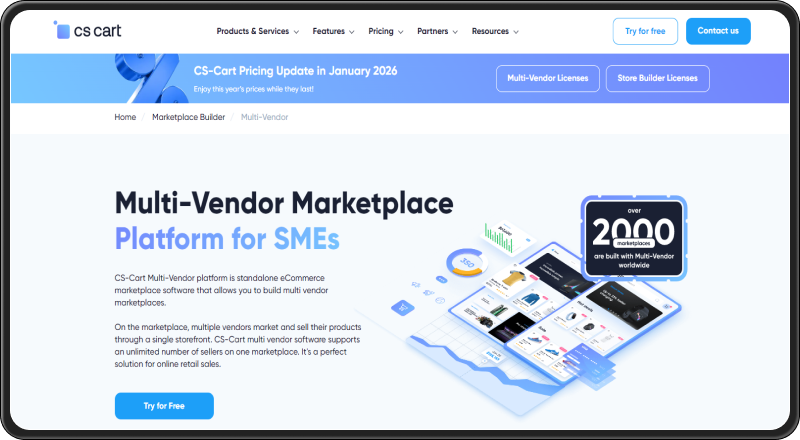
CS-Cart Multi-Vendor is a self-hosted marketplace solution popular among developer-led teams. It offers strong vendor management with extensibility through add-ons. While its core is stable and mature, many teams invest additional effort in refining user experience and extending functionality over time. CS-Cart works best for organizations comfortable managing customizations and balancing flexibility with ongoing development and maintenance planning.
Key Highlights
- Advanced vendor and product controls
- Multiple payment and shipping integrations
- Full source-code access
Pricing
- Subscription plans from ~$55/month
- One-time license starting at ~$3,299
Pros
- Feature-rich for product marketplaces
- Flexible deployment options
Cons
- UI often requires customization
- Add-ons increase total cost
4. Arcadier
Arcadier positions itself as a flexible SaaS marketplace solution that supports multiple marketplace formats out of the box. It is commonly used for different business models such as services, rentals, or B2B marketplaces. While its hosted nature simplifies early operations, growing marketplaces may encounter limitations when deeper customization or performance optimization becomes necessary. Arcadier suits businesses that value convenience and versatility during early growth stages.
Key Highlights
- Template-based setup
- API access for integrations
- Supports multiple marketplace types
Pricing
- Typically $60-$150/month
- Enterprise plans can exceed $1,500/month
Pros
- Quick deployment
- Multiple marketplace formats
Cons
- SaaS limitations at scale
- Customization is restricted on the lower tiers
5. Mirakl

Mirakl is an enterprise marketplace infrastructure platform built for large global retailers and B2B enterprises. It focuses on automation, compliance, and operational scale. Mirakl emphasizes operational robustness and automation over experimentation speed. Due to its scale and cost structure, it is typically unsuitable for startups, but remains a strong choice for enterprises launching or expanding large, mission-critical marketplaces.
Pricing
- Custom enterprise pricing (high-cost, contract-based)
Pros
- Proven enterprise scalability
- ERP and system integrations
Cons
- High implementation cost
- Not suitable for startups
6. Magento with Marketplace Extensions
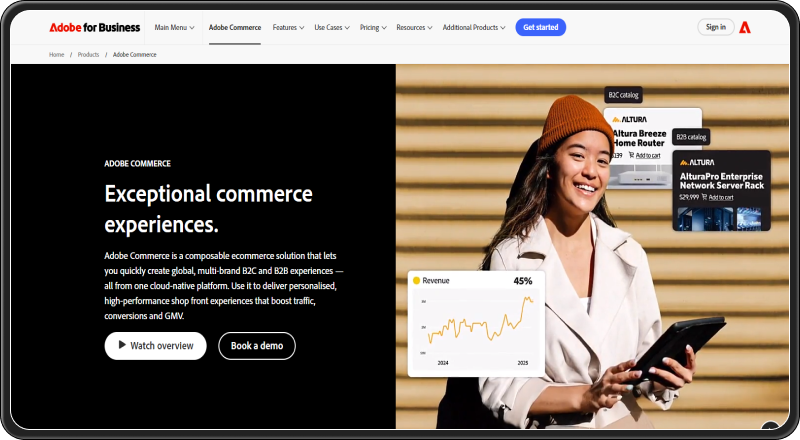
Magento, now Adobe Commerce, is a robust, enterprise-grade eCommerce platform that can be converted into a marketplace using third-party marketplace extensions. Unlike purpose-built marketplace software, Magento does not offer native multi-vendor capabilities. However, when combined with mature marketplace extensions, it can support vendor onboarding, commission management, order splitting, and seller dashboards.
Key Highlights
- Enterprise-level catalog and inventory management
- Strong B2B, wholesale, and global commerce support
- Large global ecosystem of developers and agencies
- Flexible APIs for ERP, CRM, and third-party integrations
Pricing
- Magento Open Source: Free license (hosting, development & maintenance costs apply)
- Adobe Commerce (Enterprise): Custom enterprise pricing
- Marketplace Extensions: Paid (one-time or annual licensing, depending on provider)
Important: The total cost of ownership is significantly higher than that of ready-made marketplace software.
Pros
- Extremely flexible for complex product and pricing logic
- Ideal for B2B and international marketplaces
Cons
- Marketplace functionality is not native
- High development and maintenance costs
- Longer time-to-market
- Requires experienced Magento developers
Need a Marketplace Platform Without Heavy Development Overhead?
7. Marketplacer
Marketplacer is a cloud-based marketplace platform designed for organizations managing large seller ecosystems. The platform focuses on operational control and automation rather than rapid iteration. Due to its enterprise positioning, onboarding and implementation are more structured, making Marketplacer a fit for mature businesses rather than early-stage marketplace founders.
Pricing
- Custom enterprise pricing
Pros
- Enterprise-grade architecture
- Strong analytics and automation
Cons
- Pricing not transparent
- Longer onboarding cycles
8. Dokan
Dokan converts WooCommerce stores into multi-vendor marketplaces, making it suitable for small businesses already using WordPress. It works best for small marketplaces or local businesses already invested in the WordPress ecosystem. While Dokan offers a low-cost entry point, long-term scalability and performance depend heavily on hosting quality, plugin compatibility, and ongoing maintenance discipline as the marketplace grows.
Pricing
- Free version available
- Premium plans start at ~$149/year
Pros
- Low entry cost
- Familiar WordPress environment
Cons
- Limited scalability
- Plugin dependency risks
9. Shopify with Multi-Vendor Apps

Shopify can be extended into a marketplace using third-party apps. This approach works best for simple, hosted marketplace setups. However, core marketplace logic remains dependent on external apps, which can limit flexibility as requirements become more complex. Shopify-based marketplaces are best suited for controlled experiments rather than deeply customized, long-term platforms.
Pricing
- Shopify plans: ~$39-$399/month
- Additional app fees apply
Pros
- Very easy to manage
- Reliable SaaS infrastructure
Cons
- Marketplace logic depends on apps
- Limited backend control
10. MultiMerch
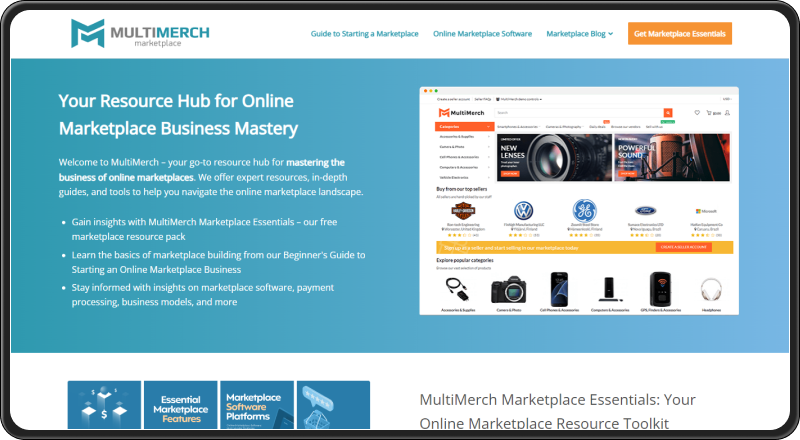
MultiMerch is a developer-centric marketplace extension for OpenCart, suited for teams building highly customized marketplace experiences. It is often chosen by technically strong teams building tailored marketplace experiences rather than standardized platforms. While flexible, it demands hands-on development and familiarity with the OpenCart ecosystem. MultiMerch is best suited for custom builds where technical control is prioritized over speed or simplicity.
Pricing
- Custom or modular pricing
Pros
- High developer flexibility
Cons
- Steep learning curve
- Smaller ecosystem
Suggested Read: Top 20 Multi-vendor eCommerce Marketplace Platforms in 2026
Comparison Table
The table below compares leading marketplace platforms in 2026 based on ownership, scalability, flexibility, cost structure, and ideal use case, the factors that most influence long-term marketplace success.
| Platform | Deployment Model | Ownership Level | Scalability | Customization Flexibility | Pricing Model | Best Suited For |
| Yo!Kart | Self-hosted | Full ownership | High | Very High (source code access) | One-time license | Businesses building long-term, scalable marketplaces |
| CS-Cart Multi-Vendor | Self-hosted | Full ownership | Medium-High | High (add-on driven) | License + paid extensions | Growing product marketplaces with dev resources |
| Sharetribe | SaaS | Limited | Medium | Low-Medium | Monthly subscription | MVPs, service & peer-to-peer marketplaces |
| Mirakl | Enterprise SaaS | Limited | High | Medium | Custom enterprise pricing | Enterprises & global retailers |
| Arcadier | SaaS | Limited | Medium | Medium | Monthly subscription | Small to mid-scale SaaS marketplaces |
| Magento + Marketplace Extensions | Self-hosted | Full ownership | High | High | Development + extension cost | Enterprises with in-house tech teams |
| Shopify + Marketplace Apps | SaaS | Limited | Medium | Low | Subscription + app fees | Simple, hosted marketplace experiments |
| Marketplacer | Enterprise SaaS | Limited | High | Medium | Custom enterprise pricing | Multi-seller ecosystems |
| WooCommerce + Dokan | Self-hosted (WordPress) | Partial | Medium | Medium | Plugin subscription | WordPress marketplaces |
| MultiMerch | Self-hosted | Full ownership | Medium-High | High | Custom / modular | Developer-led custom marketplace builds |
Build vs Buy Marketplace Software: Which Approach is Best?
One of the most critical decisions when launching a marketplace is whether to build the platform from scratch or buy ready-made marketplace software. In 2026, this decision is no longer about technical pride or custom engineering. It is about speed, capital efficiency, and execution risk. Many marketplace businesses fail not because the idea is weak, but because long development cycles and operational complexity delay traction.
1. Building a Marketplace from Scratch
Building a marketplace from scratch involves designing and developing every component internally, from vendor onboarding, catalog logic to payments, commissions, order flows, admin controls, analytics, and scalability mechanisms.
When building makes sense:
- You are an enterprise with unique, non-standard workflows
- Marketplace functionality must be deeply embedded into existing internal systems
- You have a large, experienced engineering team
- Time-to-market is not critical
Key challenges of building:
- Development cycles typically range from 6 to 18 months
- High upfront cost with uncertain ROI
- Core marketplace features must be reinvented from zero
- Scalability and security risks appear only after launch
- Business decisions become dependent on engineering bandwidth
Building offers theoretical flexibility, but in practice, most early-stage marketplaces overestimate their ability to execute quickly and underestimate long-term maintenance costs.
2. Buying Ready-Made Marketplace Software
Buying marketplace software means starting with a pre-built, production-tested foundation that already supports vendors, transactions, monetization, and administration. Purpose-built platforms offer deep customization, source-code access, and scalability without forcing founders to rebuild fundamentals.
When buying makes sense:
- You want to launch fast and validate demand
- Budget predictability matters
- Your differentiation lies in niche focus, branding, or execution
- You want to iterate based on real user behavior
Key advantages of buying:
- Launch in weeks instead of months
- Significantly lower upfront investment
- Mature workflows tested across real marketplaces
- Faster learning cycles and revenue generation
- Reduced engineering and operational risk
Build vs Buy: Practical Comparison
| Criteria | Build from Scratch | Buy Marketplace Software |
| Time to Launch | Very Slow | Fast |
| Initial Investment | Very High | Moderate |
| Technical Risk | High | Low |
| Feature Readiness | Custom but delayed | Production-tested |
| Scalability | Uncertain early | Proven architecture |
| Long-Term Cost | Hard to predict | Predictable |
| Best For | Large enterprises | Startups & growth-stage businesses |
In 2026, the most successful marketplace founders follow a “buy first, customize later” strategy. They prioritize speed, validation, and revenue, then progressively tailor the platform as the business grows. Building from scratch is no longer the default approach. It is the exception, reserved for very specific enterprise use cases.
Suggested Read: Top 10 Multi-Vendor Marketplace Software in the US (2026)
Launch Your Marketplace in a Cost-Effective and Time-Efficient Manner
Yo!Kart – Readymade Marketplace Software to Launch Your Marketplace
Yo!Kart is a ready-made white label marketplace software built for entrepreneurs and enterprises that want to launch a scalable marketplace without long-term platform dependency. Unlike generic eCommerce tools adapted for multi-vendor use, Yo!Kart is designed from the ground up for marketplace business models.
In 2026, successful marketplaces are those that balance speed to launch with ownership and flexibility. Yo!Kart addresses this by offering a production-ready foundation that eliminates the need to build core marketplace logic from scratch, while still allowing complete control over customization, integrations, and future expansion.
The platform supports a wide range of marketplace formats, including B2C, B2B, service-based, rental, and hybrid marketplaces, making it suitable for startups validating an idea as well as businesses scaling multi-region operations.
Why Yo!Kart Stands Out in 2026
- Built exclusively for marketplaces: Yo!Kart is not a modified shopping cart or plugin. Its architecture natively supports vendor onboarding, commission automation, seller dashboards, and marketplace-specific workflows.
- Full ownership, no vendor lock-in: With a one-time license model and source-code access, businesses retain complete ownership of their marketplace, eliminating recurring SaaS fees and roadmap dependency.
- Scales with business complexity: From a basic MVP to a high-volume marketplace with thousands of sellers, Yo!Kart scales without requiring platform migration or re-architecture.
- Multiple revenue models supported: Enables commissions, seller subscriptions, featured listings, and hybrid monetization without external add-ons.
- SEO-ready and performance-optimized: Built with clean URLs, indexable vendor pages, and structured data to support long-term organic growth.
- Customization-friendly: Businesses can modify workflows, UX, and integrations to match niche-specific requirements instead of adapting their model to software limitations.
Ideal For
- Founders planning a serious, long-term marketplace business
- Businesses that want to avoid SaaS cost escalation
- Marketplaces requiring customization beyond templates
- Teams that want control over data, hosting, and future development
In short, Yo!Kart aligns with how marketplaces are built in 2026: launch quickly, own the platform, and scale without compromise.
Conclusion
Choosing the best marketplace platform in 2026 is less about chasing trends and more about aligning technology with long-term business intent. As the marketplace model evolves, the real differentiator is no longer just speed to launch but the ability to adapt, monetize flexibly, and scale without rebuilding the foundation.
While SaaS marketplace tools offer convenience and faster initial validation, they often introduce constraints around customization, cost predictability, and ownership as the business grows. On the other hand, purpose-built marketplace software with ownership and extensibility enables founders to treat their platform as a long-term strategic asset rather than a rented solution.
In 2026, the strongest marketplaces are built by teams that think several years ahead. They choose software aligned with a three to five-year growth roadmap, prioritize control and scalability, and avoid early decisions that create technical or financial lock-in. Ultimately, the best marketplace platform is the one that supports your vision today and continues to perform as your marketplace gains traction and complexity tomorrow.
FAQs
Q 1. Which is the best marketplace software in 2026?
Ans. The best marketplace software depends on your business model, growth goals, and technical resources. Software like Yo!Kart is ideal for entrepreneurs looking for long-term scalability and ownership, while SaaS tools like Sharetribe or Arcadier are better for quick launches.
Q 2. What factors should I consider when selecting marketplace software?
Ans. Key factors to consider when selecting a marketplace software include:
- Ownership
- Scalability
- Customization flexibility
- Monetization options
- Integration capabilities
- Long-term usage cost
- Vendor and buyer experience.
Q 3. Is SaaS marketplace software suitable for long-term growth?
Ans. SaaS marketplace software works well for early validation and MVPs. However, as the business scales, limitations around customization, ownership, pricing control, and platform dependency can restrict long-term growth and profitability.
Q 4. Can I build a marketplace from scratch instead of using software?
Ans. Yes, you can build a marketplace from scratch instead of using software. However, it requires significant time, cost, and technical expertise. Most founders reduce risk and accelerate launch by leveraging ready-made software and customizing it as the business grows.
Q 5. What are the pricing considerations for marketplace software in 2026?
Ans. Pricing varies depending on the model. SaaS platforms involve recurring monthly fees, and license-based software requires one-time payments plus hosting and customization. Evaluating the total cost of ownership over 3-5 years is more important than initial pricing.
Q 6. Which marketplace software is best for startups?
Ans. For startups testing ideas quickly, SaaS platforms like Sharetribe or Arcadier offer a low upfront cost. In contrast, for startups planning long-term growth, platforms like Yo!Kart provides ownership and scalability, allowing them to grow beyond the MVP stage.
Q 7. Can a single marketplace platform support multiple types of marketplaces?
Ans. Yes, advanced platforms like Yo!Kart supports B2C, B2B, service-based, rental, and hybrid marketplaces. These solutions are designed for flexible workflows, configurable monetization, and scalable architecture.
Q 8. How do I ensure my marketplace scales without issues?
Ans. Choose software with proven scalability, robust vendor and buyer management, performance optimization, and support for feature extensions or integrations. Planning for growth early helps avoid costly migrations later.
Q 9. What are the most common mistakes when choosing marketplace software?
Ans. Common mistakes when choosing marketplace software include focusing only on:
- Speed
- Low cost
- SaaS convenience without evaluating long-term ownership, scalability, and customization.
It can lead to expensive migrations or business limitations later.
Launch a Marketplace That Scales Beyond MVP
Get StartedPopular Posts