

The global digital marketplace economy is expanding at an unprecedented pace. From eCommerce and B2B platforms to service-based and rental marketplaces, businesses across industries are adopting the marketplace model to scale rapidly and connect buyers and sellers more efficiently. However, building a marketplace platform from scratch can be time-consuming, expensive, and technically complex.
This is where a white-label marketplace software comes into play. In 2026, white-label solutions have matured significantly, offering enterprise-grade features, scalability, and flexibility without the heavy burden of custom development. As a result, startups, SMEs, and even established enterprises are increasingly choosing white-label marketplace software to launch faster, reduce operational risks, and stay focused on growth rather than technical challenges.
In this blog, you will explore what white-label marketplace software is, why startups prefer it, the key factors to consider before selecting a solution, and a detailed list of the Top 10 White-Label Marketplace Software in 2026.
Table of Contents
What is White-Label Marketplace Software?
White-Label marketplace software is a ready-made, fully functional marketplace solution that businesses can rebrand, customize, and deploy as their own platform. Instead of developing software from the ground up, companies license a pre-built system and tailor it to their specific business needs, branding, and target audience.
These solutions typically support multi-vendor functionality, allowing multiple sellers to list and manage their products or services while the marketplace owner manages operations, commissions, payments, and user experiences from a centralized dashboard.
White-label marketplace software is widely used for:
- eCommerce marketplaces similar to Amazon-like platforms
- B2B and wholesale marketplaces
- Service marketplaces for freelancers, professionals, and bookings
- Rental and sharing economy platforms
- Niche marketplaces across industries such as fashion, healthcare, and real estate, etc.
The biggest advantage of a white-label marketplace software is its speed-to-market. Businesses benefit from a proven, reliable architecture with ongoing technical support, enabling them to launch quickly and scale seamlessly.
Why Startups Go with White-Label Marketplace Software?
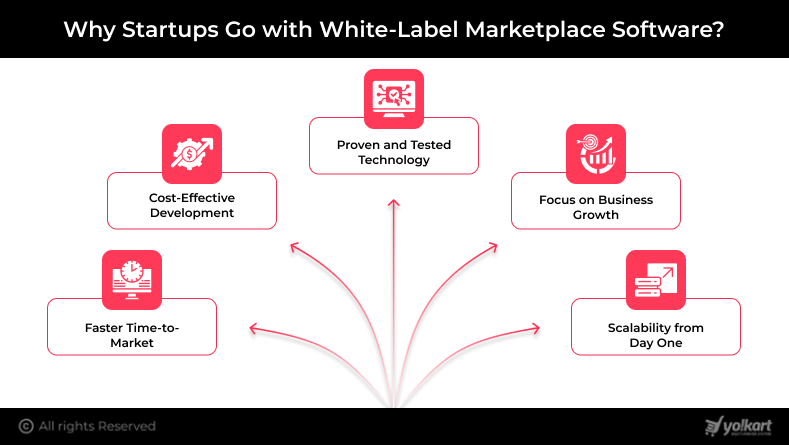
Startups often operate with limited resources, aggressive launch timelines, and uncertain market demand. Building a marketplace from scratch can slow down progress, increase cost, and introduce unnecessary risks. White-label marketplace software helps startups overcome these challenges by providing a ready-to-use, customizable platform that accelerates growth, simplifies development, and reduces complexity.
1. Faster Time-to-Market
Developing a custom marketplace from the ground up typically takes 6-12 months or even longer due to planning, development, testing, and deployment. White-label solutions drastically shorten this timeline by offering pre-built features such as user management, vendor onboarding, payments, and order processing. This allows startups to launch within weeks, validate ideas quickly, gather real user feedback, and capitalize on early market opportunities before competitors enter the market.
2. Cost-Effective Development
Custom marketplace development requires a large investment in developers, designers, QA engineers, and ongoing infrastructure maintenance. White-label marketplace software minimizes these costs by eliminating the need to build core functionalities from scratch. Hence, startups can allocate their limited budgets more strategically, focusing on marketing, customer acquisition, partnerships, and business expansion instead of expensive technical development.
3. Proven and Tested Technology
White-label solutions are typically used across multiple industries and real-world use cases. This means common bugs, performance issues, and security vulnerabilities have already been identified and resolved. Startups benefit from a stable, secure, and reliable system, reducing the risk of technical failures that can damage user trust or disrupt operations.
Validate Your Marketplace Idea Without Heavy Development Overhead
4. Focus on Business Growth
Managing backend infrastructure, server performance, security updates, and system integrations can drain a startup’s time and resources. White-label marketplace software handles these technical complexities, allowing founders and teams to focus on marketing strategies, vendor onboarding, customer engagement, and improving the overall user experience.
5. Scalability from Day One
As startups grow, their marketplace must handle more users, vendors, transactions, and data without performance issues. Modern white-label marketplace software is built with scalability in mind, enabling startups to expand seamlessly without re-engineering the entire system. Whether launching an MVP or scaling to an enterprise-level platform, startups can grow confidently knowing their technology can support future demands.
Suggested Read: Which is the Best Marketplace Platform in 2026?
Things to Consider Before Selecting White-Label Marketplace Software
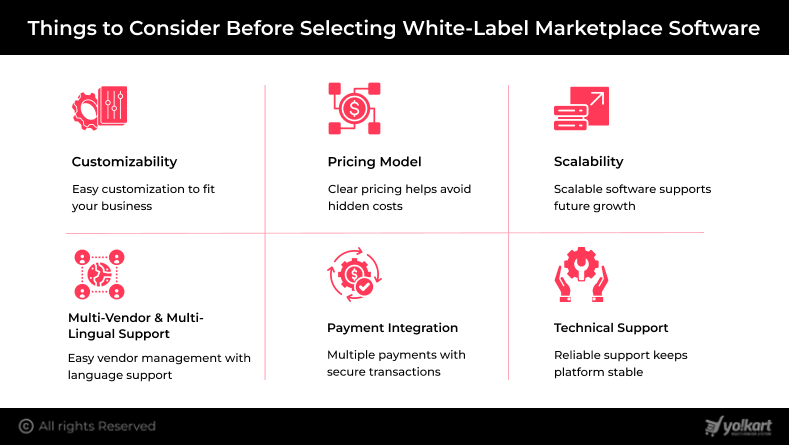
Selecting the right white-label marketplace software is a crucial decision that directly impacts your platform’s performance, scalability, and long-term success. Since this software serves as the foundation of your marketplace, evaluating the right factors beforehand can help you avoid costly limitations and future rework.
1. Customizability
Every marketplace has its own unique business requirements, workflows, and branding needs. The right software should offer deep customization of UI/UX, feature sets, commission models, and vendor workflows without forcing you to rely heavily on custom development. The ability to modify layouts, dashboards, and user journeys ensures the platform truly aligns with your business vision and brand identity.
2. Pricing Model
A clear and transparent pricing structure is essential to avoid unexpected expenses later. Some softwares charge a one-time license fee, while others operate on subscription or commission-based models. Look for solutions that clearly outline setup costs, renewal fees, transaction charges, and upgrade expenses. For startups, predictable and scalable pricing helps manage budgets more effectively.
3. Scalability
As your marketplace grows, the software must support higher traffic volumes, more vendors, and increased transaction loads without compromising performance. Choose a solution built on a scalable architecture, preferably cloud-based, that can handle growth seamlessly. Modular systems that allow feature expansion without major re-engineering are better suited for long-term growth.
4. Multi-Vendor & Multi-Lingual Support
A successful marketplace requires robust multi-vendor management, including vendor onboarding, dashboards, order management, and commission tracking. Additionally, multilingual and localization support is critical if you plan to expand into different regions. This ensures a smooth experience for both vendors and customers across diverse markets.
5. Payment Integration
Payment flexibility plays a major role in marketplace success. Thus, the software should support multiple payment gateways, currencies, and split payments to manage payouts between platform owners and vendors. Compliance with global security and payment standards such as PCI-DSS not only ensures secure transactions but also builds trust with vendors and customers.
6. Technical Support
Reliable technical support is essential, especially after launch. Look for providers that offer responsive customer support, comprehensive documentation, and regular software updates. Ongoing maintenance, bug fixes, and feature enhancements ensure your marketplace remains stable, secure, and competitive over time.
List of Top 10 White-Label Marketplace Software in 2026
Choosing the right marketplace software can define how quickly you launch, how smoothly you scale, and how much control you retain over your platform. Below is a curated list of leading white-label marketplace solutions in 2026, evaluated for flexibility, scalability, and real-world usability.
1.Yo!Kart
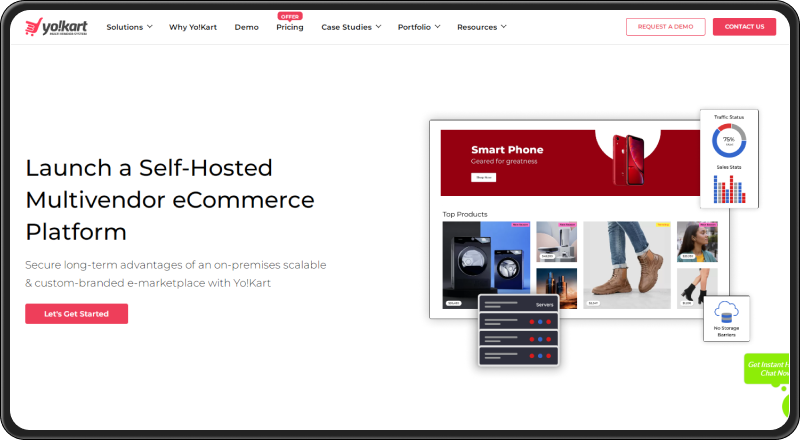
Yo!Kart is a robust, self-hosted white-label marketplace software known for its flexibility, scalability, and enterprise-grade architecture. Built exclusively for multi-vendor marketplaces that want long-term ownership, deep customization, and the freedom to scale without restrictions. The solution supports diverse marketplaces’ use cases across B2C and B2B models and can be customized for industries such as food delivery, retail, rentals, and services.
With complete control over hosting, data, and source code, Yo!Kart empowers businesses to tailor workflows, monetization strategies, and user experiences without vendor lock-ins. Its enterprise-ready architecture makes it suitable not just for launch, but for sustained growth and operational maturity.
Features and Benefits
- Fully customizable and self-hosted solution with full control over codebase and infrastructure
- Advanced multi-vendor management with commission rules, seller dashboards, and approvals
- Built-in multi-lingual and multi-currency support for global operations
- Robust admin dashboard with real-time analytics and performance reports
- Native mobile app support (iOS & Android) for customers and vendors
- Strong SEO, marketing, and promotional tools to drive traffic and conversions
Software Rating and Best For
- Rating: 4.6/5
- Best For: Startups, SMEs, and enterprises seeking a scalable, one-time licensed solution with full control and long-term growth flexibility
Request a Personalized Demo of Yo!Kart
2. Sharetribe
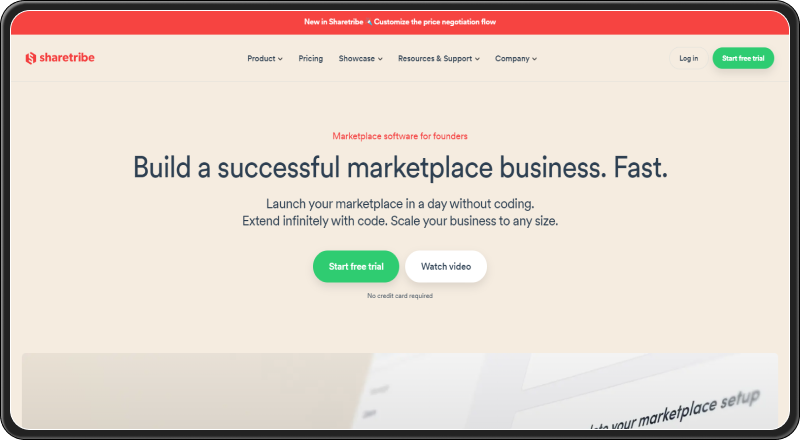
Sharetribe is a SaaS-based marketplace platform designed for speed and simplicity. It allows founders to launch MVPs quickly without heavy technical involvement. While customization is limited compared to self-hosted solutions, it excels in rapid experimentation and idea validation. Moreover, its developer-friendly APIs also allow gradual extension as the business grows.
Features and Benefits
- Easy setup with fast go-to-market capabilities
- SaaS-based hosting and maintenance are handled by the platform
- Built-in marketplace essentials like listings, payments, and messaging
- Active community support and extensive documentation
- Limited flexibility for complex business logic
Points to Consider:
- SaaS-based model restricts backend and infrastructure control
- Custom features may require developer involvement or API work
- Costs can increase as the marketplace scales
Rating and Best For
- Rating: 4.3/5
- Best For: Early-stage startups testing and validating marketplace ideas quickly
3. Mirakl

Mirakl is an enterprise-focused marketplace platform built for large-scale operations and complex ecosystems. It is widely adopted by global retailers and enterprises looking to add marketplace capabilities to their existing digital commerce infrastructure. It offers advanced vendor management, deep integrations, and high scalability, making it ideal for complex and high-volume marketplaces.
Features and Benefits
- Highly scalable infrastructure built for enterprise workloads
- Advanced seller onboarding, compliance, and performance management
- Supports both B2B and B2C enterprise marketplaces
- Strong integrations with ERP, CRM, and eCommerce systems
- High implementation cost and complexity
Points to Consider:
- High licensing and setup costs may not suit startups or SMBs
- Strong vendor governance can feel restrictive for smaller marketplaces
- Best results require integration with existing enterprise systems
Rating and Best For
- Rating: 4.4/5
- Best For: Large enterprises and established retailers launching enterprise marketplaces
4. CS-Cart Multi-Vendor
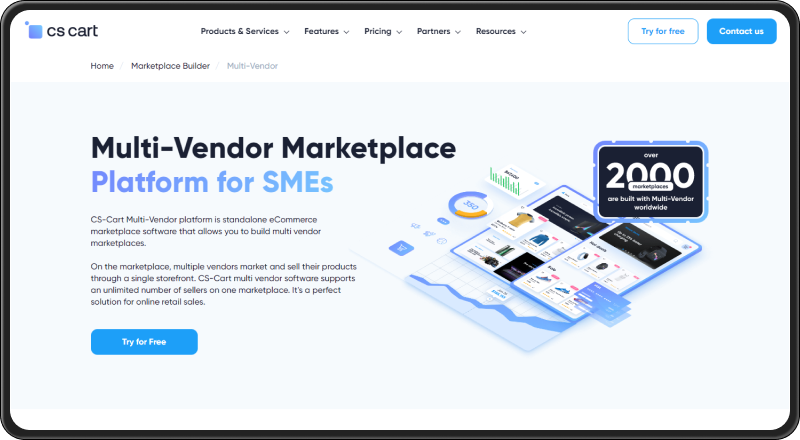
CS-Cart Multi-Vendor is a self-hosted marketplace solution offering a balance between flexibility and affordability. It offers flexibility through themes, plugins, and extensions, making it suitable for both physical and digital product marketplaces. While advanced customizations may require technical expertise, the platform provides a solid foundation for growing marketplaces that want control over hosting and functionality.
Features and Benefits
- One-time license with self-hosted deployment
- Supports unlimited vendors and product types
- Large marketplace of add-ons and extensions
- SEO-friendly structure and mobile-responsive design
- Requires some technical expertise for advanced customization
Points to Consider:
- The user interface may require refinement for premium brand positioning
- Add-ons can increase overall cost over time
- Performance depends on the hosting infrastructure and optimization
Rating and Best For
- Rating: 4.2/5
- Best For: SMBs and growing marketplaces needing customization without enterprise pricing
5. Arcadier

Arcadier is a SaaS-based marketplace builder focused on simplicity and fast deployment. It offers no-code tools suitable for launching niche marketplaces, though backend flexibility is limited. The platform provides structured workflows, hosting, and security, allowing users to focus on onboarding sellers and attracting buyers. While customization depth is limited, Arcadier works well for straightforward marketplace concepts with clear operational needs.
Features and Benefits
- No-code setup for basic marketplace requirements
- Cloud hosting and security included
- Built-in templates and workflows
- Subscription-based pricing model
- Limited customization for complex use cases
Points to Consider:
- SaaS pricing model results in ongoing subscription costs
- Custom integrations may require workarounds or external tools
- Less control over platform-level customization and hosting
Rating and Best For
- Rating: 4.1/5
- Best For: Small businesses and niche marketplace startups
Suggested Read: Top 10 White-label No-Code Marketplace Builders in 2026
6. Dokan (WooCommerce)

Dokan is a WordPress multi-vendor plugin built on WooCommerce, making it a popular choice for users already familiar with WordPress ecosystems. It enables entrepreneurs to convert a standard WooCommerce store into a functional multi-vendor marketplace with relative ease. While Dokan is especially appealing for content-driven platforms, scalability and performance rely heavily on hosting quality and third-party plugins.
Features and Benefits
- Seamless integration with WordPress and WooCommerce
- Affordable pricing with multiple plans
- Vendor dashboards and commission management
- Heavy dependency on plugins for advanced features
- Performance depends on hosting quality
Points to Consider:
- Advanced features often require multiple third-party plugins
- Scalability can become challenging as vendors and traffic grow
- Ongoing plugin updates may introduce compatibility issues
Rating and Best For
- Rating: 4.0/5
- Best For: Content-driven and small-scale marketplaces
Suggested Read: Explore the Top 20 Multi-vendor eCommerce Marketplace Platforms
7. Magento Marketplace (Adobe Commerce)

Magento offers powerful marketplace capabilities through extensions and custom development. Known for its flexibility and performance, it supports large catalogs, advanced workflows, and custom integrations. However, building and maintaining a Magento-based marketplace typically requires experienced developers and a higher budget, making it more suitable for well-funded organizations with technical resources.
Features and Benefits
- Highly customizable and scalable architecture
- Strong ecosystem of extensions and integrations
- Suitable for complex workflows and catalogs
- High development and maintenance costs
- Requires dedicated development teams
Points to Consider:
- Implementation timelines are longer due to customization complexity
- Ideal for complex catalogs and enterprise workflows, not MVP launches
- Hosting, maintenance, and upgrades must be carefully planned
Rating and Best For
- Rating: 4.3/5
- Best For: Enterprises with in-house or agency-based technical teams
8. Jungleworks (Yelo)
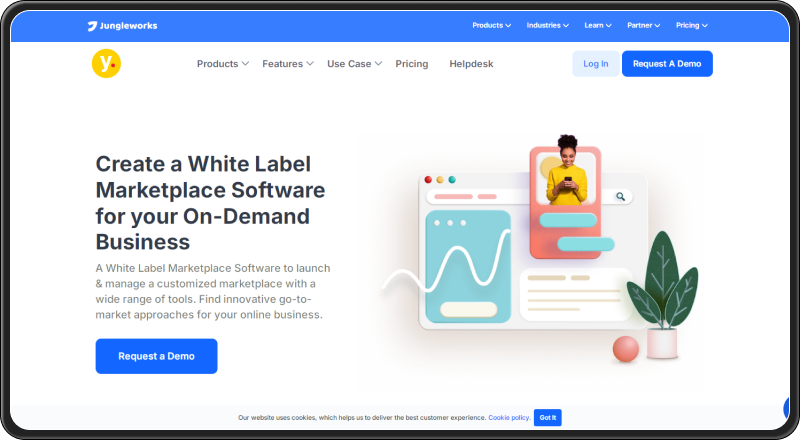
Jungleworks offers marketplace solutions focused on on-demand, hyperlocal, and service-based platforms. Its mobile-first approach makes it suitable for fast-growing service marketplaces. While the solutions are quick to deploy, deeper customization and feature expansion may involve additional costs depending on business needs.
Features and Benefits
- Ready-made solutions for services and delivery use cases
- Mobile-first design with native apps
- Modular pricing based on features
- Customization may incur additional costs
Points to Consider:
- Custom workflows or niche use cases can increase overall cost
- SaaS-based structure limits deep backend customization
- Mobile-first approach is strong, but web flexibility may be limited
Rating and Best For
- Rating: 4.1/5
- Best For: On-demand and service-based marketplaces
9. Marketplacer
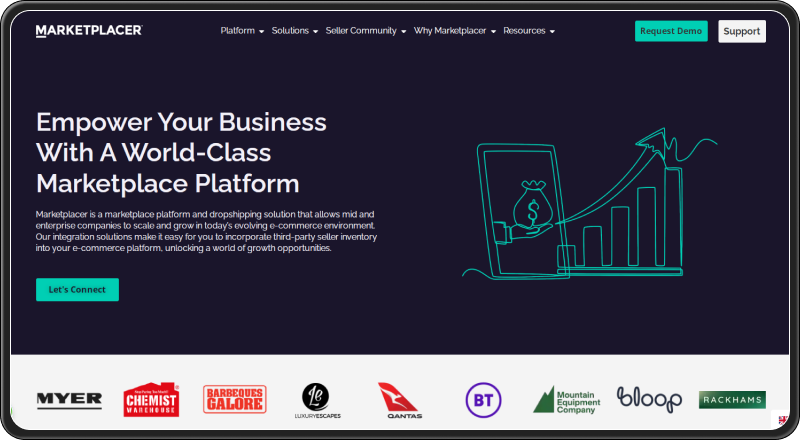
Marketplacer is a SaaS-based enterprise marketplace platform designed for mid-to-large organizations seeking scalability and deep integrations. It focuses on operational efficiency, analytics, and enterprise-level vendor management. The platform is well-suited for organizations that require strong integrations and reporting capabilities, though its SaaS nature means less control over hosting and infrastructure compared to self-hosted solutions.
Features and Benefits
- Advanced analytics and reporting tools
- Supports complex vendor workflows
- Strong integration capabilities
- Limited hosting control
- Higher pricing tiers
Points to Consider:
- Pricing can scale quickly as advanced features and integrations are added
- Implementation may require onboarding support and training
- Strong fit for businesses needing complex vendor workflows
Rating and Best For
- Rating: 4.2/5
- Best For: Mid-to-large enterprises scaling digital marketplaces
10. Hyperzod

Hyperzod is an AI-first, cloud-based white-label SaaS platform designed to help businesses launch and manage single-vendor or multi-vendor eCommerce marketplaces with integrated ordering, delivery, and growth features. It supports quick commerce models, including food, grocery, pharmacy, and general product delivery, with automation and routing tools built in.
Features and Benefits
- Rapid marketplace setup using no-code configuration tools
- AI-driven automation for order dispatch, routing, and real-time tracking
- Comprehensive multi-vendor management
- Integrated support for payment gateways
- Inbuilt marketing and customer retention capabilities
Points to Consider:
- AI and automation features are most valuable at higher order volumes
- Long-term costs should be evaluated against scaling needs
- Best results require alignment with delivery and logistics-heavy models
Rating and Best For
- Rating: 4.0/5
- Best For: Businesses building hyperlocal or quick commerce marketplaces across food, grocery, and retail delivery
Launch Faster With the Right Marketplace Solution
Conclusion
In 2026, white-label marketplace software has become the preferred choice for businesses aiming to launch scalable, feature-rich marketplaces without the high risks and costs of custom development. Whether you are a startup validating a new idea or an enterprise expanding into a new digital marketplace, selecting the right platform plays a crucial role in long-term success.
Among the leading solutions available, Yo!Kart stands out for its balance of flexibility, scalability, ownership, and long-term value, making it a strong choice for businesses that want full control over their marketplace and the freedom to grow without constraints. However, the best solution ultimately depends on your business model, budget, and growth plans.
By carefully evaluating factors such as customizability, pricing, scalability, multi-vendor support, payment integrations, and technical support, you can confidently choose a white-label marketplace software that aligns with your vision and helps you build a future-ready marketplace.
FAQs
Q 1. How long does it take to launch a marketplace with white‑label software?
Ans. The timeline to launch a marketplace with white‑label software varies based on the solution and level of customization. With a well‑structured solution like Yo!Kart, many businesses can go live within 1-2 weeks. However, simpler setups with minimal custom features can take as little as 3-4 weeks, while fully customized marketplaces may take longer.
Q 2. What pricing models do marketplace software typically use?
Ans. White‑label marketplace software generally follows one of these pricing approaches:
- One‑time license fee
- Monthly or yearly subscription
- Commission‑based pricing
- Add‑on or feature‑based pricing
Solutions like Yo!Kart often offers a one‑time license model with optional maintenance plans, which can be more cost‑effective over time since you avoid recurring SaaS fees.
Q 3. How customizable can a marketplace software be?
Ans. Customization is a major advantage of white‑label solutions. For example, Yo!Kart allows deep customization of the user interface, vendor workflows, commission structures, and plugins. You can tailor the marketplace to your niche, whether it’s food delivery, rentals, or services, without rebuilding the platform from scratch.
Useful customizations include:
- Brand colors, logos, and layout changes
- Custom vendor dashboards and commission rules
- Integration with third‑party tools, such as analytics, CRM, and logistics
Q 4. Is marketplace software secure and reliable?
Ans. Yes, reputable marketplace solutions implement strong security measures such as:
- SSL/HTTPS encryption
- Secure payment gateway integrations
- Regular software updates
- Admin‑level access controls
Choosing a mature solution comes with the added benefit of a long track record in real‑world deployments, meaning most performance and security issues have already been addressed through continuous updates.
Q 5. What ongoing costs should I consider after launch?
Ans. After deployment, there are a few recurring and periodic costs to plan for, such as:
- Hosting or cloud services
- Payment gateway fees
- Support or maintenance packages
- Marketing and customer acquisition
- Feature upgrades or custom development
However, with Yo!Kart’s one-time payment model, you also receive free technical support for the first year.
Q 6. Does white-label marketplace software support multiple languages and currencies?
Ans. Yes, most modern white-label marketplace software supports localization and international expansion. They include built‑in support for multiple languages and multi‑currency pricing, making it easier to launch in different regions and serve diverse audiences without complex integrations.
Q 7. What industries work well with white‑label marketplaces?
Ans. White‑label marketplaces are highly versatile and can be used across a wide range of industries, including:
- eCommerce and retail
- Food delivery and grocery services
- Service marketplaces, such as freelancers, professionals, and bookings
- Rental and sharing economy platforms
- Niche verticals, like healthcare, fashion, and real estate
Looking for a Scalable Marketplace Solution for Your Business?
Get In TouchPopular Posts