
Published Date 20th Jan 2026
The UK eCommerce market continues to demonstrate strong momentum in 2026, driven by widespread digital adoption, mature online consumer behaviour, and the growing preference for online marketplace-driven shopping experiences. With UK shoppers increasingly favouring platforms that offer variety, competitive pricing, and convenience, multi-vendor eCommerce marketplaces have emerged as one of the most scalable and resilient business models in the digital economy.
Unlike traditional single-seller eCommerce stores, multi-vendor marketplaces enable multiple independent sellers to operate within a unified platform. Further, this model allows businesses to expand product offerings rapidly, reduce inventory risk, and create diversified revenue streams through commissions, subscriptions, and value-added services. As a result, multi-vendor platforms are gaining rapid adoption widely across retail, services, rentals, and B2B commerce throughout the UK.
For entrepreneurs, startups, and established enterprises alike, launching a multi-vendor eCommerce platform is no longer just a growth opportunity. It has become a strategic response to evolving consumer expectations and intensifying competition. With the right technology foundation and a reliable development partner, marketplace businesses can scale efficiently while maintaining operational control and long-term profitability.
Table of Contents
What is a Multi-Vendor eCommerce Platform?
A multi-vendor eCommerce platform is a software solution that enables multiple independent sellers/vendors to register, list products or services, manage orders, and sell to customers through a single centralized marketplace.
The platform owner acts as an administrator and is responsible for:
- Managing vendors and customers
- Defining commission structure and revenue models
- Overseeing payments, disputes, and marketplace policies
Popular examples of multi-vendor marketplaces include Amazon, Etsy, Airbnb, and eBay, each connecting buyers and sellers while generating revenue from each transaction.
Furthermore, multi-vendor platforms can support various business models, including:
- B2C marketplaces for consumer products
- B2B marketplaces for wholesale & bulk selling
- Service-based marketplaces
- Rental marketplaces
- Hybrid marketplaces combining multiple models
How a Multi-Vendor eCommerce Platform Makes Money?
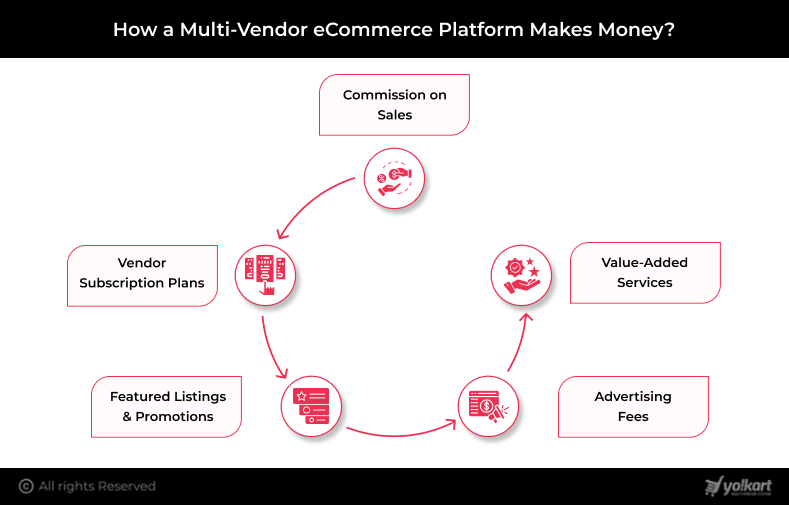
A multi-vendor eCommerce marketplace can generate revenue through multiple monetization strategies. Rather than relying on a single income stream, the most successful platforms often combine monetization strategies to generate predictable, scalable, and long-term revenue. Some popular revenue models include:
1. Commission on Sales
This is the most common revenue model for multi-vendor marketplaces. The marketplace owner earns a percentage from each successful transaction completed by vendors. However, commission rates can vary based on the product category, vendor type, or order value.
2. Vendor Subscription Plans
Under this model, sellers pay monthly or yearly fees to access the platform or premium features. Subscription tiers can be structured to offer different benefits, such as reduced commission rates, priority support, or enhanced storefront visibility.
3. Featured Listings & Promotions
Vendors pay to promote their products or stores in search results and banners. This model benefits the vendor by increasing exposure while providing the marketplace with additional income.
4. Advertising Fees
Marketplace can generate revenue by offering sponsored ads or banner placements. These may include sponsored product listings or brand campaigns targeted to specific user segments, helping vendors reach relevant buyers more effectively.
5. Value-Added Services
Beyond core marketplace functionality, platforms can earn additional income by offering services such as logistics support, fulfillment solutions, advanced analytics, or marketing tools. These services enhance vendor success while increasing platform profitability.
Turn Your Marketplace Platform into a Scalable Business
Must-Have Features in a Multi-Vendor Marketplace Platform
A successful multi-vendor marketplace depends on more than just listing products. In 2026, platforms must deliver a seamless experience for vendors, buyers, and admin/s. Below is a comprehensive list of marketplace essential features every modern multi-vendor eCommerce platform should offer to support scalability, trust, and operational efficiency:
| Feature | Description |
| Vendor Registration & Approval | Allows sellers to sign up, submit required documents, and get approved by the admin/s |
| Vendor Dashboard | A dedicated dashboard for vendors enables them to manage products, orders, earnings, and profiles |
| Product & Inventory Management | Vendors can add, edit, categorize, and manage products and stock levels |
| Commission Management | Flexible commission rules allow marketplace owners to define commission based on category, vendor, or product |
| Order Splitting | Automatically splits customer orders among multiple vendors, ensuring accurate fulfillment, vendor-specific tracking, and transparent earnings |
| Secure Payment Gateway | Supports split payments, escrow, and multiple payment methods |
| Multi-Currency & Multi-Language | Enables global selling with localized experiences, helping marketplaces expand regionally and globally |
| Ratings & Reviews | Builds buyers’ trust through vendor and product reviews, encouraging quality service and informed purchasing decisions |
| Mobile Responsiveness/Apps | Delivers a seamless mobile experience with optional native buyer & seller apps |
| Shipping Management | Allows vendors to configure shipping rules, tracking, and improved fulfillment transparency |
| Tax & Invoice Management | Automated tax calculations and invoice generation to ensure compliance and reduce manual accounting |
| Refunds & Dispute Management | Provides a structured process for handling returns and conflicts |
| Admin Control Panel | Centralized dashboard for admin/s to manage vendors, commissions, content, and policies |
| SEO & Marketing Tools | Includes SEO-friendly URLs, meta tags, discounts, coupons, and promotions to increase visibility and drive organic traffic |
| Analytics & Reporting | Detailed insights into sales, vendor performance, revenue, and traffic insights to support data-driven decisions |
Top 10 Multi-Vendor eCommerce Platforms in the UK (2026)
Below are the top 10 eCommerce software platforms that are leading the market in 2026. Platforms mentioned in this curated list are based on their market presence, feature richness, scalability, and reputation in the eCommerce marketplace software space. Let’s explore them in detail:
1. Yo!Kart
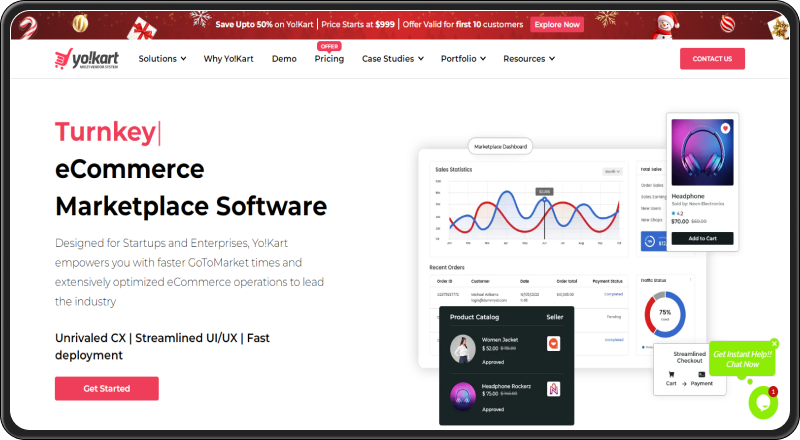
Yo!Kart is a purpose-built white label multi-vendor eCommerce platform built specifically for launching scalable online marketplaces. Unlike plugin-based solutions, it is developed as a standalone marketplace system, making it suitable for businesses that require long-term scalability, operational control, and customization flexibility.
Furthermore, it supports multiple business models, including B2C, B2B, rental, and service marketplaces. This robust solution comes equipped with built-in vendor management, advanced revenue modules, multilingual and multi-currency support, and native mobile apps, enabling businesses to launch, manage, and scale marketplaces efficiently.
Pros:
- Self-hosted solution with full source-code ownership
- One-time licensing with no recurring fees
- Comprehensive feature set for admin/s, sellers, and buyers
- Native mobile apps for buyers and sellers
Cons:
- Requires technical setup or third-party hosting
Ideal For: Startups, SMBs, and enterprises building marketplace platforms with complete control over their infrastructure.
Schedule a One-on-One Personalized Demo of Yo!Kart
2. CS-Cart Multi-Vendor
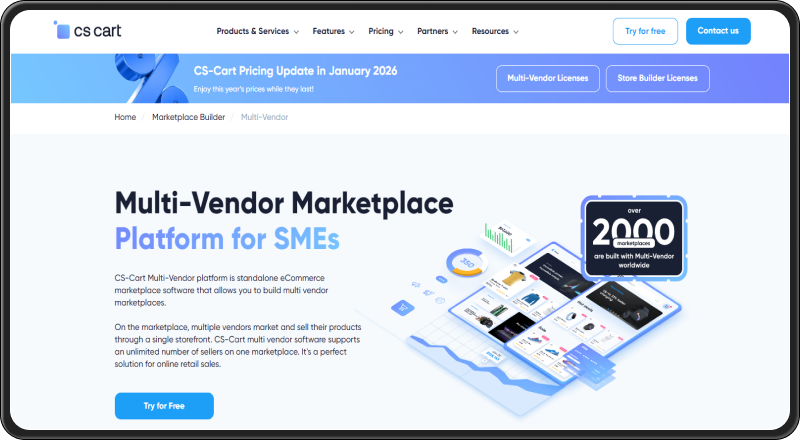
CS-Cart Multi-Vendor is a feature-rich eCommerce marketplace platform that allows businesses to launch and operate multi-vendor marketplaces. It offers features like vendor dashboards, flexible commission structures, multi-store capabilities, and powerful admin controls. Additionally, the platform offers customization and supports global expansion with built-in multilingual, multi-currency, and tax management features.
Pros:
- Flexible license options
- Extensive add-on ecosystem
- Advanced vendor and inventory management tools
Cons:
- Steeper learning curve for non-technical users
- Third-party integrations often require extra configuration
- Advanced customizations may require
- Interface and workflows may feel complex for startups or small marketplaces
Ideal For: Medium to large marketplaces seeking deep functionality and control.
Suggested Read: Why Marketplace Owners Migrate from CS-Cart to Yo!Kart?
3. Dokan (WooCommerce Extension)
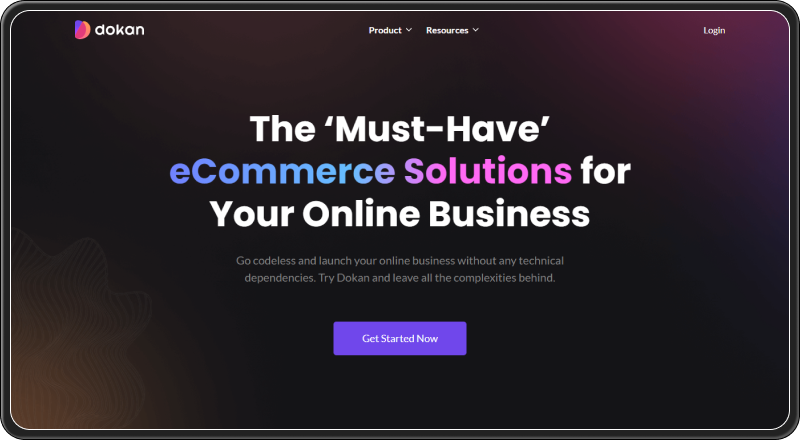
Dokan is a widely used multi-vendor eCommerce solution built on WooCommerce, transforming WordPress websites into functional online marketplaces. It allows vendors to manage products, orders, and storefronts from the frontend while leveraging WordPress’s extensive plugin ecosystem. Dokan is a popular choice for businesses that want flexibility and affordability within the WordPress environment.
Pros:
- Cost-effective with a free core version
- Simple vendor onboarding process
- Strong WordPress compatibility
Cons:
- Performance depends heavily on WordPress hosting
- May require additional plugins for full functionality
- Scaling to high traffic and large vendor volumes can be challenging
- Frequent plugin updates may introduce compatibility or maintenance overhead
Ideal For: Small to medium marketplaces with WordPress familiarity.
4. Arcadier
Arcadier is a cloud-based marketplace builder designed for fast and simple marketplace launches. It supports businesses offering products, services, rentals, or hybrid marketplaces without heavy technical involvement. Moreover, the platform offers customizable storefronts, vendor onboarding tools, built-in payment processing, and global selling capabilities. Its SaaS model allows entrepreneurs to launch quickly while handling infrastructure, security, and updates automatically.
Pros:
- Fast setup with drag-and-drop tools
- Built-in multi-currency and multi-language support
- No server or infrastructure management
Cons:
- Ongoing subscription cost based on usage
- Less control compared to self-hosted platforms
- Advanced feature extensions may require external integrations
- Limited customization compared to self-hosted or open-source platforms
Ideal For: Quick MVP launches and marketplaces that prioritize ease of use.
5. Sharetribe
Sharetribe is a no-code and low-code marketplace software designed to help entrepreneurs build and validate marketplace ideas rapidly. It is commonly used for service-based and nice marketplaces with built-in user roles, listing management, checkout flows, and secure payments. Sharetribe is especially popular among founders testing niche concepts or launching regional service marketplaces.
Pros:
- No coding required
- Readymade templates for niche use cases
- Built-in payment workflows
Cons:
- Limited advanced customization
- Not ideal for large or complex marketplaces
- Customization options are constrained unless using developer-focused versions
- The feature set may feel restrictive as the marketplace grows beyond the MVP stage.
Ideal For: Entrepreneurs launching service-based or niche marketplaces.
6. Webkul Multi-Vendor Marketplace
Webkul Multi-Vendor Marketplace is a flexible extension-based solution designed to transform existing eCommerce stores into fully functional multi-vendor marketplaces. It integrates seamlessly with popular eCommerce systems such as Magento, Shopify, WooCommerce, PrestaShop, and OpenCart. It offers dedicated vendor dashboards, commission management, and order splitting functionality.
Pros:
- Wide compatibility with popular eCommerce systems
- Flexible vendor and commission settings
- Extensive marketplace extensions
Cons:
- Licensing and integration costs vary depending on the base eCommerce platform and required extensions.
- Configuration and customization require familiarity with the base platform
- Advanced marketplace features may require additional paid extensions
- Marketplace performance and scalability depend heavily on the underlying eCommerce system and hosting setup
Ideal For: Businesses extending an existing eCommerce store into a multi-vendor marketplace.
7. Magento with Marketplace Extensions
Magento, now Adobe Commerce, is a powerful enterprise-level eCommerce platform that can be transformed into a scalable eCommerce marketplace platform using third-party marketplace extensions. This platform is known for its flexibility, performance, and ability to handle complex catalogs, custom workflows, and high transaction volumes, making it suitable for enterprise-grade multi-vendor marketplaces.
Pros:
- Enterprise-grade scalability and performance
- Large developer ecosystem
- Customizable architecture
Cons:
- Higher cost and complexity compared to other marketplace solutions
- Requires deep technical expertise
- Marketplace functionality is not native and depends on third-party extensions.
- Longer implementation timelines, make it less suitable for rapid launches or MVPs
Ideal For: Large marketplaces with complex workflows and high traffic volumes.
8. Shopify (+ Multi-Vendor Apps)
Shopify is a leading eCommerce platform that can be extended into a multi-vendor eCommerce platform through third-party marketplace apps. It offers seamless hosting, security, and store management while relying on apps to manage vendor onboarding, commission rules, and order distribution. Shopify’s simplicity makes it attractive for rapid deployment.
Pros:
- User-friendly and quick to set up
- Seamless hosting and infrastructure
- App ecosystem for extended functionality
Cons:
- Recurring subscription costs and app fees
- Core multi-vendor functionality relies entirely on third-party apps
- Limited flexibility for deep customization compared to self-hosted
- Vendor workflows and commission logic are constrained by app capabilities and Shopify’s ecosystem rules
Ideal For: Small to medium marketplaces that value simplicity and speed.
Build Your Multi-Vendor Marketplace Without Technical Hassle
9. Shuup
Shuup is a modular and extensible eCommerce marketplace software designed for businesses that need flexibility without being locked into rigid platform limitations. It supports multiple vendor types, commission models, and marketplace variations, including B2B and service-based marketplaces. Shuup’s modular design allows businesses to add only the features they need, making it a strong option for marketplaces with unique workflows.
Pros:
- Modular and extensible architecture
- Supports diverse marketplace types, including B2B, B2C, and service marketplaces
- Built-in SEO and analytics tools
Cons:
- Requires developer knowledge for full customization
- Smaller ecosystem compared to Magento or Shopify
- Not suitable for non-technical users or quick launches.
- Implementation effort may increase for highly complex or large-scale marketplaces.
Ideal For: Businesses that need flexible multi-vendor capabilities with minimal restrictions.
10. Spree Commerce
Spree Commerce is an open-source, API-first eCommerce platform commonly used as the backend for custom-built multi-vendor marketplaces. Its headless architecture allows businesses to create unique frontend experiences while maintaining full control over marketplace logic, integrations, and scalability. Spree is favored by development teams building unique or enterprise-grade solutions.
Pros:
- Highly flexible and extensible
- Ideal for headless commerce
- Control over integrations and business logic
Cons:
- Requires significant development effort
- Not a turnkey marketplace solution
- Requires ongoing technical resources for maintenance and upgrades
- Total cost can increase due to custom development
Ideal For: Custom enterprise marketplaces with unique business rules and workflows.
Suggested Read: Top 20 Multi-vendor eCommerce Marketplace Platforms in 2026
Why Choose Yo!Kart?
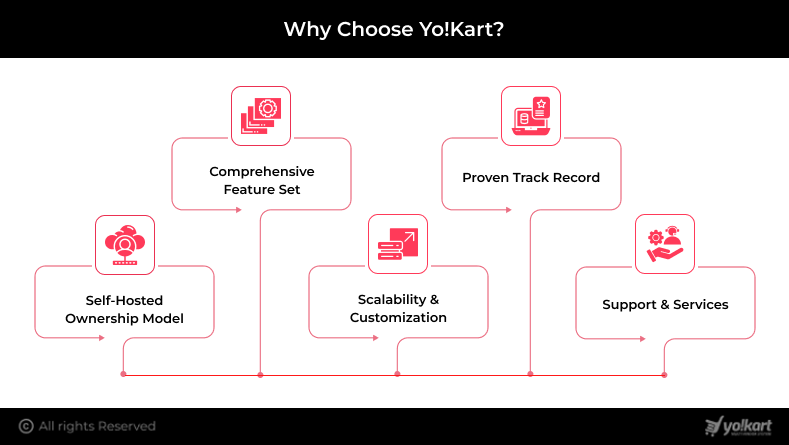
Among the top eCommerce marketplace software platforms in 2026, Yo!Kart stands out for several compelling reasons. Let’s have a look at them:
1. Self-Hosted Ownership Model
Yo!Kart offers a one-time payment and lifetime license, eliminating recurring software fees while giving you full source-code ownership. This eliminates recurring software subscription fees and ensures complete control over your marketplace infrastructure as your marketplace scales.
2. Comprehensive Feature Set
The platform includes essential marketplace tools, such asvendor dashboards, product catalogs, multi-currency and multilingual support, and mobile apps. Other than that, it supports various revenue models, including commission, featured listings, and ads.
3. Scalability & Customization
Yo!Kart’s modular architecture allows businesses to scale up with custom features, third-party API integrations, and extensive marketplace workflows suited for niche, B2C, or B2B eCommerce marketplace platforms.
4. Proven Track Record
With thousands of marketplaces launched globally and strong reviews across major software directories, Yo!Kart has established credibility as a reliable eCommerce marketplace development solution.
Explore marketplaces launched using Yo!Kart
5. Support & Services
Yo!Kart provides installation assistance, technical support, and optional development services, ensuring a smooth launch and post-launch journey for marketplace owners.
Get Guidance on Your Marketplace Idea
Conclusion
As eCommerce continues to evolve in 2026, the demand for robust, scalable, and flexible eCommerce marketplace platforms and solutions will also increase. Whether you are launching a marketplace for niche products, building a multi-vendor eCommerce platform, or expanding into B2B eCommerce marketplace development, selecting the right eCommerce marketplace platform is crucial.
From platforms like Yo!Kart and CS-Cart to customizable solutions built on Magento or Shopify with extensions, there is a diverse range of options to match every business need, budget, and technical preference. However, it is essential to evaluate your options and consider long-term scalability, customization flexibility, integration potential, and total cost of ownership before making a decision.
Launch a Scalable Multi-Vendor Marketplace for the UK Market
Get In TouchPopular Posts