
Published Date 01st May, 2026
When Faire launched in 2017, wholesale commerce was still being conducted the same way it had been for decades. Trade shows, cold calls, paper catalogs, and payment terms were negotiated traditionally. Today, Faire has rewritten those approaches entirely.
With $600+ million in estimated annual revenue in 2026, Faire is valued at approximately $5.2 billion. Today, the marketplace hosts 800,000+ retailers, 100,000+ independent brands, and nearly $3 billion in annual gross merchandise volume.
In short, Faire is not just a marketplace but has proven that B2B wholesale is one of the most powerful untapped opportunities in digital commerce.
And the numbers behind that opportunity are staggering. The global B2B e-commerce market is valued at $36.86 trillion in 2026, growing at a CAGR of 10.84% toward $61.66 trillion by 2031.
Moreover, a significant percentage of all B2B sales interactions, including research, negotiation, and remote meetings, are now taking place online. The market size and increased adoption rate will surely encourage entrepreneurs and businesses to build B2B multi-vendor marketplaces.
This guide is a complete roadmap for anyone looking to build a marketplace app like Faire. It explains what powers Faire’s success, the features that drive B2B marketplace value, how to create a multi-vendor marketplace for wholesale, how much it costs, and the fastest and most cost-effective way to launch.
Table of Contents
- The Wholesale B2B E-Commerce Opportunity in 2026
- What Makes Faire the Blueprint for Wholesale Marketplaces?
- The Strategic Pillars Behind Faire’s Success
- Faire’s Revenue Model How it Actually Makes Money
- Must-Have Features to Build a Marketplace App Like Faire
- Step-by-Step: How to Create a Multi-Vendor Wholesale Marketplace
- Why Yo!Kart is the Smarter Path to Launch Your Wholesale Marketplace
- Conclusion
- FAQs
The Wholesale B2B eCommerce Opportunity in 2026
B2B wholesale is one of the most compelling investment areas in commerce today. Entrepreneurs and businesses can fill the gap between market size and online adoption, creating the kind of structural opportunity that Faire has already begun to capture. Let’s explore some key statistics of the wholesale B2B eCommerce industry and identify the opportunity.
2026 Market Statistics You Cannot Ignore
- The global B2B eCommerce market is valued at $36.86 trillion in 2026, growing at a CAGR of 10.84% to reach $61.66 trillion by 2031 (Mordor Intelligence, January 2026 update).
- The global B2B eCommerce market was $32.11 trillion in 2025, adding over $4 trillion in new digital transaction volume in a single year. It’s the fastest absolute growth in B2B commerce history.
- 80% of B2B sales interactions between buyers and suppliers now occur through digital channels. Up from just 13% in 2019 (McKinsey, Shopify Enterprise, 2026).
- 73% of B2B buyers are willing to place orders over $50,000 via digital self-service channels, and the number of buyers willing to place $10M+ orders online has jumped 83%.
- Trillions of dollars in digital commerce yet to be claimed. Businesses can build a thriving eCommerce platform and leverage the opportunities.
- B2B marketplaces grow 2x faster than brand-owned B2B websites. Companies with strong B2B e-commerce capabilities are 3x more likely to exceed revenue goals.
- 61% of B2B buyers now prefer a buying journey that does not involve a sales representative, reinforcing the demand for self-service wholesale platforms.
- Alone, the US B2B eCommerce site sales recorded $2.297 trillion in 2024 and a 10.5% year-over-year jump is projected to reach $3.027 trillion by 2028.
- There are 2.7 million independent retailers in the US alone with an estimated $3.5 to 3.7 trillion in combined annual revenue, the core buyer audience for a Faire-style platform.
The wholesale digitization wave is not a future trend but is happening now at a good pace. Therefore, it’s the right time to build a marketplace like Faire before the market consolidates. Otherwise, displacing platforms already serving with strong footprints will be extremely difficult.
Key Insight for 2026:
Faire’s own CEO has stated that B2B wholesale penetration stands at just 5% online, despite hundreds of billions of dollars in annual purchasing. The equivalent figure for B2C retail is over 20%. That 15-point gap represents one of the largest untapped digital commerce opportunities in existence — and it will close over the next decade.
Ready to Build Your Own Fashion Marketplace?
What Makes Faire the Blueprint for Wholesale Marketplaces?
Faire is often described as the ‘Shopify for wholesale. It’s a platform that democratizes access to modern B2B commerce tools for the independent retailers and small brands that have historically been underserved by large distributors and trade show networks. Understanding the anatomy of Faire’s success is essential before you begin your own multi-vendor marketplace development.
Faire by the Numbers (2025-2026)
- Estimated annual revenue of $600-650 million in 2026, growing more than 40% year-over-year in Q3 2025.
- Valued at $5.2 billion in a November 2025 employee tender offer, led by WCM Investment Management with participation from Baillie Gifford and True North Fund. Total funding raised: $1.7 billion across 9 rounds from investors including Sequoia, Y Combinator, and Founders Fund.
- Nearly $3 billion in gross merchandise value (GMV) in 2025, representing eight consecutive quarters of GMV growth.
- 800,000+ independent retailers on the platform globally, with net dollar retention above 110%. It means existing retailers continuously increase their spending on the platform.
- 100,000+ independent brands selling on Faire, with over 10 million brand-retailer relationships facilitated to date.
- Faire Market, the platform’s flagship annual event, attracted 30,000+ brands and 79,000+ retailers in its most recent edition, forming 136,000+ new brand-retailer relationships in a single event.
- European growth is nearly double the rate of North America, and the platform has expanded into 17 European countries and Australia.
- Advertising revenue (Promoted Listings), launched just two years ago, already exceeds 5% of total revenue — a high-margin monetization layer growing faster than the core commission business.
- 75,000 retailers are actively using POS integrations (Shopify, Square, Clover, Lightspeed Retail), and POS-integrated retailers place nearly 20% more orders.
The Strategic Pillars Behind Faire’s Success
| Strategic Pillar | What Faire Does | Lesson for Marketplace Builders |
| Retailer-First Friction Removal | Free access for retailers — zero upfront fees. All monetization is on the brand/supplier side. | Removing buyer friction accelerates marketplace liquidity and network effects faster than any other lever. |
| Net 60 Payment Terms | Retailers can buy inventory and pay 60 days later; Faire pays brands upfront, absorbing the credit risk. | Embedded finance that reduces buyer risk is the single biggest conversion driver in B2B wholesale. |
| Free Returns on First Orders | New retailers can return unsold inventory from their first order, eliminating the trial-purchase risk. | Reducing first-order risk is what converts a curious retailer into a committed buyer. |
| AI-Powered Discovery | Deep learning personalizes product rankings and improves listing quality, matching retailers with brands most likely to convert. | AI-driven product matching compounds retention: retailers who discover great products come back. |
| Consolidated Shipping | Retailers can combine orders from multiple brands into one shipment from a single warehouse. | Logistics innovation that reduces shipping costs directly increases order frequency and average order size. |
| Advertising Layer | Promoted Listings allows brands to pay for visibility — already 5%+ of revenue just two years after launch. | Advertising revenue scales with GMV and carries dramatically higher margins than transaction commissions. |
| POS Integration Network | Native integrations with Shopify, Square, Clover, and Lightspeed connect wholesale ordering directly into retailer operations. | Deep integrations make the platform stickier — integrated retailers order 20% more frequently. |
| Human-Tech Hybrid Model | Software tools for independent sales reps who still manage brand-retailer relationships. | The best wholesale marketplaces combine automation with the human relationships that B2B still depends on. |
Faire’s most important competitive insight:
The platform shifted ALL monetization to the supply side (brands pay), while making the demand side (retailers) completely free to join and use. This asymmetric structure fueled explosive retailer adoption and created the dense demand network that brands now pay to access. Any new wholesale marketplace should carefully consider which side of the market to subsidize at launch.
Faire’s Revenue Model How it Actually Makes Money
Understanding Faire’s revenue model is not just an interesting context; it’s a template you can adapt when designing your own B2B marketplace’s monetization strategy. Faire generates revenue through four primary streams, each of which compounds the others.
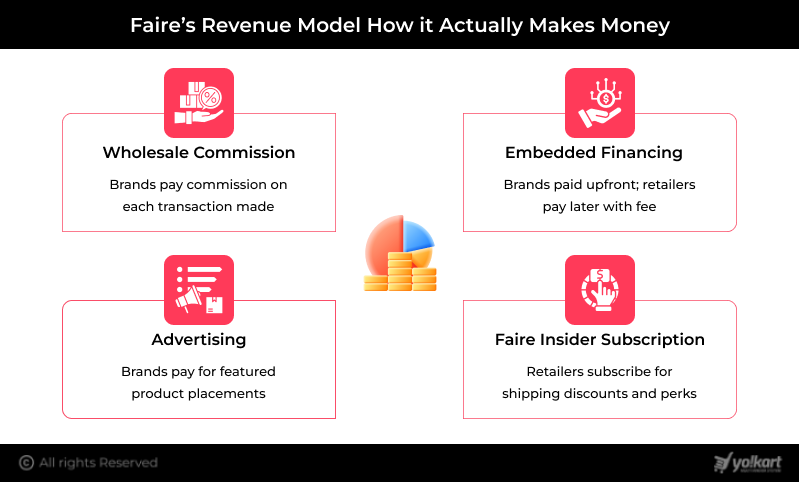
| Revenue Stream | How It Works | Estimated Contribution |
| Wholesale Commission | Brands pay a commission on each transaction, typically 15-25% on new retailer relationships and lower on repeat orders. | The majority of total revenue (~70-80%) |
| Embedded Financing (Faire Capital) | Brands receive upfront payment from Faire; retailers get Net 60 payment terms. Faire charges a financing fee for this service. | Meaningful secondary revenue stream |
| Advertising (Promoted Listings) | Brands pay for premium placement in search results, category pages, and discovery feeds. | Now exceeds 5% of total revenue. One of the fastest-growing segments |
| Faire Insider Subscription | Retailers pay $19.99/month for shipping discounts and discovery perks a loyalty and engagement tool. | Smaller revenue contribution, high strategic value |
The most important structural feature of Faire’s model is that it aligns the platform’s incentives with the marketplace’s success. Faire only earns commission when transactions happen. Therefore, every product improvement, every AI recommendation, and every logistics innovation is directly tied to increasing transaction volume. For new marketplace builders, starting with a commission-first model is the most capital-efficient approach: you earn only when your users earn, which builds trust while maintaining healthy unit economics.
Must-Have Features to Build a Marketplace App Like Faire
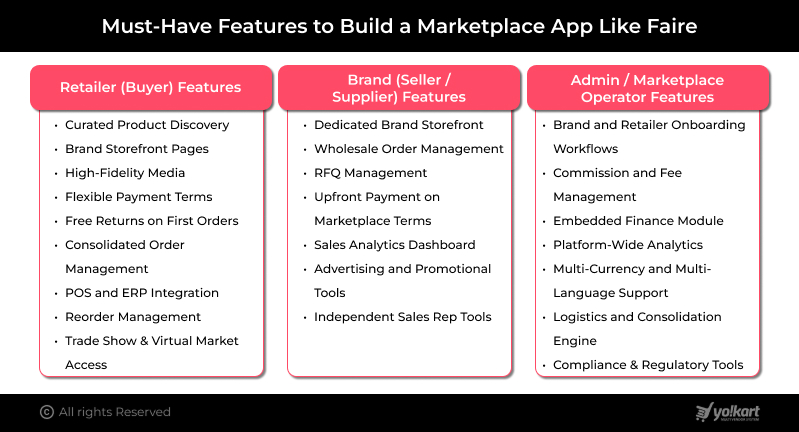
B2B wholesale marketplace development is fundamentally different from building a B2C platform. The buyer-seller dynamics, payment terms, order volumes, and trust mechanisms are all distinct. Here is a comprehensive breakdown of what features a Faire-comparable platform requires.
Retailer (Buyer) Features
- Curated Product Discovery: AI-powered search with filters by product category, minimum order quantity (MOQ), price tier, brand origin, lead time, and sustainability certification.
- Brand Storefront Pages: Rich brand profiles with product catalogs, brand story, shipping policies, and verified retailer reviews — the wholesale equivalent of an Amazon brand page.
- Flexible Payment Terms: Built-in feature for flexible payment terms. It’s the single most important feature for retailer adoption in wholesale markets.
- Free Returns on First Orders: Risk-free sampling for new brand relationships dramatically lowers the barrier to trial purchasing.
- Consolidated Order Management: Place orders from multiple brands and manage them from a unified order dashboard with tracking, invoices, and returns.
- POS and ERP Integration: Native connections to Shopify, Square, Lightspeed, QuickBooks, and other retail management systems to sync inventory and orders automatically.
- Reorder Management and Favorites: One-click reorder from previous purchases, saved brand lists, and stock alerts for bestselling products.
- Trade Show and Virtual Market Access: Digital equivalent of trade show browsing for curated seasonal collections, new brand spotlights, and virtual buying events.
Brand (Seller / Supplier) Features
- Dedicated Brand Storefront: Fully customizable product catalog with variant management, MOQ settings, tiered pricing (e.g., lower per-unit cost at higher quantities), and lead time configuration.
- Wholesale Order Management: Real-time order notifications, pick-list generation, packing slips, multi-carrier shipping label creation, and fulfillment tracking.
- RFQ (Request for Quote) Management: Brands can receive, negotiate, and respond to custom quote requests from retailers — essential for high-value or custom orders.
- Upfront Payment on Marketplace Terms: When the platform offers embedded financing, brands receive payment immediately while the marketplace manages the retailer’s credit terms.
- Sales Analytics Dashboard: Revenue by retailer, product, geography, and time period; conversion rates on catalog pages; and customer acquisition cost per channel.
- Advertising and Promotional Tools: Promoted Listings, seasonal sale participation, bundle creation, and targeted discount campaigns for specific retailer segments.
- Independent Sales Rep Tools: Assign reps to retailer accounts, track their performance, and allow reps to place orders on behalf of retail clients.
Admin / Marketplace Operator Features
- Brand and Retailer Onboarding Workflows: KYC verification for brands, business license checks for retailers, and automated approval pipelines with manual review capability.
- Commission and Fee Management: Set category-level commission rates, automate brand payouts, manage dispute resolution, and generate tax-compliant financial reports.
- Embedded Finance Module: Manage payment term extensions, credit risk assessment for retailers, and early payment fee collection from brands.
- Platform-Wide Analytics: GMV tracking, take rate analysis, net dollar retention by retailer cohort, brand performance rankings, and category-level trend reporting.
- Multi-Currency and Multi-Language Support: Serve global brands and retailers with localized pricing, translated interfaces, and country-specific payment methods.
- Logistics and Consolidation Engine: Route multi-brand orders through a consolidated fulfillment hub to reduce retailer shipping costs.
- Compliance and Regulatory Tools: GDPR and CCPA compliance, trade documentation for cross-border orders, and tariff visibility tools.
2026 Differentiator Features:
AI-powered demand forecasting that tells brands which products to restock based on retailer buying patterns; tariff impact calculators (Faire launched a ‘No Import Duties’ filter covering 10M+ products in 2025); sustainability and ethical sourcing badges; and agentic commerce integrations that allow retailers to reorder from AI assistants are all moving from competitive advantages to expected platform features.
Want to Explore Out-of-the-Box B2B Features Required to Operate a Platform like Faire?
Step-by-Step: How to Create a Multi-Vendor Wholesale Marketplace
Building a B2B wholesale marketplace is more complex than building a B2C platform. At the same time, it’s also more defensible once established. Here is the proven path from concept to live marketplace.
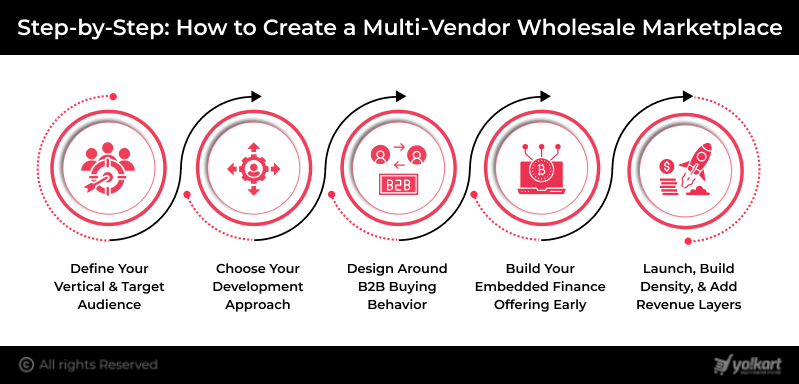
Step 1: Define Your Vertical and Target Audience
Faire’s initial focus was on independent boutique retailers and artisan brands in the US home goods and gift category. That specificity allowed it to build deep supply-demand density in a defined niche before expanding. Your marketplace needs the same clarity. Define your category (fashion, food and beverage, beauty, home goods, industrial supplies, or another niche), your target geography, your average brand size, and the types of retailers you will serve. Niche specificity at launch dramatically lowers customer acquisition cost and accelerates the flywheel.
Step 2: Choose Your Development Approach
This is the single most consequential decision in your entire multi-vendor marketplace development process. Custom development from scratch costs $80,000-$300,000+ and takes 12-24 months. A purpose-built, white-label B2B marketplace software like Yo!Kart delivers all the core features — including RFQ management, bulk ordering, tiered pricing, embedded payment terms, and a full admin dashboard. Moreover, you can launch your marketplace in days, not months, at a fraction of the cost when choosing a readymade solution. For most founders, the readymade route is not just cheaper, but it’s strategically smarter, because time-to-market is one of the most powerful competitive advantages in a marketplace business.
Step 3: Design Around B2B Buying Behavior
B2B buyers are not browsing for inspiration the way B2C shoppers do. They are solving procurement problems. Your UX must prioritize speed of reorder, clear MOQ and pricing visibility, bulk order management, and account-level relationship features like saved brand lists and rep assignments. Every UI decision should reduce the time-to-order, not showcase visual design. Study Faire’s buyer interface closely. Its simplicity is deliberate and hard-won.
Step 4: Build Your Embedded Finance Offering Early
Net payment terms are not a nice-to-have in wholesale — they are the primary reason independent retailers choose one platform over another. However, offering Net 60 terms means your platform absorbs the credit risk of retailer non-payment. Start with a limited, carefully underwritten offering for a subset of verified retailers. As you build repayment data, expand the program. This embedded finance layer will become one of your most powerful retention and revenue tools — exactly as it has for Faire.
Step 5: Launch, Build Density, and Add Revenue Layers
Launch your B2B wholesale marketplace with your committed brand set, a clean catalog, and a frictionless retailer onboarding flow. Focus the first three months exclusively on facilitating transactions and gathering feedback. Once you have consistent GMV growth and a base of returning retailers, layer in your advertising product (Promoted Listings), your subscription offering, and your logistics consolidation service. Each new revenue layer should make the core transaction experience better, not extract more value from users.
Solve the Cold Start Problem on the Supply Side
Every marketplace faces the chicken-and-egg problem: retailers will not join without brands, and brands will not join without retailers. Faire solved this by recruiting brands aggressively in its early months, offering heavily subsidized terms and zero-risk onboarding. Before you build anything, secure signed commitments from 20-50 brands willing to list on your platform at launch. Personal outreach at trade shows, niche industry events, and through manufacturer associations is more effective at this stage than any digital marketing strategy.
Step 5: Development Cost Breakdown
Cost varies dramatically based on your approach to multi-vendor marketplace development. Here is an honest, comprehensive 2026 breakdown:
| Approach | Estimated Cost | Time to Launch | Best Suited For |
| Custom Build (Agency) | $30,000 – $200,000+ | 12 – 24 months | Enterprises with proprietary B2B workflows and dedicated tech budgets |
| In-House Engineering Team | $250,000 – $700,000/yr | 18 – 36 months | Well-funded companies building for long-term technological moats |
| Freelance / Distributed Team | $40,000 – $150,000+ | 10 – 20 months | Founders are comfortable managing technical teams across time zones |
| Ready-Made B2B Solution (Yo!Kart) | $499 – $6,249 (one-time) | Days to 2 weeks | Entrepreneurs and SMEs wanting a proven, fast, cost-efficient launch |
Beyond initial development, if you are looking for a cost-efficient option, then choose a readymade solution like Yo!Kart is always a strategic and smart decision. It doesn’t just reduce cost but minimizes development timeline significantly.
Why Yo!Kart is the Smarter Path to Launch Your Wholesale Marketplace
You do not need to spend $200,000 and 18 months to build a B2B wholesale marketplace that delivers the core experience Faire’s users expect. Yo!Kart is a purpose-built, white-label multi-vendor marketplace software developed by FATbit Technologies, a company with 20+ years in e-commerce platform development since 2004. Since YoKart’s launch in 2015, The solution has powered 5,500+ marketplaces across 70+ countries, including B2B wholesale platforms, fashion marketplaces, electronics exchanges, and niche vertical platforms.
Yo!Kart B2B: Built for Wholesale Marketplace Complexity
- In-built RFQ (Request for Quote) Module: Buyers send quote requests; sellers accept, reject, or counteroffer. The entire negotiation workflow is managed within the platform. Most B2B solutions charge extra for this; Yo!Kart includes it as standard.
- Bulk Ordering with Tiered Pricing: Sellers set price breaks at quantity thresholds (e.g., 10 units at $X, 50 units at $Y, 100+ units at $Z). Buyers see live pricing as they adjust order quantities.
- Minimum Order Quantity (MOQ) Controls: Brands define per-product and per-order MOQs that are enforced automatically at checkout.
- Flexible Payment Terms: It enables configuring custom payment terms at the platform level or per brand relationship.
- Separate Panels for All Participants: Dedicated, purpose-built dashboards for buyers, sellers, advertisers, and admins, each optimized for their specific workflows without cross-contamination.
- 20+ Pre-Integrated Payment Gateways: Including Stripe Connect (for automated vendor split payouts), PayPal, and regional payment methods. Stripe Connect handles multi-brand order splitting automatically.
- 45+ Pre-Integrated Business APIs: Covering shipment management (ShipStation, EasyPost), tax compliance (TaxJar), accounting (QuickBooks), SMS, and marketing tools. All pre-built and configurable.
- Native iOS and Android Buyer Apps: Mobile-first wholesale ordering for retailers on the go — essential given the growing B2B mobile commerce trend.
- Multi-Language (70+ languages, including RTL) and Real-Time Multi-Currency: Serve global brands and retailers from a single platform instance.
- GDPR Compliance, SSL, 2FA, and PCI-DSS Security: Security is built in, not bolted on after launch.
- Customizable Source Code Ownership: No vendor lock-in, no transaction charges, no monthly SaaS fees. One-time license, owned forever. Build any custom feature on top of the Yo!Kart foundation.
Building From Scratch vs. Yo!kart
| Capability | Custom Build | Yo!Kart |
| Time to Market | 12 – 24 months | Days to 2 weeks |
| Development Cost | $30,000 – $200,000+ | Starting from $499 one-time |
| Transaction Charges | None (own infrastructure) | None — zero per transaction |
| RFQ Management Module | Custom development required | Included — in-built |
| Bulk Ordering and Tiered Pricing | Custom development required | Included out of the box |
| MOQ Controls | Custom development required | Included out of the box |
| Net Payment Term Configuration | Custom development required | Configurable included |
| Buyer Mobile App (iOS + Android) | Build from scratch | Included |
| 20+ Payment Gateways | Build each integration | Pre-integrated |
| Multi-Language and Multi-Currency | Custom development | 70+ languages, real-time FX |
| Customizable Source Code Ownership | Yes | Yes — 100% |
| Proven in Production | Unproven until live | 5,500+ platforms in 70+ countries |
Businesses that have launched on Yo!Kart reports a dramatically faster time-to-first-revenue. The freedom to focus engineering resources on competitive differentiation rather than infrastructure, and the confidence of a battle-tested platform that has already solved the hard technical problems of multi-vendor marketplace development. Yo!Kart’s portfolio includes UNI Diamonds, Israel’s largest B2B diamond trading platform, alongside diverse B2C and niche marketplace businesses across 70+ countries.
Want to See Yo!Kart B2B in Action
Conclusion
Faire’s journey from a 2017 startup to a $5.2 billion platform generating $600+ million in annual revenue is the most compelling proof point in B2B commerce today. It demonstrates that when you remove the friction from wholesale buying through digital discovery, embedded payment terms, risk-free first orders, and data-driven matching, the market responds with extraordinary scale.
The structural opportunity is even larger than Faire’s current footprint suggests. The platforms that build supply-demand density in the next three to five years will capture a disproportionate share of the digital shift.
Whether you are targeting a specific vertical, a defined geography, or an underserved segment of the independent retail ecosystem, the window to build a defensible wholesale marketplace has never been more clearly open.
Yo!Kart gives you a B2B-ready marketplace foundation with all the necessary features, such as RFQ management, bulk ordering, tiered pricing, flexible payment terms, and more, alongside customizable source code ownership. At the same time, it reduces time and costs significantly.
Frequently Asked Questions (FAQs)
Q 1. How much does it cost to build a wholesale marketplace like Faire?
Ans. Building a B2B wholesale marketplace from scratch typically costs between $30,000 and $200,000+ in development fees alone. However, the total cost of ownership may exceed. In contrast, Yo!Kart’s pricing starts at $499 as a one-time license fee with no monthly SaaS costs and no transaction charges. For most market entrants, the ready-made approach is not just more affordable
Q 2. What is the difference between a B2B wholesale marketplace and a B2C marketplace?
Ans. A B2C marketplace like Amazon or ASOS sells products directly to individual consumers, with single-unit purchases, consumer-facing pricing, and standard checkout flows. A B2B wholesale marketplace like Faire connects businesses — brands sell to retailers in bulk, at wholesale pricing, under commercial payment terms.
Key differences include:
- Bulk ordering with tiered pricing (lower per-unit cost at higher quantities),
- Minimum order quantities (MOQs),
- Flexible payment terms instead of immediate payment
- RFQ negotiation workflows
- ERP and POS system integrations
- Credit underwriting infrastructure.
B2B average order values are typically 5-10x higher than B2C, which means even a lower transaction count generates significant GMV.
Q 3. How long does multi-vendor marketplace development take for a wholesale platform?
Ans. Custom development of a B2B wholesale marketplace from scratch takes 12-24 months with an agency and 18-36 months with an in-house team. Using a purpose-built solution like Yo!Kart, you can have a fully configured, branded wholesale marketplace — including B2B-specific features like RFQ management, bulk ordering, and Net payment terms — live and accepting orders in a matter of days to two weeks. In a market where network density compounds over time, launching 12+ months earlier is one of the most durable competitive advantages available to a new marketplace.
Q 4. What is Yo!Kart and why is it well-suited for building a marketplace like Faire?
Ans. Yo!Kart is a ready-made, white-label multi-vendor marketplace software developed by FATbit Technologies, with a specific B2B variant (Yo!Kart B2B) purpose-built for wholesale commerce. It includes an in-built RFQ module, bulk ordering with tiered pricing, MOQ controls, flexible payment term configuration, and dedicated panels for buyers, sellers, advertisers, and admins. It comes with 20+ pre-integrated payment gateways, 25+ business APIs, and native iOS and Android buyer apps. CClients get customizable source code at a one-time license fee with no monthly SaaS-like recurring costs and transactional charges.
Q 5. What is the best revenue model for a wholesale marketplace?
Ans. The most proven starting point is a commission-on-transaction model. Charge brands a percentage (typically 10-25%) of each order value placed through your platform. This aligns your revenue with your users’ success and requires no upfront payment from either side. As your platform matures, layer in: an advertising product (Promoted Listings for brands), a buyer subscription for shipping perks, and an embedded finance offering (Net payment terms with a financing fee).
Faire’s model demonstrates how these layers compound: commissions drive base revenue, advertising adds high-margin revenue, and embedded finance drives retention by making the platform indispensable to retailer cash flow management.
Q 6. How do I solve the cold start problem when launching a B2B wholesale marketplace?
Ans. The cold start problem is the central challenge of any two-sided marketplace: buyers will not join without sellers, and sellers will not join without buyers. Faire’s solution was to recruit supply (brands) aggressively before launch, offering heavily subsidized terms and personal onboarding support.
For new marketplaces, the most effective approach is:
1. Pick a category narrow enough that you can personally onboard 20-50 committed brands before launch.
2. Offer brands zero or reduced commission for the first 6-12 months to lower their risk.
3. Use your initial brand catalog to recruit your first 100 retailers through targeted outreach, industry associations, and trade show attendance.
Once you have enough supply to make discovery valuable for buyers, organic inbound demand begins.
Q 7. What payment features are most important for a B2B wholesale marketplace?
Ans. The four payment features that most directly drive adoption and retention in wholesale marketplaces are:
1. Net payment terms (Net 30/60/90): The single biggest conversion driver is that retailers need inventory before they can earn revenue to pay for it.
2. Upfront brand payment: Brands receive their money immediately while the platform manages retailer credit, eliminating brands’ cash flow risk.
3. Split payouts for multi-brand orders: When a retailer orders from five brands in one transaction, each brand must receive its share automatically
4. International payment support: ACH, SEPA, bank transfer, and regional wallets for cross-border wholesale. Yo!Kart’s Stripe Connect integration handles automated split payouts natively.