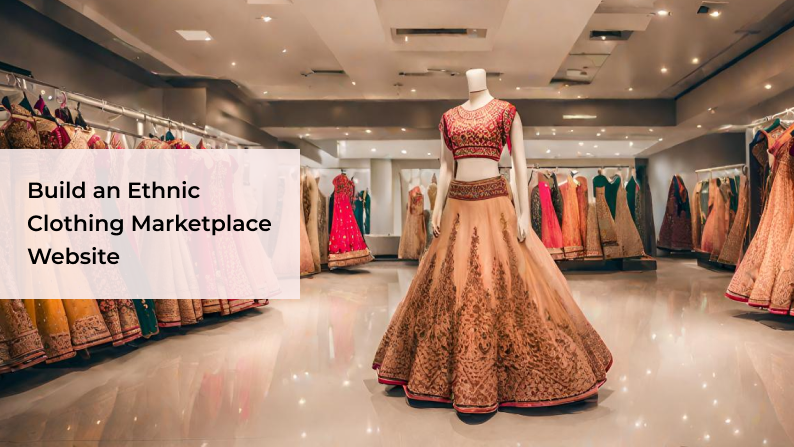

The global fashion landscape is undergoing a beautiful transformation, with ethnic wear emerging as a dominant trend that honors cultural heritage and showcases authentic craftsmanship. As consumers increasingly seek unique, handcrafted, and culturally meaningful apparel, the demand for specialized online platforms, specifically, ethnic clothing marketplace websites, has grown exponentially. These platforms not only provide consumers with access to a rich variety of garments from various regions and artisans but also provide a crucial digital bridge for small-scale sellers to reach a global audience.
Thus, building such a robust platform requires a strategic approach, blending sophisticated technology with a keen understanding of the niche market. This comprehensive blog, crafted by an industry expert, will walk you through the essential features and development choices to successfully build an ethnic clothing marketplace that is both profitable and scalable, helping you turn your vision of an online marketplace into a thriving business.
Table of Contents
What is an Ethnic Clothing Marketplace?
An ethnic clothing marketplace is a specialized type of eCommerce platform that operates on a multi-vendor model, focusing exclusively on the sale of traditional, cultural, or fusion apparel and accessories. Unlike a single-vendor online store, a marketplace allows multiple independent sellers, including artisans, boutiques, and small businesses, to register, list their products, manage their inventory, and process orders through a single, centralized website.
The platform owner, or operator, manages the overall site, marketing, and the technical infrastructure, earning revenue typically through commissions on sales, subscription fees, listing fees, or through other channels.
Key characteristics that define this niche marketplace include:
- Diverse Inventory: Products range from Indian sarees, lehengas, and kurtas to African dashikis, Japanese kimonos, and Latin American textiles.
- Focus on Authenticity: There is a high value placed on the origin, fabric quality, and traditional craftsmanship of the garments.
- Cultural Storytelling: The platform often facilitates rich product descriptions that detail the cultural significance and heritage of each item, creating an emotional connection with the buyer.
- Multi-Vendor Architecture: The core structure must support independent seller accounts, separate storefronts, and a streamlined system for order split and payment disbursement.
Benefits of Building an Ethnic Clothing Marketplace Website
Launching an ethnic clothing marketplace website offers substantial advantages for the operator, sellers, and buyers, positioning the business for significant growth in the booming cultural fashion sector. Furthermore, the benefits of building an ethnic clothing marketplace website for each user type are listed below:
For the Operator
Massive Product Scalability: You can expand your product catalog almost infinitely without the risk and cost of holding inventory. Sellers manage their own stock, allowing you to rapidly diversify offerings by onboarding new vendors and cultural niches.
1. Multiple Revenue Channels: Revenue isn’t limited to just sales. You can monetize through multiple streams, including:
- Commission: A percentage cut on every transaction.
- Subscription Plans: Monthly or annual fees for vendors to access premium features.
- Featured Listings/Ads: Selling promotional space on the website.
2. Network Effects and Reduced Acquisition Costs: A wider product range attracts more buyers, which in turn attracts more sellers, creating a powerful, self-reinforcing network effect. This can lead to lower customer acquisition costs (CAC) over time as your brand reputation grows.
3. Operational Efficiency: Sellers handle key operational tasks like inventory management, order fulfillment, and shipping logistics, allowing the operator to focus on strategic growth, platform enhancement, and marketing.
For the Sellers
1. Global Reach: Small-scale artisans and local boutiques gain instant access to a worldwide customer base that they could not reach on their own.
2. Lower Overheads: Sellers avoid the high costs and complexity of building and maintaining their own eCommerce website.
3. Increased Trust: Operating under an established marketplace brand lends credibility and trust to smaller vendors, encouraging first-time purchases from new customers.
For the Buyers
1. Vast Variety: Customers can compare and purchase thousands of unique items from diverse cultures and regions in a single, convenient location.
2. Authenticity and Transparency: Reviews and ratings offer social proof and insights into the quality and fit of the product, fostering trust.
3. Convenience: The platform is operating 24/7, offering a streamlined, easy-to-navigate shopping experience with a unified checkout process, even for items from different sellers.
Build Your Ethnic Marketplace and Connect Buyers Worldwide
Must-Have Features in an Ethnic Clothing Marketplace Website
The success of a fashion marketplace, especially one as specialized as ethnic wear, hinges on providing an exceptional user experience that addresses the unique challenges of buying clothing online, such as size and fitting. Hence, the platform must be robust for the admin and seller, and intuitive for the buyer. Let’s explore some features that your ethnic clothing marketplace website must have:
Buyer-Facing Features (Frontend)
| Feature | Description |
| Advanced Search and Filtering | Filters by fabric type, color, size, price, and crucially, ethnic origin, such as region, state, or specific craft. |
| Detailed Size & Fit Guide | Standardized size charts, product-specific measurements, and the ability for sellers to add custom notes on fit, e.g., runs small, tailored fit. |
| High-Resolution Visuals | Multiple, zoomable images, 360-degree views, and product videos that showcase the garment’s fall, texture, and movement. |
| Robust Rating & Review System | Allows buyers to review products and, more importantly, rate the sellers on quality, accuracy, and shipping speed. |
| Personalized Recommendations | AI-driven suggestions for complementary items, including jewelry, accessories, or similar styles based on browsing/purchase history. |
| Multilingual & Multi-Currency Support | Ability to display content and prices in the user’s local language and currency. |
Seller and Admin-Facing Features (Backend)
| Feature | Description |
| Easy Vendor Onboarding & Management | A streamlined process for sellers to register, create their storefront, and manage all aspects of their business from a dedicated dashboard. |
| Separate Seller Dashboard | A custom control panel for each seller to manage inventory, track sales, view earnings, manage returns/exchanges, and update shipping details. |
| Commission & Payout Management | Automated system for calculating the operator’s commission, managing multiple revenue channels, including commissions and subscriptions, and facilitating timely, accurate payouts to sellers via integrated services like PayPal Payouts or Stripe Connect. |
| Inventory Tracking & Order Split | Real-time inventory updates and a system that automatically splits a single customer order containing products from multiple sellers into separate, manageable order tickets for each vendor. |
| Promotions & Discount Engine | Tools for both the admin (site-wide sales) and the sellers (store-specific coupons) to create and manage dynamic discounts and special offers. |
| Analytics and Reporting | Comprehensive dashboards for the admin to track KPIs like sales, traffic, conversion rates, and the performance of individual sellers and product categories. |
Build Your Own Feature-Packed Ethnic Clothing Marketplace
Development Approaches: Custom VS Ready-made Solution
When looking to build your ethnic clothing marketplace, there is an important decision that you have to make: opting for custom development or utilizing ready-made eCommerce marketplace Software. However, each path has distinct implications for cost, time-to-market, flexibility, and long-term scalability. Let’s explore both approaches for a better understanding:
Custom Development: The Tailor-Made Approach
Custom development involves building the entire platform from scratch by hiring a team of developers, designers, and project managers.
| Pros | Cons |
| Total Customization: The platform is built exactly to your specifications, supporting unique features and complex business logic. | High Initial Cost: Requires a significant upfront investment in design, development, and testing. Costs can easily start at $80,000+ and climb into the hundreds of thousands. |
| Unlimited Scalability: Code is owned by you and can be optimized and scaled precisely as your business grows without being constrained by a third-party framework. | Longer Time-to-Market: Development cycles are lengthy, typically taking 6 to 12 months or more for a feature-rich marketplace. |
| Full Ownership & Control: You own the entire source code and database, giving you complete control over future updates and integrations. | Ongoing Maintenance Burden: You are responsible for all maintenance, security patches, bug fixes, and system updates, requiring a dedicated in-house technical team. |
| Unique Brand Identity: The design and user experience will be unique, helping you stand out from the competition. | High Risk: The success depends entirely on the expertise of your development team, and poor execution can lead to costly rework or failure. |
Ready-made (Off-the-Shelf) eCommerce Marketplace Software: The Smart Start
Ready-made software is a pre-built, packaged solution specifically designed to launch multi-vendor marketplaces. Solutions like Yo!Kart are designed to be easily set up, configured, and deployed.
| Pros | Cons |
| Low Initial Cost & High Affordability: The one-time licensing fee is drastically lower than custom development, typically ranging from $1,000 to $10,000+ for the core software (for lifetime ownership). | Learning Curve: While customizable, you are generally working within the software’s existing architecture and feature set. |
| Rapid Launch: Since the core architecture is already built and tested, you can launch a Minimum Viable Product (MVP) in a matter of weeks, not months. | |
| Proven & Tested Features: The software comes pre-built with the essential eCommerce and multi-vendor features, which have been tested across various niches. | |
| Reduced Maintenance: The software provider typically handles core bug fixes, security updates, and performance optimization for the underlying framework. |
Recommended Approach: Choosing Ready-made eCommerce Marketplace Software
For a business looking to create an ethnic clothing marketplace website, the ready-made software approach is the most practical, efficient, and financially sensible choice for the initial launch and early-stage growth.
Benefits of Leveraging a Ready-made Solution: The ethnic clothing market is driven by authenticity, variety, and time-to-market. By choosing a ready-made solution, you can:
- Validate Your Idea Quickly: Instead of spending a year and hundreds of thousands of dollars on custom development, you can launch a functional, feature-rich MVP in a matter of weeks. This allows you to test your business model, onboard initial sellers, and start generating revenue much faster.
- Focus on the Niche, Not the Code: Leveraging a readymade solution allows you to focus on curating unique products, onboarding high-quality artisans, and telling cultural stories, instead of managing server uptime, payment gateway integrations, and coding bugs. Thus, you do not have to worry about the technical complexities.
- Optimize for Cash Flow: The lower upfront cost preserves your capital, allowing you to allocate more budget to crucial areas like digital marketing, seller acquisition, and high-quality photography, which directly impact revenue growth.
While custom development offers maximum control, it’s a financial and logistical burden best reserved for established businesses that have already validated their niche and have complex, proprietary features that no off-the-shelf software can provide. On the other hand, for a lean and fast start, readymade is the recommended path.
Yo!Kart: The eCommerce Marketplace Software for Your Ethnic Clothing Business
Among the available ready-made solutions, Yo!Kart stands out as an exemplary eCommerce marketplace software solution that is particularly well-suited for launching an ethnic clothing platform. It is a self-hosted, white-label, multi-vendor solution built to support complex marketplace operations.
A key differentiator is that Yo!Kart offers 100% source code ownership with a one-time fee, which effectively bridges the gap between the speed of a ready-made solution and the flexibility of custom development. This means you have the freedom to customize and scale the platform as needed in the long term without being tied to a subscription model or transaction fees, providing a foundation for long-term growth.
How Yo!Kart Supports the Growth of Your Ethnic Clothing Marketplace
Yo!Kart’s robust feature set is tailored to address the specific needs of a digital ethnic clothing marketplace:
1. Dedicated Multi-Vendor Architecture
- Intuitive Seller Dashboard: Gives your artisans a simple, powerful interface to manage their individual digital storefronts, product listings, order fulfillment, and earnings, significantly easing their transition to online selling.
- Automated Commission Management: The platform automatically calculates and deducts your commission based on pre-set rules, streamlining one of the most critical aspects of the marketplace model.
2. Global Commerce Readiness
- Multilingual & Multi-Currency Support: Essential for a niche that operates globally. Yo!Kart supports multiple languages and currencies, allowing a seller in India to list prices in INR while a buyer in the US sees and pays in USD.
- Pre-Integrated Payment Gateways: Comes integrated with over 20 popular payment options, including PayPal and Stripe Connect, ensuring customers can pay securely and easily, regardless of their location.
3. Enhanced Shopping Experience for Clothing
- Advanced Search & Filtering: The system supports deep filtering, which can be configured to include highly specific ethnic attributes like weave type, embroidery style, region of origin, and cultural category, making product discovery easier for the buyer.
- Product Catalog System: Enables you to maintain product quality and standardization by allowing sellers to list against an approved master catalog, ensuring consistency across similar products from different vendors.
- Smart Recommendations: Helps increase the AOV (Average Order Value) by suggesting culturally complementary products, such as pairing an ethnic dress with traditional jewelry or a matching dupatta.
4. Scalability and Ownership
- PWA and Mobile Apps: Yo!Kart is a Progressive Web App (PWA) compliant and offers native iOS and Android apps, ensuring a seamless, high-performance shopping experience on mobile devices, which account for a significant portion of all eCommerce traffic (often over 60% of product searches).
- Full Customization: While it’s a ready-made solution, its architecture is designed to be highly customizable. The source code ownership empowers you to later integrate any unique, complex feature you need, such as an AR-powered virtual try-on or advanced customization tools for bespoke ethnic garments.
By choosing Yo!Kart, you are opting for a tested, powerful engine that accelerates your market entry. Moreover, you receive a fully functional marketplace foundation, allowing you to bypass the lengthy, expensive custom development phase and move directly to sourcing, marketing, and revenue generation.
See Yo!Kart in Action
Conclusion
The future of ethnic fashion is undeniably digital, and a well-executed ethnic clothing marketplace website is the perfect way to capitalize on this global trend. However, the journey from idea to launch requires careful consideration of the platform’s core features and the underlying development strategy.
While custom development offers maximum control, it is often a financially restrictive and time-consuming path. Thus, for the ambitious entrepreneur looking to quickly build an ethnic clothing marketplace that is scalable, affordable, and feature-rich, leveraging a sophisticated eCommerce marketplace software like Yo!Kart is the smarter choice.
By choosing a self-hosted solution that provides dedicated multi-vendor tools, global commerce capabilities, and critical features for the fashion niche, such as advanced filtering and robust visuals, you position your business to become a leading online destination for authentic cultural apparel.
FAQs
Q 1. Why is using ready-made eCommerce marketplace software better for building an ethnic clothing website?
Ans. Ready-made eCommerce marketplace software offers quick setup, cost-efficiency, and a range of built-in features to launch your marketplace faster. Moreover, these platforms come equipped with secure payment gateways, customizable designs, and scalability options, allowing you to focus on building your brand without worrying about the technical complexities.
Q 2. Is Yo!Kart a good platform to launch an ethnic clothing marketplace?
Ans. Yes, Yo!Kart is an excellent choice for starting your ethnic clothing marketplace. It supports multi-vendor functionality, provides customization options, and includes essential eCommerce tools. Additionally, its scalable infrastructure allows you to grow your business as demand increases. Furthermore, Yo!Kart also offers features like mobile optimization, SEO-friendly tools, and integrated marketing options, ideal for niche markets like ethnic clothing.
Q 3. Can I customize my ethnic clothing marketplace website to fit different regions and cultures?
Ans. Yes, you can customize your ethnic clothing marketplace website to fit different regions and cultures. Solutions like Yo!Kart offers customization options for design and functionality, enabling you to personalize your marketplace for specific regional preferences, such as offering products that cater to different cultural practices, adding regional payment gateways, and setting up localized shipping options.
Q 4. What are the startup costs for building an ethnic clothing marketplace website?
Ans. The costs for building an ethnic clothing marketplace website depend on whether you choose custom development or a ready-made solution.
- Custom Development: Could cost anywhere from $30,000 to $1,00,000 or more, depending on the complexity.
- Ready-made Software: Platforms like Yo!Kart offer packages start at around $999, with additional costs for any customizations you might need.
Q 5. Is it possible to integrate ethnic clothing marketplace websites with social media platforms?
Ans. Yes, it is possible to integrate your marketplace with social media platforms like Instagram, Facebook, and Pinterest. Moreover, it is a great way to promote ethnic clothing and reach more customers. Many eCommerce platforms, including Yo!Kart offers seamless integration with social media to showcase products, run ads, and drive sales.
Q 6. How long does it take to launch my ethnic clothing marketplace website?
Ans. With a ready-made software like Yo!Kart, you can launch your marketplace in as little as a few days to a couple of weeks, depending on the customization level. Custom development, on the other hand, may take several months or more than a year, as it requires design, development, and testing from the ground up.
Q 7. How can I attract buyers to my ethnic clothing marketplace website?
Ans. By leveraging the following methods, you can attract buyers to your ethnic clothing marketplace website:
- Use SEO to optimize product pages.
- Leverage social media marketing to showcase ethnic styles.
- Create ads targeting niche ethnic fashion enthusiasts.
- Partner with influencers in the ethnic fashion space.
- Offer promotions and discounts to draw in first-time customers.
Q 8. What countries are the best for launching an ethnic clothing marketplace?
Ans. Countries with rich cultural diversity or a high demand for ethnic wear are great markets to target. Popular regions include:
- Middle Eastern countries: For traditional Arabic clothing.
- The US, UK, and Canada: For multicultural audiences looking for ethnic clothing.
- France, Germany: For consumers interested in ethnic fusion wear.
Additionally, consider regions with large emigration communities or areas where traditional ethnic wear is in demand.
Ready to Start Your Own Ethnic Clothing Marketplace?
Reach OutPopular Posts