
Published date 15th January 2026
The eCommerce landscape has evolved rapidly over the past decade, and one business model has consistently proven its value in terms of scalability, profitability, and long-term sustainability, the multi-vendor eCommerce website. Industry leaders such as Amazon, Etsy, and Alibaba have proven that enabling multiple sellers to operate on a single platform can unlock massive growth opportunities and market dominance.
Today, startups, entrepreneurs, and enterprises are actively exploring multi-vendor eCommerce website development to launch their own online marketplaces. However, building a marketplace from scratch is not just a technical task. It requires careful strategic planning, a deep understanding of marketplace dynamics, and the right platform selection to support long-term growth.
In this comprehensive blog, we’ll walk through everything you need to know about how to build a multi-vendor eCommerce website from scratch, from understanding the business model and features to choosing the right development approach and overcoming common challenges.
Whether you’re a startup founder, business owner, or enterprise decision-maker, this guide will help you make informed decisions and build a future-ready multi-vendor eCommerce marketplace website.
Table of Contents
- What is a Multi-Vendor eCommerce Website?
- Top Multi-Vendor eCommerce Websites
- Why Build a Multi-Vendor eCommerce Website?
- How do Multi-Vendor eCommerce Websites Make Money?
- Must-Have Features in a Multi-Vendor eCommerce Website
- Development Approaches: Custom vs Readymade Solutions
- Common Challenges in Multi-Vendor eCommerce Website Development
- Yo!Kart: Best eCommerce Platform to Build a Multi-Vendor eCommerce Website
- Conclusion
- FAQs
What is a Multi-Vendor eCommerce Website?
A multi-vendor eCommerce website is an online marketplace where multiple independent sellers can register, list their products, manage inventory, process orders, and sell directly to customers, all within a single, unified platform.
Unlike a single-vendor eCommerce store, a multi-vendor model positions the platform owner as a facilitator rather than a direct seller. The platform generates revenue through commissions, vendor subscriptions, advertisements, or value-added services.
Key Characteristics of a Multi-Vendor Marketplace Website:
- Multiple sellers/vendors operating on the same platform
- Individual seller dashboards for product, order, and inventory management
- Centralized admin control over vendors, commissions, and transactions
- Shared customer base that benefits all vendors
- Commission-based or multi-stream revenue model
Top Multi-Vendor eCommerce Websites
Studying successful multi-vendor marketplaces helps businesses understand how the right combination of technology, vendor management, and customer experience can drive large-scale growth.
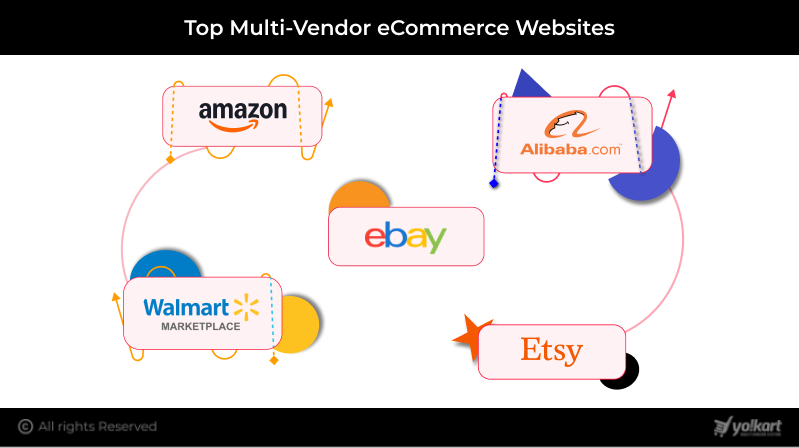
Below are some of the most well-known multi-vendor eCommerce websites, each demonstrating a distinct and unique marketplace approach.
1. Amazon
Amazon is the world’s largest multi-vendor eCommerce website, hosting millions of third-party sellers across nearly every product category. Its success is driven by advanced logistics, strong seller tools, data-driven recommendations, and strong customer trust. Amazon illustrates how a highly scalable marketplace ecosystem, combined with robust fulfillment and vendor management systems, can dominate global eCommerce.
2. eBay
eBay is one of the earliest examples of a multi-vendor eCommerce marketplace website, originally built around peer-to-peer auctions. Later, it expanded into fixed-price B2C selling. Its strength lies in flexible selling models, global reach, and strong buyer-seller feedback mechanisms that build trust without centralized inventory control.
3. Etsy
Etsy focuses on niche sellers offering handmade, vintage, and creative products. This marketplace shows how a multi-vendor eCommerce marketplace can succeed in specialized verticals by prioritizing community-driven selling, strong branding, and personalized shopping experiences. Etsy’s model highlights the value of vendor individuality within a structured marketplace platform.
4. Alibaba
Alibaba is a global leader in B2B multi-vendor eCommerce marketplace software, connecting manufacturers, wholesalers, and buyers worldwide. It supports bulk purchasing, trade assurance, and cross-border commerce, showcasing how marketplaces can scale beyond consumer retail into enterprise and wholesale markets.
5. Walmart Marketplace
Walmart Marketplace is one of the leading US-based multi-vendor eCommerce platforms, enabling third-party sellers to reach millions of customers nationwide. Its success is driven by a strong omnichannel strategy, trusted brand presence, integrated logistics, and strict seller quality standards. Walmart Marketplace demonstrates how established retail brands can scale multivendor ecosystems while maintaining control, trust, and performance.
These platforms clearly demonstrate the power of eCommerce marketplace development when paired with the right feature set, a strong seller ecosystem, and a scalable technology strategy.
Launch a Multi-Vendor Marketplace Inspired by Global Leaders
Why Build a Multi-Vendor eCommerce Website?
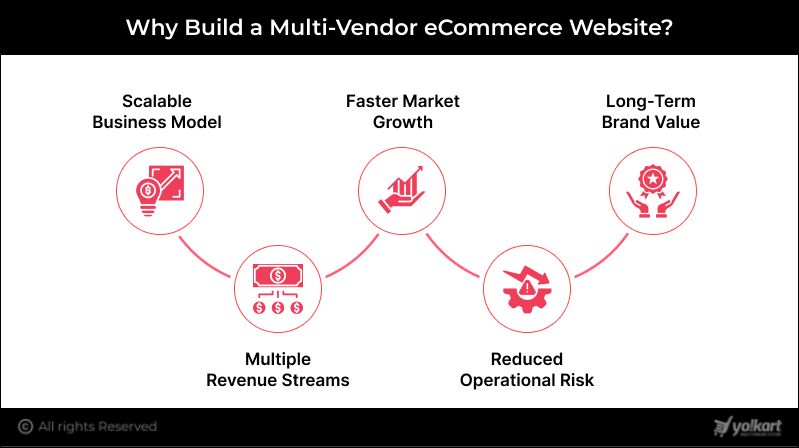
Building a multi-vendor eCommerce website is a strategic decision for businesses seeking scalability, diversified revenue, and long-term digital growth. Unlike single-seller eCommerce stores, a multi-vendor model allows you to create a marketplace ecosystem where multiple sellers collectively contribute to growth, product variety, and customer acquisition. Some of the benefits include:
1. Scalable Business Model
A multi-vendor eCommerce website allows the platform to scale without the need to manage inventory or product sourcing internally. As new vendors join the marketplace, they bring their own products, expanding the catalog without significantly increasing operational costs or resource requirements.
2. Multiple Revenue Streams
Multi-Vendor marketplaces are not limited to a single income source. Platform owners can generate revenue through sales commissions, vendor subscription plans, paid advertisements, featured product placements, and value-added services. This diversified revenue model improves financial stability and increases long-term profitability.
3. Faster Market Growth
Each vendor actively promotes their own products and storefront, indirectly promoting the marketplace itself. This shared effort significantly accelerates customer acquisition and brand visibility. As more sellers join, the platform benefits from network effects that drive exponential growth.
4. Reduced Operational Risk
Since vendors are responsible for inventory management, pricing, and order fulfillment, the marketplace owner avoids the risks associated with unsold stock and logistics. This reduces financial exposure and operational complexity while allowing the platform to focus on growth and user experience.
5. Long-Term Brand Value
Over time, a successful multi-vendor marketplace evolves into a trusted digital ecosystem. Ongoing buyer-seller interactions strengthen credibility, encourage repeat usage, and build lasting brand authority in the market.
How Do Multi-Vendor eCommerce Websites Make Money?
A well-structured multi-vendor eCommerce marketplace website generates revenue through multiple monetization channels. Rather than relying on a single income source, marketplaces combine several models to ensure steady cash flow and long-term profitability. Given below are some of the popular and common revenue streams that multi-vendor marketplaces follow:
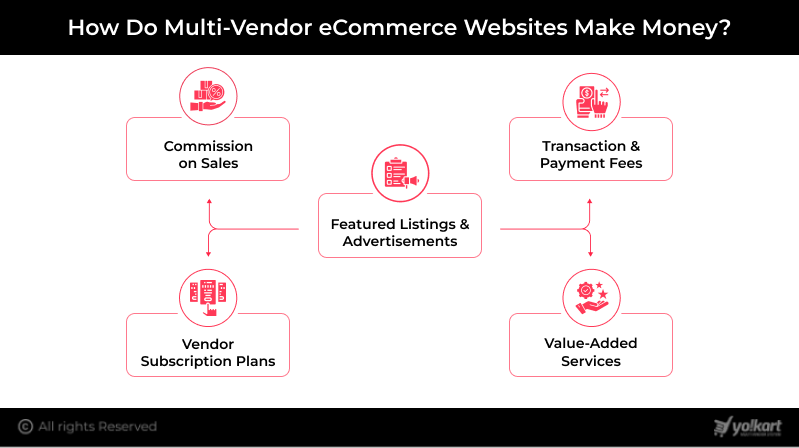
1. Commission on Sales
This is the most widely used monetization model in multi-vendor marketplaces. The platform owner earns a fixed or variable percentage-based commission from every successful transaction made by vendors. Commission rates can differ based on product categories, vendor plans, or order value, allowing flexibility in revenue optimization.
2. Vendor Subscription Plans
In this model, sellers pay a recurring monthly or annual fee to access the marketplace. Subscription plans often include benefits such as higher product listing limits, homepage banners, access to advanced selling tools, analytics, or reduced commission rates. This creates predictable and recurring revenue for the platform owner.
3. Featured Listings & Advertisements
Vendors can pay to promote their products or storefronts through sponsored listings, homepage banners, or priority placement in search results. This increases vendor visibility and sales while also providing an additional income stream for the marketplace.
4. Transaction & Payment Fees
Some marketplaces charge small service or processing fees on each transaction completed through the platform. These fees help offset operational costs such as payment gateway charges, platform maintenance, and security infrastructure.
5. Value-Added Services
Beyond core selling features, marketplaces can offer premium services, such as logistics support, marketing assistance, advanced analytics, onboarding support, or priority customer service. These offerings enhance vendor success while generating extra revenue for the platform.
By using flexible multi-vendor eCommerce marketplace software, platform owners can combine multiple monetization strategies to build a profitable, scalable marketplace business over time.
Must-Have Features in a Multi-Vendor eCommerce Website
To compete effectively in today’s digital marketplace, a multi-vendor eCommerce website must offer features that support vendors, administrators, and customers equally. These core functionalities ensure smooth operations, platform scalability, and a consistent, high-quality user experience.
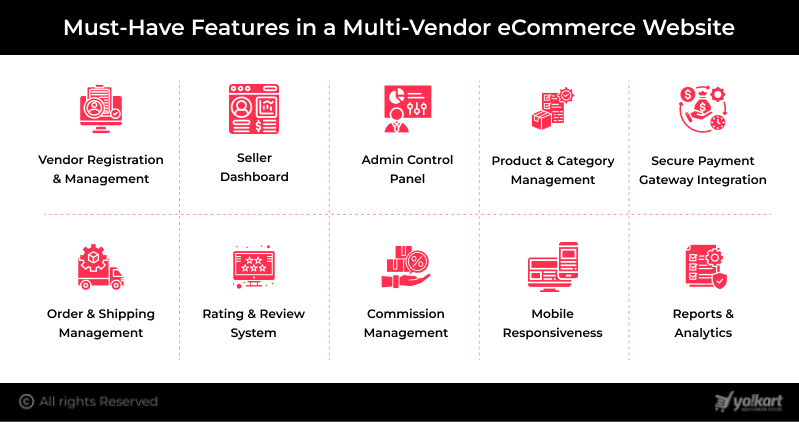
1. Vendor Registration & Management
A structured vendor registration process allows sellers to sign up easily while enabling admins to approve, reject, or verify vendors. Further, profile management features help vendors showcase their brand, policies, and offerings, while admins maintain quality standards and compliance across the platform.
2. Seller Dashboard
The seller dashboard serves as the vendor’s control center. From a single interface, vendors can manage product listings, pricing, inventory, orders, and earnings in real time, improving operational efficiency and transparency.
3. Admin Control Panel
The admin panel provides complete control over marketplace operations. It allows admin/s to manage vendors, set commission rates, monitor transactions, control content, and enforce marketplace policies through a centralized interface.
4. Product & Category Management
This feature enables vendors to add and manage products efficiently using bulk uploads, product variations, and structured category assignments. Support for both digital and physical products ensures flexibility across multiple business models.
5. Secure Payment Gateway Integration
Integrated payment gateways ensure safe and seamless transactions. Automated split payments allow commissions to be deducted instantly while vendors receive their share without manual intervention, improving trust and operational efficiency.
6. Order & Shipping Management
Order management tools enable vendors and admins to track order status, manage returns, and apply shipping rules. Integration with logistics and delivery partners helps streamline logistics and improve order fulfillment speed.
7. Rating & Review System
A verified review and rating system builds credibility and trust among buyers. It helps customers make informed purchasing decisions while encouraging vendors to maintain product quality and service standards.
8. Commission Management
Flexible commission settings allow marketplace owners to define commission rates based on vendors, product categories, or order value. This ensures profitability while offering vendors fair and transparent earning structures.
9. Mobile Responsiveness
A mobile-responsive marketplace delivers a consistent user experience across smartphones, tablets, and desktops. Since a large share of eCommerce traffic comes from mobile devices, this feature is essential for higher conversions.
10. Reports & Analytics
Advanced reporting and analytics provide insights into sales performance, vendor activity, customer behavior, and revenue trends. These insights help marketplace owners make data-driven decisions and optimize platform growth.
These features collectively form the foundation of successful eCommerce marketplace development, ensuring scalability, security, and long-term profitability.
Launch Your Own Feature-Packed Multi-Vendor eCommerce Website
Development Approaches: Custom vs Readymade Solutions
When planning multi-vendor eCommerce website development, businesses typically choose between two approaches: building a custom marketplace from scratch or using readymade eCommerce marketplace software. Each option has distinct use cases, costs, and implications for scalability and long-term growth.
1. Custom Multi-Vendor eCommerce Website Development
Custom development involves designing and building a multi-vendor eCommerce website from stratch using specific programming frameworks and technologies. Every feature, workflow, and interface is tailored to meet unique business requirements.
This approach offers complete control over design, functionality, and system architecture. However, it also demands extensive planning, continuous ongoing development, and a dedicated technical team to manage performance, security, and future upgrades.
Advantages:
- Complete freedom in design, user experience, and feature customization
- Tailored system architecture aligned with specific business processes
Disadvantages:
- High initial development and long-term maintenance costs
- Longer time-to-market due to extensive development and testing
- Continuous dependency on developers for updates and bug fixes
- Higher risk of performance, scalability, and security issues if not managed effectively
Custom development is generally suitable for large enterprises with complex requirements, substantial budgets, and longer development timelines.
2. Readymade eCommerce Marketplace Software
Readymade eCommerce marketplace software consists of pre-built platforms specifically builtd for multi-vendor eCommerce marketplace websites. These solutions come with core marketplace features that are already developed, tested, and optimized.
Instead of building everything from scratch, businesses can customize existing modules, configure workflows, and launch the marketplace much faster. Additionally, readymade solutions are built on proven architectures that support scalability, security, and performance from day one.
Advantages:
- Faster marketplace launch with significantly reduced development time
- Cost-effective compared to custom-built solutions
- Proven and scalable architecture tested across multiple deployments
- Built-in multi-vendor features such as vendor management, commission handling, and payment splitting
- Regular updates, security patches, and performance enhancements
Disadvantages:
- The rich feature set may require some onboarding time, but it enables teams to fully leverage advanced marketplace capabilities.
For most startups and growing businesses, readymade multi-vendor eCommerce marketplace software provides a smarter, safer, and more scalable approach, allowing them to focus on vendor acquisition, customer experience, and revenue growth rather than development complexities.
Common Challenges in Multi-Vendor eCommerce Website Development
Building and managing a multi-vendor eCommerce website presents unique challenges that can affect platform performance, vendor satisfaction, and customer trust. Understanding these challenges early helps businesses select the right technology and development approach.
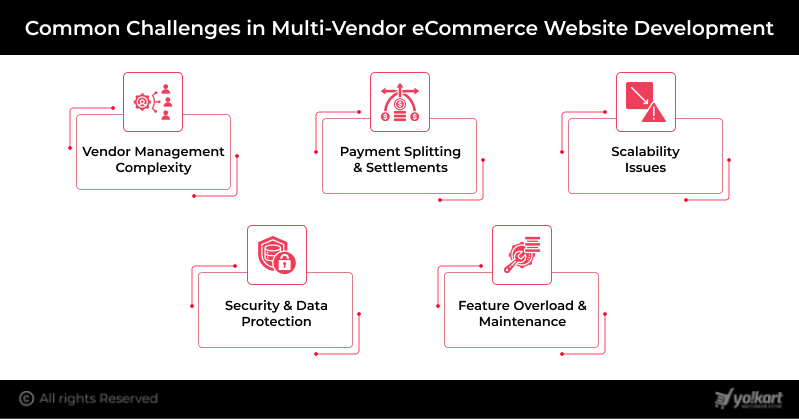
1. Vendor Management Complexity
Managing multiple sellers involves onboarding, verification, approval workflows, and ongoing support. Without strong vendor management tools, handling disputes, performance tracking, and compliance issues can become difficult.
2. Payment Splitting & Settlements
Accurate and timely vendor payouts are critical for trust and retention. Managing commissions, refunds, and multiple payment methods becomes increasingly complex, especially as the number of vendors grows.
3. Scalability Issues
As more vendors and buyers join the platform, performance bottlenecks can arise, including slow page load times, server crashes, and database inefficiencies. Thus, scalability must be planned and built into the platform from the start.
4. Security & Data Protection
Multi-Vendor marketplaces handle sensitive customer information, payment details, and vendor data. Weak security measures can lead to breaches, data loss, and reputational damage, making robust protection and compliance essential.
5. Feature Overload & Maintenance
Adding new features, upgrading the platform, and fixing bugs require continuous technical effort. Without proper maintenance, the platform can become outdated, unstable, or difficult to manage.
These challenges highlight the importance of choosing a marketplace-specific eCommerce website builder that is built to handle multiple vendors, automate complex workflows, and scale efficiently as the business grows.
Yo!Kart: Best eCommerce Platform to Build a Multi-Vendor eCommerce Website
Yo!Kart is a powerful, ready-made multi-vendor eCommerce marketplace software designed to help entrepreneurs and enterprises launch scalable online marketplaces quickly and efficiently.
Unlike generic eCommerce website builders, Yo!Kart is purpose-built for multi-vendor eCommerce website development, and comes equipped with enterprise-grade marketplace features. It is designed to handle complex vendor workflows, high transaction volumes, and long-term scalability from day one.
Why Choose Yo!Kart?
- 100% customizable & license-based ownership
- Advanced vendor onboarding and management system
- Built-in commission & payout management
- Scalable architecture for high traffic
- Mobile-ready and SEO-friendly
- Multi-language & multi-currency support
- Secure and performance-optimized
Yo!Kart significantly reduces time-to-market while addressing the most common marketplace challenges, making it an ideal solution for founders and businesses looking to build a serious, growth-ready eCommerce platform.
Discover How Yo!Kart Powers Successful Marketplaces
Real-World Success: Multi-Vendor Websites Powered by Yo!Kart
Yo!Kart is not just a theoretical ecommerce marketplace solution. It powers successful real-world, revenue-generating multi-vendor platforms across diverse industries and regions. From B2B commerce to regulated marketplaces, these implementations demonstrate how a robust technology foundation enables scalability, security, and long-term growth.
You can explore their extensive case studies to see how various industries utilize the platform. Here are a few notable examples:
- Uni-Diamonds: A sophisticated B2B diamond marketplace built to support complex pricing structures, bulk transactions, and high-security requirements. The platform enables seamless trading between verified buyers and sellers in a highly specialized industry.
Read Case Study - NPK Marketplace: A sustainable fertilizer marketplace that connects crop growers with livestock farmers. This platform demonstrates how niche and eco-driven marketplaces can thrive with tailored vendor workflows and industry-specific functionality.
- Tana: A leading horizontal marketplace in Albania that successfully scaled to serve a national audience. The platform supports multiple product categories, including electronics, fashion, and beauty, showcasing strong performance at scale.
Explore Case Study - RxAll: A healthcare marketplace in Africa that ensures access to authentic medicines. Built for a highly regulated environment, the platform emphasizes security, traceability, and trust across the pharmaceutical supply chain.
These real-world implementations demonstrate how a purpose-built multivendor eCommerce platform can adapt to different industries, regulatory environments, and business models while maintaining performance, reliability, and scalability.
Conclusion
Building a multi-vendor eCommerce website from scratch is a strategic step for businesses aiming to create scalable, high-revenue online platforms. However, long-term success depends on selecting the right development approach, feature set, and technology foundation from the beginning.
While custom development offers a high degree of flexibility, it comes with higher risks, costs, and timelines. In contrast, readymade solutions like Yo!Kart provides a proven, scalable, and cost-effective path to launch a multi-vendor eCommerce marketplace website without compromising on performance, security, or future growth potential.
If your objective is to enter the eCommerce marketplace space quickly, securely, and profitably, investing in the right multi-vendor eCommerce marketplace software can significantly accelerate your path to success.
FAQs
Q 1. Is building a multi-vendor eCommerce website profitable?
Ans. Yes, building a multi-vendor eCommerce website can be highly profitable when designed with the right monetization strategy. Revenue can be earned through:
- Sales commissions
- Subscription plans
- Featured listings
- Advertisements
- Value-added services.
With multiple vendors contributing to the catalog and customer acquisition, marketplaces can scale faster and generate recurring income without managing inventory directly.
Q 2. How Long Does It Take to Build a multi-vendor eCommerce Website?
Ans. The timeline to build a multi-vendor eCommerce website depends on the development approach. Custom development can take anywhere from 6-12 months or more due to design, coding, testing, and deployment requirements. Whereas, readymade solutions like Yo!Kart can significantly reduce this timeline to a few weeks, as core features and marketplace architecture are already built and ready to launch.
Q 3. What is the Best Platform for a multi-vendor eCommerce Website?
The best platform is the one designed specifically for multi-vendor marketplaces. It should include:
- Vendor management
- Commission handling
- Payment splitting
- Analytics
- Scalability features.
Yo!Kart is widely recognized as a top solution, offering robust features, security, flexibility, and proven performance for startups and enterprises alike.
Q 4. How Much Does a multi-vendor eCommerce Website Cost in 2026?
Ans. The cost varies depending on the features and development approach. Custom-built marketplaces can cost anywhere from $50,000 to over $200,000, depending on complexity. While readymade solutions like Yo!Kart is more cost-effective, with pricing starting from $999. However, additional costs depend on customization, integrations, and marketing investments.
Q 5. Can You Build a multi-vendor eCommerce Website Without Coding?
Ans. Yes, you can build a multi-vendor eCommerce website without coding. Solutions like Yo!Kart provides ready-to-use modules, drag-and-drop interfaces, and admin dashboards to manage vendors, products, and payments, making it accessible even to non-technical entrepreneurs.
Take the First Step Toward Building Your Multi-Vendor Marketplace Website
Contact UsPopular Posts