
The eCommerce landscape has transformed rapidly over the past decade, moving beyond single-brand online stores to dynamic digital marketplaces where multiple sellers operate under one platform. Industry giants like Amazon, Flipkart, and Etsy have proven that the multi-vendor model is not only scalable but also highly profitable. As mobile commerce continues to dominate online shopping, businesses are increasingly looking to build a multi-vendor eCommerce app to connect buyers and sellers seamlessly.
A multi-vendor eCommerce app enables multiple vendors to sell their products or services through a single application, while the platform owner generates revenue through commissions, subscriptions, or other monetization models. That being said, building a successful multi-vendor eCommerce app requires more than basic eCommerce functionality. It demands careful planning, the right technology, and a scalable architecture. This blog covers everything you need to know, from understanding the multi-vendor model to choosing the right development approach and solution for long-term growth.
Table of Contents
What is a Multi-Vendor eCommerce App?
A multi-vendor eCommerce app is a mobile application that enables multiple independent sellers to offer their products or services to customers through a single digital marketplace. Unlike traditional eCommerce apps, where only one business sells products, a multi-vendor eCommerce app acts as an intermediary platform that connects multiple buyers with sellers.
In this setup, the marketplace owner typically does not own or manage inventory. Vendors are responsible for uploading product listings, setting prices, managing stock, and fulfilling orders. While the platform owner focuses on maintaining the app, driving traffic, managing payments, ensuring quality standards, and providing customer support.
A typical multi-vendor eCommerce app consists of three main panels:
- Customer App: Used by buyers to browse products, place orders, make payments, and track deliveries.
- Vendor App or Dashboard: Allows sellers to manage product listings, pricing, inventory, orders, and earnings from a single interface.
- Admin Panel: Enables the marketplace owner to manage vendors, commissions, categories, promotions, analytics, and overall platform operations.
This model is widely used across various industries such as retail, grocery, food delivery, fashion, electronics, services, rentals, and digital products. A well-built multi-vendor eCommerce app solution offers flexibility, scalability, and multiple revenue opportunities, making it an attractive option for startups and enterprises alike.
Suggested Read: How to Build a Multi-Vendor eCommerce Website from Scratch
Top Multi-Vendor eCommerce Apps
To understand what makes a successful multi-vendor eCommerce app, it is helpful to look at some of the most popular platforms dominating the global market. These marketplace leaders show how the right mix of technology, vendor value, and revenue strategy can drive long-term growth. Let’s have a look at them:
1. Amazon
It is the world’s largest multi-vendor eCommerce app, hosting millions of sellers and products across almost every category. Its robust logistics network and trust-driven ecosystem are the key behind its success and offering a seamless user experience.
2. Etsy
Etsy specializes in handmade, vintage, and creative products. It empowers small and independent sellers by offering easy onboarding, built-in marketing tools, and a niche-focused marketplace experience.
3. eBay
One of the pioneers of the online marketplaces, eBay continues to operate as a global multi-vendor eCommerce app that connects buyers and sellers through auction-based and fixed-price listings across diverse categories.
4. Alibaba
Alibaba serves as a large-scale B2B and B2C marketplace, connecting manufacturers, wholesalers, and retailers through a powerful multi-vendor ecosystem designed for global trade.
Below is a comparative overview of top multi-vendor eCommerce apps along with their core business and revenue models.
| Multi-Vendor eCommerce App | Industry Focus | Business Model | Primary Revenue Model |
| Amazon | Retail, Electronics, FMCG | B2C & B2B Marketplace | Commission per sale, Seller subscriptions, Ads |
| Etsy | Handmade & Creative Goods | Niche B2C Marketplace | Listing fees, Transaction fees |
| eBay | Consumer-to-Consumer & B2C | Auction & Fixed-price Marketplace | Listing fees, Final value fees |
| Alibaba | Wholesale & Manufacturing | B2B & B2C Marketplace | Membership fees, Advertising, Commissions |
These platforms demonstrate that there is no one-size-fits-all approach to building a successful multi-vendor eCommerce app. The key to success is choosing the right niche, offering value to vendors, and selecting a sustainable revenue model that aligns with your target audience and long-term business goals.
Build Your Own Multi-Vendor Marketplace Similar to Amazon or Etsy
Must-Have Features in a Multi-Vendor eCommerce App
To build a multi-vendor eCommerce app that users trust and vendors rely on, certain features are essential. These features ensure smooth day-to-day operations, high engagement, and long-term scalability. Given below is a list of must-have features that your multi-vendor marketplace must have:
- User Registration and Profiles
Customers and vendors should be able to register seamlessly using email, phone numbers, or social logins. Personalized user profiles enhance the experience further and help increase user engagement.
- Vendor Onboarding and Management
A structured vendor onboarding process allows sellers to register, submit required documents, and get approved by the admin. Once onboarded, vendors should have access to dashboards where they can manage products, pricing, inventory, and orders efficiently.
- Product Catalog and Search
A well-organized product catalog with advanced categorization, filters, and search functionality is critical to help users find what they need quickly. Additionally, features like keyword search, price filters, and ratings improve usability and conversion rates.
- Shopping Cart and Checkout
A seamless checkout experience with minimal steps reduces cart abandonment. Support for multiple vendors in a single cart is a requirement in a multi-vendor eCommerce app.
- Secure Payment Gateway
The app should support multiple payment options such as credit/debit cards, wallets, UPI, and net banking. Automated payment splitting between vendors and the admin is a key requirement that ensures accurate and transparent transactions.
- Order and Delivery Management
Real-time order tracking, delivery status updates, and instant notifications improve transparency for customers and vendors alike.
- Ratings and Reviews
User-generated reviews and ratings build trust and influence purchasing decisions. Vendors benefit from feedback, while customers gain confidence in product quality and seller reliability.
- Admin Dashboard
The admin panel serves as the control centre of the marketplace. It should provide full visibility and control over vendors, commissions, orders, content, promotions, and analytics.
- Security and Compliance
Strong data protection measures such as GDPR compliance, SSL encryption, and secure payment processing are non-negotiable features for maintaining user trust and platform credibility.
Suggested Read: A Detailed Guide For Multi-Vendor Marketplace Development
How to Build a Multi-Vendor eCommerce App
Building a multi-vendor eCommerce app requires a structured approach. A well-defined development process helps reduce risks, control costs, and create a marketplace that can scale as demand grows. Below are the key steps involved in the development journey:
Step 1: Conduct Market Research
Market research forms the foundation of any successful marketplace. Before you start building a multi-vendor eCommerce app, it is essential to identify your target audience, niche, and competitors. Analyze existing marketplace apps to understand what they do well and where they fall short. So that you can fill the existing gaps in the market.
Key questions to reflect on include:
- Which industry or niche will your marketplace serve?
- Who are your target buyers and vendors?
- What problems will your app solve better than existing platforms?
Thorough research helps validate your idea and minimizes risks during development.
Step 2: Decide on Revenue Model and Features
A clear revenue model is critical for long-term sustainability. Common monetization strategies for multi-vendor marketplace include:
- Commission on each transaction
- Vendor subscription plans
- Featured listings and advertisements
- Value-added services for vendors
At the same time, define the core features required for your minimum viable product (MVP). Avoid feature overload in the initial phase and focus on essential functionalities that deliver value to users. It includes:
- Multi-Vendor Registration and Login
- Vendor Dashboard and Store Management
- Product Listing and Catalog Management
- Advanced Search and Filters
- Multi-Vendor Cart and Checkout
- Secure Payment Processing and Commission Split
- Order Tracking and Notifications
- Ratings, Reviews, and Vendor Feedback
These features are essential for launching quickly while still delivering real value to both buyers and sellers.
Plan Features That Drive Real Marketplace Value
Step 3: Development Approach: Custom vs Readymade Solution
Choosing the right development approach is one of the most important decisions when you build a multi-vendor eCommerce app. Most businesses typically choose between custom development and readymade multi-vendor eCommerce app solutions; each comes with its own advantages and challenges.
- Custom Development Approach
Custom development involves building the multi-vendor eCommerce app entirely from scratch. This approach offers complete control over design, features, and workflows, making it suitable for businesses with highly specific requirements or unique workflows.
However, custom development comes with significant drawbacks. It requires:
- Large upfront investment
- Longer development timelines
- Extensive testing
- Ongoing maintenance.
Any future updates or feature additions also require additional development effort and cost.
- Readymade Multi-Vendor eCommerce App Solution
A readymade multi-vendor eCommerce app solution like yo!kart is a pre-built, market-tested platform designed specifically for launching online marketplaces. These solutions come with essential marketplace features, scalable architecture, and mobile apps that can be customized to match your brand and business requirements.
Readymade solutions drastically reduce:
- Development time
- Minimize technical risks
Provide predictable costs.They are especially suitable for startups, SMEs, and even enterprises that want to enter the market quickly while retaining flexibility for customization and scaling.
Comparison: Custom Development vs Readymade Solution
The table below highlights the key differences between the two approaches:
| Parameter | Custom Development | Readymade Multi-Vendor eCommerce App Solution |
| Development Time | 6-12 months or more | 2-6 weeks |
| Initial Cost | Very high | Significantly lower |
| Feature Availability | Built from scratch | Pre-built & marketplace-ready |
| Scalability | Depends on the architecture | Designed for scalability |
| Maintenance | Ongoing and costly | Vendor-supported |
| Risk Level | High (bugs, delays, overruns) | Low (tested solution) |
| Time-to-Market | Slow | Fast |
| Ideal For | Large enterprises with unique needs | Startups, SMEs, fast-growing businesses |
For most businesses, a readymade multi-vendor eCommerce app solution offers the best balance of cost, speed, reliability, and scalability, allowing them to focus on growth rather than technical complexities.
Step 4: Launch and Promote the Marketplace
Once development is complete, thorough testing is essential to ensure performance, security, and a smooth user experience. After launch, marketing efforts such as app store optimization, digital advertising, influencer partnerships, and vendor outreach play a crucial role in driving adoption.
A successful launch strategy focuses on attracting both vendors and customers simultaneously to create a balanced marketplace ecosystem.
Cost to Build a Multi-Vendor eCommerce App.
The cost to build a multi-vendor eCommerce app varies depending on the development approach, features, and overall platform complexity level.
If you select custom development, the investment required is significantly higher. Costs typically range from $50,000 to $150,000 or more, depending on the features, platform support (Android and iOS), and ongoing maintenance requirements. Additional expenses include hosting, security, updates, and third-party integrations, which further increase the cost.
In contrast, readymade multi-vendor eCommerce app solutions are far more budget-friendly. Businesses can expect to invest anywhere between $1,000 and $10,000, depending on licensing, customization, and feature requirements.
Apart from the lower upfront cost, readymade solutions offer predictable pricing, faster deployment, and long-term cost savings. This makes them a practical and cost-effective choice for most businesses.
Yo!Kart: Best Multi-Vendor eCommerce App Solution
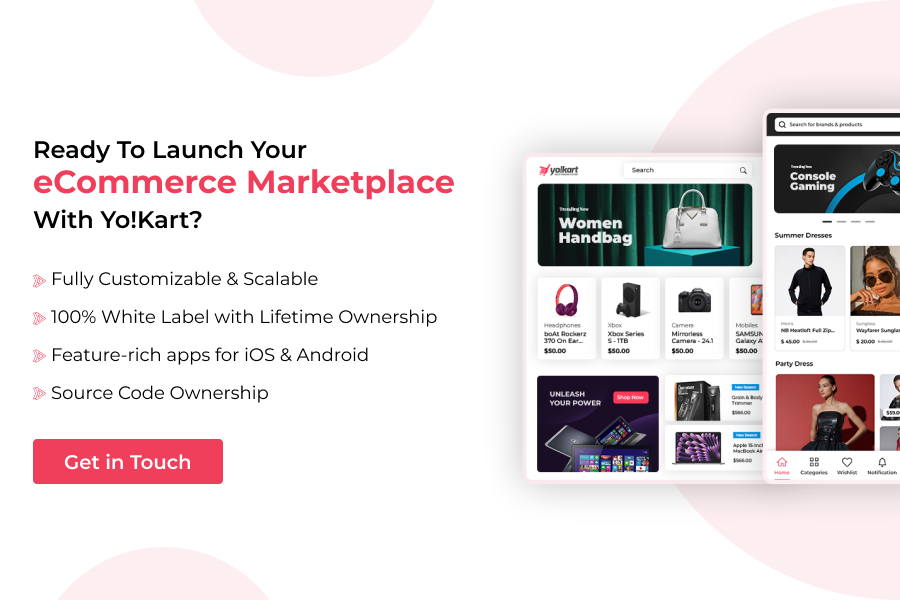
When it comes to building a reliable and scalable multi-vendor eCommerce app, Yo!Kart stands out as one of the most trusted marketplace solutions available today. It is a fully customizable, self-hosted multi-vendor eCommerce solution designed to help businesses launch and scale online marketplaces efficiently, without the complexity of starting from scratch.
Yo!Kart supports both web and mobile platforms and comes with ready-to-use Android and iOS apps, making it an ideal choice for businesses adopting a mobile-first approach. The solution comes equipped with a robust feature set, including advanced vendor management, flexible commission structures, multi-currency and multilingual support, and a powerful admin dashboard. Built to handle high traffic and large vendor volumes, Yo!Kart ensures long-term scalability without compromising performance.
With pre-built yet highly customizable mobile apps, Yo!Kart significantly reduces development time and costs while giving businesses full control over branding, functionality, and future enhancements.
Top Reasons to Choose Yo!Kart
- Ready-Made Android & iOS Apps: Launch your multi-vendor eCommerce app without developing the mobile apps from scratch.
- Self-Hosted & White-Label: Maintain complete ownership, branding freedom, and access to your data.
- Advanced Vendor Management: Separate dashboards for vendors to manage products, orders, and earnings efficiently.
- Flexible Commission & Revenue Models: Support for multiple monetization strategies to suit different marketplace business models.
- Highly Scalable Architecture: Designed to support growing vendors, products, and traffic as your business grows.
- Multi-Currency & Multilingual Support: Ideal for marketplace businesses targeting a global user base.
- Secure Payment Integrations: Supports multiple payment gateways with automated commission and payment splitting.
- SEO-Friendly & Performance Optimized: Built to improve visibility, speed, and overall user experience.
- Cost-Effective & Faster Time-to-Market: Lower upfront investment compared to custom development with quicker deployment.
This combination of flexibility, scalability, and ready-to-launch mobile apps makes Yo!Kart a preferred multi-vendor eCommerce app solution for startups and enterprises alike.
See How Yo!Kart Works for Your Business
Conclusion
The marketplace economy continues to grow at an unprecedented pace, and mobile apps are at the center of this transformation. Building a multi-vendor eCommerce app creates opportunities for scalable growth, diversified revenue streams, and long-term business sustainability.
While the process of building a multi-vendor marketplace may seem complex, choosing the right development approach and technology partner can make all the difference. From validating your idea and feature planning to selecting a reliable multi-vendor eCommerce app solution like Yo!Kart, every decision plays a crucial role in the success of your marketplace.
By leveraging a readymade solution, businesses can minimize risks, control costs, and focus on growth rather than technical challenges. With the right strategy, tools, and execution, launching a successful multi-vendor eCommerce app is well within reach.
FAQs
Q 1. How long does it take to build a multi-vendor eCommerce app?
Ans. The timeline to build a multi-vendor eCommerce app depends on the development approach. Custom development typically takes 6 to 12 months due to design, development, and testing phases. While leveraging a readymade multi-vendor eCommerce app solution, you can launch your app within a few weeks.
Q 2. Which industries can use multi-vendor eCommerce apps?
Ans. Multi-Vendor eCommerce apps are widely used across various industries, such as:
- Retail
- Grocery
- Fashion
- Electronics
- Services
- Rentals
- Digital products
Thus, any business model involving multiple sellers and buyers can leverage this approach.
Q 3. Why choose a readymade multi-vendor eCommerce app solution?
Ans. Readymade multi-vendor eCommerce app solutions offer faster time-to-market, lower development costs, and built-in marketplace features. They are already tested for performance and scalability, making them a reliable option compared to custom development.
Q 4. Can a multi-vendor eCommerce app support multiple payment gateways?
Ans. Yes, most modern multi-vendor eCommerce app solutions support multiple payment gateways. This allows customers to choose their preferred payment method while enabling automated commission and vendor payment management.
Q 5. Is it possible to scale a multi-vendor eCommerce app as the business grows?
Ans. Yes, a well-built multi-vendor eCommerce app is designed to scale. Most of the readymade solutions have a robust architecture that allows you to add more vendors, products, and users without compromising performance.
Q 6. Do multi-vendor eCommerce apps support both Android and iOS?
Ans. Yes, most professional multi-vendor eCommerce app solutions offer support for both Android and iOS platforms. Moreover, some solutions, like Yo!Kart provides ready-made mobile apps for both operating systems.
Q 7. How does the admin earn revenue from a multi-vendor eCommerce app?
Ans. Marketplace owners can earn revenue in various ways. It includes commissions on sales, vendor subscription plans, featured listings, and advertisements. Many platforms support multiple revenue models simultaneously.
Q 8. Is technical expertise required to manage a multi-vendor eCommerce app?
Ans. No, technical expertise is not a necessary requirement to manage a multi-vendor eCommerce app. Modern solutions, such as Yo!Kart offers user-friendly admin dashboards to manage vendors, orders, payments, and content efficiently.
Q 9. Can a multi-vendor eCommerce app be customized?
Ans. Yes, multi-vendor eCommerce apps can be customized based on business needs. Readymade solutions allow you to modify design, features, workflows, and third-party integrations without rebuilding the entire platform.
Want to Launch a Multi-Vendor Marketplace Without the Complexity?
Contact UsPopular Posts