
The eCommerce landscape has shifted dramatically over the last few years. By 2028, the global retail eCommerce sales are estimated to reach 8 trillion dollars, according to Statista. This surge isn’t just coming from traditional single-vendor stores; it is being driven by the marketplace model, the platform economy where multiple vendors coexist.
If you are looking to build a marketplace website in 2026, you are not just simply launching an online store; you’re building an ecosystem. However, with advanced technologies like AI-driven search, headless commerce architecture, and complex global compliance standards, estimating the cost of building such a platform has become more nuanced than ever.
In this blog, you will break down every financial aspect of creating an eCommerce marketplace website, from initial development to long-term maintenance, helping you choose the path that aligns with your budget and business goals.
Table of Contents
- What is a Marketplace Website?
- Why Build a Marketplace Website in 2026? (The Benefits)
- Types of Marketplace Websites You Can Build
- Top Marketplace Websites and Their Revenue Models
- Features That Define the Cost to Build a Marketplace Website
- Development Cost: Different Approaches in 2026
- How to Reduce the Cost of Building Your Marketplace
- Yo!Kart: A Readymade Self-Hosted Marketplace Solution
- Conclusion
What is a Marketplace Website?
A marketplace website is an online platform that enables buyers to purchase products or services from multiple sellers in one place. Unlike a traditional eCommerce site that follows a one-to-many model, where a single business sells to many customers, a marketplace operates on a many-to-many model, connecting multiple vendors with multiple buyers through a shared platform.
In this model, the platform owner does not necessarily hold inventory. Instead, they provide the digital infrastructure for third-party vendors to list their products or services. The admin earns revenue through commissions, subscription fees, or listing charges.
In simple terms, it is a digital shopping mall where the mall owner (marketplace owner) provides the space, security, and foot traffic, while individual shopkeepers manage their own stock and sales.
Why Build a Marketplace Website in 2026?
Launching a marketplace website in 2026 offers distinct advantages over traditional retail models, especially as consumer behavior leans toward convenience and variety. The marketplace model is designed to grow efficiently while keeping operational risks under control. Mentioned below are the reasons that will clarify why you should build a marketplace website:
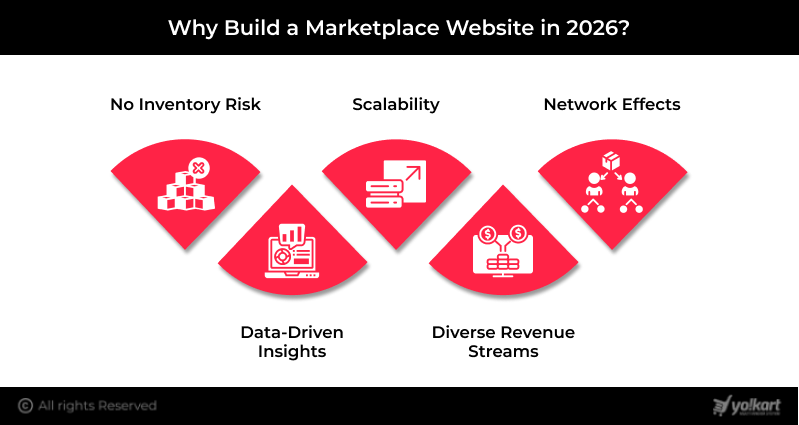
- No Inventory Risk: One of the biggest financial challenges in retail is buying and storing stock. In a marketplace model, inventory is managed by the sellers. This significantly reduces your overhead and financial risk.
- Scalability: Scaling a traditional online store often requires more storage, logistics, and capital. In contrast, for scaling a marketplace, you need to onboard new vendors and expand categories.
- Network Effects: As more vendors join, more buyers are attracted. As more buyers arrive, more vendors want to join. This “flywheel effect” creates organic growth that single-vendor stores struggle to match.
- Diverse Revenue Streams: Marketplaces are not dependent on product margins alone. Platform owners can generate revenue through transaction commissions, vendor subscriptions, premium storefronts, sponsored listings, and on-platform advertising, creating a more resilient business model.
- Data-Driven Insights: By hosting multiple vendors, you gain a macro-view of market trends. This allows you to identify which niches are growing and pivot your strategy accordingly.
Suggested Read: Make a Marketplace Website from Scratch in 2026
Types of Marketplace Websites You Can Build
Depending on your business vision, target audience, and monetization strategy, you can build different types of marketplace websites, each with its own operational and technical requirements. Here is a brief look at the primary types of marketplace websites you can build in 2026:
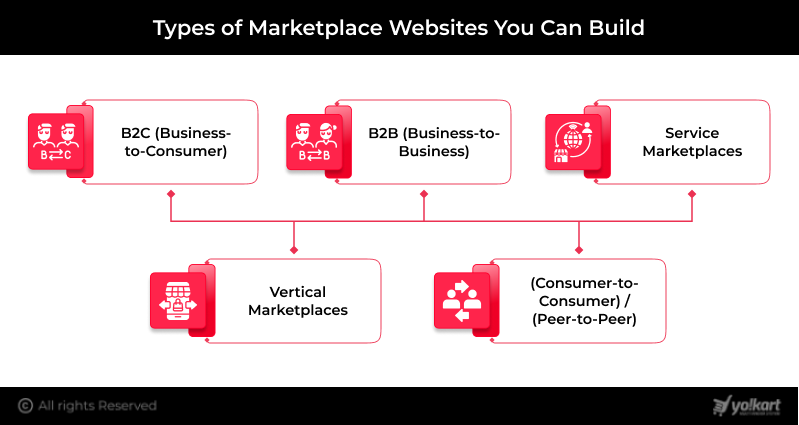
1. B2C (Business-to-Consumer)
This is the standard retail model where established brands, businesses, and individual sellers sell products directly to buyers. The platform acts as a digital storefront for many brands, focusing on high-speed transactions, mobile-first design, and integrated loyalty programs.
- Key Focus:
- User experience (UX)
- Fast checkout
- High-volume order processing.
- Examples: Amazon, Walmart Marketplace, AliExpress.
2. B2B (Business-to-Business)
B2B platforms connect wholesalers or manufacturers with other business entities (retailers). Because these transactions are professional, your platform must support complex logic like tiered bulk pricing (discounts for larger quantities), “Request for Quote” (RFQ) modules, and tax-exempt purchasing for verified businesses.
- Key Focus:
- Bulk ordering
- Customized pricing lists
- Recurring supply contracts.
- Examples: Alibaba, Amazon Business.
Suggested Read: Top B2B eCommerce Platforms in 2026
3. C2C/P2P (Consumer-to-Consumer/Peer-to-Peer)
In this model, the platform facilitates transactions between private individuals rather than commercial businesses. These sites require heavy investment in trust-building features, such as social verification, escrow payment systems (holding money until the buyer confirms receipt), and robust internal messaging.
- Key Focus:
- Community trust
- Identity verification
- Dispute resolution tools.
- Examples: eBay, Airbnb, Vinted.
4. Vertical Marketplaces
Unlike “Horizontal” marketplaces (like Amazon) that sell everything, vertical marketplaces focus on a single, specific niche. This allows the platform to offer specialized features, such as high-resolution zoom for artwork or authentication services for luxury sneakers, that general platforms cannot provide.
- Key Focus:
- Niche-specific search filters
- Expert quality-assurance tools.
- Examples: Etsy (Handmade), StockX (Sneakers), Chewy (Pet supplies).
5. Service Marketplaces
Rather than physical goods, these platforms connect service providers, such as freelancers, drivers, or cleaners, with clients. Thus, the technical architecture must handle time-based booking, project-based milestones, or real-time geolocation tracking for on-demand services.
- Key Focus:
- Booking calendars
- Project milestone tracking
- Provider ratings.
- Examples: Fiverr (Digital services), TaskRabbit (Home services), Uber (Transport).
Turn Your Marketplace Idea Into a Scalable Platform
Top Marketplace Websites and Their Revenue Models
Before determining your own monetization strategy, it is crucial to understand the financial anatomy of the world’s most successful platforms. In 2026, the most profitable marketplaces have moved beyond simple transaction fees. They often use hybrid revenue models that combine multiple streams, creating more predictable cash flow and long-term margins.
These marketplaces monetize not just transactions, but also access, visibility, and value-added services within their ecosystems. The following table breaks down the diverse ways industry leaders monetize their ecosystems:
| Marketplace | Type | Primary Business Model |
| Amazon | B2C/B2B | Commission per sale, Subscription (Prime), Advertising |
| Airbnb | P2P | Service fees from both hosts and guests |
| eBay | C2C/B2C | Listing fees (Insertion fees), Final value fees |
| Alibaba | B2B | Membership fees (Gold Supplier), Marketing services |
| Etsy | Vertical | Listing fees, Commission, and payment processing fees |
The key takeaway is that, rather than depending solely on commissions, these marketplace giants layer in subscriptions, paid visibility, and platform services, allowing them to scale revenue without proportionally increasing operational costs.
Suggested Read: Best Multivendor E-commerce Marketplace Platforms
Features That Define the Cost to Build a Marketplace Website
In 2026, building a multi-vendor marketplace website goes far beyond product listing. It’s about managing a multi-sided ecosystem that serves buyers, sellers, and admins simultaneously.
Here are the 10 most important features that define a modern marketplace and significantly drive the development cost. Let’s begin:
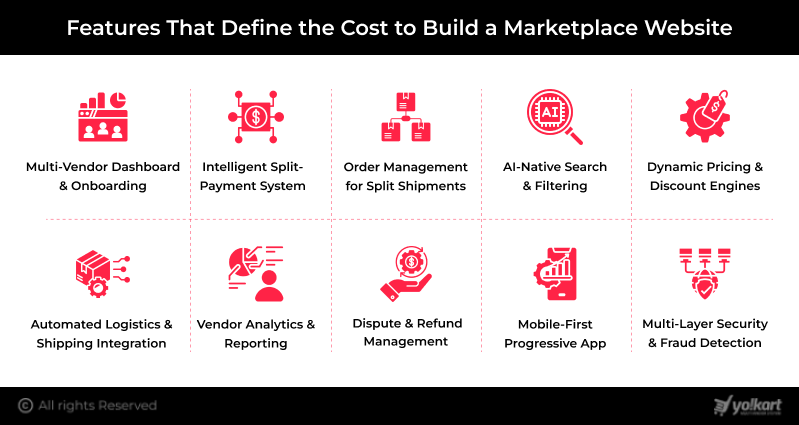
1. Multi-Vendor Dashboard & Onboarding
Unlike a single-seller store, a marketplace requires dedicated dashboards for vendors to register, upload products, and track their specific sales. The automated onboarding process includes identity verification and KYC checks to ensure legal compliance and trust.
2. Intelligent Split-Payment System
Marketplace must automatically calculate your commission and split the buyer’s payment between multiple vendors in real-time. This requires integrating complex escrow-style gateways like Stripe Connect to handle payouts and tax obligations accurately.
3. Order Management for Split Shipments
When a user buys from three different sellers in one transaction, the backend must break it into separate vendor-specific orders. This includes generating three separate orders, three sets of shipping labels, and three different tracking numbers while keeping a unified view for the customer.
4. AI-Native Search & Filtering
Standard keyword search is no longer sufficient. Modern marketplaces use intent-based search and AI filters that understand spelling variations and buyer behavior. This requires advanced indexing tools like Algolia or Elasticsearch that process data across thousands of catalogs instantly.
5. Vendor Analytics & Reporting
To attract and retain high-quality sellers, you must provide them with meaningful data and insights. This includes visual dashboards showing their top-performing products, conversion rates, and customer demographics, which involves complex data aggregation.
6. Automated Logistics & Shipping Integration
To cater to the needs of global customers, your marketplace must be integrated with global carriers, such as UPS, FedEx, and DHL, to provide real-time shipping rates and automated label generation for vendors. This often extends to hyperlocal delivery tracking for service-based marketplaces.
7. Dispute & Refund Management Workflow
A centralized system to handle returns and disagreements between buyers and sellers. This feature requires a multi-step communication ticket system and an admin interface for your team to act as a mediator.
8. Mobile-First Progressive Web App (PWA)
Marketplaces must function like native apps on mobile devices, supporting push notifications, offline browsing, and thumb-zone navigation, without requiring users to download an app from the App Store, all of which add to development complexity.
9. Dynamic Pricing & Discount Engines
The ability for vendors to set their own flash sales, BOGO – Buy One Get One deals, or volume discounts. Building a logic engine that can handle thousands of overlapping rules from different sellers is a major technical undertaking.
10. Multi-Layer Security & Fraud Detection
Beyond basic SSL protection, marketplaces require AI-driven fraud detection to detect fraudulent activity. This includes identifying fake reviews, self-purchasing by sellers, suspicious logins, and abnormal transaction patterns to protect both users and platform credibility.
These features form the technical foundation of a modern marketplace. The more advanced and automated these systems are, the higher the development cost, but also the greater the platform’s ability to scale efficiently and compete in the industry.
Development Cost: Different Approaches in 2026
In 2026, the strategy you choose to build your marketplace is the single most important factor that has the greatest impact on your budget and time-to-market. Here is a breakdown of the three primary development approaches:
1. Custom Development (Building from Scratch)
This approach involves hiring a development agency or a dedicated team of developers to write every line of code specifically for your business logic. This approach is typically chosen by businesses pursuing highly innovative concepts, such as proprietary auction mechanisms or AI-first marketplace experiences that cannot be supported by existing platforms.
- The Process: You begin with a discovery phase to map out user journeys, followed by UI/UX design, frontend/backend development, and rigorous QA testing. Because you own the entire codebase, you have zero limitations on scalability or feature sets.
- Cost Involved: This is the most expensive path. Typically, costs range from $40,000 to $150,000+, depending on the complexity of the vendor workflows, third-party integrations, and the seniority of the team.
- Timeline: 6 to 12+ months.
2. Readymade Software Solutions (The “Hybrid” Approach)
Readymade solutions are pre-engineered marketplace solutions that come with the majority of essential features, like vendor portals and commission tracking. These solutions significantly reduce development time and cost compared to building from scratch. They are categorized into two distinct types: SaaS and Self-Hosted.
1. SaaS (Software-as-a-Service)
SaaS is a cloud-based model where you rent the software. You do not install it on your own servers; instead, you log in to a platform provided by a vendor who handles all the maintenance, security, and hosting.
- Definition: A subscription-based model where the software is centrally managed. You do not own the source code, which means you are restricted to the updates and features provided by the platform. If you stop paying, your site goes offline.
- Cost & Examples: Platforms like Sharetribe or Shopify (using multi-vendor apps) fall here.
- Software Pricing: Basic plans start around $50-$500/month.
- Additional Costs: You often pay transaction fees (1%-3%) and extra for specialized apps/plugins.
2. Self-Hosted (One-Time License)
In the self-hosted model, you purchase a license for a ready-to-use software package and install it on your own server. This offers a major advantage: you own the code and the data, giving you the freedom to customize the platform without ongoing transaction fees.
- Example: Yo!Kart is a premier example of a self-hosted, multi-vendor software. It is designed to be a complete, white-label solution that includes built-in features like split payments, vendor management, and mobile-responsive designs without needing extra plugins.
- Pricing & Ownership: Yo!Kart follows a one-time payment model starting at approximately $999. One of its standout benefits is that there are no recurring hosting fees or monthly subscriptions paid to the software provider. While you manage your own server space, you eliminate the perpetual monthly “rental” costs associated with SaaS. Additionally, it allows you to launch your marketplace within a few weeks.
Looking for a Cost-Efficient Way to Start Your Marketplace?
How to Reduce the Cost of Building Your Marketplace
Building a marketplace website does not have to be an expensive, high-risk investment. With the right strategy and technology choices, you can significantly reduce development costs while still launching a competitive and scalable platform. Given below are the ways that help in reducing the cost of building a marketplace:
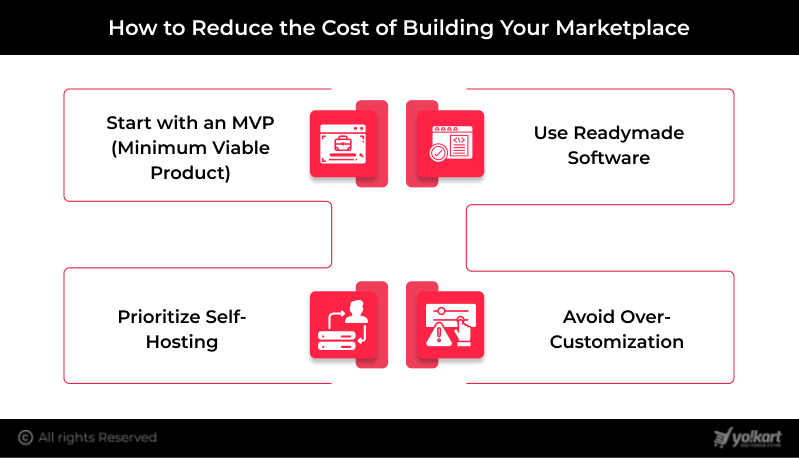
- Start with an MVP (Minimum Viable Product): It is advised not build a full-scale platform from day one. Focus on essential features such as vendor listings, search, and checkout. Once your marketplace gains traction and validates demand, you can gradually introduce advanced capabilities like AI-driven recommendations or immersive product experiences.
- Use Readymade Software: Instead of spending much on custom code for a login button or a cart, leverage high-quality eCommerce marketplace software. Readymade software comes integrated with essential features and reduces development cost and time-to-market.
- Prioritize Self-Hosting: SaaS-based solutions seem cheap at first, but recurring monthly fees and transaction percentages will erode your margins as you scale. Hence, a one-time license for self-hosted software is more cost-effective in the long run.
- Avoid Over-Customization: Stick to the software’s default workflows as much as possible for the first version. Customizing every single design element adds hundreds of billable hours for developers.
By making informed, cost-conscious decisions early, you can launch your marketplace efficiently and reserve your budget for growth, marketing, and user acquisition rather than unnecessary development overhead.
Yo!Kart: A Readymade Self-Hosted Marketplace Solution
If you are looking for a balance between the flexibility of custom development and the speed of a ready-made platform, Yo!Kart stands out as a strong choice in 2026. It is designed for entrepreneurs and businesses that want to launch a full-featured multi-vendor marketplace without the high costs, long timelines.
Yo!Kart is a self-hosted, white-label premium eCommerce marketplace software designed specifically for multi-vendor businesses. Unlike general eCommerce platforms that rely on third-party plugins to support multiple sellers, Yo!Kart is built with a multi-vendor architecture at its core. This ensures better performance, cleaner workflows, and fewer operational limitations as your marketplace scales.
Additionally, this robust solution is trusted by marketplace owners globally to launch B2C, B2B, C2C, and niche marketplaces across industries such as retail, wholesale, rentals, and vertical commerce.
Key Benefits of Yo!Kart
- One-Time Payment: No monthly recurring fees or transaction commissions. You own the license for life.
- Fully Customizable: You get access to the source code, allowing you to tailor the platform as your business evolves.
- Scalable: Built to handle millions of products and thousands of concurrent users. Whether you are starting small or planning aggressive growth, Yo!Kart is built to scale with your marketplace.
- Feature-Rich: Includes built-in marketing tools, SEO features, vendor management, and automated shipping integrations, such as ShipStation, etc.
- Faster Time to Market: Yo!Kart significantly reduces development time and allows you to validate your business idea and start generating revenue much sooner.
For entrepreneurs focused on building a marketplace cost-efficiently while maintaining long-term control, Yo!Kart offers a practical and future-ready foundation.
Schedule a Personalized Demo of Yo!Kart
Conclusion
In 2026, the cost of building a marketplace website can range from a few thousand dollars when using a readymade solution to well over $100,000 for a custom-built enterprise platform. Thus, for most entrepreneurs and SMEs, the most viable path is utilizing readymade eCommerce marketplace software like Yo!Kart. It provides the professional-grade features required to compete with industry giants while keeping the initial investment and long-term overhead manageable.
The marketplace economy continues to expand. However, choosing the right technology stack today ensures that your budget is spent on growing your brand rather than just keeping the lights on.
Create a Marketplace Website Without High Upfront Costs
Contact UsPopular Posts