
The global fitness industry has evolved rapidly over the past decade. With growing health awareness, an increase in home workouts, and the rapid adoption of digital commerce, the demand for gym and fitness equipment has surged significantly. Today’s buyer no longer depends solely on physical stores to purchase treadmills, dumbbells, resistance bands, or professional gym machines. Instead, they prefer browsing multiple brands, comparing prices, reading reviews, and placing orders online, all from the comfort of their homes.
This shift has opened the door to a powerful business opportunity in the form of launching a gym equipment marketplace. Unlike a traditional single-vendor eCommerce store, a marketplace connects multiple sellers with buyers on a single platform. This model offers a wider product range, competitive pricing, and better scalability.
In this comprehensive blog, you will explore everything you need to know to build a gym equipment marketplace, from understanding the business model and its benefits to key features, development approaches, cost considerations, and how a ready-made eCommerce marketplace software like Yo!Kart can accelerate your launch.
Table of Contents
What is a Gym Equipment Marketplace?
A gym equipment marketplace is an online multi-vendor platform where multiple sellers list and sell fitness and gym-related equipment to customers through a single digital storefront. The marketplace owner manages the platform, facilitating transactions between buyers and sellers while earning revenue through commissions, subscriptions, or listing fees.
Unlike a conventional online store that sells products from a single brand or inventory, a marketplace brings together various manufacturers, wholesalers, distributors, and even individual sellers. This model allows customers to explore a wide range of products, such as:
- Home gym equipment
- Commercial gym machines
- Strength training tools
- Cardio equipment
- Fitness accessories
- Rehabilitation and physiotherapy equipment
For sellers, the marketplace offers instant access to a large audience without the cost and effort of building and marketing a standalone website. For buyers, it delivers convenience, variety, transparent pricing, and the ability to make informed decisions in one place.
Benefits of Building a Gym Equipment Marketplace
A gym equipment marketplace creates value across the entire ecosystem by addressing the needs of platform owners, sellers, and buyers simultaneously. By bringing all stakeholders together on a single platform, the marketplace model delivers scale, efficiency, and long-term growth potential. Further, let’s break down the benefits for each user type:
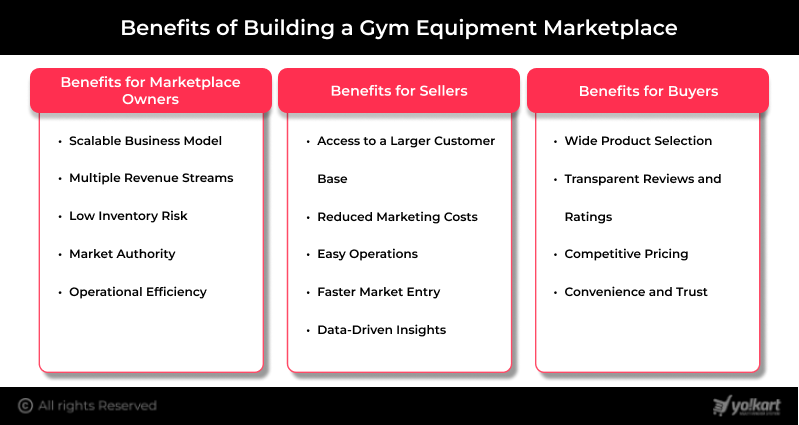
Benefits for Marketplace Owners
1. Scalable Business Model: A marketplace grows by onboarding more sellers rather than managing inventory. This makes it easier to scale without heavy operational overhead.
2. Multiple Revenue Streams: Marketplace owners can earn through multiple revenue streams, including commissions, seller subscriptions, featured listings, advertisements, and premium services.
3. Low Inventory Risk: Since sellers manage their own inventory, the platform owner avoids stock-related risks and logistics complexities.
4. Market Authority: With the right strategy, your platform can become a trusted destination for gym equipment, building long-term brand value.
5. Operational Efficiency: Centralized management tools reduce manual work and streamline platform operations.
Benefits for Sellers
1. Access to a Larger Customer Base: Sellers gain exposure to more customers, who are actively searching for gym equipment.
2. Reduced Marketing Costs: The marketplace handles traffic acquisition, branding, and promotions. Hence, reduced marketing costs for the seller.
3. Easy Operations: Sellers can manage listings, orders, and payouts through a centralized dashboard.
4. Faster Market Entry: New or small sellers can start selling immediately without investing in website development.
5. Data-Driven Insights: Sellers get access to buyer behavior, pricing trends, and demand patterns, which help make smarter business decisions.
Benefits for Buyers
1. Wide Product Selection: Buyers can compare products across brands, prices, and features in one place.
2. Transparent Reviews and Ratings: Real user feedback supports confident purchasing decisions.
3. Competitive Pricing: Multiple sellers drive price competition, benefiting customers.
4. Convenience and Trust: Secure payments, easy returns, and centralized support help gain user trust and improve overall shopping experience.
Ready to Build a Multi-Vendor Gym Equipment Platform and Scale Faster
Top Gym Equipment Marketplaces
Several established marketplaces already dominate the global fitness equipment industry. Analyzing how these platforms operate provides clear insights into product strategy, vendor relationships, logistics, and customer trust, all of which are critical for marketplace success.
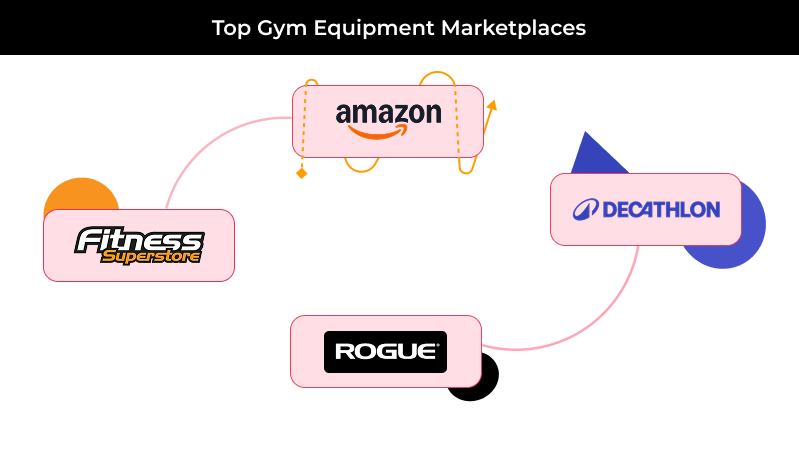
- Amazon Fitness Section: Amazon’s fitness category is one of the most comprehensive in the world, offering everything from entry-level yoga mats and resistance bands to high-end commercial gym machines. Its success is driven by vast seller participation, competitive pricing, fast and reliable logistics, customer reviews, and a frictionless buying experience. The platform sets a benchmark for scale, fulfillment efficiency, and buyer trust.
- Rogue Fitness: Rogue Fitness has built a strong reputation by focusing on premium strength and conditioning equipment. Widely trusted by athletes, CrossFit gyms, and professional training facilities, Rogue emphasizes durability, performance, and brand credibility. Its success highlights the value of niche specialization, product quality, and a loyal community-driven customer base.
- Decathlon: Decathlon operates at a global scale, offering affordable fitness and sports equipment across a wide range of categories. Its strong online presence, private-label products, and value-driven pricing make fitness accessible to a broad audience. Decathlon’s model shows how affordability, consistent quality, and an omnichannel strategy can drive massive adoption.
- Fitness Superstore (UK): Fitness Superstore is well known in the UK for its extensive selection of cardio and strength training equipment. The platform appeals to both home fitness users and commercial buyers by combining product variety with expert advice and localized market understanding, reinforcing the importance of regional focus and customer support.
These platforms highlight the importance of product diversity, strong vendor relationships, and seamless customer experiences that consistently build trust and repeat engagement.
Suggested Read: Build a Marketplace for Sporting Goods and Equipment
Must-Have Features in a Gym Equipment Marketplace
To build a successful gym equipment marketplace, your platform must deliver a smooth and reliable experience for all buyers, sellers, and admin/s. The right feature set not only improves usability but also builds trust and supports long-term scalability. Below are essential features your marketplace must have:
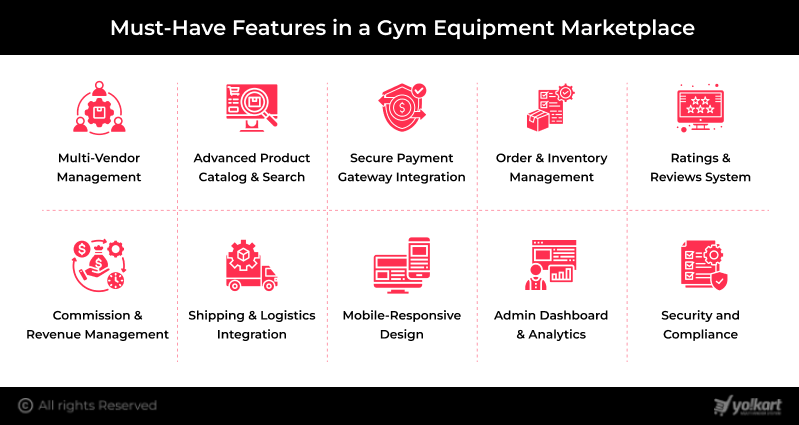
1. Multi-Vendor Management
This feature enables multiple sellers to register, create stores, upload products, manage inventory, and track sales independently within a single centralized platform.
2. Advanced Product Catalog and Search
A well-structured product catalog with filters for price, brand, equipment type, weight capacity, and home or commercial usage helps customers find the right products quickly and easily.
3. Secure Payment Gateway Integration
Support for multiple payment methods, such as credit/debit cards, wallets, net banking, and international payments, ensures trust and convenience.
4. Order and Inventory Management
Automated order processing, real-time inventory updates, and order tracking help streamline operations for sellers and keep buyers informed throughout the purchase journey.
5. Ratings and Reviews System
Verified customer reviews and seller ratings build transparency and credibility, influencing purchase decisions.
6. Commission and Revenue Management
Allows admins to set global or seller-specific commission rates, track earnings in real time, and manage payouts with complete financial visibility.
7. Shipping and Logistics Integration
Integration with shipping providers allows accurate delivery estimates, real-time tracking, and shipping cost calculations.
8. Mobile-Responsive Design
A mobile-friendly interface ensures a seamless shopping experience across smartphones, tablets, and desktops, meeting modern shopping expectations.
9. Admin Dashboard and Analytics
A centralized dashboard helps admins monitor platform performance, user activity, sales trends, and revenue metrics, supporting data-driven decision-making
10. Security and Compliance
Robust security measures, including data encryption, secure authentication, and compliance with payment and data protection standards, are critical for maintaining user trust and platform credibility.
Choosing the Right Development Approach & Cost Considerations
When planning to build a gym equipment marketplace, one of the most important decisions is how you will develop the platform. Entrepreneurs typically choose between two paths: custom development or leveraging ready-made eCommerce marketplace software. Each approach has its own advantages, costs, and trade-offs. Let’s have a look at them:
1. Custom Development Approach
Custom development means building your marketplace from the ground up, tailored specifically to your business model and vision. This approach gives you complete control over design, features, and scalability, ensuring the platform aligns perfectly with your long-term goals.
This approach is ideal for businesses with unique requirements or those aiming to differentiate themselves in a competitive market. However, it demands significant investment in time, money, and technical expertise.
Pros:
- Tailored to unique business requirements.
- Full control over design, features, and scalability.
- Potential for long-term differentiation.
Cons:
- High upfront costs (often $50,000-$150,000+).
- Longer development timelines (6-12+ months).
- Requires ongoing technical support and updates.
2. Ready-Made Software Solutions
Ready-made software solutions are pre-built eCommerce marketplace platforms designed to help entrepreneurs launch quickly and cost-effectively. These solutions come equipped with essential features like vendor dashboards, secure payment gateways, and logistics integration already in place.
They are best suited for startups or businesses that want to enter the market fast without heavy upfront investment. Additionally, readymade solutions provide a reliable foundation with lower risk and faster time-to-market.
Pros:
- Faster deployment (within weeks instead of months).
- Cost-effective, starting from $999-$10,000 depending on features or customization.
- Pre-built features like vendor dashboards, payment gateways, and logistics integration.
- No technical expertise required.
- Supports multiple revenue streams and business models.
Cons:
- Need to meet the server requirements to host the marketplace.
Looking for a Robust Readymade Multi-Vendor Software?
Comparison Table: Custom vs. Ready-Made Solutions
To help you choose the right development approach, the table below compares custom development and ready-made marketplace solutions across key factors such as cost, launch time, scalability, and maintenance:
| Criteria | Custom Development | Ready-Made Software Solution |
| Cost | High ($50k-$150k+) | Affordable ($1k-$10k) |
| Time to Launch | 6-12 months | 2-6 weeks |
| Customization | Unlimited | Moderate to High |
| Scalability | High | Moderate to High |
| Maintenance | Requires a dedicated team | Managed by the provider |
| Risk | Higher (due to complexity) | Lower (tested solutions) |
Our Recommendation: For most entrepreneurs and startups looking to create a gym equipment marketplace, a ready-made solution offers the best balance of cost, speed, and functionality. Further, it allows you to validate your idea, launch faster, and scale with confidence while keeping technical complexity under control.
How Yo!Kart Can Help You Build a Gym Equipment Marketplace
Yo!Kart is a robust and scalable eCommerce marketplace software solution designed specifically for launching multi-vendor marketplaces quickly and efficiently. It provides businesses with a ready-to-launch foundation that removes the technical complexities of custom development while supporting long-term growth.
With Yo!Kart, entrepreneurs can launch a feature-rich gym equipment marketplace where multiple sellers list and manage their products, buyers enjoy a smooth shopping experience, and administrators retain full control over operations. The platform is designed to handle everything from product discovery and secure payments to commissions and seller management, all within a single unified system.
Key Features
- Multi-vendor architecture that allows unlimited sellers to onboard and operate independently
- Separate dashboards for admin, sellers, and buyers to streamline operations
- Advanced catalog and product management for handling diverse gym equipment categories
- Built-in payment and shipping integrations for secure and efficient transactions
- Commission and revenue management with flexible earning rules
- Mobile-responsive and SEO-friendly design to maximize reach and visibility
- Scalable and customizable framework that grows with your business needs
Benefits for Marketplace Owners
- Faster time to market compared to custom-built platforms
- Reduced development and operational costs with predictable investment
- Technical support and regular updates
- Ideal for startups, SMEs, and growing enterprises
- Proven performance across multiple marketplace industries
By handling the technical foundation, Yo!Kart empowers businesses to focus on growth, seller acquisition, and customer experience rather than technical development challenges.
See Yo!Kart in Action With a Live Demo
Conclusion
The fitness industry’s shift toward digital commerce has made online marketplaces more relevant than ever. A thoughtfully built gym equipment marketplace not only meets the growing demand for fitness products but also creates a scalable, profitable business opportunity.
Whether you choose custom development or a ready-made eCommerce marketplace software solution, success depends on delivering real value through the right features, intuitive usability, and a high level of trust for both buyers and sellers.
For entrepreneurs looking to build a gym equipment marketplace quickly and cost-effectively, solutions like Yo!Kart provides a strong foundation to launch, scale, and succeed in this competitive niche. With the right strategy, technology, and execution, your marketplace can become a go-to destination for fitness enthusiasts and gym owners worldwide.
FAQs
Q 1. How is a gym equipment marketplace different from a regular eCommerce store?
Ans. Unlike a regular eCommerce store that sells products from a single seller, a gym equipment marketplace allows multiple vendors to sell their products on the same platform. This gives buyers access to broader product choices, competitive pricing, and side-by-side comparisons, while sellers benefit from shared traffic, trust, and reduced marketing effort.
Q 2. How long does it take to create a gym equipment marketplace?
Ans. A custom-built gym equipment marketplace typically takes 6 to 12 months, depending on complexity. On the other hand, using a ready-made marketplace solution significantly reduces timelines, allowing businesses to launch a full marketplace within a few weeks.
Q 3. What are the main revenue models for a gym equipment marketplace?
Ans. Gym equipment marketplaces earn through multiple revenue streams,, such as:
- Commission on each sale
- Seller subscription plans
- Featured product listings
- Advertising placements
- Value-added services such as logistics or marketing support.
Q 4. Can sellers manage their own products and orders?
Ans. Yes, sellers can manage their own products and orders. Modern marketplace platforms provide sellers with dedicated dashboards where they can manage product listings, inventory, pricing, orders, and payouts independently. This self-service approach reduces admin workload while giving sellers full operational control over their online store within the marketplace.
Q 5. Is a gym equipment marketplace scalable?
Ans. Yes, a gym equipment marketplace is highly scalable. As your platform grows, you can onboard more sellers, expand product categories, and add new features without managing inventory yourself.
Q 6. Can I launch a gym equipment marketplace without technical expertise?
Ans. Yes, with a ready-made eCommerce marketplace software like Yo!Kart, you can launch and manage a gym equipment marketplace without deep technical knowledge. Core features such as vendor management, payments, and order workflows are pre-built and easy to operate.
Q 7. Is Yo!Kart suitable for launching a gym equipment marketplace?
Ans. Yes, Yo!Kart is specifically designed for multi-vendor marketplaces and offers the flexibility, scalability, and features required to successfully create and grow a gym equipment marketplace. It supports advanced product management, secure transactions, and long-term growth without custom development complexity.