

Published 03 July, 2026
Quick Summary
Building an enterprise B2B marketplace requires identifying a niche, defining business requirements, choosing the right marketplace software, integrating enterprise systems, ensuring security, and launching with scalable technology.
Businesses today prefer ready-made marketplace software like Yo!Kart to reduce development costs, accelerate launch timelines, and gain enterprise-grade features without building everything from scratch.
Introduction
Enterprise B2B marketplaces are transforming the way manufacturers, wholesalers, distributors, and procurement organizations conduct business. Unlike traditional B2C eCommerce platforms that cater to individual consumers, enterprise B2B marketplaces are designed to support complex business transactions involving multiple buyers and sellers, customized pricing, bulk ordering, negotiated contracts, approval workflows, and long-term business relationships.
As digital commerce continues to evolve, enterprises are increasingly investing in marketplace models to streamline procurement, expand supplier networks, improve operational efficiency, and unlock new revenue opportunities. According to industry reports, the global B2B eCommerce market is expected to continue growing at a rapid pace over the coming years, driven by digital transformation initiatives, changing buyer expectations, and the widespread adoption of cloud-based technologies.
Building an enterprise B2B marketplace, however, involves much more than developing a website. Businesses must carefully plan their marketplace model, identify target users, define revenue streams, implement robust security measures, integrate enterprise systems such as ERP and CRM, and deliver a seamless user experience that can support high transaction volumes and complex business processes.
Whether you’re a manufacturer looking to create a supplier ecosystem, a wholesale distributor planning a digital procurement platform, or an entrepreneur launching an industry-specific marketplace, choosing the right development approach is critical to long-term success.
In this comprehensive guide, we’ll walk you through the essential steps involved in building an enterprise B2B marketplace—from validating your business idea and selecting the right technology stack to implementing key features, understanding development costs, overcoming common challenges, and choosing the best marketplace software to accelerate your launch.
Table of Contents
- What is an Enterprise B2B Marketplace?
- Why Enterprises are Investing in B2B Marketplaces
- Types of Enterprise B2B Marketplaces
- Essential Features Every Enterprise B2B Marketplace Needs
- How to Build an Enterprise B2B Marketplace: 7 Easy Steps to Follow
- How Much Does It Cost to Build an Enterprise B2B Marketplace?
- Common Challenges in Enterprise B2B Marketplace Development and How to Overcome Them
- Why Businesses Choose Yo!Kart for Enterprise B2B Marketplace Development?
- Conclusion
- FAQs
What is an Enterprise B2B Marketplace?
An enterprise B2B marketplace is a multi-vendor digital platform where businesses buy and sell products or services in bulk. Unlike traditional ecommerce websites that focus on individual consumers, enterprise marketplaces are built to handle complex procurement workflows, large inventories, and bulk ordering.
It connects manufacturers, distributors, wholesalers, suppliers, procurement teams, and corporate buyers, enabling wholesale transactions, procurement, RFQs, negotiations, bulk ordering, custom pricing, and enterprise integrations.
Well-known enterprise B2B marketplaces include:
- Amazon Business
- Alibaba
- Faire
- Thomasnet
- Global Sources
- Grainger
Why Enterprises are Investing in B2B Marketplaces
The enterprise commerce landscape is rapidly shifting toward digital procurement. Enterprise-level B2B marketplaces simplify procurement while improving operational efficiency for businesses worldwide. The factors below suggest why enterprises are investing in B2B marketplaces.
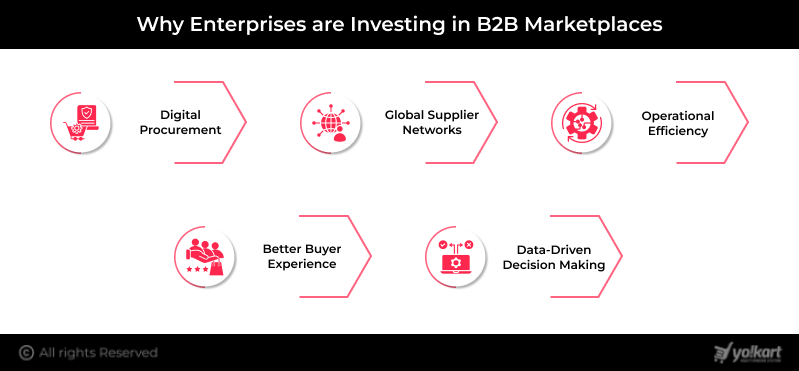
1. Digital Procurement
Organizations today increasingly prefer self-service purchasing portals that reduce manual processes and prevent procurement delays. B2B marketplaces are channels that streamline the procurement process.
2. Global Supplier Networks
Enterprise marketplaces provide access to thousands of verified suppliers from multiple regions, reducing dependency on a single vendor. Businesses can connect and trade with global businesses.
3. Operational Efficiency
After the evolution of online marketplaces, B2B trade has become more seamless. Automation of quotations, order management, invoicing, inventory synchronization, and approvals significantly lowers administrative workload and further enables frictionless transactions.
4. Better Buyer Experience
Modern B2B buyers expect the same intuitive purchasing experience they receive from consumer platforms. B2B marketplaces allow buyers to find and place orders online with just a few clicks, enhancing the overall trading experience.
5. Data-Driven Decision Making
Marketplace analytics enable enterprises to optimize supplier performance, purchasing trends, pricing strategies, and inventory planning. Moreover, businesses can also make data-driven decisions and grow.
Types of Enterprise B2B Marketplaces
The B2B industry has different procurement workflows, pricing structures, compliance requirements, and buyer expectations, depending on the business model, target audience and trading preferences.
Choosing the right marketplace model is one of the most critical decisions they need to take before they start building a B2B marketplace.
Below are the most common types of enterprise B2B marketplaces that you can explore and decide on the right business model
1. Wholesale Marketplace
A wholesale marketplace connects manufacturers, distributors, wholesalers, and retailers, enabling businesses to buy products in bulk at negotiated prices.
These platforms typically support:
- Bulk ordering
- Tiered pricing
- Minimum Order Quantity (MOQ)
- RFQ (Request for Quote)
- Inventory management
- Multi-vendor selling
Popular examples:
- Alibaba
- Faire
Best suited for industries such as:
- FMCG
- Electronics
- Fashion & Apparel
- Industrial Supplies
- Home & Furniture
- Packaging
Ideal for businesses that want to digitize traditional wholesale distribution networks.
2. Procurement Marketplace
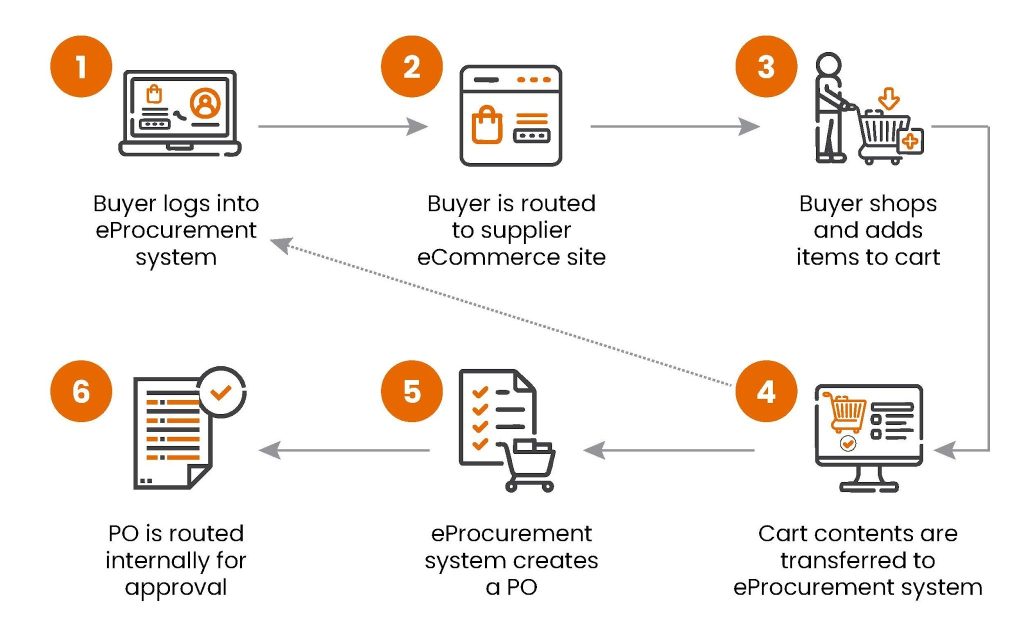
A procurement marketplace is designed for large organizations that need to source products from multiple vendors while managing approvals, budgets, and compliance.
Key capabilities include:
- Vendor onboarding & verification
- Purchase approvals
- Budget controls
- Contract management
- RFQ & bidding
- Invoice management
Common use cases:
- Government procurement
- Manufacturing companies
- Healthcare organizations
- Educational institutions
- Large enterprises with centralized purchasing
Best when procurement workflows, approvals, and compliance are critical.
3. Vertical B2B Marketplace
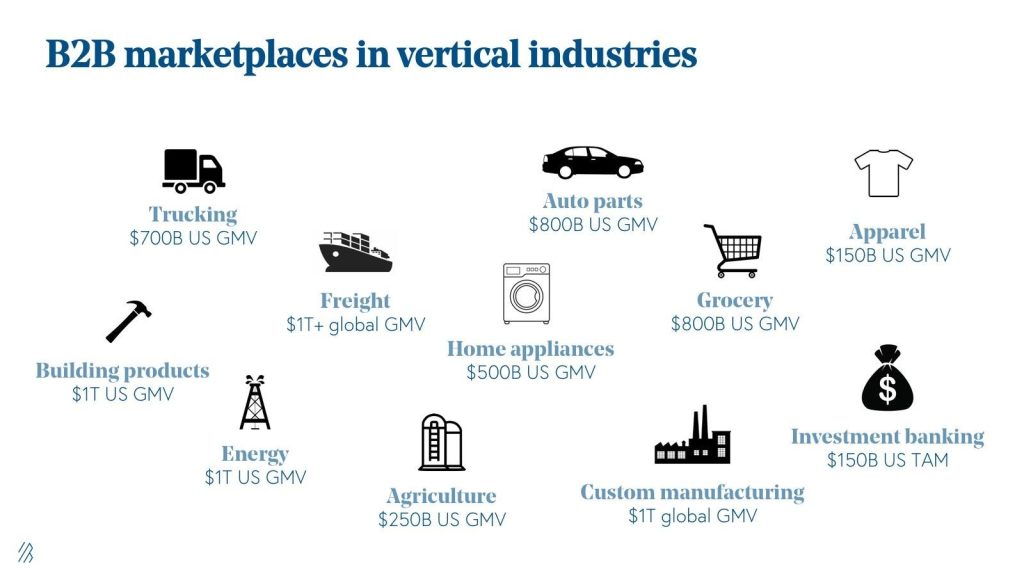
A vertical marketplace focuses on one specific industry, offering specialized workflows, catalogs, and compliance features.
Examples include marketplaces for:
- Healthcare equipment
- Automotive parts
- Construction materials
- Chemicals
- Agriculture
- Medical supplies
Because they serve a single industry, vertical marketplaces can provide industry-specific filters, certifications, regulatory compliance, and technical specifications. Often easier to differentiate because they solve highly specialized industry problems.
4. Horizontal B2B Marketplace
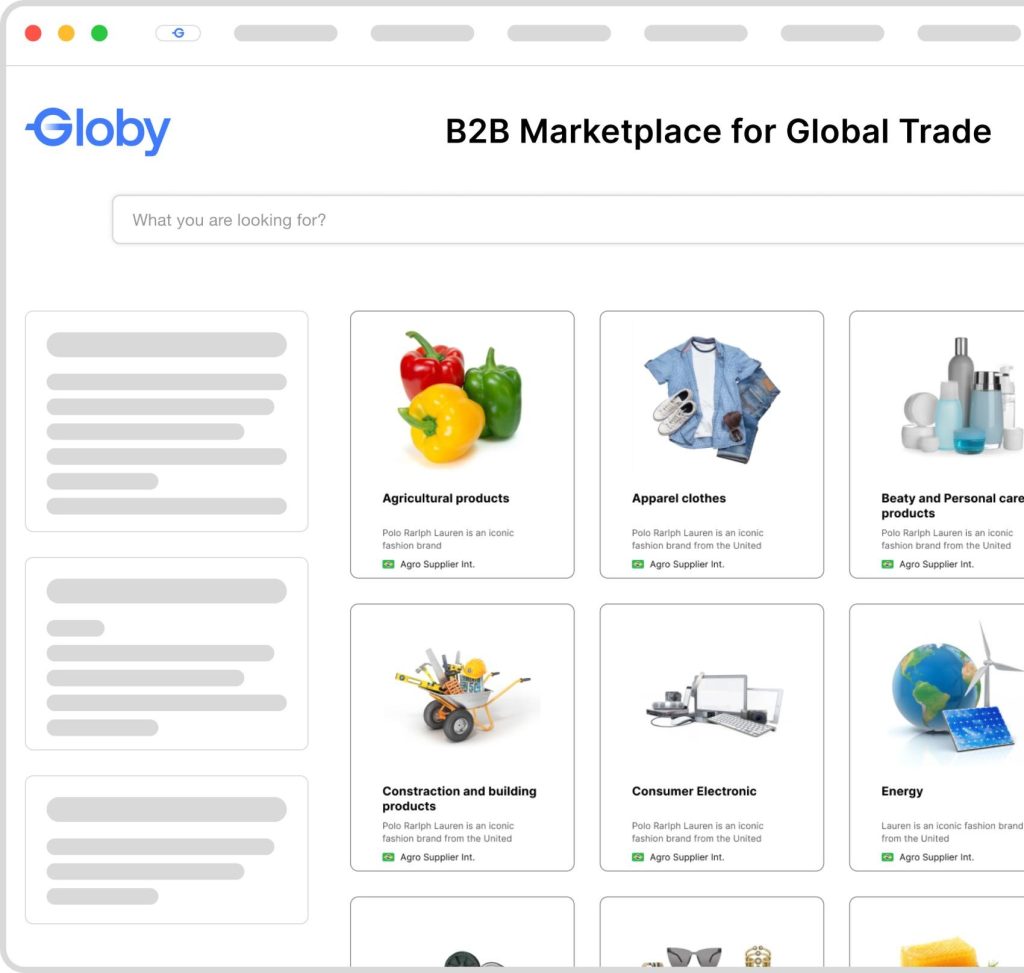
A horizontal marketplace serves multiple industries and product categories under a single platform.
For example, a buyer may purchase office supplies, electronics, industrial tools, and furniture from the same marketplace.
These platforms typically support:
- Bulk ordering
- Tiered pricing
- Minimum Order Quantity (MOQ)
- RFQ (Request for Quote)
- Inventory management
- Multi-vendor selling
Popular example:
- Amazon Business
- Alibaba
Advantages:
- Larger buyer base
- More product categories
- Higher transaction volume
- Cross-category selling opportunities
Challenges:
- More competition
- Complex catalog management
- Greater operational scale
Suitable for businesses aiming to build a large-scale, multi-category marketplace.
Launch Your B2B Multi-Vendor Marketplace with a Highly Trusted Readymade Software
Essential Features Every Enterprise B2B Marketplace Needs
Enterprise buyers have far more complex purchasing requirements than individual consumers. Therefore, they need distinct features and functionalities to trade seamlessly. B2B buyers expect a marketplace that streamlines procurement, supports multiple stakeholders, and enables seamless transitions. Below are the essential features every enterprise B2B marketplace should include to deliver a seamless buying and selling experience.
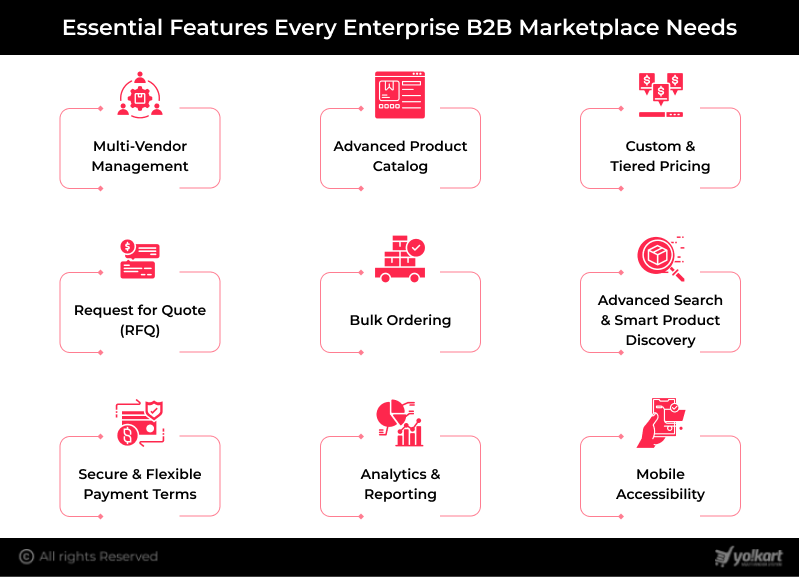
1. Multi-Vendor Management
An enterprise marketplace should enable administrators to efficiently onboard, verify, and manage multiple vendors from a centralized dashboard. A robust vendor management system simplifies supplier operations, ensures quality control, and provides complete visibility into marketplace performance.
Key capabilities include:
- Vendor registration and verification
- Product listing and approval
- Commission management
- Performance tracking
- Product approvals
- Seller analytics
- Vendor communication tools
2. Advanced Product Catalog
Enterprise marketplaces often manage thousands or even millions of SKUs across multiple categories. A well-structured product catalog helps buyers quickly discover products and enables vendors to manage extensive inventories with ease.
Features include:
- Bulk product uploads
- Product variants
- Multiple categories
- Technical specifications
- Product comparison
- Inventory synchronization
- Rich media support
3. Custom & Tiered Pricing
Unlike B2C commerce, B2B transactions rarely follow fixed pricing. Different buyers may receive unique pricing based on contracts, order volume, or long-term business relationships. Flexible pricing capabilities help businesses deliver personalized purchasing experiences while supporting complex pricing agreements.
Your platform should support:
- Customer-specific pricing
- Tiered pricing
- Quantity discounts
- Contract pricing
- Region-based pricing
- Promotional pricing
4. Request for Quote (RFQ)
RFQ functionality is a cornerstone of enterprise B2B marketplaces, allowing buyers to request customized quotations for bulk purchases or specialized requirements. It facilitates price negotiations and helps businesses secure competitive offers from multiple suppliers.
Buyers should be able to:
- Submit quotation requests
- Counteroffer from multiple vendors
- Negotiate pricing and terms
- Compare quotations
- Accept or reject offers
- Convert approved quotes into orders
5. Bulk Ordering
Enterprise customers frequently place high-volume orders involving hundreds or thousands of products. The marketplace should support bulk ordering and simplify bulk purchasing by reducing manual effort and enabling faster order processing for procurement teams.
Essential capabilities include:
- Bulk checkout
- Quick reorder options
- Multiple shipping destinations
- Bulk discount management
Suggested Read: Best B2B Marketplace Software Compared in 2026
6. Advanced Search & Smart Product Discovery
Finding the right product quickly becomes increasingly important. Advanced search capabilities powered by intelligent filters and search algorithms improve the buying experience and help users locate relevant products within seconds by minimizing the search results. Moreover, smart recommendations also improve the buying experience.
Search filters may include:
- Product specifications
- Brand
- Industry
- Supplier
- Certifications
- Availability
- Price range
- Product attributes
7. Secure & Flexible Payment Terms
Enterprise buyers require more than standard online payment methods. At the same time, they also need flexibility in making payments, which also helps them maintain cash flow. Your marketplace should support secure payment processing along with flexible payment options that align with business procurement practices and contractual agreements.
Payment options may include:
- Bank transfers
- Credit terms
- Net 30/60/90 payment terms
- Corporate credit cards
- Multiple payment gateways
- Escrow payments (where applicable)
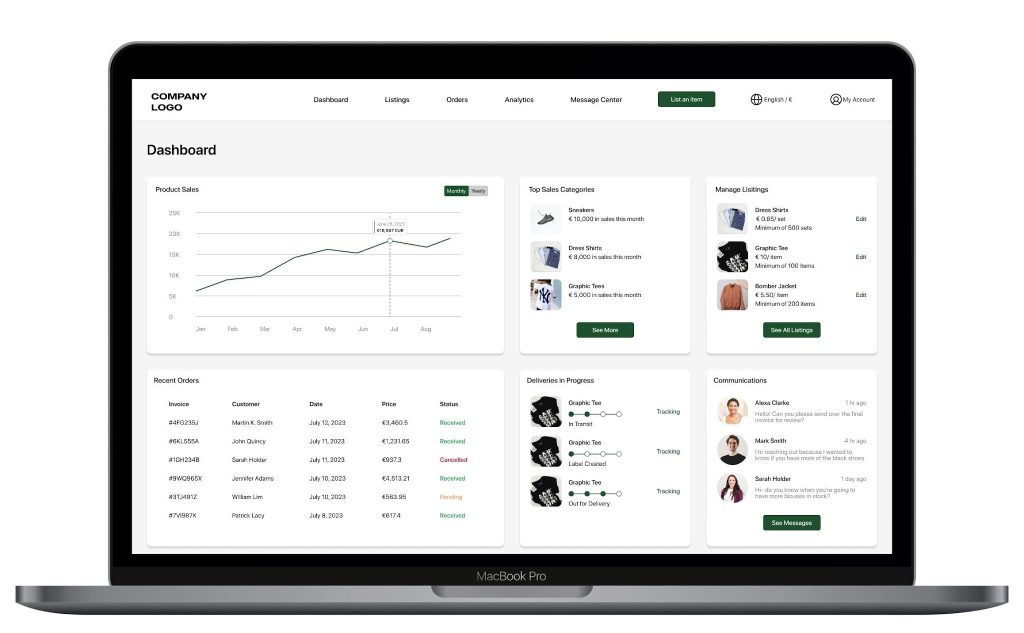
8. Analytics & Reporting Dashboard
A comprehensive analytics dashboard enables marketplace owners, vendors, and enterprise buyers to make informed business decisions. Access to real-time insights helps monitor performance, identify growth opportunities, and optimize overall marketplace operations.
Key reports should include:
- Sales performance
- Vendor growth
- Buyer activity
- Gross Merchandise Value (GMV)
- Conversion rates
- Revenue trends
- Inventory insights
- Commission reports
- Customer acquisition metrics
9. Mobile Accessibility
Although many enterprise transactions take place on desktops, decision-makers increasingly rely on mobile devices to review orders, approve purchases, communicate with suppliers, and monitor business performance. A responsive marketplace or dedicated mobile app ensures users can manage critical tasks anytime and from anywhere.
Mobile-friendly capabilities include:
- Responsive design
- Order tracking
- Push notifications
- Mobile approvals
- Secure login
- Real-time communication
How to Build an Enterprise B2B Marketplace: 7 Easy Steps to Follow
Building an enterprise B2B marketplace goes beyond creating a simple multi-vendor eCommerce platform. It requires careful planning and execution, selecting the right features, choosing the right approach, optimizing workflows and following trends.
The step-by-step guide below will help enterprises and business owners to build and launch a thriving B2B marketplace platform. Let’s explore the steps suggested and build a scalable marketplace that meets the evolving needs of buyers and sellers.
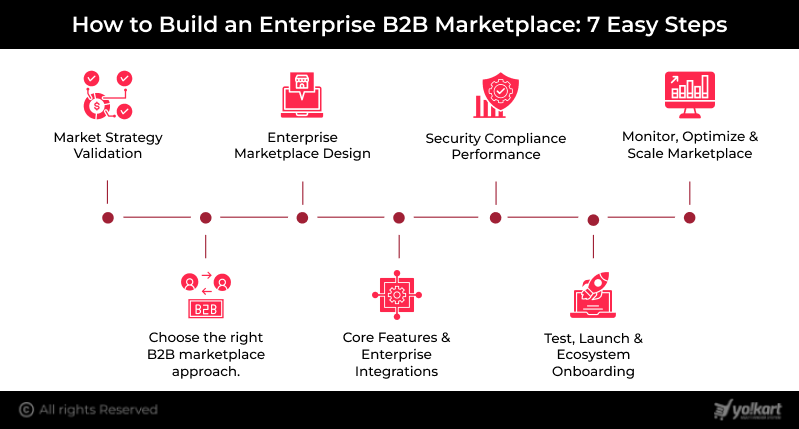
Step 1: Define Your Marketplace Strategy & Validate the Business Opportunity
Every successful marketplace starts with a clear business strategy. Identify the industry you want to serve, your target buyers and sellers, and the unique value proposition your platform will offer.
At this stage, it’s equally important to validate market demand by analyzing competitors, identifying procurement challenges, and understanding customer expectations.
Find answers to these questions:
- Which industry or niche will the marketplace serve?
- Who are your buyers and suppliers?
- What problems will your marketplace solve?
- How will you differentiate from competitors?
- What revenue model will you adopt?
You should also evaluate leading B2B marketplaces such as Amazon Business, Alibaba, Thomasnet, and Faire to understand market trends and identify opportunities for innovation. Also, define your B2B marketplace business model. It helps you define revenue channels you will be generating revenue from.
Popular monetization models include:
- Commission on each transaction
- Subscription plans
- Vendor listing fees
- Featured product advertisements
- Transaction or service fees
Step 2: Choose the Right Approach to Build Your B2B Marketplace
Once your business model is validated, the next step is selecting how you’ll build the B2B platform. Businesses generally choose between custom marketplace development and readymade marketplace software.
Developing from scratch offers complete flexibility but requires significant investment, a dedicated development team, and a longer time-to-market.
Alternatively, enterprise-ready marketplace software enables businesses to launch much faster while reducing development costs and minimizing the need for technical expertise.
Build From Scratch vs. Ready-Made Marketplace Software
| Factor | Build From Scratch | Yo!Kart |
| Development Time | 6–12+ Months | 2–8 Weeks |
| Initial Investment | High, up to $200,000 or more | Cost-effective Starts at $1,249 only |
| Enterprise Features | Built from scratch | Built-in |
| Maintenance | Ongoing | Vendor Supported |
| Scalability | Depends on Development | Enterprise Ready |
For businesses looking to launch quickly without compromising on functionality, Yo!Kart is a practical and scalable solution with built-in multi-vendor capabilities, RFQ management, custom pricing, and enterprise-grade security.
Step 3: Design an Enterprise-Ready Marketplace Experience
Enterprise buyers expect the same convenience as modern B2C platforms while requiring features tailored to business procurement. Moreover, an intuitive user experience encourages adoption, improves buyer retention, and reduces operational inefficiencies. The marketplace should simplify complex purchasing workflows for buyers, sellers, and administrators alike, making it simple and seamless. A well-designed user experience can be focused on:
Buyer Experience
- Advanced product search
- Personalized pricing
- Bulk ordering
- RFQ management
- Purchase approvals
- Multiple shipping addresses
- Saved procurement lists
Vendor Experience
- Easy onboarding
- Inventory management
- Order processing
- Quote management
- Performance analytics
- Customer communication
Admin Experience
- Vendor verification
- Commission management
- Marketplace analytics
- Content moderation
- Financial reporting
- User management
Explore B2B Features Required in a Multi-Vendor Marketplace
Step 4: Develop Core Marketplace Features & Enterprise Integrations
The functionality of your marketplace directly impacts its ability to serve enterprise customers. Beyond standard eCommerce capabilities, enterprise marketplaces require specialized procurement and operational features that support complex B2B transactions.
Essential features include:
- Multi-vendor management
- Advanced product catalog
- Request for Quote (RFQ)
- Custom pricing
- Bulk ordering
- Role-based access control
- ERP & CRM integrations
- Inventory management
- Payment gateway integration
- Analytics dashboard
Step 5: Prioritize Security, Compliance & Performance
Enterprise buyers entrust your marketplace with sensitive business information, making security and compliance critical. Implementing enterprise-grade security measures not only protects user data but also builds credibility and long-term trust. Moreover, a secure and reliable platform minimizes business risks while delivering a seamless user experience.
Your marketplace should include:
- SSL encryption
- Multi-factor authentication
- Secure payment processing
- Data encryption
- Role-based permissions
- Audit logs
- Automated backups
- GDPR and industry-specific compliance
- Performance optimization for high traffic
Step 6: Test, Launch & Onboard Your Marketplace Ecosystem
Before launching, thoroughly test every aspect of the marketplace to ensure a seamless experience for buyers, vendors, and administrators. Functional testing, performance testing, security testing, and mobile responsiveness should all be part of the pre-launch checklist.
Once testing is complete, focus on onboarding vendors and attracting early buyers through digital marketing, partnerships, and promotional campaigns. A successful launch depends not only on technology but also on building a balanced marketplace ecosystem.
Key areas to test include:
- Vendor onboarding
- Product management
- RFQ workflows
- Checkout process
- Payment gateways
- API integrations
- Mobile responsiveness
- Website performance
Step 7: Monitor Performance & Scale Your Marketplace
Launching your marketplace is only the beginning. Continuous optimization is essential for sustaining growth, improving user satisfaction, and increasing revenue. Monitor marketplace performance using key business metrics and implement updates based on customer feedback.
Track important KPIs such as:
- Gross Merchandise Value (GMV)
- Active buyers and sellers
- Conversion rate
- Average Order Value (AOV)
- Customer Acquisition Cost (CAC)
- Customer Lifetime Value (CLV)
- Vendor retention rate
- Repeat purchase rate
How Much Does It Cost to Build an Enterprise B2B Marketplace?
The cost of building an enterprise B2B marketplace can be anywhere between $40000 and $200000 or more. However, it varies significantly depending on factors such as development approach, platform complexity, feature requirements, technology stack, integrations, and level of customization.
For example, a marketplace supporting multiple vendors, custom pricing, RFQ management, ERP integrations, and enterprise-grade security will require a larger investment than a basic multi-vendor platform.
Below is a general cost comparison based on different development approaches.
| Development Approach | Estimated Timeline | Estimated Cost* |
| Custom Development | 6–12 Months | $50,000 – $200,000+ |
| Ready-Made Marketplace Software | 2–8 Weeks | $1,500 – $10,000 |
| SaaS Marketplace Platform | Few Days | Lower Initial Cost but Recurring Subscription Fees |
Note: The actual cost may vary depending on your business requirements, third-party integrations, UI/UX customization, and post-launch support requirements.
Common Challenges in Enterprise B2B Marketplace Development and How to Overcome Them
Building an enterprise marketplace comes with unique challenges that extend beyond technology. Understanding these hurdles early can help you establish a platform that delivers long-term value for buyers, sellers, and marketplace operators.
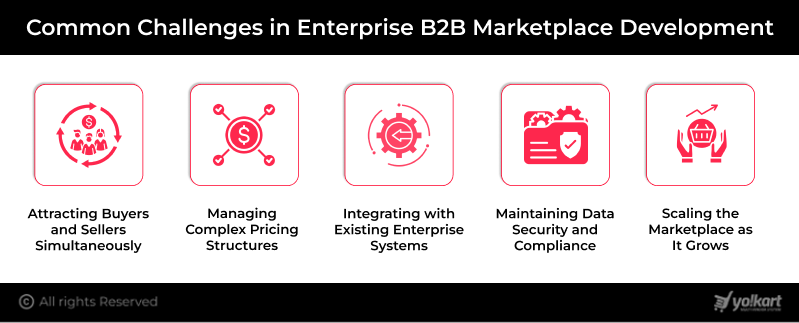
1. Attracting Buyers and Sellers Simultaneously
Every marketplace faces the classic “chicken-and-egg” problem—buyers want a wide selection of suppliers, while vendors prefer platforms with an active customer base. Now, whom to attract first? It’s one of the biggest challenges and sources of confusion for businesses.
How to overcome it:
- Focus on a niche industry initially.
- Onboard high-quality vendors before launch.
- Offer early incentives for both buyers and suppliers.
- Invest in targeted digital marketing and partnerships.
2. Managing Complex Pricing Structures
Enterprise transactions often involve negotiated pricing, volume discounts, customer-specific contracts, and long-term agreements.
How to overcome it:
Choose a marketplace solution that supports:
- Custom pricing
- Tiered pricing
- Quantity discounts
- RFQ workflows
- Contract-based pricing
3. Integrating with Existing Enterprise Systems
Many organizations already rely on ERP, CRM, accounting, inventory, and procurement software. Without seamless integrations, businesses may struggle with duplicate data entry and inefficient workflows.
How to overcome it:
Select a platform that offers APIs and supports integrations with third-party tools.
4. Maintaining Data Security and Compliance
Enterprise buyers expect robust security measures to protect sensitive business information and financial transactions.
How to overcome it:
Choose a white-label B2B multi-vendor marketplace software that implements:
- SSL encryption
- Secure payment gateways
- Multi-factor authentication
- Role-based access controls
- Regular security audits
- Compliance with relevant industry standards and data privacy regulations
5. Scaling the Marketplace as It Grows
As the number of buyers, sellers, products, and transactions increases, your marketplace must continue delivering consistent performance without downtime.
How to overcome it:
Choose a solution with a scalable architecture that supports growth and expansion. In addition to this, choosing scalable marketplace software from the beginning also eliminates the need for future migration costs and technical expertise.
Why Businesses Choose Yo!Kart for Enterprise B2B Marketplace Development?
For businesses looking to accelerate their go-to-market strategy, Yo!Kart provides a feature-rich, self-hosted marketplace solution designed to support enterprise commerce from day one.
It comes with capabilities such as multi-vendor management, RFQ functionality, custom pricing, bulk ordering, multilingual and multi-currency support, and API integrations. Moreover, being a 100% white-label solution, Yo!Kart enables businesses to launch scalable B2B marketplaces under their own brand without the complexity of developing every feature from scratch.
Whether you’re building a wholesale marketplace, procurement platform, industry-specific marketplace, or global B2B commerce ecosystem, choosing a scalable and customizable solution can help reduce development time while supporting long-term business growth. And Yo!kart is the one you can get started with.
Looking for an Enterprise-Level Marketplace Software to Launch Your B2B Marketplace?
Conclusion
Enterprise B2B marketplaces have become a cornerstone of modern digital commerce, enabling businesses to streamline procurement, improve supplier collaboration, and create new revenue opportunities.
However, building a successful marketplace requires more than just technology. It demands a well-defined strategy, the right business model, enterprise-grade features, and a scalable development approach.
If you’re planning to build an enterprise B2B marketplace, investing in a flexible and future-ready solution like Yo!Kart can help you accelerate development, reduce technical complexity, and focus on what matters most.
FAQs
1. What is an enterprise B2B marketplace?
An enterprise B2B marketplace is a multi-vendor digital platform where businesses buy and sell products or services in bulk. It supports enterprise-specific capabilities such as custom pricing, RFQs, procurement workflows, role-based access, and integrations with business systems.
2. How is a B2B marketplace different from a B2C marketplace?
Unlike B2C marketplaces that target individual consumers, B2B marketplaces focus on business transactions involving bulk orders, negotiated pricing, purchase approvals, long-term supplier relationships, and enterprise integrations.
3. How long does it take to build an enterprise B2B marketplace?
Building from scratch may take 6 to 12 months or more, while a ready-made marketplace solution can significantly reduce the launch timeline to a few weeks, depending on customization requirements.
4. What features should an enterprise B2B marketplace include?
Enterprise B2B marketplaces require specialized capabilities to handle complex organizational buying behaviors. Key features include:
- Multi-vendor management
- Custom pricing
- RFQ functionality
- Bulk ordering
- Role-based user access
- ERP and CRM integrations
- Secure payments
- Analytics dashboard
- Inventory management
- Multi-language and multi-currency support
5. Should I build a marketplace from scratch or use ready-made software?
If your business requires highly specialized functionality and has significant development resources, custom development may be appropriate. However, if you want to tap into the market quickly, saving costs significantly, a readymade B2B marketplace software can be the right tool to get started with.
6. Can an enterprise marketplace support international operations?
Yes. Modern enterprise marketplace platforms can support multiple languages, currencies, payment gateways, tax rules, and shipping providers, making it easier to expand into global markets.
7. Which industries can benefit from an enterprise B2B marketplace?
Enterprise B2B marketplaces primarily benefit industries with highly fragmented supply chains, complex procurement needs, and regulated ecosystems. However, enterprise marketplaces are widely used across industries such as:
- Manufacturing
- Wholesale distribution
- Healthcare
- Automotive
- Agriculture
- Construction
- Electronics
- Chemicals
- Food & Beverage
- Industrial Supplies
Looking for an Alternative to Custom B2B Marketplace Development?
Click HerePopular Posts