

Published date: 16th November, 2026
Launching an online marketplace involves more than setting up a website to list products or services. It brings buyers and sellers together, enables transactions, manages multiple vendors, and supports business growth. All through a centralized platform.
Therefore, the technology requirements of a marketplace vary significantly. It depends on the marketplace type and objectives. A startup validating its first marketplace idea may need a cost-effective solution that enables a faster launch. An entrepreneur building a niche marketplace may prioritize customization and business model flexibility. An established company entering the marketplace industry may require greater control over operations, integrations, scalability, and long-term technology ownership.
This is why the decision of choosing marketplace software varies depending on the business’s requirements. Businesses need to assess how well a platform supports their current requirements and whether it can accommodate future growth.
However, this guide suggests the best marketplace software options for startups, entrepreneurs, and established businesses. Businesses can evaluate these solutions and choose the best one as per their specific requirements.
Table of Contents
- What is Marketplace Software?
- 10 Essential Features to Look for in Marketplace Software
- How to Choose Marketplace Software Based on Your Business Model
- Marketplace Software Selection for Different Business Stages
- Types of Marketplace Software You Need to Consider
- Best Marketplace Software Options to Build Your eCommerce Platform
- Essential Features to Look for in Marketplace Software
- How Much Does Marketplace Software Cost?
- Common Mistakes to Avoid When Selecting Marketplace Software
- A Practical Checklist Before Choosing Marketplace Software
- Why Consider Yo!Kart for Building a Multi-Vendor Marketplace?
- Final Thoughts
- FAQs
What is Marketplace Software?
Marketplace software is a technology solution that enables businesses to create and manage an online platform. It offers a readymade foundation where multiple independent sellers or vendors can list and offer products to customers.
Unlike a conventional eCommerce website that typically sells products from a single business, multi-vendor marketplace software enables businesses to onboard multiple vendors and connect them with customers with diverse needs. However, the marketplace operator manages the platform, establishes business rules, and ensures secure transactions between buyers and vendors.
Overall, marketplace software comes with all the essential features built in. Businesses can simply choose the right solution and launch their multi-vendor marketplace without developing the platform from scratch.
A multi-vendor Marketplace software generally includes three interconnected interfaces:
| Interface | Primary purpose |
| Customer interface | Allows buyers to browse listings, compare options, place orders, and manage purchases. |
| Vendor interface | Enables sellers to manage profiles, product or service listings, orders, and relevant business activities. |
| Admin interface | Gives the marketplace owner control over vendors, listings, transactions, commissions, platform settings, and operations. |
The right marketplace software should support these three user groups while allowing the business to configure the platform around its intended operating model.
10 Essential Features to Look for in Marketplace Software
Operating a multi-vendor marketplace requires a lot more than just a digital infrastructure. Here, we have listed essential features to look for while evaluating a readymade marketplace software.
1. Advanced Search Filters
Advanced search and filter options are primary requirements of a multi-vendor marketplace. These features enable customers to discover relevant products or services without navigating through an unnecessarily complicated interface.
Useful capabilities may include:
- Keyword search
- AI Product Search
- Voice Search
- Image Search
- Category-based browsing
- Product and service filters
- Sorting and filtering options
2. Vendor Registration and Management
Vendor onboarding is the primary feature of a multi-vendor marketplace. The software should allow sellers to register, create profiles, submit relevant information, and manage their marketplace activities. Administrators should be able to review vendor applications, manage approvals, and control vendor access.
3. Product Listing Management
The listing system allows vendors to list products. They can add product descriptions, images, select categories, update inventory information, and pricing to list their products on the marketplace.
4. Catalog Management
A multi-vendor marketplace should allow sellers to independently manage their product catalogs while giving administrators control over the overall product listing process. Important capabilities include product uploads, bulk product imports, inventory updates, product categorization, product variations, pricing management, and product approval workflows.
5. Order Management
A marketplace needs reliable processes for managing orders and transactions involving multiple vendors. Evaluate how the software handles order placement, order status updates, cancellations, refunds, vendor-specific order processing, and transaction records.
6. Payment and Commission Management
Marketplace operators often implement and generate revenue from multiple monetization models. The marketplace software should support multiple revenue streams. Moreover, the solution also needs to support complete payment workflows such as commission calculation, vendor payouts, refunds, and more.
7. Shipping and Delivery Management
Shipping management enables vendors to handle order fulfillment efficiently while allowing marketplace administrators to oversee the entire delivery process. A multi-vendor marketplace software with a shipping and delivery management system includes:
- Multiple shipping carrier integrations
- Vendor-specific shipping rates
- Automated shipping label generation
- Real-time shipment tracking
- Delivery status notifications
- Return and exchange management
8. Reports and Analytics
Reports and analytics help marketplace owners make informed business decisions by providing insights into marketplace performance, vendor activities, sales, and customer behavior. Important analytical capabilities of multi-vendor marketplace software should include:
- Sales and revenue reports
- Vendor performance reports
- Commission and payout reports
- Customer acquisition and retention analytics
- Product performance tracking
- Order and transaction reports
- Marketplace growth insights
9. Ratings and Reviews
The ratings and reviews feature helps customers share their experience and feedback related to the product and the marketplace. A transparent review process can support trust between buyers and vendors. Therefore, the marketplace owner should ensure this feature is included in their marketplace.
10. Integration Capabilities
A marketplace may need to connect with external services such as payment gateways, shipping providers, accounting tools, CRM systems, ERP software, or marketing platforms. Businesses should review available APIs, integration options, access, and any additional requirements while evaluating marketplace software.
How to Choose Marketplace Software Based on Your Business Model
Different marketplace models have different operational requirements. A solution designed for a B2C marketplace may not automatically support every workflow needed for a B2B marketplace. Let’s understand the capabilities you need to evaluate.
| Marketplace business model | Example business concept | Capabilities to evaluate |
| B2C marketplace | Multiple retailers selling to individual customers | Vendor management, product catalog, customer accounts, checkout, and order management. |
| B2B marketplace | Suppliers selling to business buyers | Bulk ordering, business accounts, negotiated pricing, RFQ, purchase orders, and invoicing workflows. |
| P2P marketplace | Individuals selling products to other individuals | User profiles, listings, seller management, transaction workflows, and trust mechanisms. |
| Hybrid marketplace | A platform combining multiple business models | Flexible listing structures, user roles, transaction workflows, and customization. |
Seeking Expert Guidance to Decide on the Marketplace Software?
Marketplace Software Selection for Different Business Stages
There is no single marketplace solution that is suitable for every business. The right choice depends on factors such as the business model, launch budget, technical resources, expected transaction volume, and long-term objectives.
Here is how marketplace software requirements differ across three business stages.
Marketplace Software for Startups
Entrepreneurs often need to validate an idea, attract initial vendors, and acquire their first customers without investing heavily in technology development.
For this reason, marketplace software for startups should help reduce the time and effort involved in building the initial platform.
Key requirements include:
- Faster marketplace launch with essential marketplace functionality.
- Predictable initial software and development costs.
- Easy vendor onboarding and listing management.
- Basic order and transaction management.
- Responsive customer and vendor interfaces.
- Essential administrative controls.
- Flexibility to refine the marketplace as the business model develops.
For instance, an entrepreneur planning a niche fashion marketplace may initially focus on vendor registration, product listings, customer accounts, checkout, and order management. Advanced integrations and additional workflows can be evaluated as the marketplace gains traction.
What should startups or entrepreneurs prioritize?
Startups should prioritize a solution that supports their minimum viable marketplace requirements without creating unnecessary technical complexity. However, choosing a platform solely because it is inexpensive can become costly if essential capabilities need to be rebuilt later.
Marketplace Software for SMBs
SMBs may have a more defined marketplace concept but still need flexibility to establish their market positioning and revenue model.
Unlike startups that may still be validating an idea, SMBs often need to differentiate their marketplace through its user experience, niche-specific workflows, and business model.
Key requirements include:
- Customizable marketplace design and branding.
- Support for the intended marketplace business model.
- Flexible vendor and product management.
- Multiple revenue-generation possibilities.
- Mobile-friendly customer and vendor experiences.
- Integration capabilities for relevant third-party services.
- Options to introduce additional functionality as the business expands.
What should entrepreneurs prioritize?
SMBs should look beyond the initial launch. The software should provide enough flexibility to establish a distinct marketplace identity and support the business model without requiring a complete technology replacement as the business evolves.
Marketplace Software for Established Businesses
Established businesses usually approach marketplaces with more defined operational requirements. They may already have customers, suppliers, internal systems, and established processes that need to be incorporated into the new marketplace.
For these businesses, the technology decision can influence long-term operational efficiency and the ability to expand into new markets.
Key requirements include:
- Scalable architecture suited to anticipated business growth.
- Customization for business-specific workflows.
- API and third-party integration capabilities.
- Advanced administrative and vendor management.
- Security and access-control considerations.
- Mobile application support, where required.
- Data ownership and hosting control.
- Technical support and a clear upgrade roadmap.
What should established businesses prioritize?
Established companies should evaluate software based on its ability to fit into their existing technology environment, support complex operating requirements, scale to support future growth, and provide sufficient control over the platform. They should also assess customization flexibility, security, and the long-term cost of ownership.
Types of Marketplace Software You Need to Consider
Marketplace software can be evaluated through different technology and deployment approaches. Each has advantages and limitations, and the right option depends on how much control, customization, and technical responsibility the business wants to retain.
SaaS Marketplace Software
SaaS marketplace platforms are hosted and maintained by a software provider. Businesses generally access the platform through a subscription-based arrangement.
The provider manages much of the underlying infrastructure, which can reduce the technical responsibilities of the marketplace owner.
Best suited for: Businesses that prefer managed hosting and want to avoid handling much of the platform infrastructure themselves.
Advantages:
- Managed hosting and platform maintenance.
- Relatively straightforward initial setup.
- Low initial investment.
Limitations:
- Recurring subscription expenses.
- Customization may be restricted by the provider’s platform.
- Data access, portability, and hosting control need careful evaluation.
- Additional transaction, app, or feature charges may apply depending on the provider.
- Costly in the long run
SaaS can be convenient for businesses that prioritize managed operations. However, companies expecting extensive customization or greater control over their technology should assess the platform’s limitations before committing.
Custom Marketplace Development
Custom marketplace development involves building a platform around the business’s specific requirements. The development team typically works on architecture, user interfaces, marketplace workflows, integrations, and other components.
Best suited for: Businesses with specialized requirements that cannot be adequately supported through available marketplace software.
Advantages:
- Greater freedom to define marketplace workflows.
- Technology can be designed around specific operational needs.
- Flexibility in integrations and user experience.
- Greater control over development decisions.
Limitations:
- Higher initial development investment in many cases.
- Longer planning and development cycles.
- Requires ongoing technical resources.
- Testing, maintenance, upgrades, and security remain important responsibilities.
Custom development may be justified when a business has unique technical requirements or a well-defined need for a proprietary platform. However, building every marketplace component from scratch is not always necessary.
Self-Hosted Marketplace Software
Self-hosted marketplace software allows businesses to deploy the platform in a hosting environment they select, subject to the software’s technical and licensing requirements.
It can provide greater control over hosting, deployment, data management, and technical customization compared with a provider-managed platform.
Best suited for: Businesses that want greater control over their marketplace infrastructure and are prepared to manage or arrange the required technical resources.
Advantages:
- More control over the hosting environment.
- Greater flexibility in deployment and technical management.
- Better alignment with internal infrastructure policies.
- More control over customization and integrations, depending on the software license.
- No recurring or hidden charges
- Customizable source code
Limitations:
- Hosting and infrastructure management need to be arranged.
- Technical maintenance and updates require planning.
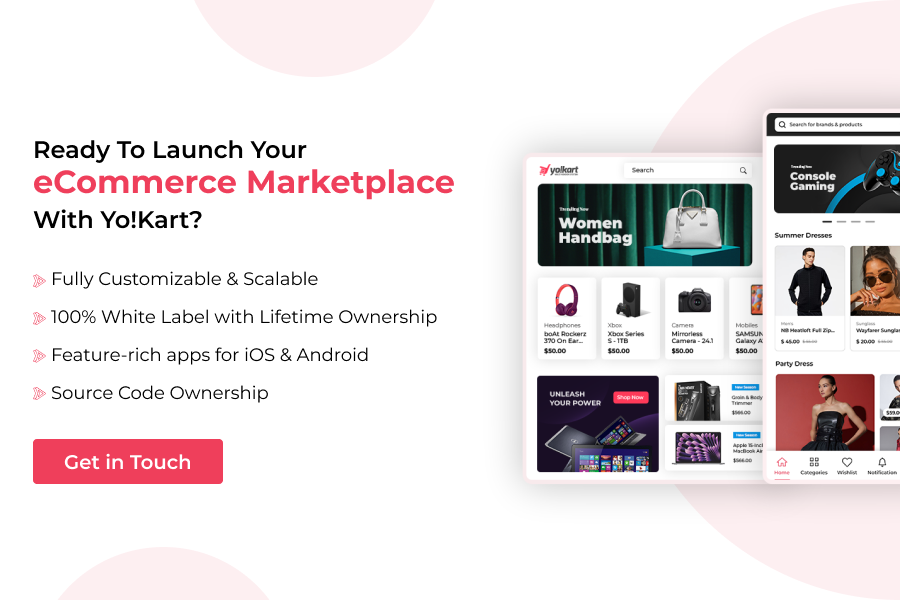
A ready-made solution such as Yo!Kart can be considered in this category. It provides a pre-built multi-vendor marketplace foundation that businesses can configure easily and customize for different marketplace concepts. With one-time licensing fees, the solution offers source code ownership, customization flexibility, and scalable architecture.
Best Marketplace Software Options to Build Your eCommerce Platform
The marketplace software market includes ready-made multi-vendor solutions and hosted platforms. The following options represent different approaches to marketplace development rather than a universal ranking.
Before shortlisting any product, businesses should confirm its current features, pricing, supported business models, customization scope, and contractual terms.
Yo!Kart
Best for: Businesses planning to launch a multi-vendor eCommerce marketplace with self-hosted, scalable software.
Yo!Kart is a readymade, self-hosted multi-vendor eCommerce software solution designed for businesses that want to create their own online marketplaces. The solution can be considered by startups, entrepreneurs, and established businesses looking to build B2C, B2B, or P2P marketplace concepts. It’s fully customizable and flexible enough to meet specific marketplace development needs regardless of business size and business model.
Rather than developing the complete marketplace foundation from scratch, businesses can start with Yo!Kart. It provides a ready-to-deploy foundation and allows businesses to configure or customize it as needed for their specific operations.
Key Offerings:
- Multi-vendor marketplace functionality.
- Customer, vendor, and administrator dashboards.
- Support for B2C, B2B, and P2P marketplace concepts.
- Customization options for business-specific requirements.
- Android and iOS mobile application availability.
- Self-hosted deployment approach.
- License-based purchasing model rather than a standard recurring SaaS subscription.
Yo!Kart may be particularly relevant to businesses that want more control over their marketplace deployment and prefer a ready-made foundation over complete custom development.
However, businesses need to evaluate the exact requirements of their business model.
Why consider Yo!Kart?
For businesses that have already defined their marketplace concept, Yo!Kart offers a way to begin with an established multi-vendor platform rather than building every core component independently. Its suitability should be assessed through a feature walkthrough, technical discussion, and demonstration of the workflows that matter to the business.
Businesses can explore Yo!Kart’s multi-vendor marketplace software and review its capabilities before deciding whether it fits their requirements.
Build Your Marketplace Using Self-Hosted Software
CS-Cart Multi-Vendor
CS-Cart Multi-Vendor is a marketplace software solution designed to help businesses manage multiple sellers through a shared online storefront. It is worth considering for companies that want to compare readymade marketplace platforms and assess their available vendor management, catalog, order, and administrative capabilities.
What to evaluate:
- Vendor management and onboarding.
- Product catalog and order workflows.
- Available themes and extensions.
- Customization and integration requirements.
- Licensing and upgrade costs.
- Technical support arrangements.
Sharetribe
Sharetribe is another solution that allows businesses to build a multi-vendor marketplace. It helps businesses launch and operate marketplace platforms seamlessly. However, the solution can be relevant to entrepreneurs who want to test a marketplace concept and assess the trade-offs between a managed platform and more extensive technical customization.
What to evaluate:
- Supported marketplace transaction workflows.
- Listing and user management.
- Payment and service integrations.
- Customization options.
- Subscription and transaction-related costs.
- Migration and scalability considerations.
Arcadier
Arcadier offers a marketplace foundation for businesses looking to establish online marketplaces without managing every component through a fully custom development project. It may be worth evaluating for organizations that prefer a hosted approach because it’s a SaaS-based solution. However, the solution charges monthly recurring fees. Moreover, cost can be a critical consideration for businesses starting with Arcadier.
What to evaluate:
- Supported marketplace models.
- Vendor and listing management.
- Available integrations.
- Branding and customization options.
- Pricing and transaction terms.
- Data access and portability.
Mirakl
Mirakl is associated with enterprise marketplace and dropship technology. It is particularly relevant to established retailers and organizations exploring marketplace expansion as part of a broader commerce strategy.
Moreover, the solution can be considered a dedicated, enterprise-grade multi-vendor marketplace solution. At the same time, it has an enterprise quote-based pricing model that typically combines recurring base fees with a cut of your Gross Merchandise Value (GMV). This makes it financially challenging for small-to-medium businesses (SMBs).
What to evaluate:
- Enterprise marketplace operating requirements.
- Seller onboarding and management.
- Integration with existing commerce systems.
- Product and order management workflows.
- Implementation scope and support.
- Total cost of ownership.
Shopify-Based Marketplace Approaches
Shopify is primarily an eCommerce platform rather than a native multi-vendor marketplace solution in its standard store setup. Businesses can explore third-party marketplace applications or custom development to introduce vendor-related functionality.
This approach may be practical for businesses already invested in Shopify. However, they should verify whether the combination of apps and custom development can support their complete marketplace operating model.
What to evaluate:
- Third-party marketplace app capabilities.
- Vendor registration and approval.
- Commission and payout workflows.
- Product and order synchronization.
- App subscription and transaction costs.
- Compatibility with the existing Shopify setup.
Essential Features to Look for in Marketplace Software
A marketplace may start with a limited number of vendors and products, but its technology should be capable of supporting the operating processes required as the business develops.
Here are the major features and capabilities to assess.
Vendor Registration and Management
Vendor onboarding is one of the first operational requirements of a multi-vendor marketplace.The software should allow sellers to register, create profiles, submit relevant information, and manage their marketplace activities. Administrators should be able to review vendor applications and control vendor access according to the marketplace’s policies.
Product and Listing Management
The listing system should support the type of products or services offered through the marketplace. For a product marketplace, this may include product descriptions, images, categories, inventory information, and pricing. A service or rental marketplace may require additional attributes and workflows. Businesses should verify whether the platform supports their required listing structure natively or through customization.
Order and Transaction Management
A marketplace needs reliable processes for managing orders and transactions involving multiple vendors. Evaluate how the software handles order placement, order status updates, cancellations, refunds, vendor-specific order processing, and transaction records. For marketplaces involving bookings or services, assess whether the transaction workflow can accommodate scheduling, availability, or service completion requirements.
Payment and Commission Management
Marketplace operators often generate revenue by charging vendors a commission or using another monetization model. The software should support the payment workflows required by the business, including the relevant payment gateway integrations and commission calculations.
Importantly, marketplace payments can involve additional considerations such as vendor payouts, payment-provider onboarding, refunds, and regional compliance. These should be discussed with the software provider and payment service provider before launch.
Search, Filters, and Navigation
Customers should be able to discover relevant products or services without navigating through an unnecessarily complicated interface.
Useful capabilities may include:
- Keyword search.
- Category-based browsing.
- Product and service filters.
- Sorting options.
- Relevant listing information.
- Mobile-friendly navigation.
For marketplaces with extensive catalogs, search quality can directly influence product discovery and customer experience.
Ratings and Reviews
Ratings and reviews help customers evaluate sellers, products, and services.
The marketplace owner should assess how reviews are collected, displayed, moderated, and connected to completed transactions. A transparent review process can support trust between buyers and vendors.
Administrative Controls and Reporting
The administrator needs visibility into marketplace operations.
Useful reporting areas may include:
- Vendor registrations and activity.
- Product or service listings.
- Orders and transactions.
- Commission and revenue records.
- Customer activity.
- Marketplace performance.
The exact reporting capabilities should be checked against the management information the business needs.
Mobile Experience and Applications
Customers and vendors increasingly expect convenient access across devices.
At a minimum, the marketplace should provide a responsive experience on mobile devices. Businesses that require dedicated applications should also evaluate Android and iOS availability, feature parity, maintenance, and the cost of future app updates.
Integration and Customization Capabilities
As the marketplace grows, it may need to connect with external services such as payment gateways, shipping providers, accounting tools, CRM systems, ERP software, or marketing platforms.
Businesses should review available APIs, integration options, customization access, and any additional development requirements.
How Much Does Marketplace Software Cost?
There is no reliable single price that applies to every marketplace software. Costs vary according to the business requirements, licensing model, customization scope, integrations, and ongoing operational needs.
Several factors can increase or reduce the total investment:
- Marketplace complexity: A basic marketplace has different requirements from a platform with complex operational needs.
- Customization: Unique workflows, interface changes, and additional modules can increase development costs.
- Integrations: Payment, logistics, ERP, CRM, and other integrations may require additional work and can influence cost.
- Mobile applications: Dedicated Android and iOS applications can affect the overall investment.
- Support and maintenance: Updates, security, backups, and technical assistance also affect the overall cost.
The following table outlines the major cost components businesses should consider.
| Cost component | Ready-made self-hosted marketplace software | SaaS marketplace platform | Custom marketplace development |
| Initial software cost | License or package fee | Often an initial setup or subscription fee | Discovery, design, and development investment |
| Hosting | Arranged by the business | Generally included or managed | Depends on the architecture and deployment |
| Customization | Can be customized as per the required features | Depends on provider limitations and plan | Included in the project scope |
| Integrations | May involve configuration or development costs | May require apps or additional services | Developed according to requirements |
| Maintenance | Depends on license and support agreement | Generally managed by the provider | Requires an ongoing technical arrangement |
| Long-term expenses | Hosting, support, upgrades, and customization | Recurring subscriptions and additional charges | Maintenance, infrastructure, and development resources |
Looking for a Fully Customizable Readymade Marketplace Software?
Common Mistakes to Avoid When Selecting Marketplace Software
Even a feature-rich platform can become a poor investment if it does not align with the business’s actual requirements.
Here are some mistakes to avoid.
1. Choosing Software Based Only on Price
A low initial price may seem attractive, but it does not necessarily reflect the total investment. Consider integrations, customization, support, and ongoing recurring subscription fees alongside other hidden charges.
2. Ignoring the Marketplace Business Model
A B2C marketplace and a B2B procurement marketplace have different workflows.
Selecting software before documenting the business model can lead to functionality gaps and unexpected development requirements.
3. Overlooking Vendor Experience
Marketplace success depends on attracting and retaining sellers or service providers.
The vendor interface should make it practical for sellers to register, manage listings, and handle their marketplace activities.
4. Assuming Every Feature Is Included
Marketing pages may describe a broad range of capabilities, but not every feature will necessarily be included in the selected edition or license.
Ask the provider to demonstrate critical workflows and identify which capabilities require customization or third-party services.
5. Neglecting Integrations and Future Growth
A marketplace may initially operate with a limited technology stack, but its integration requirements can increase as operations expand.
Review API availability, integration flexibility, technical documentation and scalability before making a decision.
6. Not Evaluating Support and Maintenance
You may experience bugs and errors at any time or you may need technical support to implement your specific requirements.
Businesses should understand how updates, technical support, bug fixes, security, and future upgrades are handled.
A Practical Checklist Before Choosing Marketplace Software
Before selecting a platform, businesses can use the following checklist to evaluate whether a solution meets their requirements.
- Does the platform support the intended marketplace business model?
- Are customer, vendor, and administrator interfaces available?
- Can vendors register and manage their listings?
- Does the software support the required order and transaction workflows?
- Are the necessary payment gateways and payout arrangements supported?
- Can the marketplace be customized to reflect the business’s branding?
- Are the required integrations available or technically feasible?
- Does the solution provide a suitable mobile experience?
- Are Android and iOS applications available if the business needs them?
- Are hosting, licensing, and data ownership terms clear?
- Are customization and upgrade costs documented?
- Is technical support available under clearly defined terms?
- Can the software accommodate the business’s expected growth?
Why Consider Yo!Kart for Building a Multi-Vendor Marketplace?
Choosing marketplace software is a long-term technology decision. Businesses need a solution that provides the necessary marketplace foundation while leaving room to align the platform with their business model.
Yo!Kart is one option businesses can evaluate when looking for ready-made, self-hosted multi-vendor eCommerce software.
It is designed for businesses of all sizes planning B2C, B2B, and P2P marketplace concepts. Its readymade approach can help reduce the need to develop the complete marketplace foundation from scratch, while its customization options can be evaluated for business-specific requirements.
Yo!Kart may be relevant to:
- Startups looking to launch a multi-vendor marketplace using an existing software foundation.
- Entrepreneurs planning niche marketplaces that require distinct branding and workflows.
- Established businesses exploring marketplace expansion and seeking a self-hosted platform that can be customized around their operations.
Its license-based purchasing approach may also appeal to businesses that prefer a software purchase over a conventional recurring SaaS subscription.
To understand whether Yo!Kart is suitable for your marketplace idea, review its multi-vendor marketplace software capabilities and request a product demonstration.
Want to See How is Yo!Kart the Right Fit for Your Business?
Final Thoughts
The best marketplace software is not necessarily the platform with the longest feature list or the lowest price. It is the solution that aligns with the business’s current requirements, supports its operating model, and offers a practical path for future development.
Startups should focus on launching efficiently without compromising essential marketplace functionality. Entrepreneurs should prioritize flexibility and differentiation. Established businesses should pay close attention to integrations, operational control, scalability, and long-term ownership considerations.
However readymade marketplace software can be a practical starting point when its existing capabilities match the business’s needs. For businesses exploring a self-hosted multi-vendor eCommerce platform, Yo!Kart is worth evaluating alongside other available solutions.
FAQs
What is the best marketplace software for established businesses?
Established businesses should evaluate marketplace software based on scalability, integration capabilities, customization, security, hosting control, support, and total cost of ownership.
Yo!Kart is an enterprise-oriented solution.It’s a fully customizable and scalable solution that can be customized as per your specific requirements and its architecture enables businesses to establish a future-proof marketplace. In short, Yo!kart’s self-hosted nature, flexibility, control and code-level access make it the best marketplace software for enterprises.
Is ready-made marketplace software better than custom development?
Neither approach is universally better. The decision always depends on the specific requirements. Readymade software can reduce development effort and provide an existing marketplace foundation. Custom development offers greater freedom to design specialized workflows but generally requires more planning, investment, and ongoing technical resources.
The right approach depends on how closely existing software aligns with the business’s requirements, budget and timeline
Can I build a multi-vendor marketplace without coding?
Yes, you can utilize readymade marketplace software to establish a multi-vendor platform without developing every component from scratch.
Is self-hosted marketplace software better than SaaS?
Self-hosted and SaaS solutions serve different business needs.
Self-hosted software can provide greater control over deployment, hosting, and technical customization. SaaS platforms generally reduce infrastructure management responsibilities by having the provider manage hosting and platform maintenance.
Businesses should compare flexibility, recurring costs, data access, technical responsibilities, and support before choosing.
How much does it cost to build a multi-vendor marketplace?
The cost of building a multi-vendor marketplace can be anywhere between $5000 to $200000 or more. It depends on the approach, marketplace complexity, customization, integrations, mobile applications, hosting, and ongoing maintenance.
Readymade software may reduce the initial development investment, while custom development typically requires a larger project budget.
Build Your Marketplace Using Readymade Software
Get StartedPopular Posts