
Published Date: 13th Nov, 2026
Introduction
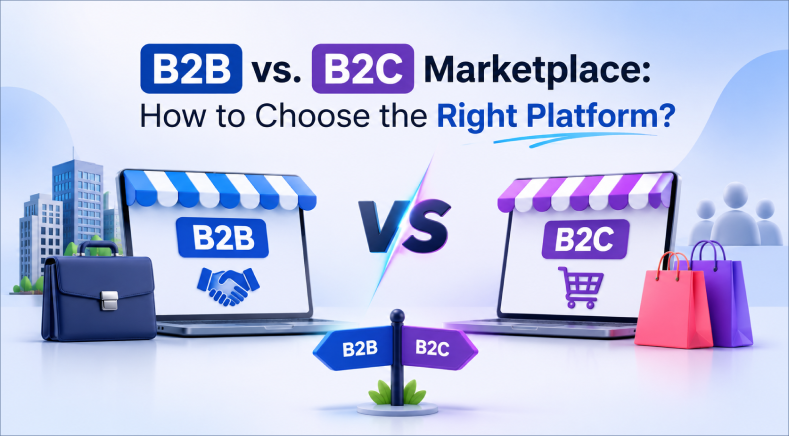
Businesses and entrepreneurs often confuse the B2B and B2C marketplace models, and that confusion can lock them into the wrong one. The real cost of mixing them up is spending the next two years fighting your own digital store. Both models share the same core functions, but they serve different customer roles.
B2B marketplaces revolve around bulk orders, negotiated pricing, repeat buyers, and long-term supplier relationships. B2C marketplaces thrive on high traffic, quick purchase decisions, and frictionless checkout. Choosing between them is one of the most consequential decisions a business makes. It shapes budget, defines who you sell to, and determines the platform features, sales cycle, and growth path that follow.
However, the decision is not always as straightforward as choosing between business buyers and individual consumers. Some businesses need to support both customer groups, while others may want to combine wholesale and retail operations within one marketplace.
This blog explores B2B or B2C business models in detail that help in making informed decisions for entrepreneurs. Explore key differences between B2B and B2C marketplaces, the factors, and how to evaluate platforms with confidence, to invest in the model that fits your business today and supports where you plan to be tomorrow.
Table of Contents
- Understanding B2B and B2C Marketplace Business Models
- B2B vs. B2C Marketplace: Key Differences
- Essential Features of a B2B Marketplace Platform
- Essential Features of a B2C Marketplace Platform
- Can One Marketplace Platform Support Both B2B and B2C?
- How to Choose the Right Marketplace Platform for Your Business
- What Should You Evaluate Before Investing in a Marketplace Platform?
- How Much Does It Cost to Build a B2B or B2C Marketplace?
- Why Consider Yo!Kart for B2B, B2C, and Hybrid Marketplace Development?
- Conclusion
- Frequently Asked Questions (FAQs)
Understanding B2B and B2C Marketplace Business Models
For entrepreneurs planning to launch an online marketplace, understanding the B2B and B2C business models is essential to make an informed investment decision. Evaluating how each model works helps businesses identify the right marketplace structure, define their functional requirements, and select a business model that aligns with their business objectives and long-term growth strategy.
Below is the detailed explanation of both business models
What Is a B2B Marketplace?
A B2B (Business-to-Business) marketplace is an online platform where businesses sell products or services to other businesses. It brings multiple suppliers, manufacturers, wholesalers, distributors, and business buyers together in one digital environment.
Unlike conventional retail marketplaces, B2B marketplaces often accommodate large orders, negotiated pricing, repeat purchases, and more complex purchasing workflows.
Examples of B2B marketplaces include:
- Alibaba.com – Connects manufacturers, suppliers, and wholesale buyers.
- Global Sources – Facilitates global sourcing between suppliers and business buyers.
- Faire – Connects independent brands with retailers.
- IndiaMART – Connects businesses with suppliers across different product categories.
A B2B marketplace is particularly relevant for businesses operating in wholesale distribution, industrial supplies, manufacturing, bulk procurement, and business sourcing.
What is a B2C Marketplace?
A B2C (Business-to-Consumer) marketplace is an online platform where businesses sell products directly to individual consumers.
The marketplace brings multiple sellers and their product catalogs together, allowing consumers to discover, compare, purchase, and review products from different vendors.
B2C marketplaces generally focus on convenient and quick shopping experiences, competitive pricing, product discovery, payment flexibility, and order fulfilment.
Examples of B2C marketplaces include:
- Amazon – Offers products across multiple consumer categories.
- eBay – Facilitates transactions between sellers and buyers.
- Etsy – Focuses on handmade, vintage, and creative products.
- Walmart Marketplace – Enables third-party sellers to reach consumers through Walmart’s online marketplace.
B2C marketplaces are suitable for businesses planning to sell fashion, electronics, groceries, home products, beauty products, and other consumer goods.
B2B vs. B2C Marketplace: Key Differences
B2B and B2C marketplaces both connect multiple vendors with buyers through a single shared platform, but they serve different purchasing needs. B2B marketplaces are built for procurement at scale, with bulk ordering, negotiated pricing, multi-stakeholder approvals, and long-term supplier relationships. B2C marketplaces focus on fast, individual purchases driven by convenience and price. Both business models possess lot of differences. The following table highlights the major differences.
| Comparison Factor | B2B Marketplace | B2C Marketplace |
| Target audience | Businesses, wholesalers, retailers, manufacturers | Individual consumers |
| Purchasing purpose | Resale, business operations, procurement | Personal consumption |
| Order volume | Often bulk or high-volume orders | Usually individual or smaller orders |
| Pricing | Negotiated, tiered, or volume-based | Generally fixed or promotional |
| Purchasing cycle | Longer and often involves multiple decision-makers | Usually shorter and more direct |
| Payment methods | Credit terms, invoices, bank transfers, business payments | Cards, digital wallets, online payment methods, and COD |
| Customer relationships | Often long-term and account-based | Frequently transaction-driven, with repeat purchases |
| Order management | May involve complex approvals and fulfilment | Typically streamlined order processing |
| Marketing approach | Account-based marketing, industry outreach, and lead generation | SEO, social media, paid advertising, and promotions |
| Sales process | Quotations, negotiation, and purchase orders | Product selection and checkout |
| Customer support | Account management and business assistance | Shopping assistance and order support |
Key takeaway: B2B marketplaces are generally designed around business procurement and long-term supplier relationships, whereas B2C marketplaces prioritize convenient shopping and direct consumer transactions.
The business model you choose should support the purchasing behaviour of your intended audience rather than simply provide a conventional multi-vendor storefront.
Need Expert Consultation On the Right Marketplace Business Model?
B2B Or. B2C: Which Marketplace Model Is Right for Your Business?
The right choice significantly depends on the following:
- What are your business objectives?
- What products/ services you sell?
- Who is your target audience?
- What pricing strategy do you want to follow?
- Do you prefer long-term business transactions or quick customer purchases?
Understand these key factors to make an informed decision.
Here are some practical situations to help you evaluate both options.
Choose a B2B Marketplace If:
- Your primary customers are businesses rather than individual consumers.
- Your products are sold in bulk or require minimum order quantities.
- Buyers expect volume-based pricing or negotiated commercial terms.
- You operate in manufacturing, wholesale, distribution, or industrial supply.
- Your business involves recurring procurement and supplier relationships.
- Buyers need quotations, invoices, or purchase-order-based workflows.
Example: An entrepreneur planning to connect industrial equipment manufacturers with construction companies and distributors would benefit from a B2B marketplace model.
The B2B marketplace makes it easier for business buyers to compare suppliers, request quotations, evaluate product specifications, and manage larger orders.
Choose a B2C Marketplace If:
- You want to sell directly to individual consumers.
- Your product categories are suitable for everyday shopping.
- Buyers expect transparent pricing and straightforward checkout.
- Product images, descriptions, ratings, and reviews influence purchasing decisions.
- Your business depends on consumer acquisition and repeat purchases.
- You want to support promotional campaigns, discounts, and consumer-focused marketing.
Example: An entrepreneur planning to launch a multi-vendor fashion marketplace connecting clothing brands and independent retailers with consumers would generally benefit from a B2C model.
The B2C marketplace should offer intuitive product discovery, category navigation, shopping carts, secure payments, and order tracking.
Consider a Hybrid Marketplace If:
A hybrid marketplace supports transactions involving both businesses and individual consumers. It can accommodate different customer groups, pricing structures, and purchasing workflows within one marketplace ecosystem.
For example, an electronics marketplace could allow individual consumers to purchase one laptop while offering retailers discounted pricing for orders of 50 or more units.
A hybrid approach can be useful when:
- You want to serve both retail and wholesale buyers.
- Your suppliers sell to different customer segments.
- You want to introduce business accounts alongside regular customer accounts.
- Your growth strategy includes expanding into new customer segments.
- You need different pricing and purchasing rules for different buyer types.
However, a hybrid marketplace comes with more complexities and operational challenges.. Before selecting this model, evaluate whether your software solution can support different buyer experiences, pricing rules, and order workflows without creating unnecessary administrative overhead.
Essential Features of a B2B Marketplace Platform
A B2B marketplace requires more than basic product listings and shopping cart functionality. It should make it easier for businesses to manage bulk orders, connect with suppliers, negotiate prices, and handle transactions smoothly. Therefore, businesses must choose the right B2B software solution with built-in features that support their operations and ensure seamless marketplace functionality.
Here are some key features to look for when choosing a B2B marketplace platform.
1. Bulk Order Discount
Good sellers reward buyers who buy regularly and in large quantities. This feature helps allow sellers to provide discounts when buyers purchase higher quantities, making bulk purchases more attractive. This helps businesses build long-term customer relationships and encourage repeat purchases.
2. Tiered and Custom Pricing
B2B transactions frequently involve pricing based on order quantity, customer type, or commercial agreements. A B2B marketplace platform should support suitable pricing configurations, such as:
- Quantity-based discounts.
- Wholesale pricing.
- Customer-specific pricing.
- Minimum order values.
- Negotiated pricing arrangements.
These capabilities help businesses create flexible purchasing conditions for different buyers.
3. Request for Quote (RFQ)
Buyers don’t always want to pay the listed price, and in B2B they rarely have to. With the RFQ module, a buyer can raise a request for the products they need and propose their own price. Sellers can review these requests and accept, reject, or send a counteroffer based on their pricing preferences. The result is a negotiation that works the way real business deals do, but without the endless emails and phone calls.
4. Part Payment Option
B2B marketplaces often involve large orders that require significant investments. The part payment option allows buyers to pay a certain amount in advance and clear the remaining balance after order fulfillment. Buyers and sellers can mutually decide on the payment terms and split the total amount into installments. This makes it easier for businesses to manage payments and maintain a smooth flow of transactions.
5. Minimum Order Quantity
This is one of the features that truly sets a B2B marketplace apart from a B2C one. Sellers set the smallest quantity they’re willing to supply, and buyers can’t place orders below it. That way, every order is worth the seller’s time, effort, and shipping costs.
Essential Features of a B2C Marketplace Platform
B2C marketplace focuses on providing a quick and hassle-free shopping experience to customers. Buyers should be able to discover products, evaluate sellers, complete purchases, and track orders without unnecessary friction. However, businesses should choose a software solution that has the ability to satisfy all these requirements.
The following features are particularly important.
1. Product Catalog and Category Management
A reliable B2C platform must have a well-organized product catalog that helps consumers find relevant products quickly. The platform should support product categories, subcategories, product attributes, descriptions, images, and variations.
For example, a fashion marketplace may need size, color, material, and brand filters, whereas an electronics marketplace may require specifications such as storage capacity, screen size, and connectivity.
2. Product Search and Filters
Customers want to find the products they are looking for without spending too much time browsing through listings. As the marketplace grows and more products are added, a smooth search experience and useful filters become even more important.
Here are some key search and filtering capabilities that every B2C marketplace should offer:
- Keyword-based product search.
- Category and brand filters.
- Price-range filters.
- Product attributes.
- Sorting by price, popularity, or relevance.
- Product suggestions.
- Shopping Cart and Checkout
A smooth checkout process is essential for converting shopping interest into completed transactions.
A B2C multi-vendor marketplace may need to support a unified shopping experience even when buyers purchase products from multiple sellers.
Evaluate how the platform handles cart management, shipping calculations, payment processing, order splitting, and checkout validation.
3. Cart Abandonment Alerts
Customers sometimes add products to their cart but leave the marketplace without completing the purchase. Cart abandonment alerts help marketplace owners and sellers remind customers about their pending orders through notifications. These reminders encourage customers to return to their carts and complete the purchase, helping businesses recover potentially lost sales.
4. Multiple Payment Options
Choose a B2C marketplace that offers multiple payment options for customers to complete the payment securely. Consumers may prefer different payment methods depending on their location and purchasing habits.
Consider regional payment preferences, transaction fees, refund processes, and the availability of marketplace-compatible payment solutions.
5. Order Tracking and Notifications
A B2C marketplace should offer order tracking functionality that allows customers to check their order status and stay updated on its delivery progress. Timely notifications about order confirmation, shipment, and delivery help keep customers informed throughout the buying process.
These capabilities also reduce unnecessary support requests.
Build a Feature-Rich Marketplace That Engages Users and Drives Growth
Can One Marketplace Platform Support Both B2B and B2C?
Yes, a single marketplace platform can support both B2B and B2C operations. However, this depends on the software you choose and the features it offers. The platform should provide the necessary functionalities and customization flexibility to manage both business transactions and individual customer purchases. This allows entrepreneurs to serve different customer segments through a single marketplace.
This approach is commonly known as a hybrid marketplace model.
However, supporting both customer segments involves more than adding separate registration options. The platform needs to accommodate their different purchasing requirements.
Before choosing a hybrid marketplace platform, check whether it supports:
- Different buyer account types.
- Flexible pricing configurations.
- Minimum order quantities and bulk purchasing.
- Separate purchasing workflows.
- Suitable payment and invoicing processes.
- Seller-specific product and order management.
- Administrative controls for managing both segments.
A hybrid approach is worth considering when your business has a genuine need to serve both audiences. It should not be selected simply because it offers more features.
How to Choose the Right Marketplace Platform for Your Business
The right choice depends on several considerations, such as what you sell, who your customers are, and what your business goals are. With all these considerations, one of the most important factors is selecting the right development solution.
There are mainly three development approaches businesses choose from: ready-made marketplace software, custom marketplace development, and SaaS marketplace platforms.
Each approach has different implications for cost, flexibility, ownership, maintenance, and launch timelines.
Ready-Made Multi-Vendor Marketplace Software
A ready-made marketplace software allows businesses to launch an online store with built-in core features without developing each functionality from scratch. White-label, ready-made software allows businesses to customize their marketplace, gain full ownership, and launch without requiring coding from scratch.
Advantages:
- Faster route to launching a marketplace.
- Existing buyer, seller, and administrator workflows.
- Lower initial development effort compared with building everything from scratch.
- Access to established marketplace functionality.
- Opportunities for customization, depending on the software and licensing model.
Potential limitations:
- Not every software solution supports specialized business workflows.
- Businesses must understand licensing, ownership, and support conditions.
A ready-made software solution is worth considering for entrepreneurs and businesses that want to launch b2b or b2c marketplace without developing every core feature from scratch and having full ownership.
Custom Marketplace Development
Custom marketplace development involves building the marketplace from scratch and requires technical expertise and coding knowledge to manage the development process.
It can be suitable when the business needs specialized workflows, complex integrations, unique user experiences, or functionality that existing software cannot adequately support.
Advantages:
- Greater control over architecture and functionality.
- Ability to implement specialized workflows.
- Flexibility in designing user experiences.
- Tailored integrations and business rules.
Potential limitations:
- Higher development investment.
- Longer planning and implementation cycles.
- Greater involvement in product management and technical decisions.
- Ongoing responsibility for maintenance, upgrades, and security.
Custom development can be justified when the marketplace has requirements that cannot be addressed effectively through an existing solution.
SaaS Marketplace Platforms
Software-as-a-Service (SaaS) solutions provide marketplace functionality through a hosted service, generally via service fees or a commission.
The provider generally manages the underlying infrastructure and software maintenance, while the business operates its marketplace through the available platform.
Advantages:
- Reduced infrastructure management responsibilities.
- Subscription-based pricing.
- Potentially quicker initial setup.
- Provider-managed updates and maintenance, depending on the service agreement.
Potential limitations:
- Recurring subscription costs.
- Platform-dependent customization.
- Possible restrictions on source-code access and ownership.
- Dependence on the provider’s pricing, policies, and technical capabilities.
SaaS can be suitable for businesses that prioritize managed infrastructure and prefer a subscription-based operating model.
The table below will help you better understand which development approach best aligns with your business needs.
| Aspect | Ready-Made Marketplace Software | Custom Marketplace Development | SaaS Marketplace Software |
| Development Time | Faster launch with prebuilt features. | Longer development and testing. | Quick setup with existing features. |
| Initial Cost | Lower upfront investment. | Higher upfront investment. | Recurring subscription fees. |
| Customization | Depends on software capabilities and license. | Extensive flexibility. | Limited by provider and plan. |
| Hosting and Control | Self-hosted with greater control. | Depends on deployment model. | Managed by the provider. |
| Technical Expertise | Needed for setup and advanced customization. | Requires developers or a technical partner. | Minimal technical involvement for routine operations. |
| Best Suited For | Businesses seeking faster launches and hosting control. | Businesses with complex, specialized requirements. | Businesses seeking managed solutions with recurring costs. |
Launch Your B2B or B2C Marketplace Faster With A Ready-Made Solution.
Note: These are general comparisons. Actual costs, ownership rights, customization options, and maintenance responsibilities vary by vendor and agreement.
What Should You Evaluate Before Investing in a Marketplace Platform?
A platform may appear suitable based on its feature list, but businesses should evaluate its technical and operational capabilities before making a decision. Consider seamless integrations, customization ability, ownership control, and scalability that supports growth and expansion.
Below are some factors to consider before making an investment decision.
1. Ownership and Customization
Choose a marketplace platform that offers customization with reliable and robust technologies that help eCommerce businesses stay dynamic and keep pace with ongoing and upcoming trends. Consider the following checklist:
- Does the platform provide source-code access?
- Can you modify its functionality?
- Are there restrictions on hosting, integrations, or third-party development?
Scalability and Performance
Your marketplace may begin with a limited number of sellers and products but expand significantly over time. Evaluate the platform’s ability to scale with the growing number of users, hosting requirements, database performance, caching capabilities, and infrastructure options. Analyze the technical architecture and how it handles increasing traffic and transaction volumes.
Choose a Marketplace Solution That Scales With Your Business.
2. Mobile Experience
A marketplace should offer a consistent and hassle-free experience across desktop and mobile devices. In today’s era of the eCommerce industry, mobile experience matters because customers mostly shop from mobile devices making it a must have thing for businesses. Depending on your business model, consider developing a responsive web design and dedicated Android and iOS applications.
Mobile functionality should cover essential activities such as product discovery, account management, purchasing, order tracking, and seller operations.
3. Payment and Shipping Integrations
Payment and fulfilment requirements differ across industries and countries. Evaluate whether the platform integrates with the payment gateways, shipping providers, tax services, and other systems required for your target market.
Also check whether marketplace payments, commissions, refunds, and seller settlements are handled appropriately.
Security and Compliance
Security is an important factor to consider when choosing a marketplace platform. Since a marketplace handles customer information, seller data, and transaction records, it must ensure that all user information is protected and secure
Evaluate authentication, role-based access, data protection, secure payment integrations, backup procedures, and software update policies.
Depending on the countries and industries involved, additional privacy, tax, and regulatory requirements may apply.
Technical Support and Documentation
Choose a marketplace software provider that offers the necessary guidance and support in times of difficulty and whenever a technical issue occurs. Before making a decision, check what kind of support is available, how software upgrades are handled, how quickly the support team responds, and whether customization assistance is included.
How Much Does It Cost to Build a B2B or B2C Marketplace?
The overall cost to build a b2b and b2c marketplace platform depends on the development approach, feature requirements, customization, integrations, infrastructure, and ongoing operational expenses.
A B2B marketplace carries high order values which requires additional investment in quotation workflows, business account management, pricing rules, and procurement processes.
On the other hand a B2C marketplace looks cheaper on paper with lower average order value, simpler payments, and faster setup. But it spends more on marketing to earn each sale.A hybrid marketplace may involve both sets of requirements, increasing development and testing complexity.
Below are the factors that influence marketplace development costs.
| Cost Factor | B2B Marketplace | B2C Marketplace |
| Initial Development | Higher investment due to complex business workflows and purchasing requirements. | Depends on catalog size, customer-facing features, and platform complexity. |
| Platform Features | RFQ, bulk ordering, MOQ, custom pricing, and part payments. | Product search, filters, shopping cart, reviews, and order tracking. |
| Customization | May require custom pricing rules, supplier integrations, and approval workflows. | May require personalized shopping experiences, recommendations, and checkout customization. |
| Payment Processing | May involve invoicing, negotiated payment terms, and partial payments. | Usually involves online payment gateways, cards, wallets, and COD. |
| Marketing and Customer Acquisition | Focuses on business partnerships, supplier relationships, and lead generation. | Focuses on digital advertising, SEO, social media, and customer acquisition. |
Ready-Made Software vs. Custom Development: Which Is More Cost-Effective?
Ready-made marketplace software reduces the initial development effort because the core marketplace functionality is already available. A ready-made software solution eliminates the requirement of having coding expertise because it is a ready-to-use platform with built-in features for smooth functionality. However, depending on the software solution provider, it also offers customization that helps in building platform according to the needs of the business.
On the other hand, custom development requires a larger initial investment and coding expertise to build every feature from scratch, because the architecture, user interfaces, and business workflows need to be developed and tested.
When comparing solutions, consider:
- Initial software or development fees.
- Customization and integration costs.
- Hosting and infrastructure expenses.
- Maintenance and upgrade charges.
- Payment gateway and transaction fees.
- Mobile application costs.
- Technical support requirements.
For businesses with standard marketplace requirements, a white-label ready-made software can provide a practical starting point.
Looking to launch your marketplace without the high costs and complexities of custom development?
Why Consider Yo!Kart for B2B, B2C, and Hybrid Marketplace Development?
A thriving marketplace can only be built when you choose the right software solution that fulfills all business needs and helps in achieving the business goals.
Yo!Kart and Yo!Kart B2B software solution is a reliable choice for businesses and entrepreneurs who want to build a scalable and feature-rich B2B and B2C marketplace. It is a white-label, self-hosted, multi-vendor eCommerce marketplace software to help businesses launch online marketplaces, and offers full ownership through a one-time license payment model. With Yo!kart and Yo!Kart B2B, you get extensive customization options and integrations, allowing businesses to adapt the platform to their changing needs.
Rather than building every core marketplace component from scratch, businesses can use Yo!Kart as an existing foundation and evaluate the customization required for their specific operating model. Yo!Kart supports both B2B and B2C business models, offering features and functionalities to manage their operations seamlessly.
Some of the key functionalities of Yo!Kart include the following:
- Full Ownership (One-Time License): Yo!Kart is a one-time license model that allows businesses to own the marketplace by paying one time and owning it forever. It offers full code ownership and unlimited customization rights for niche-specific features
- AI Features: Yo!Kart has built-in generative AI features to automate product descriptions, generate high-quality images, and also create SEO friendly meta descriptions and titles for SEO purposes.
- Vendor Management System: Yo!Kart provides a dedicated dashboard for each vendor to manage their inventory, orders, sales, and analytics independently, which is crucial for complex product catalogs.
- Multiple Payment Options: Yo!Kart provides multiple payment options for your customers to make payments through their preferred payment method. Yo!Kart has 20+ pre-integrated payment methods to support secure and convenient transactions across different regions.
Below are some of the examples of Yo!Kart B2B and B2C business models
B2C Marketplaces Launched by Yo!Kart
With over 10 years of industry experience and expertise, Yo!Kart has helped businesses across the globe launch and grow their online marketplaces. Here are some successful businesses built using Yo!Kart’s software solution.
Voyij: It is a travel, activities, and shopping marketplace that connects travelers with local experiences, businesses, and products in Alaska. Its feature-rich functionalities makes it easier for customers to discover and book travel experiences.
GNPK Marketplace: It is an online marketplace focused on sustainable agriculture, connecting customers with eco-friendly fertilizers and farming supplies. A convenient platform for discovering products that support responsible farming practices.
RxAll Delivered: A digital healthcare and medicine delivery marketplace that connects patients and pharmacies with verified pharmaceutical products. It simplifies the process of finding and ordering medicines through a convenient online experience.
Jewora: It is an online fashion and artificial jewelry marketplace based in India. It brings together a range of jewelry collections, making it easier for customers to explore and shop for stylish accessories.
4GoodVibes: An online marketplace for handmade and vintage products, connecting shoppers with unique, creatively crafted, and pre-loved items. It offers customers a convenient way to discover products beyond conventional retail collections.
B2B Marketplaces Launched by Yo!Kart
Yo!Kart has helped businesses worldwide launch and grow successful B2B marketplaces. Here are some examples of businesses that have built their B2B marketplaces using Yo!Kart’s software solution.
Uni Diamonds: A B2B diamond and gemstone trading marketplace that connects suppliers, wholesalers, and buyers. It simplifies trade with tools for managing product inventory and communicating with business partners.
Watersorted: A New Zealand-based B2B marketplace that connects water suppliers with businesses looking to procure water. Its platform uses RFQ (Request for Quotation) functionality to simplify the sourcing and quotation process.
Procurenet: A Hong Kong-based healthcare procurement marketplace that brings together suppliers and buyers of medical and healthcare products. It offers a large product catalog, making it easier for businesses to source medical supplies online.
Anyflexo: An Estonia-based B2B marketplace specializing in flexographic printing and packaging supplies. It connects businesses with suppliers offering products and solutions for their printing and packaging needs.
Bozinga: A Colombia-based wholesale marketplace that connects multiple vendors with business buyers. It provides a platform for businesses to explore and source wholesale products from different suppliers.
Conclusion
Choosing between a B2B and B2C marketplace platform requires a clear understanding of how your business will operate and whom it intends to serve.
While B2B marketplaces focus on business procurement and supplier relationships, B2C platforms prioritize consumer shopping experiences. Hybrid marketplaces offer another option for businesses that need to serve both audiences.
Define your requirements before evaluating software, and select a solution that can support your purchasing workflows, operational needs, and long-term business objectives.
Entrepreneurs planning to launch a multi-vendor marketplace, must explore Yo!Kart to understand how its existing marketplace capabilities and customization options can fit best for your business model.
Frequently Asked Questions (FAQs)
What is the difference between a B2B and B2C marketplace?
A B2B marketplace connects businesses with other businesses for transactions such as wholesale purchasing, bulk procurement, and supplier sourcing. A B2C marketplace connects businesses with individual consumers who purchase products for personal use. The two models differ in pricing, order volumes, purchasing processes, and customer relationships.
Which is better: B2B or B2C marketplace?
Neither model is universally better. B2B is suitable for businesses targeting wholesalers, manufacturers, distributors, and corporate buyers. B2C is suitable for businesses selling directly to individual consumers. The right choice depends on your target audience, products, and transaction requirements.
Can a marketplace support both B2B and B2C customers?
Yes. A hybrid marketplace can support both business buyers and individual consumers. It may offer different account types, pricing structures, minimum order quantities, and purchasing workflows. The selected software must be capable of supporting these requirements.
What features does a B2B marketplace need?
A B2B marketplace may require business registration, company accounts, bulk ordering, minimum order quantities, tiered pricing, quotation management, purchase orders, invoices, supplier management, and repeat ordering.
What features does a B2C marketplace need?
A B2C marketplace generally requires product catalog management, search and filters, shopping carts, checkout, payment integrations, product reviews, seller storefronts, order tracking, and customer notifications.
Is B2B marketplace development more expensive than B2C development?
Not necessarily. Development costs depend on the complexity of the required functionality. B2B projects may need specialized pricing, quotation, and procurement workflows, while B2C projects may require extensive consumer-facing features and marketing integrations. Customization and third-party integrations can influence the cost of either model.
Can I use ready-made software to build a B2B marketplace?
Yes. Ready-made multi-vendor marketplace software can provide an existing foundation for B2B marketplace development. However, verify whether it supports your required business workflows, including bulk ordering, pricing configurations, RFQs, business accounts, and invoicing. Additional customization may be necessary.
Is custom development better than ready-made marketplace software?
Custom development offers greater control over architecture and specialized functionality, but it generally requires more development time, planning, and investment. Ready-made software can be a practical alternative when its existing features and customization options meet your business requirements.
Can Yo!Kart be used to build a B2B or B2C marketplace?
Yo!Kart is a self-hosted, customizable multi-vendor ecommerce software that can be evaluated for B2B, B2C, P2P, and hybrid marketplace projects. Businesses should review its current features and demonstrate any specialized workflows they require before selecting it.
How do I choose the right multi-vendor marketplace platform?
Start by defining your target audience, marketplace business model, product categories, purchasing workflows, and revenue strategy. Then compare software based on functionality, customization, source-code access, scalability, integrations, security, support, and total cost of ownership.
What is a hybrid marketplace business model?
A hybrid marketplace combines B2B and B2C operations within one platform. It allows businesses to sell to individual consumers and business buyers, potentially using different pricing rules, account types, and order processes.
What should I check before buying marketplace software?
Review the software’s feature coverage, customization options, deployment model, source-code access, mobile capabilities, payment and shipping integrations, security practices, technical support, licensing conditions, and future upgrade policies. Request a demonstration of your most important workflows before purchasing.
Ready to launch your B2B or B2C marketplace?
Contact us todayPopular Posts