
Back To Home
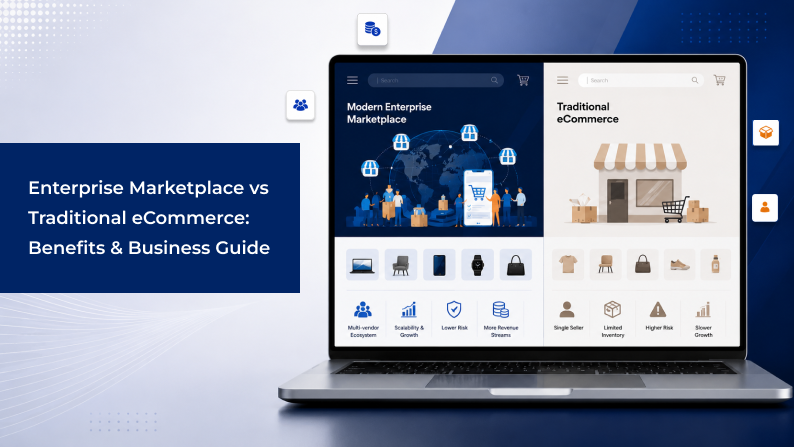
Enterprise Marketplace vs Traditional eCommerce: Key Differences, Benefits & Business Guide (2026)
588
Views
Published Date 31st July, 2026
TL;DR
If you’re short on time, here’s the quick comparison:
| Enterprise Marketplace | Traditional eCommerce |
| Multiple independent sellers | Single seller |
| Platform earns commissions, subscriptions, and service fees | Business earns revenue from direct product sales |
| Huge product catalog | Limited to owned inventory |
| Lower inventory risk | Higher inventory investment |
| Faster product expansion | Expansion depends on purchasing inventory |
| Complex operations | Easier management |
| Highly scalable | Moderate scalability |
| Requires vendor management | No vendor management |
Choose an Enterprise Marketplace if:
- You want to build a scalable digital ecosystem.
- You plan to onboard multiple vendors.
- You want recurring revenue streams.
- You aim to become an industry platform.
Choose Traditional eCommerce if:
- You sell your own products.
- Brand consistency is your highest priority.
- Inventory control matters most.
- You want operational simplicity.
Introduction
Digital commerce has evolved far beyond the traditional online store. While businesses once relied primarily on single-seller eCommerce websites to sell products and services, today’s digital economy is increasingly driven by enterprise marketplaces that connect multiple buyers and sellers on one unified platform.
This shift is redefining how businesses grow and compete. Global leaders like Amazon, Alibaba, Walmart Marketplace, Etsy, and Airbnb have demonstrated how marketplace ecosystems can scale rapidly, diversify revenue streams, and create lasting competitive advantages. By enabling third-party vendors to participate, these platforms deliver greater customer choice while creating sustainable, long-term growth opportunities.
But does this mean traditional eCommerce is becoming obsolete? Not at all.
For businesses that prioritize complete control over inventory, pricing, customer experience, and product quality, the traditional eCommerce model continues to be a highly effective choice. In fact, many successful direct-to-consumer (D2C), business-to-business (B2B), and omnichannel brands still rely on it to drive growth.
Choosing between an enterprise marketplace and a traditional eCommerce model goes beyond selecting a technology platform. It influences your revenue model, operational complexity, scalability, customer acquisition strategy, and long-term business success. This guide compares both models, highlights their strengths and limitations, and helps you identify the right approach for your business in 2026.
Table of Contents
- What is Traditional eCommerce?
- Benefits of Traditional eCommerce
- Challenges of Traditional eCommerce
- What is an Enterprise Marketplace?
- Why Are Enterprise Marketplaces Growing Rapidly?
- Enterprise Marketplace vs Traditional eCommerce: A Detailed Comparison
- Real-World Enterprise Marketplace Examples
- How to Choose Between an Enterprise Marketplace and Traditional eCommerce
- When Should Businesses Build an Enterprise Marketplace?
- Can Traditional eCommerce Businesses Transition to a Marketplace?
- Challenges of Running an Enterprise Marketplace
- Why Modern Enterprises Choose Marketplace Software Instead of Building From Scratch
- How Yo!Kart Supports Enterprise Marketplace Development
- Final Thoughts
- Frequently Asked Questions (FAQs)
What is Traditional eCommerce?
Traditional eCommerce is the most widely adopted online business model, where a company sells its own products or services directly to customers through its own website or application.
In this model, the business owns or manages the inventory, pricing, fulfills orders, and provides customer support. Since only one seller is involved, the company has complete control over the entire shopping experience, from product discovery to post-purchase service.
Some well-known examples of traditional eCommerce businesses include:
- Apple Online Store
- Nike
- Samsung
- Zara
- IKEA
- Dell
Unlike a marketplace, customers purchase directly from a single business throughout their buying journey.
How Does Traditional eCommerce Work?
The traditional eCommerce process follows a straightforward workflow:
- The business purchases or manufactures inventory.
- Products are listed on the online store.
- Customers browse and place orders.
- Payments are securely processed.
- Orders are packed and shipped from the warehouse.
- Customer support handles returns, refunds, and post-purchase queries.
The business is responsible for every operational aspect, including inventory management, warehousing, shipping, returns, marketing, and customer satisfaction.
Benefits of Traditional eCommerce
Despite the rise of multi-vendor marketplaces, traditional eCommerce remains a strong business model for companies seeking operational simplicity and direct customer relationships. Its structured approach offers several advantages that make it an ideal choice for many brands.
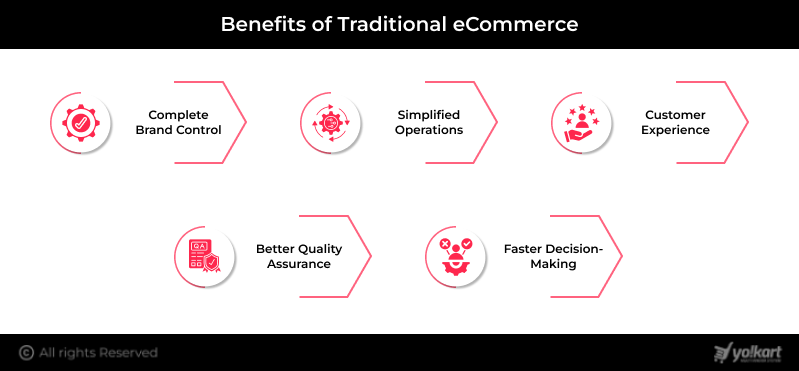
1. Complete Brand Control
Traditional eCommerce gives businesses full authority over their brand, including pricing, promotions, branding, product quality, and customer communication.
2. Simplified Operations
Since only one seller is involved, day-to-day operations on the platform become easier to manage. Businesses can streamline management, order fulfilment, logostics, and customer support without coordinating with third-party vendors.
3. Consistent Customer Experience
Customer interact with a single brand throughout their buying journey. This allows businesses to deliver a consistent experience across product selection, checkout, shipping, and after-sales support, helping build trust and long-term loyalty.
4. Better Quality Assurance
Since the business controls the products it sells, maintaining quality standards is much easier. This minimizes inconsistencies, reduces customer complaints, and strengthens the brand’s reputation.
5. Faster Decision-Making
Businesses can quickly update pricing, promotional campaigns, introduce new products, or modify marketing campaigns without relying on external sellers, allowing them to respond faster to changing market demands and customer preferences.
Challenges of Traditional eCommerce
Although traditional eCommerce offers simplicity, it also comes with several limitations. As businesses expand, managing inventory, increasing product offerings, and scaling operations often require substantial investments in time, capital, and resources.
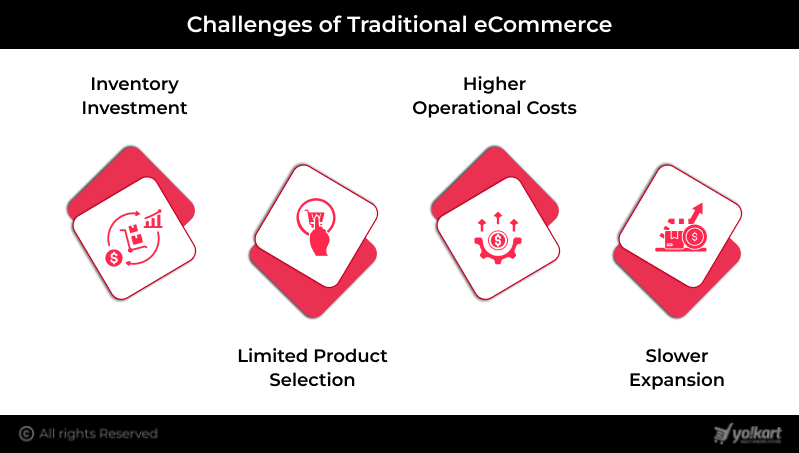
1. Inventory Investment
Unlike marketplace businesses, traditional eCommerce requires companies to purchase or manufacture products before making sales. This ties up working capital and increases the financial risk associated with unsold inventory.
2. Limited Product Selection
The range of products a business can offer is restricted by its inventory capacity, supplier network, and storage capabilities. Expanding into new categories often requires additional investment and operational planning.
3. Higher Operational Costs
Businesses are responsible for managing warehousing, inventory, packaging, shipping, returns, and fulfillment. As order volumes increase, these operational expenses continue to grow, impacting overall profitability.
4. Slower Expansion
Entering new markets or launching additional product lines typically involves sourcing new inventory, expanding logistics capabilities, and investing in infrastructure. These requirements can slow down growth compared to asset-light marketplace models.
What is an Enterprise Marketplace?
An enterprise marketplace is a multi-vendor digital platform that enables multiple independent sellers to offer products or services to customers through a single online marketplace. Instead of selling inventory directly, the marketplace operator provides the technology, infrastructure, and governance needed to facilitate transactions between buyers and sellers.
While vendors manage their own product listings, pricing, inventory, and often order fulfillment, the marketplace owner oversees platform operations, vendor management, customer experience, and marketplace policies..Revenue is typically generated through multiple streams, including transaction commissions, vendor subscriptions, listing fees, featured placements, advertising, payment processing, logistics services, and other value-added offerings.
Some of the world’s leading enterprise marketplaces include:
- Amazon Marketplace
- Walmart Marketplace
- Alibaba
- Etsy
- eBay
- Faire
- Zalando Marketplace
Unlike traditional online stores, enterprise marketplaces focus on enabling transactions between multiple participants while maintaining platform governance and customer trust.
How Does an Enterprise Marketplace Work?
A typical enterprise marketplace follows this workflow:
- Marketplace owner launches and manages the platform.
- Vendors register, complete verification, and onboarding.
- Sellers create and manage their product catalogs.
- Customers browse products from multiple vendors.
- Orders are placed through the marketplace.
- Vendors fulfill orders directly or through integrated logistics services.
- The marketplace collects commissions and service fees.
By allowing vendors to manage their own inventory and product catalogs, enterprise marketplaces can expand product offerings, enter new markets, and scale efficiently without investing heavily in inventory ownership.
Why Are Enterprise Marketplaces Growing Rapidly?
Enterprise marketplaces are experiencing rapid adoption as businesses shift toward scalable, asset-light growth models. Rather than expanding through inventory investments, companies are building digital ecosystems where multiple vendors contribute products and services. At the same time, evolving customer expectations and advances in technology are making the marketplace model more practical and profitable than ever before.
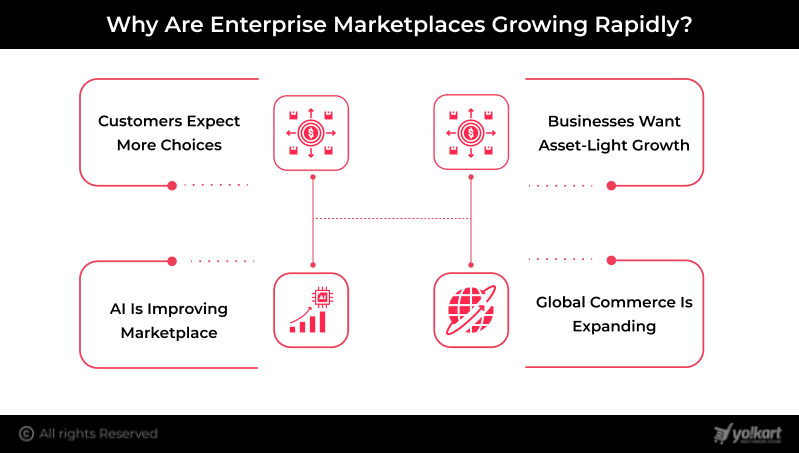
Several trends are accelerating marketplace adoption:
1. Customers Expect More Choices
Modern buyers prefer platforms where they can compare multiple brands, prices, delivery options, and reviews without visiting different websites. Enterprise marketplaces meet these expectations by bringing together multiple sellers, creating a more convenient and engaging shopping experience.
2. Businesses Want Asset-Light Growth
Instead of investing millions in inventory, enterprises increasingly focus on building digital ecosystems that allow third-party sellers to expand the product catalog. This approach reduces operational costs while enabling faster and more sustainable growth.
3. AI Is Improving Marketplace Operations
Artificial intelligence is helping marketplaces automate vendor onboarding, personalize product recommendations, detect fraud, optimize pricing, forecast demand, and improve customer support. These capabilities help businesses scale while delivering better user experiences.
4. Global Commerce Is Expanding
With built-in support for multilingual storefronts, multiple payment gateways, automated tax calculations, and international shipping, enterprise marketplaces can expand into new markets more efficiently than ever before, helping businesses reach customers worldwide.
These advancements have made enterprise marketplaces one of the fastest-growing digital commerce models across B2B, B2C, D2C, wholesale, manufacturing, healthcare, automotive, fashion, food delivery, rental, and service industries.
Build an Enterprise Marketplace for Sustainable Growth
Enterprise Marketplace vs Traditional eCommerce: A Detailed Comparison
While both business models enable online selling, they differ significantly in terms of ownership, operations, scalability, technology, and profitability. Understanding these differences can help businesses choose a model that aligns with their strategic objectives, operational capabilities, and future expansion plans.
The comparison below examines the key factors that distinguish these two commerce models.
1. Business Model
The most fundamental difference between an enterprise marketplace and traditional eCommerce lies in how products are sold and who manages the transaction.
a. Traditional eCommerce
Traditional eCommerce operates on a single-seller model, where one business owns the products (or sources them), manages inventory, sets prices, fulfills orders, and supports customers directly. Every transaction occurs between the customer and the business.
Ideal for:
- Manufacturers
- Direct-to-consumer (D2C) brands
- Retailers
- Wholesalers
- Businesses selling proprietary products
b. Enterprise Marketplace
An enterprise marketplace follows a multi-vendor model, where numerous independent sellers list products or services on one platform. The marketplace operator facilitates transactions, establishes platform policies, manages payments (where applicable), and maintains trust, while vendors handle catalog management and often fulfillment.
Ideal for:
- Large enterprises
- B2B ecosystems
- Industry-specific marketplaces
- Procurement platforms
- Digital commerce platforms
- Franchise networks
Key Insight: Instead of selling products, enterprise marketplaces create a scalable commerce ecosystem where multiple buyers and sellers interact through a centralized platform.
2. Inventory Ownership
Inventory ownership is one of the biggest operational differences between these two business models and has a direct impact on costs, scalability, and risk.
a. Traditional eCommerce
The business purchases, stores, and manages inventory. This requires:
- Warehousing
- Inventory forecasting
- Stock replenishment
- Quality inspections
- Warehouse staff
- Capital investment
Poor inventory planning can result in stockouts or excess inventory, directly affecting profitability and customer satisfaction.
b. Enterprise Marketplace
The marketplace operator generally does not own inventory.
Instead, vendors manage:
- Product listings
- Stock availability
- Warehousing
- Inventory updates
- Shipping (or integrated fulfillment)
This asset-light approach allows the platform to expand product offerings without investing heavily in inventory.
Key Takeaway: Traditional eCommerce offers complete inventory control but requires significant capital investment. Enterprise marketplaces follow an asset-light model, enabling rapid growth without owning inventory.
3. Revenue Generation
Revenue models play a critical role in determining long-term profitability and business sustainability.
a. Traditional eCommerce
Traditional online stores primarily generate revenue through direct product sales, supported by additional opportunities such as:
- Product sales
- Upselling
- Cross-selling
- Product bundles
- Subscription products
- Extended warranties
Business growth largely depends on increasing sales volume and continuously acquiring new customers.
b. Enterprise Marketplace
Marketplaces can diversify income through multiple recurring streams, including:
- Commission on every transaction
- Vendor subscription plans
- Product listing fees
- Featured listings
- Sponsored advertisements
- Payment processing fees
- Logistics services
- Warehousing
- Premium storefronts
- Analytics services
- Vendor verification programs
Diversified revenue streams make marketplace businesses more resilient and less dependent on direct product sales.
Key Takeaway: Traditional eCommerce primarily relies on product sales, whereas enterprise marketplaces benefit from multiple recurring revenue streams, creating greater long-term revenue potential.
4. Scalability
Scalability determines how efficiently a business can grow without significantly increasing operational complexity or costs.
a. Traditional eCommerce
Scaling a traditional eCommerce business typically requires:
- Purchasing additional inventory
- Expanding warehouses
- Hiring staff
- Increasing fulfillment capacity
- Managing larger supply chains
As the business grows, operational expenses usually increase at a similar pace.
b. Enterprise Marketplace
Enterprise marketplace growth occurs by:
- Onboarding new vendors
- Expanding categories
- Entering new regions
- Increasing customer acquisition
- Adding value-added services
Each new vendor contributes additional products without requiring inventory investment from the marketplace owner. As the seller network expands, the platform becomes increasingly valuable to buyers, creating a powerful network effect that fuels long-term growth.
Key Takeaway: Enterprise marketplaces scale more efficiently by onboarding vendors and expanding product offerings, while traditional eCommerce growth typically requires proportional investments in inventory and operations.
5. Product Catalog Expansion
Product variety has become a key competitive advantage in digital commerce, making catalog expansion an important consideration.
a. Traditional eCommerce
Adding new products requires:
- Supplier negotiations
- Inventory purchases
- Warehouse capacity
- Product photography
- Stock management
As a result, expanding into new categories is often slower and requires significant investment.
b. Enterprise Marketplace
Marketplace operators rely on vendors to expand the catalog, enabling:
Benefits include:
- Faster catalog growth
- Greater product diversity
- Niche product availability
- Seasonal expansion without inventory risk
With vendors continuously adding new listings, enterprise marketplaces can scale from thousands to millions of SKUs far more efficiently than traditional online stores.
Key Takeaway: Traditional eCommerce expands its catalog through inventory investments, whereas enterprise marketplaces grow faster by allowing vendors to continuously add products without increasing inventory costs.
6. Customer Experience
Customer experience remains a competitive differentiator for both models. While one prioritizes consistency and brand control, the other focuses on offering greater choice and flexibility. The ideal model depends on the experience you want to deliver to your customers.
a. Traditional eCommerce
Since customers interact with a single business throughout their buying journey, traditional eCommerce delivers a consistent and predictable shopping experience with:
- Consistent branding
- Uniform shipping policies
- Predictable quality
- Standardized packaging
- Centralized customer support
This level of control helps businesses build trust, strengthen brand loyalty, and maintain a seamless customer experience.
b. Enterprise Marketplace
Enterprise marketplaces provide customers with greater flexibility by bringing together multiple sellers on one platform. Key benefits include:
- More product choices
- Competitive pricing
- Multiple brands
- Diverse shipping options
- Customer reviews
- Vendor ratings
- Flexible buying options
However, maintaining a consistent customer experience requires strong marketplace governance, vendor onboarding standards, and service-level agreements (SLAs).
Key Takeaway: Traditional eCommerce delivers a more consistent brand experience, while enterprise marketplaces stand out by offering greater product variety, competitive pricing, and customer choice.
7. Technology Requirements
Technology complexity varies significantly. Understanding these requirements is essential when selecting the right platform for your business.
a. Traditional eCommerce
Traditional eCommerce platforms typically include essential commerce capabilities such as:
- Product management
- Shopping cart
- Payment gateway
- Inventory management
- Order management
- CRM
- Shipping integration
With a single seller and straightforward workflows, the overall architecture is relatively simple to implement and maintain.
b. Enterprise Marketplace
Marketplace platforms require additional capabilities, including:
- Vendor onboarding
- Multi-vendor dashboards
- Commission management
- Split payments
- Catalog moderation
- Vendor verification
- Role-based permissions
- Marketplace analytics
- Multi-store management
- Dispute resolution
- Vendor settlements
- Multi-location taxation
Choosing marketplace software with these capabilities already built in can significantly reduce development time and long-term maintenance costs.
Launch a Multi-Vendor Marketplace Without Starting from Scratch
8. AI and Automation
Artificial intelligence is reshaping digital commerce by automating repetitive tasks, improving decision-making, and delivering more personalized customer experiences. While both business models benefit from AI, enterprise marketplaces often leverage it on a much larger scale.
a. Traditional eCommerce
AI is commonly used to enhance customer engagement and streamline business operations through:
- Personalized recommendations
- Customer segmentation
- Chatbots
- Dynamic pricing
- Marketing automation
- Demand forecasting
b. Enterprise Marketplace
Enterprise marketplaces utilize AI across both customer-facing and operational processes, including:
- Intelligent vendor onboarding
- Product categorization
- Duplicate listing detection
- Fraud prevention
- Automated moderation
- Recommendation engines
- Marketplace search optimization
- Inventory forecasting
- Review analysis
- Predictive analytics
Because enterprise marketplaces process data from multiple vendors and millions of transactions, AI can deliver deeper insights, greater automation, and more accurate business intelligence.
9. Global Expansion
Expanding into international markets presents both opportunities and operational challenges. The ease of global expansion varies significantly between traditional eCommerce and enterprise marketplaces.
a. Traditional eCommerce
Expanding internationally often requires substantial investment in infrastructure, including:
- New warehouses
- Local suppliers
- Regional inventory
- Country-specific logistics
- Currency support
- Tax compliance
Growth into each new market can involve substantial investment.
b. Enterprise Marketplace
Rather than investing in local inventory, enterprise marketplaces can expand by onboarding regional sellers who already understand their local markets. This approach enables:
- Faster market entry
- Localized product offerings
- Reduced inventory investment
- Region-specific catalogs
- Local fulfillment through vendors
This makes marketplaces particularly attractive for enterprises pursuing international expansion.
Key Takeaway: Traditional eCommerce often requires substantial infrastructure investments for global expansion, whereas enterprise marketplaces can enter new markets faster by leveraging local vendor networks.
10. Cost Structure
Cost structure plays a crucial role in determining the long-term profitability and sustainability of any digital commerce business.
a. Traditional eCommerce Costs
Operating a traditional eCommerce business typically involves ongoing expenses such as:
- Inventory procurement
- Warehousing
- Shipping
- Packaging
- Staff
- Returns management
- Marketing
- Customer service
Many of these costs increase as the business grows, making large-scale expansion increasingly resource-intensive.
b. Enterprise Marketplace Costs
Enterprise marketplaces generally invest in platform development and ecosystem growth rather than inventory, with costs including:
- Platform development or licensing
- Vendor acquisition
- Marketing
- Platform security
- Compliance
- Customer support
- Vendor success
- Technology upgrades
Although enterprise marketplaces require a higher initial investment in technology and governance, they often reduce inventory-related expenses and unlock recurring revenue opportunities.
Key Takeaway: Traditional eCommerce incurs ongoing inventory and fulfillment costs as it grows, while enterprise marketplaces prioritize technology and ecosystem investments that support scalable, long-term growth.
Enterprise Marketplace vs Traditional eCommerce Comparison Table
| Feature | Enterprise Marketplace | Traditional eCommerce |
| Business Model | Multi-vendor | Single seller |
| Inventory Ownership | Vendors | Business |
| Product Variety | Very High | Limited to owned inventory |
| Revenue Streams | Multiple | Primarily product sales |
| Scalability | Excellent | Moderate |
| Inventory Risk | Low | High |
| Vendor Management | Required | Not required |
| Customer Choice | Extensive | Limited |
| Initial Complexity | Higher | Lower |
| International Expansion | Easier | More resource-intensive |
| Technology Requirements | Advanced | Standard |
| Long-Term Growth Potential | Very High | Moderate to High |
Real-World Enterprise Marketplace Examples
Many of the world’s most successful digital businesses have embraced the enterprise marketplace model to expand their offerings, attract more customers, and scale without owning all the inventory. By empowering third-party sellers, these companies have built thriving commerce ecosystems that generate long-term growth and multiple revenue streams.
1. Amazon Marketplace
Amazon began as an online bookstore before evolving into one of the world’s largest enterprise marketplaces. By opening its platform to third-party sellers, Amazon dramatically expanded its product catalog while reducing the need to own or manage every item it sells. Today, independent merchants contribute a substantial share of products available on the platform.
2. Alibaba
Alibaba connects manufacturers, wholesalers, distributors, and buyers across global markets through a multi-vendor digital ecosystem. Rather than operating as a traditional retailer, it facilitates B2B and B2C transactions, enabling businesses of all sizes to reach customers worldwide.
3. Walmart Marketplace
Walmart expanded its digital commerce strategy by inviting third-party sellers to join its marketplace. This approach has enabled the company to significantly increase product variety, enhance the customer shopping experience, and create additional revenue streams beyond its own inventory.
4. Etsy
Etsy has built a niche marketplace focused on handmade, vintage, and creative goods sold by independent artisans and small businesses. Its marketplace model allows millions of unique items to be listed without Etsy producing or stocking them, making it a leading destination for one-of-a-kind products.
Turn Your Business into a Thriving Marketplace Ecosystem
How to Choose Between an Enterprise Marketplace and Traditional eCommerce?
While both enterprise marketplaces and traditional eCommerce can be highly profitable, the right business model depends on your long-term vision, available resources, and growth objectives. Understanding your priorities will help you invest in a model that supports sustainable growth.
- Choose traditional eCommerce if your primary goal is to sell products that your company owns and controls. This model is well-suited for businesses that want complete oversight of inventory, pricing, fulfillment, branding, and customer experience.
- Choose an enterprise marketplace if your objective is to build a digital ecosystem where multiple vendors can sell through a centralized platform. Instead of relying solely on product sales, marketplaces generate value by connecting buyers and sellers while earning revenue from commissions, subscriptions, and value-added services.
Before selecting a model, consider the following questions:
- Do you want to own inventory or facilitate transactions between buyers and sellers?
- Is your business growth constrained by inventory, warehouse capacity, or supplier relationships?
- Would expanding your catalog through third-party vendors create a competitive advantage?
- Are recurring revenue streams, such as commissions and vendor subscriptions, part of your long-term strategy?
- Do you plan to expand internationally or across multiple business verticals?
The answers to these questions will help you identify the business model that best aligns with your organization’s objectives, available resources, and future growth ambitions.
When Should Businesses Build an Enterprise Marketplace?
An enterprise marketplace is particularly effective when businesses want to move beyond being a retailer and become a platform provider. If your goal is to scale efficiently, diversify revenue, and create a thriving digital ecosystem, launching an enterprise marketplace can be a strategic next step.
Consider building an enterprise marketplace if you want to:
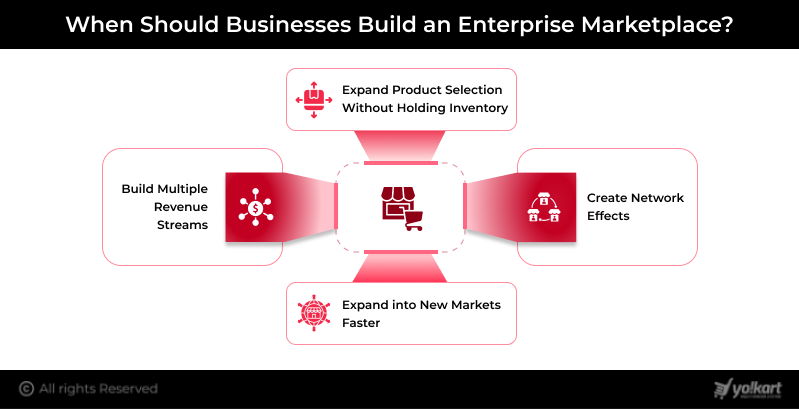
1. Expand Product Selection Without Holding Inventory
By enabling verified vendors to manage their own products and inventory, businesses can rapidly expand their product catalog without investing in additional stock, warehousing, or inventory management.
2. Build Multiple Revenue Streams
Unlike traditional eCommerce, enterprise marketplaces generate revenue from multiple sources, including:
- Transaction commissions
- Vendor subscriptions
- Featured listings
- Advertising opportunities
- Logistics services
- Payment processing fees
- Premium seller plans
This diversified revenue model is often more resilient than relying solely on direct product sales.
3. Create Network Effects
Enterprise marketplaces become more valuable as they grow. As more vendors join the platform, customers gain access to a broader selection of products and competitive pricing. Increased customer traffic, in turn, attracts even more sellers, creating a self-reinforcing growth cycle known as the network effect.
4. Expand into New Markets Faster
Instead of investing in local warehouses or sourcing inventory for every new region, businesses can onboard regional sellers who already understand their local markets. This approach accelerates geographic expansion, lowers operational costs, and enables businesses to serve new regions more efficiently.
If your long-term vision is to build a scalable, asset-light business with multiple revenue streams and long-term growth potential, an enterprise marketplace offers a stronger foundation than a traditional single-seller eCommerce model.
Can Traditional eCommerce Businesses Transition to a Marketplace?
Yes, many of today’s globally recognized companies started as traditional online retailers before evolving into marketplace businesses. As their customer base grew, they expanded beyond selling their own products by inviting third-party vendors to join the platforms.
A typical transition follows this progression:
- Launch a branded online store.
- Build customer trust and attract steady traffic.
- Expand into new product categories.
- Onboard carefully selected third-party sellers.
- Implement vendor management and marketplace operations.
- Scale into a full-fledged enterprise marketplace.
This hybrid approach enables businesses to continue selling their own products while introducing additional inventory from external vendors. As a result, companies can increase customer choice, improve retention, unlock new revenue streams, and scale without making proportional investments in inventory.
Turn Your eCommerce Store into a Scalable Marketplace
Challenges of Running an Enterprise Marketplace
While marketplaces offer tremendous growth potential, they also introduce operational complexities that require careful planning. From maintaining vendor quality to ensuring consistent customer experiences, marketplace operators need well-defined processes and the right technology to support sustainable growth.
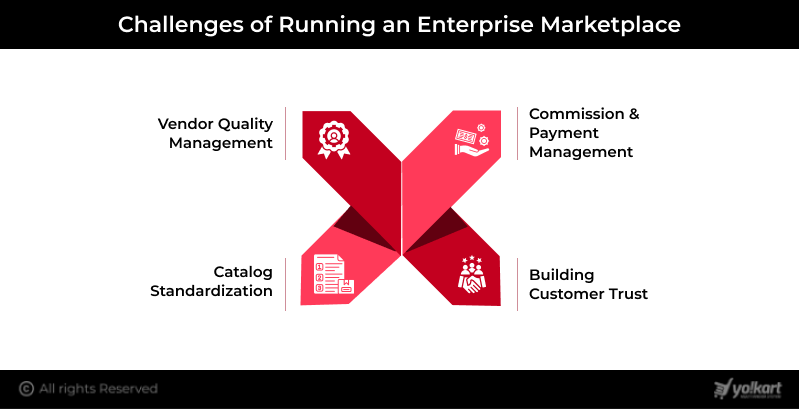
1. Vendor Quality Management
Marketplace success depends on maintaining high standards across all sellers. Enterprises should establish clear onboarding criteria, verification processes, performance benchmarks, and regular review mechanisms to help maintain high service standards and deliver a consistent customer experience.
2. Commission and Payment Management
Managing payments across multiple vendors requires accurate and transparent financial processes. Marketplace operators must efficiently handle:
- Automated commission calculations
- Vendor payouts
- Tax compliance
- Refund processing
- Settlement reports
A streamlined payment system ensures timely settlements, minimizes disputes, and builds trust among marketplace participants.
3. Catalog Standardization
As product listings grow, maintaining a consistent and well-organized catalog becomes increasingly important. Standardized categories, attributes, image guidelines, and moderation workflows help improve searchability, enhance the customer experience, and maintain catalog quality across vendors.
4. Building Customer Trust
Trust is the foundation of every successful marketplace. Customers expect secure transactions, transparent pricing, reliable deliveries, and responsive support. Features such as verified sellers, customer reviews, ratings, return policies, and dispute resolution mechanisms are essential for building trust and encourage repeat purchases.
Successfully operating an enterprise marketplace requires more than attracting vendors. Businesses must implement robust governance, streamlined operations, and trust-building mechanisms to deliver a reliable experience for both buyers and sellers.
Why Modern Enterprises Choose Marketplace Software Instead of Building From Scratch?
Developing an enterprise marketplace from the ground up can require significant investments in time, engineering resources, testing, and ongoing maintenance. For many organizations, this significantly increases both the time to market and the overall cost of launching a marketplace.
Developing essential marketplace capabilities such as:
- Vendor management
- Commission engines
- Split payments
- Product moderation
- Multi-vendor order management
- Analytics
- Multi-language support
- Multi-currency functionality
- Tax management
- Mobile responsiveness
- Security
can take months or even years to develop, test, and optimize.
As a result, many organizations choose ready-made marketplace software that provides these features while allowing extensive customization to meet unique business requirements. This approach enables organizations to reduce development time, lower implementation costs, and accelerate time to market while retaining the flexibility to customize the platform according to their unique business requirements.
How Yo!Kart Supports Enterprise Marketplace Development?
For organizations planning to launch a scalable multi-vendor marketplace, choosing the right technology foundation is just as important as selecting the right business model. Choosing a marketplace software with built-in multi-vendor capabilities can significantly reduce development time, lower implementation costs, and accelerate your go-to-market strategy.
Yo!Kart is a self-hosted, white-label multi-vendor marketplace software designed to help startups, SMEs, and enterprises launch marketplace platforms without building everything from scratch. Its flexible architecture supports a wide range of marketplace business models while allowing extensive customization to meet unique business requirements.
Some capabilities that make it suitable for enterprise marketplace projects include:
1. Multi-Vendor Architecture
Yo!Kart enables multiple independent sellers to manage products, inventory, pricing, orders, and storefronts from dedicated dashboards, making it easy to operate and scale a multi-vendor marketplace.
2. White-Label Customization
Businesses have complete control over the marketplace’s branding, design, workflows, and business logic. As a white-label solution, Yo!Kart allows organizations to build a fully branded marketplace while retaining complete ownership of the platform.
3. Global Commerce Features
Designed for businesses with global ambitions, Yo!Kart includes features such as:
- Multiple languages
- Multiple currencies
- Tax management
- International payment gateways
- Shipping integrations
These capabilities simplify cross-border commerce and help businesses expand into international markets more efficiently.
4. Built-In Marketplace Management
Yo!Kart provides administrators with a centralized dashboard to efficiently manage marketplace operations, including:
- Vendor approvals
- Commission structures
- Catalog moderation
- Product approvals
- User roles
- Reports and analytics
These built-in tools help streamline day-to-day operations while ensuring greater control over the marketplace ecosystem.
5. Scalable Foundation
Whether you’re building a B2B marketplace, B2C marketplace, wholesale platform, niche marketplace, or industry-specific commerce solution, Yo!Kart provides a flexible architecture that can be tailored to evolving business needs. Its flexibility allows enterprises to adapt workflows, expand features, and support evolving business requirements without rebuilding the platform.
Rather than replacing your business strategy, marketplace software should support it by reducing development complexity and accelerating time to market.
Experience Yo!Kart Firsthand
Final Thoughts
Both enterprise marketplaces and traditional eCommerce marketplaces offer distinct advantages, and the right choice ultimately depends on your business goals, operational model, and long-term growth strategy. If your focus is on maintaining complete control over products, inventory, and customer experience, a traditional eCommerce model remains a strong option.
However, if your goal is to build a scalable ecosystem that connects multiple buyers and sellers while unlocking diverse revenue streams, an enterprise marketplace offers significant long-term advantages. Its asset-light approach, extensive product variety, and ability to scale through vendor participation make it an increasingly preferred business model across industries.
For organizations looking to launch an enterprise marketplace development without the time, cost, and complexity of custom development, Yo!Kart offers a robust, enterprise-ready foundation with built-in multi-vendor capabilities, extensive customization options, and global commerce features. This allows businesses to accelerate time to market and focus on scaling their marketplace, growing their vendor network, and delivering exceptional customer experiences.
Frequently Asked Questions (FAQs)
Q 1. What is the main difference between an enterprise marketplace and traditional eCommerce?
Ans. Traditional eCommerce involves a single business selling its own products. An enterprise marketplace, on the other hand, enables multiple independent vendors to sell through one centralized platform. While eCommerce focuses on direct sales, marketplaces facilitate transactions and generate revenue from multiple vendor-related services.
Q 2. Is an enterprise marketplace more scalable than traditional eCommerce?
Ans. Yes, enterprise marketplaces can scale more efficiently because vendors contribute their own products, inventory, and, in many cases, order fulfillment. This asset-light model enables businesses to expand product offerings, enter new markets, and grow revenue without making proportional investments in inventory, warehousing, or operational infrastructure.
Q 3. Which industries benefit most from enterprise marketplaces?
Ans. Enterprise marketplaces are widely adopted across industries such as:
- Retail
- Wholesale
- Manufacturing
- Healthcare
- Automotive
- Food and grocery
- Electronics
- Construction
- Fashion
- Rental
- B2B procurement
Any industry that connects multiple buyers and sellers can benefit from the scalability, flexibility, and diverse revenue opportunities offered by the marketplace model.
Q 4. Can I sell my own products in a marketplace?
Ans. Yes, many marketplace operators follow a hybrid business model, selling their own products alongside offerings from third-party vendors. This approach helps expand product variety, attract more customers, increase revenue opportunities, and maintain greater control over selected product categories while benefiting from vendor participation.
Q 5. How do enterprise marketplaces make money?
Ans. Enterprise marketplaces generate revenue through multiple monetization channels, including:
- Transaction commissions
- Subscription plans
- Advertising
- Featured listings
- Payment processing fees
- Logistics services
- Premium seller features
These diversified revenue streams make marketplace businesses more resilient than relying solely on direct product sales.
Q 6. Is marketplace software better than custom development?
Ans. The right choice depends on your business requirements. Ready-made marketplace software helps reduce development time, costs, and technical complexity by offering built-in marketplace features. Custom development may be suitable for businesses with highly specialized workflows, although it typically requires greater investment, longer development cycles, and ongoing maintenance.
Q 7. What features should enterprise marketplace software include?
Ans. A reliable enterprise marketplace solution should include:
- Multi-vendor management
- Commission management
- Order management
- Payment integrations
- Catalog moderation
- Analytics
- Multilingual support
- Security
- Mobile responsiveness
- Scalability
These capabilities help businesses efficiently manage operations while supporting long-term marketplace growth.
Q 8. Is Yo!Kart suitable for enterprise marketplace development?
Ans. Yes, Yo!Kart is a self-hosted, white-label marketplace software designed to help startups, SMEs, and enterprises launch scalable multi-vendor marketplaces. It includes built-in vendor management, marketplace administration, global commerce features, extensive customization options, and a flexible architecture that supports a wide range of marketplace business models.
Ready to Transform Your eCommerce Business into a Marketplace?
Get StartedPopular Posts