

Published Date 01st Jul, 2026
Modern B2B supply chains have become increasingly complex, with businesses managing multiple suppliers, manufacturers, logistics providers, and distributors simultaneously. Coordinating contracts, product catalogs, purchase orders, invoices, and shipments through emails, spreadsheets, and disconnected systems often results in delays, communication gaps, operational inefficiencies, and limited visibility across the supply chain. As businesses expand and supplier networks grow, manual vendor management processes become increasingly difficult to maintain.
To stay competitive, organizations are embracing digital vendor ecosystem management to centralize supplier operations, automate procurement workflows, and improve collaboration across their entire supply chain. A modern B2B marketplace platform brings buyers, suppliers, and procurement teams together on a single platform, enabling seamless vendor onboarding, streamlined communication, efficient order management, and greater transparency throughout the procurement lifecycle.
Instead of investing significant time and resources in building custom software from scratch, businesses can leverage ready-made B2B marketplace solutions to accelerate their digital transformation. These platforms provide the essential tools needed to simplify vendor management, optimize procurement processes, strengthen supplier relationships, and build a scalable, future-ready procurement ecosystem.
Additionally, in this guide, we’ll explore why vendor ecosystem digitization has become a strategic priority for modern businesses, the limitations of traditional vendor management, the key features to look for in B2B marketplace software, and how the right solution can help create a more efficient, connected, and resilient vendor ecosystem.
Table of Contents
- Understanding Vendor Ecosystem Digitization
- Why Traditional Vendor Management Models Are Failing
- Why Businesses Need a Digital Vendor Management Platform
- Essential Features to Look for in B2B Marketplace Software
- Step-by-Step Guide to Digitizing Your Vendor Ecosystem
- Build a Future-Ready Vendor Ecosystem
- Accelerate Vendor Ecosystem Digitization with Yo!Kart B2B
- Conclusion
- Frequently Asked Questions (FAQs)
Understanding Vendor Ecosystem Digitization
Vendor ecosystem digitization is the process of transforming traditional supplier management into a centralized, technology-driven system where businesses can manage suppliers, procurement, inventory, and transactions from a single platform. Instead of relying on disconnected spreadsheets, emails, and manual approvals, organizations use B2B marketplace software to streamline vendor collaboration, improve procurement efficiency, and gain real-time visibility across the supply chain.
As supply chains become more global and interconnected, digital vendor management has shifted from being a competitive advantage to a business necessity. According to Gartner, organizations that invest in digital supply chain capabilities are better positioned to improve operational resilience, enhance supplier collaboration, and respond faster to market disruptions. Similarly, McKinsey & Company reports that companies adopting digital procurement solutions can reduce procurement costs by 15–20% while improving supplier delivery performance by up to 35%.
A fully digitized vendor ecosystem typically includes the following key capabilities:
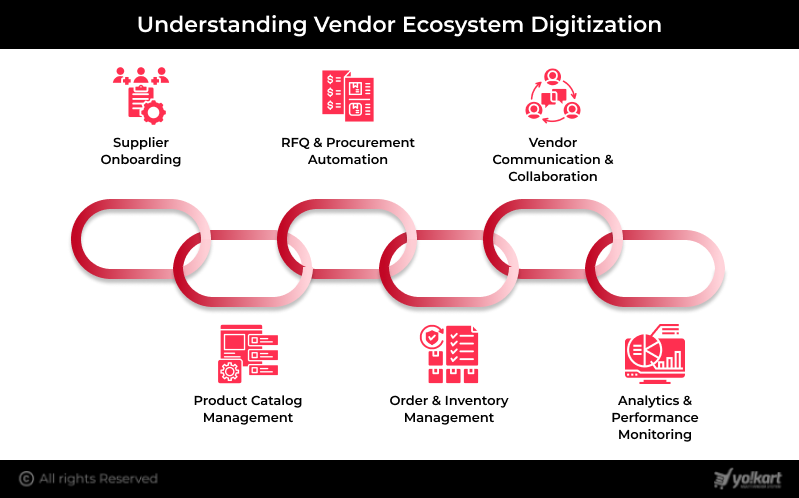
1. Supplier Onboarding
Enable vendors to register, upload compliance documents, complete verification, and receive approval through a self-service onboarding process. This significantly reduces administrative workload and accelerates supplier activation.
2. Product Catalog Management
Allow suppliers to manage their own product catalogs, pricing, inventory, and product information while administrators maintain control through approval workflows and quality checks.
3. RFQ and Procurement Automation
Digitize Request for Quotation (RFQ) processes so buyers can invite multiple suppliers, compare quotations, negotiate pricing, and generate purchase orders from a single dashboard.
4. Order & Inventory Management
Track purchase orders, inventory availability, shipment progress, and delivery status in real time, improving supply chain visibility and reducing manual follow-ups.
5. Vendor Communication & Collaboration
Centralize messaging, document sharing, notifications, and order-related discussions to maintain a complete audit trail and improve collaboration between buyers and suppliers.
6. Analytics & Performance Monitoring
Access dashboards that provide insights into supplier performance, procurement spending, order fulfillment rates, delivery timelines, and overall supply chain efficiency, enabling data-driven decision-making.
When these capabilities are integrated into a single B2B marketplace platform, businesses gain far more than operational efficiency. They improve supplier transparency, accelerate procurement cycles, strengthen compliance, and build a more resilient supply chain capable of adapting to changing market conditions. According to Deloitte’s Global Chief Procurement Officer Survey, digital procurement remains one of the top strategic priorities for organizations seeking greater agility, cost savings, and long-term supplier collaboration, making vendor ecosystem digitization a critical investment for future growth.
Simplify Vendor Collaboration with the Right Solution
Why Traditional Vendor Management Models Are Failing
Traditional vendor management methods were built for an era of smaller supplier networks and simpler procurement processes. Today, businesses work with multiple suppliers, logistics partners, distributors, and manufacturers across different regions, making manual processes slow, error-prone, and difficult to scale. Managing vendors through emails, spreadsheets, phone calls, and disconnected systems creates operational inefficiencies that directly impact productivity, costs, and customer satisfaction.
According to Deloitte’s 2023 Global Chief Procurement Officer (CPO) Survey, 79% of procurement leaders reported that supply chain disruptions significantly affected their business performance, highlighting the urgent need for stronger digital procurement capabilities. Likewise, Gartner found that improving supply chain visibility remains one of the top priorities for procurement and supply chain leaders.
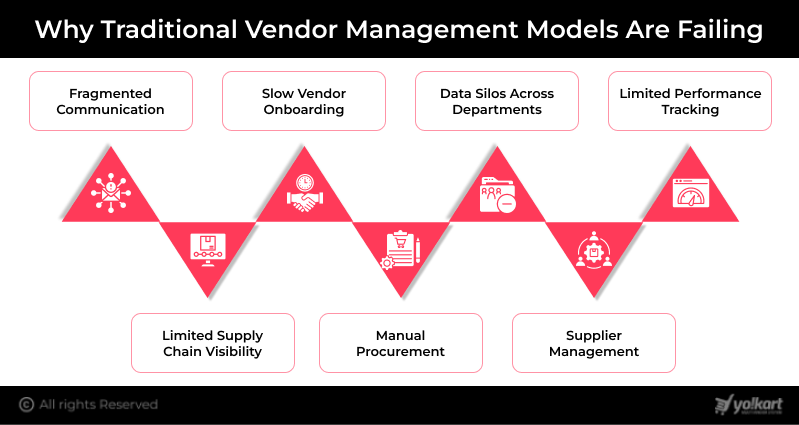
1. Fragmented Communication
Vendor communication often takes place across multiple channels, including emails, messaging apps, phone calls, and shared documents. This fragmented approach increases the risk of missed updates, pricing discrepancies, delayed approvals, and poor collaboration, ultimately slowing procurement operations.
2. Limited Supply Chain Visibility
Without a centralized platform, businesses struggle to monitor supplier inventory, order status, and shipment progress in real time. According to Gartner, 43% of supply chain leaders identify poor inventory visibility as one of their biggest operational challenges, leading to stock shortages, excess inventory, and inefficient planning.
3. Slow Vendor Onboarding
Traditional onboarding requires collecting documents, verifying certifications, negotiating contracts, and manually creating vendor records. These lengthy processes delay supplier activation and reduce an organization’s ability to respond quickly to changing market demands.
4. Manual Procurement Processes
Many businesses still rely on spreadsheets, PDFs, and email approvals for purchase orders and procurement workflows. The Institute for Supply Management (ISM) estimates that manually processing a purchase order can cost between $50 and $200, making manual procurement both expensive and prone to errors.
5. Data Silos Across Departments
Procurement, finance, warehouse, and operations teams often use separate systems that don’t share information. This lack of integration results in duplicate data entry, delayed approvals, reconciliation issues, and limited visibility into supplier performance and spending.
6. Difficulty Managing Growing Supplier Networks
As businesses expand, the number of suppliers, contracts, product catalogs, and purchase orders increases significantly. Managing this growing ecosystem without centralized B2B marketplace software becomes increasingly complex, making it difficult to maintain compliance, track vendor performance, and optimize procurement.
7. Limited Performance Tracking
Traditional systems provide little visibility into supplier KPIs such as on-time deliveries, order accuracy, response times, and contract compliance. Without real-time analytics, businesses struggle to identify high-performing vendors or address supplier-related risks before they impact operations.
Why Businesses Need a Digital Vendor Management Platform
The limitations of traditional vendor management are driving organizations toward digital transformation. Modern B2B marketplace software centralizes supplier onboarding, procurement, communication, inventory management, analytics, and order processing into a single platform. This enables businesses to improve supplier collaboration, reduce operational costs, increase supply chain visibility, and make faster, data-driven procurement decisions.
As global supply chains become more interconnected and customer expectations continue to rise, businesses that embrace digital vendor ecosystem management will be better positioned to build resilient, scalable, and future-ready procurement operations.
1. Improved Vendor Collaboration
A centralized B2B marketplace platform enables buyers, suppliers, distributors, and procurement teams to collaborate seamlessly through a single digital interface. Instead of managing conversations across emails, spreadsheets, messaging apps, and phone calls, every interaction is recorded and accessible in one place.
Businesses benefit from:
- Real-time communication with vendors
- Centralized document and contract management
- Faster dispute resolution
- Complete audit trails
- Better supplier transparency
With every purchase order, quotation, invoice, and communication stored digitally, procurement teams spend less time searching for information and more time strengthening supplier relationships. Improved collaboration also builds trust with vendors, leading to quicker negotiations, faster issue resolution, and long-term strategic partnerships. As supplier networks expand, having a centralized communication hub ensures everyone works with accurate, up-to-date information.
2. Faster and More Efficient Procurement
One of the biggest advantages of B2B marketplace software is procurement automation. Digital procurement workflows eliminate repetitive manual tasks and reduce approval bottlenecks, allowing procurement teams to focus on strategic sourcing instead of administrative work.
The platform enables businesses to:
- Send RFQs to multiple suppliers simultaneously
- Compare quotations side by side
- Automate purchase order creation
- Digitize approval workflows
- Reduce paperwork and manual data entry
According to McKinsey’s Procurement 4.0 research, companies that automate procurement processes can reduce procurement cycle times by up to 60% and lower administrative costs by 30–40%. Faster procurement cycles not only improve operational efficiency but also help businesses respond quickly to changing customer demand and supply chain disruptions. Automated workflows minimize human errors, reduce duplicate entries, and ensure every procurement activity follows standardized business processes.
3. Greater Supply Chain Visibility
Modern multi-vendor marketplace software provides complete visibility into procurement and supply chain operations. Businesses can monitor inventory levels, supplier availability, purchase orders, shipment progress, and delivery timelines through a centralized dashboard.
This helps organizations:
- Track orders in real time
- Prevent inventory shortages
- Improve demand forecasting
- Identify supply chain bottlenecks
- Respond proactively to delays
According to Gartner, improving supply chain visibility remains one of the top priorities for procurement leaders worldwide. Real-time insights enable businesses to make informed decisions before disruptions impact production or customer deliveries. Better visibility also improves coordination between procurement, warehouse, logistics, and finance teams, creating a more agile and resilient supply chain.
4. Data-Driven Procurement Decisions
A digitized vendor ecosystem generates valuable procurement data that enables businesses to make smarter sourcing decisions. Instead of relying on assumptions or manual reports, procurement teams can leverage real-time analytics to evaluate supplier performance and optimize purchasing strategies.
Advanced dashboards provide insights into:
- Supplier delivery performance
- Procurement spending
- Order fulfillment rates
- Product quality and return rates
- Vendor response times
- Contract compliance
These analytics help businesses identify high-performing suppliers, negotiate better pricing, reduce procurement risks, and forecast future purchasing needs with greater accuracy. Historical procurement data also supports strategic planning, allowing organizations to optimize supplier selection and improve long-term procurement efficiency.
5. Better Compliance and Risk Management
Managing supplier compliance manually becomes increasingly difficult as businesses expand their vendor networks. A B2B marketplace platform centralizes vendor documentation, certifications, tax records, contracts, and regulatory compliance requirements in one secure system.
Businesses can:
- Verify supplier credentials
- Track certification renewals
- Maintain digital audit trails
- Ensure regulatory compliance
- Reduce supplier-related risks
Automated alerts for expiring certifications and compliance documents help procurement teams stay ahead of regulatory requirements. This reduces legal risks, minimizes compliance violations, and strengthens supplier governance across the entire vendor ecosystem.
6. Increased Business Scalability
As businesses grow, managing hundreds or even thousands of suppliers manually becomes increasingly complex. Multi-vendor marketplace software enables organizations to scale procurement operations without proportionally increasing administrative workload or staffing requirements.
Businesses can quickly:
- Onboard new suppliers
- Launch new product categories
- Expand into new regions
- Add distributors and wholesalers
- Handle higher transaction volumes
A scalable B2B marketplace platform supports business growth while maintaining operational efficiency. Whether entering international markets or expanding supplier networks, businesses can onboard vendors in hours instead of weeks, ensuring faster expansion with minimal disruption.
7. Lower Operational Costs
Digitizing vendor management significantly reduces procurement and administrative expenses by eliminating manual processes and improving operational efficiency. Automation reduces paperwork, minimizes processing errors, and streamlines supplier management from onboarding to payment.
Businesses reduce costs through:
- Automated procurement workflows
- Faster purchase order processing
- Better inventory optimization
- Improved supplier competition
- Reduced administrative workload
- Fewer procurement errors
According to McKinsey & Company, organizations adopting digital procurement solutions can achieve 15–20% lower procurement costs while improving overall operational efficiency. Over time, these savings compound, allowing businesses to reinvest resources into innovation, supplier development, and strategic growth initiatives.
Transform Your B2B Vendor Ecosystem with Digital Procurement
Essential Features to Look for in B2B Marketplace Software
Choosing the right B2B eCommerce marketplace software is critical to building a scalable and efficient vendor ecosystem. Unlike B2C marketplace platforms, B2B marketplace solutions are designed to handle complex procurement workflows, multi-vendor operations, contract-based pricing, bulk ordering, and supplier management. The right platform should not only streamline day-to-day operations but also support long-term business growth and digital transformation.
According to Gartner, organizations investing in digital procurement technologies achieve greater operational efficiency, improved supplier collaboration, and enhanced supply chain visibility. When evaluating B2B marketplace software, look for the following essential features.
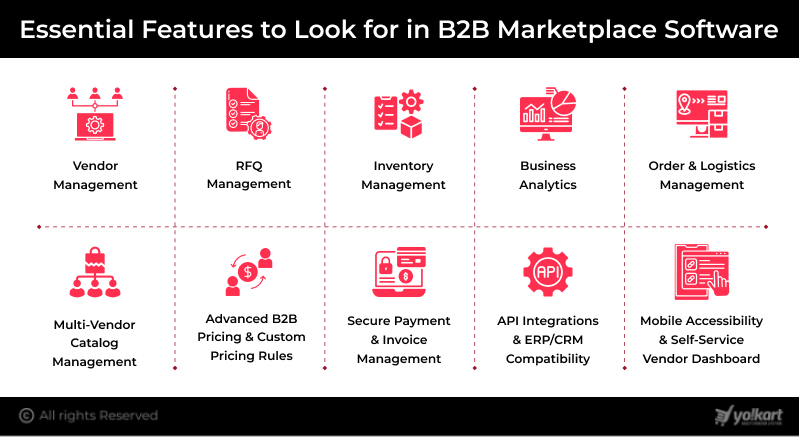
1. Vendor Management System
An effective vendor management system is the backbone of any B2B marketplace platform. It should simplify supplier onboarding while giving administrators complete control over vendor verification, compliance, and ongoing performance.
Look for features such as:
- Self-service vendor registration
- Digital document submission
- Approval workflows
- Vendor verification and compliance tracking
- Role-based access controls
A robust vendor management module reduces onboarding time, minimizes administrative work, and ensures only verified suppliers can sell on your marketplace. It also helps businesses maintain compliance with industry regulations while improving vendor transparency and accountability.
2. RFQ (Request for Quotation) & Quote Management
For businesses dealing with bulk purchases and negotiated pricing, RFQ functionality is essential. A modern B2B marketplace solution should automate the entire quotation process, allowing buyers to request quotes from multiple suppliers and compare offers in one place.
Key capabilities include:
- Digital RFQ creation
- Multiple supplier quotations
- Quote comparison tools
- Price negotiation
- Purchase order generation
- Volume discount management
Automating the RFQ process speeds up procurement, increases supplier competition, and helps businesses secure better pricing while reducing manual paperwork.
3. Multi-Vendor Catalog Management
Managing thousands of products from multiple suppliers requires a flexible catalog management system. Each vendor should have the ability to maintain their own product information while administrators retain complete control over marketplace quality.
Look for:
- Independent vendor catalog management
- Bulk CSV or Excel uploads
- API-based product synchronization
- Inventory updates
- Product approval workflows
- Category and attribute management
A centralized catalog ensures accurate product information, consistent pricing, and improved shopping experiences for B2B buyers while reducing the administrative burden on marketplace owners.
4. Advanced B2B Pricing & Custom Pricing Rules
Pricing in B2B commerce is far more complex than traditional online retail. Different buyers often receive different prices based on contracts, order quantities, or customer groups.
Your platform should support:
- Tiered pricing
- Customer-specific pricing
- Volume discounts
- Contract pricing
- Wholesale pricing
- Negotiated pricing
- Minimum order quantities (MOQs)
Flexible pricing models help businesses build stronger customer relationships while maximizing profitability and supporting diverse sales strategies.
5. Order & Logistics Management
A complete B2B marketplace software should manage the entire order lifecycle from purchase order creation to final delivery. Integrated logistics management ensures better coordination between suppliers, warehouses, and buyers.
Essential capabilities include:
- Purchase order management
- Shipment tracking
- Delivery updates
- Return and refund management
- Split orders
- Warehouse management integration
- Logistics partner integration
Real-time order tracking improves customer satisfaction, reduces fulfillment errors, and provides complete visibility into supply chain operations.
6. Analytics & Business Intelligence Dashboard
Data-driven decision-making is one of the biggest advantages of digital procurement. A powerful analytics dashboard helps businesses monitor supplier performance, procurement efficiency, and overall marketplace growth.
Look for dashboards that provide:
- Vendor performance reports
- Procurement KPIs
- Revenue analytics
- Inventory reports
- Sales trends
- Order fulfillment metrics
- Customer purchasing behavior
Advanced reporting enables procurement teams to identify high-performing suppliers, optimize inventory, forecast demand, and improve strategic sourcing decisions.
7. Inventory Management & Real-Time Stock Synchronization
Inventory visibility is essential for preventing stockouts, overselling, and procurement delays. A modern multi-vendor marketplace platform should automatically synchronize inventory across vendors, warehouses, and sales channels.
Important features include:
- Real-time inventory updates
- Multi-warehouse inventory management
- Low-stock alerts
- Inventory forecasting
- Stock reservation
- Automated inventory synchronization
Accurate inventory management improves order fulfillment rates, reduces excess stock, and helps businesses make smarter purchasing decisions.
8. Secure Payment & Invoice Management
B2B transactions often involve larger order values, flexible payment terms, and multiple payment methods. Your marketplace should simplify financial operations while maintaining security and compliance.
Look for features such as:
- Multiple payment gateways
- Net payment terms (Net 30, Net 60, etc.)
- Automated invoice generation
- Tax calculation
- Credit management
- Payment reconciliation
Integrated payment and invoicing systems reduce accounting errors, improve cash flow management, and create a seamless purchasing experience for buyers and suppliers.
9. API Integrations & ERP/CRM Compatibility
No B2B marketplace operates in isolation. Your marketplace software should integrate seamlessly with your existing business systems to eliminate duplicate data entry and improve operational efficiency.
Key integrations include:
- ERP systems
- CRM software
- Accounting software
- Warehouse Management Systems (WMS)
- Shipping providers
- Payment gateways
- Marketing automation tools
Open APIs and third-party integrations create a connected business ecosystem, allowing data to flow automatically across departments and reducing manual work.
10. Mobile Accessibility & Self-Service Vendor Dashboard
Today’s suppliers and procurement teams expect the flexibility to manage operations from anywhere. A responsive vendor dashboard or dedicated mobile app empowers vendors to update catalogs, manage orders, and communicate with buyers in real time.
Features to look for include:
- Mobile-friendly interface
- Vendor self-service dashboard
- Order notifications
- Inventory updates
- Sales reporting
- Secure account management
Mobile accessibility improves vendor engagement, speeds up response times, and enhances the overall user experience for everyone on the platform.
The best B2B marketplace software goes beyond basic eCommerce functionality—it serves as a comprehensive digital ecosystem for managing suppliers, procurement, inventory, pricing, logistics, and business analytics. By choosing a platform with these essential features, businesses can automate operations, improve supplier collaboration, reduce procurement costs, and build a scalable marketplace capable of supporting long-term growth. A feature-rich multi-vendor marketplace solution also provides the flexibility to adapt to changing market demands, helping organizations stay competitive in an increasingly digital B2B landscape.
Power Your B2B Marketplace with Enterprise-Ready Features
Step-by-Step Guide to Digitizing Your Vendor Ecosystem
Digitizing your vendor ecosystem is more than implementing new technology—it’s about transforming how your business collaborates with suppliers, manages procurement, and scales operations. A well-planned implementation strategy helps businesses maximize the value of B2B marketplace software, improve operational efficiency, and build a resilient supply chain.
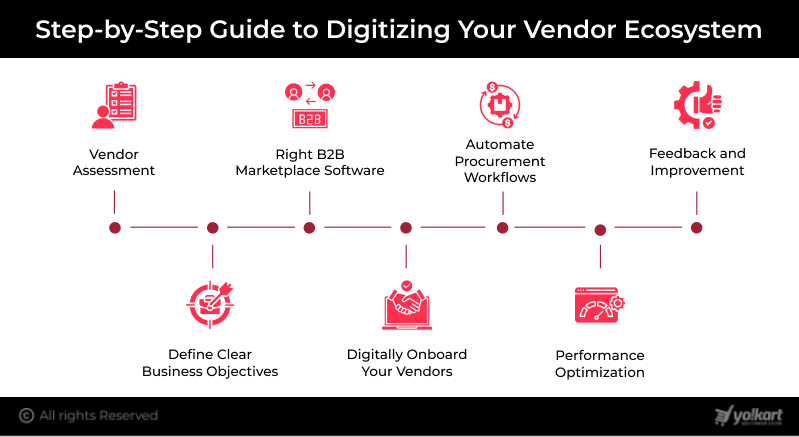
Step 1: Assess Your Existing Vendor Management Process
The first step is to evaluate your current vendor management and procurement workflows. Analyze every stage of the supplier lifecycle, from vendor discovery and onboarding to RFQ management, purchase orders, invoicing, inventory management, and performance evaluation. The goal is to identify manual processes, communication gaps, approval delays, and areas where operational inefficiencies occur most frequently.
This assessment provides a clear understanding of where your business loses time and resources while creating a roadmap for digital transformation. It also helps define the platform capabilities your organization truly needs, ensuring that your investment in a B2B marketplace platform delivers measurable business value rather than simply replacing one system with another.
Step 2: Define Clear Business Objectives
Before selecting a marketplace solution, establish measurable business objectives that align with your organization’s long-term strategy. Instead of aiming to simply “improve procurement,” define goals such as reducing vendor onboarding time, lowering procurement costs, increasing supplier participation, improving order processing speed, or expanding your supplier network.
Clear objectives allow you to measure the success of your digitization initiative through meaningful KPIs. They also help stakeholders understand the expected return on investment and ensure every department works toward common business outcomes throughout the implementation process.
Step 3: Choose the Right B2B Marketplace Software
Selecting the right B2B marketplace software is one of the most important decisions in your digital transformation journey. The ideal platform should support complex B2B procurement workflows, multi-vendor management, advanced pricing models, RFQ automation, ERP integration, inventory synchronization, and comprehensive analytics.
Beyond features, evaluate the software’s scalability, customization capabilities, security standards, implementation timeline, and ongoing technical support. A future-ready marketplace platform should be capable of adapting as your business grows, enabling you to add new suppliers, expand into new markets, and handle increasing transaction volumes without disrupting operations.
Step 4: Digitally Onboard Your Vendors
Vendor adoption plays a critical role in the success of any marketplace implementation. Once your platform is ready, begin onboarding suppliers through a structured digital process that simplifies registration, document verification, compliance checks, and account activation. Providing clear guidance and onboarding support helps suppliers become productive more quickly.
It’s often beneficial to onboard your highest-value suppliers first, allowing your procurement team to refine processes before expanding across the entire supplier network. A smooth onboarding experience encourages vendor participation, reduces resistance to change, and accelerates the overall success of your digital marketplace.
Step 5: Automate Procurement Workflows
After vendors are successfully onboarded, begin replacing manual procurement activities with automated workflows. Digital RFQs, automated purchase orders, approval workflows, invoice processing, inventory synchronization, and payment management significantly reduce administrative work while improving procurement accuracy.
According to McKinsey’s Procurement 4.0 research, procurement automation can reduce purchasing cycle times by up to 60% while lowering administrative costs by 30–40%. Automation also minimizes human error, ensures standardized procurement processes, and enables procurement teams to focus on strategic supplier management instead of repetitive operational tasks.
Step 6: Monitor Performance and Continuously Optimize
Successful vendor ecosystem digitization doesn’t end after implementation. Businesses should continuously monitor procurement performance using real-time analytics and reporting dashboards. Tracking metrics such as vendor onboarding time, procurement cycle time, supplier delivery performance, order fulfillment rates, procurement spending, and vendor response times provides valuable insights into operational efficiency.
These insights help procurement teams identify bottlenecks, evaluate supplier performance, improve purchasing decisions, and optimize workflows over time. Continuous monitoring ensures the marketplace continues delivering measurable improvements as business requirements evolve.
Step 7: Gather Feedback and Improve the Platform
One of the biggest advantages of digital procurement is the ability to evolve continuously. Regular feedback from procurement teams, finance departments, warehouse staff, and suppliers helps identify usability challenges, process inefficiencies, and opportunities for further automation.
Businesses should treat their B2B marketplace platform as a continuously improving ecosystem rather than a one-time software implementation. Regular platform enhancements, feature updates, and user training ensure higher adoption rates, better supplier engagement, and improved operational performance as the marketplace grows.
Build a Future-Ready Vendor Ecosystem
In today’s fast-changing B2B landscape, relying on manual procurement processes and disconnected vendor management systems can limit growth and expose your business to unnecessary risks. A modern B2B marketplace platform empowers you to build a connected, transparent, and highly efficient vendor ecosystem where suppliers, buyers, and procurement teams collaborate seamlessly from a single platform.
By investing in the right B2B marketplace software, you can automate procurement workflows, streamline vendor onboarding, improve supply chain visibility, reduce operational costs, and make faster, data-driven decisions. More importantly, you create a scalable digital infrastructure that adapts as your business grows—whether you’re expanding your supplier network, entering new markets, or managing higher transaction volumes.
Build vs. Buy: What’s the Best Approach for Vendor Ecosystem Digitization?
One of the biggest decisions businesses face when digitizing their vendor ecosystem is whether to build a custom B2B marketplace platform or invest in ready-made B2B marketplace software. While both approaches can support digital procurement, they differ significantly in terms of cost, implementation time, scalability, and long-term maintenance.
For most manufacturers, wholesalers, distributors, and procurement networks, the decision ultimately comes down to balancing flexibility with speed, budget, and business goals. Choosing the right approach can determine how quickly your organization realizes the benefits of vendor ecosystem digitization.
| Factor | Custom B2B Marketplace Development | Ready-Made B2B Marketplace Software |
| Time to Market | 8-18 months | A few weeks |
| Development Cost | High | Significantly lower |
| Implementation Risk | High | Low |
| Feature Availability | Built from scratch | Pre-built and battle-tested |
| Maintenance & Updates | Managed internally | Vendor-supported |
| Scalability | Depends on development quality | Proven and scalable architecture |
| Technical Expertise | Requires a dedicated development team | Minimal technical involvement |
| Future Upgrades | Time-consuming and expensive | Regular updates and feature enhancements |
| Support & Security | Managed in-house | Ongoing vendor support and security updates |
Building a Custom B2B Marketplace
Custom development offers complete control over your marketplace’s functionality, user experience, and workflows. Every feature is designed specifically for your business requirements, making it an attractive option for organizations with highly specialized procurement processes or unique operational models.
However, this flexibility comes with significant challenges. Building a marketplace from scratch often requires substantial investment, extended development timelines, ongoing testing, and continuous maintenance. Businesses also need dedicated technical teams to manage upgrades, security, infrastructure, and future enhancements. According to the Standish Group CHAOS Report 2022, 68% of custom software projects fail to meet their original budget, timeline, or scope, making custom development a high-risk investment for many organizations.
Choosing Ready-Made B2B Marketplace Software
For most businesses, ready-made B2B marketplace software provides a faster, more cost-effective path to digital transformation. These platforms include pre-built features such as vendor management, RFQ automation, multi-vendor catalogs, advanced pricing, procurement workflows, order management, analytics, and third-party integrations.
Because the core functionality has already been tested across multiple real-world implementations, businesses can launch their digital marketplace in weeks instead of months. This significantly reduces implementation risk while allowing teams to focus on supplier relationships, procurement optimization, and business growth rather than software development.
Another major advantage is continuous innovation. Software vendors regularly release feature updates, security enhancements, performance improvements, and integration capabilities, ensuring your marketplace remains competitive without requiring expensive redevelopment projects.
Which Option Is Right for Your Business?
Unless your organization has highly complex and unique operational requirements that cannot be addressed through customization, ready-made B2B marketplace software is generally the smarter investment. It delivers a lower total cost of ownership, faster deployment, reduced technical risk, and quicker return on investment.
Instead of allocating significant resources to building and maintaining technology, businesses can focus on what truly creates competitive advantage—expanding their supplier network, improving procurement efficiency, strengthening vendor relationships, and delivering exceptional customer experiences.
If you’re looking for a proven solution to digitize your vendor ecosystem, Yo!Kart B2B provides everything you need to launch a scalable B2B marketplace platform without starting from scratch. It comes equipped with advanced vendor management, RFQ management, multi-vendor catalog management, flexible B2B pricing, procurement automation, analytics, and enterprise integrations—all designed specifically for manufacturers, wholesalers, distributors, and procurement businesses.
Accelerate Vendor Ecosystem Digitization with Yo!Kart B2B
The longer your business relies on manual procurement processes and disconnected vendor management systems, the more opportunities you lose to inefficiencies, rising operational costs, and supply chain disruptions. The fastest way to modernize your procurement operations is to adopt a proven B2B marketplace platform that is ready to scale with your business.
Yo!Kart empowers manufacturers, wholesalers, distributors, and procurement organizations to launch a fully functional digital marketplace without the cost, complexity, and lengthy timelines of custom development. Instead of waiting months to build technology from scratch, you can go live faster with a feature-rich platform built specifically for B2B commerce.
With built-in vendor management, RFQ automation, multi-vendor capabilities, advanced B2B pricing, procurement workflows, and seamless integrations, Yo!Kart helps you streamline supplier collaboration, improve operational visibility, and automate critical business processes from day one.
Rather than investing your time and budget in software development, you can focus on what truly drives growth: expanding your supplier network, strengthening vendor relationships, improving procurement efficiency, and delivering better experiences for your buyers. Whether you’re building a private procurement portal or a large-scale B2B marketplace, Yo!Kart provides the technology foundation to help you launch faster, scale confidently, and build a future-ready vendor ecosystem that creates lasting competitive advantage.
Why Choose Yo!Kart B2B for Vendor Ecosystem Digitization?
Digitizing your vendor ecosystem requires a platform that can handle complex B2B procurement workflows while remaining scalable and cost-effective. Yo!Kart B2B is a purpose-built B2B marketplace software designed for manufacturers, wholesalers, distributors, and procurement businesses looking to launch a feature-rich multi-vendor marketplace without the time and expense of custom development.
Unlike generic eCommerce platforms that require extensive customization, Yo!Kart comes equipped with essential B2B marketplace capabilities, enabling businesses to digitize supplier management, automate procurement, and accelerate digital transformation.
1. Purpose-Built for B2B Commerce
Yo!Kart is designed specifically for B2B operations, supporting RFQ management, bulk ordering, minimum order quantities (MOQs), vendor-specific catalogs, and negotiated pricing. These built-in capabilities eliminate the need for extensive custom development and simplify complex procurement workflows.
2. Robust Multi-Vendor Marketplace
The platform provides independent vendor dashboards and a centralized admin panel, making it easy to onboard suppliers, manage product catalogs, track orders, and monitor marketplace activities from a single interface.
3. Advanced B2B Pricing
Yo!Kart supports tiered pricing, customer-specific pricing, volume discounts, and negotiated pricing, allowing businesses to create flexible pricing strategies that meet diverse B2B purchasing requirements.
4. Faster Time-to-Market
Instead of spending months building a marketplace from scratch, businesses can launch with Yo!Kart in just a few weeks. Its ready-made architecture reduces implementation time, development costs, and project risks while enabling a faster return on investment.
5. Fully White-Label Solution
Yo!Kart is a completely white-label platform, allowing businesses to customize the marketplace with their own branding, domain, and user experience while maintaining complete ownership of their brand identity.
6. Lifetime Source Code Ownership
With a one-time license, businesses receive lifetime source code ownership, giving them complete control over customization, future enhancements, and platform scalability without recurring licensing fees or vendor lock-in.
7. Enterprise-Ready and Scalable
Built on a scalable architecture, Yo!Kart can support growing vendor networks, larger product catalogs, and increasing transaction volumes while maintaining high performance and enterprise-grade security.
8. Seamless Integrations
The platform easily integrates with ERP systems, CRMs, payment gateways, shipping providers, and other third-party business applications, helping businesses create a connected digital procurement ecosystem.
9. Dedicated Technical Support
Yo!Kart includes ongoing technical support, regular updates, and security enhancements, ensuring your marketplace remains secure, reliable, and aligned with evolving business requirements.
With Yo!Kart, you can focus on growing your supplier network, improving procurement efficiency, and delivering exceptional buyer experiences while the platform provides the technology foundation for long-term success.
See How Yo!Kart Simplifies Vendor Management
Conclusion
Digitizing your vendor ecosystem is no longer a future initiative—it’s a strategic necessity for businesses that want to improve procurement efficiency, strengthen supplier relationships, and build resilient supply chains. As supplier networks expand and procurement processes become more complex, relying on manual workflows and disconnected systems can slow growth, increase costs, and limit visibility across operations.
A modern B2B marketplace platform brings every aspect of vendor management—from supplier onboarding and RFQ management to procurement automation, inventory tracking, analytics, and collaboration into one centralized ecosystem. This enables businesses to make faster decisions, reduce operational costs, improve compliance, and scale confidently in an increasingly competitive market.
For businesses looking to accelerate their digital transformation without investing months in custom software development, Yo!Kart B2B offers a powerful and cost-effective solution. Built specifically for manufacturers, wholesalers, distributors, procurement organizations, and enterprise businesses, Yo!Kart comes equipped with advanced B2B capabilities such as multi-vendor management, RFQ automation, custom pricing, procurement workflows, seamless integrations, and white-label customization. With lifetime source code ownership, 12 months of free technical support, and a faster time-to-market, it provides everything needed to launch and grow a future-ready B2B marketplace.
Whether you’re digitizing an existing supplier network or building a new procurement ecosystem from the ground up, Yo!Kart B2B gives you the technology foundation to streamline operations, strengthen vendor collaboration, and achieve sustainable long-term growth.
Frequently Asked Questions (FAQs)
1. What is vendor ecosystem digitization?
Vendor ecosystem digitization is the process of replacing manual supplier management processes with a centralized digital platform. It enables businesses to manage vendor onboarding, procurement, product catalogs, orders, payments, communication, and performance tracking more efficiently through automation and real-time visibility.
2. Why is vendor ecosystem digitization important for B2B businesses?
Digitizing the vendor ecosystem helps businesses reduce procurement costs, improve supplier collaboration, automate repetitive workflows, increase supply chain visibility, minimize errors, and make data-driven purchasing decisions. It also improves scalability and business resilience during supply chain disruptions.
3. What is B2B marketplace software?
B2B marketplace software is a platform that connects buyers and multiple suppliers in a single digital marketplace. It includes features such as vendor management, RFQ management, bulk ordering, custom pricing, inventory management, order processing, analytics, and payment management to simplify B2B commerce.
4. How does a B2B marketplace improve vendor management?
A B2B marketplace centralizes supplier onboarding, communication, procurement, document management, order tracking, and performance monitoring. This eliminates manual processes, improves transparency, speeds up procurement cycles, and strengthens supplier relationships.
5. Is it better to build a custom B2B marketplace or buy ready-made software?
For most businesses, ready-made B2B marketplace software is the better option because it offers lower development costs, faster deployment, reduced implementation risks, and continuous updates. Custom development is generally suitable only for organizations with highly specialized operational requirements and larger technology budgets.
6. How long does it take to launch a B2B marketplace?
A custom-built marketplace can take anywhere from 8 to 18 months to develop. In contrast, a ready-made solution like Yo!Kart B2B can typically be deployed within a few weeks, depending on customization and integration requirements.
7. Can Yo!Kart B2B be customized for specific business requirements?
Yes. Yo!Kart B2B is a fully white-label solution that can be customized to match your branding, business workflows, pricing models, user roles, and industry-specific requirements. Businesses also receive lifetime source code ownership, allowing further customization as their needs evolve.
8. Why choose Yo!Kart B2B for vendor ecosystem digitization?
Yo!Kart B2B provides everything businesses need to digitize procurement and vendor management in one platform. It offers multi-vendor capabilities, RFQ management, flexible B2B pricing, procurement automation, seamless third-party integrations, enterprise scalability, lifetime source code ownership, and 12 months of free technical support. This enables businesses to launch faster, reduce development costs, and build a scalable digital vendor ecosystem with confidence.
Transform Your Supplier Network into a Digital Ecosystem
Get StartedPopular Posts