
In today’s digital economy dominated by platform-based businesses, online marketplaces have become a proven path to scalable growth. From B2B procurement platforms to niche product ecosystems and service aggregators, entrepreneurs across industries are actively looking to build an eCommerce marketplace that seamlessly connects buyers and sellers while driving growth and revenue.
However, before embarking on development, there is a pivotal decision that will shape the success of your marketplace: whether to leverage marketplace software or invest in custom marketplace development. This choice influences your time to market, overall investment, ability to scale, and competitive positioning in an increasingly crowded digital landscape.
This guide aims to provide a clear comparison of both approaches in depth, examining what each truly entails, their practical advantages and limitations, cost considerations, and scalability potential.
Table of Contents
- What is Custom Marketplace Development?
- What is Marketplace Software?
- Custom Marketplace Development: Pros & Cons
- Marketplace Software: Pros & Cons
- Which Option is Best for Starting Your eCommerce Business in 2026?
- Top Marketplace Software Solutions to Consider in 2026
- Conclusion
- Frequently Asked Questions (FAQs)
What is Custom Marketplace Development?
Custom marketplace development refers to building a multi-vendor platform entirely from scratch, tailored to your unique business model, workflows, and user experience. Unlike pre-built systems, every component, from the database architecture to the frontend interface, is developed specifically for your platform. This gives you complete control over functionality, scalability, and design, allowing you to shape the marketplace exactly the way you envision.
1. How Does it Work?
Building a custom marketplace is a structured and resource-intensive process that typically involves:
- Requirement analysis and technical planning to define features and system architecture
- UI/UX design from scratch to ensure a seamless user experience
- Backend and frontend development tailored to your business needs
- Integration with third-party services, such as payment gateways, shipping APIs, and analytics tools
- Rigorous testing, deployment, and ongoing maintenance
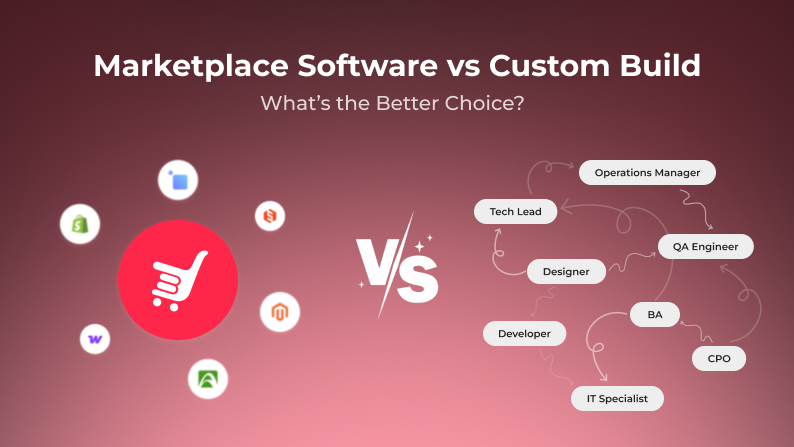
This process requires a specialized team, often including developers, UI/UX designers, QA engineers, and DevOps specialists, to ensure smooth performance, scalability, and long-term stability.
2. When Businesses Consider Custom Development
Custom marketplace development is often chosen when:
- The business model is highly unique or unconventional
- Complex workflows are required, such as bidding systems or AI-based matching
- Complete control over infrastructure, data, and security is essential
- Compliance and industry-specific regulations must be strictly followed
- Important Trade-Offs to Understand
While custom development offers unmatched flexibility and the potential for competitive differentiation, it comes with clear trade-offs. Development timelines can stretch from several months to over a year, and costs can escalate quickly, particularly if requirements evolve mid-project. Ongoing maintenance is another major factor, requiring continuous investment in updates, bug fixes, and security enhancements.
In short, custom development gives you freedom and total control, but at a significant cost of time, money, and technical complexity. However, it is best suited for businesses with unique requirements, sufficient resources, and a long-term growth perspective.
What is Marketplace Software?
Marketplace software is a ready-made solution designed to help businesses build an eCommerce marketplace quickly without developing everything from scratch. It provides a pre-built foundation with essential features already in place, allowing businesses to launch faster, reduce costs, and focus on growth rather than technical development. Unlike custom development, marketplace software comes with tested workflows and scalable architecture, making it a reliable option for startups as well as growing enterprises.
1. How Does it Work?
Marketplace software is designed to simplify the entire setup process and typically includes:
- Pre-integrated features such as vendor onboarding, product catalog management, and order processing
- Payment gateway integration and automated commission handling
- User dashboards for buyers and sellers, providing analytics and reporting tools
- Configurable modules or extensions to add new features without major coding
- Regular updates, maintenance, and support from the software provider
Most marketplace software is designed to be user-friendly, requiring minimal technical expertise. Businesses can often launch their platform within weeks, test their marketplace concept, and scale operations as their user base grows.
2. Types of Marketplace Software
Marketplace software comes in different forms to match varying business needs:
- SaaS-Based Platforms: Cloud-hosted solutions with subscription pricing, ideal for fast deployment and minimal technical overhead
- Self-Hosted Platforms: One-time license solutions with full ownership, offering more control over data and customizations
3. Why Businesses Choose Marketplace Software
Marketplace software is often the preferred choice when:
- Rapid time to market is critical for a competitive advantage
- Budget constraints make custom development impractical
- Businesses want a tested, scalable solution with minimal risk
- Focus needs to be on marketing, vendor acquisition, and growth rather than technical maintenance
Modern marketplace software provides sufficient customization options through APIs, modules, and integrations, making it a practical and efficient solution for most businesses in 2026.
Ready To Simplify Your Marketplace Journey With The Right Solution?
Custom Marketplace Development: Pros & Cons
Custom marketplace development offers complete control and flexibility, making it a strong choice for businesses with unique requirements. However, it also involves significant investment, longer timelines, and higher complexity. Understanding both its advantages and limitations is essential before committing to this approach.
Advantages
- Full control over features, workflow, and user experience.
- Complete flexibility to align the platform with your business vision.
- Ideal for highly unique or niche marketplace models.
- Enables deep integration with internal systems and enterprise tools.
- Can evolve into a strong,g long-term competitive asset.
Limitations
- High upfront investment and continuous development costs.
- Requires a skilled technical team for ongoing support and upgrades
- Longer time to market, delaying launch, and revenue generation
- Higher risk of delays, bugs, and scope changes
- Budget overruns can impact scalability and growth plans
Marketplace Software: Pros & Cons
Marketplace software provides a faster, more accessible way to launch an online platform without heavy development efforts. It reduces technical complexity and lowers initial investment, making it suitable for most businesses. However, it operates within certain limitations that should be considered based on your requirements.
Advantages
- Rapid deployment, enabling faster time to market
- Lower initial investment with predictable costs
- Pre-built and tested features reduce technical risks
- Scalable architecture to support business growth
- Helps you focus on growth strategies, such as customer acquisition, vendor onboarding, marketing, and expansion
- Minimal technical expertise required to launch and manage
Limitations
- Dependency on the software provider, especially in SaaS models
- Advanced or highly specific requirements may need additional customization
However, for most businesses, these limitations are minor compared to the benefits.
Which Option is Best for Starting Your eCommerce Business in 2026?
In today’s fast-paced digital landscape, success is not just about having a great idea. It’s about how quickly and effectively you can bring that vision to life. To achieve that, one of the most critical decisions that an entrepreneur has to make is whether to build a marketplace from scratch through custom development or leverage marketplace software. While both options have their advantages, understanding how they differ across key factors can help you make an informed decision.
| Aspect | Custom Marketplace Development | Marketplace Software |
| Development Time | 6-18 months or more | 2-8 weeks |
| Initial Cost | High (development + team) | Lower, predictable |
| Customization Possiblity | Unlimited | High but structured |
| Scalability | Depends on the architecture | Built-in scalability |
| Technical Expertise | Required | Minimal to moderate |
| Maintenance | Fully your responsibility | Often supported |
| Risk Level | High | Lower |
| Time to Revenue | Delayed | Faster |
Looking For The Smartest Way To Start Your Marketplace?
For most startups, SMEs, and even growing enterprises in 2026, multi-vendor marketplace software emerges as the smarter choice. It allows businesses to launch quickly, validate their idea, and gain traction without long development cycles. With pre-built features, built-in scalability, and ongoing support, it reduces both risk and technical burden. This enables founders to focus on growth strategies, vendor acquisition, and customer experience rather than managing development teams or maintaining complex infrastructure.
Custom development, while offering unmatched flexibility and control, is best suited for businesses with highly unconventional models, complex workflows, or specific regulatory requirements. However, it demands significant time, financial investment, and technical expertise, with returns taking longer to materialize.
In short, for the majority of businesses aiming to build an eCommerce marketplace in 2026, marketplace software offers the fastest, most practical, and cost-effective path to launch, scale, and succeed.
Top Marketplace Software Solutions to Consider in 2026
Choosing the right platform is as crucial as choosing the approach. The software you select directly impacts how quickly you can launch, how well your marketplace scales, and how much flexibility you have as your business grows. With several options available, it is important to pick a solution that aligns with your goals, budget, and technical capabilities.
Here are some of the leading marketplace software solutions to consider in 2026:
1. Yo!Kart
Yo!Kart is a self-hosted, feature-rich marketplace solution designed for both startups and growing enterprises. It offers a lifetime license model, making it a cost-effective option in the long-run. With advanced vendor management, multiple payment gateway integrations, and a scalable architecture, it supports business growth seamlessly. Its flexibility allows entrepreneurs to customize workflows and branding while benefiting from a ready-made foundation, making it ideal for businesses that want speed without compromising control.
Ready To Explore Yo!Kart In Action?
2. Sharetribe
Sharetribe is a SaaS-based marketplace solution known for its simplicity and rapid deployment. It allows entrepreneurs to launch a fully functional marketplace in a matter of weeks without heavy technical expertise. The platform comes with essential features such as vendor onboarding, product listings, and payment processing. While it offers ease of use and speed, deep customization options are limited compared to self-hosted or open-source solutions, making it better suited for small to medium-sized marketplaces.
3. CS-Cart Multi-Vendor
CS-Cart Multi-Vendor strikes a powerful balance between built-in functionality and customization. It comes with a robust admin panel, vendor management tools, and a wide range of features. CS-Cart supports scalability and offers a reliable architecture, making it suitable for growing marketplaces looking for both flexibility and stability.
Take a look at: Yo!Kart: The Best CS-Cart Alternative
4. Magento (Adobe Commerce)
Magento, now part of Adobe Commerce, is a highly flexible eCommerce platform that can be extended into a multi-vendor marketplace using modules and extensions. It offers advanced capabilities for product management, analytics, and scalability, but it requires a dedicated development team for setup, maintenance, and optimization.
5. Shopify with Marketplace Apps
Shopify is a user-friendly platform that can be transformed into a marketplace using third-party apps and plugins. It handles hosting, security, and updates, reducing the technical burden on entrepreneurs. This makes it ideal for small to medium businesses that want to launch quickly. However, its marketplace capabilities depend heavily on apps for extended functionality, and deep customization is limited compared to self-hosted solutions.
Suggested Read: How to Choose the Right eCommerce Marketplace Platform
Why Yo!Kart is the Best Choice?
Choosing the right marketplace software can make a significant difference in how quickly and efficiently you launch and scale your platform. Yo!Kart stands out as a reliable option because it combines speed, flexibility, and scalability, helping businesses move from idea to execution without unnecessary complexity.
It is designed to support both startups and growing businesses, offering a strong foundation with built-in features and customization capabilities. This allows entrepreneurs to focus on business growth while relying on a proven system to manage operations smoothly and efficiently.
Key Advantages:
- No coding required to launch a marketplace quickly
- Feature-rich solution with vendor management and analytics tools
- Support multiple payment gateways and global transactions
- Separate dashboards for admin, buyers, and sellers
- Built-in marketing tools
- Scalable architecture to support business growth
- Customizable design and workflows for brand flexibility
- One-time license model with long-term cost efficiency
Marketplaces Launched with Yo!Kart
1. Tajer
Tajer is a B2B eCommerce marketplace in Qatar that connects suppliers and buyers through a streamlined digital platform. Built on Yo!Kart, it offers efficient vendor onboarding, product management, and seamless transactions, enabling businesses to scale their operations and digitize procurement processes effectively.
2. Sawa Shopping
Sawa Shopping is a multi-vendor marketplace designed to support local businesses in Lebanon. Powered by Yo!Kart, it enables sellers to create online stores, manage products, and reach a wider audience, helping drive digital commerce in a competitive regional market.
3. Customize Your Truck
Customize yout truck This niche marketplace focuses on truck customization products and accessories. Leveraging Yo!Kart, it delivers a tailored buying experience with advanced product listings and vendor management, allowing users to easily explore and purchase specialized automotive solutions.
4. Regake
Regake is a digital products marketplace offering items like software, templates, and online resources. Built with Yo!Kart, it supports digital product delivery, vendor management, and secure transactions, creating a seamless experience for both sellers and buyers in the digital goods space.
See the eCommerce Marketplace Platforms Powered By Yo!Kart
Conclusion
The decision between custom marketplace development and marketplace software ultimately comes down to your business goals, budget, and timeline. While custom development offers flexibility, it requires heavy investment and patience. On the other hand, marketplace software provides a faster, more efficient, and lower-risk path to launching your platform.
In 2026, where speed and adaptability define success, businesses that move quickly and iterate effectively have a clear advantage. For most entrepreneurs, marketplace software provides the right balance of efficiency, scalability, and cost-effectiveness, allowing them to validate ideas, scale confidently, and focus on growth.
FAQs
Q 1. What are the cost implications of choosing custom development over marketplace software?
Ans. Custom development usually requires a significant upfront investment. It includes the cost for design, development, testing, and ongoing maintenance. Readymade marketplace software, on the other hand, are mor budget-friendly to start with and comes with pre-built modules and a market-tested framework. They allow you to launch your marketplace without heavy investment.
Q 2. How long does it take to build a marketplace via custom development?
Ans. Custom marketplace development typically takes 6 to 12 months or even more, depending on the feature complexity, integrations, and testing. Timelines often extend due to bug fixes and changing requirements. However, for entrepreneurs aiming for a quick market entry, a more efficient approach is leveraging a readymade marketplace software. It minimizes delays, lowers risk, and helps you enter the market faster while focusing on growth and user acquisition.
Q 3. How do scalability and performance compare between the two options?
Ans. Custom development allows full control over scalability, but achieving it requires time, expertise, and continuous investment. Marketplace software, in contrast, is built with scalability in mind. Most modern solutions handle a growing user base efficiently without added complexity. Moreover, they provide a reliable and practical way to scale without managing technical infrastructure or investing heavily in performance optimization.
Q 4. Is readymade marketplace software suitable for startups?
Ans. Yes, readymade marketplace software is often the best choice for startups. It reduces technical complexity and allows founders to focus on growth, marketing, and user experience. Additionally, early market entry enables startups to gather real feedback and improve quickly.
Q 5. Is a hybrid approach, using marketplace software with custom integrations, a practical middle ground?
Ans. Yes, adapting a hybrid approach is a highly practical option for many businesses. Starting with a marketplace software allows for quick deployment, while custom integrations can be added as needs evolve. This balance helps reduce initial costs while still offering flexibility. It enables businesses to scale gradually without overinvesting early, making it a smart strategy for long-term growth.
Q 6. Can marketplace software be customized to match specific business processes?
Ans. Yes, marketplace software offers customization to match specific business processes. Entrepreneurs can tailor workflow, integrate third-party tools, and enhance functionality without building from scratch. For more specific needs, additional customizations can be done, making it a flexible and efficient alternative to full custom development.