
Published date 27th Feb, 2026
In the global eCommerce landscape, Amazon and Alibaba are two titans that have transformed how people shop, sell, and engage with businesses online. With a combined valuation exceeding $2.37 trillion as of Feb 2026, these companies dominate the digital commerce landscape worldwide, driven by innovative and profitable business models spanning retail, cloud services, digital media, and more.
Both companies have achieved immense success, yet they follow distinctly different paths to profitability. This raises an important question for entrepreneurs and industry observers alike: Which business model is more profitable, and which is better positioned for long-term growth?
In this blog, we’ll compare Amazon and Alibaba’s business models, looking at how they generate revenue, their profit margins, and the strategies that have driven their success. By the end, you’ll gain a clear understanding of which company has the most sustainable and profitable model for the future.
Table of Contents
- Key Stats to Consider:
- Overview of Alibaba and Amazon’s Business & Revenue Models
- Profitability Comparison
- Key Factors Affecting Profitability for Alibaba and Amazon
- Growth Strategies: Profitability in the Long Term
- Why is it Profitable to Build an eCommerce Marketplace Like Alibaba or Amazon in 2026
- Yo!Kart: The Best eCommerce Marketplace Builder
- Conclusion
- FAQs
Key Stats to Consider:
- Amazon’s 2025 Revenue: $716.9 billion, with AWS contributing 18% of operating income.
- Alibaba’s 2025 Revenue: $137.3 billion, with Alibaba Cloud contributing 12% to total annual revenue.
- Amazon Prime Subscribers: Over 200 million globally, generating billions in annual revenue.
- Alibaba’s Cloud Computing (AI): Dominates China’s AI cloud services market with 35.8% of market share.
Overview of Alibaba and Amazon’s Business & Revenue Models
Although both companies dominate global eCommerce, they operate differently. Amazon prioritizes control through infrastructure, logistics, and direct sales, whereas Alibaba emphasizes platform economies and ecosystem partnerships. These opposing strategies shape how each company earns, spends, and scales. Let’s examine the foundation of Alibaba’s business model first.
Alibaba’s Business Model
Alibaba Group was founded in 1999 by Jack Ma and has since evolved into one of the largest eCommerce conglomerates in the world. What sets Alibaba apart is its ability to operate across a wide range of sectors, including online retail, cloud computing, digital entertainment, and logistics. Its biggest strength lies in its marketplace-first strategy, enabling millions of businesses to sell online without Alibaba owning the inventory itself.
Key Components of Alibaba’s Business Model:
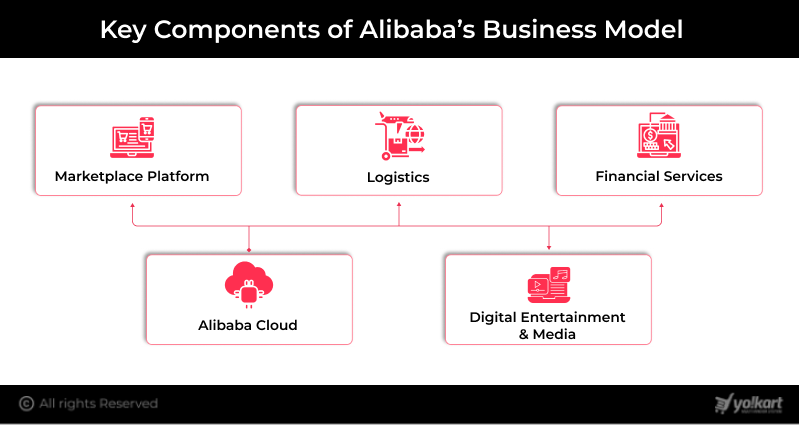
- Marketplace Platform: Alibaba’s core platforms, Taobao (C2C) and Tmall (B2C), connect buyers and sellers, charging a small commission for each transaction. It operates primarily as a marketplace, facilitating transactions without holding significant amounts of inventory, which reduces operational risk and heavy inventory costs.
- Alibaba Cloud: The cloud division, Alibaba Cloud, is one of the largest cloud computing platforms globally. Alibaba Cloud plays a crucial role in profitability and technological expansion, particularly across Asia and emerging markets.
- Logistics (Cainiao): Rather than operating a traditional delivery fleet, Cainiao connects local and international logistics partners, offering streamlined services to improve delivery speed.
- Digital Entertainment & Media: Alibaba has ventured into entertainment with platforms like Youku (video streaming), AliMusic (music streaming), and AliSports (sports media), diversifying its income sources while strengthening user engagement across Alibaba’s ecosystem.
- Financial Services: Ant Financial (now Ant Group), Alibaba’s financial services affiliate, operates the popular payment platform Alipay, which is also used for eCommerce transactions and has grown into a fintech powerhouse.
Suggested Read: Alibaba Business Model: How Does Alibaba Make Money?
Amazon’s Business Model
Amazon, founded in 1994 by Jeff Bezos, began as an online bookstore before expanding into virtually every category of retail, cloud computing, and digital services. Amazon’s business model is based on a combination of direct product sales, third-party marketplace services, and subscription-based services.
Key Components of Amazon’s Business Model:
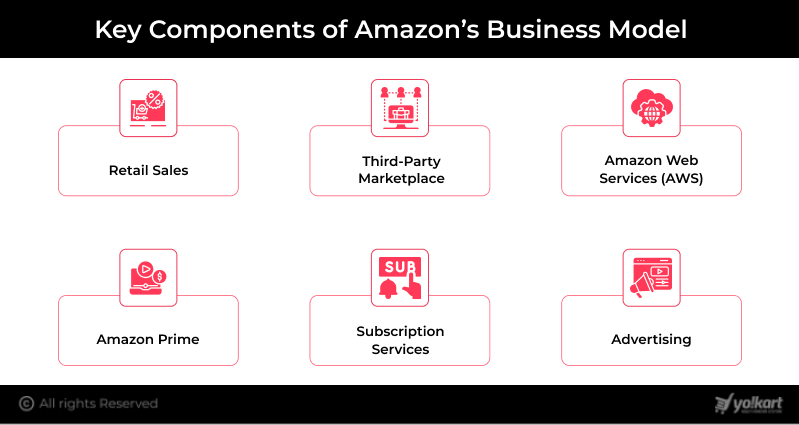
- Retail Sales: Amazon’s primary revenue comes from direct sales of products on its platform. It stocks, ships, and sells millions of products across numerous categories. Unlike Alibaba, Amazon directly owns and sells a significant portion of its inventory. This approach allows control over pricing, quality, and customer experience.
- Third-Party Marketplace: In addition to retail, Amazon allows third-party sellers to list their products on its platform. In exchange, it charges commissions on each sale, along with fees for services such as fulfillment and advertising.
- Amazon Web Services (AWS): AWS is Amazon’s cloud computing arm and one of the most profitable segments of the company. It offers businesses computing power, storage, and other services, generating higher margins than retail operations.
- Amazon Prime: Amazon’s subscription program, Amazon Prime, offers benefits like free shipping, video streaming, and other perks, generating a recurring revenue stream. Prime is often considered Amazon’s secret weapon for increasing customer loyalty.
- Subscription Services: Beyond Prime, Amazon offers other subscription-based services such as Amazon Music, Kindle Unlimited, and Amazon Fresh, diversifying its income and adding predictable, recurring revenue.
- Advertising: Amazon’s rapidly growing ad business allows brands to promote products directly on its platform, adding another high-margin revenue source.
Turn Your Industry Experience into a Global Commerce Platform
Profitability Comparison
Amazon and Alibaba generate profits through very different operational models, which is why a segment-wise comparison offers better clarity than overall revenue alone. The table below compares how profitable each major segment is for both companies, along with key stats that highlight where each giant holds a competitive advantage.
| Segment | Alibaba Profitability | Amazon Profitability | Key Insights |
| Core Commerce/Retail | Moderate (asset-light marketplace) | Low (inventory-heavy retail) | Alibaba avoids inventory costsAlibaba FY2025 revenue ~$137.3 billionAmazon invests heavily in logisticsAmazon FY2025 revenue ~$716.9 billion |
| Marketplace & Seller Services | High | Moderate to High | Both depend on third-party sellersTaobao and Tmall dominate China’s online retail market with 41% and 47% share, respectivelyOver 60% of Amazon unit sales come from sellers |
| Cloud Computing | Improving | Very High | Cloud drives profits for bothAlibaba Cloud is ranked as the number 1 cloud service provider in the Asia-Pacific regionAWS holds approx 30% market share globally |
| Advertising | High growth | Very High | Retail media is a major profit engine for bothAds contributes 43% of the revenue share for AlibabaAmazon ad revenue ~$68 billion (2025) |
| Subscriptions | Limited | High (Prime) | Recurring revenue strengthens Amazon’s profitability with 200M+ Prime members globally |
| Subscriptions | Limited | High (Prime) | Recurring revenue strengthens Amazon’s profitability with 200M+ Prime members globally |
Key Takeaway: Amazon currently leads in profitability due to high-margin segments like AWS, advertising, and subscriptions. Alibaba’s asset-light marketplace and fintech ecosystem, however, offer strong scalability and long-term growth potential, especially in emerging markets.
Suggested Read: How Does Amazon Make Money?
Key Factors Affecting Profitability for Alibaba and Amazon
Profitability for both Alibaba and Amazon is shaped not just by their revenue streams, but by external market forces, regulatory environments, infrastructure investments, and global expansion strategies. While each company operates at a massive scale, their future earnings depend on how effectively they navigate regional risks, technological shifts, and rising operational costs. Understanding these factors reveals where each giant faces pressure and where new profit opportunities may emerge.
Factors Affecting Alibaba’s Profitability
- China’s Economic Landscape: Alibaba’s dominance in China remains its biggest advantage and risk. Economic slowdowns, shifting consumer spending, and evolving regulatory policies can directly influence marketplace activity, advertising revenue, and fintech operations.
- Global Expansion Efforts: Alibaba is heavily focused on expanding internationally, especially through platforms like AliExpress and Tmall Global. However, to face competition from local players, especially in Europe and North America, it requires heavy investment in logistics, compliance, and brand trust.
- Cloud Computing: Alibaba Cloud is central to the company’s future profitability. Expanding its enterprise presence outside China will be critical, especially as global demand for cloud infrastructure and AI capabilities accelerates.
Factors Affecting Amazon’s Profitability
- AWS Growth: The continued dominance and growth of AWS remains Amazon’s primary profit engine. Continued leadership in cloud computing, AI services, and enterprise solutions will heavily influence the company’s overall margins and financial stability.
- International Expansion: Amazon’s ability to scale internationally, particularly in emerging markets like India and Latin America, will impact its future profitability.
- Retail and Fulfillment Costs: Amazon’s vast delivery infrastructure is a competitive advantage but also a major expense. Rising shipping, labor, and last-mile delivery costs continue to pressure retail margins despite efficiency improvements through automation.
Create a Future-Ready Marketplace With Diversified Revenue Streams
Growth Strategies: Profitability in the Long Term
Long-term profitability for Amazon and Alibaba depends less on current revenue and more on how effectively they expand into new markets, technologies, and high-margin services. Both companies are investing heavily in cloud computing, global reach, and ecosystem diversification to reduce reliance on low-margin retail operations. Further, let’s have a look at the growth strategies of both companies:
Alibaba’s Growth Strategies
- Global Expansion: Alibaba is expanding its operations outside of China and targeting Southeast Asia, Europe, and other emerging markets to boost its profitability.
- Cloud Computing: Alibaba Cloud will continue to be a significant growth driver for the company’s profitability in the coming years. As businesses worldwide adopt digital infrastructure, the company is positioning its cloud services to compete globally and generate higher-margin enterprise revenue.
- Diversification: To balance its commerce-heavy income, Alibaba is diversifying its income sources into entertainment, digital finance, and logistics. This diversified ecosystem strengthens user engagement while creating multiple monetization channels beyond marketplace commissions.
Amazon’s Growth Strategies
- AWS Expansion: Amazon Web Services continues to be a key driver of profit. Expanding data centers and enterprise solutions across new regions will further strengthen Amazon’s leadership in cloud computing.
- Global Market Penetration: Amazon is focusing on high-growth regions such as India, Latin America, and the Middle East, where eCommerce adoption is rising rapidly. Capturing these markets early can deliver substantial long-term revenue.
- Automation and Logistics: Investment in automation, AI, and robotics for its warehouses and fulfillment centers helps Amazon reduce costs in the long run. Further, greater operational efficiency will be key to improving margins in Amazon’s retail business.
Why is it Profitable to Build an eCommerce Marketplace Like Alibaba or Amazon in 2026
With global eCommerce projected to surpass $7 trillion by 2026, now is the perfect time to build an eCommerce marketplace. Industry leaders like Alibaba and Amazon have proven that marketplace platforms can scale rapidly, remain resilient during market shifts, and generate multiple high-margin revenue streams. Moreover, these platforms leverage asset-light models, cloud services, and diverse revenue streams to achieve massive profitability.
Key Benefits of Building a Marketplace in 2026:
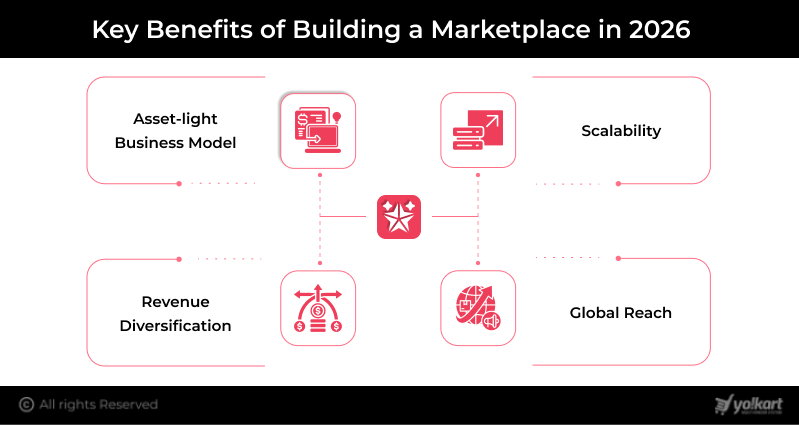
- Asset-light Business Model: Like Alibaba’s approach, you don’t need to invest in large inventories, which allows for reduced upfront costs. Your platform can simply connect buyers and sellers while charging transaction fees, commissions, and offering additional services.
- Scalability: Through network effects marketplaces grow organically and become more valuable. More sellers attract more buyers, which in turn brings additional sellers. This self-reinforcing growth model enables rapid scaling without proportional cost increases.
- Revenue Diversification: Beyond product sales, your platform can generate revenue from advertising, subscription models, premium seller services, and even payment gateways, similar to Amazon and Alibaba.
- Global Reach: eCommerce continues to expand globally, especially in regions like Asia, Latin America, and Africa. Launching now positions your platform to capture demand in regions where digital commerce adoption is still rising.
Building a marketplace allows you to tap into these multiple revenue streams, much like Amazon and Alibaba, positioning you for substantial long-term profits in a rapidly growing market.
Yo!Kart: The Best eCommerce Marketplace Builder
If you’re planning to launch your own eCommerce marketplace inspired by leaders like Alibaba or Amazon, Yo!Kart is the ultimate solution. It provides a ready-to-deploy foundation to get started quickly. It is a comprehensive eCommerce marketplace builder that allows entrepreneurs to create a scalable, secure, and customizable platform with minimal effort and investment.
Why Yo!Kart is the Perfect Choice for Your Marketplace:
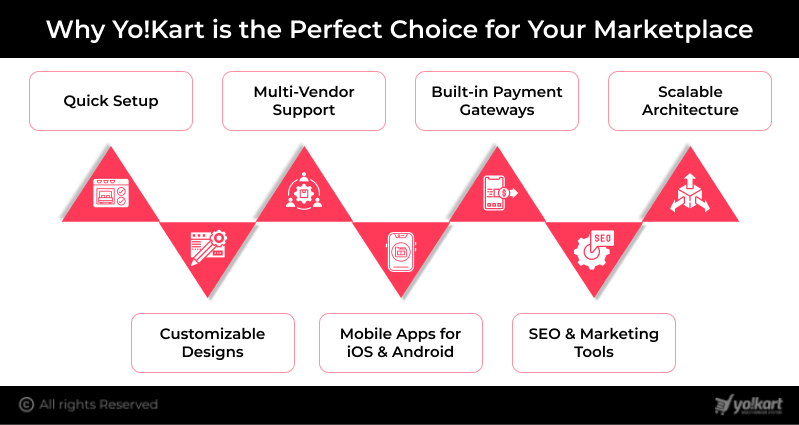
- Quick Setup: Yo!Kart enables you to launch your online marketplace quickly and easily without the need for technical expertise. Its intuitive interface makes setup a breeze, letting you focus on growing your business.
- Customizable Designs: With Yo!Kart, you get access to fully customizable themes to create a marketplace that reflects your brand and delivers a superior user experience. Whether you’re building a niche marketplace or a global eCommerce platform, Yo!Kart adapts to your needs.
- Mobile Apps for iOS & Android: Yo!Kart includes native mobile apps for both Android and iOS, making it easy for your customers to shop on-the-go, thus increasing engagement and retention.
- Multi-Vendor Support: Just like Amazon and Alibaba, Yo!Kart supports a multi-vendor structure, allowing various sellers to list products on your platform. You can generate revenue by taking a commission on each transaction while offering tools to enhance seller success.
- Built-in Payment Gateways: The platform integrates with multiple payment gateways, ensuring smooth and secure transactions. This feature helps you scale globally and provide convenient payment options for users.
- SEO & Marketing Tools: Yo!Kart comes with built-in SEO tools, enabling you to optimize your marketplace for search engines and drive organic traffic. Additionally, it includes marketing and promotional tools to help you grow your user base quickly.
- Scalable Architecture: As your marketplace grows, Yo!Kart scales with you. The solution is designed to handle large traffic volumes and increasing product listings, making it an ideal choice for growing businesses.
Schedule a Personalized Demo of Yo!Kart
Conclusion
Amazon and Alibaba stand as benchmarks for what is possible in global digital commerce, proving that large-scale platforms can achieve extraordinary profitability while continuing to expand into new markets and technologies. Their success reflects the growing dominance of online marketplaces, cloud infrastructure, and ecosystem-driven growth in shaping the future of digital commerce. As eCommerce adoption accelerates worldwide, the competitive landscape will increasingly favor companies that can innovate quickly, diversify revenue streams, and deliver seamless experiences to both buyers and sellers.
The rapid rise of digital commerce, cross-border trade, and platform-based economies depicts that new marketplaces can emerge and thrive. Businesses that act now can capitalize on underserved niches, regional demand, and evolving consumer behavior to build sustainable and profitable platforms. The path forward is not about replicating existing giants, but about applying the underlying principles of scalability, adaptability, and customer-centric innovation to create the next generation of successful online marketplaces.
Frequently Asked Questions (FAQs)
Q 1. How long does it take to launch an eCommerce marketplace like Amazon or Alibaba?
Ans. Launching a marketplace like Amazon or Alibaba can take 6 to 12 months if you go the traditional route with custom development. However, with ready-made marketplace software like Yo!Kart, you can launch your platform within a few weeks, due to its pre-built templates and features.
Q 2. What is the main difference between Alibaba and Amazon’s business models?
Ans. Amazon acts as both a retailer and a marketplace, selling products directly and also hosting third-party sellers. Alibaba, on the other hand, operates primarily as a marketplace, connecting buyers and sellers without holding inventory, while also focusing heavily on cloud services and fintech.
Q 3. Can I build a niche eCommerce marketplace similar to Amazon or Alibaba?
Ans. Yes, Yo!Kart allows you to create specialized, niche marketplace like Alibaba. You can easily tailor your platform to any industry, be it fashion, electronics, or services, with customizable designs and features suited to your niche and business model.
Q 4. How do Amazon and Alibaba make money, and how can I apply their strategies to my marketplace?
Ans. Both companies make money through various channels, such as commissions, subscription models, and advertising. You can implement similar revenue streams in your marketplace by charging transaction fees, offering premium seller services, and allowing paid promotions for increased visibility.
Q 5. What are the advantages of starting an eCommerce marketplace over a traditional online store?
Ans. An eCommerce marketplace allows you to scale faster with lower overhead by connecting buyers and sellers without holding inventory. Additionally, you can generate revenue through multiple streams, including commissions, transaction fees, subscriptions, and advertising, while benefiting from network effects.
Q 6. How does Yo!Kart help me compete with large platforms like Amazon and Alibaba?
Ans. Yo!Kart gives you the tools to compete with large platforms like Amazon and Alibaba by offering multi-vendor support, customization, mobile apps, and SEO tools. The solution is scalable, integrates global payment gateways, and allows you to offer a unique, branded experience while driving growth with lower costs.