

The global B2B marketplace industry is growing at an exceptional pace. In fact, global B2B eCommerce sales are projected to exceed $25 trillion by 2028, nearly five times the size of B2C eCommerce.
Businesses are no longer relying on traditional distribution channels. They are building scalable online B2B marketplace platforms that can connect manufacturers, wholesalers, distributors, and enterprise buyers under one digital roof.
Businesses often consider Shopify to build their B2B multi-vendor marketplace because of its popularity in the eCommerce industry. If you are also one of them, you should not miss this blog.
However, when it comes to building a complex B2B marketplace platform, Shopify often falls short. There are several areas where Shopify lacks, especially when it comes to supporting multi-vendor features. Therefore, businesses often seek a Shopify alternative to get started with.
This informative blog on the best Shopify alternative is crafted for entrepreneurs and businesses who need more clarity on the alternative. Adding highlights that you will explore:
- Why Shopify struggles with B2B marketplace requirements
- Key features required in professional B2B marketplace software
- Limitations of Shopify for B2B multi-vendor businesses
- The best Shopify alternative for B2B marketplaces
- Cost, scalability, and ownership comparison
Let’s dive in.
Table of Contents
- Understanding the B2B Marketplace Model
- Why Shopify Is Not Ideal for B2B Marketplaces
- What to Look for in a B2B Marketplace Platform
- Quick Evaluation Checklist
- Best Shopify Alternative for B2B Marketplaces
- Shopify vs Dedicated B2B Marketplace Software
- How to Choose the Right B2B Marketplace Software
- Why Yo!Kart Stands Out as a Strong Shopify Alternative
- Conclusion
- Frequently Asked Questions (FAQs)
Understanding the B2B Marketplace Model
A B2B marketplace is an online platform where businesses sell products or services to other businesses. Unlike B2C marketplaces, B2B platforms handle a large volume of transactions. At the same time, you can’t ignore that the B2B transactions are complex and require distinct features to ensure a seamless transition on the platform. Below are a few key characteristics of the B2B marketplace model.
Key Characteristics of a B2B Marketplace Platform
| Feature | B2B Requirement |
| Bulk Purchasing | Minimum order quantity (MOQ) |
| Tiered Pricing | Volume-based discounts |
| Quote System | Request for quotation (RFQ) |
| Custom Pricing | Buyer-specific pricing |
| Multi-user Accounts | Corporate buying teams |
| Role-Based Access | Procurement, finance, admin |
| Reorder System | Quick repeat purchases |
Popular Examples of B2B multi-vendor marketplaces include Alibaba, ThomasNet, Amazon Business, and IndiaMART.
Why Shopify Is Not Ideal for B2B Marketplaces
Shopify is an excellent B2C eCommerce platform for online stores, not a B2B multi-vendor marketplace. Building a full-scale B2B marketplace platform requires much and Shopify relies on plugins that may lead to several complexities and challenges. Let’s analyze the challenges.
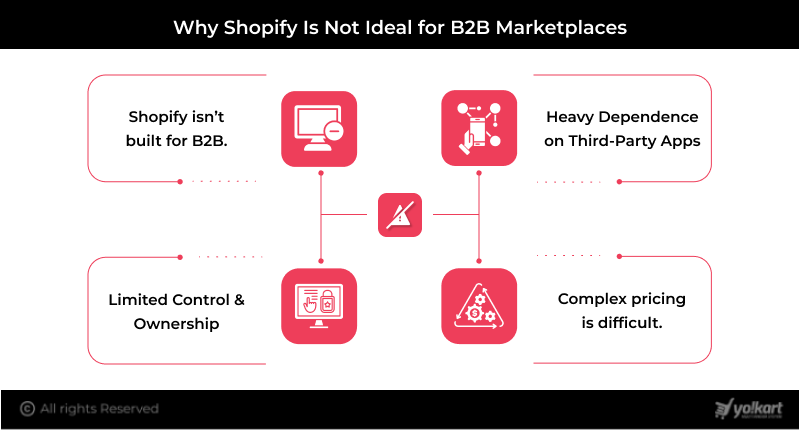
1. Shopify Isn’t Inherently Built for B2B
Shopify’s core structure is designed for:
- Single vendor stores
- Direct-to-consumer sales
- Standard checkout flows
- Fixed pricing
However, Shopify Plus is designed to support B2B features, but only for a single vendor.
B2B marketplaces require:
- Multi-vendor architecture
- B2B-specific features such as custom pricing, RFQ, and more.
- Commission Management
- Vendor Onboarding and account management
Shopify is ideally not the right fit when comparing built-in multi-vendor B2B features.
2. Heavy Dependence on Third-Party Apps
To build a B2B marketplace on Shopify, you need to integrate it with third-party multi-vendor applications like Webkul and Shipturtle.
This leads to:
- High recurring costs
- Integration conflicts
- Performance slowdowns
- Limited customization
Over 3 years, app subscription costs can exceed $8,000–$15,000, depending on the growth and expansion of the businesses. In addition, it poses several restrictions that may lead to unexpected challenges in the future.
3. Limited Control & Ownership
Shopify is a SaaS-based eCommerce platform. It doesn’t offer complete control and ownership, neither over the platform nor the data. It simply provides access to the platform. Therefore, the dependency on the third-party service provider is greater.
Key areas you may be challenged with:
- Monthly subscription model
- Limited backend access
- Platform dependency
- Transaction fees in certain plans
For enterprise-level B2B marketplace software, businesses prefer:
- Full code ownership
- Custom workflow control
- Hosting flexibility
- Long-term scalability
Getting customizable source ownership helps businesses gain complete control over the platform. At the same time, hosting preference enables businesses to store data on their own server.
4. Complex Pricing Structures Are Hard to Implement
Like a B2C platform where a uniform pricing for the product works. In B2B, a different pricing structure is needed, varied by specific requirements.
B2B pricing structures include:
- Tiered pricing
- Contract pricing
- Customer group pricing
- Volume-based discounts
- Negotiated quotes
On Shopify, this requires stacking multiple apps — which increases complexity. At the same time, it leads to additional costs.
Looking for a Feature-rich Dedicated B2B Marketplace Software?
What to Look for in a B2B Marketplace Platform
Choosing the right B2B marketplace platform is not just a technical decision but a long-term business strategy. Unlike B2C platforms, a B2B marketplace must support complex pricing structures, corporate buying workflows, vendor operations, and large-volume transactions.
Selecting the wrong B2B marketplace software can result in operational inefficiencies, high customization costs, limited scalability, and vendor dissatisfaction. Let’s explore key factors that one should consider when looking for a B2B multi-vendor marketplace software.
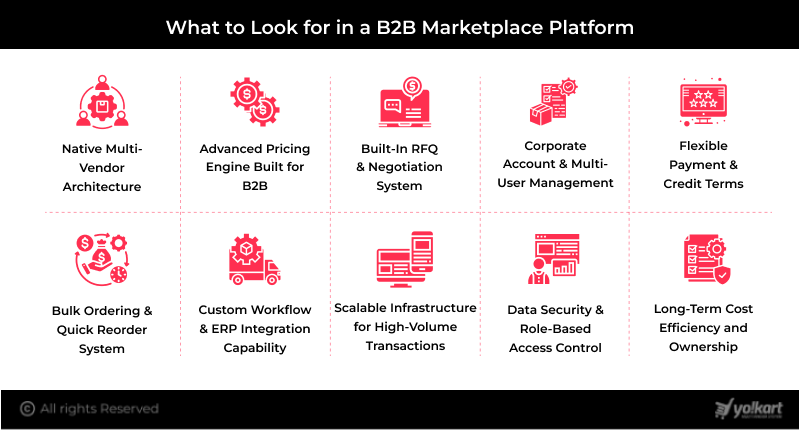
1. Native Multi-Vendor Architecture (Not Plugin-Based)
A professional B2B marketplace must be built from the ground up to support multiple vendors.
Your platform should include:
- Dedicated vendor dashboards
- Product and inventory management per vendor
- Vendor-specific shipping rules
- Commission management system
- Vendor performance analytics
- Vendor subscription or membership plans
- Automated payout management
If multi-vendor functionality depends on third-party plugins, scalability becomes a challenge. At the same time, it brings several more challenges and leads to additional recurring costs. A native architecture ensures better performance, stability, and offers long-term flexibility.
2. Advanced Pricing Engine Built for B2B
Pricing in B2B commerce is rarely fixed. The B2B eCommerce platform should support varied pricing based on order quantity, buyer type, relationship, agreement and payment terms.
Your B2B marketplace software must support:
- Minimum Order Quantity (MOQ)
- Tiered pricing (e.g., 100 units = $8/unit, 500 units = $6/unit)
- Customer group pricing
- Contract-based pricing
- Dynamic bulk discounts
- Custom catalog pricing
For example, a wholesaler may offer 5% discount for orders above $10,000 and 12% discount for orders above $50,000. Your platform must handle this automatically. It enhances the overall buying experience.
3. Built-In RFQ (Request for Quote) & Negotiation System
B2B trade is more about negotiation and personalized pricing. Businesses negotiate and agree with custom pricing, considering several factors. In the B2B industry, the RFQ module is critical, not optional. It enables them to interact, quote and counteroffer to decide on the pricing on various terms.
A strong B2B marketplace platform should allow:
- Buyers to submit RFQ requests
- Vendors to send custom quotes
- Counter-offer functionality
- Quote approval workflows
- Conversion of quotes into confirmed orders
- Attachments for specifications and compliance documents
4. Corporate Account & Multi-User Management
Operating a multi-vendor marketplace means handling multiple sellers from onboarding to user management. In addition, B2B buyers are organizations, not individuals.
Your platform must support:
- Company-based accounts
- Multiple users under one corporate account
- Role-based permissions (Admin, Procurement, Finance, Operations)
- Approval workflows for purchases
- Purchase limits by role
- Shared cart functionality
- Company credit balance tracking
For example:
A procurement executive adds products to the cart → Finance manager approves → Admin finalizes order.
If your platform cannot support structured buying workflows, enterprise clients may avoid it.
5. Flexible Payment & Credit Terms
Unlike B2C platforms, B2B commerce rarely operates on instant payments. B2B businesses look for flexible payment options and a credit line. A feature offering flexible payment options helps them maintain the cash flow.
Your B2B marketplace software should support:
- Credit limits per buyer
- Partial payments
- Invoice-based checkout
- Offline payment approval
- Escrow system (if required)
For instance, a distributor ordering $100,000 worth of products may not pay immediately but may operate on approved credit terms.
A B2B marketplace platform must accommodate this reality.
6. Bulk Ordering & Quick Reorder System
Efficiency is crucial in B2B procurement. Bulk ordering and quick reorder or one-click reordering enable B2B buyers to place orders and fulfill their requirements by eliminating the lengthy buying process.
Your platform should provide:
- Bulk Ordering
- Quick order forms
- SKU-based ordering
- One-click reorder
- Saved purchase lists
- Automated recurring orders
Large buyers often reorder the same products monthly. Reducing friction improves retention and lifetime value by improving the overall buying experience
7. Custom Workflow & ERP Integration Capability
A B2B eCommerce platform should support third-party integrations. Marketplaces rely on several tools, APIs, ERP and CRM to enable out-of-the-box services that are not in-built.
Your B2B marketplace platform must offer:
- API access
- ERP integration capability
- CRM integration
- Custom module development support
- Third-party shipping integrations
8. Scalable Infrastructure for High-Volume Transactions
Scalability is something that allows businesses to grow without worrying about the architecture. The B2B marketplace software you are choosing should be scalable. Especially when operating a B2B multi-vendor marketplace where businesses trade in large volumes, a scalable solution is a primary need.
Your platform must support:
- High traffic volume
- Multiple vendors simultaneously
- Large product catalogs
- Advanced search and filtering
- Multi-currency support
- Multi-language capability
9. Data Security & Role-Based Access Control
A B2B multi-vendor marketplace should be highly secure. It helps protect sensitive financial data, prevent high-stakes payment fraud, and maintain trust. Ultimately, foster a safe digital platform for high-volume transactions.
A strong B2B marketplace software must include:
- SSL security
- Data encryption
- Role-based data visibility
- Secure payment gateways
- Compliance readiness (GDPR, etc.)
- Audit logs
B2B buyers demand enterprise-level security. Key benefits include secure, encrypted payments and reduced risk of data breaches.
10. Long-Term Cost Efficiency and Ownership
Cost consideration is another critical factor to consider when evaluating a readymade B2B marketplace software. Primarily, solutions available in the market operate following two business models. One is recurring subscription fees and the other is one-time payment models.
Shopify charges a monthly subscription fee, excluding multi-vendor plugin charges, transactional charges, costs for add-ons and many more. On the other hand, if you choose a solution that is available at a one-time payment model, you need to pay a one-time license fee only for complete control and ownership.
In addition, solutions operating with a one-time payment model are more transparent with their pricing and reliable. Things to consider before you decide on a B2B multi-vendor marketplace software: :
- Are there recurring subscription fees or is a one-time payment needed?
- Are transaction fees charged?
- Is the software self-hosted?
- Do you own the customizable source code?
- Can you migrate if needed?
Over 3–5 years, SaaS-based platforms often cost significantly more than licensed B2B marketplace software.
A platform that gives you complete ownership at a one-time payment y reduces long-term financial risk.
Suggested Read: Key Things to look for in a B2B Marketplace Software
Quick Evaluation Checklist: Decide on the Right B2B Marketplace Software
The checklist below can help you get clarity when deciding on a B2B multi-vendor marketplace. Use this table before selecting your B2B marketplace platform:
| Requirement | Must Have? |
| Native Multi-Vendor System | ✅ |
| RFQ Module | ✅ |
| Tiered Pricing | ✅ |
| Corporate Accounts | ✅ |
| Credit Terms | ✅ |
| Bulk Ordering | ✅ |
| API Integration | ✅ |
| No Heavy Plugin Dependency | ✅ |
| Scalable Architecture | ✅ |
| Flexible Ownership Model | ✅ |
Need Guidance on Deciding on the Best B2B eCommerce Platform?
Best Shopify Alternative for B2B Marketplaces
Now comes the most important question:
If Shopify struggles with complex B2B workflows, vendor coordination, and enterprise procurement models — what is the best Shopify alternative to build a feature-rich B2B marketplace?
The answer isn’t just “another eCommerce platform.”
The real solution is a dedicated B2B marketplace software built specifically for multi-vendor commerce — such as Yo!Kart.B2B
Why a Dedicated B2B Marketplace Platform Like Yo!Kart Makes the Difference
Unlike Shopify, which is fundamentally a store-centric eCommerce platform, a purpose-built B2B marketplace platform, architected especially to handle B2B transactions, can help ensure seamless B2B transactions. Instead of layering multiple plugins on top of a retail system, dedicated B2B marketplace software provides these capabilities natively, resulting in better performance, lower long-term costs, and fewer technical conflicts.
A Dedicate B2B Multi-vendor marketplace Software Offers:
- Multi-vendor ecosystems
- Vendor commission management
- Bulk transaction workflows
- Negotiation-based pricing
- Corporate procurement systems
- Scalable marketplace operations
Shopify vs Dedicated B2B Marketplace Software
A Strategic Comparison for Enterprise B2B Platforms
Choosing between Shopify and a dedicated B2B marketplace software is not just about features — it’s about long-term scalability, cost efficiency, control, and operational stability.
Below is a deeper comparison across the most critical pillars of a modern B2B marketplace platform.
1. Core Architecture: Store-Based vs Marketplace-First
| Criteria | Shopify | Dedicated B2B Marketplace Software |
| Core Model | Single-store (B2C-first) | Multi-vendor native architecture |
| Marketplace Functionality | Requires third-party apps | Built-in |
| Vendor Panel | App-dependent | Native vendor dashboards |
| Order Splitting | Plugin-based | Automatic & structured |
Why it matters:
A B2B marketplace platform must manage multiple vendors seamlessly. Native marketplace architecture ensures better performance, data consistency, and scalability compared to plugin-based extensions.
2. B2B Pricing & Negotiation Capabilities
| Feature | Shopify | Dedicated B2B Software |
| Tiered Pricing | App-based | Built-in |
| MOQ Support | Limited | Native |
| Contract Pricing | Custom setup | Supported |
| RFQ System | External app | Built-in / Customizable |
| Dynamic Bulk Discounts | Plugin required | Native engine |
Strategic Insight:
B2B transactions are rarely fixed-price. A professional B2B marketplace software must handle negotiation-based pricing structures without stacking multiple paid apps.
3. Corporate Account Management
| Feature | Shopify | Dedicated B2B Platform |
| Company Accounts | Limited | Fully supported |
| Multi-User Roles | Add-ons required | Role-based access control |
| Purchase Approval Workflow | Custom setup | Built-in capability |
| Credit Limits | External configuration | Native support |
In real B2B marketplaces, buyers often include procurement managers, finance teams, and department heads.
A proper B2B marketplace platform must replicate enterprise buying workflows — not just allow customer logins.
4. Cost Structure (3–5 Year Outlook)
| Cost Factor | Shopify | Dedicated B2B Marketplace Software |
| Base Platform Fee | Monthly subscription | One-time license |
| Marketplace App | Recurring | Included |
| B2B Apps | Recurring | Built-in |
| Transaction Fees | Yes (varies by plan) | No platform transaction fees |
| Customization Cost | Higher (SaaS limits) | Flexible |
| 5-Year Cost Projection | $20,000–$40,000+ | Lower long-term ownership cost |
Key Point:
While Shopify appears affordable initially, recurring subscription and app fees compound significantly over time.
For large-scale B2B marketplaces, long-term cost efficiency becomes a decisive factor.
5. Customization & Integration Capability
| Criteria | Shopify | Dedicated B2B Software |
| Backend Code Access | Limited | Full control |
| ERP Integration | Complex | API-ready |
| CRM Integration | App-based | Flexible |
| Custom Workflow Development | Restricted | Fully customizable |
| Hosting Control | No | Yes |
Enterprise B2B operations often rely on ERP systems such as SAP, Oracle, or custom inventory software. A scalable B2B marketplace platform must support deep system integrations.
6. Scalability & Performance
| Factor | Shopify | Dedicated Marketplace Software |
| Large SKU Management | Moderate | High-volume optimized |
| Vendor Scaling | App-dependent | Native support |
| Multi-Currency | Supported | Supported |
| Multi-Language | Supported | Supported |
| Performance at Scale | Plan-dependent | Hosting-controlled scalability |
B2B marketplaces often manage:
- 10,000+ products
- 100+ vendors
- High-value bulk transactions
Scalability must be predictable and infrastructure-ready.
7. Ownership & Strategic Control
| Factor | Shopify | Dedicated B2B Software |
| Platform Ownership | SaaS-based | Self-hosted |
| Data Control | Limited | Full |
| Dependency Risk | High | Low |
| Exit Flexibility | Restricted | Independent |
For founders building long-term B2B marketplace businesses, platform ownership reduces strategic risk.
How to Choose the Right B2B Marketplace Software
A Strategic Decision Framework for Long-Term Success
Selecting the right B2B marketplace software is essential to ensure the success of your B2B multi-vendor marketplace. Here’s a structured framework to help you choose the right platform confidently.
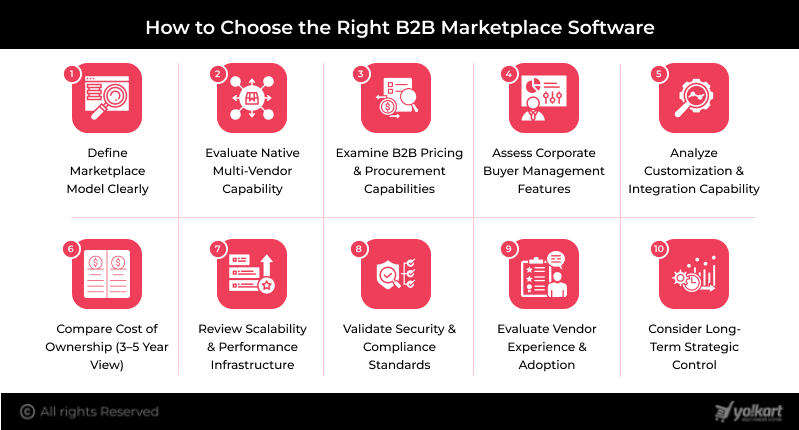
Step 1: Define Your Marketplace Model Clearly
Before evaluating any B2B marketplace software, clarify your marketplace structure.
Ask yourself:
- Is it a pure multi-vendor marketplace or a hybrid (inventory + vendors)?
- Will vendors manage their own pricing?
- Do buyers require negotiation (RFQ)?
- Are transactions bulk-based or contract-based?
- Will you operate nationally or globally?
For example:
A wholesale industrial marketplace with 50 vendors and 10,000+ SKUs requires a very different architecture compared to a niche distributor network.
Your platform must match your business model — not the other way around.
Step 2: Evaluate Native Multi-Vendor Capability
A B2B marketplace platform must be marketplace-first.
Key things to verify:
- Does it include built-in vendor dashboards?
- Can vendors manage their own catalogs?
- Is commission configuration flexible?
- Does it support vendor-specific shipping rules?
- Is order splitting automatic?
If multi-vendor functionality relies on external plugins, scalability and performance may suffer over time.
Step 3: Examine B2B Pricing & Procurement Capabilities
Pricing complexity is the heart of B2B commerce.
Your B2B marketplace software must support:
- Minimum Order Quantity (MOQ)
- Tiered pricing
- Contract pricing
- Buyer-group pricing
- Volume discounts
- Quote-to-order workflow
- Credit terms (Net-30, Net-60)
For example:
If a buyer orders 1,000 units monthly under a contract agreement, the system must apply negotiated pricing automatically.
Without a strong pricing engine, manual intervention increases and efficiency drops.
Step 4: Assess Corporate Buyer Management Features
B2B buyers are companies, not individuals.
Your platform should allow:
- Company-based accounts
- Multiple users under one company
- Role-based permissions
- Approval workflows
- Purchase limits
- Shared order history
- Credit limit tracking
Enterprise procurement often follows this path:
Procurement adds to cart → Finance approves → Admin confirms order.
If your B2B marketplace platform cannot replicate this workflow, large buyers may avoid it.
Step 5: Analyze Customization & Integration Capability
Most B2B businesses rely on:
- ERP systems
- CRM platforms
- Accounting software
- Inventory systems
Ask:
- Does the platform provide API access?
- Can it integrate with ERP systems?
- Is backend customization allowed?
- Can custom modules be developed?
A scalable B2B marketplace software must support integration flexibility. Otherwise, you risk creating disconnected operational silos.
Step 6: Compare Cost of Ownership (3–5 Year View)
Many businesses focus only on initial cost. That’s a mistake.
Instead, calculate:
- Platform subscription fees
- Marketplace app costs
- B2B app costs
- Transaction fees
- Custom development costs
- Hosting expenses
- Upgrade charges
For example:
A SaaS-based platform charging $299/month equals nearly $18,000 over five years — excluding apps and transaction fees.
Licensed B2B marketplace software often has a higher upfront cost but lower long-term ownership expense.
Evaluate total cost — not just entry cost.
Step 7: Review Scalability & Performance Infrastructure
A serious B2B marketplace platform should handle:
- 100+ vendors
- 10,000–100,000+ products
- High-value bulk orders
- International traffic
- Multi-currency transactions
Check:
- Hosting flexibility
- Database performance
- Load handling capacity
- CDN support
- Security infrastructure
B2B buyers expect enterprise-grade performance.
Step 8: Validate Security & Compliance Standards
B2B marketplaces deal with:
- Large financial transactions
- Contract pricing
- Sensitive company data
Ensure the platform offers:
- SSL encryption
- Role-based data access
- Secure payment gateway integration
- Audit trails
- GDPR or relevant compliance support
Security failures damage trust instantly.
Step 9: Evaluate Vendor Experience & Adoption
Your marketplace is only as strong as its vendors.
Ask:
- Is vendor onboarding simple?
- Are dashboards intuitive?
- Can vendors track performance metrics?
- Is commission reporting transparent?
- Can vendors manage bulk uploads easily?
If vendors struggle to operate efficiently, retention drops.
Step 10: Consider Long-Term Strategic Control
Finally, ask the most important question:
Do you own the platform — or are you renting it?
Ownership affects:
- Cost predictability
- Custom development freedom
- Exit flexibility
- Business valuation
- Strategic independence
For founders building long-term B2B marketplace businesses, ownership is often a decisive factor.
Why Yo!Kart B2B Stands Out as a Strong Shopify Alternative
Yo!Kart B2B is designed specifically for launching and scaling multi-vendor B2B marketplaces. It is not an extension but provides a complete ecosystem. It offers out-of-the-box B2B-specific features required to complete transactions effortlessly. Yo!Kart B2B isis marketplace-first software.
From multiple vendor onboarding to separate storefronts, multiple revenue streams to easy commission management and advanced reporting tools to advanced SEO and marketing tools, Yo!Kart B2B is always the best Shopify alternative to get started with.
In addition, Yo!Kart’s scalable architecture that supports growth and expansion, flexibility with customization that allows businesses to tailor the platform according to their specific requirements and customizable source code that provides complete control and ownership is exceptional. These offerings make Yo!Kart always the best B2B multi-vendor marketplace software among a large number of available options.
As purpose-built B2B marketplace software, Yo!Kart offers:
✔ Native multi-vendor architecture
✔ Tiered pricing, volume discounts, and contract pricing
✔ Built-in RFQ and negotiation functionality
✔ Corporate account management with multi-user roles
✔ Custom payment terms (Net-30, Net-60, credit limits)
✔ Full code access and deep customization
✔ No heavy reliance on third-party plugins
✔ A one-time license model for predictable long-term costs
Explore Out-of-the-Box B2B features of Yo!Kart
Conclusion
Building a successful B2B marketplace is one of the most strategic moves a business can make in the digital economy. But unlike simple retail websites, B2B marketplaces require advanced pricing structures, complex workflows, vendor ecosystems, and enterprise-grade capabilities.
While Shopify is a powerful platform for traditional eCommerce and even small wholesale setups, it was not built for the complexities of a multi-vendor B2B marketplace.
On the other hand, Yo!Kart emerges as a superior Shopify alternative for B2B marketplaces. highly scalable, feature-rich, and cost-efficient choice for companies serious about building a professional B2B marketplace platform. By getting started with Yo!Kart B2B, you can experience positive impacts on profitability, vendor adoption, buyer experience, and long-term growth.
Frequently Asked Questions (FAQs)
Q 1. Is Shopify a good platform for B2B marketplaces?
Ans. Shopify can support basic wholesale features, but it is primarily designed for single-vendor retail stores. To build a full B2B marketplace on Shopify, you must rely on multiple apps, which can be costly, limited, and technically complex. For enterprise B2B functionality, a dedicated marketplace solution like Yo!Kart is a better fit.
Q 2. Why is Yo!Kart considered a strong Shopify alternative for B2B marketplaces?
Ans. Yo!Kart is purpose-built multi-vendor marketplace software that includes native support for features critical to B2B commerce, such as tiered pricing, RFQ workflows, vendor dashboards, corporate account management, and advanced checkout processes without depending on external plugins. This makes it a robust Shopify alternative for B2B marketplace builders.
Q 3. What features should I look for in B2B marketplace software?
Ans.
- Several features are there that are essentially required to operate a successful B2B multi-vendor marketplace. However, features highlighted below are crucial:
Custom pricing (tiered, bulk, contract)
- RFQ and negotiation workflows
- Corporate accounts with role-based access
- Advanced order and vendor management
- Flexible payment terms (credit, partial payments)
- API capabilities for ERP/CRM integration
- Scalable infrastructure and performance optimization
Yo!Kart checks all these boxes as an enterprise-grade B2B marketplace platform.
Q 4. Can Yo!Kart support international B2B marketplaces?
Ans. Yes. Yo!Kart offers multi-currency, multi-language support, and flexible regional settings, making it suitable for global B2B marketplaces. Its architecture is designed to handle international tax rules, localized payments, and cross-border vendor management.
Q 5. How does the cost of Yo!Kart compare to Shopify for a B2B marketplace?
Ans. Shopify involves monthly subscription fees, multiple paid apps, and possible transaction fees, which accumulate over time. Yo!Kart follows a one-time license model with full access and no mandatory recurring marketplace charges, generally offering a more predictable and lower long-term total cost of ownership for B2B marketplace businesses.
Q 6. Does Yo!Kart support corporate account management?
Ans. Yes. Yo!Kart allows corporate buyer accounts with multi-user roles, permission levels, purchase approval workflows, and credit limit tracking — features that are critical for professional B2B procurement environments.
Q 7. Can Yo!Kart integrate with ERP and CRM systems?
Ans. Yes. Yo!Kart is designed to integrate with ERP, CRM, inventory, and other enterprise systems via APIs and custom modules, enabling seamless data flow and operational efficiency across business tools.
Looking for the Best Shopify Alternative?
Contact UsPopular Posts