
Back To Home

Best Alternative to a Shopify Multivendor Marketplace: Why Yo!Kart Stands Out
1208
Views
The marketplace model has completely transformed modern eCommerce by shifting businesses away from inventory-heavy operations toward platform-driven ecosystems. Instead of selling products yourself, you enable multiple vendors to sell under one platform, while earning through commissions, subscriptions, or advertising. It’s the same model that powers giants like Amazon, Etsy, Flipkart, and Alibaba, proving its scalability across industries and regions.
Many entrepreneurs begin their journey with Shopify because it is easy to use, quick to launch, and widely trusted. But when the goal shifts to building a true multi-vendor marketplace, Shopify often feels restrictive. Its core architecture is not designed for managing multiple sellers, complex commissions, or vendor-level operations.
As your marketplace vision expands, relying on third-party apps, recurring subscriptions, and technical workarounds can quickly increase costs and slow growth. This is where Yo!Kart stands out. Built specifically for multi-vendor marketplaces, it removes integration complexity and provides a scalable foundation, making it easier to build, manage, and grow a marketplace aligned with long-term business goals.
Table of Contents
- Understanding Shopify’s Multivendor Marketplace Setup
- The Real Challenges of Shopify for Marketplaces
- Introducing Yo!Kart: Built Specifically for Multi-Vendor Marketplaces
- Why Yo!Kart is a Strong Shopify Alternative
- Real-World Marketplace Use Cases for Yo!Kart
- Marketplace Models Yo!Kart Can Support
- Shopify vs Yo!Kart: Detailed Comparison Summary
- Conclusion
- Frequently Asked Questions (FAQs)
Understanding Shopify’s Multivendor Marketplace Setup
Shopify was originally built for single-vendor stores. Its core strength lies in helping merchants quickly set up their online store, manage products, process payments, and customize themes without coding.
However, Shopify does not natively support multi-vendor functionality.
To transform Shopify into a marketplace, businesses must rely on third-party apps that:
- Allow vendors to register
- Assign commission rules
- Manage separate seller dashboards
- Split payments between sellers
While this approach may seem functional initially, it introduces dependencies and limitations that often surface as the marketplace begins to scale.
The Real Challenges of Shopify for Marketplaces
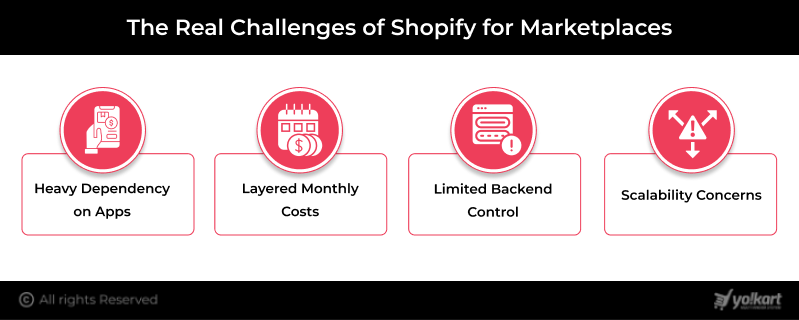
At first, Shopify can appear to be a practical starting point for a marketplace idea. However, as your platform evolves from a concept into a growing ecosystem with multiple vendors, its limitations become more visible. Below are some key challenges that typically surface as your business expands:
1. Heavy Dependency on Apps
To manage vendors, commissions, shipping rules, and payouts, you must rely on multiple third-party apps. If one app stops updating or becomes incompatible, your marketplace operations can be disrupted and create unexpected downtime.
2. Layered Monthly Costs
Running a marketplace on Shopify involves several ongoing expenses, including:
- Marketplace app subscription
- Additional feature apps
- Transaction fees
Over time, these recurring costs add up significantly.
3. Limited Backend Control
Since Shopify is SaaS-based, you don’t get full control over core system logic. Deep customization often requires complex API integrations or advanced development, limiting flexibility for unique business models.
4. Scalability Concerns
As vendor count grows, managing plugin integrations and workflows can become complex. What works for a small marketplace can quickly become inefficient at scale, slowing growth and complicating operations.
For a small experiment, Shopify might work. But for a serious marketplace venture, you need a platform that is built specifically for this model.
Upgrade From Store to Marketplace Platform
Introducing Yo!Kart: Built Specifically for Multi-Vendor Marketplaces
Unlike Shopify, Yo!Kart is not a general store builder adapted for marketplaces. It is a purpose-built multi-vendor marketplace software.
Instead of adding marketplace functionality through third-party apps, Yo!Kart delivers it natively. Vendor management, commission handling, order tracking, and seller dashboards are part of the core architecture. As a result, you are not assembling workarounds; you are launching a true marketplace from day one, designed to scale with your business.
Why Yo!Kart is a Strong Shopify Alternative
When choosing a marketplace platform, surface-level features are not enough. The real evaluation lies in architecture, cost structure, flexibility, and long-term scalability. Here is how Yo!Kart compares with Shopify across the factors that matter most.
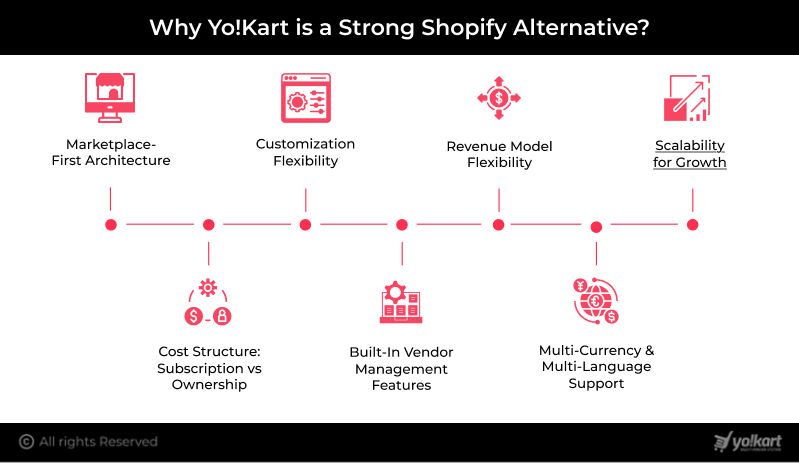
1. Marketplace-First Architecture
- Shopify: Designed for single sellers. Marketplace capability depends on third-party apps layered on top of its core system.
- Yo!Kart: Engineered exclusively for multi-vendor platforms. Vendors can create and manage their own storefronts, admins can configure flexible commission rules, orders are automatically split between sellers, and approval workflows are built in. Each vendor also gets performance analytics to track growth.
There is no patchwork setup. The structure naturally supports the marketplace model from day one.
2. Cost Structure: Subscription vs Ownership
One of the biggest differences between Shopify and Yo!Kart lies in the pricing.
- With Shopify, you pay a monthly subscription, plus additional marketplace app fees, feature add-ons, and potentially transaction charges. Over 3 to 5 years, these recurring costs can compound significantly.
- Yo!Kart, on the other hand, follows a one-time license model. You gain lifetime ownership without mandatory recurring marketplace plugin costs. For growing marketplaces, this structure often results in a lower total cost of ownership and better long-term predictability.
3. Customization Flexibility
If you are building a niche marketplace such as luxury fashion, electronics, digital products, rental services, or B2B wholesale, customization becomes critical.
- Shopify allows theme-level customization easily, but deeper marketplace logic changes are often limited by APIs and app capabilities.
- Yo!Kart provides greater control over platform logic, workflows, and commission structures. As your business evolves, the system can evolve with it. For founders planning long-term growth, flexibility is not optional – it is strategic.
4. Built-In Vendor Management Features
A successful marketplace must empower both the admin and the sellers.
Yo!Kart includes individual seller dashboards, commission tracking, tax configuration, order management, inventory control, review systems, and performance analytics as part of the core system.
In Shopify, achieving similar functionality typically requires combining multiple third-party tools. Fewer dependencies mean smoother operations and fewer technical bottlenecks.
5. Revenue Model Flexibility
A marketplace should not rely on just commissions.
Yo!Kart supports multiple monetization methods, including:
- Commission on each sale
- Subscription-based seller plans
- Featured product listings
- Advertising banners
- Pay-per-click promotions
This flexibility helps diversify income streams and reduce reliance on a single revenue model.
6. Multi-Currency and Multi-Language Support
For international expansion, your platform must support:
- Multiple currencies
- Localized content
- Regional payment gateways
Yo!Kart is structured to support cross-border marketplaces more efficiently.
While Shopify enables international selling, marketplace-level localization often requires additional plugins and configurations.
7. Scalability for Growth
Marketplace growth is rarely linear. You may scale from 10 vendors to 100, then to 1000, and beyond.
At scale, you need stable architecture, efficient order processing, vendor-level reporting, and performance tracking. Yo!Kart is designed specifically to power large marketplace ecosystems, not just individual online stores.
Create a Marketplace Built to Grow Beyond 1000 Vendors
When Should You Choose Shopify Instead?
Shopify is not a bad choice for everyone.
Choose Shopify if:
- You are launching a simple online store.
- You are testing a small marketplace idea.
- You want an extremely fast setup with minimal technical involvement.
- You prefer SaaS simplicity over ownership control.
However, if your goal is to build a structured, scalable multi-vendor platform, Shopify may feel restrictive over time.
Real-World Marketplace Use Cases for Yo!Kart
One of the biggest advantages of Yo!Kart is its flexibility across industries. Because it is built specifically for multi-vendor ecosystems, it supports a wide variety of marketplace business models, not just standard product selling. Whether you are targeting a niche audience, enabling wholesale trade, or building a large multi-category platform, the architecture adapts to different business models with ease.
Here are real-world marketplace scenarios where Yo!Kart performs exceptionally well:
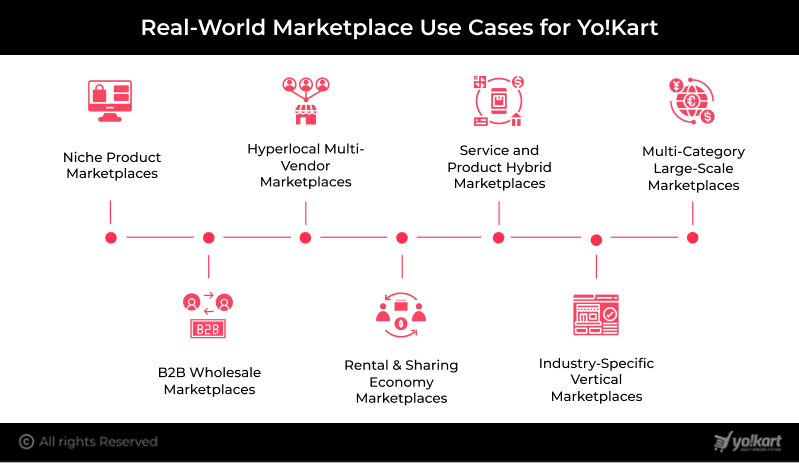
1. Niche Product Marketplaces
Niche marketplaces often outperform broad platforms because they focus on a specific audience segment instead of competing with large horizontal platforms.
Examples:
- Sustainable fashion marketplace
- Handmade crafts platform
- Organic food marketplace
- Luxury watch marketplace
- Pet products marketplace
Why Yo!Kart Works Here:
- Vendor-level store creation
- Category-based commission structures
- Featured product placements for monetization
- Advanced filtering and search functionality
- Review & rating system to build trust
For example, a handmade crafts marketplace could onboard 200 artisans, charge 10-15% commission per sale, and offer featured listing placements for additional revenue.
2. B2B Wholesale Marketplaces
B2B marketplaces operate differently from B2C platforms. They often offer bulk ordering, tiered pricing, negotiation flexibility, tax handling, and minimum order quantities.
Yo!Kart is suitable for:
- Industrial equipment marketplaces
- Raw materials trading platforms
- Wholesale apparel marketplaces
- Manufacturing supplier networks
Key Capabilities Include:
- Vendor-specific pricing controls
- Order management tools
- Multi-tier commission settings
- Customizable workflows
For example, a wholesale textile marketplace can allow suppliers to set minimum order quantities of 500 units while the platform earns a 5% commission on high-value bulk transactions.
3. Hyperlocal Multi-Vendor Marketplaces
Hyperlocal marketplaces connect local vendors within a specific city or region.
Examples include:
- Grocery delivery marketplace
- Local electronics sellers
- Pharmacy aggregators
- Restaurant + food delivery hybrid marketplaces
Why Yo!Kart Is Effective:
- Vendor location management
- Commission-based earnings
- Separate vendor order handling
- Delivery management integrations
For instance, a city-based grocery marketplace could onboard 50 local stores, allowing each vendor to manage inventory independently while the platform earns commission per order.
4. Rental & Sharing Economy Marketplaces
Rental marketplaces are growing rapidly across industries, from consumer goods to heavy machinery.
Examples:
- Car rental marketplace
- Camera equipment rental platform
- Furniture rental marketplace
- Heavy machinery rental marketplace
What Makes Yo!Kart Suitable:
- Customizable order workflows
- Vendor-level inventory control
- Commission flexibility
- Payment gateway integration
A rental marketplace allows vendors to list products, while the admin earns commission on each rental booking.
5. Service and Product Hybrid Marketplaces
Some marketplaces combine service offerings with physical or digital products.
Examples:
- Fitness trainers selling programs & equipment
- Beauty professionals selling products
- Home improvement vendors offering services & tools
- Educational platforms selling courses and materials
Why Yo!Kart Works:
- Flexible listing structures
- Vendor storefront customization
- Multiple revenue models (commission and subscription)
For example, a fitness marketplace could allow trainers to sell digital workout programs and physical fitness accessories on the same platform.
6. Industry-Specific Vertical Marketplaces
Vertical marketplaces focus on one specialized industry where trust, verification, and structured catalogs are critical.
Examples:
- Automotive parts marketplace
- Medical equipment marketplace
- Agriculture supply platform
- Electronics component marketplace
Why Vertical Platforms Prefer Yo!Kart:
- Advanced product catalog management
- Category-level control
- Vendor verification workflows
- Custom commission rules
In industries where trust and verification are critical, having built-in moderation and approval systems is essential.
7. Multi-Category Large-Scale Marketplaces
For entrepreneurs aiming to build the next Amazon-like ecosystem, Yo!Kart provides a scalable foundation.
Suitable For:
- Multi-category consumer marketplaces
- Regional eCommerce platforms
- Emerging market digital marketplaces
Key Benefits:
- Vendor dashboards
- Order splitting automation
- Commission tracking
- Revenue diversification tools
- Scalability architecture
As vendor count grows from 50 to 500 to 2000+, platform stability and operational efficiency become crucial, and this is where marketplace-first architecture truly proves its value.
Explore Real-World Yo!Kart Marketplace Use Cases
Marketplace Models Yo!Kart Can Support
Every marketplace vision is different. Some founders begin with a focused niche, while others aim for large-scale, multi-category ecosystems. The strength of Yo!Kart lies in its ability to support multiple marketplace models without forcing structural changes as your business evolves.
| Marketplace Type | Revenue Model | Vendor Control | Scalability |
| Niche B2C | Commission + Featured Listings | High | Medium to High |
| B2B Wholesale | Commission + Subscription | Moderate | High |
| Hyperlocal | Commission | High | Medium |
| Rental | Commission per Booking | Moderate | High |
| Hybrid (Service + Product) | Mixed Revenue | Flexible | High |
| Multi-Category | Commission + Ads + Subscription | Structured | Very High |
This flexibility allows entrepreneurs to choose a model that aligns with their immediate goals while keeping room for expansion.
Why This Flexibility Matters
Many entrepreneurs start with one niche but expand later.
Example Growth Path:
- Year 1 → Niche electronics marketplace
- Year 2 → Add accessories vendors
- Year 3 → Expand to home appliances
- Year 4 → Launch multi-category platform
A rigid system can slow this expansion. In contrast, a marketplace-first system supports both horizontal scaling, adding new categories, and vertical scaling, increasing vendors and revenue streams. Yo!Kart’s architecture allows businesses to expand strategically without rebuilding their infrastructure at every stage of growth.
Power Your Marketplace Expansion With Yo!Kart
Shopify vs Yo!Kart: Detailed Comparison Summary
Choosing the right marketplace platform is not just about feature comparing. It is about a strategic decision that affects long-term sustainability, operational control, and scalability. Below is a more in-depth comparison to help you evaluate both platforms strategically.
1. Core Marketplace Capability Comparison
| Criteria | Shopify (With Marketplace Apps) | Yo!Kart |
| Native Multi-Vendor Architecture | No (Requires Apps) | Yes (Built-In) |
| Vendor Storefront Creation | App-Based | Native |
| Commission Management | Via App | Built-In & Flexible |
| Order Splitting Between Vendors | App-Dependent | Automatic |
| Vendor Subscription Plans | Via Plugin | Supported |
| Product Moderation Controls | Limited | Built-In |
| Vendor Performance Analytics | App-Based | Integrated |
Shopify extends marketplace functionality through external tools. Yo!Kart delivers it as part of its core system, reducing dependency and operational friction.
2. Cost & Ownership Comparison
| Factor | Shopify | Yo!Kart |
| Pricing Model | Monthly Subscription | One-Time License |
| Marketplace App Cost | Recurring | Included |
| Long-Term Cost Growth | Increases Over Time | Predictable |
| Platform Ownership | SaaS (No Full Ownership) | Full Ownership |
| Customizable Source Code Access | No | Yes |
For short-term testing, Shopify may feel affordable. However, for long-term marketplace operations such as 3-5+ years, recurring subscriptions and app fees can accumulate significantly. Yo!Kart’s one-time licensing model offers stronger long-term cost predictability.
3. Customization & Flexibility Comparison
| Aspect | Shopify | Yo!Kart |
| Core Logic Customization | Limited | Extensive |
| Custom Commission Structures | App-Dependent | Flexible |
| Workflow Modifications | Restricted | Adaptable |
| Third-Party Dependency | High | Low |
| Control Over Platform Roadmap | Limited | High |
If your marketplace needs custom onboarding rules, vendor tiers, region-based commission, or unique checkout flows, flexibility becomes critical. This is where Yo!Kart provides a structural advantage.
4. Scalability & Growth Readiness
| Growth Stage | Shopify | Yo!Kart |
| Early Stage (10-50 Vendors) | Manageable | Smooth |
| Growth Stage (100+ Vendors) | App Management Becomes Complex | Stable |
| Large Scale (500+ Vendors) | Heavy App Dependency | Designed for Scale |
| Multi-Currency & Global Expansion | Possible with Setup | Built-In Support |
As vendor count increases, operational complexity multiplies. Platforms built natively for marketplaces handle this transition more efficiently and with fewer integration risks.
Strategic Summary: Which One Should You Choose?
Choose Shopify if:
- You are launching a simple store with limited vendor collaboration.
- You want a quick setup with minimal technical involvement.
- You are testing a small-scale marketplace idea.
Choose Yo!Kart if:
- You are building a dedicated multi-vendor marketplace.
- You want full control and ownership.
- You plan long-term scalability.
- You want predictable costs.
- You expect your vendor base to grow significantly.
If your marketplace vision extends beyond experimentation and into long-term ecosystem building, a marketplace-first platform provides a stronger foundation.
Experience Yo!Kart Before You Decide
Conclusion
Building a multi-vendor marketplace goes far beyond launching a website. It is about creating an ecosystem where vendors thrive, customers trust the platform, and your revenue scales without friction. The right platform becomes the foundation for trust, operational efficiency, and long-term marketplace sustainability.
Shopify is undeniably a strong eCommerce solution for single-vendor stores and small-scale setups. However, when it comes to building a structured, scalable, and feature-rich multi-vendor marketplace, it relies heavily on third-party apps and recurring subscriptions to deliver functionality that is not native to its architecture.
That’s where Yo!Kart stands apart. Built as a marketplace-first platform, it delivers native vendor management, commission control, order splitting, performance analytics, and revenue diversification tools without stacking multiple plugins. Additionally, its one-time license model provides long-term cost predictability, while full ownership ensures flexibility and control as your marketplace grows.
Frequently Asked Questions (FAQs)
Q 1. Can Shopify be used to create a multi-vendor marketplace?
Ans. Yes, Shopify can be used to create a multi-vendor marketplace, but it requires third-party marketplace apps. Shopify does not offer native multi-vendor functionality. You must rely on third-party apps to handle vendor registration, commission management, and order splitting, which increases costs and operational complexity as your marketplace grows.
Q 2. Why is Yo!Kart considered a better alternative to Shopify for marketplaces?
Ans. Yo!Kart is built specifically for multi-vendor marketplaces. Unlike Shopify, it includes built-in vendor management, commission control, order distribution, and seller dashboards, which reduces dependency on external plugins. Additionally, it offers a one-time licensing model instead of recurring subscription costs, making it a cost-effective solution.
Q 3. Is Yo!Kart suitable for large-scale marketplaces?
Ans. Yes, Yo!Kart is designed to support scalable marketplace operations. It can handle hundreds or thousands of vendors, multiple product categories, and high transaction volumes. Its marketplace-first architecture ensures stability, performance tracking, and scalability as your platform grows.
Q 4. What is the difference between Shopify apps and Yo!Kart’s built-in features?
Ans. Shopify relies on third-party apps to add marketplace functionality. These apps often come with monthly fees and compatibility limitations. Yo!Kart, on the other hand, includes marketplace features as part of its core system, reducing operational complexity and recurring expenses.
Q 5. Does Yo!Kart support multiple revenue models?
Ans. Yes, Yo!Kart supports various revenue streams, including:
- Commission per sale
- Vendor subscription plans
- Featured product listings
- Advertising banners
- Promotional placements
This allows marketplace owners to diversify income beyond just commissions.
Q 6. Is Yo!Kart a one-time investment or subscription-based?
Ans. Yo!Kart follows a one-time license model. Unlike Shopify, which operates on monthly subscriptions, Yo!Kart allows you to purchase the software license and own the platform, making long-term costs more predictable.
Q 7. Can I customize Yo!Kart, according to my marketplace niche?
Ans. Yes, Yo!Kart offers high customization flexibility. Since it is designed specifically for marketplaces, it allows you to modify workflows, commission structures, vendor onboarding processes, and other platform elements based on your niche requirements.
Q 8. Which platform is better for a startup marketplace: Shopify or Yo!Kart?
Ans. Platform suitability depends on your business goals.
- If you are testing a small idea with minimal vendors, Shopify may work.
- However, if you are planning to build a serious, scalable multi-vendor marketplace, Yo!Kart is generally a stronger long-term solution.
Q 9. Does Yo!Kart support international marketplaces?
Ans. Yes, Yo!Kart supports international marketplaces. It is equipped with features like multi-currency and multilingual capabilities, making it suitable for global marketplace expansion.
Q 10. What type of marketplaces can be built with Yo!Kart?
Ans. Yo!Kart can be used to build:
- Niche product marketplaces
- B2B wholesale platforms
- Hyperlocal marketplaces
- Rental marketplaces
- Multi-category eCommerce marketplaces
- Industry-specific vertical marketplaces
Its architecture is flexible enough to support different business models.
Move Beyond Shopify Apps and Build Smarter
Reach OutPopular Posts