

Published Date: 25th September, 2026
Australia has a mature and highly developed eCommerce market, with consumers increasingly turning to online retailers and marketplaces for everyday purchases. At the same time, the country’s large geographic footprint presents unique operational challenges for marketplace businesses.
Shipping between major metropolitan areas, regional communities, and remote locations can involve significant differences in delivery costs and timeframes. For marketplace operators, this makes logistics, shipping configuration, payment flexibility, GST handling, and vendor management important considerations when selecting the underlying technology.
The opportunities also extend beyond large general marketplaces. Niche categories such as fashion, home and garden, consumer electronics, food and grocery, beauty, sports, hobbies, pet products, and specialized B2B or service marketplaces can all provide opportunities for businesses that understand a particular customer segment.
This guide compares leading multi-vendor eCommerce platforms for businesses targeting Australia and explains the key factors to evaluate before making a decision.
Table of Contents
- Australia eCommerce & Marketplace Industry: Key Statistics
- Which Australian eCommerce Categories Offer Opportunities?
- What to Look For in a Multi-Vendor eCommerce Platform
- The Top Multi-Vendor eCommerce Platforms in Australia
- Considerations Specific to the Australian Market
- How to Choose the Right Platform for Your Australian Marketplace
- Why Choose Yo!Kart for an Australian Multi-Vendor Marketplace?
- Conclusion
- FAQs
Australia eCommerce & Marketplace Industry: Key Statistics
Australia’s eCommerce market continued to grow through FY26, although consumer behaviour became increasingly value-conscious. The latest Australia Post Quarterly eCommerce Update for FY26 Q4 reports that Australians spent $21.9 billion online during the quarter, while the average online basket declined to a record-low $90 as shoppers became more selective about their purchases.
Online marketplaces continued to strengthen their position as a major sales channel. In FY26 Q4, 42% of online transactions occurred through marketplaces, with marketplace transactions growing 17% year over year. This highlights the growing role of multi-vendor platforms in Australia’s digital commerce ecosystem.
Consumer expectations are also shaping the market. Australia Post reports that 59% of shoppers say they never buy at full price, demonstrating the importance of competitive pricing and promotions. Delivery flexibility remains another important consideration, with 69% of shoppers wanting a range of delivery options at checkout.
Key Australian eCommerce statistics
| Metric | Latest figure |
| Online spend in FY26 Q4 | $21.9B |
| Shoppers who never buy at full price | 59% |
| Online marketplace spending | 42% |
| Marketplace spending growth | +17% YoY |
| Shoppers wanting multiple delivery options | 69% |
| Average online basket | $90 |
The latest figures indicate that Australia’s eCommerce market is moving toward higher purchase frequency, smaller baskets, and stronger value sensitivity. For marketplace operators, this makes competitive pricing, product assortment, promotions, and flexible delivery options increasingly important to the customer experience.
Which Australian eCommerce Categories Offer Opportunities?
Marketplace opportunities are not limited to general merchandise. Australia Post’s 2026 data highlights several other major online categories, including:
- Consumer electronics
- Food and grocery
- Fashion and apparel
- Home and garden
- Hobbies and recreational goods
- Health and beauty
- Books, stationery and multimedia
- Pet products
- Footwear
- Sports and athleisure
Some categories are particularly notable for their online opportunity. Home and garden generated $9.9 billion in online spending, while pet products reached $1.4 billion. Footwear generated approximately $1 billion in online spending. Furthermore, food and grocery also showed area online penetration potential, with only 9.6% of spending in the category occurring online.
This creates potential for specialized marketplaces serving:
- Fashion and apparel
- Electronics and appliances
- Home and garden
- Sports and outdoor products
- Beauty and wellness
- Food and grocery
- Pet products
- Handmade and artisan products
- Second-hand and resale
- Automotive products
- B2B wholesale
- Trade and professional services
- Rental marketplaces
- Regional and local products
The opportunity for a new marketplace does not necessarily depend on competing directly with Amazon or eBay. A more focused proposition, such as a marketplace for Australian outdoor equipment, local producers, trade services, specialist B2B supplies, or second-hand products, can provide a clearer differentiation strategy.
Launch Your Multi-Vendor Marketplace to Turn Category Demand Into Business Growth
What to Look For in a Multi-Vendor eCommerce Platform
A marketplace platform needs to manage considerably more complexity than a standard online store. Therefore, before selecting a platform, evaluate the following areas:
1. Hosting Model
SaaS platforms handle hosting, infrastructure, and much of the technical maintenance in exchange for recurring fees. They can be attractive for businesses that prioritize speed and simplicity.
Self-hosted platforms, on the other hand, are licensed platforms that provide greater control over the hosting environment, integrations, deployment, and customization.
For an Australian marketplace, this distinction can become important as order volume grows and the business needs more control over its technology costs and infrastructure.
2. GST Handling
Australia generally applies a 10% Goods and Services Tax (GST) to most taxable goods and services.
Thus, marketplace operators also need to consider the GST rules applicable to imported goods and marketplace transactions. The platform should therefore provide appropriate tax configuration and allow integration with accounting or tax systems where required.
Businesses should obtain professional tax advice for their specific marketplace model rather than assuming that a platform’s default tax settings provide complete GST compliance.
3. Payment Gateway Support
Australian shoppers are accustomed to a range of online payment options. Depending on the marketplace’s target audience, businesses may want to evaluate support for:
- Stripe
- PayPal
- Card payments
- Afterpay
- Zip
- BPAY or other locally relevant payment methods
- Marketplace split payments
- Seller payouts
- Refunds and partial refunds
The ability to handle payments between customers, the marketplace operator, and multiple sellers is particularly important.
4. Shipping and Logistics
This is one of the most important considerations for an Australian marketplace. A customer in Sydney may have very different delivery costs and expected delivery times from a customer in Perth, Darwin, Tasmania, or a remote regional location.
A marketplace platform should ideally support:
- Shipping zones
- Vendor-specific shipping rates
- Weight-based shipping
- Product-based shipping
- Distance-based rules
- Multiple carriers
- Free-shipping thresholds
- Pickup options
- Delivery estimates
- Seller-specific fulfillment rules
For marketplace operators, shipping flexibility can therefore have a direct impact on the customer experience.
5. Customization Depth
A marketplace may start with relatively simple requirements but become more complex as vendors and customers increase.
You may eventually need:
- Vendor-specific workflows
- Advanced commissions
- Booking functionality
- Subscription models
- Auction functionality
- Regional delivery rules
- B2B purchasing
- RFQs
- Memberships
- Loyalty programs
- Industry-specific catalog structures
A platform with deeper customization capabilities can make these changes easier without requiring a complete migration.
6. Vendor Management
Multi-vendor software should provide functionality for managing sellers throughout their lifecycle.
Important capabilities include:
- Vendor registration
- Vendor approval
- Seller dashboards
- Product management
- Inventory management
- Vendor commissions
- Seller payouts
- Order management
- Vendor-specific shipping
- Seller reviews
- Vendor analytics
- Seller communication
7. Total Cost of Ownership
The cheapest platform to launch with is not necessarily the cheapest platform to operate over several years.
Consider:
- Platform subscription
- Transaction fees
- Payment gateway fees
- Hosting
- Development
- Maintenance
- Plugins or extensions
- Security
- Third-party integrations
- Migration costs
For a marketplace processing substantial GMV, even a small percentage-based platform fee can become significant over time.
The Top Multi-Vendor eCommerce Platforms in Australia
Choosing the right technology is an important step when launching a multi-vendor marketplace in Australia. The platform needs to support essential marketplace operations while also accommodating local requirements such as GST, payment methods, shipping, vendor management, and scalability.
The following platforms offer different approaches to building and managing an Australian marketplace:
1. Yo!Kart
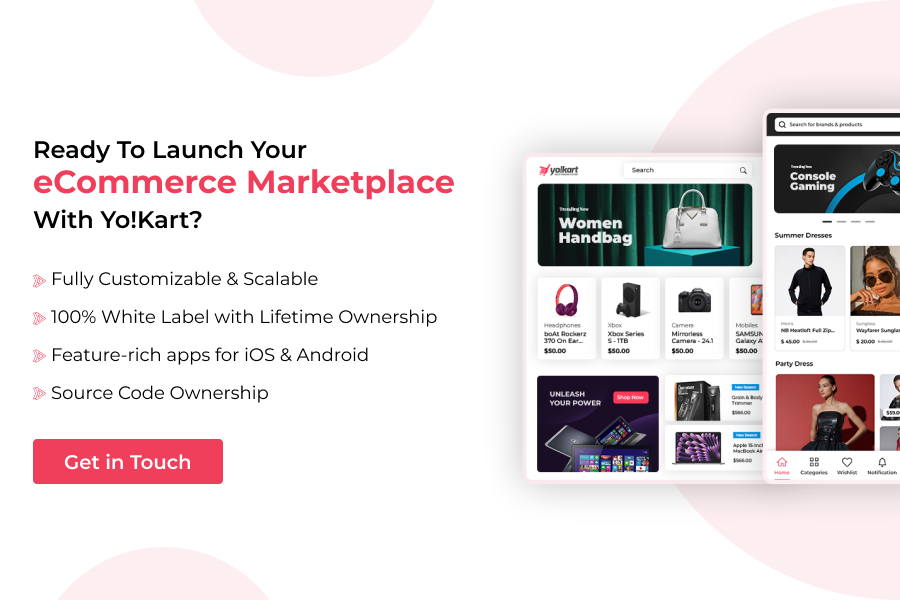
Yo!Kart is a self-hosted, licensed multi-vendor marketplace platform designed for businesses that want greater control over their marketplace technology. Unlike conventional SaaS marketplace builders, it allows businesses to deploy the software on their own hosting infrastructure rather than relying exclusively on a recurring marketplace subscription.
For Australian businesses, this can provide greater flexibility around infrastructure, integrations, marketplace workflows, and long-term technology costs. Yo!Kart supports multiple vendors, configurable commissions, multiple currencies, multiple languages, and integrations with payment gateways such as Stripe and PayPal. Its customizable source code can also be adapted to business-specific requirements, including specialized shipping, catalog, vendor, or checkout workflows.
Key Highlights:
- Self-hosted and licensed marketplace solution
- Multi-vendor and multi-category marketplace support
- Customizable source code
- Configurable vendor commissions
- Multi-currency and multilingual capabilities
- Payment gateway integrations, including Stripe and PayPal
- Flexible catalog, shipping, checkout, and vendor workflows
- Suitable for different marketplace business models and industries
- Global clientele across diverse markets
Global Clientele: Yo!Kart has been used by clients across multiple countries and industries, supporting businesses looking to launch and scale various types of multi-vendor marketplaces.
Best suited for: Businesses with a validated marketplace model that want a self-hosted, customizable solution and greater long-term control.
Potential trade-off: Compared with a SaaS marketplace builder, the business takes on greater responsibility for hosting, deployment, and technical management.
Explore the Cutting-Edge Capabilities of Yo!Kart
2. Sharetribe
Sharetribe is a SaaS marketplace platform designed to help businesses launch marketplace concepts relatively quickly. Its major advantage is speed-to-market. Businesses can test an idea without building the entire marketplace infrastructure from scratch.
The platform supports different marketplace models and provides tools for marketplace listings, transactions, user management, and administration. However, businesses with highly customized logistics, vendor workflows, or complex integrations should evaluate its customization capabilities against their specific requirements.
Key Highlights:
- SaaS-based marketplace platform
- Faster marketplace launch
- Support for different marketplace models
- Built-in marketplace management capabilities
- Suitable for validating new marketplace concepts
- Managed infrastructure reduces technical overhead
Best suited for: Startups and founders validating a new marketplace concept.
Potential trade-off: Businesses requiring extensive customization or complex marketplace workflows may need to assess whether the platform can accommodate their long-term requirements.
3. Spree Commerce
Spree Commerce is an open-source, self-hosted eCommerce platform that supports multi-vendor marketplaces, B2B commerce, and cross-border operations. Its marketplace capabilities include vendor onboarding, commission management, vendor payouts, multi-vendor checkout, and vendor-specific shipping.
Its open-source architecture and REST API provide considerable flexibility for businesses that want to customize the commerce stack or connect it with existing systems. Spree also offers a production-ready Next.js storefront and supports multi-region commerce through country-specific currencies, languages, and payment methods.
Key Highlights:
- Open-source and self-hosted architecture
- Built-in multi-vendor marketplace capabilities
- Vendor onboarding and commission management
- Stripe Connect payouts
- Multi-vendor cart and checkout
- REST API and headless commerce capabilities
- Multi-language and multi-currency support
- Shopify and WooCommerce vendor synchronization
Best suited for: Businesses with development resources looking for an open-source, customizable marketplace platform.
Potential trade-off: Self-hosted and open-source deployments require technical resources for implementation, hosting, customization, and ongoing management.
4. CS-Cart Multi-Vendor
CS-Cart Multi-Vendor is a dedicated marketplace solution available in self-hosted and cloud configurations. It includes established functionality for vendor management, product catalogs, commissions, orders, and marketplace administration.
Its deployment flexibility can appeal to businesses that want more control than a purely SaaS-based solution provides. Its support for Australia Post and other major carriers can be particularly relevant for businesses serving the Australian market.
Key Highlights:
- Dedicated multi-vendor marketplace platform
- Vendor dashboards and management tools
- Configurable commissions and payouts
- Multi-language and multi-currency support
- Product and vendor moderation
- Shipping and fulfillment configuration
- Australia Post integration
- Self-hosted deployment and customization options
Best suited for: Small and mid-sized marketplaces requiring established multi-vendor functionality.
Potential trade-off: Businesses may still require technical resources for customization, integrations, hosting, and ongoing marketplace management.
Suggested Read: Yo!Kart vs CS-Cart – Tale of Good vs Bad Client Experience
5. Virto Commerce
Virto Commerce is a composable digital commerce platform with marketplace capabilities designed for B2B, B2C, and hybrid marketplace models. It supports vendor onboarding, separate catalogs and pricing, order routing, payment splitting, custom workflows, and multi-vendor order management.
Its API-first and modular architecture makes it particularly relevant for businesses with complex commerce requirements or existing enterprise systems. The platform also supports contract pricing, approval workflows, localized catalogs, and multi-region marketplace operations.
Key Highlights:
- B2B, B2C, and hybrid marketplace support
- Vendor onboarding and approval workflows
- Separate catalogs and pricing
- Multi-vendor order and payment splitting
- Contract and account-specific pricing
- API-first and modular architecture
- Multi-region and multi-storefront capabilities
- ERP, CRM, PIM, and third-party integration support
Best suited for: Enterprises and established businesses building complex B2B, B2C, or hybrid marketplaces.
Potential trade-off: Its enterprise-oriented architecture and customization capabilities can involve greater implementation complexity than simpler marketplace platforms.
6. Mirakl/Marketplacer
Mirakl and Marketplacer are positioned toward larger organizations looking to build or expand enterprise marketplace operations. Marketplacer is particularly relevant to Australia because it was founded in Melbourne and has been used by businesses building marketplace models across different sectors.
Marketplacer is particularly relevant to the Australian market because it originated in Melbourne and has focused on marketplace models across different industries.
Key Highlights:
- Enterprise marketplace capabilities
- Support for complex vendor ecosystems
- Vendor and catalog management
- Integration-focused architecture
- Support for different marketplace business models
- Suitable for large-scale marketplace operations
- Marketplacer has Australian origins
Best suited for: Enterprise retailers, large organizations, and established businesses expanding into marketplace commerce.
Potential trade-off: Enterprise marketplace platforms can involve higher implementation complexity, investment, and resource requirements than solutions designed for smaller businesses.
7. WooCommerce+Dokan or WC Vendors
WooCommerce combined with a marketplace extension such as Dokan or WC Vendors can provide a relatively accessible way to build a multi-vendor marketplace. Its major advantage is the WordPress ecosystem and broad availability of extensions.
The combination provides access to the broader WordPress and WooCommerce extension ecosystem. However, the marketplace operator remains responsible for hosting, security, updates, plugin compatibility, performance, and technical maintenance.
Key Highlights:
- Built on the WooCommerce ecosystem
- Multiple marketplace plugin options
- Vendor registration and dashboards
- Vendor product and order management
- Large WordPress plugin ecosystem
- Flexible storefront customization
- Suitable for smaller marketplace implementations
Best suited for: Smaller marketplaces and technically capable businesses looking for a flexible, lower-cost entry point.
Potential trade-off: Using multiple plugins can increase dependency on third-party extensions and make compatibility, security, performance, and maintenance more important considerations.
8. Nautical Commerce
Nautical Commerce was a multi-vendor commerce platform designed to help businesses build and manage marketplace operations without developing the marketplace infrastructure entirely from scratch. Its positioning focused on supporting marketplace operators with vendor management, catalog and order workflows, and marketplace-specific commerce functionality.
However, Nautical Commerce’s assets have since been acquired by Traide, which now positions its multi-vendor commerce technology around marketplace transaction orchestration. Therefore, businesses evaluating this option in 2026 should verify the current product, support, and roadmap before including it in a technology shortlist.
Key Highlights:
- Multi-vendor marketplace technology
- Marketplace transaction orchestration
- Vendor and marketplace operations
- Designed for multi-vendor commerce workflows
- Current technology and assets associated with Traide
Best suited for: Businesses researching marketplace technology associated with Nautical Commerce or evaluating the current Traide multi-vendor commerce offering.
Potential trade-off: Nautical Commerce is no longer operating as an independent platform following the acquisition, so businesses should evaluate Traide’s current offering rather than treating Nautical as a standalone 2026 platform.
Comparison at a Glance
| Platform | Hosting Model | Pricing Approach | Customization | Best For |
|---|---|---|---|---|
| Yo!Kart | Self-hosted, licensed | One-time license | High | Businesses seeking customization and long-term control |
| Sharetribe | SaaS | Subscription | Moderate to high | Fast marketplace validation |
| Spree Commerce | Open-source, self-hosted | Open-source; development and infrastructure costs | Moderate to high | Businesses seeking an open-source and customizable marketplace |
| CS-Cart Multi-Vendor | Self-hosted/cloud | License/subscription | High | Small and mid-sized marketplaces |
| Virto Commerce | Self-hosted/cloud | Custom/enterprise pricing | Very high | Enterprises and complex B2B, B2C, and hybrid marketplaces |
| Mirakl/Marketplacer | SaaS/enterprise | Custom enterprise pricing | High | Large Australian and international retailers |
| WooCommerce+Dokan/WC Vendors | Self-hosted | Platform+plugin costs | Moderate to high | Budget-conscious, hands-on businesses |
| Nautical Commerce | SaaS/managed | Custom pricing | High | Marketplace businesses evaluating Nautical’s technology and its current successor offering |
Looking for a Reliable Technology For Your Marketplace?
Considerations Specific to the Australian Market
Choosing a marketplace platform for Australia involves more than comparing features and pricing. Local tax requirements, geographic challenges, payment preferences, delivery expectations, and data governance can all influence how the marketplace operates.
Evaluating these factors early can help businesses select technology that better aligns with their target market and operational requirements:
1. GST on Imported Goods
Businesses selling imported goods to Australian consumers need to understand the GST rules applicable to low-value imported products and marketplace transactions. Collection and reporting responsibilities can vary based on the structure of the transaction and the role played by the marketplace.
Your technology should therefore support appropriate tax configuration and integration with the financial systems used by the business.
2. Shipping Across a Large Geographic Market
Australia’s geography makes delivery one of the defining operational challenges for eCommerce businesses. A platform should allow vendors to define shipping rules that reflect their actual fulfillment costs rather than forcing the entire marketplace into a single nationwide shipping rate.
This is particularly important when vendors are located in different states or territories and fulfill orders independently.
3. Buy Now, Pay Later
Buy-now-pay-later services such as Afterpay and Zip are part of Australia’s established digital payments landscape. However, BNPL should be evaluated as part of the overall payment strategy rather than treated as a mandatory feature for every marketplace.
The important consideration is whether your selected payment architecture can integrate the payment methods that your target customers actually prefer.
4. Delivery Expectations
Convenience is increasingly part of the value proposition of online commerce. Australia Post reports that 69% of shoppers want multiple delivery choices, while 26% expect same-day or next-day delivery for urgent purchases.
For a marketplace, this means delivery information should be clearly communicated before checkout and should account for the seller’s location, customer location, product availability, and selected delivery method.
5. Data Hosting and Security
Some Australian organizations may prefer Australian-hosted infrastructure depending on their internal policies, customer requirements, industry obligations, or data governance approach. Self-hosted software can provide more flexibility because the business can select its hosting environment.
However, hosting location alone does not guarantee regulatory compliance. Security controls, access management, data processing, backups, and the overall technology architecture also matter.
How to Choose the Right Platform for Your Australian Marketplace
The right platform depends on your marketplace’s business model, current stage, technical capabilities, and long-term requirements.
Consider the following options based on your priorities:
Choose a SaaS platform if:
- You want to validate the marketplace quickly.
- Your initial requirements are relatively straightforward.
- You have limited technical resources.
- You prefer managed infrastructure.
- You are comfortable with recurring platform costs.
Consider self-hosted marketplace software if:
- You need greater control over infrastructure.
- You require significant customization.
- You want to build specialized shipping or vendor workflows.
- You need extensive third-party integrations.
- Long-term technology control is important.
Consider an enterprise platform if:
- You already operate at significant scale.
- You have complex catalog and vendor requirements.
- You require enterprise integrations.
- You have dedicated technical and operational teams.
- Your marketplace will support a large number of vendors.
The most important step is to map your actual business model before comparing platforms. A marketplace for physical products will have very different technology requirements from a marketplace for services, rentals, bookings, or B2B procurement.
Why Choose Yo!Kart for an Australian Multi-Vendor Marketplace?
Yo!Kart can be a strong option for Australian businesses that have moved beyond the idea-validation stage and want a marketplace platform that can be customized around their business model.
1. Self-Hosted Architecture
Yo!Kart can be deployed on infrastructure selected by the business rather than requiring the marketplace to operate entirely within a SaaS provider’s hosting environment.
This can provide greater control over deployment, infrastructure configuration, integrations, backups, and data management.
2. Customizable Source Code
Australian marketplaces can develop unique requirements around shipping, vendor management, checkout, commissions, catalog structures, or industry-specific workflows.
Yo!Kart’s customizable source code provides the flexibility to adapt the platform rather than relying entirely on third-party applications.
3. Designed for Multi-Vendor Commerce
Yo!Kart is built around the multi-vendor marketplace model rather than requiring businesses to convert a conventional single-vendor store into a marketplace through multiple extensions.
Core marketplace functionality includes:
- Vendor registration
- Seller approval
- Vendor dashboards
- Product management
- Inventory management
- Order management
- Vendor commissions
- Seller payouts
- Customer management
- Reviews and ratings
4. Flexible Marketplace Models
The platform can support different marketplace approaches, including:
- B2C marketplaces
- B2B marketplaces
- P2P marketplaces
- Product marketplaces
- Service marketplaces
- Rental marketplaces
- Niche marketplaces
This flexibility can be valuable for businesses that expect their marketplace model to evolve.
5. Multi-Currency and Multi-Language Support
Australian businesses may initially focus on the domestic market and later expand to New Zealand, Asia-Pacific, North America, or other international markets.
Multi-currency and multi-language capabilities can provide a foundation for international expansion without requiring the entire marketplace architecture to be rebuilt.
6. No Percentage-Based Platform Transaction Fee
Yo!Kart’s licensing approach differs from marketplace platforms that charge a percentage of every transaction as a platform fee.
For businesses processing significant order volumes, this can make the long-term technology cost structure more predictable.
Payment gateway charges and other operating expenses still apply, but these are separate from the platform licensing model.
7. Suitable for Industry-Specific Marketplaces
Australia’s marketplace opportunity extends across categories such as home and garden, electronics, fashion, pet products, sports, food, and specialized services.
A customizable platform can be useful when the business wants to build a marketplace around a specific niche rather than replicate a generic online store.
Get Complete End-to-End Solution For Your Multi-Vendor Marketplace
Conclusion
Australia’s eCommerce market provides a substantial opportunity for businesses building specialized and multi-vendor commerce models. Australian businesses need to consider GST, payment options, seller management, delivery zones, regional shipping costs, customer expectations, infrastructure, and long-term technology costs.
Sharetribe and Mirakl can make sense for businesses prioritizing rapid marketplace validation. For businesses looking for a self-hosted, licensed marketplace platform with customizable source code and built-in multi-vendor functionality, Yo!Kart is worth evaluating as part of the shortlist.
The best choice ultimately depends on the marketplace’s business model, vendor requirements, expected transaction volume, technical resources, and long-term growth strategy.
FAQs
What is the best multi-vendor eCommerce platform in Australia?
There is no single platform that is best for every Australian marketplace. Yo!Kart, Sharetribe, CS-Cart, Marketplacer, Mirakl, and Shopify-based solutions can all suit different requirements. The right choice depends on marketplace complexity, budget, customization, hosting, and scalability.
Is Yo!Kart suitable for the Australian market?
Yes, Yo!Kart can be used to build a multi-vendor marketplace targeting Australian customers and sellers. Its self-hosted architecture, customizable source code, multi-vendor functionality, multi-currency capabilities, and payment integrations make it suitable for a range of marketplace models.
Can I build a B2B marketplace in Australia?
Yes, platforms such as Yo!Kart, CS-Cart, Mirakl, and Marketplacer can be used or adapted for B2B marketplace models.
B2B businesses should specifically evaluate support for RFQs, bulk purchasing, negotiated pricing, company accounts, buyer approvals, minimum order quantities, and other procurement workflows.
What payment methods should an Australian marketplace support?
The right payment mix depends on the target audience and business model. Australian marketplaces can evaluate card payments, Stripe, PayPal, Afterpay, Zip, and other relevant payment methods.
Marketplace-specific payment capabilities such as seller payouts, split payments, refunds, and payment reconciliation are also important.
How important is shipping configuration for an Australian marketplace?
Shipping configuration is particularly important because Australia has a large geographic footprint and significant differences between metropolitan, regional, and remote delivery locations.
Zone-based, weight-based, vendor-specific, and carrier-specific shipping rules can help marketplaces provide more accurate delivery costs.
Does an Australian marketplace need to charge GST?
Many taxable goods and services in Australia are subject to 10% GST, but the exact obligations depend on the business and transaction structure. Marketplaces involving imported goods can have additional GST considerations.
Businesses should obtain professional tax advice and configure their platform accordingly.
Can an Australian marketplace expand internationally?
Yes, an Australian marketplace can expand into markets such as New Zealand, Singapore, the United States, the UK, and other regions.
International expansion requires consideration of currencies, taxes, payment methods, shipping, consumer regulations, languages, and seller requirements.
Should I choose SaaS or self-hosted marketplace software?
SaaS is generally better suited to businesses prioritizing speed, simplicity, and managed infrastructure. Self-hosted software can be more appropriate when customization, infrastructure control, integrations, and long-term technology flexibility are priorities.
The decision should be based on the marketplace’s expected requirements over the next several years rather than only its launch requirements.
Ready to Launch a Multi-Vendor Marketplace in Australia?
Get StartedPopular Posts