
In today’s digital economy, the multi-vendor marketplace model has become an engine for scalable digital commerce. From global leaders like Amazon, eBay, and Etsy to fast-growing niche platforms, online marketplaces are redefining how businesses acquire customers, onboard sellers, and generate recurring revenue.
For entrepreneurs, the opportunity to build a feature-rich, scalable multi-vendor marketplace platform is significant. Yet, the real challenge lies in execution. However, choosing the right multi-vendor marketplace development company plays a crucial role in determining the success. But with countless options available, the important question is, how do you identify a reliable technology partner who delivers innovation and long-term ROI? The answer lies in the careful evaluation.
This comprehensive blog offers exactly that and delves deep into what multi-vendor marketplaces are, the different platform types, leading global marketplaces, top companies for multi-vendor marketplace development, and expert tips for choosing the right partner.
Table of Contents
- What is a Multi-Vendor Marketplace Platform?
- Different Types of Multi-Vendor Marketplace Platforms
- Top Companies for Multi-Vendor Marketplace Development
- Comparison Table of Top 5 Multi-Vendor Marketplace Development Companies
- Key Things to Consider While Choosing the Right Marketplace Development Company
- Conclusion
- FAQs
What is a Multi-Vendor Marketplace Platform?
A multi-vendor marketplace platform is an online ecosystem where numerous independent sellers list and sell their products or services through a single centralized website or mobile application. Unlike traditional eCommerce stores that operate under a single seller, multi-vendor marketplaces bring together many vendors on one platform, offering a wider variety, competition-driven pricing, and enhanced customer choice.
This model benefits both businesses and consumers. Vendors gain access to an established customer base and digital infrastructure without building their own eCommerce systems, while customers enjoy greater choice and conveinece within one unified marketplace environment.
Key Features of a Multi-Vendor Marketplace
A robust multi-vendor marketplace typically includes several essential components that support smooth operations for all stakeholders:
- Vendor dashboards for managing inventory, orders, and analytics
- Buyer interface with advanced search, filters, reviews, and secure checkout
- Admin panel for marketplace control, commission setup, and vendor management
- Payment gateway integration supporting multiple payout mechanisms
- Scalability & security to handle a growing number of sellers, buyers, and transactions seamlessly.
By aggregating supply from multiple vendors while maintaining centralized control, multi-vendor marketplaces reduce inventory risk for the marketplace owner and simultaneously increase sales opportunities and brand visibility for vendors.
Suggested Read: Top 10 Multivendor Marketplace Platform Solutions in 2026
Different Types of Multi-Vendor Marketplace Platforms
The concept of a multi-vendor marketplace platform has evolved far beyond simple product selling. Over the years, the marketplace ecosystem has evolved into multiple specialized formats catering to different industries, audiences, and monetization models.
Understanding these marketplace structures is crucial when planning your multi-vendor marketplace development strategy. Choosing the right model helps define platform features, vendor onboarding processes, revenue streams, and long-term scalability.
Below are the major types of multi-vendor marketplaces dominating the digital economy:
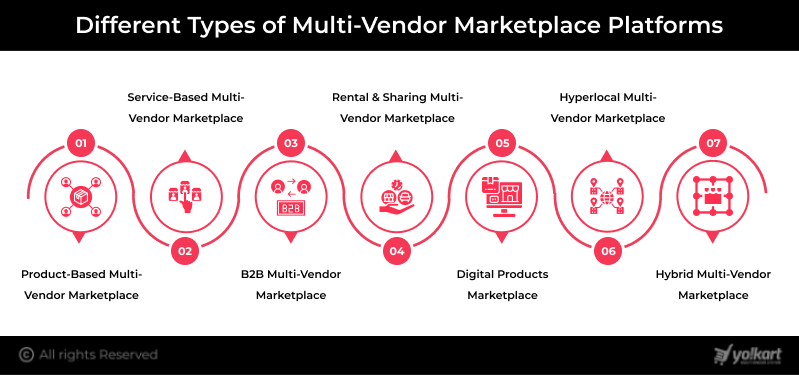
1. Product-Based Multi-Vendor Marketplace
This is the most common and widely recognized multi-vendor marketplace platform, where multiple sellers list and sell physical goods under one digital storefront.
How It Works:
- Vendors register on the platform and upload products.
- Customers browse the catalog, compare products from different sellers, and complete purchases through the marketplace.
- The marketplace owner earns revenue by charging commissions or vendor fees.
Common Categories:
- Electronics
- Fashion & Apparel
- Beauty & Personal Care
- Furniture & Home Decor
- Groceries
Revenue Model:
- Commission per sale
- Vendor subscription fees
- Featured product listing charges
- Advertising revenue
Examples: Amazon, eBay
Best For: Entrepreneurs targeting large-scale retail ecosystems with multiple product categories and vendors.
2. Service-Based Multi-Vendor Marketplace
In this type, vendors provide services instead of physical goods. The platform acts as an intermediary that connects service providers with customers seeking professional or on-demand services.
How It Works:
- Service providers create profiles, list their offerings, and set pricing.
- Customers book services directly through the platform.
- Payments are processed online.
- The marketplace earns commission on each booking.
Common Industries:
- Online tutoring and education
- Freelancing platforms
- Home services
- Legal or financial consulting
- Fitness and wellness coaching
Revenue Model:
- Commission on service booking
- Subscription plans for service providers
- Lead generation fees
Examples: Urban Company, Fiverr, TaskRabbit
Best For: Businesses building on-demand or skill-based ecosystems.
3. B2B Multi-Vendor Marketplace
A B2B (Business-to-Business) multi-vendor marketplace platform connects manufacturers, wholesalers, and suppliers with business buyers.
How It Works:
- Suppliers list products in bulk
- Buyers negotiate pricing or submit RFQs (Request for Quotation)
- The platform supports enterprise payment, logistics integrations, and large order values
Key Features:
- MOQ (Minimum Order Quantity) management
- Tiered or volume-based pricing
- Trade credit support
- Logistics and shipment integration
Revenue Model:
- Subscription-based vendor membership
- Transaction commissions
- B2B Lead generation fees
Examples: Alibaba
Best For: Businesses targeting wholesale trade networks and bulk transactions.
Launch Your Own B2B Multi-Vendor Marketplace
4. Rental & Sharing Multi-Vendor Marketplace
Rental marketplaces focus on temporary usage instead of ownership. Vendors list items for rent. Some of the popular categories include property rentals, vehicle rentals, equipment rentals, and fashion rentals.
How It Works
- Vendors list items available for rent along with availability calendars.
- Customers select rental duration and book items.
- Payments and deposits are processed securely through the platform.
- Commission is earned per booking.
Unique Features:
- Booking calendar
- Security deposit management
- Availability tracking
- Dynamic pricing
Revenue Model:
- Commission per booking
- Insurance add-ons
- Premium listing charges
Examples: Airbnb, Turo
Best For: Entrepreneurs leveraging the rapidly growing sharing economy.
5. Digital Products Marketplace
A digital product marketplace platform enables vendors to sell downloadable content, online courses, or digital assets.
How It Works
- Vendors upload digital files or create access-based products.
- Customers purchase or subscribe.
- The platform automatically delivers files or grants access.
Special Features Required:
- Secure digital file delivery
- DRM protection
- Subscription-based access
- Licensing management and usage control
Revenue Model:
- Commission per download
- Monthly subscription models
- Tiered access models
Examples: ThemeForest, Udemy
Best For: Creators, educators, SaaS providers, and digital entrepreneurs.
6. Hyperlocal Multi-Vendor Marketplace
Hyperlocal multi-vendor marketplaces connect vendors and buyers within a specific geographic area.
How It Works
- Local vendors register and list their products on the platform.
- Customers search for products or services based on their location.
- Orders are placed and delivered within hours (or same day).
Core Features:
- Real-time inventory sync
- Delivery slot management
- GPS tracking and route optimization
- Location-based search filters
Revenue Model:
- Commission on orders
- Delivery charges
- Vendor subscription fees
Examples: Instacart, DoorDash
Best For: Entrepreneurs targeting city-specific or region-specific markets.
7. Hybrid Multi-Vendor Marketplace
A hybrid multi-vendor marketplace combines multiple business models in one platform. Instead of focusing on just one category, it allows vendors to sell physical products, offer services, or distribute digital goods within the same ecosystem.
How It Works
In a hybrid multi-vendor marketplace:
- Sellers offer physical products, digital goods, and services.
- Buyers can shop, book services, and access digital content, all from one platform.
- The marketplace owner manages different vendor types, commission models, and payout mechanisms.
- Commission is collected according to the transaction type, product sale, service booking, subscription access, etc.
Why It’s Powerful:
- Multiple revenue streams
- Higher customer lifetime value
- Greater platform scalability
- Cross-selling opportunities
Revenue Models
- Commission on product sales or service bookings
- Subscription plans for vendors
- Listing fees for products or services
- Advertising and sponsored placements
- Premium storefront or vendor membership plans
Examples: Amazon, Walmart Marketplace, Alibaba
Best For: Businesses aiming to build large-scale, diversified digital commerce ecosystems with multiple revenue channels.
Top Companies for Multi-Vendor Marketplace Development
Selecting the right development partner is a crucial step in building a successful, scalable multi-vendor marketplace platform. The right company not only brings technical expertise but also a deep understanding of marketplace ecosystems, vendor management, monetization models, and long-term scalability. Below are some ofthe top multi-vendor marketplace development companies that have proven experience delivering high-quality marketplace solutions across industries.
1. FATbit Technologies
Location: India (Global Clients across the US & Europe)
Years of Experience: 20+
Rating: 4.8/5
FATbit Technologies has established itself as a leading company in multi-vendor marketplace development with a strong focus on buildingmarketplace platforms with deep domain expertise. Unlike many general software companies, FATbit combines ready frameworks (like Yo!Kart) with custom engineering, helping businesses launch, scale, and monetize marketplace platforms efficiently.
This approach allows businesses to launch faster while still maintaining the flexibility needed to build industry-specific marketplace features. With over two decades of experience, the company has supported entrepreneurs, startups, and enterprises in launching marketplaces across eCommerce, services, rentals, and B2B industries.
Portfolio Highlights:
The company has developed several marketplace-focused platforms, including:
- Yo!Kart: Multi-vendor eCommerce marketplace
- Yo!Coach: Tutoring marketplace solution
- Yo!Rent: Rental marketplace platform
- Yo!Gigs: Service-Based Marketplace Platform
In addition to these products, the team has delivered numerous custom marketplace implementations for global clients.
Key Highlights:
- Specialized in marketplace logic and vendor ecosystems
- Thousands of global deployments
- Fastest time-to-market with customizable frameworks
- Scalable architecture built for growth
Why FATbit Stands Out: FATbit blends marketplace product excellence with custom development, providing a cost-efficient, growth-ready solution that accelerates marketplace launches while ensuring long-term scalability.
Discuss Your Marketplace Requirements with Our Experts
2. Mirakl

Location: France & USA
Years of Experience: 12+
Rating: 4.6/5
Mirakl is widely recognized for delivering enterprise marketplace solutions used by global retailers and mid to large-sized brands. The company focuses on enabling large businesses to integrate marketplace capabilities directly into their existing eCommerce ecosystems, allowing them to expand product offerings without managing additional inventory.
Portfolio Highlights:
- Marketplaces for major retail enterprises
- Complex B2B portals and omnichannel ecosystems
Key Highlights:
- Enterprise focus with strong security protocols
- Comprehensive vendor and catalog management
- Powerful analytics and marketplace governance
Ideal For: Large retailers and enterprises seeking an integrated marketplace ecosystem with enterprise workflows and compliance.
3. Arcadier
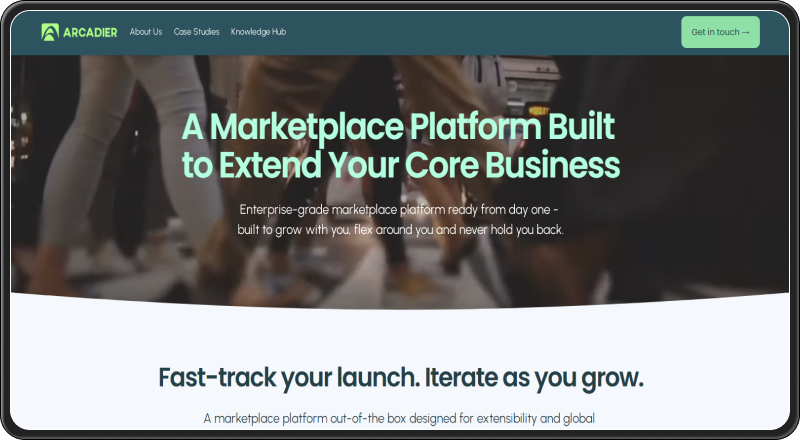
Location: Singapore
Years of Experience: 11+
Rating: 4.4/5
Arcadier provides a cloud-based SaaS platform designed to help businesses launch customizable multi-vendor marketplaces without extensive development. Its flexible system supports a wide range of marketplace types, including product, services, rentals, and B2B trade, through a flexible and extendable system.
Portfolio Highlights:
- Retail marketplaces
- Service booking platforms
- Peer-to-peer rental marketplaces
Key Highlights:
- No-code/low-code marketplace builders
- Multi-currency and multi-language support
- Plugin ecosystem for integrations
Ideal For: Small to medium businesses looking for a SaaS approach that offers flexibility, customization, and fast deployment.
4. Sharetribe
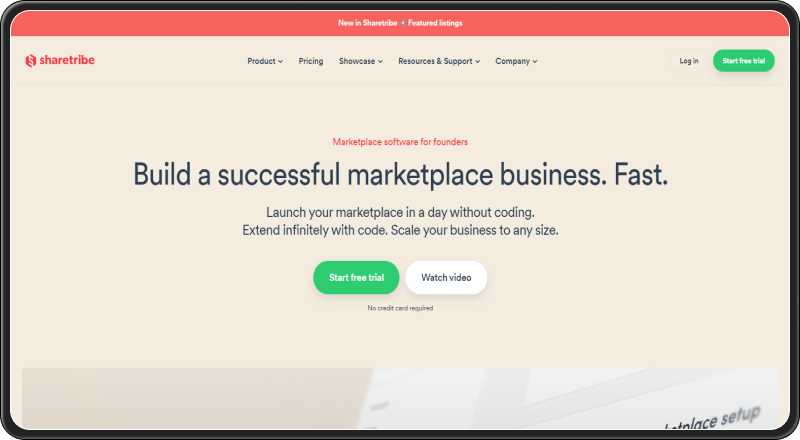
Location: Finland (Europe)
Years of Experience: 13+
Rating: 4.5/5
Sharetribe offers an intuitive marketplace platform designed for entrepreneurs and startups aiming to create and launch a marketplace quickly. The platform is particularly popular for peer-to-peer, service, or niche marketplaces where speed and simplicity are key priorities.
Portfolio Highlights:
- Marketplaces for rentals, services, and local commerce
- Rapid MVP marketplace setups
Key Highlights:
- No-code editing and simple configuration
- Native payment support
- Quick provisioning for testing ideas
Ideal For: Startups and early-stage marketplaces validating business models before large-scale investment.
5. Jungleworks
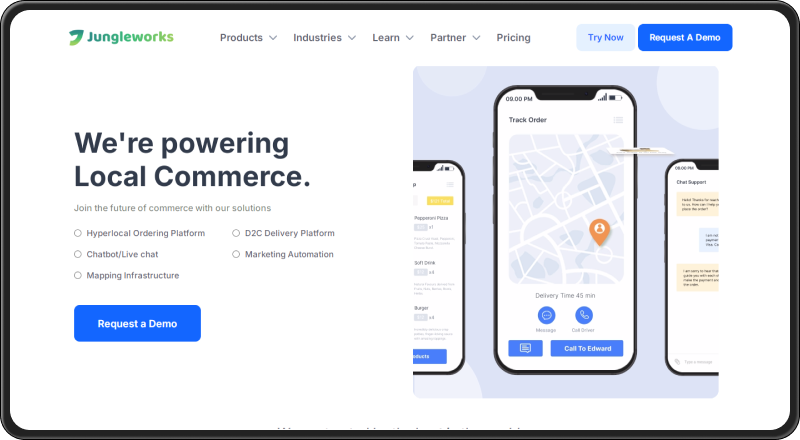
Location: United States
Years of Experience: 10+
Rating: 4.3/5
Jungleworks focuses on developing high-performance marketplace platforms designed for on-demand and delivery-centric business models. The company’stechnology is tailored for businesses that require real-time order management, routing, service dispatch, and efficient logistics coordination across multiple vendors and service providers.
Portfolio Highlights:
- Marketplace platforms with built-in logistics modules
- On-demand delivery and service marketplaces
Key Highlights:
- Strong real-time operations management
- Mobile-first architecture
- Support for service and goods delivery marketplaces
Ideal For: Companies building delivery-oriented marketplaces and local service ecosystems.
6. Brainhub
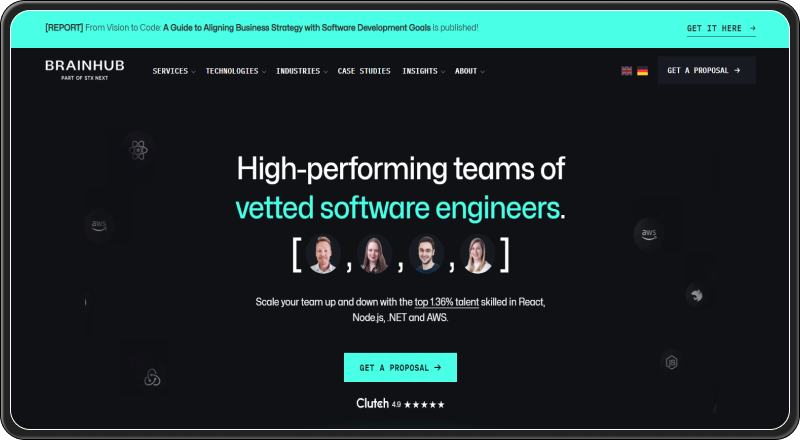
Location: Poland (Europe)
Years of Experience: 9+
Rating: 4.4/5
Brainhub is a European software engineering firm known for developing high-performance digital platforms, including scalable marketplace solutions. The company specializes in high-performance marketplace solutions with clean architecture, scalable design, and modern tech stacks such as React and Node.js to support complex marketplace infrastructure.
Portfolio Highlights:
- Custom digital platforms with marketplace modules
- High-traffic consumer marketplaces
Key Highlights:
- Engineering excellence with a focus on scalability
- Modular, maintainable codebases
- Cloud-ready infrastructure planning
Ideal For: Marketplaces focused on performance, stability, and long-term technical growth.
7. Netguru
Location: Poland (Europe)
Years of Experience: 16+
Rating: 4.5/5
Netguru is a global digital product development company that combines UX design, product strategy, and full-stack development to build digital marketplace platforms. The company focuses on creating user-friendly platforms that balance strong design principles with scalable technology architecture.
Portfolio Highlights:
- Digital platforms and enterprise marketplaces
- UX-optimized consumer marketplaces
Key Highlights:
- Strong design and product strategy integration
- End-to-end development capabilities
- Scalable systems with analytics integration
Ideal For: Brands seeking marketplaces with standout user experience and seamless journeys.
8. Pentalog
Location: France (Europe)
Years of Experience: 30+
Rating: 4.4/5
Pentalog is a global software engineering and digital transformation company known for building enterprise platforms. With decades of experience and distributed global teams, Pentalog supports businesses seeking advanced digital infrastructure and enterprise-grade marketplace ecosystems.
Portfolio Highlights:
- Enterprise marketplace platforms
- Integrated commerce systems
Key Highlights:
- Full digital transformation services
- Compliance and enterprise governance capabilities
- Global team scale
Ideal For: Organizations requiring strong security protocols and enterprise-grade platforms.
9. DockYard
Location: USA
Years of Experience: 14+
Rating: 4.3/5
DockYard focuses on building modern, user-focused digital platforms and marketplace systems. Their strength lies in intuitive design combined with scalable backend engineering.
Portfolio Highlights:
- Digital products and marketplace systems
- Clientworksk with globally recognized brands
Key Highlights:
- UX and interface-driven development
- Scalable architecture
- Product strategy expertise
Ideal For: Businesses that prioritize user engagement and design excellence.
10. ScienceSoft, Enterprise Marketplace Development Company
Location: USA
Years of Experience: 34+
Ratings: 4.8/5
ScienceSoft is a US-based IT consulting and software development company with a strong presence in Europe. With over three decades of experience, ScienceSoft delivers enterprise-grade multi-vendor marketplace development services tailored for B2B, B2C, and niche industry platforms. The company is known for building scalable, secure, and highly customized multi-vendor marketplace platforms for complex business ecosystems.
Portfolio Highlights:
- B2B wholesale multi-vendor marketplace platforms
- Healthcare and medical supply marketplaces
- Industrial equipment trading platforms
- Enterprise procurement marketplaces
Key Highlights:
- Strong expertise in enterprise-grade marketplace development
- Advanced integration capabilities (ERP, CRM, payment gateways)
- Dedicated security and compliance frameworks
- Scalable architecture for high-traffic marketplaces
- Long-term technical support and modernization services
Looking for a Reliable Marketplace Development Company?
Comparison Table of Top 5 Multi-Vendor Marketplace Development Companies
Choosing the right marketplace development partner requires evaluating several critical factors, including experience, specialization, scalability, development approach, and time to market. The table below provides a side-by-side comparison of some of the leading marketplace development companies to help businesses better understand their strengths and positioning.
| Criteria | FATbit Technologies | ScienceSoft (USA | Itransition (USA) | Netguru (Poland) | Brainvire (USA) |
| Headquarters | India (Global Clients) | USA | USA | Poland | USA |
| Years of Experience | 20+ Years | 34+ Years | 25+ Years | 15+ Years | 20+ Years |
| Core Focus | Dedicated multi-vendor marketplace platform development | Enterprise IT & custom software | Digital transformation & enterprise systems | Digital product development | Enterprise eCommerce solutions |
| Marketplace Specialization | Highly specialized in multi-vendor marketplace development | Moderate | Moderate | Moderate | Moderate |
| Ready-Made Marketplace Solution | Yes (Yo!Kart: purpose-built marketplace software) | Custom only | Custom only | Custom only | Custom only |
| Custom Marketplace Development | Yes | Yes | Yes | Yes | Yes |
| Time to Market | Faster (Pre-built + Customizable) | Medium–Long | Medium–Long | Medium–Long | Medium–Long |
| Cost Efficiency | High ROI | Enterprise-level pricing | Enterprise-level pricing | Premium pricing | Mid–High pricing |
| B2B & B2C Marketplace Expertise | Strong in both | Strong B2B | Strong B2B | B2C & digital | B2B focus |
| Scalability | High (Cloud-ready architecture) | High | High | High | High |
| Vendor Management Features | Advanced (commission, multi-currency, split payments) | Custom-built | Custom-built | Custom-built | Custom-built |
| Best For | Startups, SMBs, Large Enterprises | Large enterprises | Large enterprises | Funded startups | Mid-to-large enterprises |
| Overall Marketplace Readiness | 5/5 | 4/5 | 4/5 | 4/5 | 4/5 |
The comparison shows that FATbit Technologies focuses specifically on multi-vendor marketplace development, while other firms act as broader software development providers. Companies like ScienceSoft, Itransition, Netguru, and Brainvire typically rely on fully custom development, which can increase timelines and costs.
In contrast, FATbit’s purpose-built solution Yo!Kart combines pre-tested architecture with customization, helping businesses launch faster with scalable and cost-efficient marketplace platforms.
Suggested Read: Top eCommerce Marketplace Builder in 2026
Key Things to Consider While Choosing the Right Marketplace Development Company
Choosing the right multi-vendor marketplace development company is a long-term business investment. A marketplace platform operates as a complex ecosystem involving vendors, buyers, administrators, payment gateways, commission structures, dispute management systems, analytics, and scalability infrastructure. A wrong decision can lead to delayed launches, budget overruns, poor vendor adoption, and long-term technical limitations.
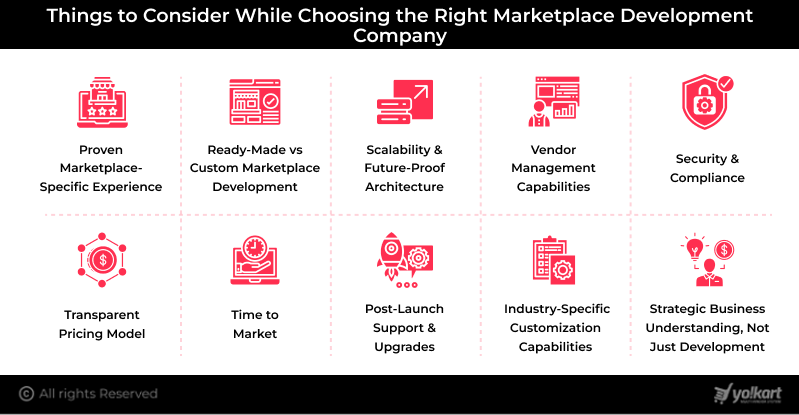
Here are the most critical factors you must evaluate before selecting a multi-vendor marketplace development partner:
1. Proven Marketplace-Specific Experience
Not every eCommerce developer understands marketplace complexity. Building a traditional online store is fundamentally different from a multi-vendor marketplace platform. Marketplaces require complex workflows such as vendor onboarding, commission structures, split payments, dispute resolution systems, and vendor analytics dashboards. A company with proven marketplace experience understands these operational dynamics and can design platforms that support multi-stakeholder interactions efficiently. Always review marketplace-specific case studies and previous implementations before making a decision.
2. Ready-Made vs Custom Marketplace Development
One of the biggest decisions businesses face is whether to build a marketplace from scratch or leverage a readymade marketplace solution. Fully custom development offers flexibility but often requires longer timelines and significantly higher investment. In contrast, purpose-built marketplace software provides a pre-tested architecture that accelerates deployment while still allowing customization. For many businesses, a hybrid approach combining ready-made foundations with tailored features offers the best balance between speed, cost efficiency, and scalability.
3. Scalability & Future-Proof Architecture
Your marketplace may start small, but it should be built to scale. A reliable development company plans for scalable infrastructure, optimized databases, load-tested performance, and cloud-ready deployment. This ensures the platform can support increasing traffic, multiple regions, and large transaction volumes without performance bottlenecks.
4. Vendor Management Capabilities
Vendor experience directly impacts marketplace success. If the platform does not provide intuitive tools for sellers, it becomes difficult to attract and retain quality vendors. A strong marketplace solution should offer automated commission management, vendor analytics dashboards, flexible payout systems, subscription options, and multi-payment gateway integrations. Effective vendor management tools help maintain transparency and improve platform participation.
5. Security & Compliance
Multi-vendor marketplaces process large volumes of sensitive information, including customer data, payment credentials, and vendor financial records. Security must therefore be built into the platform architecture from the beginning. A capable development company ensures compliance readiness, secure API integrations, role-based access controls, and fraud detection mechanisms. Strong security frameworks not only protect the platform but also build trust among users and vendors.
6. Transparent Pricing Model
Marketplace development costs can vary drastically depending on customization requirements, integrations, hosting infrastructure, and ongoing maintenance. Before committing to a development partner, it is essential to understand the complete pricing structure. Clarify licensing fees, customization costs, support packages, upgrade policies, and any recurring maintenance charges. Transparent pricing helps businesses avoid unexpected costs and plan long-term investments more effectively.
7. Time to Market
Speed is a competitive advantage in marketplace businesses. The longer it takes to launch, the more resources are spent before revenue generation begins. Delayed launches can also increase competitive pressure and reduce market advantage. A specialized marketplace development company with established frameworks and structured deployment processes can significantly reduce development timelines and help businesses enter the market faster.
8. Post-Launch Support & Upgrades
Launching the marketplace is only the beginning. Continuous platform improvement is essential to remain competitive and secure. Businesses should evaluate whether the development company offers ongoing support, regular software updates, performance monitoring, and feature enhancements. A partner that provides long-term technical support ensures the marketplace continues to evolve alongside changing market demands.
9. Industry-Specific Customization Capabilities
Different industries require different marketplace workflows and operational features. For example, B2B marketplaces often require RFQ systems and bulk pricing tools, while rental marketplaces rely on booking calendars and availability tracking. Service marketplaces need scheduling functionality, and digital product marketplaces require secure file delivery and licensing management. A capable development partner understands these industry-specific requirements and can tailor the platform accordingly.
10. Strategic Business Understanding, Not Just Development
The most effective marketplace development partners go beyond coding and platform deployment. They understand the broader business strategy behind marketplace success. This includes designing sustainable revenue models, supporting vendor acquisition strategies, improving buyer onboarding experiences, and addressing liquidity challenges between supply and demand. Companies that combine technical expertise with marketplace business knowledge create stronger and more sustainable platforms.
Start your Entrepreneurial Journey and Build Your Multi-Vendor Marketplace
Conclusion
The global demand for multi-vendor marketplace platforms is accelerating as businesses across industries embrace the marketplace model to scale faster, reduce operational risk, and create diversified revenue streams. From B2B wholesale networks and service-based platforms to rental and niche product marketplaces, the opportunities are vast, but success depends on flawless execution.
While many US and European software firms offer custom development services, they often treat marketplace development as just another component of broader digital transformation projects. This approach typically results in longer development cycles, higher upfront costs, and complex post-launch dependencies. On the other hand, a specialized multi-vendor marketplace development company that focuses specifically on marketplace ecosystems brings significant advantages, such as pre-tested marketplace architecture, faster time-to-market, a marketplace-first feature stack, predictable scalability, and a deep understanding of vendor–buyer dynamics.
Among the companies reviewed, FATbit Technologies stands out due to its specialized focus on marketplace development. Instead of offering generic custom builds alone, FATbit provides purpose-built marketplace software combined with customization flexibility, creating a balanced approach between speed, cost-efficiency, and scalability. This balanced approach enables startups, SMBs, and enterprises to reduce risk, optimize cost, and accelerate growth. In a platform-driven digital economy, the right development partner can determine whether your marketplace remains a simple website or evolves into a scalable, revenue-generating ecosystem.
Frequently Asked Questions (FAQs)
Q 1. What is a multi-vendor marketplace platform?
Ans. A multi-vendor marketplace platform is an online system where multiple independent sellers can register, list products or services, manage orders, and sell to customers under a single centralized website or application. The marketplace owner does not typically hold inventory but earns revenue through commissions, subscriptions, listing fees, or transaction charges.
Q 2. How is multi-vendor marketplace development different from regular eCommerce development?
Ans. Traditional eCommerce websites support a single seller managing products and orders. In contrast, multi-vendor marketplace development involves a multi-stakeholder architecture. It requires vendor onboarding and verification systems, commission management, automated multi-party payment distribution, dedicated vendor dashboards, dispute resolution mechanisms, and advanced analytics. The technical complexity is significantly higher because the system must manage multiple independent businesses within one platform.
Q 3. How much does multi-vendor marketplace development cost?
Ans. The cost of building a multi-vendor marketplace depends on several variables, such as custom versus readymade solutions, feature depth, industry-specific requirements, scalability goals, and third-party integrations. Fully custom enterprise builds can require substantial investment and longer timelines. Fully custom enterprise builds can be expensive and time-consuming. In contrast, companies offering ready-made marketplace frameworks often provide faster and more cost-effective deployment options.
Q 4. How long does it take to build a multi-vendor marketplace?
Ans. Development timelines vary based on the development approach. A fully custom marketplace can take several months from planning to deployment. Whereas, choosing a specialized multi-vendor marketplace development company that offer pre-build modules can reduce time-to-market considerably.
Q 5. Which industries can benefit from a multi-vendor marketplace?
Ans. The marketplace model is highly adaptable and works across industries such as:
- B2B wholesale
- Fashion & retail
- Electronics
- Rental services
- Education & tutoring
- Healthcare
- Digital products
- Service-based platforms
Any sector that involves multiple suppliers serving a shared customer base can leverage a marketplace structure to scale efficiently.
Q 6. What features are essential in a multi-vendor marketplace platform?
Ans. Key features in a multi-vendor marketplace platform include:
- Vendor registration & verification
- Commission management
- Multi-currency support
- Secure payment gateways
- Vendor analytics dashboards
- Product management tools
- Ratings & reviews
- Order management system
- Admin control panel
A strong feature foundation determines long-term success, ensures operational efficiency, transparency, and scalability.
Q 7. Should I choose a US/European development firm or a specialized global marketplace company?
Ans. US and European firms offer strong enterprise engineering capabilities but typically rely on fully custom builds. Whereas, a marketplace-focused company that provides both ready-made solutions and customization flexibility may offer faster deployment, lower cost risk, pre-validated marketplace architecture, and deeper domain expertise. However, the right choice depends on your business goals, budget, and timeline.
Q 8. Why is specialization important in multi-vendor marketplace development?
Ans. Marketplaces involve complex business logic, including vendor competition management, supply-demand balance, commission optimization, and multi-party financial workflows. A company specializing in multi-vendor marketplace development understands these nuances and reduces execution risk, improves system stability, and enhances long term platform performance.
Q 9. Can a marketplace scale globally?
Ans. Yes, provided scalability is built into the original architecture. A globally scalable marketplace should support multi-language capabilities, multi-currency transactions, region-specific tax rules, country-based shipping logic, and international vendor onboarding. Early architectural planning is critical to avoid costly restructuring during expansion.
Q 10. What makes a marketplace successful beyond technology?
Ans. Technology is only one part of the equation. Success also depends on vendor acquisition strategy, customer trust building, liquidity balance between supply and demand, marketing execution, and monetization optimization. A strong development partner should understand both technical and business fundamentals required to build a sustainable, high-growth marketplace ecosystem.
Need a Reliable Foundation to Build Your Marketplace Platform?
Get In TouchPopular Posts