

Published Date 18th May, 2026
The global marketplace industry has experienced exceptional growth over the past decade, transforming the way businesses and consumers buy, sell, and interact online. From established platforms like Amazon and eBay to emerging niche marketplaces, the marketplace business model continues to dominate the digital economy. Therefore, today, multiple startups across industries are increasingly investing in launching an eCommerce marketplace business that connects buyers and sellers through a single digital platform. The demand for scalable marketplace platforms continues to rise globally, in diverse business models, whether it is a multi-vendor online store, a B2B marketplace, a hyperlocal delivery platform, a wholesale marketplace, or a service-based marketplace.
As competition in the digital commerce space grows, choosing the right eCommerce marketplace software has become one of the most important decisions for startup founders. The software that powers your marketplace directly influences the platform user experience, vendor management, scalability, operational efficiency, SEO performance, security, and long-term profitability. However, with numerous marketplace software solutions available today, selecting the right platform can quickly become overwhelming. Some eCommerce marketplace software prioritise ease of use, while others focus on advanced customisation, scalability, mobile responsiveness, or marketplace-specific features.
Consequently, to assist businesses in finding an aligned software provider, this comprehensive guide will explore the top eCommerce Marketplace Software solutions for startups in 2026. Find the feature comparison, benefits, and limitations, which will also help you understand what to look for when selecting the ideal platform for your business requirements. Whether you are planning to launch a niche marketplace, multi-vendor eCommerce platform, B2B marketplace, or hyperlocal marketplace, this blog is aimed at assisting you in making a more informed and strategic decision for long-term growth.
Table of Contents
- What is eCommerce Marketplace Software?
- Why Startups Need eCommerce Marketplace Software?
- Key Features to Look for in eCommerce Marketplace Software
- Prevalent Types of eCommerce Marketplace Software
- Which Marketplace Software Type is Best for Startups?
- Top eCommerce Marketplace Software for Startups in 2026
- At a Glance: Marketplace Software Comparison Table
- Common Challenges Faced by Marketplace Startups
- How Yo!Kart Helps Solve Common Marketplace Challenges?
- Conclusion
- Frequently Asked Questions (FAQs)
What is eCommerce Marketplace Software?
An eCommerce marketplace software is a specialised solution for businesses to launch their eCommerce marketplace platform. This marketplace allows businesses to create and manage online marketplaces, enabling easy listings for multiple vendors to sell products or services through a single website or application.
Unlike traditional eCommerce stores that are operated by a single seller, marketplace platforms support multiple independent vendors. Each seller can create their own product listings, manage inventory, process orders, and interact with customers through dedicated dashboards. Some of the world’s largest online businesses, including Amazon, eBay, and Alibaba, operate using advanced marketplace systems that connect buyers and sellers efficiently.
Features Essential in a Readymade eCommerce Marketplace Software
At its core, a readymade eCommerce marketplace software is fully-equipped with industry features, such as vendor registration management, product catalogues, customer orders, payments, commissions, shipping, reviews, and overall marketplace activities from a centralised system. Furthermore, modern readymade marketplace software typically includes more features as listed below.
- Multi-vendor management
- Vendor dashboards
- Product catalogue management
- Secure payment gateways
- Order and inventory management
- Mobile responsiveness
- SEO-friendly architecture
- Shipping integrations
- Analytics and reporting tools
- Marketing and promotional features
There has been a recorded inclination of preference towards the readymade software, and one of the biggest advantages of using ready-made eCommerce marketplace software is that startups can significantly reduce development time and costs. Instead of building an entire marketplace from scratch, businesses can launch faster using pre-built functionalities and focus more on growth, vendor acquisition, and customer experience.
Business Models Supported by these eCommerce Software Solutions
Another major benefit of readymade software is its customisability and architectural flexibility. Further, an eCommerce marketplace software can support different business models, which include.
- B2C marketplaces- Business-to-Customer Marketplace: This model connects businesses with customers to directly sell their products or services. For example, Amazon, Etsy, etc.
- B2B marketplaces- Business-to-Business Marketplace: This model connects wholesale seller businesses with other businesses, rather than individual buyers. For example, Amazon Business, Alibaba, etc.
- Service marketplaces: A service marketplace is an online platform that connects service providers with skill sets with individuals or businesses offering expertise. For example, freelance writing, home cleaning, etc.
- Rental marketplaces: The rental marketplace is an online platform that connects people with assets with the people who want to rent them temporarily. For example, Turo, car rental, Rent the Runway, etc.
- Hyperlocal marketplaces: A hyperlocal marketplace is an eCommerce platform that connects consumers with locals within a geographical area for an on-demand delivery. For example, Instacart, Shipt, etc.
- Niche industry marketplaces: A niche eCommerce marketplace is a specialised digital platform focusing on a specific product, industry, or demographics. For example, Chairish, Chewy, etc.
As the marketplace economy continues to grow globally, choosing the right eCommerce Marketplace Software has become increasingly important for startups aiming to build scalable and competitive online businesses.
Upscale your eCommerce Marketplace Business With the Industry Experts
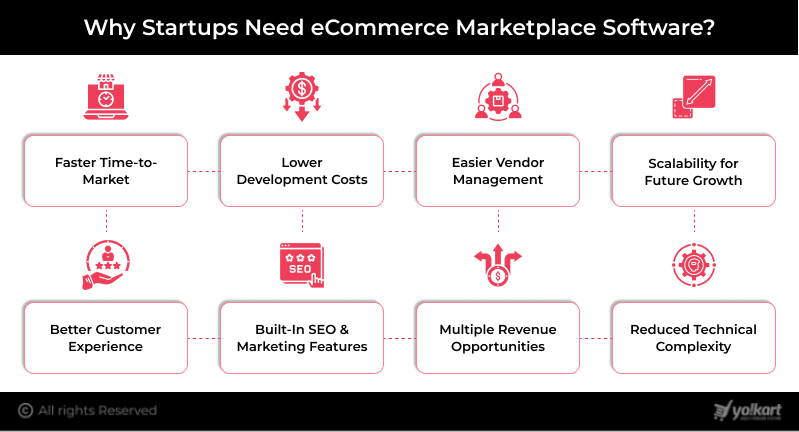
Why Startups Need eCommerce Marketplace Software?
The marketplace business model has become increasingly popular among startups because it offers strong scalability, lower inventory risks, and multiple revenue generation opportunities. However, building and managing a marketplace manually can quickly become complex as the number of vendors, products, and customers grows. This is where eCommerce Marketplace Software becomes essential.
To sustainably capitalise on the eCommerce marketplace a business owner, instead of spending months developing a platform from scratch, can use ready-made marketplace software to launch faster, reduce technical challenges, and streamline day-to-day operations.
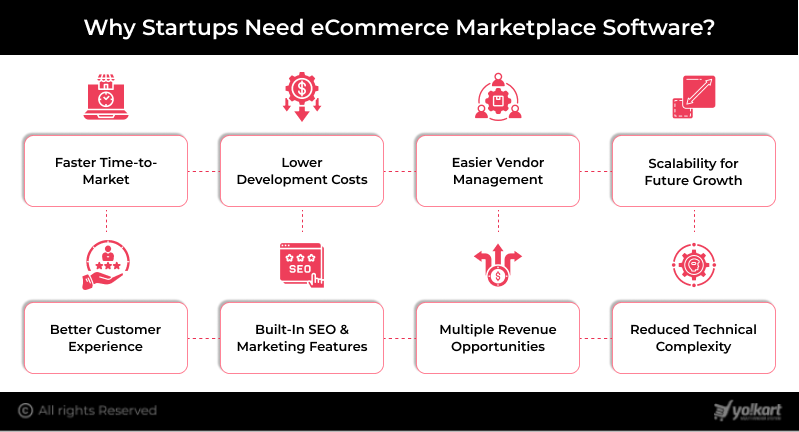
1. Faster Time-to-Market
Speed plays a critical role in the success of any startup. Developing a custom marketplace platform from the ground up often requires extensive planning, development, testing, and ongoing maintenance.
Ready-made eCommerce Marketplace Software helps startups significantly reduce launch time by providing pre-built marketplace functionalities. Along with allowing startups with limited resources to gain a major competitive advantage, this allows businesses in the following:
- Launch quickly
- Validate their business idea faster
- Enter the market ahead of competitors
- Start acquiring vendors and customers sooner
2. Lower Development Costs
Custom marketplace development can be extremely expensive, especially for startups operating on limited budgets. Therefore, using marketplace software eliminates the need to build essential features from scratch, helping businesses reduce overall development complexity and long-term operational costs.
- Development expenses
- Technical hiring costs
- Infrastructure investments
- Maintenance overheads
3. Easier Vendor Management
Managing multiple vendors manually can quickly become overwhelming. Therefore, the modern eCommerce Marketplace Software provides dedicated vendor management tools that simplify and provide operational efficiency with teh automation, while enhancing the overall seller experience.
- Vendor onboarding
- Product approvals
- Inventory management
- Order processing
- Commission tracking
- Vendor communication
4. Scalability for Future Growth
Scalable marketplace software ensures the platform can handle business growth without major operational disruptions. Choosing scalable software early helps startups avoid expensive migrations later. Scalability is one of the biggest advantages of marketplace businesses. As the platform grows, startups may need to support,
- More vendors
- Larger product catalogues
- Increased customer traffic
- Higher transaction volumes
5. Better Customer Experience
Customer experience plays a major role in marketplace success. Therefore, a top eCommerce marketplace software helps businesses deliver an enhanced customer experience that offers,
- Faster website performance
- Smooth navigation
- Advanced product search
- Secure payments
- Mobile-friendly experiences
- Simplified checkout processes
6. Built-In SEO and Marketing Features
The built-in tools of an eCommerce marketplace software enable startups to improve visibility and attract customers more effectively. The organic traffic is crucial for startup growth. Many eCommerce Marketplace Software solutions include built-in SEO capabilities such as,
- SEO-friendly URLs
- Meta tag management
- Mobile optimisation
- Fast page loading
- Structured navigation
Some more platforms also include marketing features like:
- Discount coupons
- Email marketing tools
- Referral systems
- Promotional banners
7. Multiple Revenue Opportunities
Powerful eCommerce marketplace software helps automate revenue streams, making it easier for startups to manage finances and scale profitably. Therefore, a powerful marketplace business software can generate revenue through different monetisation models, that includes,
- Vendor commissions
- Subscription fees
- Featured listings
- Advertising placements
- Transaction charges
8. Reduced Technical Complexity
The ready-made marketplace software simplifies these complexities through pre-built features and ongoing technical support. This allows startups to focus more on business growth instead of technical maintenance. Some technical challenges that may arise in managing a marketplace platform involve,
- Payment integrations
- Security management
- Database handling
- Performance optimisation
- Vendor management
- Mobile responsiveness
Now that a business owner is aware of the reasons to build and launch their robust eCommerce marketplace, it is essential to look at the features that enable a smooth operationality of their platform.
Key Features to Look for in eCommerce Marketplace Software
Choosing the right eCommerce Marketplace Software is one of the most important decisions for any startup. The software you select will directly impact your platform’s scalability, operational efficiency, customer experience, and long-term growth. While different marketplace solutions offer varying capabilities, there are certain essential features that every startup should prioritise before making a decision.
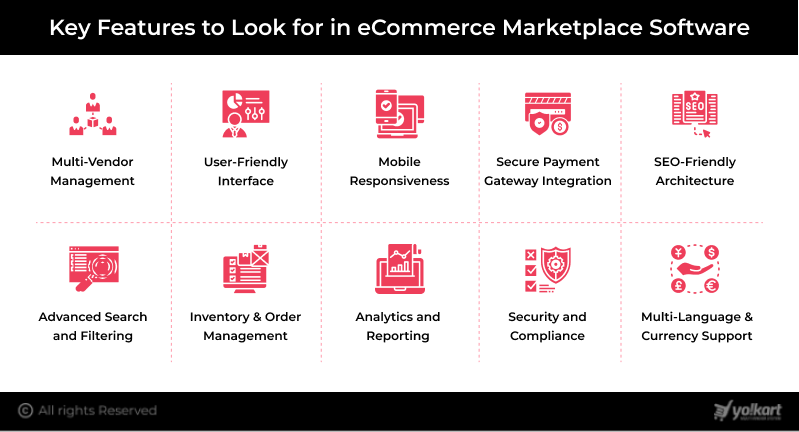
1. Multi-Vendor Management
A dedicated vendor dashboard helps sellers operate independently while reducing administrative workload for the marketplace owner. Therefore, launching a multi-vendor eCommerce is the foundation of any marketplace platform. A dedicated vendor dashboard helps sellers operate independently while reducing administrative workload for the marketplace owner. The software should allow multiple vendors to:
- Register easily
- Create and manage product listings
- Track inventory
- Process orders
- Monitor sales performance
- Manage shipping and returns
2. User-Friendly Interface
A clean and intuitive interface improves user engagement for both buyers and sellers. Whereas a complicated navigation or poor user experience can increase bounce rates and reduce conversions. An easy-to-use interface encourages repeat customers and improves seller satisfaction. Therefore, a good marketplace software should provide,
- Simple navigation
- Easy product browsing
- Smooth checkout process
- Responsive dashboards
- Clear product categorisation
3. Mobile Responsiveness
Mobile commerce continues to dominate online shopping behaviour globally. So, it is important to equip your marketplace platform to deliver a seamless experience across different platforms, as a mobile-responsive design ensures better usability, improved SEO performance, and higher customer engagement. Furthermore, a business owner can choose from marketplace solutions that support dedicated mobile apps for buyers and sellers.
- Smartphones
- Tablets
- Desktops
4. Secure Payment Gateway Integration
Secure and flexible payment processing is essential for marketplace success. The eCommerce marketplace software should support multiple payment gateways and offer features and support reliable payment systems to help build trust among both customers and vendors.
- Secure transactions
- Split payments
- Multi-currency support
- Automated commission management
- Refund processing
5. SEO-Friendly Architecture
Search engine visibility is critical for attracting organic traffic; therefore, platforms with strong SEO capabilities can help startups reduce customer acquisition costs over time. Choose an eCommerce marketplace software solution that is designed with built-in SEO-friendly architecture to support organic growth strategies. An SEO-oriented eCommerce Marketplace Software helps improve rankings through features such as:
- SEO-friendly URLs
- Meta title and description management
- Fast-loading pages
- Mobile optimisation
- Structured site architecture
6. Advanced Search and Filtering
Advanced search functionality improves customer experience. As marketplaces grow, users need efficient ways to find products or services quickly. Hence, investing in a better search experience often leads to higher engagement and improved conversion rates. These are the most popular filtering categories.
- Smart search suggestions
- Product filters
- Category-based navigation
- Price filters
- Location-based filtering
7. Inventory and Order Management
Efficient inventory and order management are essential for smooth marketplace operations, and automation reduces manual errors and improves operational efficiency. This feature enables the software to assist vendors and admins to
- Track stock levels
- Manage orders
- Process returns
- Update shipping statuses
- Monitor fulfilment activities
8. Analytics and Reporting
Analytics and reporting allow business owners to make strategic and industry-aligned decisions, as data-driven decision-making is essential for marketplace growth. Therefore, an eCommerce marketplace software should provide detailed analytics related to:
- Sales performance
- Vendor activity
- Customer behaviour
- Traffic sources
- Revenue tracking
- Conversion rates
These insights help startups optimise operations and improve marketing strategies.
9. Security and Compliance
Security plays a major role in customer trust and business credibility, as a strong security infrastructure protects both user data and financial transactions. Hence, businesses need to choose a good marketplace software that supports,
- SSL security
- GDPR compliance
- User verification
- Secure payment processing
- Fraud prevention measures
10. Marketing and Promotional Tools
Built-in marketing tools help startups attract and retain customers more effectively. These promotional tools can significantly improve customer engagement and sales performance. Important marketing features may include:
- Discount coupons
- Loyalty programmes
- Referral systems
- Email marketing integrations
- Promotional banners
- Social media integrations
11. Multi-Language and Multi-Currency Support
Finally, for startups targeting international markets, localisation features are extremely important. This flexibility allows businesses to expand globally more efficiently. Choose an eCommerce marketplace software should support,
- Multiple languages
- Multiple currencies
- Regional tax settings
- International payment gateways
Explore more Features that are Essential To Build a Robust eCommerce Marketplace!
Prevalent Types of eCommerce Marketplace Software
Before selecting a marketplace platform, startups should understand the different types of eCommerce marketplace software available in the market. Each type offers different levels of flexibility, ownership, scalability, and pricing. Furthermore, choosing the right model depends on your business goals, budget, technical expertise, and long-term growth plans. Broadly, marketplace software solutions can be divided into three popular development methods.
- SaaS Marketplace Platforms
- Self-Hosted Marketplace Software
- Custom Marketplace Development
1. SaaS Marketplace Platforms
SaaS (Software-as-a-Service) marketplace platforms are cloud-based solutions that are hosted and managed by the software provider or the server owner. Startups usually pay a monthly or annual subscription fee to use the platform. Popular SaaS marketplace solutions include platforms like Shopify and Sharetribe.
Advantages of SaaS Marketplace Software
- Faster Setup: SaaS platforms are usually easy to configure and launch quickly.
- Lower Initial Investment: Businesses can start with smaller upfront costs compared to custom development.
- Hosting and Maintenance: The provider manages hosting, updates, security, and maintenance.
- Beginner-Friendly: Most SaaS platforms offer user-friendly interfaces and require minimal technical expertise.
Limitations of SaaS Marketplace Software
- Ongoing Subscription Costs: Monthly fees can become expensive as the business grows.
- Limited Customisation: Many SaaS platforms restrict deep customisation and feature modifications.
- Dependency on the Provider: Businesses rely heavily on the software provider for updates, infrastructure, and platform changes.
- Scalability Constraints: Some SaaS platforms may struggle to support highly customised or large-scale marketplaces.
SaaS marketplace software is only suitable for startups looking for quick MVP launches with limited technical involvement an d want to test the industry with no long-term expansion plans.
2. Self-Hosted Marketplace Software
The popular choice for new businesses or aspiring entrepreneurs looking to efficiently capitalize over the eCommerce industry are self-hosted marketplace software that gives businesses complete ownership and control over their platform.
The software is purchased through a licence and hosted independently on the startup’s preferred server or hosting provider. Solutions like Yo!Kart and CS-Cart fall under this category.
Advantages of Self-Hosted Marketplace Software
- Greater Ownership: Businesses have full control over their platform, data, and infrastructure.
- Better Customisation: Self-hosted platforms allow extensive feature modifications and integrations.
- Long-Term Cost Efficiency: Many self-hosted solutions operate on a one-time licence model, reducing recurring subscription costs.
- Higher Scalability: Businesses can scale server resources and customise the platform according to growth requirements.
Limitations of Self-Hosted Marketplace Software
- Hosting Responsibility: Businesses are responsible for server hosting and infrastructure management.
- Initial Setup Complexity: Setup may take slightly longer compared to SaaS solutions.
Self-hosted marketplace software is often ideal for all business sizes, ranging from startups to SMBs to large businesses, seeking scalability, flexibility, and long-term ownership.
3. Custom Marketplace Development
Custom marketplace development involves building a platform entirely from scratch according to specific business requirements. This approach provides maximum flexibility but usually requires significant investment with hourly rates for long 6-12 months development time.
Advantages of Custom Marketplace Development
- Fully Tailored Solution: Every feature and workflow can be customised according to business needs.
- Unlimited Flexibility: Businesses are not restricted by pre-built platform limitations.
- Complete Ownership: Just like self-hosted, the business or startup owns the entire technology infrastructure.
Limitations of Custom Marketplace Development
- High Development Costs: Custom development can be extremely expensive for startups.
- Longer Time-to-Market: Building a marketplace from scratch may take several months or longer.
- Ongoing Maintenance Costs: Continuous development, updates, and security management require dedicated technical resources.
- Higher Risk: Technical delays and development challenges can impact launch timelines and budgets.
The Custom marketplace development is generally more suitable for enterprises or startups with highly specialised requirements, substantial budgets, and more time to enter the market.
Which Marketplace Software Type is Best for Startups?
For most startups, ready-made marketplace solutions offer the best balance between affordability, scalability, and speed. SaaS and self-hosted eCommerce marketplace software work well for businesses seeking quick deployment with minimal technical involvement. However, as discussed above, many businesses prefer self-hosted marketplace software because it provides,
- Better long-term flexibility
- Greater scalability
- Lower recurring costs
- More control over customisation
- Full ownership of the platform
Looking for an Expert Self-Hosted eCommerce Software for your Marketplace Launch?
Top eCommerce Marketplace Software for Startups in 2026
Choosing the right eCommerce Marketplace Software can significantly influence the success of a startup. The ideal platform should offer scalability, strong vendor management capabilities, mobile responsiveness, SEO-friendly architecture, and flexibility for future growth.
Today, there are several marketplace software solutions available, each designed for different business needs and budgets. Some focus on simplicity and quick deployment, while others prioritise advanced customisation and enterprise-level scalability. Below are some of the top marketplace software solutions startups should consider in 2026.
1. Yo!Kart
Software Type: Self-hosted
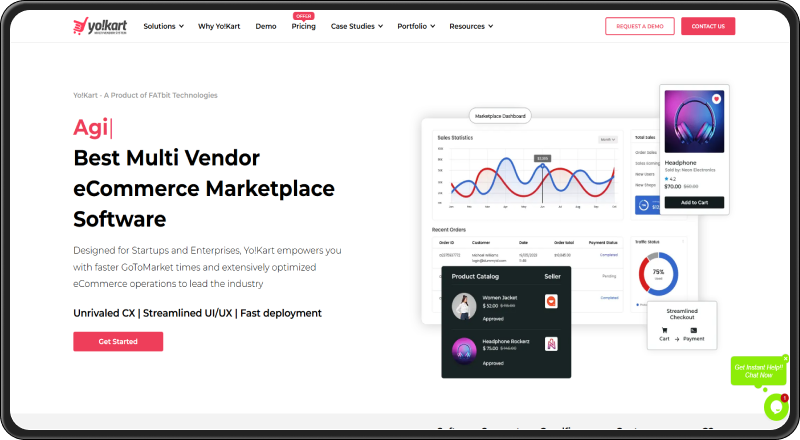
Yo!Kart is one of the leading self-hosted eCommerce Marketplace Software solutions designed specifically for startups, SMEs, and enterprises. Unlike many generic eCommerce platforms, Yo!Kart is purpose-built for multi-vendor marketplaces, making it highly suitable for businesses planning to launch scalable online marketplaces across different industries.
The platform offers a one-time licence model, allowing startups to avoid recurring subscription costs while maintaining complete ownership of their marketplace.
Key Features of Yo!Kart
- Multi-vendor management
- Separate buyer and seller dashboards
- Advanced product catalogue management
- SEO-friendly architecture
- Mobile-responsive design
- Multi-language and multi-currency support
- Commission management
- Multiple payment gateway integrations
- Tax and shipping management
- Inventory management
- Analytics and reporting tools
- GDPR compliance
- Abandoned cart recovery
- Advanced search and filtering
Advantages of Yo!Kart
- Built Specifically for Marketplaces: Yo!Kart is designed exclusively for multi-vendor marketplace operations rather than traditional single-vendor eCommerce.
- Cost-Effective Licensing: The one-time licence model helps startups reduce long-term operational expenses.
- High Scalability: The platform supports business growth efficiently as vendor and customer numbers increase.
- Strong SEO Capabilities: Built-in SEO features help marketplaces improve organic visibility and search engine rankings.
- Extensive Customisation: Businesses can customise workflows, themes, integrations, and features according to their specific requirements.
- Faster Time-to-Market: Pre-built functionalities help startups launch their marketplace faster.
Limitations of Yo!Kart
- A self-hosted setup may require a server for the launch
- Advanced customisations may require developer assistance
Best For
Yo!Kart is highly suitable for startups seeking a scalable and feature-rich marketplace platform with long-term ownership benefits. It remains one of the strongest options available in 2026.
- Multi-vendor eCommerce marketplaces
- B2B marketplaces
- Hyperlocal marketplaces
- Wholesale marketplaces
- Rental marketplaces
- Fashion marketplaces
- Grocery marketplaces
- Electronics marketplaces
- Niche product marketplaces
Experience The Powerful Operationality Of Yo!Kart by Industry Experts!
2. Sharetribe
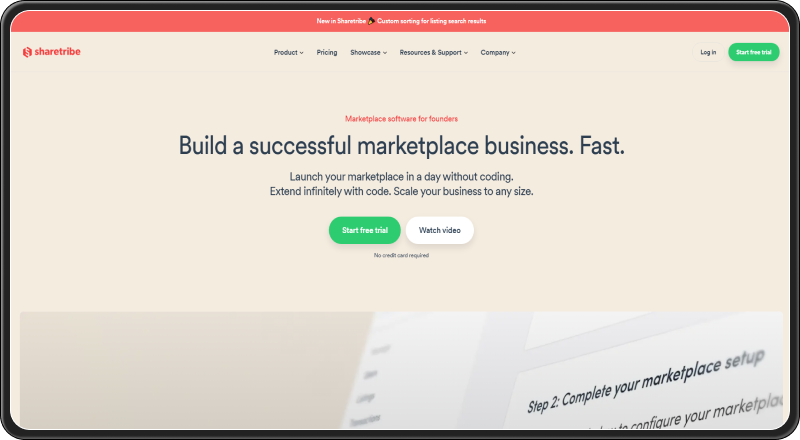
Software Type: SaaS-based
Sharetribe is a SaaS-based eCommerce Marketplace Software solution designed for startups looking to launch service, rental, or peer-to-peer marketplaces quickly and with minimal technical complexity.
The platform is widely recognised for its simplicity, faster deployment process, and beginner-friendly interface, making it a popular choice for MVP launches.
Key Features
- Vendor management
- Booking and scheduling tools
- Payment gateway integrations
- Built-in messaging system
- Mobile-responsive design
- Marketplace templates
- User reviews and ratings
| Advantages | Limitations |
| Hosted infrastructure and maintenance | Limited deep customisation |
| Easy-to-use interface | Subscription-based pricing model |
| Quick marketplace setup | Scalability limitations for large marketplaces |
Best For
- Service marketplaces
- Rental platforms
- Freelance marketplaces
- Early-stage startup MVPs
3. Shopify with Marketplace Apps
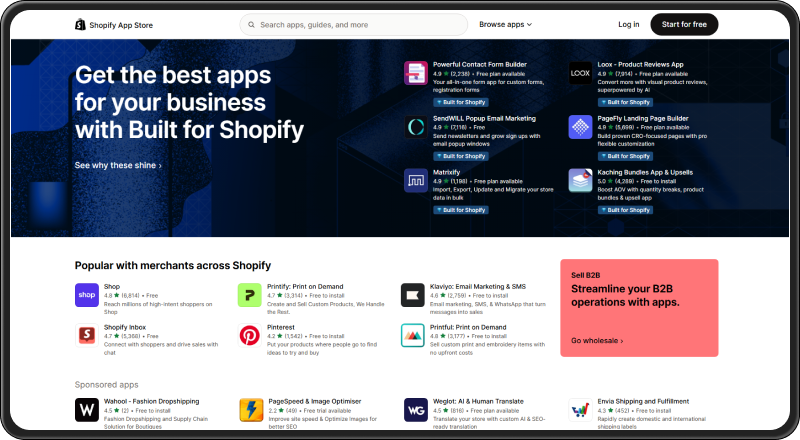
Software Type: SaaS-based
Shopify is one of the world’s most popular eCommerce platforms and supports marketplace functionality through third-party multi-vendor applications. It is known for its ease of use, reliable hosting, and extensive app ecosystem.
Key Features
- User-friendly dashboard
- Hosted infrastructure
- Large app marketplace
- Mobile-responsive themes
- Secure payment processing
- Marketing and SEO tools
| Advantages | Limitations |
| Easy to launch and manage | Marketplace features rely on external apps |
| Minimal technical maintenance | Ongoing subscription and app costs |
| Reliable performance and security | Limited flexibility for complex marketplace workflows |
Best For
- Small online marketplaces
- Fashion and lifestyle platforms
- Startup MVP launches
4 . Magento with Multi-Vendor Extensions

Software Type: SaaS-based, On-Premise
Magento is a highly scalable and customisable software that can be transformed into a marketplace using multi-vendor extensions. It is widely preferred by businesses requiring enterprise-level flexibility and advanced marketplace functionality.
Key Features
- Advanced catalogue management
- Strong SEO capabilities
- Extensive extension ecosystem
- Enterprise-grade scalability
- Flexible customisation options
| Advantages | Limitations |
| Highly customisable platform | Complex setup and management |
| Suitable for complex business requirements | Higher development and maintenance costs |
| Large global developer community | Requires high technical expertise |
Best For
- Enterprise marketplaces
- Large-scale B2B marketplaces
- Highly customised marketplace projects
5. CS-Cart Multi-Vendor
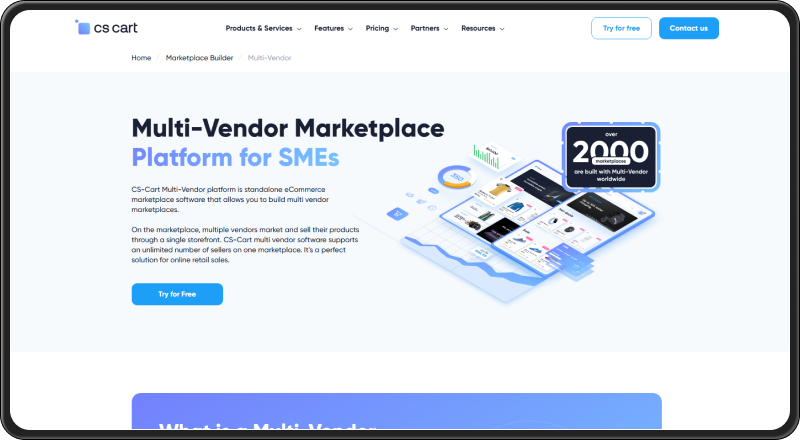
Software Type: Self-hosted
CS-Cart is a self-hosted multi-vendor marketplace solution designed specifically for online marketplace businesses. The platform offers several built-in marketplace functionalities suitable for startups and growing businesses.
Key Features
- Multi-vendor management
- Commission management
- Product approval workflows
- SEO-friendly structure
- Inventory management
- Payment gateway integrations
| Advantages | Limitations |
| Marketplace-focused architecture | Premium add-ons may increase costs |
| Self-hosted ownership | The interface may require modernisation |
| Good customisation flexibility | Advanced customisations may need developer support |
Best For
- Mid-sized marketplaces
- Multi-vendor retail platforms
- Growing startup marketplaces
6. Arcadier

Software Type: SaaS-based
Arcadier is a SaaS-based marketplace builder that supports product, service, booking, and rental marketplace models. The platform focuses on helping startups launch marketplaces quickly with minimal technical involvement.
Key Features
- Marketplace templates
- Vendor management
- Payment integrations
- Booking functionality
- Mobile-responsive design
- Drag-and-drop tools
| Advantages | Limitations |
| Faster deployment | Subscription-based pricing |
| Supports multiple marketplace models | Limited deep customisation |
| Hosted infrastructure included | Scalability challenges for larger platforms |
Best For
- Small startups
- Service marketplaces
- Rental and booking platforms
7. Mirakl
Software Type: Cloud-based
Mirakl is an enterprise-grade marketplace platform designed for large businesses and global retailers looking to expand into marketplace commerce. The platform is known for its advanced automation capabilities and enterprise scalability.
Key Features
- Enterprise marketplace infrastructure
- Vendor onboarding automation
- Advanced analytics and reporting
- API integrations
- Workflow automation
- Scalable cloud infrastructure
| Advantages | Limitations |
| Enterprise-level scalability | Expensive for startups |
| Suitable for high-volume marketplaces | Complex implementation process |
| Reliable infrastructure | Requires larger operational resources |
Best For
- Enterprise marketplaces
- Global B2B platforms
- Large retailer marketplaces
At a Glance: Marketplace Software Comparison Table
| Software | Pricing Model | Customisation | Scalability | SEO Features | Startup Friendly | Best For |
| Yo!Kart | One-Time Licence | High | High | Strong Built-In SEO | Excellent | Multi-vendor, B2B, Hyperlocal, Wholesale |
| Sharetribe | Monthly Subscription | Moderate | Moderate | Basic SEO | Good | Service & Rental Marketplaces |
| Shopify | Monthly Subscription | Moderate | Moderate | Good SEO | Excellent | Small Online Marketplaces |
| Magento | Development-Based | Very High | Very High | Advanced SEO | Moderate | Enterprise & Custom Marketplaces |
| CS-Cart | Licence-Based | High | High | Good SEO | Good | Mid-Sized Multi-Vendor Marketplaces |
| Arcadier | Subscription-Based | Moderate | Moderate | Basic SEO | Good | Service & Booking Platforms |
| Mirakl | Enterprise Pricing | Very High | Enterprise-Level | Advanced SEO | Limited | Large Enterprise Marketplaces |
Stay Ahead of the Industry Competition and Invest in the Proven Solution!
Common Challenges Faced by Marketplace Startups
Launching a marketplace business can offer significant growth opportunities, but it also comes with several operational and strategic challenges. Even with the right eCommerce marketplace software, startups need to carefully manage different aspects of marketplace growth to remain competitive and sustainable.
Therefore, understanding these common challenges can help businesses prepare better and build stronger marketplace strategies from the beginning.
1. Attracting Buyers and Sellers
One of the biggest challenges for any marketplace startup is balancing both sides of the platform. Therefore, a marketplace needs enough vendors to attract customers and enough customers to encourage vendors to join. Without this balance, marketplace growth can slow down significantly.
Solution
The business owners can address this challenge effectively by focusing on niche markets, offering vendor incentives, running targeted marketing campaigns, and associating in strategic partnerships in the business niches.
2. Building Customer Trust
A robust eCommerce marketplace software for startups needs to offer a secure and client-oriented platform that enables secure transactions, reliable vendors, genuine product listings, transparent policies, and timely delivery. Overall, trust plays a major role in marketplace success.
Solution
To cater to this challenge, the business owner needs to integrate their platform with features such as ratings and reviews, vendor verification, secure payment systems, and buyer protection policies that assist in building long-term customer confidence.
3. Managing Competition
The online eCommerce marketplace industry is highly competitive. The industry has witnessed many startups compete against established platforms with larger budgets and wider audiences. Therefore, it is important to cater to your target audience to stand out in the industry.
Solution
A business owner can choose a scalable and flexible eCommerce Marketplace Software to differentiate their marketplace experience more effectively. Some of the features that assist in managing the competition are niche market positioning, better customer experience, specialised product categories, faster support, and integrating the marketplace with unique value propositions.
4. Vendor Management Challenges
As the number of vendors grows, marketplace management becomes more complex. Some of the common vendor-related challenges include product quality control, inventory management, order fulfilment issues, vendor disputes, commission tracking, and more.
Solution
For effectively catering to this challenge, a startup owner can integrate the marketplace software with strong vendor management features and functionalities, which can help automate many of these processes and improve operational efficiency.
5. Technical Scalability
As traffic and transactions increase, marketplaces need stronger infrastructure and performance optimisation. Startups may face issues related to website speed, server performance, database management, security, and mobile responsiveness
Solution
To achieve technical scalability, the business owners or aspiring entrepreneurs should choose self-hosted platforms like Yo!Kart that assists businesses in handling growth more efficiently without requiring complete platform migrations.
6. Customer Acquisition Costs
Another major challenge faced by the industry is the cost of acquiring customers on the eCommerce marketplace and generating consistent traffic. It can become an expensive venture, especially in competitive industries.
Solution
To cater to this challenge, marketplace startups often invest heavily in SEO, paid advertising, social media marketing, influencer campaigns, email marketing, and more. Businesses with SEO-friendly marketplace software with in-built marketing tools can improve organic visibility and reduce long-term customer acquisition costs.
7. Managing Operations Efficiently
Marketplace operations involve multiple steps to complete a business transaction, including vendor onboarding, payments, shipping, returns, customer support, marketing campaigns, and more. This procedure, without proper automation, can quickly increase the operational complexity.
Solution
To effectively manage the eCommerce marketplace, startups often prefer marketplace software that offers end-to-end operational convenience, with built-in management tools that simplify day-to-day operations.
8. Maintaining Platform Security
Online marketplaces handle sensitive customer and payment data, making it important to offer secure transactional convenience to the users. These security challenges may include fraud prevention, payment security, user data protection, fake accounts, spam product listings, adn more.
Solution
A start-up business owner must look for a reliable and experienced software that has been delivered to global businesses with a security-compliant infrastructure. Strong security infrastructure and compliance measures are essential for maintaining platform credibility and customer trust.
Although marketplace startups face several challenges, the right business strategy and reliable eCommerce Marketplace Software can significantly improve operational efficiency, scalability, and long-term growth potential.
How Yo!Kart Helps Solve Common Marketplace Challenges?
Building and scaling an online marketplace comes with several operational and technical challenges. From vendor management and customer acquisition to scalability and SEO, startups often struggle to manage multiple aspects of marketplace growth simultaneously.
This is where Yo!Kart helps businesses streamline marketplace operations through its built-in marketplace-focused features and scalable architecture.
1. Simplified Multi-Vendor Management
Managing multiple vendors manually can quickly become complicated as the marketplace grows. Yo!Kart simplifies vendor operations through dedicated seller dashboards, product and inventory management, order management tools, commission management, and vendor approval workflows.
These features help marketplace owners manage vendors more efficiently while allowing sellers to independently control their business activities.
2. Faster Marketplace Launch
Developing a marketplace from scratch often requires significant time and technical resources. Yo!Kart offers ready-made marketplace functionalities that help startups to reduce development timelines, launch faster, lower technical complexity, and focus on business growth.
This allows startups to validate their marketplace idea and enter the market more quickly.
3. Scalable Marketplace Architecture
As marketplaces grow, they need software capable of handling increasing traffic, more vendors, larger product catalogues, and higher transaction volumes.
Effectively, Yo!Kart is designed with scalability in mind, helping businesses expand without major operational disruptions or platform limitations.
4. Built-In SEO-Friendly Features
Organic traffic is essential for marketplace growth. Therefore, Yo!Kart includes several SEO-focused features, such as SEO-friendly URLs, meta tag management, mobile responsiveness, fast-loading pages, and structured website architecture.
These capabilities help marketplaces improve search engine visibility and attract long-term organic traffic.
5. Improved Customer Experience
A better shopping experience can improve customer retention and increase conversions. Hence, the customer experience directly impacts marketplace success. Catering to this industry demand, Yo!Kart helps improve user engagement through
- Mobile-responsive design
- Advanced search and filtering
- Easy product navigation
- Secure checkout process
- Multiple payment gateway integration
6. Flexible Revenue Generation
Marketplace businesses often rely on multiple monetisation models. Multiple revenue channels offer flexibility that helps startups build sustainable income. Yo!Kart is fully equipped to support diverse revenue streams, such as
- Commission-based earnings
- Subscription models
- Featured listings
- Advertising opportunities
7. Strong Security and Performance
For a start up, security and reliability are critical for building customer trust. The following features of Yo!Kart help startups maintain secure and reliable marketplace operations.
- Secure payment processing
- Data protection
- User authentication
- Platform stability
- GDPR compliance
8. Extensive Customisation Flexibility
Businesses can create personalised marketplace experiences according to their niche and target audience with Yo!Kart. Every marketplace startup has different operational requirements, and the software offers customisation flexibility for
- Design and themes
- Marketplace workflows
- Third-party integrations
- Payment methods
- Industry-specific features
9. Suitable for Multiple Marketplace Models
The flexible architecture of Yo!Kart makes the platform suitable for startups across multiple industries. It supports various marketplace business models, including, but not limited to,
- B2C marketplaces
- B2B marketplaces
- Hyperlocal marketplaces
- Rental marketplaces
- Wholesale marketplaces
- Niche marketplaces
By addressing many common marketplace challenges through built-in functionalities and scalable infrastructure, Yo!Kart helps startups focus more on growth, customer acquisition, and long-term business success rather than operational complexity.
Conclusion
The online marketplace industry continues to create enormous opportunities for startups across multiple sectors, including retail, B2B commerce, rentals, hyperlocal delivery, and service-based businesses. However, building a successful marketplace requires more than just a strong business idea. Choosing the right eCommerce marketplace software plays a critical role in determining your platform’s scalability, operational efficiency, customer experience, and long-term growth potential.
With several marketplace solutions available today, startups should carefully evaluate factors such as scalability, customisation flexibility, SEO capabilities, vendor management, mobile responsiveness, and overall cost before making a decision.
The right choice ultimately depends on your business goals, technical requirements, and future expansion plans. For startups looking to build scalable and feature-rich multi-vendor marketplaces, Yo!Kart stands out as a strong solution due to its marketplace-focused architecture, extensive built-in functionalities, SEO-friendly framework, and cost-effective one-time licence model.
As competition in the marketplace industry continues to increase, investing in reliable and future-ready eCommerce marketplace software can help startups launch faster, manage operations more efficiently, attract customers organically, and scale successfully in the evolving digital commerce landscape.
Frequently Asked Questions (FAQs)
Q 1. What is eCommerce Marketplace Software?
Ans. An eCommerce Marketplace Software is a solution that allows businesses to create online marketplaces where multiple vendors can sell products or services through a single website or application.
It helps manage vendors, products, payments, commissions, orders, and customer interactions efficiently.
Q 2. Which is the best eCommerce Marketplace Software for startups?
Ans. The best marketplace software depends on business goals, budget, scalability requirements, and customisation needs.
Many startups prefer solutions like Yo!Kart because it offers built-in marketplace functionalities, scalability, SEO-friendly architecture, and a one-time licence model.
Q 3. How much does it cost to build a marketplace platform?
Ans. The cost varies depending on the development approach.
- Custom marketplace development can cost significantly more and require longer timelines.
- SaaS marketplace solutions usually involve monthly subscription fees.
- Self-hosted marketplace software often provides a more cost-effective long-term solution.
Using ready-made marketplace software can help startups reduce overall development costs and launch faster.
Q 4. What is the difference between SaaS and self-hosted marketplace software?
Ans. SaaS marketplace software is hosted and managed by the provider, usually through a monthly subscription model.
Self-hosted marketplace software gives businesses full ownership and control over the platform, including hosting, customisation, and infrastructure management.
Startups often choose self-hosted solutions for greater scalability and long-term flexibility.
Q 5. Can marketplace software support mobile users?
Ans. Yes, most modern eCommerce Marketplace Software solutions are mobile responsive and designed to support users across smartphones, tablets, and desktops.
Some platforms also offer dedicated mobile apps or Progressive Web App (PWA) support.
Q 6. Is eCommerce Marketplace Software SEO-friendly?
Ans. Many marketplace platforms include built-in SEO capabilities, such as SEO-friendly URLs, meta tag management, mobile optimisation, fast-loading pages, and structured website architecture.
SEO-friendly marketplace software such as Yo!Kart helps businesses improve organic visibility and attract long-term traffic from search engines.
Q 7. How long does it take to launch a marketplace?
Ans. The launch timeline depends on the software and level of customisation required.
- SaaS platforms may take a few days or weeks
- Self-hosted solutions may require several weeks
- Custom-built marketplaces can take several months
Ready-made marketplace software helps startups reduce launch timelines significantly.
Q 8. Can marketplace software support multiple business models?
Ans. Yes, modern eCommerce marketplace software such as Yo!Kart can support various business models, including:
- B2C marketplaces
- B2B marketplaces
- Service marketplaces
- Rental marketplaces
- Hyperlocal marketplaces
- Wholesale marketplaces
This flexibility allows startups to build marketplaces according to their niche and target audience.
Q 9. Why is scalability important for marketplace startups?
Ans. As marketplaces grow, they need to support more vendors, higher customer traffic, larger product catalogues, and increased transaction volumes.
Therefore, scalable marketplace software helps businesses grow without major operational or technical limitations.
Q 10. Why do startups choose Yo!Kart for marketplace development?
Ans. Many startups choose Yo!Kart because it offers:
- Marketplace-focused architecture
- One-time licence pricing
- Strong scalability
- SEO-friendly features
- Multi-vendor management
- Extensive customisation flexibility
These features make it suitable for startups looking to build scalable and long-term marketplace businesses.
Launch Your Powerful eCommerce Marketplace with Yo!Kart!
Contact UsPopular Posts