
Published Date 09th Jan 2026
The global eCommerce landscape is evolving rapidly, and in 2026, launching a successful online marketplace remains one of the most lucrative opportunities for entrepreneurs and enterprises alike. Unlike conventional online stores that only sell products from a single seller, a marketplace brings multiple vendors together on a single digital platform, much like Amazon, Etsy, or eBay. This approach allows businesses to scale rapidly, diversify offerings, and tap into new customer segments.
In this comprehensive blog, you will explore the top eCommerce marketplace builders in 2026, tools that enable anyone from bootstrapped founders to large enterprises to launch feature-rich, scalable marketplaces without building everything from scratch. Additionally, you will know about what a marketplace is, key factors to consider when selecting the right builder, detailed reviews of leading platforms, a comparison table, and a clear conclusion.
Whether you plan to build a product marketplace, a services platform, or a niche vertical-specific marketplace, this blog will help you choose the best marketplace builder to bring your idea to life.
Table of Contents
What is an eCommerce Marketplace?
An eCommerce marketplace is an online platform where multiple sellers can list their products or services, while buyers can browse, compare, and purchase from different vendors, all in one place. Unlike standalone eCommerce stores, marketplaces facilitate the connection between sellers and buyers while typically earning revenue through commissions, subscriptions, or listing fees.
Some key features of eCommerce marketplaces include:
- Multi-vendor support: Enables multiple sellers to register and sell under one platform.
- Vendor dashboards: Give sellers control over product listings, inventory, and order tracking.
- Centralized checkout: Buyers experience a unified checkout flow even when purchasing from different vendors.
- Commission management: Admins can set different commission structures for different vendors.
- Reviews and ratings: Build trust among users and help buyers make informed decisions.
Building a marketplace from scratch involves complex development work, involving vendor management systems, secure payment integrations, and scalable infrastructure. That’s where eCommerce marketplace builders come in, offering ready-to-use solutions to accelerate deployment and reduce technical overhead.
Real-world Examples
- Amazon: The largest global marketplace, offering everything from books to electronics.
- Etsy: A niche marketplace focused on handmade and vintage goods.
- Alibaba: A B2B marketplace connecting global suppliers and buyers.
These examples highlight how marketplaces can serve diverse niches, from mass retail to highly specialized industries.
Create Your Own Multi-Vendor eCommerce Marketplace Similar to Amazon or Etsy
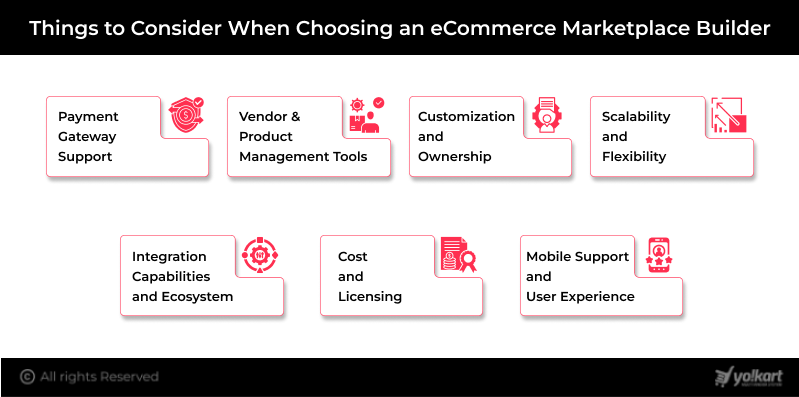
Things to Consider When Choosing an eCommerce Marketplace Builder
Selecting the right eCommerce marketplace builder is one of the most strategic decisions you’ll make on your entrepreneurial journey to launch a successful marketplace platform. The choice you make today will shape your operational efficiency, vendor relationships, customer satisfaction, and long-term scalability. Thus, each option should be evaluated thoughtfully.
Below are the essential factors every business should assess before committing to a marketplace platform:
1. Scalability and Flexibility
A marketplace should be built not only to cater to current needs but also for future growth. This means choosing a marketplace solution that can scale seamlessly as you add more vendors, products, users, and global audiences. Further, a scalable marketplace builder handles increased traffic, larger catalogs, and more complex workflows without performance degradation or costly migrations.
Key questions to ask:
- Can the platform support your projected growth?
- Does it allow easy upgrades and feature add-ons?
- Will performance remain stable under peak usage?
2. Customization and Ownership
Every marketplace has unique requirements, from branding and UX design to specialized workflows and integrations. Some builders offer limited configuration within predefined templates, while others provide deep customization or full source code ownership.
Owning the source code empowers you to:
- Tailor features to your exact business model.
- Integrate with legacy systems or third-party services.
- Differentiate from competitors with custom functions.
3. Vendor and Product Management Tools
The success of a marketplace depends on how well vendors can operate on the platform. However, for vendors to perform well, a robust marketplace builder must include comprehensive tools for vendor onboarding, catalog management, pricing controls, and commission structures.
Features to look for include:
- Automated seller onboarding workflows
- Inventory and product categorization tools
- Vendor dashboards with performance analytics
- Custom commission rates and payout automation
4. Payment Gateway Support
Seamless and secure payment processing is critical to converting visitors into paying customers and satisfying sellers who expect timely payouts. Hence, your selected marketplace builder should support smooth transactions and timely payouts.
A good marketplace builder should support:
- Multiple global payment gateways
- Multi-currency processing
- Escrow or split payment capabilities
- Compliance with international payment standards, such as PCI DSS
5. Mobile Support and User Experience
Mobile commerce now drives a significant portion of eCommerce traffic. Thus, your marketplace must offer a responsive user interface or dedicated mobile applications that deliver fast, intuitive experiences, from product discovery to checkout.
Consider whether the provider offers:
- Responsive design and mobile-friendly layouts
- Smooth navigation and search features
- Performance-optimized mobile UI elements
6. Cost and Licensing
Marketplace builders vary widely in cost structure, ranging from one-time self-hosted licenses to subscription-based SaaS offerings. Understanding the full cost is critical to long-term planning.
Evaluate:
- Upfront costs versus the lifetime total cost of ownership
- Recurring subscription fees and transaction charges
- Costs for custom features, hosting, maintenance, or support
Suggested Read: Cost to Build a Marketplace Website in 2026
7. Integration Capabilities and Ecosystem
A marketplace rarely operates as standalone systems. Ensuring the builder you choose can integrate with your existing business stack, such as CRM systems, marketing platforms, analytics tools, and logistics solutions, is essential for operational efficiency.
Good integration capabilities mean:
- Seamless data exchange across systems
- Efficient workflows between departments
- Greater automation and fewer manual tasks
By carefully evaluating each of these factors, you’ll be better positioned to choose an eCommerce marketplace builder that not only meets your current needs but also supports future growth, drives higher engagement, and enables sustainable revenue generation.
Top eCommerce Marketplace Builders in 2026
Here’s a curated list of the top eCommerce marketplace builders you should consider in 2026. Each platform enables you to launch and scale a multi-vendor marketplace, but they differ in deployment, flexibility, target users, and scalability.
1. Yo!Kart
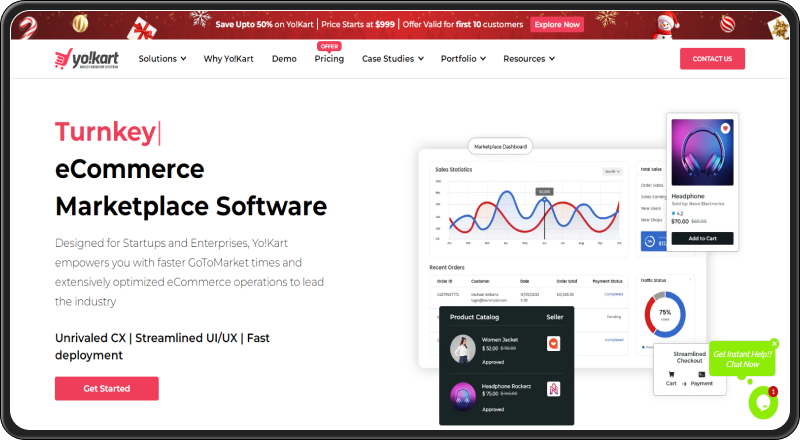
Yo!Kart is a self-hosted, purpose-built eCommerce marketplace builder ideal for businesses that want full control over their marketplace. Built to support both product and service marketplaces, it includes advanced vendor and order management. With a strong focus on performance, security, and extensibility, Yo!Kart enables businesses to evolve their marketplace alongside changing market demands while maintaining full control over their technology stack. Further, it offers a one-time license with lifetime ownership, minimizing long-term costs while providing deep customization and ownership. It also supports diverse marketplace models, including B2C, B2B, and service-based platforms, without structural limitations.
Key Features & Benefits:
- Self-hosted solution with full source-code access for customization.
- Advanced vendor dashboards, analytics, and commission tracking.
- Multi-currency, multilingual support, and SEO-friendly architecture.
- Multiple secure payment gateways and split payments.
- Includes up to 1 year of free technical support.
Best For: Startups, SMBs, and enterprises seeking a fully owned, scalable marketplace with robust built-in features.
Take a Guided Walkthrough of Yo!Kart
2. CS-Cart Multi-Vendor
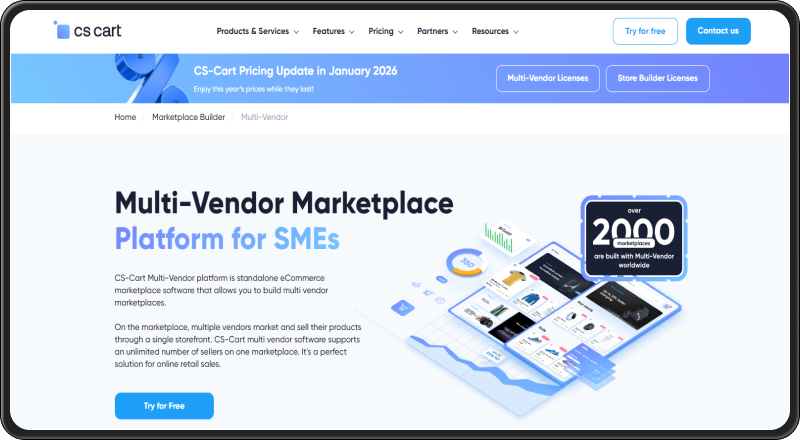
CS-Cart Multi-Vendor is a self-hosted marketplace builder with a strong emphasis on administrative control and operational stability. It supports core marketplace operations like product moderation, flexible commissions, and payout controls. Its admin panel is straightforward, and add-ons allow added functionality without complex coding. While its design feels traditional compared to newer SaaS tools, its reliability and upgrade options make it attractive for established marketplaces.
Key Features & Benefits:
- Built-in vendor dashboards and commission management.
- Flexible shipping and payment configurations.
- Add-on marketplace modules and API integrations.
Best For: Businesses that want backend control with options to extend functionality through modules.
3. Sharetribe
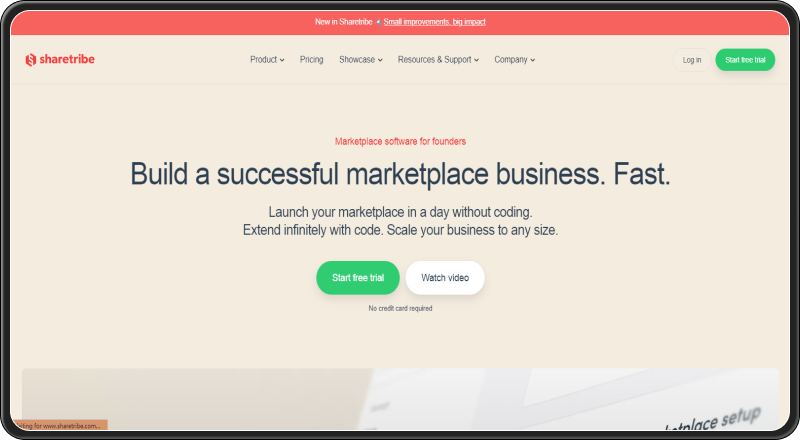
Sharetribe is a cloud-based marketplace builder focused on simplicity and speed. It emphasizes speed to market and ease of use, making it a popular choice for validating ideas and testing niche concepts. It offers vendor onboarding, integrated payments, and essential marketplace workflows in a clean and accessible interface. While it trades flexibility for simplicity, Sharetribe is effective for early-stage marketplaces that value fast iteration and lower operational overhead.
Key Features & Benefits:
- No-code setup with built-in marketplace essentials.
- Clean, responsive design for buyers and sellers.
- Supports Stripe, PayPal, and basic vendor tools.
Best For: Startups and niche marketplaces looking to test ideas quickly.
4. Arcadier
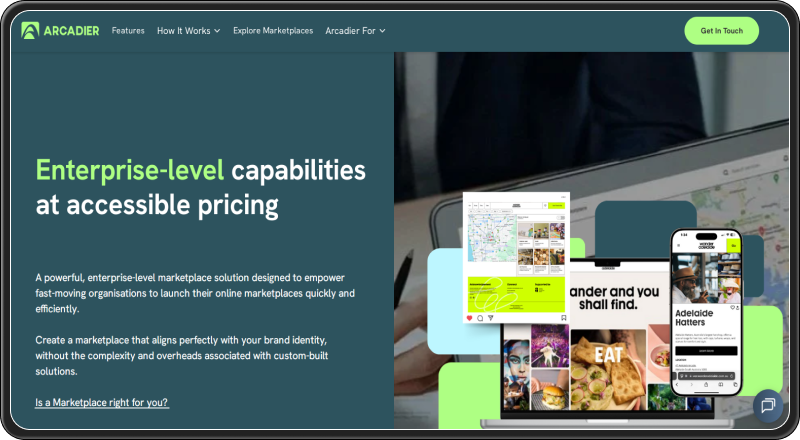
Arcadier is a SaaS-based marketplace builder that enables entrepreneurs to create marketplaces for products, services, bookings, or rentals in a short timeframe. With ready-to-use templates and a drag-and-drop setup, Arcadier reduces development effort for founders. The platform supports a wide range of marketplace use cases and provides a structured environment for managing listings and users.
Key Features & Benefits:
- Drag-and-drop marketplace creation.
- Multi-currency and multi-language ready.
- Cloud hosting and scalability built into the platform.
Best For: Entrepreneurs and SMEs who need a quick launch with minimal setup.
5. Magento with Marketplace Extensions

Magento (Adobe Commerce) is a powerful eCommerce solution that can be turned into a marketplace using marketplace extensions. This approach allows marketplaces to leverage Magento’s enterprise-grade foundation while tailoring workflows to complex or high-volume requirements. It’s suited to businesses with established development teams looking for control over marketplace logic. Custom integrations, complex workflows, and enterprise-grade features are possible, but require technical expertise.
Key Features & Benefits:
- Leverages Magento’s powerful commerce backend.
- Supports multi-store catalogs and advanced product management
- Highly customizable workflows and integrations.
Best For: Large or enterprise marketplaces with dedicated development resources.
6. WooCommerce + Marketplace Plugins
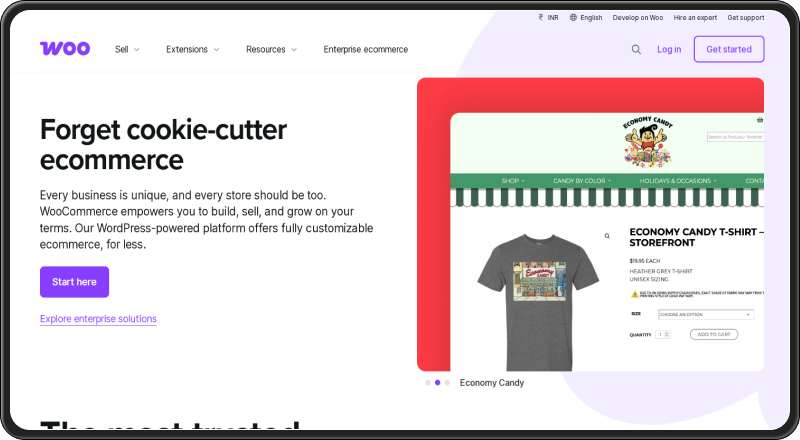
WooCommerce, combined with marketplace plugins, is a popular choice for businesses already invested in the WordPress ecosystem. It offers a familiar environment, extensive community resources, and freedom to experiment with layouts and extensions. However, as vendor count and traffic increase, maintaining performance, security, and consistency often requires careful optimization and experienced technical oversight.
Key Features & Benefits:
- Adds vendor dashboards, commission tools, and product management.
- Extremely flexible with WordPress plugins.
- Affordable entry point for small to mid-size marketplaces.
Best For: Small and medium marketplaces, especially WordPress-centric projects.
7. Shopify Plus with Multi-Vendor Apps
Shopify Plus itself is a comprehensive eCommerce platform. When paired with multi-vendor marketplace apps, it becomes a marketplace builder. This is ideal for established brands that want enterprise-grade infrastructure with high uptime and support. Because Shopify doesn’t natively support multi-vendor logic, you’ll rely on extensions to add vendor functionality. Still, its robust hosting, security, and ecosystem make it a reliable choice.
Key Features & Benefits:
- Enterprise SaaS platform with scalable hosting.
- Large partner ecosystem and app integrations.
- Excellent uptime and support.
Best For: Established brands looking for SaaS convenience and marketplace extensions.
8. Marketplacer
Marketplacer is built for organizations that view marketplaces as a core enterprise strategy rather than an experimental channel. It offers strong vendor onboarding, analytics, and API-first flexibility, making it suitable for businesses that need to integrate deeply with ERP, CRM, or logistics systems. This solution excels when scaling globally but is typically aimed at larger organizations with significant budgets and technical resources.
Key Features & Benefits:
Best For: Large enterprises and B2B marketplaces with complex system needs.
Looking for a Robust eCommerce Marketplace Builder?
9. Mirakl

Mirakl is a high-end SaaS marketplace builder used by large retailers and global brands to run multi-vendor ecosystems. It supports extensive catalog management, vendor onboarding, and multi-country operations. Mirakl is built for performance and reliability at scale, often integrating with enterprise commerce stacks. Due to its complexity and pricing model, Mirakl is typically adopted by organizations with established digital infrastructure.
Key Features & Benefits:
- Enterprise-grade marketplace orchestration.
- Strong catalog and vendor management workflows.
- Multi-region support and analytics.
Best For: Large retailers and enterprises needing robust marketplace infrastructure.
10. X-Cart Multi-Vendor
X-Cart Multi-Vendor is an open-source marketplace platform that enables businesses to build multi-vendor marketplaces with deep customization. Its modular architecture allows developers to tailor workflows, integrate APIs, and scale as needed. While powerful, it requires ongoing development effort to manage updates, security, and scalability effectively.
Key Features & Benefits:
- Highly customizable with open-source flexibility.
- Vendor dashboards and marketplace management tools.
Best For: Tech-savvy teams building tailored marketplace experiences.
Top eCommerce Marketplace Builders Compared: Which One Is Right for You?
Choosing the best eCommerce marketplace software in 2026 requires balancing your business needs with the strengths of each solution. Some solutions offer fast, no‑code setups ideal for MVPs and niche marketplaces, while others provide deep customization, ownership, and enterprise‑grade scalability for large operations. By comparing key metrics like hosting model, pricing structure, source code ownership, demo availability, and technical support, you can identify the platform that aligns with your goals and long‑term growth strategy. This side‑by‑side view helps you make an informed decision that fits your budget, technical resources, and marketplace vision.
| Platform | Hosting | Pricing | Source Code | Free Demo/Trial | Technical Support |
| Yo!Kart | Self-hosted | One-time license | Yes | Live demo available | Included initial support |
| CS-Cart Multi-Vendor | Self-hosted/Cloud | One-time or subscription | Yes | 14-day trial | Paid support plans |
| Sharetribe | SaaS | Monthly subscription | No | Free trial | Plan-based support |
| Arcadier | SaaS | Subscription/Enterprise | No | Demo on request | Included (plan-based) |
| Magento + Extensions | Self-hosted/Cloud | Free core + add-on costs | Yes (open-source) | Community edition | Community/Paid |
| WooCommerce + Plugins | Self-hosted | Free + plugin fees | Yes (open-source) | Plugin demos vary | Community/Paid |
| Shopify Plus + Apps | SaaS | Subscription + app fees | No | Trial available | 24/7 platform support |
| Marketplacer | SaaS (Enterprise) | Custom pricing | No | Demo on request | Enterprise support |
| Mirakl | SaaS (Enterprise) | Custom pricing | No | Demo on request | Enterprise-grade |
| X-Cart Multi-Vendor | Self-hosted | One-time or subscription | Yes | Demo available | Plan-based support |
Suggested Read: Top 20 Multi-vendor eCommerce Marketplace Platforms in 2026
Choosing the right eCommerce marketplace builder depends on your need for control, scalability, and long-term flexibility. While SaaS platforms are suitable for quick launches, they can limit growth over time. For full ownership, deep customization, and a marketplace-first approach, Yo!Kart stands out as a strong choice for building and scaling a sustainable marketplace in 2026.
Turn Your Marketplace Idea Into a Scalable Online Business
Conclusion
Choosing the right eCommerce marketplace builder is a foundational step in building a thriving online eCommerce multi-vendor marketplace. In 2026, businesses can choose from a wide range of options, from self-hosted solutions like Yo!Kart and CS-Cart to SaaS platforms like Sharetribe and enterprise solutions such as Mirakl. Each marketplace Builder offers distinct benefits across pricing models, scalability, customization, and deployment speed.
For businesses seeking long-term ownership, high scalability, and a marketplace-focused solution, Yo!Kart remains one of the most compelling choices. Meanwhile, for quick launches or specific niche marketplaces, SaaS options like Sharetribe or Arcadier provide simple entry points with minimal technical requirements.
Ultimately, the right choice depends on your business goals, budget, technical resources, and growth plans. With this guide, you’re now equipped to make an informed decision and confidently embark on your marketplace development journey in 2026.
Frequently Asked Questions (FAQs)
Q 1. What exactly is an eCommerce marketplace, and how is it different from a regular online store?
Ans. An eCommerce marketplace is a platform where multiple sellers can list their products or services, and buyers can browse and purchase from many vendors in one place. Unlike a traditional single-seller online store, a marketplace facilitates interactions between many sellers and buyers, often earning revenue through commissions, subscriptions, or listing fees.
Q 2. Do I need technical skills to build a marketplace?
Ans. No, you do not need to be a tech expert to build a marketplace. Many modern marketplace builders offer no‑code or low‑code tools that let you launch without deep technical knowledge. Self‑hosted solutions may require some setup assistance, but many also include support or setup services to help non‑technical founders get started.
Q 3. How much does it cost to build and maintain a marketplace?
Ans. The cost to build and maintain a maerketplace vary widely based on the builder you choose. Self-hosted solutions like Yo!Kart typically offers one-time licenses starting from $499 and can go higher based on features, with no recurring fees. SaaS-based marketplace builders usually charge monthly subscriptions,
Q 4. Can I build a marketplace for both products and services?
Ans. Yes, you can build a marketplace for products and services. Many builders support both types of marketplaces. However, some platforms are especially strong for product marketplaces, while others are flexible enough to support service marketplaces such as booking services or peer‑to‑peer offerings.
Q 5. What payment options do marketplace builders support?
Ans. Robust marketplace builders will support multiple payment gateways, multi‑currency transactions, and features like split payments or escrow. This ensures that buyers have flexible payment choices and vendors receive payouts smoothly and securely.
Q 6. Will my marketplace be mobile‑friendly?
Ans. Mobile compatibility is essential today, as many buyers browse and purchase on smartphones. Moreover, most modern marketplace builders offer responsive design or even native mobile apps to ensure a smooth user experience across devices.
Q 7. What level of support should I expect from a marketplace builder provider?
Ans. Support varies by the provider and plan you choose. Some builders include dedicated technical support for months after purchase, while SaaS builders offer support tiers as part of their subscription. Therefore, you should always review support coverage before committing to a platform.
Q 8. Can I scale my marketplace as it grows?
Yes, you can scale your marketplace as your business grows. However, the level of scalability depends on the solution. Enterprise‑grade builders and self‑hosted solutions generally offer greater control and scalability for large vendor counts, high traffic, and complex operations. Simpler SaaS platforms may be easier to start with, but can have limits as your business grows.
Q 9. Why do businesses often choose Yo!Kart as their marketplace builder?
Many businesses choose Yo!Kart because it’s a purpose‑built marketplace solution with full source‑code access, deep customization, and scalable architecture. It supports multilingual and multi‑currency operations, advanced vendor tools, and includes free technical support during the early stages, making it suitable for startups, SMBs, and enterprises looking for long‑term control and flexibility.
Ready to Build a Future-Proof eCommerce Marketplace?
Get In TouchPopular Posts