


Published Date 13th May, 2026
Launching an online marketplace is exciting, but scaling one successfully is where the real challenge begins. What works during the initial stages of your marketplace may start creating bottlenecks as your business grows and customer expectations evolve. Moreover, slow performance, limited customization, rising operational costs, or poor vendor management can quickly turn growth into annoyance.
This is why many marketplace businesses eventually reach an important crossroads: Should you continue struggling with platform limitations or switch to a solution built for long-term growth? Migrating to a new marketplace platform directly impacts scalability, operational efficiency, vendor experience, and future profitability.
If you are considering a marketplace platform migration, this guide will help you understand why businesses switch platforms, common migration challenges, key features to evaluate, and how to ensure a smooth transition without disrupting growth.
Table of Contents
- Why Businesses Switch Marketplace Platforms?
- Challenges of Marketplace Platform Migration
- Key Features to Look for in a New Marketplace Platform
- How to Successfully Migrate to a New Marketplace Platform?
- Why Scalability Matters in Marketplace Businesses?
- Yo!Kart: A Scalable Marketplace Solution for Long-Term Growth
- Conclusion
- FAQs
Why Businesses Switch Marketplace Platforms?
Choosing the right marketplace platform is a foundational decision for any online marketplace business. While many businesses initially prioritize a platform based on affordability, quick deployment, or short-term business needs, operational challenges often begin to surface as the marketplace grows.
As vendor networks expand, customer expectations evolve, and transaction volumes increase, businesses frequently realize that their existing marketplace software is no longer capable of supporting their long-term growth strategy. Furthermore, performance bottlenecks, limited flexibility, rising maintenance costs, and inadequate vendor management capabilities are among the key factors driving marketplace platform migration.
Below are some of the most common reasons businesses migrate to a new marketplace platform:
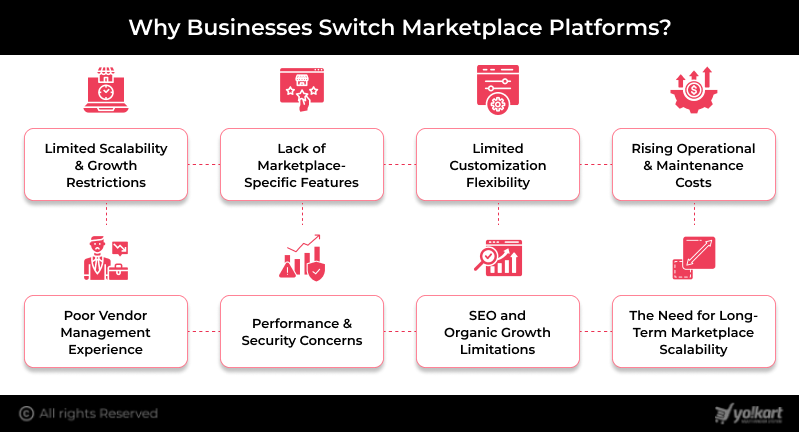
1. Limited Scalability and Growth Restrictions
Scalability is one of the biggest concerns for growing marketplace businesses. Many platforms work efficiently during the early stages but struggle when businesses begin handling higher website traffic, large product catalogs, multiple vendors, complex order management, international expansion, and increased customer activity. Without scalable infrastructure, performance bottlenecks, slow-loading pages, and operational inefficiencies can begin affecting both customer experience and vendor satisfaction.
As a result, businesses often migrate to scalable marketplace platforms that can support long-term expansion without compromising performance.
2. Lack of Marketplace-Specific Features
Not all eCommerce platforms are designed specifically for multi-vendor marketplaces. Many businesses initially build marketplaces using traditional eCommerce systems that require heavy third-party plugin dependency to support vendor management and marketplace operations.
Over time, this dependency can create technical limitations, compatibility issues, complex maintenance requirements, and higher operational costs. As a result, businesses often move toward purpose-built marketplace software that includes native capabilities such as vendor dashboards, commission management, multi-vendor order processing, subscription systems, product moderation, and vendor analytics.
Solutions like Yo!Kart is specifically developed for multi-vendor marketplaces, helping businesses streamline operations while reducing dependency on fragmented plugin ecosystems.
3. Limited Customization Flexibility
As marketplaces evolve, businesses often require custom workflows, unique monetization models, and specialized operational features. However, many marketplace platforms impose restrictions on backend modification, API integrations, workflow customization, and feature scalability. These limitations can slow innovation and make it difficult for businesses to differentiate themselves in competitive markets.
Switching to a more flexible marketplace platform allows businesses to customize operations according to their long-term vision and industry-specific requirements.
4. Rising Operational and Maintenance Costs
Some marketplace platforms may appear affordable initially, but become increasingly expensive as the business scales. Growing businesses often face high monthly subscription fees, additional plugin costs, transaction commission, third-party integration expenses, and ongoing maintenance charges. Over time, these recurring costs can significantly impact profitability.
To gain greater operational control and long-term cost predictability, many businesses migrate to ownership-based marketplace solutions.
Scale Your Marketplace Without Rising Platform Costs
5. Poor Vendor Management Experience
Vendor experience directly impacts marketplace growth and retention. If vendors face difficulties in managing products, orders, payments, inventory, and analytics, they may eventually leave the platform. Additionally, businesses often switch marketplace platforms when their existing system lacks intuitive vendor dashboards, automated commission handling, vendor subscription management, marketplace analytics, and product approval workflows.
A strong vendor management system is essential for building a scalable and sustainable marketplace ecosystem.
6. Performance and Security Concerns
Website speed, uptime, and platform security are critical for online marketplace success. Poor platform performance can lead to higher bounce rate, reduced conversions, vendor dissatisfaction, and lower search engine rankings.
At the same time, security vulnerabilities can damage customer trust and create compliance risks. Businesses increasingly prioritize marketplace platforms that offer optimized performance, scalable infrastructure, strong security architecture, mobile responsiveness, and SEO-friendly technical frameworks.
7. SEO and Organic Growth Limitations
Search engine visibility is one of the most important traffic sources for marketplace businesses. However, some platforms provide limited SEO capabilities, making it difficult to optimize technical elements required for long-term search performance.
Restrictions around URL structures, metadata management, site architecture, page speed, and mobile usability can negatively impact organic visibility.
Businesses looking to improve organic growth often migrate to SEO-friendly marketplace solutions that support long-term search visibility and technical SEO optimization.
8. The Need for Long-Term Marketplace Scalability
Ultimately, most businesses switch marketplace platforms because their existing system no longer aligns with their future growth strategy. Modern marketplace businesses require platforms that support scalability, operational flexibility, vendor ecosystem growth, multi-category expansion, revenue diversification, and evolving business models.
Purpose-built marketplace solutions like Yo!Kart helps businesses address these challenges with built-in multi-vendor functionality, scalable architecture, customization flexibility, and marketplace-focused operational tools.
For businesses planning long-term marketplace growth, migrating to the right platform can become a strategic investment rather than just a technical upgrade.
Suggested Read: Best Multi-Vendor Marketplace Platforms for Enterprises: Top Solutions, Features & Strategic Considerations
Challenges of Marketplace Platform Migration
Switching to a new marketplace platform can unlock better scalability, operational efficiency, and long-term business growth. However, without proper planning, migration can create operational disruptions, traffic losses, vendor dissatisfaction, and data management issues. This is why businesses must carefully evaluate migration risks before transitioning to a new marketplace solution.
Understanding the most common marketplace migration challenges can help businesses prepare effectively and ensure a smoother transition process.
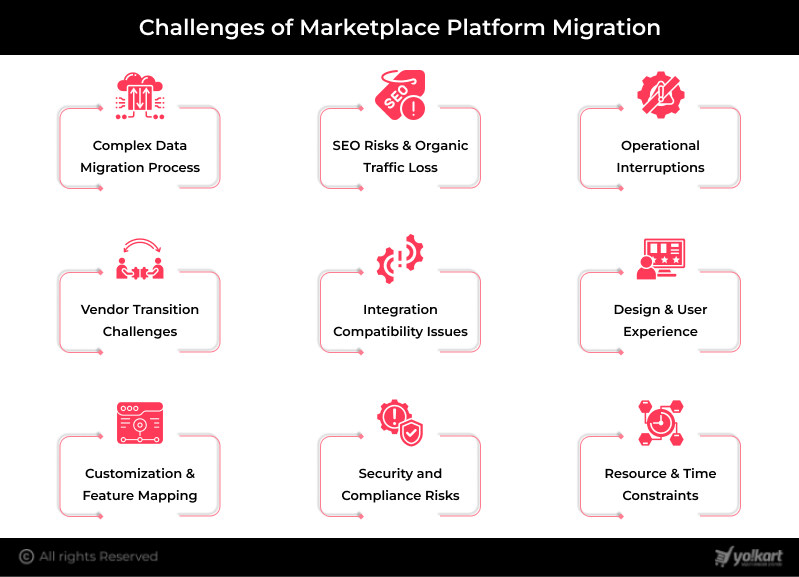
1. Complex Data Migration Process
One of the biggest challenges during marketplace migration is transferring large volumes of business-critical data accurately. Marketplace ecosystems typically include vendor accounts, customer databases, product catalogs, categories, order histories, transaction records, and SEO metadata. Small inaccuracies during data transfer can result in missing product information, incomplete records, and vendor dissatisfaction, making data migration one of the most critical aspects of platform transition.
How to Overcome it:
Businesses should begin with a structured data audit to identify critical assets and remove redundant information before migration. Using staging environments, validating data mapping, creating secure backups, and conducting post-migration verification can help minimize disruptions and maintain data accuracy.
2. SEO Risks and Organic Traffic Loss
Search engine visibility is one of the most valuable assets for online marketplaces. During migration, changes to URLs, site structure, metadata, or page performance can negatively impact search rankings, organic traffic, indexed pages, backlink authority, and overall visibility. Even temporary SEO disruptions can affect customer acquisition, making search performance one of the biggest concerns during marketplace platform migration.
How to Overcome it:
Businesses should prioritize proper 301 redirect implementation, preserve URL structure wherever possible, migrate metadata accurately, and conduct a technical SEO audit before and after migration. Additionally, monitoring crawl errors, indexing, and ranking performance is equally important to maintain search visibility.
3. Downtime and Operational Interruptions
Marketplace businesses operate continuously, often serving multiple vendors and customers simultaneously. Unexpected downtime during migration can interrupt customer purchases, order processing, payment transactions, vendor activities, and communication workflows.
How to Overcome it:
Businesses should implement phased migration plans, staging environments, and backup systems to reduce operational risks. Scheduling migration during low-migration periods and conducting thorough testing before launch can further minimize disruptions.
4. Vendor Transition Challenges
Vendors are one of the most important stakeholders in any marketplace ecosystem. Platform migration can create challenges related to dashboard functionality, product management, order handling, payment workflows, and account access. Moreover, if vendors struggle to adapt to the new system, businesses may experience reduced seller activity, lower engagement, and vendor retention issues.
How to Overcome it:
Providing vendor onboarding resources, training materials, migration support, and clear communication throughout the transition process can improve adoption and reduce operational confusion.
5. Integration Compatibility Issues
Modern marketplaces rely heavily on third-party integrations such as payment gateways, shipping providers, CRM systems, ERP software, marketing tools, and analytics platforms. During migration, integration incompatibility, API limitations, workflow disruptions, and synchronization issues may affect business continuity and operational performance.
How to Overcome it:
Businesses should evaluate integration compatibility before migration begins, test APIs thoroughly, and prioritize critical workflows to ensure uninterrupted marketplace operations.
6. Design and User Experience Adjustments
Migration to a new platform often requires updates to user interfaces, navigation flows, vendor dashboards, checkout experiences, and mobile responsiveness. Although platform improvements may enhance long-term usability, abrupt changes in user experience can temporarily affect customer familiarity, engagement, and overall satisfaction.
How to Overcome it:
Maintaining intuitive navigation, familiar workflows, and mobile optimization can help reduce friction. Testing user journeys before launch can also improve transition outcomes.
7. Customization and Feature Mapping Complexity
Every marketplace operates differently based on its business model, industry requirements, vendor workflows, and monetization strategy. During migration, businesses may face challenges in recreating custom features, workflows, permissions, and operational systems. Without proper feature mapping, essential functionality may be overlooked or lost, potentially affecting day-to-day marketplace operations.
How to Overcome it:
Conducting a detailed feature audit before migration and prioritizing business-critical workflows can help preserve functionality. Choosing a scalable and customizable platform can further support long-term operational needs.
8. Security and Compliance Risks
Marketplace migration involves transferring sensitive business and customer data. Poor migration practices can expose businesses to security vulnerabilities, compliance risks, payment concerns, and potential data breaches. Any compromise in data security can directly affect marketplace trust and business continuity.
How to Overcome it:
Businesses should implement secure data transfer methods, access controls, backup systems, compliance verification, and platform security audits throughout the migration process.
9. Internal Resource and Time Management Challenges
Marketplace migration often requires coordination between development teams, marketplace administrators, SEO specialists, customer support teams, vendors, and external service providers. Without structured planning, migration projects can become resource-intensive, time-consuming, and operationally disruptive.
How to Overcome it:
Establishing clear migration roadmaps, assigning dedicated teams, implementing testing environments, and monitoring performance after launch can help ensure smoother execution.
Key Features to Look for in a New Marketplace Platform
A marketplace platform that supports early-stage growth may not always meet the demands of a rapidly expanding business. As vendor ecosystems grow, transaction volumes increase, and customer expectations evolve, businesses require technology that can scale alongside operational complexity. Choosing the right platform becomes essential for sustaining long-term growth and avoiding future migration challenges.
That said, below are some of the most important features businesses should evaluate before migrating to a new marketplace platform:
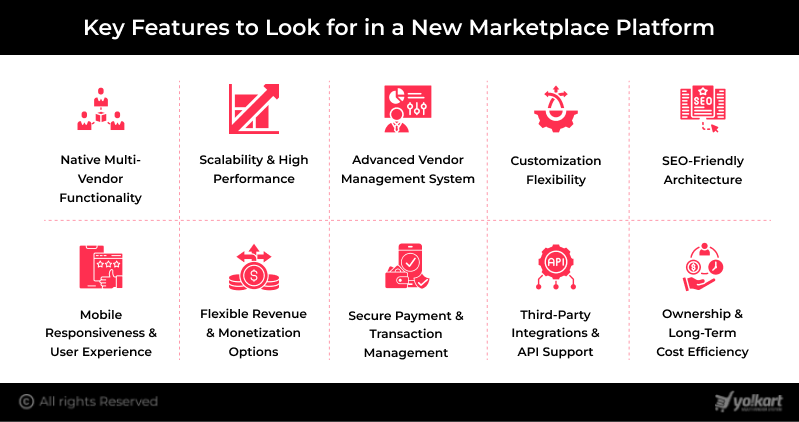
1. Native Multi-Vendor Functionality
A marketplace platform should be purpose-built for multi-vendor operations rather than relying heavily on third-party plugins or external integrations. Native multi-vendor functionality helps streamline seller management, product catalogs, commissions, payouts, and order workflows. Solutions like Yo!Kart provides marketplace-specific features, helping businesses simplify operations and scale efficiently.
2. Scalability and High Performance
As your marketplace grows, your platform must support increasing traffic, larger product catalogs, more vendors, and higher transaction volumes without compromising performance. Limited scalability can lead to slower page speeds, downtime, and checkout disruptions. A scalable platform ensures operational stability and consistent user experiences as business demands evolve.
3. Advanced Vendor Management System
Vendor experience plays a major role in marketplace growth and retention. A strong marketplace platform should simplify vendor onboarding, product management, commissions, subscriptions, order handling, and reporting. Features like dedicated dashboards and automation tools improve seller efficiency while reducing administrative complexity for marketplace owners.
4. Customization Flexibility
Every marketplace business has unique workflows, monetization models, and operational requirements. A flexible platform should support UI customization, workflow modifications, API integrations, and feature enhancements. Limited customization can restrict growth, making operational flexibility essential for long-term marketplace scalability.
5. SEO-Friendly Marketplace Architecture
Strong SEO capabilities are essential for driving long-term organic traffic and customer acquisition. A marketplace platform should support clean URLs, metadata management, mobile optimization, fast page performance, and technical SEO flexibility. SEO-friendly architecture improves search visibility while supporting sustainable marketplace growth.
6. Mobile Responsiveness and User Experience
With mobile commerce continuing to grow, marketplace platforms must deliver seamless experiences across devices. Responsive design, mobile-friendly navigation, optimized checkout flows, and accessible vendor dashboards are critical. Poor mobile usability can negatively impact engagement, conversions, customer retention, and search performance.
7. Flexible Revenue and Monetization Options
Modern marketplace businesses often rely on multiple revenue streams beyond standard commissions. A scalable platform should support subscriptions, featured listings, advertisements, membership packages, premium services, and transaction-based fees. Flexible monetization capabilities help businesses diversify revenue and improve long-term profitability.
Improve Marketplace Engagement With Better User Experience
8. Secure Payment and Transaction Management
Trust and transaction security are essential for marketplace success. Businesses should evaluate whether a platform supports secure payment gateways, vendor payouts, fraud prevention, transaction tracking, encryption, and compliance standards. Reliable payment infrastructure helps build confidence among both customers and vendors.
9. Third-Party Integrations and API Support
Marketplace businesses often depend on external tools such as CRM systems, ERP platforms, shipping providers, analytics software, and payment gateways. Strong API support and seamless integration capabilities help streamline operations, improve efficiency, and ensure the platform can scale alongside business requirements.
10. Ownership and Long-Term Cost Efficiency
While some platforms appear affordable initially, recurring subscription fees, plugin dependency, and maintenance costs can increase over time. Businesses should assess long-term ownership costs, scalability expenses, and operational flexibility. Ownership-based solutions often provide greater cost control and long-term business value.
How to Successfully Migrate to a New Marketplace Platform?
Outgrowing an existing marketplace platform is common as vendor ecosystems expand, transaction volumes increase, and operational complexity grows. While migration can improve scalability and efficiency, a poorly planned transition may disrupt operations, impact traffic, and affect vendor and customer experiences.
Below are some of the most important steps for successfully migrating to a new marketplace platform.
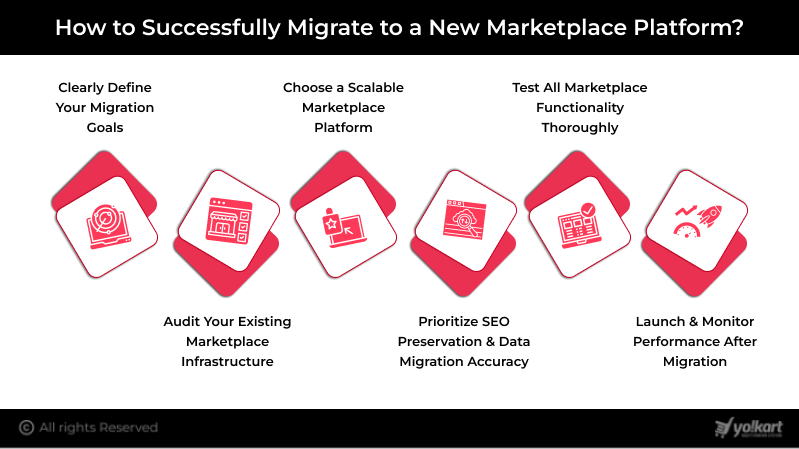
1. Clearly Define Your Migration Goals
Before selecting a new marketplace platform, businesses should first identify why they are migrating and what they aim to achieve after the transition.
Common migration goals may include:
- Improving scalability
- Reducing operational complexity
- Enhancing vendor management
- Expanding into new markets
- Improving SEO performance
- Supporting additional revenue models
- Increasing customization flexibility
Clearly defining business objectives helps ensure that the new platform aligns with both current operational needs and long-term growth plans.
2. Audit Your Existing Marketplace Infrastructure
A comprehensive audit of your current marketplace is essential before migration begins. Businesses should evaluate:
- Vendor accounts
- Product catalogs
- Customer databases
- Order histories
- Payment systems
- Third-party integrations
- SEO assets
- Custom workflows
- Existing technical issues
This process helps identify critical business data, migration dependencies, operational risks, and areas that require improvement before the transition begins.
3. Choose a Scalable Marketplace Platform
One of the most important migration decisions is selecting the right marketplace software. Businesses should prioritize platforms that support native multi-vendor functionality, scalability, customization flexibility, vendor management, mobile responsiveness, SEO optimization, and long-term operational efficiency.
Many growing businesses now prefer dedicated marketplace solutions like Yo!Kart because they are purpose-built for multi-vendor marketplaces while supporting long-term scalability.
To know more, visit.
4. Prioritize SEO Preservation and Data Migration Accuracy
Protecting SEO performance and ensuring accurate data transfer are two of the most important aspects of marketplace migration. Improper handling can lead to ranking losses, broken pages, missing information, and poor user experience.
Businesses should preserve URL structures where possible, implement 301 redirects, migrate metadata, validate data mapping, create backups, and verify products, vendors, orders, and customer records before launch.
5. Test All Marketplace Functionality Thoroughly
Before launching the new platform, businesses should conduct extensive testing across all operational areas, including vendor onboarding, product uploads, checkout systems, payment processing, shipping integrations, mobile responsiveness, and user permissions. At the same time, vendors and customers should be informed about migration timelines, platform updates, account-related changes, and onboarding resources to reduce confusion and improve adoption.
6. Launch & Monitor Performance After Migration
Migration does not end once the new platform goes live. Businesses should closely monitor website performance, SEO rankings, vendor activity, conversion rates, payment systems, and technical functionality after launch.
Post-migration monitoring helps identify and resolve issues quickly while ensuring the platform performs efficiently and supports long-term marketplace growth.
Upgrade Your Marketplace Without Operational Disruptions
Why Scalability Matters in Marketplace Businesses?
Scalability plays a critical role in the long-term success of any online marketplace. As marketplaces grow, they must manage increasing traffic, expanding vendor networks, larger product catalogs, higher transaction volumes, and evolving customer expectations without compromising performance. A platform that cannot scale efficiently may create operational bottlenecks, affect customer and vendor experiences, and limit future growth opportunities. This is why scalability should be treated as a core business requirement when building or migrating an online marketplace.
A scalable marketplace platform helps businesses support growth while maintaining operational efficiency, customer satisfaction, and marketplace stability through:
- Supports increasing website traffic and transaction volumes
- Enables seamless onboarding of more vendors and sellers
- Helps manage expanding product catalogs efficiently
- Improves website speed, performance, and uptime stability
- Enhances customer experience through faster navigation and checkout
- Supports expansion into new markets, languages, and currencies
- Reduces operational inefficiencies through automation
- Minimizes the need for costly future platform migration
- Supports flexible monetization and business model expansion
Yo!Kart: A Scalable Marketplace Solution for Long-Term Growth
Purpose-built marketplace solutions like Yo!Kart is specifically designed to support the long-term growth needs of multi-vendor businesses. Unlike generic eCommerce platforms that often rely heavily on third-party plugins to enable marketplace functionality, Yo!Kart offers a comprehensive ecosystem with built-in marketplace features, helping businesses reduce technical complexity while improving scalability and operational control.
Yo!Kart is developed to help marketplace businesses efficiently manage increasing operational demands through:
- Native multi-vendor functionality for managing vendors, product catalogs, commissions, payouts, subscriptions, and marketplace workflows from a centralized system
- Scalable architecture capable of supporting increasing traffic, larger product inventories, growing vendor participation, and higher transaction volumes without affecting platform performance
- Advanced vendor management tools including dedicated dashboards, order management, reporting, product approvals, and analytics, to improve seller experiences and marketplace efficiency
- Flexible monetization options that support commissions, subscription plans, featured listings, advertisements, and additional revenue opportunities
- SEO-friendly architecture designed to support clean URLs, metadata management, mobile optimization, and stronger organic visibility for long-term traffic growth
- Mobile apps for buyers and sellers to deliver seamless experiences across devices and support growing mobile commerce demand
- Customization flexibility that enables businesses to adapt workflows, integrations, and marketplace functionality according to industry-specific requirements
Additionally, regular product updates and feature enhancements help marketplaces stay aligned with changing business needs and technology trends.
The solution helps businesses reduce long-term operational complexity through marketplace-focused automation features such as vendor onboarding, commission management, order workflows, and reporting. This enables marketplace owners to manage growth more efficiently while reducing administrative overhead.
For businesses planning long-term marketplace expansion, choosing technology built specifically for multi-vendor ecosystems can significantly reduce future migration risks, technical bottlenecks, and operational inefficiencies.
By combining scalability, customization, performance, and marketplace-specific functionality, Yo!Kart helps businesses build a stronger foundation for sustainable marketplace growth while remaining adaptable to changing market demands.
Schedule a Personalized Demo to See Yo!Kart in Action
Conclusion
Switching your marketplace platform is a major business decision, but in many cases, it becomes essential for sustainable growth and long-term operational success. As marketplaces expand, businesses require technology that is capable of handling increasing vendor participation, rising customer demand, better scalability, better SEO performance, and more flexible monetization capabilities.
Many businesses eventually outgrow platforms that were initially selected for short-term convenience or lower upfront costs. Over time, limitations related to scalability, customization, vendor management, and operational flexibility can begin affecting marketplace performance and growth potential. This is why marketplace migration should be viewed as an opportunity to build a stronger foundation for future expansion.
Purpose-built marketplace solutions like Yo!Kart helps businesses simplify marketplace operations through native multi-vendor functionality, scalable architecture, advanced vendor management, and more. Ultimately, choosing the right marketplace technology can improve vendor experiences, enhance customer satisfaction, and support sustainable marketplace growth in an increasingly competitive digital landscape.
FAQs
Q 1. Why do businesses switch marketplace platforms?
Ans. Businesses usually switch marketplace platforms when their current system struggles to support growth. Common reasons include scalability limitations, poor vendor management capabilities, customization restrictions, rising operational costs, or performance issues affecting long-term growth.
Q 2. What should I consider before migrating to a new marketplace platform?
Ans. Before migration, businesses should evaluate factors like:
- Scalability
- Multi-vendor functionality
- SEO capabilities
- Vendor management tools
- Customization flexibility
- Mobile responsiveness
- Long-term operational costs
This ensures the platform supports future business growth.
Q 3. What are the biggest marketplace migration challenges?
Ans. Common marketplace migration challenges include:
- Data migration complexity
- SEO risks
- Downtime management
- Vendor transition issues
- Integration compatibility
- Operational disruptions
Q 4. How can I migrate my marketplace without losing SEO rankings?
Ans. To preserve SEO during migration:
- Implement proper 301 redirects
- Maintain important URLs
- Preserve metadata
- Monitor indexing and crawl errors
- Optimize mobile performance and page speed
Q 5. Why is scalability important for marketplace businesses?
Ans. Scalability helps marketplaces efficiently manage:
- Growing vendor networks
- Increasing traffic
- Larger product catalogs
- Higher transaction volumes
without compromising performance or user experience.
Q 6. What features should a scalable marketplace platform include?
Ans. A scalable marketplace platform should offer:
- Native multi-vendor functionality
- Vendor dashboards
- Commission systems
- SEO-friendly architecture
- Mobile responsiveness
- Secure payment integrations
- Flexible monetization options
- Customization support
Q 7. Why do businesses prefer dedicated marketplace software?
Ans. Dedicated marketplace software is specifically built for multi-vendor operations. It helps reduce plugin dependency, improve operational efficiency, and support long-term marketplace scalability with built-in marketplace features.
Q 8. Can I build a marketplace without developing everything from scratch?
Ans. Yes, businesses can launch an online marketplace using readymade solutions like Yo!Kart. This includes built-in marketplace functionality, customization capabilities, and essential tools needed to support scalable growth.
Q 9. How does marketplace technology impact vendor experience?
Ans. Strong marketplace technology improves vendor experience through:
- Easy product management
- Automated commission handling
- Streamlined order workflows
- Vendor analytics
- User-friendly dashboards
A seamless vendor experience improves seller satisfaction, retention, and overall marketplace growth.
Q 10. Is marketplace migration worth it for growing businesses?
Ans. In many cases, yes. Migrating to a scalable and marketplace-focused platform can be a smart long-term decision. Upgrading to a scalable platform helps businesses improve operational efficiency, support long-term growth, enhance user experiences, and reduce future technical limitations.
Thinking of Switching to a Scalable Marketplace Solution Built for Growth?
Get In TouchPopular Posts