
Published Date 05th Dec, 2025
Artificial Intelligence (AI) and Robotics are no longer future tech, but very much a part of the present. From smart home assistants and sophisticated consumer drones to collaborative industrial robots and AI-powered health wearables, these products represent the highest-growth segment in the global hardware market.
However, the challenge for manufacturers, suppliers, and buyers is fragmentation. This is where the massive opportunity of building a centralized, trusted eCommerce marketplace platform dedicated solely to AI gadgets and robotics lies.
Building a multivendor eCommerce marketplace platform for AI Gadgets and Robotics is a highly strategic move. This blog serves as the definitive guide, walking you through the market dynamics, essential features, and the critical technology choices, specifically highlighting the use of eCommerce marketplace software like Yo!Kart, to launch and scale a dominant platform in this complex, specialized industry.
Table of Contents
- What is an AI Gadget and Robotics Marketplace?
- Top AI Gadget and Robotics Marketplaces
- Benefits of Building a Marketplace for AI Gadgets and Robotics
- Must-Have Features in Your AI Gadget and Robotics Marketplace
- How to Build a Marketplace for AI Gadget and Robotics (The 4-Step Process)
- Yo!Kart: A Strategic Choice to Launch Your AI & Robotics Marketplace
- Conclusion
What is an AI Gadget and Robotics Marketplace?
An AI Gadget and Robotics Marketplace is a specialized multivendor eCommerce platform that connects multiple manufacturers, suppliers, and distributors (vendors) of AI-driven hardware and robotics products with global consumers, businesses, and researchers (buyers).
Unlike a standard electronics store, this platform is built to handle the unique demands of complex, high-value, and often highly technical products.
Key Product Categories:
- Consumer AI & Wearables: Smart glasses, personal AI companions (like the Rabbit R1 or personalized AI earbuds), health and fitness trackers with predictive analytics.
- Domestic & Service Robotics: Robot vacuums, lawnmowers, pet feeders, and personal telepresence or emotional support robots.
- Industrial & Professional Robotics: Collaborative robot arms (Cobots), Autonomous Guided Vehicles (AGVs) for warehouses, inspection drones, and specialized robotic components (sensors, controllers, actuators, and ROS (Robot Operating System) -compatible parts).
- Development Kits & Components: Microcontroller boards (Arduino, Raspberry Pi), AI chips (NVIDIA Jetson), specialized sensors, and DIY robotics kits aimed at hobbyists and researchers.
Additionally, the marketplace’s core function is to facilitate secure transactions while providing the highly specific product information, compatibility data, and technical support required for these complex purchases.
Top AI Gadget and Robotics Marketplaces
While Amazon and eBay carry a large volume of these items, true specialized eCommerce marketplace platforms dedicated to robotics and high-tech components are gaining popularity by offering deeper expertise and better vendor services. Let’s explore some of the popular platforms, their core features, and key differentiations:
| Platform | Core Focus | Key Differentiation |
| RobotShop | Consumer, Educational, and Industrial Robotics & Components | Vast catalog, global shipping options, and deep specialization in actuators, controllers, and development parts. |
| Qviro | Industrial Robotics & Automation | Provides detailed reviews, specifications, and comparison tools specifically for B2B industrial buyers. |
| Robu.in | DIY, Maker, and Educational Robotics Components | Strong focus on the hobbyist and educational market in regions like India, selling microcontrollers, sensors, and kits. |
The Strategic Lesson: Success in this space is driven by specialization. Henceforth, a new platform must prioritize technical trust, offering tools that help customers verify product compatibility and access necessary documentation, which large generalist sites often fail to provide.
Benefits of Building a Marketplace for AI Gadgets and Robotics
Launching a multivendor eCommerce marketplace platform in this sector offers significant advantages over launching a single-vendor store. This industry not only allows for a diverse inventory and faster growth but also fosters collaboration with startups and innovators, attracting a broader audience, and diversifying multiple revenue streams. Beyond that, it presents many other benefits. Let’s have a look at some of them:

1. Capturing the R&D and B2B Market
While the B2C segment offers broad appeal, the long-term value lies in the B2B and R&D segments. Businesses and universities purchase components, sensors, and development kits in bulk for experimentation and production. Thus, a multi-vendor marketplace can aggregate niche suppliers to meet this diverse, high-value demand, ensuring better product availability and faster innovation cycles.
2. High Average Order Value (AOV)
AI gadgets and professional robotics equipment carry significantly higher price tags than standard consumer electronics. Moreover, industrial robots, specialized sensors, and high-end AI servers drive high Average Order Values, leading to robust revenue streams even with lower transaction volume compared to mass-market items. This makes each sale considerably more impactful for overall profitability.
3. Revenue Diversification
Beyond standard commission-based revenue, a marketplace for AI and robotics can unlock multiple income streams, such as:
- Certification Fees: Charging vendors for product verification or “AI-Readiness” certification.
- Premium Listings: Offering featured placement for high-ticket or newly launched robotics products.
- Data Monetization: Providing aggregated, anonymized sales and demand data, such as trends in sensor purchases or robotics kit adoption, back to manufacturers for market intelligence.
4. Supply Chain Resilience
By onboarding multiple vendors for key components, like specific microcontrollers or motor drivers, the platform mitigates the supply chain risks inherent in the electronics sector, ensuring continuous availability for buyers. This ensures consistent product availability for buyers, supports uninterrupted R&D and production, and strengthens the platform’s reputation as a reliable source for specialized AI and robotics products.
Must-Have Features in Your AI Gadget and Robotics Marketplace
To cater to the highly technical nature of the products and earn the trust of B2B and technical buyers, your eCommerce marketplace platform needs specialized features that go beyond standard eCommerce marketplace software. Given below are some of the must-have features for your AI gadgets and robotics marketplace:

1. Robust Product Catalog and Technical Filtering
AI and robotics buyers know exactly what they’re looking for, including exact sensor type or processor clock speed. Hence, your marketplace should allow vendors to list detailed technical specifications. Other than that, buyers should be able to use advanced filters to quickly and accurately locate the exact technical components they need for specialized projects. This significantly improves search efficiency and conversion rates for technical goods.
2. Dedicated Vendor Storefronts and Management Dashboards
Each manufacturer or distributor should have a professional and branded store page within the marketplace. Alongside this, a private dashboard gives vendors full control over their inventory, order processing, sales analytics, and customer communication, reducing the administrative burden on the central platform for every small update.
3. Secure Global Payment Processing and Escrow
Given the high value of many AI and robotics products, secure payments are non-negotiable. Thus, your platform must integrate major payment gateways and feature a critical escrow system to hold funds securely. This guarantees payment security for high-value, cross-border transactions, ensuring buyers only release payment after confirming safe receipt and inspection of the hardware.
4. Multilingual and Multicurrency Support
AI and robotics are global industries, and this feature removes global barriers by allowing users to view the entire website in multiple languages. It also provides automatic currency conversion, ensuring accurate local pricing and a seamless user experience for buyers and sellers across different international markets.
5. Advanced Shipping and Logistics Management
Technical products, especially robotics equipment, often require careful packaging, special handling, or custom shipping rules. Therefore, integrating real-time carrier rates, automated tracking, and accurate cost calculations based on weight, dimensions, and destination is essential. Moreover, it ensures safety and transparency in the delivery of sensitive and high-value equipment.
6. Comprehensive Review and Rating System
Trust is an essential component for a platform where buyers are spending thousands of dollars. A robust system should allow buyers to leave detailed, verified feedback on both product quality and vendor service. This transparency helps build critical trust, helping future buyers make informed decisions and encouraging all participating vendors to maintain high standards.
7. Bulk Ordering and B2B Pricing Functionality
To capture the lucrative enterprise market, the platform should support large-volume orders and specialized pricing. This includes allowing vendors to set quantity-based discount tiers and process transactions via Purchase Orders (POs) and custom invoicing. These features attract and retain B2B buyers.
8. Promotion and Discount Management Engine
Whether it’s a flash sale on robotics kits or a launch offer for a new AI module, your marketplace should make it easy to create and manage promotions. This feature provides flexibility for running targeted sales campaigns across the marketplace. Further, it allows both the admin and individual vendors to easily create and manage flash sales, promo codes, and bundled deals, efficiently driving sales volume and inventory turnover.
Build a Future Ready Marketplace for AI Gadgets and Robotics
How to Build a Marketplace for AI Gadget and Robotics (The 4-Step Process)
Launching a niche, high-tech marketplace follows a structured process, with the technology choice being the most important decision. However, breaking it down into a clear and strategic process makes the journey far more manageable. Whether you’re targeting hobbyists, researchers, or enterprise buyers, the key is to combine strong marketplace fundamentals with the specialized features this industry demands.
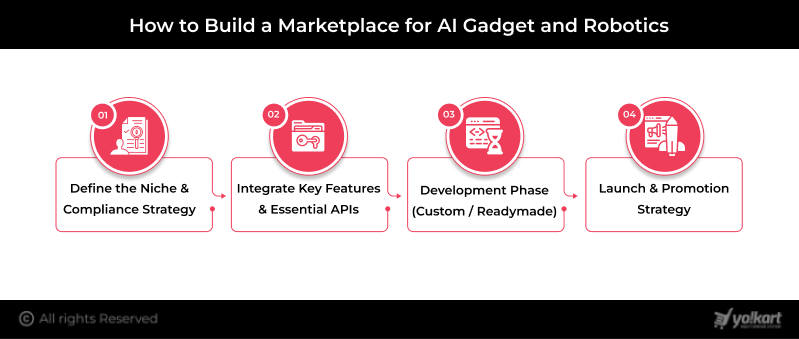
Below is a simple four-step framework to guide you from concept to launch:
Step 1: Define the Niche and Compliance Strategy
- Hyper-Focus: Decide whether you want to focus on B2C (e.g., premium smart home robots), B2B (e.g., factory automation components), or Developer/Educational institutions (e.g., Arduino/ROS parts). This dictates every feature thereafter.
- Compliance: Establish rigorous policies for FCC (Federal Communications Commission), CE (Conformité Européenne (European Conformity)), RoHS (Restriction of Hazardous Substances), and other electronic hardware certifications. The platform must require vendors to upload proof of compliance for high-risk products.
- Monetization: Confirm your primary revenue channel, likely a commission (5%-15%), combined with premium vendor subscriptions for analytics and lead generation.
Step 2: Integrate Key Features and Essential APIs
This is the most crucial phase, as this is where your marketplace becomes a functional platform capable of serving highly technical products and global users.
Key features and integrations include:
| Marketplace Core | Multivendor architectureVendor dashboards & storefrontsProduct management with extended technical specsOrder, inventory, and commission management |
| Logistics & Fulfillment APIs | Integrations with carriers like DHL, FedEx, UPS, USPS, and regional couriersReal-time shipping rates, tracking, and automated label generation |
| Payments & Security | Gateways: Stripe, PayPal, Razorpay, AdyenEscrow service integration for safe, high-value hardware transactionsFraud detection and KYC tools |
| Multilingual & Multicurrency APIs | Language translation enginesAutomatic currency conversion and tax calculation |
| AI & Robotics-Specific Enhancements | Documentation hosting (datasheets, CAD files, API docs)Integration with GitHub or GitLab for firmware or SDK Developer-friendly tagging and component taxonomy |
| Performance, Security & Compliance | Cloud hosting setupCDN, caching, and scalability architectureGDPR, PCI-DSS, and export-control compliance |
This step ensures your marketplace is not just functional but technically powerful, secure, and tailored to the robotics ecosystem.
Step 3: The Development Phase (Custom vs. Readymade)
Choosing the technology to build the eCommerce marketplace requires a trade-off between control and speed. However, the most popular approaches to building a marketplace for AI gadgets and robotics are:
A. Custom Development (Building from Scratch)
- Approach: Hiring a full development team (frontend, backend, QA, DevOps) to build the platform using frameworks like Laravel, Django, or Node.js.
- Pros: Absolute freedom for unique, proprietary features like a custom 3D model viewer for robots or specialized predictive analytics. Total ownership of the codebase.
- Cons: High Cost ($150k–$500k+) and Long Time-to-Market (12–24 months). High maintenance burden and slow feature iteration. The core features (cart, checkout, payment integration) must all be built and tested from scratch.
- Best For: Well-funded enterprises whose primary competitive edge is a unique piece of software technology.
B. Readymade Marketplace Software (Turnkey Solutions)
- Approach: This approach involves licensing a professional, pre-built, and tested eCommerce marketplace software designed specifically for multi-vendor operations. Utilizing a specialized platform ensures you start with a proven, scalable architecture, dedicating your resources primarily to acquiring high-quality vendors and focused marketing efforts. Examples of such powerful, dedicated solutions include Yo!Kart.
- Pros: Fast Deployment (Weeks, not Years) and Lower Initial Cost. Reduces the need to code basic eCommerce features, such as login, cart, and payment. Allows resources to be focused on niche features (e.g., technical filtering) and marketing.
- Cons: Requires customization for highly unique features.
- Best For: Most startups and entrepreneurs who need a robust, scalable foundation immediately to test their market hypothesis and rapidly onboard vendors.
Recommended: For a specialized platform that requires speed and reliability, a scalable, feature-rich solution is the preferred path.
Step 4: Launch and Promotion Strategy
Once the platform is built, the focus shifts entirely to user acquisition.
1. Acquire Supply First (Vendors): Target key manufacturers and distributors in your niche. Offer highly attractive initial terms (e.g., 0% commission for the first three months) and emphasize the platform’s high-quality audience.
2. Targeted Marketing:
- Content Marketing: Create high-value, technical content, such as “Comparison of Lidar Sensors for Drone Mapping,” to establish authority and drive organic traffic through long-tail keywords.
- Niche Partnerships: Partner with robotics forums, university R&D departments, and industry trade associations to reach specific buyers.
- Paid Media: Run highly targeted campaigns on platforms like LinkedIn or specialized industry publications.
By combining strategic planning, robust features, and steady scaling, you can launch a platform that drives innovation, supports global users, and grows into a competitive industry destination.
Yo!Kart: A Strategic Choice to Launch Your AI & Robotics Marketplace
Building a marketplace for AI gadgets and robotics requires a platform capable of handling technical product data, complex transaction flows, and a growing network of vendors. Yo!Kart stands out as a strategic foundation for such a marketplace because it’s purpose-built for large-scale, multivendor ecosystems. It is a leading example of a white-label, multi-vendor solution designed specifically to power large-scale multi-vendor eCommerce marketplaces. Its white-label architecture allows you to fully tailor the platform to the unique demands of AI and robotics, whether that means supporting detailed specification sheets, advanced search attributes, or engineering-grade documentation.
Yo!Kart also provides the structural backbone needed to manage high-value hardware transactions securely and maintain smooth marketplace operations from day one. With its robust infrastructure, adaptability, and marketplace-focused design, it helps entrepreneurs move quickly from concept to launch while ensuring long-term scalability as product categories, vendors, and global buyers grow.
Benefits of Choosing Yo!Kart
- Vendor Management System: Offers a dedicated dashboard for each vendor to manage their inventory, orders, sales, and analytics independently, which is crucial for complex product catalogs.
- Scalable Product Catalog: Capable of handling hundreds of thousands of SKUs and managing complex product variants (essential for electronic components).
- Revenue Flexibility: Comes with built-in tools for setting tiered commissions, charging listing fees, and managing vendor payouts, giving the admin full control over monetization.
- Full Ownership (One-Time License): Unlike most SaaS platforms that charge recurring fees and restrict customization, solutions like Yo!Kart often offers a one-time license, granting full code ownership and unlimited customization rights for niche-specific features.
Experience the Yo!Kart Platform Live
Conclusion
The market for AI gadgets and robotics is on a steep, exponential trajectory. Launching a multivendor eCommerce marketplace to serve this specific niche is a lucrative opportunity, however, it demands an understanding of the sector’s high technical requirements.
Additionally, success will be defined by your platform’s ability to engender technical trust, through robust data, stringent vendor vetting, and specialized filtering. By choosing a powerful, proven eCommerce marketplace software like Yo!Kart, you bypass the costly, time-consuming phase of building core functionality and focus your capital on attracting the high-value vendors and buyers that will establish your platform as the authoritative source for the future of technology.
Build the Ultimate AI & Robotics Marketplace
Get StartedPopular Posts