

Back To Home

eBay Business Model Explained: How eBay Makes Money & What Entrepreneurs Can Learn
1069
Views
Published Date 16th July, 2026
Quick Answer
eBay operates a multi-vendor marketplace business model that connects buyers and sellers without owning most of the inventory sold on its platform. The company primarily earns revenue through seller fees, final value fees, promoted listings, store subscriptions, advertising services, and payment-related services.
Entrepreneurs looking to build a marketplace like eBay can adopt a similar platform-based model using scalable marketplace software such as Yo!Kart, which offers the core functionality needed to launch and manage a multi-vendor marketplace.
Entrepreneurs looking to build a marketplace like eBay can adopt a similar platform-based model using scalable marketplace software such as Yo!Kart, which offers the core functionality needed to launch and manage a multi-vendor marketplace.
For more than two decades, eBay has remained one of the world’s most recognized online marketplaces, redefining how people buy and sell online. Instead of managing its own inventory, eBay pioneered a different approach, creating a digital platform where millions of buyers and sellers can connect and transact directly.
From collectibles and electronics to fashion, automobiles, and industrial equipment, eBay has evolved into a global marketplace supporting businesses of all sizes. Its asset-light business model, diverse revenue streams, and scalable marketplace ecosystem have made it a benchmark for entrepreneurs looking to launch their own online marketplaces.
As online commerce continues to grow, many entrepreneurs are curious about how eBay makes money, what drives the success of its marketplace model, and whether it is possible to build a similar platform. The answer is yes. With modern marketplace software, launching a scalable multi-vendor marketplace is now faster and more accessible than ever.
In this guide, we will explore how the eBay business model works, its primary revenue streams, the factors behind its long-term success, and the key lessons entrepreneurs can apply when building their own marketplace.
Table of Contents
- What is eBay?
- The Evolution of eBay
- How Does eBay Work?
- Why is eBay one of the World’s Largest Online Marketplaces?
- eBay Business Model Explained
- How Does eBay Make Money?
- Why is eBay’s Revenue Model So Successful?
- Challenges of the eBay Business Model
- What Entrepreneurs Can Learn from eBay?
- How to Build a Marketplace Like eBay
- Why Choose Yo!Kart to Build an Online Marketplace?
- Conclusion
- Frequently Asked Questions
What is eBay?
eBay is a global online marketplace that enables individuals and businesses to buy and sell products across a wide range of categories. Unlike traditional online retailers, eBay primarily acts as an intermediary, providing the infrastructure that allows third-party sellers to list products while buyers browse, purchase, and communicate through the platform.
Founded in 1995, eBay began its journey as an online auction website where users could bid on unique and collectible items. As online shopping evolved, the platform expanded beyond auctions by introducing fixed-price listings, making the platform more appealing for businesses, professional sellers, and everyday shoppers alike.
Today, eBay supports millions of active buyers and sellers across numerous product categories, including:
- Electronics
- Fashion
- Automotive Parts
- Collectibles
- Home & Garden
- Sports Equipment
- Jewelry
- Business & Industrial Supplies
- Toys & Hobbies
Its marketplace model allows sellers to manage their own inventory and pricing while eBay provides essential services such as product listings, search functionality, secure payments, seller tools, buyer protection programs, and dispute resolution.
Rather than investing in warehouses or manufacturing products, eBay focuses on enabling transactions between marketplace participants. This asset-light approach has played a major role in its long-term scalability.
The Evolution of eBay
eBay’s journey from a niche auction website to one of the world’s largest online marketplaces demonstrates how continuous innovation and a scalable business model can drive long-term success. Since its launch in 1995, the platform has consistently evolved to meet changing consumer expectations while expanding its global marketplace ecosystem.
1. 1995: The Auction Marketplace Era
Founded in 1995, eBay started as an online auction platform where individuals could sell collectibles and second-hand products through competitive bidding. At a time when eCommerce was still emerging, this innovative concept attracted millions of users seeking unique products that were difficult to find through traditional retail channels.
2. Early 2000s: Expansion into Fixed-Price Selling
As online shopping became mainstream, buyers increasingly preferred immediate purchases instead of waiting for auctions to end. To meet this shift in buying behaviour, eBay introduced fixed-price listings, allowing businesses and professional merchants to sell products similarly to traditional online stores. This transition significantly expanded the platform’s commercial potential.
3. 2000s to 2010s: Growth of Professional Sellers
Over the years, eBay evolved beyond its consumer-to-consumer (C2C) roots into serving individual sellers, small businesses, large retailers, brand stores, and international merchants. This diversification strengthened the marketplace while increasing product variety and customer choice.
4. 2010s to Present: Focus on Marketplace Services
Instead of competing directly with sellers, eBay invested heavily in improving marketplace infrastructure. The company introduced better search capabilities, seller management tools, advertising solutions, cross-border commerce, buyer protection, and secure payment experiences. This strategy enabled eBay to create value for both sides of the marketplace while generating multiple recurring revenue streams.
Today, eBay connects approximately 135 million active buyers and hosts over 2.5 billion live listings worldwide, facilitating nearly $80 billion in annual Gross Merchandise Volume (GMV). These milestones reflect the scalability of its marketplace model and the power of continuously evolving alongside market demands.
Build a Marketplace Designed for Long-Term Growth
How Does eBay Work?
At its core, eBay operates as a multi-vendor marketplace that connects buyers with independent sellers.
A simplified version of the process looks like this:
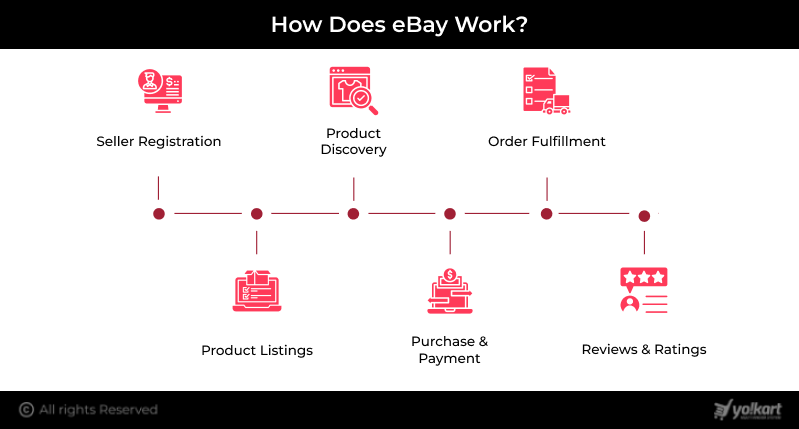
- Seller Registration: Businesses and individual sellers create accounts and register to sell products through the platform.
- Product Listings: Sellers upload product information, pricing, images, shipping details, and inventory. Depending on the product category, sellers may choose auction listings, fixed-price listings, and best offer options.
- Product Discovery: Buyers search for products using keywords, categories, filters, recommendations, and personalized search results. The platform’s search engine helps customers quickly find relevant products from millions of listings.
- Purchase & Payment: Once buyers place an order, payment is securely processed through integrated payment systems. eBay facilitates the transaction while providing safeguards for both buyers and sellers.
- Order Fulfillment: Unlike inventory-based retailers, sellers are generally responsible for shipping products directly to customers.
- This allows eBay to scale globally without maintaining extensive warehousing infrastructure.
- Reviews & Ratings: After each transaction, buyers can leave feedback based on their shopping experience. These ratings help build seller credibility and encourage high-quality service across the marketplace.
This marketplace model creates a self-sustaining ecosystem where increased seller participation attracts more buyers, while growing buyer demand encourages additional sellers to join.
Why is eBay one of the World’s Largest Online Marketplaces?
eBay’s success isn’t based on a single innovation. Instead, it results from a combination of strategic decisions that have enabled the company to remain competitive in the evolving eCommerce landscape. Since its launch in 1995, the platform has evolved into one of the world’s largest online marketplaces, serving 135 million active buyers across more than 190 markets, with over 2.5 billion live listings and facilitating nearly $80 billion in Gross Merchandise Volume (GMV) annually.
1. Massive Product Selection
With over 2.5 billion live listings spanning categories such as electronics, fashion, collectibles, automotive parts, and home goods, eBay offers one of the broadest product selections in the eCommerce industry. This extensive inventory, powered by millions of independent sellers, gives buyers greater choice and increases the likelihood of finding unique, rare, and competitively priced products.
2. Asset-Light Business Model
Unlike traditional retailers, eBay doesn’t purchase, store, or manage most of the products sold on its platform. Instead, sellers handle inventory and order fulfillment while eBay provides the marketplace infrastructure. This asset-light approach significantly reduces operational costs, minimizes inventory risks, and enables the company to scale efficiently without investing in warehouses or logistics networks.
3. Strong Network Effects
eBay benefits from powerful network effects that strengthen its marketplace over time. As more sellers join the platform, product variety and pricing become more competitive, attracting a larger buyer base. In turn, increased buyer demand encourages more merchants to list their products, creating a self-reinforcing growth cycle that is difficult for competitors to replicate.
4. Multiple Revenue Streams
Rather than relying solely on transaction commissions, eBay generates revenue through multiple streams, including seller fees, store subscriptions, promoted listings, advertising solutions, and payment-related services. This diversified monetization strategy creates predictable revenue while allowing the platform to continue investing in innovation and marketplace growth.
5. Global Reach
Operating in more than 190 markets, eBay enables cross-border commerce by connecting buyers and sellers worldwide. Its support for international selling, multiple currencies, and localized shopping experiences helps merchants expand into new markets while giving customers access to products that may not be available locally.
6. Continuous Platform Innovation
eBay has consistently evolved to meet changing customer expectations by investing in advanced search capabilities, AI-powered listing tools, personalized recommendations, seller solutions, advertising products, secure payments, and buyer protection programs. These ongoing innovations have helped the platform remain competitive despite the rapid emergence of new marketplace players and changing consumer preferences.
As eBay’s marketplace continued to grow, its revenue model also evolved. Instead of relying on a single income source, the company built multiple monetization strategies that generate recurring revenue while supporting sellers and improving the buyer experience.
Launch a Marketplace That Scales Globally
eBay Business Model Explained
eBay operates on a platform-based marketplace model that connects buyers and sellers without owning or managing most of the inventory sold on its platform. Instead of selling products directly, it provides the technology, infrastructure, and services needed to facilitate secure and seamless transactions. This asset-light approach allows eBay to scale efficiently while offering millions of products across diverse categories.
This creates value for all stakeholders:
- Buyers access a variety of products from multiple sellers, often at competitive prices.
- Sellers can reach a global customer base without building their own eCommerce infrastructure.
- eBay earns revenue by enabling and supporting these transactions through various marketplace services.
One of the biggest advantages of this model is the network effect. As more sellers join the platform, product selection increases, attracting more buyers. In turn, a growing customer base encourages additional sellers to list their products, creating a self-reinforcing growth cycle.
Another strength of eBay’s business model is its flexibility. The platform supports individual entrepreneurs, small businesses, established brands, and enterprise sellers, making it suitable for businesses of all sizes. For entrepreneurs planning to launch their own marketplace, this model demonstrates that success comes from building a reliable ecosystem rather than owning products.
How Does eBay Make Money?
eBay generates revenue through multiple income streams instead of relying on a single source. By combining multiple monetization strategies, the platform generates consistent revenue while providing sellers with tools to grow their businesses. This balanced approach has contributed significantly to eBay’s long-term profitability and scalability.
Let’s explore its primary revenue streams.
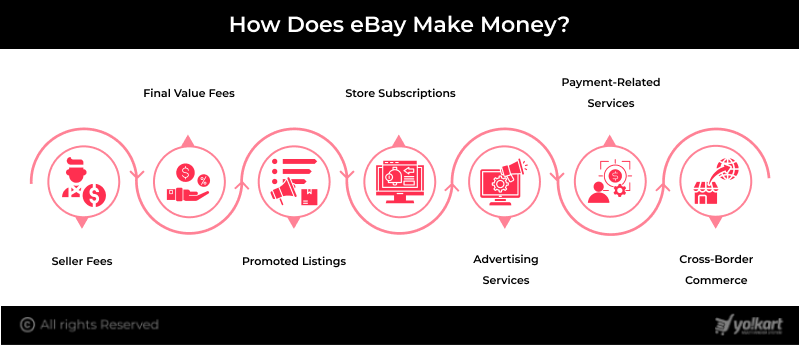
1. Seller Fees
One of eBay’s primary revenue sources is the fees charged to sellers for using the platform. Depending on the listing type, product category, and selling plan, merchants may pay fees for listing products or accessing premium selling tools.
These fees help eBay maintain the platform, invest in new features, and provide marketplace services. For entrepreneurs building a marketplace, charging reasonable seller fees can create a predictable revenue stream while supporting platform operations.
2. Final Value Fees
Whenever a product is successfully sold, eBay charges sellers a percentage of the transaction value. This commission-based revenue model is one of the most common monetization strategies used by online marketplaces.
This approach creates alignment between marketplace operators and sellers, encouraging both parties to focus on increasing transactions and customer satisfaction. Many modern multi-vendor marketplaces adopt a similar commission-based model due to its scalability and recurring revenue potential.
3. Promoted Listings
Competition among sellers often makes product visibility a challenge. To help merchants increase exposure, eBay offers promoted listing options that allow sellers to advertise products in prominent positions within search results and category pages.
Sellers pay promotional fees based on campaign performance or advertising preferences. This advertising model benefits both parties; sellers receive greater visibility, and eBay generates additional advertising revenue. As a marketplace grows, sponsored listings can become a valuable monetization channel without negatively impacting the shopping experience.
4. Store Subscriptions
Professional sellers often require advanced selling capabilities. To meet these needs, eBay offers subscription-based store plans that include benefits such as lower selling fees, higher listing limits, branding tools, marketing features, inventory management, and detailed analytics.
Subscription plans provide recurring monthly revenue while encouraging sellers to expand their businesses on the platform. For marketplace entrepreneurs, premium membership plans can become an effective way to generate predictable recurring income.
5. Advertising Services
Beyond promoted product listings, eBay also offers advertising opportunities that help brands and sellers reach targeted audiences across the marketplace. Advertising solutions may include sponsored placements, display advertising, and seasonal campaigns.
These services allow sellers to improve product discovery while creating an additional revenue stream for the marketplace operator. As buyer traffic increases, advertising often becomes one of the most profitable business opportunities for marketplace platforms.
6. Payment-Related Services
Although payment processing models have evolved over the years, facilitating secure transactions remains an important part of eBay’s marketplace ecosystem. By integrating secure payment systems, marketplaces create trust among buyers and sellers while simplifying the purchasing process.
For marketplace operators, payment services may also contribute to revenue depending on the business model and payment infrastructure adopted. More importantly, efficient payment management improves customer satisfaction and reduces transaction friction.
7. Cross-Border Commerce
One of eBay’s biggest competitive advantages is its ability to connect buyers and sellers across multiple countries. International selling expands market opportunities for merchants while increasing product availability for customers.
Cross-border commerce also encourages greater transaction volume, which indirectly contributes to higher marketplace revenue through commissions, seller services, and advertising. For entrepreneurs, supporting multiple currencies, languages, taxation rules, and international shipping can significantly increase marketplace growth potential.
Access All Possible Revenue Streams For Your Multi-Vendor Marketplace
Why is eBay’s Revenue Model So Successful?
The strength of eBay’s business model lies in its diversified approach to monetization. Instead of depending on product sales alone, eBay earns revenue from multiple complementary sources that scale alongside marketplace growth.
Some of its biggest advantages include:
Reason 1: Recurring Revenue: Subscription plans, advertising services, and seller tools generate ongoing revenue even when transaction volumes fluctuate.
Reason 2: Low Inventory Risk: Since sellers manage their own inventory, eBay avoids the significant warehousing and inventory costs associated with traditional retail businesses.
Reason 3: Scalability: Adding new sellers and product categories requires relatively low operational investment compared to inventory-based retailers.
Reason 4: Global Expansion: Supporting international commerce enables eBay to attract buyers and sellers from multiple markets without establishing physical retail operations.
Reason 5: Marketplace Network Effects: Every new seller increases product variety, while every new buyer makes the platform more attractive for merchants.
These network effects strengthen marketplace growth over time and create barriers for competitors.
Challenges of the eBay Business Model
Despite its success, operating a global online marketplace comes with several challenges that entrepreneurs should understand before launching a similar platform.
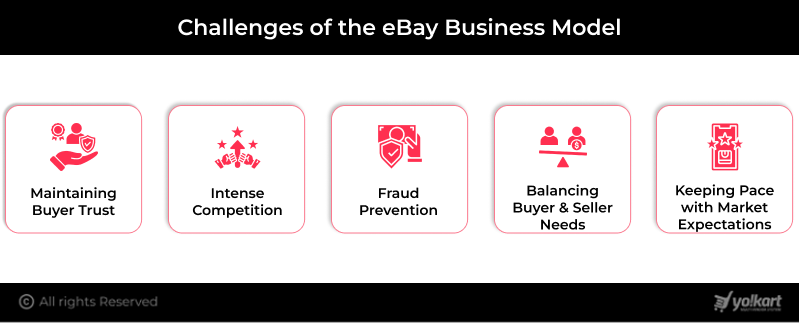
1. Maintaining Buyer Trust
With millions of independent sellers, maintaining consistent product quality and customer service standards can be difficult.
Solution: Marketplace operators must invest in seller verification, dispute resolution, secure payment systems, customer support, and review mechanisms to build trust.
2. Intense Competition
eBay competes with global marketplaces, niche marketplaces, direct-to-consumer brands, and traditional retailers. Moreover, to remain competitive, continuous innovation and improvements in customer experience are essential.
Solution: Entrepreneurs should identify underserved niches or unique value propositions rather than attempting to compete solely on size.
3. Fraud Prevention
Marketplaces are attractive targets for fraudulent sellers, counterfeit products, fake reviews, and payment-related scams.
Solution: Robust moderation systems, AI-assisted fraud detection, seller verification, and transparent marketplace policies are essential for maintaining platform integrity.
4. Balancing Buyer and Seller Needs
A successful marketplace must create value for both sides. High seller fees may discourage merchants, while poor customer experiences can reduce buyer retention.
Solution: Find the right balance between monetization and user satisfaction to retain users on the platform.
5. Keeping Pace with Market Expectations
Consumer expectations continue to evolve. Buyers increasingly expect faster deliveries, personalized recommendations, mobile-first experiences, flexible payment options, and easy product discovery.
Solution: To keep pace with market expectations, marketplace businesses must continuously improve their platforms and remain competitive.
Understanding how eBay generates revenue and overcomes marketplace challenges provides valuable insights for entrepreneurs. While building a marketplace of eBay’s scale takes time, the underlying principles, creating value for buyers and sellers, diversifying revenue streams, and investing in platform experience, can be applied to marketplaces of any size.
In the next section, we’ll explore the key lessons entrepreneurs can learn from eBay, how to build a marketplace inspired by its business model, and why solutions like Yo!Kart provides a faster and more cost-effective path to launching a scalable multi-vendor marketplace.
What Entrepreneurs Can Learn from eBay?
eBay’s journey offers valuable lessons for entrepreneurs planning to launch their own online marketplace. While few businesses will replicate eBay’s global scale, the core principles behind its success can be adapted to marketplaces across industries.
Here are some key takeaways.
1. Focus on Building an Ecosystem, Not Just a Website
One of eBay’s greatest strengths is that it created a marketplace ecosystem where buyers and sellers benefit from each other’s participation. Rather than simply building an eCommerce website, entrepreneurs should focus on creating a trusted ecosystem with seamless transactions, intuitive seller tools, and strong customer support to encourage repeat engagement and long-term marketplace growth.
2. Choose a Sustainable Revenue Model
eBay doesn’t rely on a single source of income. Instead of relying on a single source of income, eBay combines multiple monetization strategies, including commissions, subscriptions, promoted listings, and advertising services. This approach not only improves financial stability but also creates opportunities to scale revenue as your marketplace grows.
3. Prioritize Trust and Transparency
Trust is one of the most valuable assets for any marketplace. Buyers are more likely to purchase from sellers with strong ratings, while sellers prefer platforms that offer fair policies and reliable support. Features such as verified seller profiles, customer reviews, secure payment gateways, transparent return policies, and efficient dispute resolution help establish credibility and encourage repeat transactions.
4. Invest in User Experience
A seamless user experience is essential for attracting and retaining customers. From product discovery to checkout, every interaction should be intuitive and frictionless. Prioritize fast navigation, advanced search, mobile responsiveness, personalized recommendations, and secure checkout to improve customer satisfaction, boost conversions, and encourage repeat visits.
5. Start with a Niche and Scale Gradually
Many successful marketplaces begin by serving a specific audience before expanding into broader categories. Launching with a niche marketplace allows entrepreneurs to build a loyal customer base and attract specialized sellers, creating a strong foundation before expanding into new categories or geographic markets.
6. Invest in Technology That Supports Growth
Choose scalable marketplace software that offers essential features, customization options, and reliable performance. The right technology reduces development time, simplifies operations, and enables your marketplace to adapt as your business grows.
Roadmap to Build a Marketplace Like eBay?
Thanks to modern marketplace technology, building a platform similar to eBay is more accessible than ever. Entrepreneurs no longer need to develop every feature from scratch or invest years in software development before launching.
By following a structured roadmap and choosing the right technology, you can validate your idea, attract buyers and sellers, and build a marketplace designed for long-term growth.
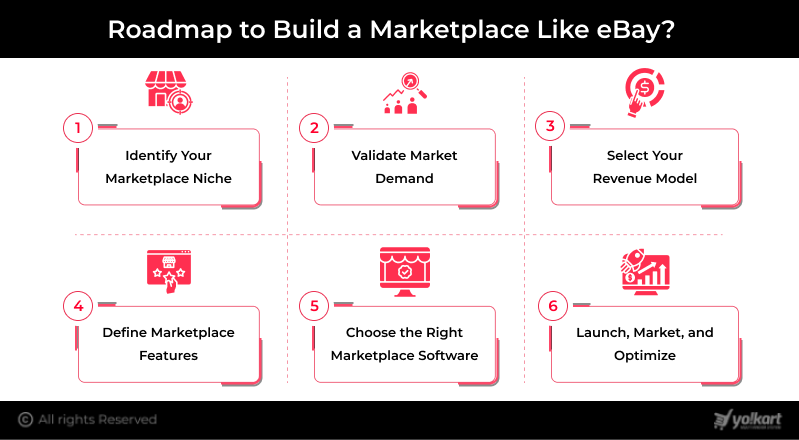
Step 1: Identify Your Marketplace Niche
Start by defining the niche your marketplace will serve. Instead of competing with established marketplaces across every category, focus on solving a specific problem or serving an underserved market.
Whether it’s electronics, collectibles, automotive parts, fashion, B2B products, or another niche. A well-defined niche helps you attract the right sellers, differentiate your platform, and build a loyal customer base.
Step 2: Validate Market Demand
Before investing in development, validate your marketplace idea through thorough market research. Analyze competitors, identify gaps in existing platforms, study customer purchasing behaviour, and evaluate seller demand within your chosen niche.
Engaging with potential buyers and vendors through surveys or interviews can provide valuable insights, helping you refine your business model and reduce the risks associated with launching a new marketplace.
Step 3: Select Your Revenue Model
A sustainable marketplace requires a clear monetization strategy. Determine how your platform will generate revenue based on your target audience and business objectives. Common monetization models include commissions on each transaction, subscription plans, advertising, featured listings, or a combination of these models.
Many successful marketplaces combine multiple revenue streams to create predictable income while delivering value to both buyers and sellers.
Step 4: Define Marketplace Features
The success of your marketplace depends on delivering a seamless experience for every user. Identify the essential functionality required for buyers, sellers, and admin/s before the development begins. Essential features include:
- Product management
- Order processing
- Reviews
- Payments
- Reporting
- Commission management
- Mobile Responsiveness
As your marketplace grows, AI-powered recommendations, marketing tools, and analytics can further enhance user engagement and operational efficiency.
Step 5: Choose the Right Marketplace Software
Selecting the right technology is one of the most critical decisions in your marketplace journey.
While custom development offers complete flexibility, it often involves significant investment, lengthy development timelines, and ongoing maintenance. Alternatively, a white-label marketplace solution enables businesses to launch much faster with built-in marketplace functionality that can be customized to suit their specific requirements. This approach reduces time-to-market, lowers development costs, and minimizes technical complexity.
Step 6: Launch, Market, and Optimize
After launching your marketplace, focus on attracting quality sellers and building a strong buyer community through targeted marketing, partnerships, SEO, social media, and referral programs. Continuously monitor platform performance, gather user feedback, and analyze key metrics such as traffic, conversions, customer retention, and seller activity. Successful marketplaces are built through continuous optimization, regular feature enhancements, and ongoing efforts to improve the buying and selling experience as your business scales.
Why Choose Yo!Kart to build an Online Marketplace like eBay?
If you are inspired by eBay’s marketplace model and want to build a similar kind of marketplace, choosing the right technology is one of the most important decisions you will make.
Developing a marketplace from scratch can require extensive technical expertise, significant investment, and months of development. Hence, many startups and enterprises opt for a white-label marketplace platform as it provides a more practical and cost-effective path to launch an online marketplace.
Yo!Kart is a self-hosted multi-vendor marketplace software designed to help entrepreneurs launch scalable online marketplaces across a wide range of industries. Whether you’re building a marketplace for B2C, B2B, wholesale, rental, or niche products, Yo!Kart provides the essential features needed to launch quickly and grow efficiently.
Key features of Yo!Kart include:
- Self-hosted architecture with customizable source code
- Ready-to-launch multi-vendor marketplace functionality
- Dedicated dashboards for buyers, sellers, and administrators
- Flexible commission and revenue management
- Product catalog and inventory management
- Secure payment gateway integrations
- Multi-language and multi-currency support
- Mobile-responsive design
- SEO-friendly architecture
- Built-in marketing and promotional tools
- Easy customization to match unique business requirements
- Scalable infrastructure to support future growth
Rather than investing valuable time in developing core marketplace functionality, businesses can leverage Yo!Kart’s proven framework to reduce development time and focus on acquiring vendors, serving customers, and growing their marketplace, delivering exceptional customer experiences and scaling their marketplace.
Experience Yo!Kart Firsthand
Conclusion
eBay’s success demonstrates the enduring potential of the marketplace business model. By creating a trusted platform connecting buyers and sellers, the company has built one of the world’s most recognizable online marketplaces without relying on traditional inventory ownership. Its diversified revenue model, asset-light operations, strong network effects, and continuous innovation offer valuable lessons for entrepreneurs planning to launch their own marketplace.
That said, to build a successful marketplace today, entrepreneurs must identify a profitable niche, create a seamless user experience, implement sustainable monetization strategies, and choose technology that supports long-term scalability.
Rather than starting from scratch, many businesses accelerate their journey by using a proven white-label marketplace solution. If you’re planning to build a marketplace inspired by eBay, Yo!Kart provides the flexibility, scalability, and built-in marketplace capabilities needed to launch faster, reduce development costs, and adapt your platform as your business grows.
Frequently Asked Questions
Q 1. What is eBay’s business model?
Ans. eBay operates on a multi-vendor marketplace business model that connects buyers and sellers on a single platform. While facilitating transactions between independent merchants and customers, it earns revenue through seller fees, commissions, advertising, and subscription services.
Q 2. How does eBay make money?
Ans. eBay generates revenue through multiple streams, including:
- Seller fees
- Final value fees
- Promoted listings
- Store subscriptions
- Advertising services
- Payment-related services
Q 3. Why is eBay’s business model successful?
Ans. eBay’s business model succeeds because it is asset-light, scalable, and supported by strong network effects. As more buyers and sellers join the platform, its value increases for all participants, creating sustainable long-term growth.
Q 4. Can I build a marketplace like eBay?
Ans. Yes, entrepreneurs can build a marketplace similar to eBay by identifying a niche, selecting a suitable revenue model, defining marketplace features, and using scalable marketplace software such as Yo!Kart to accelerate development.
Q 5. What is the difference between eBay and a traditional eCommerce store?
Ans. A traditional eCommerce store sells products owned by a single business, whereas eBay operates as a multi-vendor marketplace where multiple independent sellers list and sell products to buyers across the globe through a shared platform.
Q 6. Is custom marketplace development better than white-label software?
Ans. The ideal development approach depends on your business goals. Undoubtedly, custom development offers complete flexibility, but at the same time, it requires greater investment and longer timelines. White-label marketplace software, on the other hand, enables businesses to launch faster with pre-built functionality while retaining customization capabilities.
Q 7. Which industries can use the marketplace business model?
Ans. The marketplace model can be applied across numerous industries, including:
- Fashion
- Electronics
- Wholesale
- Automotive
- Healthcare
- Food
- Rental services
- Digital products
- Home décor
- Industrial supplies, and many others
Q 8. Can Yo!Kart be customized to build a marketplace like eBay?
Ans. Yes, Yo!Kart is a fully customizable, self-hosted marketplace software that enables businesses to build marketplace platforms inspired by eBay. It allows entrepreneurs to tailor the workflows, branding, features, and integrations to meet their specific business requirements.