

Back To Home

Healthcare Marketplace Development: A Complete Guide to Building a Scalable Platform
296
Views
Published date 01st September, 2026
TL;DR
- Digital healthcare is transforming patient access. Healthcare marketplaces bring providers, pharmacies, laboratories, insurers, and medical suppliers together, creating new opportunities for healthpreneurs.
- Build around the healthcare model that fits your audience. Telemedicine, medical supplies, and mental health marketplaces serve different needs and require distinct workflows.
- Compliance and security shape healthcare platforms. From provider licensing and prescription laws to data protection and medical device regulations, build compliance into the foundation.
- Prioritize essential features and choose the right development approach. A focused MVP, secure infrastructure, and scalable technology reduce development complexity and support long-term growth.
Introduction
Akin to every other aspect of modern life, healthcare is becoming increasingly digital, and patients now expect instant services and high convenience from the healthcare industry. Technology today has made it possible to consult doctors virtually, access medical records, and purchase healthcare equipement through a single platform. This shift toward digitalization is fueling the growth of digital healthcare, which, as per Grand View Research, is projected to grow from $420.2 billion in 2026 to $1,830.4 billion by 2033, at a CAGR of 23.4% from 2026 to 2033.
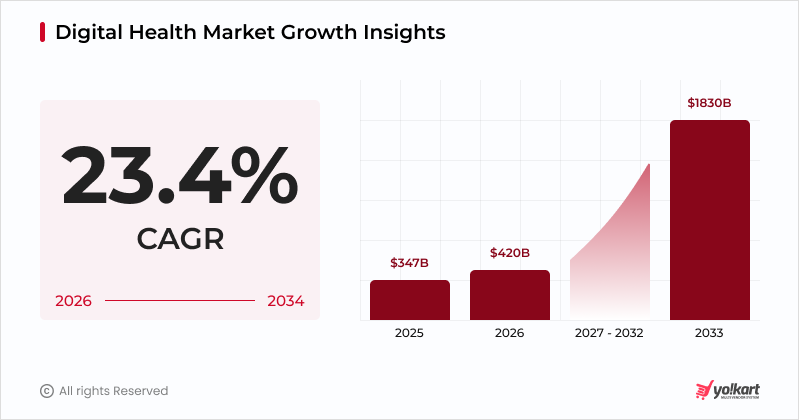
For entrepreneurs, this growth presents an opportunity to build a scalable business that connects patients, healthcare providers, pharmacies, laboratories, and medical suppliers within one integrated ecosystem. Such platforms streamline healthcare delivery, improve operational efficiency, and make quality care more accessible while creating multiple revenue opportunities.
To help healthpreneurs, this guide provides a complete roadmap to healthcare marketplace development, covering marketplace models, emerging industry trends, compliance requirements, must-have features, development costs, common challenges, and the most efficient approach to building a future-ready healthcare marketplace.
Table of Contents
- Understanding the Concept of an Enterprise Healthcare Marketplace
- Trends & Technologies Shaping the Healthcare Industry
- Types of Healthcare Marketplace
- Business Benefits of Building a Healthcare Marketplace
- Marketplace Compliance: What Every Founder Should Know Before Building
- Must-Have Features for a Healthcare Marketplace
- How to Build a Healthcare Marketplace: A Step-by-Step Roadmap
- Healthcare Marketplace Development Cost
- Challenges in Building a Healthcare Marketplace
- Yo!Kart: A Customizable Solution for Healthcare Marketplace Development
- Conclusion
- FAQs
Understanding the Concept of an Enterprise Healthcare Marketplace
An enterprise healthcare marketplace is a digital marketplace that has changed the way people access healthcare. Typically, these marketplaces bring together healthcare providers, patients, pharmacies, laboratories, insurers, medical equipment suppliers, and other healthcare stakeholders within a single, unified ecosystem.
Unlike conventional marketplaces that primarily facilitate buying and selling, enterprise healthcare marketplaces orchestrate complex healthcare workflows and give patients a centralized destination to discover, compare, book, and pay for healthcare services.
At the same time, an enterprise healthcare marketplace streamlines operations, improves care coordination, and opens doors for new revenue opportunities while maintaining regulatory compliance and data security.
How Does an Enterprise Healthcare Marketplace Work?
To understand the marketplace better, let us have a look at the workflow of an enterprise healthcare marketplace:
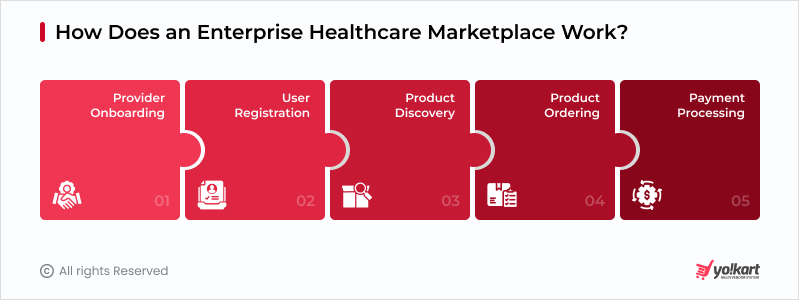
1. Provider Onboarding & Verification
Healthcare providers, pharmacies, laboratories, and insurers register on the platform by submitting required licenses and certifications. The marketplace verifies these credentials before activating their accounts.
2. User Registration
Patients register using their email, phone number, or social login. Secure authentication and identity verification protect sensitive health information and ensure only authorized users can access healthcare services.
3. Product Discovery
Based on their need and requirements, patients search and compare healthcare providers, products, medicines, or diagnostic centers using filters such as specialty, availability, pricing, reviews, location, and more before selecting an option.
4. Product Ordering
Patients can upload prescriptions or order medicines and medical equipment. Real-time scheduling and secure checkout ensure a smooth and convenient booking experience.
5. Payment Processing
Secure payments, insurance verification, and claims processing simplify transactions for both patients and providers.
Working behind the scenes and powering the entire ecosystem, admin/s supervise marketplace operations. The admin validates provider onboarding, oversees orders, commissions, settlements, and user interactions, and enforces regulatory compliance.
Want to Build an Online Healthcare Marketplace?
Trends & Technologies Shaping the Healthcare Industry
Healthcare and technology have become two sides of the same coin. Integration of technology for AI-powered diagnostics, virtual consultations, remote patient monitoring, and interoperable health records is redefining how care is delivered, managed, and experienced.
Beyond improving clinical outcomes, healthcare organizations are leveraging advanced technologies to enhance operational efficiency, reduce administrative burdens, and deliver more personalized patient experiences.
Below are some of the key trends and technologies transforming the healthcare landscape in 2026:
1. Digital innovation and AI
AI-powered tools are being used in healthcare to accelerate diagnostics, support clinical decision-making, automate documentation, and enable predictive analytics for early disease detection. As AI becomes deeply embedded into healthcare workflows, it is enabling providers to focus more on patient outcomes while improving efficiency across the care spectrum.
2. Proactive Healthcare with Wearables
Technology is not limited to hospital or clinic machinery; it is being integrated into wearable devices such as smartwatches, fitness bands, biosensors, and remote patient monitoring devices. These devices collect health data, including heart rate, blood pressure, blood oxygen levels, sleep patterns, and physical activity. This real-time data collection enables healthcare providers to detect health risks early and monitor chronic conditions.
3. Interoperable Healthcare IT Systems
Interoperability enables hospitals, clinics, laboratories, pharmacies, insurers, and other healthcare providers to securely exchange patient information across different platforms. This seamless flow of data improves care coordination, minimizes duplicate tests, enhances clinical decision-making, and ensures providers have access to accurate patient records when needed. Standards such as HL7 FHIR (Health Level Seven Fast Healthcare Interoperability Resources) are further accelerating secure data sharing, creating a more connected and efficient healthcare ecosystem.
4. Telemedicine
Telemedicine refers to the delivery of healthcare services remotely through digital communication technologies, allowing patients to consult healthcare professionals through video calls, phone calls, and digital platforms. It reduces the need for in-person visits, making healthcare more convenient for patients in remote locations or those requiring routine consultations and follow-ups. Beyond improving accessibility, telemedicine helps healthcare providers optimize resources, reduce administrative workloads, and deliver care more efficiently.
5. Electronic Health Records
Electronic Health Records (EHRs) are transforming how patient information is stored, accessed, and shared across healthcare organizations. They digitally centralize medical histories, diagnoses, medications, test results, and treatment information, giving authorized healthcare providers access to comprehensive patient data when needed. In addition to that, when integrated with interoperable healthcare systems, AI, analytics, and digital health platforms, EHRs can also help healthcare providers derive actionable insights from patient data and deliver more connected, efficient, and personalized care.
Types of Healthcare Marketplace
Healthcare marketplaces are not one-size-fits-all. Depending on the healthcare services they offer and the target audience they serve, these platforms cater to different segments of the healthcare ecosystem. Some focus on connecting patients with doctors, while others simplify medicine purchases, enable virtual consultations, or provide access to mental health professionals and medical equipment.
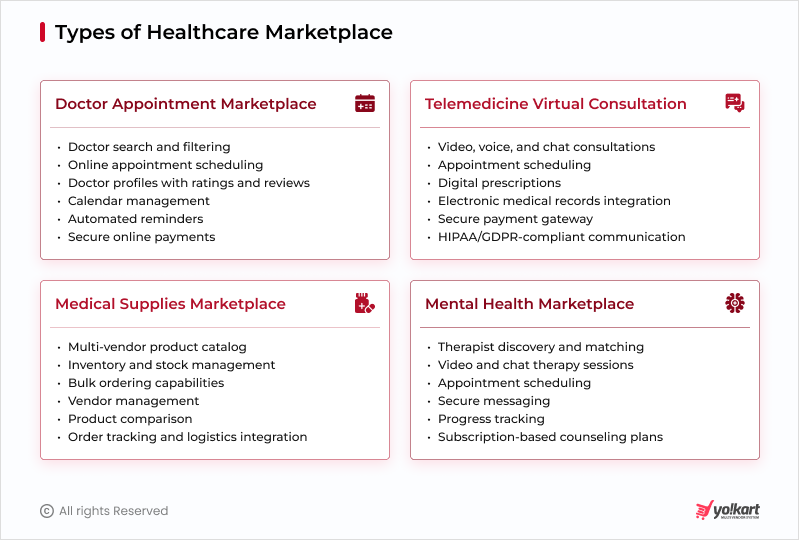
Below are the most common types of healthcare marketplaces that are transforming the industry:
1. Doctor Appointment Marketplace
A doctor appointment marketplace enables patients to discover healthcare providers, compare profiles, view real-time availability, and book appointments online. These platforms eliminate the hassle of phone-based scheduling while helping hospitals and clinics manage appointments more efficiently.
Patients can search for doctors based on specialty, location, consultation fees, experience, language, or patient reviews. On the provider side, healthcare professionals can manage schedules, reduce no-shows, and optimize patient flow.
Key features include:
- Advanced doctor search and filtering
- Online appointment scheduling
- Doctor profiles with ratings and reviews
- Calendar and availability management
- Automated reminders and notifications
- Secure online payments
2. Telemedicine/Virtual Consultation
A telemedicine marketplace allows patients to consult licensed healthcare professionals remotely through video, voice, or chat. It removes geographical barriers, making healthcare accessible to patients in rural areas, individuals with mobility limitations, and those seeking faster medical advice.
Beyond virtual consultations, modern telemedicine platforms often support digital prescriptions, electronic health records (EHR) integration, follow-up scheduling, and secure payment processing. Many platforms also facilitate specialist consultations and chronic disease management.
Key features include:
- Video, voice, and chat consultations
- Appointment scheduling
- Digital prescriptions
- Electronic medical records integration
- Secure payment gateway
- HIPAA/GDPR-compliant communication
3. Medical Supplies Marketplace
A medical supplies marketplace connects manufacturers, distributors, and healthcare providers through a centralized platform for purchasing medical equipment and healthcare products. Buyers can compare products from multiple vendors, evaluate pricing, and place bulk or individual orders from a single marketplace.
These platforms typically serve hospitals, clinics, laboratories, caregivers, and individual consumers seeking products such as diagnostic devices, surgical equipment, mobility aids, home healthcare products, and personal protective equipment (PPE).
Key features include:
- Multi-vendor product catalog
- Inventory and stock management
- Bulk ordering capabilities
- Vendor management
- Product comparison
- Order tracking and logistics integration
4. Mental Health Marketplace
A mental health marketplace connects individuals with licensed psychologists, psychiatrists, therapists, and counselors for online or in-person therapy sessions. These platforms make mental healthcare more accessible by reducing barriers such as geographical limitations, scheduling conflicts, and social stigma.
Many mental health marketplaces also offer self-help resources, wellness programs, guided meditation, mood tracking, and anonymous counseling options to support long-term mental well-being.
Key features include:
- Therapist discovery and matching
- Video and chat therapy sessions
- Appointment scheduling
- Secure messaging
- Progress tracking
- Subscription-based counseling plans
Exploring Healthcare Marketplace Opportunities But Unsure Which Model to Pursue?
Business Benefits of Building a Healthcare Marketplace
A healthcare marketplace serves medical service providers and service seekers at the same time. Compared to the way healthcare services are delivered traditionally, a marketplace automates several day-to-day tasks, reducing operational bottlenecks.
Given below are some of the benefits of building a healthcare marketplace:
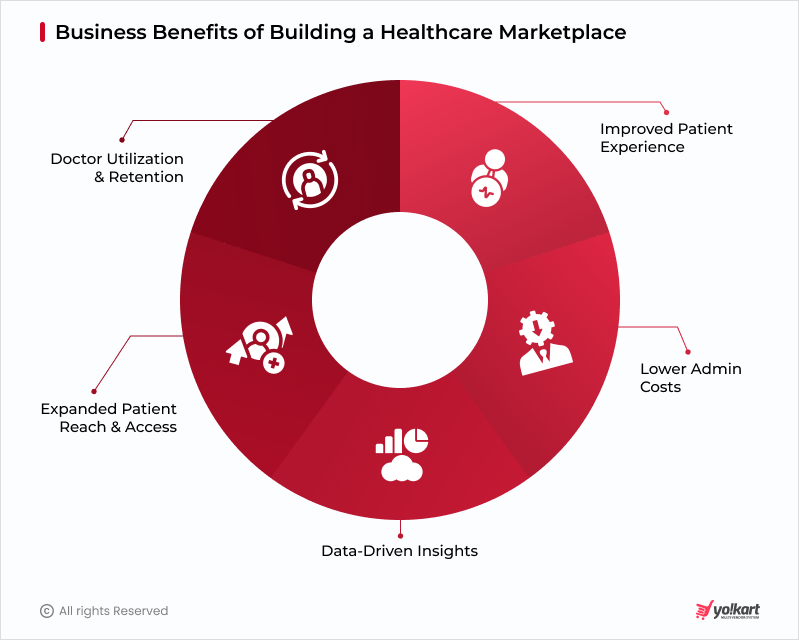
1. Lower Administrative Costs
A healthcare marketplace streamlines repetitive tasks such as patient onboarding, billing, and insurance verification. This reduces the need for manual intervention and helps healthcare businesses lower administrative overhead. In addition to that, marketplaces offer a centralized platform, simplifying routine workflows and enabling providers to allocate their resources efficiently.
2. Optimized Doctor Utilization and Retention
Marketplace platforms offer transparency into doctor availability, and patient demand. It helps healthcare organizations to manage schedules more efficiently, reduce idle time, and balance workloads across available providers. Furthermore, transparency and better utilization of doctors reduce scheduling gaps and improve job satisfaction and retention.
3. Expanded Patient Reach and Access
A healthcare marketplace brings multiple healthcare providers and services together on a single platform, making it easier for patients to find suitable care. Additionally, features such as provider search, location-based discovery, and telemedicine help providers reach a wider patient base, including patients in remote or underserved areas.
4. Data-Driven Insights
Healthcare marketplaces collect valuable data from patient interactions, provider activity, and service usage. Healthcare professionals can analyze this data to understand patient preferences and patterns, monitor habits, and identify correlations in patient health records. These insights support informed decision-making while helping healthcare businesses improve service delivery and operational efficiency.
5. Improved Patient Experience
A healthcare marketplace gives patients greater control over how they find and access healthcare services. Patients can compare providers, review available services, check availability, and choose options based on their specific needs. This convenience, combined with greater transparency and personalized choices, improves patient satisfaction and creates a user-friendly healthcare experience.
Marketplace Compliance: What Every Founder Should Know Before Building
A healthcare marketplace collects sensitive information such as patient details, insurance claims, prescriptions, and financial transactions. To protect this information, the marketplace should follow applicable healthcare regulations and implement the necessary security controls.
Most of the time, healthpreneurs are either unaware of these regulations or overlook them during the initial development stage. Thus, to help you plan the platform better, a list of key compliance areas is mentioned below:
1. Data Security Layer
A healthcare marketplace should implement a strong data security layer to protect sensitive healthcare and financial information from unauthorized access and misuse. Key security measures include:
- Data encryption
- Role-based access controls
- Secure authentication
- Regular security audits
2. Prescription Laws
If the marketplace supports online prescriptions, founders need to consider the prescription laws applicable to their target market and the type of medicines offered. The platform should ensure:
- Verify prescribing professionals
- Follow e-prescription requirements
- Restrict controlled medicines where applicable
- Maintain prescription records
3. Medical Device Regulations
Marketplaces listing medical devices need to comply with the regulations applicable to the products and markets they serve. Requirements may differ based on the device category and intended use. Founders should focus on:
- Verify product certifications
- Follow device approval requirements
- Maintain accurate product information
- Ensure compliant labeling and claims
4. HIPAA (US)/GDPR (Europe)
Healthcare marketplaces handling health data in the US or Europe should consider regulations such as HIPAA and GDPR. These frameworks define how sensitive personal and health information should be collected, processed, and protected. To support compliance, the platform should include:
- Obtain required user consent
- Apply access and security controls
- Follow data protection requirements
- Manage third-party data processors
5. Medical Licensing
A healthcare marketplace should verify the credentials and professional licenses of doctors and other healthcare providers before allowing them to offer services through the platform. This can include:
- Verify professional credentials
- Check license validity
- Maintain provider records
- Reverify licenses periodically
Must-Have Features for a Healthcare Marketplace
A healthcare marketplace has to keep primary stakeholders, care seekers, and providers in sync. Every stage of the healthcare journey, from finding a suitable provider to booking consultations, making payments, and managing interactions, needs to work seamlessly.
Thus, to keep these processes streamlined and create a more cohesive marketplace experience, the platform should include the right set of features. Below are some of the must-have features for a healthcare marketplace:
Patient/Care Seeker Features
- User Registration & Profile Management
Patients should be able to create a profile and manage essential personal, healthcare, and insurance information seamlessly. A centralized profile helps provide smooth access to healthcare services.
- Doctor Search & Filtering
An advanced search system enables care seekers to discover suitable doctors based on speciality, location, availability, experience, consultation fees, ratings, and other relevant preferences.
- Telemedicine & Secure Messaging
Integrating telemedicine enables patients to consult healthcare providers remotely through video, audio, or chat while allowing them to securely exchange messages and medical documents.
- Device & IoT Integration Layer
A healthcare marketplace should enable integration with wearables and connected medical devices, allowing care seekers to track health vitals and securely share relevant data with authorized healthcare providers.
- Digital Medical Records & Prescription Management
The marketplace should enable users to securely access medical histories, laboratory reports, prescriptions, and treatment records from a centralized location, making healthcare information easier to manage and share.
- Payments, Insurance & Medication Management
Integrated payment, insurance, and medication management features should allow patients to manage healthcare expenses, coverage details, prescriptions, and medication schedules through a single platform.
Healthcare Provider Features
- Provider Registration, Verification & Onboarding
Healthcare providers should be able to register and submit professional credentials, licenses, and certifications for verification. A structured onboarding process should help maintain a trusted provider network.
- Professional Profile Management
The platform should enable doctors to create detailed profiles showcasing their specializations, qualifications, experience, consultation fees, and locations while managing key aspects of their practice.
- Patient Records & Consultation History
Healthcare providers should be able to securely access relevant patient information, medical history, previous consultations, reports, prescriptions, and consultation notes to support informed decisions and continuity of care.
- Telemedicine & Digital Prescriptions
Telemedicine tools should enable doctors to conduct remote consultations through video, audio, or chat and issue digital prescriptions while securely sharing medical documents and managing follow-up consultations.
- Provider Payments, Earnings & Performance Analytics
A centralized dashboard enables care providers to track earnings, payouts, transactions, patient ratings, and performance metrics for greater financial and operational visibility.
Admin Features
- User, Doctor & Provider Management
Admin/s should be able to manage care seeker and provider accounts, oversee profiles, approve or suspend users, and monitor marketplace activity through a centralized administration panel.
- Provider License & Credential Verification
The platform should allow admin/s to verify professional licenses, qualifications, certifications, and submitted documents before approving providers, helping maintain platform credibility and support healthcare compliance requirements.
- Payment, Commission & Payout Management
A centralized financial system allows admin/s to manage patient payments, provider payouts, marketplace commissions, refunds, invoices, and transaction records across the marketplace.
- Review, Dispute & Complaint Management
The admin should be able to address patient complaints, resolve provider disputes, and investigate reported content to maintain service quality and foster trust throughout the marketplace ecosystem.
- Compliance & Security Management
Admin/s should be able to manage access controls, audit logs, consent records, security activities, and compliance requirements to safeguard sensitive healthcare information and support regulatory obligations.
- Analytics, Reporting & AI-Assisted Insights
Analytics tools should provide visibility into patient activity, provider performance, appointments, revenue, and service demand, while AI-assisted insights should help identify trends and improve marketplace operations.
Empower Your Healthcare Marketplace with a Strong Suite of Features
How to Build a Healthcare Marketplace: A Step-by-Step Roadmap
Now that you understand the key considerations involved in healthcare marketplace development, the next step is to turn those insights into an actionable plan. To assist you in that regard, a clear and practical approach to developing a healthcare marketplace is given below:
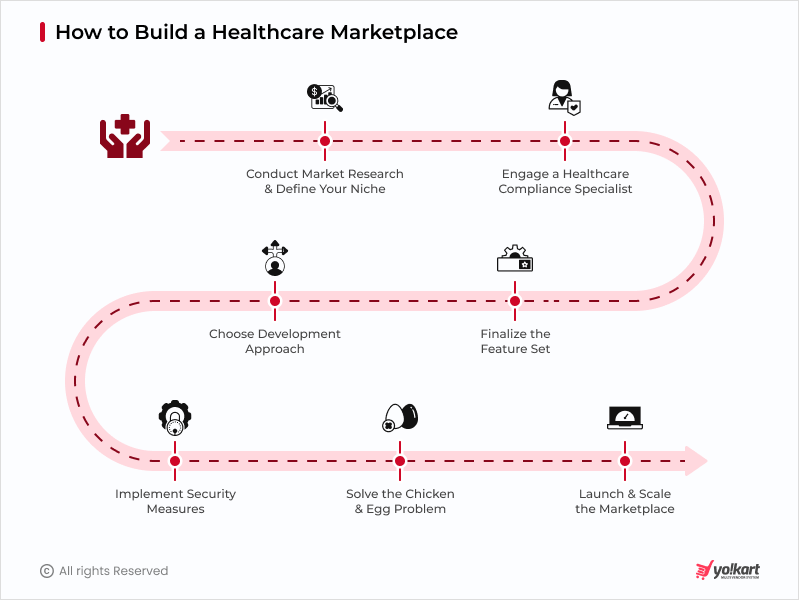
Step 1: Conduct Market Research and Define Your Niche
Before investing in development, first determine exactly who you are serving and what problem your platform is solving. A focused niche makes it easier to understand demand, identify competitors, attract providers, and build a marketplace around genuine healthcare needs.
Start by researching key areas, such as:
- Target audience and patient demographics
- Healthcare provider availability and requirements
- Competitor offerings and pricing models
- Market demand and emerging healthcare trends
- Potential revenue and monetization opportunities
Once you have gathered the market insights, use them to narrow down your focus and identify where your marketplace can create the most value.
Ask Yourself:
- Which healthcare services are in high demand?
- Who is your primary audience: patients, providers, insurers, or all three?
- Which specialties or geographic markets offer the strongest opportunity?
- What gaps do existing healthcare marketplaces leave unresolved?
Step 2: Engage a Healthcare Compliance Specialist
Healthcare marketplaces cannot treat compliance as an afterthought. Before beginning with the development process, work with a healthcare compliance specialist to identify the regulations, licensing requirements, privacy standards, and data-handling obligations applicable to your target market, region, or country.
Consider:
- Applicable healthcare and data-protection regulations
- Patient consent and data-processing requirements
- Provider licensing and verification
- Medical data storage and access controls
- Payment and insurance-related regulations
- Requirements for third-party integrations
Step 3: Finalize the Feature Set
Features work as a backbone for any marketplace, but at the same time, integrating every feature from day one is untenable. Instead, ascertain the functionalities required to deliver your core value proposition and prioritize for the MVP. This approach keeps the development focused while leaving room for future expansion.
Prioritize the following features:
- Patient registration and profile management
- Provider profiles and verification
- Search, filters, and provider discovery
- Telemedicine and communication tools
- Secure payments and transaction management
- Notifications and reminders
- Admin dashboards and marketplace management
Pro Tip: Separate must-have MVP features from advanced features that can be introduced after validating user demand.
Step 4: Choose Development Approach
After finalising your niche, regulatory compliance, and features, decide how you will develop the marketplace. Generally, entrepreneurs come across two approaches: leveraging a self-hosted solution or custom development.
Undoubtedly, both approaches have their own set of benefits and drawbacks. However, the right choice depends on your budget, timeline, customization requirements, and growth plans.
Have a look at the table below to understand both approaches better:
| Evaluation Factor | Custom Development | White-Label Solution |
| Development Speed | Slow | Fast |
| Initial Cost | High | Low to Moderate |
| Scalability | High | Moderate to High (Depending on the provider) |
| Security & Compliance | Can be tailored to specific requirements | Depends on the solution and provider |
| Long-Term Maintenance | Requires ongoing technical resources | Typically managed or supported by the solution provider |
Which approach is right for you?
To select the right development approach, consider your current resources, business model, technical requirements, and growth plans.
- Choose custom development when long-term flexibility and ownership outweigh the higher initial investment.
- Choose a white-label self-hosted solution when validating your marketplace concept and achieving faster time to market are the primary goals.
Focus on Growth Instead of Complex Development
Step 5: Implement Security Measures
Healthcare marketplaces handle highly sensitive information, making security a fundamental requirement. Rather than focusing on security later on, integrate security layers from the beginning.
Mentioned below are some of the necessary security measures to cover:
- Data encryption in transit and at rest
- Secure authentication and authorization
- Role-based access controls
- API security
- Audit logs and activity monitoring
- Regular vulnerability assessments
- Secure data backup and recovery
- Privacy-focused data management
Primary objective: Protect patient information while ensuring authorized users can access the data they need.
Step 6: Solve the Chicken-and-Egg Problem Strategically
Getting a healthcare marketplace off the ground presents a familiar challenge: patients need providers, but providers need patients. Trying to build both sides simultaneously can stretch your resources and leave neither side with enough activity to see value.
Instead of trying to attract everyone at once, start by building traction within a clearly defined segment. This could mean:
- Starting with one healthcare specialty or service category
- Targeting a specific geographic market
- Onboarding a reliable base of verified providers first
- Offering early-adopter incentives where appropriate
- Running targeted campaigns to attract patients
- Using early transactions and feedback to improve the experience
The objective is to establish enough provider supply and patient demand within a focused market to create initial momentum. Once that foundation is established, you can gradually expand into new specialties, locations, and services.
Step 7: Launch and Scale the Marketplace
A successful launch is less about making a big entrance and more about learning what works. Once your healthcare marketplace reaches real users, monitor how patients and providers interact with the platform, identify gaps in the experience, and use those findings to shape future improvements and expansion.
To make sure that marketplace is gaining traction, keep an eye on the following metrics:
- Patient acquisition and activation
- Provider onboarding and retention
- Consultation completion rates
- Cancellation and no-show rates
- Repeat bookings
- Transaction volume
- Customer acquisition cost
- Patient and provider satisfaction
Once patient demand and provider participation become consistent, expand your marketplace based on validated opportunities rather than assumptions.
Healthcare Marketplace Development Cost
The cost of developing a healthcare marketplace is rarely determined by a single factor. The scope of the platform, feature complexity, healthcare integrations, compliance requirements, and development approach can all influence the final investment. Understanding these cost drivers early can help you make informed decisions, prioritize what matters, and avoid unnecessary development expenses.
Cost Breakdown
For marketplace development, one factor that makes a significant difference is development approach. A self-hosted or white-label solution can reduce the initial development effort by providing ready-made marketplace functionality, whereas custom development requires building the core platform and workflows around your exact requirements.
| Marketplace Type | Self-Hosted/White-Label | Custom Development |
| MVP Marketplace | $2,000-$5,000+ | $40,000-$80,000 |
| Basic Marketplace | $10,000+ | $60,000-$120,000 |
| Advanced Marketplace | $10,000+ | $120,000-$250,000+ |
| Enterprise Marketplace | $10,000+ | $250,000-$500,000+ |
Suggested Read: Cost to Build a Marketplace Website in 2026
What Determines the Development Cost?
Features and Functional Requirements
Features such as appointment scheduling, video consultations, payments, EHRs, AI-based tools, wearable integrations, and analytics can add substantially to development costs. Advanced healthcare functionality typically requires more specialized engineering, testing, and integration work.
How to optimize:
Prioritize features according to their business value and launch an MVP with only the capabilities essential to the initial user journey. Once the marketplace gains traction, expand the feature set based on real user feedback.
Healthcare Integrations
Integrations can become one of the more substantial cost drivers as the marketplace expands. EHR/EMR systems, insurance verification, payment gateways, telemedicine services, laboratory systems, and wearable devices each introduce additional development and testing requirements.
How to optimize:
Identify which integrations are essential for launch and use established third-party APIs where practical instead of developing every capability internally. This can reduce development effort while still providing the required functionality.
Security and Compliance
Healthcare marketplaces handle sensitive health information, making security and regulatory compliance an important part of the development budget. Encryption, access controls, audit logs, authentication, risk assessments, penetration testing, and other safeguards can increase development costs, but they are fundamental to handling healthcare data responsibly.
How to optimize:
Treat compliance and security as part of the initial architecture rather than retrofitting them later. Building these requirements into the platform from the beginning can help avoid expensive rework as the marketplace grows.
Platform and UI/UX Requirements
Supporting multiple platforms, such as Android and iOS, can increase development and maintenance requirements. Similarly, custom UI/UX design, accessibility, responsive interfaces, and separate experiences for patients, providers, and administrators can add to the overall effort.
How to optimize:
If you need both mobile platforms, cross-platform development can reduce development effort by allowing teams to work from a shared codebase. For design, prioritize the workflows that matter most to patients and providers before investing in extensive customization.
Maintenance and Long-Term Support
The investment does not end when the marketplace goes live. Security patches, operating-system updates, bug fixes, infrastructure, third-party API changes, and feature enhancements create ongoing costs. Healthcare platforms may also need updates as regulatory or operational requirements evolve.
How to optimize:
Include maintenance and infrastructure in the initial budget and use a phased product roadmap. This allows you to spread development investment over time while keeping the marketplace secure, functional, and ready to scale.
Challenges in Building a Healthcare Marketplace
Building a healthcare marketplace is not simply about putting patients and providers on the same platform. Trust, data protection, regulatory requirements, provider participation, and user experience can all determine whether the marketplace gains traction.
Identifying these challenges early allows you to address them before they become barriers to growth.
| Challenge | How to Overcome It |
| Regulatory Compliance: Healthcare platforms must meet strict privacy, data-handling, and industry requirements. | Address compliance early by identifying applicable regulations and incorporating them into platform design and workflows. |
| Provider Acquisition: Without enough providers, patients have limited choice and availability. | Make participation seamless through simple onboarding, efficient scheduling, and tools that reduce administrative work. |
| Patient Trust: Patients need confidence in providers, platform security, and the information presented. | Build credibility with verified provider profiles, qualifications, reviews, transparent information, and secure interactions. |
| Patient Experience: Complicated discovery, booking, and communication can discourage marketplace usage. | Simplify the patient journey from provider search to booking, consultation, payment, and follow-up. |
| Data Integration: Healthcare information is often spread across different systems and platforms. | Prioritize interoperability through secure APIs and appropriate data exchange standards. |
| Patient Acquisition: Reaching the right audience while maintaining credible and compliant healthcare marketing can be challenging. | Use targeted marketing based on specific patient segments, relevant messaging, and appropriate digital channels. |
Yo!Kart: A Customizable Solution for Healthcare Marketplace Development
Building a healthcare marketplace from scratch is a resource-intensive process, particularly when your marketplace needs to support multiple vendors, secure transactions, regulatory requirements, and industry-specific workflows. This is where a self-hosted customizable solution such as Yo!Kart can simplify the development journey. It is a ready-made, white-label software that can be tailored to fit different healthcare marketplace models and business requirements.
Powered by FATbit Technologies, Yo!Kart offers a customizable and scalable architecture that enable businesses launch a marketplace without developing the entire infrastructure from the ground up. Its white-label and self-hosted model also gives businesses control over branding, hosting, data, and marketplace operations.
Some of the key reasons to consider Yo!Kart for healthcare marketplace development include:
- Self-Hosted Control: Retain control over hosting, data, branding, and marketplace operations with self-hosting.
- Customizable Functionality: Customize features, workflows, branding, and integrations for specific healthcare industry requirements.
- Multiple Business Models: Support B2B, B2C, and aggregator-based marketplace models for diverse business needs.
- Third-Party Integrations: Extend functionality through third-party integrations for evolving business requirements.
- One-Time Licensing: Avoid recurring SaaS fees with Yo!Kart’s one-time licensing model.
- Technical Support: One year of free technical support for implementation and marketplace management.
Diverse Marketplaces Powered by Yo!Kart
- Rxall: Rxall connects pharmacies and consumers with drug wholesalers across Africa, creating a digital channel for sourcing and purchasing medicines.
- CX Marketplace: A B2B cannabis infrastructure marketplace connecting European wholesalers with businesses for physical products and related services.
- Voyij: Designed around Alaska’s tourism ecosystem, Voyij brings travel activities and shopping together.
- Tajer: Tajer connects local and global brands through a multi-category marketplace, offering pre-orders, bilingual invoices, and web and mobile experiences.
Explore How Yo!Kart Fits Your Marketplace Requirements
Conclusion
A healthcare marketplace brings together several aspects such as provider onboarding, patient discovery, bookings, payments, security, and compliance. The challenge is not to build these components, but to bring them together into a seamless experience for every participant.
A practical approach is to begin with a focused healthcare use case, prioritizing essential workflows and features, building security and compliance into the foundation. Moreover, the technology choice also matters. While custom development offers greater control for specialized requirements, a self-hosted solution such as Yo!Kart provides an established marketplace foundation that can be tailored as per your business requirements.
The right choice should support your needs while giving you the flexibility to scale with future demand.
FAQs
Q 1. How does a healthcare marketplace make money?
Ans. A healthcare marketplace can generate revenue through several channels, including:
- Commissions
- Provider subscriptions
- Listing fees
- Advertising
Yo!Kart supports multiple marketplace revenue streams, allowing businesses to choose a model that fits their marketplace strategy.
Q 2. What are the legal risks of launching a non-compliant healthcare marketplace?
Ans. Launching a non-compliant healthcare marketplace can expose a business to regulatory fines, legal action, financial penalties, operational disruption, and reputation damage. Compliance failures involving patient privacy, billing, licensing, or data security can also affect provider and payer relationships. The consequences depend on the regulations and healthcare services involved.
Q 3. How does a marketplace check insurance coverage automatically?
Ans. A marketplace can automate insurance eligibility verification by connecting with payer systems or authorized eligibility services. The marketplace sends relevant patient and coverage information through the integration and receives an eligibility response, reducing manual verification and administrative work. The exact process depends on the payer, available APIs, and applicable healthcare data standards.
Q 4. What is the difference between a healthcare marketplace and a wellness marketplace?
Ans. A healthcare marketplace generally helps users access healthcare services, providers, medical products, or insurance plans, depending on its model. A wellness marketplace, on the other hand, focuses more on preventive health and lifestyle offerings.
The distinction lies primarily in the services offered, the users served, and the regulatory requirements governing those offerings.