

Published Date 17th March, 2026
Manufacturers today are operating in a rapidly evolving landscape where traditional distribution models are not enough to sustain growth. With rising competition and increasing digital expectations from buyers, relying solely on wholesalers, distributors, or retail networks can limit both reach and scalability. At the same time, buyers are demanding more convenience, transparency, and direct access to a wider range of products.
So how can manufacturers stay competitive while strengthening existing partnerships?
One of the most effective strategies is to build a multi-vendor marketplace that allows manufacturers, suppliers, distributors, and third-party sellers to operate on a single digital platform. This not only expands product offerings but also enables buyers to compare options, streamline procurement, and make informed decisions.
By adopting this model, manufacturers gain greater control over pricing, brand positioning, and supply chain transparency while unlocking new revenue opportunities. In this blog, we will explore how manufacturers can build a multi-vendor marketplace, the benefits of adopting this model, and the key steps required to launch and scale a successful marketplace platform.
Table of Contents
- Why Manufacturers Are Moving Toward Multi-Vendor Marketplaces
- Understanding the Multi-Vendor Marketplace Model for Manufacturers
- Key Benefits of Building a Multi-Vendor Marketplace for Manufacturers
- Key Features Required to Build a Multi-Vendor Marketplace
- Steps to Build a Multi-Vendor Marketplace for Manufacturers
- Common Challenges in Building a Multi-Vendor Marketplace
- Conclusion
- FAQs
Why Manufacturers Are Moving Toward Multi-Vendor Marketplaces?
The marketplace model has transformed how industries operate worldwide. From B2B procurement marketplaces to digital wholesale platforms, centralized marketplaces are proving to be more efficient for both buyers and sellers.
For manufacturers, this shift is not just about selling products online. It is about creating a digital ecosystem that connects suppliers, distributors, and buyers in one place. Here’s a closer look at the key factors driving this shift:
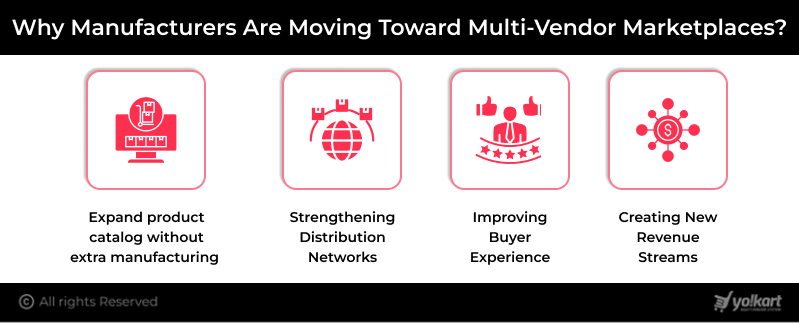
1. Expanding Product Catalog Without Additional Manufacturing
Manufacturers can significantly expand their product catalog by allowing third-partyvendors to list complementary products on the platform. For example, a manufacturer producing construction equipment can allow vendors selling tools, accessories, safetyequipment, and spare parts to join the platform. This creates a one-stop procurement hub for buyers while increasing platform engagement.
2. Strengthening Distribution Networks
Instead of replacing distributors, manufacturers can onboard them as vendors on the marketplace. This ensures that existing partners remain part of the ecosystem while benefiting from digital visibility, centralized ordering, and better inventory management.
3. Improving Buyer Experience
Modern buyers expect convenience, transparency, and quick comparisons. A multi-vendor marketplace enables buyers to compare products, review specifications, check ratings, and place bulk or customized orders, all in one place. This helps improve buyer confidence and encourages repeat purchases.
4. Creating New Revenue Streams
Manufacturers operating a marketplace can generate revenue through multiple monetization models, including vendor commissions, subscriptions, listing fees, advertising, and value-added services, turning the platform into a scalable digital business.
Understanding the Multi-Vendor Marketplace Model for Manufacturers
Before building a multi-vendor marketplace, it is important for manufacturers to clearly understand how the marketplace model works and why it is different from a traditional eCommerce store.
In a conventional online store, a single business sells its own products directly to buyers. However, a multi-vendor marketplace allows multiple independent sellers to list and sell products through a centralized platform managed by the marketplace owner.
For manufacturers, this model goes beyond online selling. It enables them to create a collaborative digital ecosystem where suppliers, distributors, wholesalers, and third-party vendors can sell products under a unified platform. While vendors manage their products and orders, the manufacturer manages the infrastructure and governance of the marketplace.
This approach allows manufacturers to move beyond being just product suppliers and instead become platform operators within their industry.
Key Participants in a Manufacturer-Led Marketplace
A successful multi-vendor marketplace operates through the collaboration of three core participants, each playing a specific role in the platform ecosystem.
a. Marketplace Owner (Manufacturer)
The manufacturer acts as the marketplace administrator and ecosystem builder. Rather than focusing only on selling its own products, the manufacturer provides the infrastructure that enables other vendors to sell through the platform.
Key responsibilities include:
- Managing vendor onboarding and verification
- Maintaining platform security and performance
- Defining commission structures and pricing policies
- Monitoring product quality and compliance
- Handling payments, disputes, and platform governance
This control helps protect brand reputation and ensures a consistent buyer experience.
b. Vendors and Suppliers
Vendors are independent sellers who join the marketplace to reach a wider audience. These may include:
- Authorized distributors
- Component suppliers
- Third-party product vendors
- Industry service providers
Each vendor typically receives access to a dedicated vendor dashboard to manage product listings, pricing, inventory, and order fulfillment. Their participation increases product variety, making the platform more valuable and comprehensive for buyers.
c. Buyers
Buyers on a manufacturer marketplace can include businesses, procurement managers, retailers, and sometimes individual consumers, depending on the marketplace model.
Instead of dealing with multiple suppliers separately, buyers benefit from a centralized procurement platform where they can:
- Compare products from multiple vendors
- Evaluate pricing and product specifications
- Review vendor ratings and reliability
- Place orders through a single checkout system
This streamlined buying experience makes the marketplace more attractive, improves trust, and encourages repeat purchases.
Want to Develop a Centralized Platform for Your Vendor Network?
Key Benefits of Building a Multi-Vendor Marketplace for Manufacturers
Building a multi-vendor marketplace for manufacturers creates a strategic foundation for growth, control, and long-term scalability in an increasingly digital landscape. Given below are some of the key benefits of building a multi-vendor marketplace for manufacturers:
1. Direct Market Insights
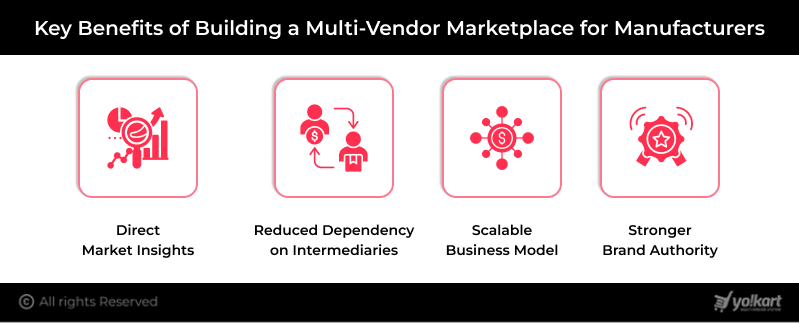
Operating a marketplace gives manufacturers real-time visibility into buyer behavior, product demand, and pricing trends. These insights can be used to optimize production planning, improve product offerings, and make more informed business decisions.
2. Reduced Dependency on Intermediaries
While distributors and wholesalers remain important, a marketplace allows manufacturers to establish a direct digital channel to buyers. This helps reduce dependency on limited sales channels while maintaining stronger control over the sales process.
3. Scalable Business Model
Unlike traditional eCommerce stores, marketplaces scale quickly because vendors contribute products and inventory. As more vendors join, the platform becomes more valuable for buyers and drives higher engagement.
4. Stronger Brand Authority
By operating a marketplace, manufacturers position themselves as industry leaders and ecosystem builders. This not only strengthens brand credibility but also builds trust among vendors, partners, and buyers.
Suggested Read: A Detailed Guide For Multi-Vendor Marketplace Development
Key Features Required to Build a Multi-Vendor Marketplace
When manufacturers plan to build a multi-vendor marketplace, selecting the right set of platform features is critical for ensuring smooth operations, vendor participation, and a seamless buying experience.
Unlike a traditional eCommerce store, a marketplace must support multiple sellers, complex product catalogs, and coordinated transactions between buyers and vendors. This requires a robust and scalable infrastructure that can efficiently manage vendor activities, product listings, orders, payments, and customer interactions.
Below are some of the key features manufacturers should consider when developing a scalable multi-vendor marketplace platform.
1. Vendor Registration and Management System
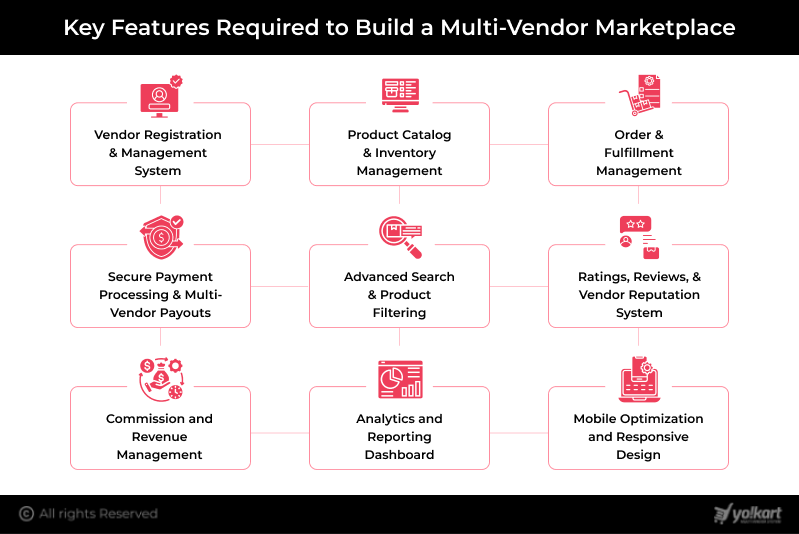
A marketplace must provide a streamlined onboarding process for vendors to register, create profiles, and start selling on the platform. An efficient vendor management system should allow admin/s to verify vendors, manage permissions, track performance, and oversee commissions and payouts.
At the same time, vendors should have access to a dedicated dashboard where they can manage their products, track orders, and analyze their sales performance.
2. Product Catalog and Inventory Management
A strong catalog system forms the backbone of any marketplace. It should support multiple categories, product variations, bulk pricing, and detailed specifications.
For industries like manufacturing, the ability to include technical attributes and documentation is especially important. Efficient inventory tools also help vendors update stock levels in real-time and avoid overselling.
3. Order and Fulfillment Management
A centralized order management system is essential for coordinating transactions between buyers and multiple vendors. Features like order tracking, automated notifications, vendor-specific processing, and shipment tracking ensure smooth operations.
Some marketplaces also integrate with logistics providers to simplify the shipping and delivery process.
4. Secure Payment Processing and Multi-Vendor Payouts
Handling payments in a multi-vendor setup requires flexibility and security. The platform should support trusted payment gateways, split payments or escrow systems, automated commission calculations, and timely vendor payouts.
Strong security measures, such as encrypted transactions and fraud protection, are also essential to build trust among both buyers and vendors.
5. Advanced Search and Product Filtering
As product listings grow, buyers need efficient tools to quickly find relevant products. Advanced search and filtering options help buyers quickly find relevant products based on categories, pricing, specifications, vendor ratings, and availability.
An optimized search experience significantly improves usability and drives conversions.
6. Ratings, Reviews, and Vendor Reputation System
Trust plays a major role in marketplace success. Buyers rely on ratings and reviews to make purchasing decisions.
A transparent feedback system not only helps buyers evaluate vendors but also encourages sellers to maintain high standards, improving overall platform credibility.
7. Commission and Revenue Management
A marketplace should support flexible monetization strategies such as commissions, subscriptions, featured listings, and advertising.
Having customizable revenue options ensures the marketplace can scale profitably while adapting to different vendor segments and business needs.
8. Analytics and Reporting Dashboard
Data insights are essential for marketplace growth and optimization. A robust analytics dashboard provides insights into vendor performance, buyer behaviour, product demand, and revenue trends.
These insights help manufacturers make data-driven decisions about product offerings, pricing strategies, and marketplace expansion.
9. Mobile Optimization and Responsive Design
Many buyers and vendors now access marketplaces through mobile devices. Therefore, the platform must offer a responsive design that works smoothly across smartphones, tablets, and desktops.
Some businesses also extend this experience through dedicated mobile apps to enhance engagement.
Power Your Multi-Vendor Marketplace with Robust Features
Steps to Build a Multi-Vendor Marketplace for Manufacturers
Building a multi-vendor marketplace platform requires a well-thought-out strategy that brings together the right business model, vendor ecosystem, technology infrastructure, and buyer acquisition strategy.
For manufacturers, the goal is to create a connected digital ecosystem where suppliers, distributors, and buyers can interact seamlessly while the manufacturer manages the overall platform experience.
Below are the key steps manufacturers should follow to successfully launch and scale their own marketplace.
Step 1: Define the Marketplace Model and Business Strategy
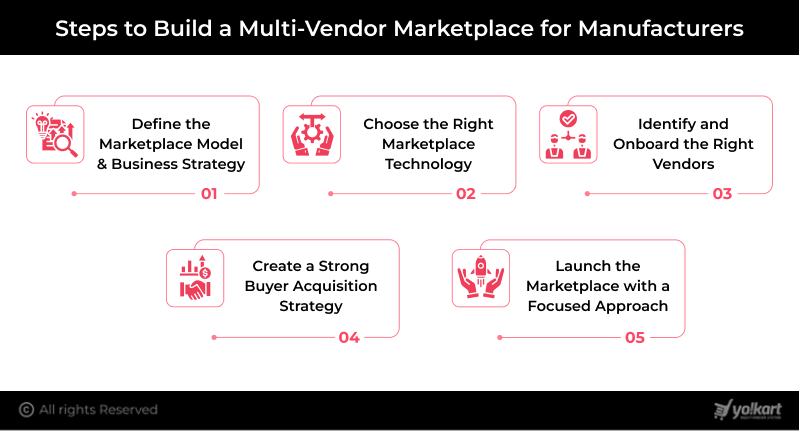
The first step in marketplace development is determining the type of platform you want to build. Different industries require different marketplace models depending on the nature of the products, the target audience, and the existing supply chain structure.
Manufacturers may consider launching:
- B2B procurement marketplaces for wholesalers and retailers
- B2B2C marketplaces where distributors sell directly to end customers
- Industry-specific supplier marketplaces focused on specialized products
As clearly defining the marketplace model helps determine platform features, vendor types, and revenue strategies.
At this stage, it is also important to decide how the marketplace will generate revenue, whether through vendor commissions, subscription plans, product promotion fees, or value-added services.
Step 2: Choose the Right Marketplace Technology
Selecting the right technology solution is one of the most important decisions in the development process. As it will directly impact how quickly you can launch and how well your marketplace scales.
Manufacturers typically have two main options when they build a multi-vendor marketplace:
a. Custom Marketplace Development
Custom development offers maximum flexibility and allows businesses to build a platform tailored entirely to their requirements. However, this approach often requires significant investment, longer development timelines, and ongoing technical maintenance.
b. Readymade Marketplace Software Solutions
Another option is using ready-made marketplace software such as Yo!Kart, which provides pre-built marketplace functionality including vendor management, product catalogs, payment integrations, and order management tools.
Such platforms allow manufacturers to launch faster while still offering customization options to match specific industry needs.
Choosing the right technology framework helps ensure the marketplace is scalable, secure, and capable of supporting long-term growth.
Suggested Read: Top Multi-Vendor Marketplace Platform Development Companies
Step 3: Identify and Onboard the Right Vendors
Vendors are the foundation of your marketplace. Without a strong and reliable supply base, it becomes difficult to attract buyers.
Manufacturers already have an advantage because they often maintain long-standing relationships with distributors, suppliers, and industry partners. These existing relationships can serve as the foundation for the initial vendor network.
To build a healthy vendor ecosystem, manufacturers should:
- Invite existing distributors and suppliers to join the platform
- Partner with complementary product vendors
- Establish clear vendor policies and quality standards
- Provide incentives for early vendor adoption
Starting with a curated group of trusted vendors ensures product quality and helps build buyer confidence in the marketplace.
Step 4: Create a Strong Buyer Acquisition Strategy
Even with a large vendor base, a marketplace cannot succeed without consistent buyer demand. Attracting the right audience requires a proactive and well-planned marketing approach.
Manufacturers should leverage multiple channels such as SEO, content marketing, industry partnerships, digital advertising, and targeted email outreach to drive traffic and engagement. Their existing brand credibility and industry relationships can also play a key role in attracting early buyers.
As buyer demand increases, more vendors become interested in joining the platform, creating a positive network effect that fuels long-term growth.
Step 5: Launch the Marketplace with a Focused Approach
Many new marketplaces fail because they attempt to scale too quickly without establishing a stable foundation. Instead of onboarding hundreds of vendors immediately, manufacturers should start with a focused group of trusted partners and a limited product catalog.
This controlled launch approach allows the platform to:
- Test key marketplace features
- Optimize vendor workflows
- Gather feedback from buyers and vendors
- Improve platform performance
Once the marketplace begins generating consistent transactions, it becomes easier to scale by expanding vendor participation and product categories in a controlled and sustainable way.
Common Challenges and Their Solutions in Building a Multi-Vendor Marketplace
While many manufacturers are exploring ways to build a multi-vendor marketplace, launching and managing a successful platform comes with several operational and strategic challenges. Unlike a traditional eCommerce website, a marketplace must balance the needs of multiple stakeholders, including vendors, buyers, and platform administrators.
Understanding these challenges early helps manufacturers design better systems, implement effective strategies, and create a more sustainable marketplace ecosystem.
Below are some of the most common challenges businesses encounter when developing and scaling a marketplace platform.
1. Vendor Acquisition and Onboarding
One of the biggest challenges during the early stages of a marketplace is attracting vendors to join the platform. Most vendors prefer selling on established platforms that already have strong buyer traffic.
Solution: Manufacturers can overcome this challenge by onboarding trusted partners first, offering early incentives, and simplifying the onboarding process. A strong initial vendor base helps build product variety and attracts buyers.
2. Achieving Marketplace Liquidity
Marketplace liquidity refers to maintaining a healthy balance between supply (vendors and products) and demand (buyers and orders). If a marketplace has many vendors but very few buyers, vendors may lose interest in the platform. Similarly, if buyers visit the platform but cannot find enough product variety, they may abandon the marketplace.
Solution: To overcome this challenge, manufacturers should launch the platform with a curated vendor group, targeted niche, and invest in early buyer acquisition. Once the marketplace reaches a critical level of activity, the platform becomes more attractive to both vendors and buyers, creating a positive network effect.
3. Maintaining Product Quality and Vendor Standards
Since multiple vendors operate on the same platform, maintaining consistent product quality and service standards can be challenging. Poor vendor performance can damage the overall reputation of the marketplace and reduce buyer trust.
Solution: Manufacturers can address this challenge by implementing clear vendor guidelines, verification processes, performance tracking, and a transparent review system to help maintain quality and protect the platform’s reputation.
4. Managing Payments and Vendor Payouts
Handling payments in a multi-vendor environment is more complex than traditional eCommerce transactions. The platform must process buyer payments while ensuring that vendors receive their payouts accurately and on time.
Solution: This requires systems that can support features like split payments, automated payouts, and secure gateways to build trust and ensure smooth financial operations.
5. Platform Scalability and Technology Challenges
As the marketplace grows, the platform must be able to handle increasing numbers of vendors, product listings, transactions, and users. Poorly designed technology infrastructure can lead to performance issues, slow loading times, or system downtime, which negatively impacts user experience.
Solution: To ensure scalability, manufacturers should invest in scalable architecture, cloud infrastructure, and reliable integrations. This helps avoid costly upgrades later.
6. Building Buyer Trust and Platform Credibility
For new marketplaces, earning buyer trust can be difficult because customers are often hesitant to purchase from unfamiliar platforms. Manufacturers must focus on building credibility through transparency and reliable service.
Solution: Follow strategies such as verified vendor badges, authentic reviews, secure payments, and responsive support to strengthen buyer trust and encourage repeat purchases
7. Balancing Marketplace Governance
Managing a marketplace also means setting clear rules. Without proper governance, conflicts between vendors and buyers may arise, which can damage the platform’s reputation.
Solution: Manufacturers should implement policies covering vendor conduct, product authenticity, returns, and dispute resolution to ensure fairness and long-term platform stability.
While these challenges are real, they are far from roadblocks. With the right strategy and technology, they can be effectively managed and even turned into growth opportunities. Successful manufacturers focus on creating consistent value for both vendors and buyers while maintaining clear operational processes.
By proactively addressing key areas like vendor onboarding, marketplace liquidity, technology scalability, and buyer trust, manufacturers can develop a strong and sustainable marketplace ecosystem that supports long-term digital growth.
Build a Multi-Vendor Marketplace with Yo!Kart
Launching a multi-vendor marketplace from scratch can be complex, especially for manufacturers managing multiple vendors, product types, and transactions. To simplify this process, many businesses turn to purpose-built solutions like Yo!Kart, which provides a read-to-deploy foundation tailored for marketplace operations.
With Yo!Kart, manufacturers can move from planning to execution much faster. Instead of dealing with lengthy development cycles, the platform offers built-in features and flexible customization options, allowing businesses to create a marketplace that fits their specific industry needs while delivering a seamless experience for both vendors and buyers.
As a result, manufacturers can significantly reduce time-to-market and development costs, while allocating their resources to other important aspects, such as a strong vendor ecosystem, attracting buyers, and scaling their digital marketplace effectively.
Key Advantages of Leveraging Yo!Kart
- Faster Time-to-Market: Launch your marketplace quickly with pre-built features, reducing development time and accelerating your go-to-market strategy.
- Comprehensive Feature Set: Access all essential marketplace functionalities, including vendor management, product catalogs, payments, and order processing in one place.
- Customizable and Scalable: Adapt the platform to your business needs and scale effortlessly as your marketplace grows.
- Cost-Effective Solution: Eliminate the high costs of custom development while benefiting from a feature-rich, ready-made platform.
- Vendor-Friendly Interface: Provide vendors with intuitive dashboards and tools to manage products, orders, and performance efficiently.
- Secure and Reliable: Ensure safe transactions and platform stability with built-in security features and robust infrastructure.
- Flexible Monetization Options: Generate revenue through commissions, subscriptions, and promotional listings with configurable monetization models.
- Seamless User Experience: Deliver a smooth and responsive experience across devices, improving engagement for both buyers and vendors.
Explore Cutting-Edge Capabilities of Yo!Kart
Conclusion
Digital commerce is transforming how manufacturers interact with suppliers, distributors, and buyers. What once relied on fragmented channels is now shifting toward unified platforms where multiple stakeholders interact seamlessly. This shift is not just about going online; it is about building connected ecosystems that drive efficiency and growth.
By building a multi-vendor marketplace, manufacturers can create a centralized hub that connects vendors, expands product offerings, and simplifies procurement for buyers. A well-designed marketplace not only improves supply chain efficiency but also provides valuable data insights into customer behavior, product demand, and vendor performance. These insights help manufacturers make informed decisions about product development, pricing strategies, and future expansion.
However, launching a marketplace requires careful planning, the right technology foundation, and a clear vendor acquisition strategy. With modern marketplace solutions simplifying development, manufacturers can focus on scaling their ecosystem, unlocking new revenue streams, and staying competitive in an increasingly digital-first market.
Frequently Asked Questions
Q 1. What is a multi-vendor marketplace?
Ans. A multi-vendor marketplace is an online platform where multiple independent sellers can register, list, and sell their products to buyers through a centralized system. The marketplace owner manages the platform infrastructure, vendor policies, and transactions while vendors/sellers manage their own product listings, pricing, and order fulfillment.
Q 2. Why should manufacturers build a multi-vendor marketplace?
Ans. Manufacturers can benefit from building a marketplace because it allows them to expand their product catalog without increasing production by onboarding third-party vendors. It helps strengthen supplier relationships with distributors, reach a broader customer base, and create new revenue opportunities through commissions, vendor subscriptions, and platform services.
Q 3. What are the key features required to build a multi-vendor marketplace?
Ans. To successfully build a multi-vendor marketplace, businesses typically require features such as:
- Vendor management systems
- Product catalog management
- Secure payment processing
- Order tracking
- Commission management
- Search and filtering tools
- Analytics dashboards
These features ensure smooth interactions between vendors, buyers, and marketplace administrators.
Q 4. How long does it take to build a multi-vendor marketplace?
Ans. The development timeline to build a multi-vendor marketplace depends on the approach chosen. Custom marketplace development can take several months to complete, depending on platform complexity. Alternatively, ready-made marketplace solutions can significantly reduce development time by providing pre-built features and integrations.
Q 5. How can manufacturers attract vendors to their marketplace?
Ans. Manufacturers can attract vendors by leveraging existing supplier relationships, offering competitive commission structures, providing marketing support, and ensuring that the platform offers strong buyer traffic and visibility for vendor products. Early vendor incentives and simplified onboarding processes can also help accelerate vendor adoption.
Q 6. What are the common monetization models for a multi-vendor marketplace?
Ans. Marketplace operators typically generate revenue through various monetization strategies, including:
- Sales commissions on vendor transactions
- Vendor subscription plans
- Product listing or promotion fees
- Advertising placements
- Value-added services such as logistics or analytics tools
Using a combination of these models can help create a sustainable marketplace business.
Q 7. What technology can be used to build a multi-vendor marketplace?
Ans. Businesses can either develop a marketplace from scratch or use specialized marketplace software platforms. Solutions like Yo!Kart provides built-in features such as vendor dashboards, order management, payment integrations, and customizable marketplace functionality, which can help accelerate the launch process.
Transform Your Distribution Network into a Digital Marketplace
Reach OutPopular Posts