

Published Date 08th May, 2026
Building an online marketplace has never been more accessible. Whether you are a first-time founder in London, an aspiring entrepreneur in Dubai, a tech-savvy startup in Toronto, or a bootstrapped business in Sydney. The decision you make about your marketplace software has a signifcant impact on the success of your business.
The numbers tell a compelling story. Global eCommerce revenue is forecasted to reach $5.05 trillion by 2030, growing at a CAGR of 6.84% from 2026 to 2030, and online marketplaces are the single biggest engine driving that growth. Founders who choose the right software now position themselves to capture a meaningful slice of this expanding opportunity.
In this guide, we review the 10 leading marketplace software available to founders in 2026, compare them across every dimension that matters, including pricing structure, scalability, customisation depth, mobile readiness, payment flexibility, B2B capability, and total cost of ownership. This will help provide clear and honest guidance to help you choose the right foundation for your marketplace business.
Table of Contents
- Why Marketplace Software Choice is a Founder’s Most Critical Decision?
- The 2026 Marketplace Opportunity: Why Now is the Right Time to Launch
- Types of Marketplace Software: Understanding Your Options Before You Choose
- The 10 Best Marketplace Software Platforms for Founders in 2026: In-Depth Reviews
- Head-to-Head: All 10 Marketplace Platforms Compared (2026)
- Founder’s Evaluation Framework: 7 Criteria That Actually Matter
- Market-Specific Guidance: Choosing Your Platform in the US, UK, Canada, Australia & UAE
- Common Mistakes Founders Make When Choosing Marketplace Software
- Conclusion: Choose the Foundation That Matches Your Ambition
- Frequently Asked Questions
Why Marketplace Software Choice is a Founder’s Most Critical Decision?
Most founders spend considerable time on their idea, branding, pitch deck, and go-to-market strategy. Fewer give adequate thought to the technology layer that underpins everything. Yet the marketplace software you choose is not a back-office detail but the foundation on which your entire business is built.
The wrong choice can result in locked-in rising subscription fees as you scale, an inability to customise the buyer or seller experience, or a costly rebuild from scratch after investing months of development time. The right choice gives you a stable, scalable foundation from day one, with the freedom to grow in any direction your market demands.
The Key Questions Every Entrepreneur Should Ask:
- Do I own the customizable source code, or am I renting access to someone else’s platform?
- What is my true total cost of ownership over three to five years?
- How difficult and expensive is it to customise the software for my business model?
- Does the software handle compliance and payment requirements in my target markets?
- What happens to my business if the provider changes pricing or discontinues the product?
The 2026 Marketplace Opportunity: Why Now is the Right Time to Launch
The marketplace model is rapidly becoming the dominant form of eCommerce globally. In the US, eCommerce retail marketplace sales are expected to reach $1.55 trillion by 2030, up from $1.22 trillion in 2026. Mobile commerce will account for nearly 60% of all online retail globally, representing approximately $4.01 trillion in transactions.
The UK remains one of Europe’s highest-penetration eCommerce markets. At the same time, Canada and Australia are experiencing consistent double-digit growth in digital commerce adoption. The UAE has become one of the fastest-growing eCommerce markets in the Middle East. Across all five of these target markets, the demand for well-designed, multi-vendor marketplace platforms has never been stronger, and the infrastructure to serve them has never been better.
Types of Marketplace Software: Understanding Your Options Before You Choose
From SaaS solutions and open-source frameworks to self-hosted marketplace software and enterprise-grade solutions, entrepreneurs today have more options than before. However, every marketplace software category serves a different purpose. Some are ideal for validating ideas quickly, while others are designed for ownership, deep customization, and global scalability. Understanding these differences can help you avoid costly migration and redevelopment challenges later.
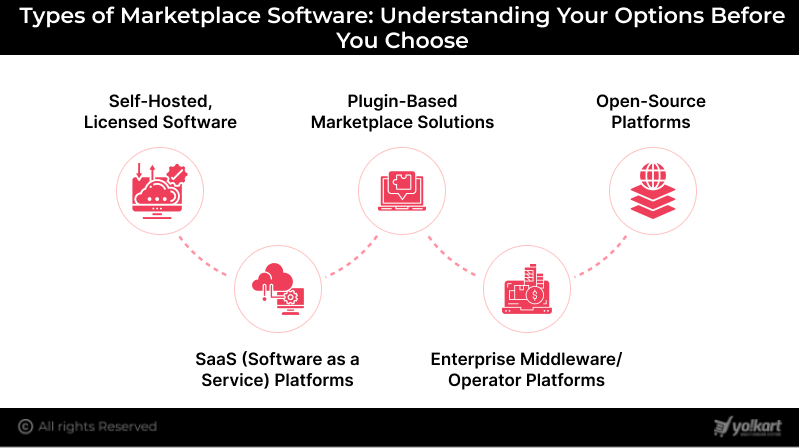
1. Self-Hosted, Licensed Software
You purchase a licence, receive the customizable source code, and deploy the platform on your own servers or chosen cloud environment. Hence, you own the software, control every line of code, and pay no ongoing licensing fees.
Best for: Founders who want full control, long-term cost efficiency, and deep customisation freedom.
2. SaaS (Software as a Service) Platforms
You pay a monthly or annual subscription for access to a hosted, managed environment. Minimal technical setup is required, but customisation is limited to what the provider allows, and costs scale with usage.
Best for: Founders who want a fast launch with minimal upfront investment.
Suggested Read: SaaS vs Licensed Multi-vendor eCommerce Platforms | Which Is Right For Your Business?
3. Plugin-Based Marketplace Solutions
Add-on plugins or apps that extend an existing platform (WordPress, Shopify, Magento) into a multi-vendor marketplace. Leverages an ecosystem you may already know, but inherits the parent platform’s limitations and recurring cost structure.
Best for: Founders already committed to a particular eCommerce platform.
4. Enterprise Middleware/Operator Platforms
Enterprise-grade platforms designed for established businesses launching large-scale marketplaces. Typically require significant technical investment and come with high annual contract values.
Best for: Large retailers or corporations adding a marketplace channel to an existing eCommerce operation.
5. Open-Source Platforms
Freely available codebases you can modify and deploy however you choose. The software itself may be free, but development, maintenance, and hosting costs can be substantial.
Best for: Technically sophisticated teams building highly bespoke experiences.
Launch a Marketplace with Software Tailored to Your Business Model
The 10 Best Marketplace Software Platforms for Founders in 2026: In-Depth Reviews
We evaluated each platform across seven critical dimensions: total cost of ownership, customisability, multi-vendor functionality, mobile readiness, payment gateway breadth, B2B capability, and suitability for the US, UK, Canada, Australia, and UAE markets. Here is our detailed assessment of all ten:
1. Yo!Kart, Best Overall: Full Ownership, Enterprise Features, Founder-Friendly Pricing
- Pricing: From $1,249 one-time (lifetime licence)
- Customizable Source Code Ownership: Yes
- Free Technical Support: 1 full year included
- Best For: Startups through enterprises, B2C, B2B, and P2P marketplaces
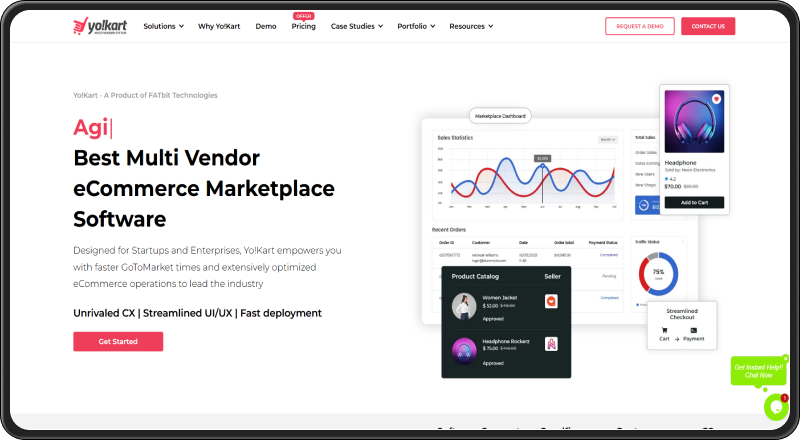
If you are a founder who is serious about building a scalable, sustainable online marketplace business, Yo!Kart is the most compelling all-around solution available in 2026. Developed by FATbit Technologies, Yo!Kart has powered more than 5,000 marketplaces globally across B2B, B2C, and P2P models, with clients ranging from bootstrapped startups to Fortune 500 companies.
What sets Yo!Kart apart is its ownership model. When you invest in Yo!Kart, you receive the complete customizable source code, a lifetime software licence, and one full year of free technical support. You are not renting access to a platform; you own it outright. Initially, the upfront cost may seem higher than a monthly SaaS subscription, but after approximately two years, Yo!Kart becomes significantly cheaper than subscription-based alternatives. Moreover, over a five-year horizon, the cost advantage is substantial.
What Yo!Kart Delivers?
- Built-in eCommerce features include abandoned cart recovery, discount coupons, a global product catalogue, and advanced order management
- 20+ pre-integrated payment gateways and methods, including Stripe Connect, PayPal, credit/debit cards, digital wallets, and pay-at-store, covering payment preferences across all target markets
- Ready-to-deploy native mobile apps for iOS and Android, a major competitive advantage in a market where mobile commerce approaches 60% of all transactions
- Dedicated B2B marketplace module supporting bulk pricing, account-based purchasing, RFQ (request for quotation) workflows, and complex vendor management at scale
- Pre-integrated APIs for accounting (QuickBooks), logistics (ShipStation and AfterShip), tax management (TaxJar and Avalara), and location services (Google Maps)
- Multi-language support and multi-currency functionality, making it the most internationally capable purpose-built marketplace platform in its class
- Built-in SEO tools, including clean URL structures, metadata management, and structured data support, are essential for organic ranking in competitive markets like the US, UK, and Australia
- In-house agile development team at FATbit Technologies available for end-to-end custom development, meaning bespoke features can be built without sourcing and vetting third-party developers
What Verified Founders Are Saying About Yo!Kart
“Overall, I have been very impressed with Yo!Kart. Upfront, the cost seems more than their competitors’, but it’s a one-time cost. After about 2 years, it’s cheaper than a subscription model, and over 20 years, it’s a fraction of the cost.”, Verified review, Capterra 2026
Purpose-Built B2B Capability
“The amount of features, especially for a B2B Marketplace. We found no marketplace framework or software that offers more features for this price than Yo!Kart, and it was very easy to install.” Tobias B., CEO & Founder (tryfl.de), verified review
Yo!Kart is particularly well-suited to founders targeting the US, UK, Canada, Australia, and UAE because it has been designed with international commerce in mind. Multi-currency transactions, regional payment methods, and tax management integrations address the different tax structures across these jurisdictions, from US sales tax to UK VAT to Australian GST.
Furthermore, the software’s latest version (V10.3) features a refreshed UI/UX, reimagined workflows, AI-enabled tools, and new pre-integrated APIs, demonstrating ongoing investment in keeping the product competitive. For founders who need a mature, market-tested solution they genuinely own and can grow with, Yo!Kart remains the strongest option in the market.
Verdict: Yo!Kart is our top recommendation for founders building a real marketplace business. Its one-time licence, customizable source code ownership, comprehensive features, dedicated B2B module, and mobile apps make it the strongest long-term value proposition of any platform in this comparison.
See Yo!Kart in Action
2. Sharetribe: Best for Fast MVP Validation Without Coding
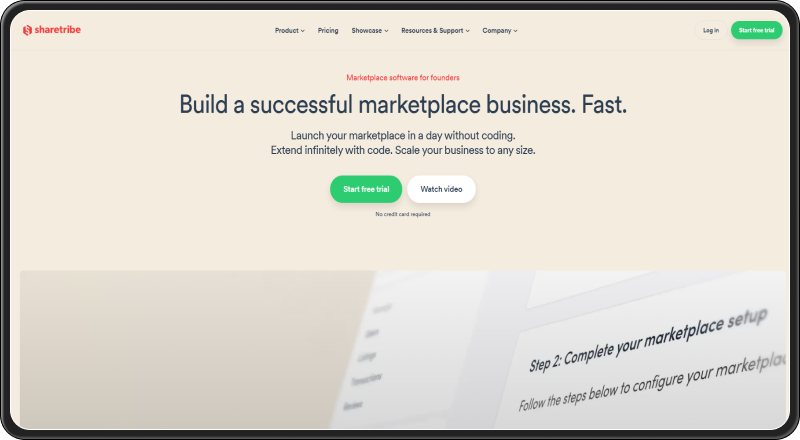
- Pricing: From ~$39/month (SaaS subscription)
- Customizable Source Code Ownership: No
- Best For: Non-technical founders validating a marketplace concept quickly
Sharetribe has earned a strong reputation as one of the most accessible marketplace builders for non-technical founders. Its no-code interface allows you to stand up a functional marketplace in days, and subscription tiers scale from managing a few hundred to 100,000 active users. Unlike eCommerce platforms that graft multi-vendor features on as an afterthought, Sharetribe was built from the ground up for two-sided markets, product, service, and rental platforms.
However, the platform’s primary limitation is dependency. Because you do not own the customizable source code, you are subject to Sharetribe’s pricing decisions, product roadmap, and platform policies. Advanced customisation requires developer involvement through their API, which can significantly increase costs as your requirements mature. For founders who have validated their concept and are ready to scale seriously, the migration away from Sharetribe is a transition many eventually face.
Verdict: An excellent starting point for rapid idea validation with minimal upfront investment. Less suitable once you are ready to build a serious, long-term marketplace business without the risk of platform dependency or subscription cost escalation.
3. CS-Cart Multi-Vendor: Best Option for Technical Teams
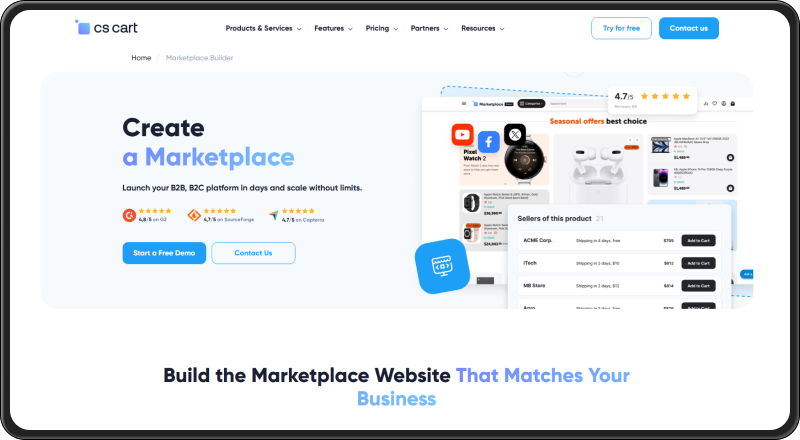
- Pricing: From $1,450 (one-time licence) and $61/month
- Customizable Source Code Ownership: Yes
- Best For: Technically capable teams wanting deep customisation on a self-hosted platform
CS-Cart multi-vendor is a well-established self-hosted marketplace platform with strong customisation capabilities and an active add-on ecosystem. CS-Cart’s modular architecture allows features to be added or removed as needed, and its admin panel provides granular control over the marketplace’s operations.
The platform offers mobile-only as a paid add-on rather than being included in base packages. Technical support after the initial period is primarily available through paid channels. For marketplaces with very specific technical requirements and a capable development team, CS-Cart is a solid choice, though Yo! Kart’s superior out-of-the-box feature set and included mobile apps give it the edge for most founders.
Verdict: A strong self-hosted alternative with full customizable source code ownership, but Yo!Kart outpaces it on included features, B2B depth, and mobile app readiness for most marketplace business models.
4. Kreezalid: Best No-Code Option for Simple Marketplace Concepts
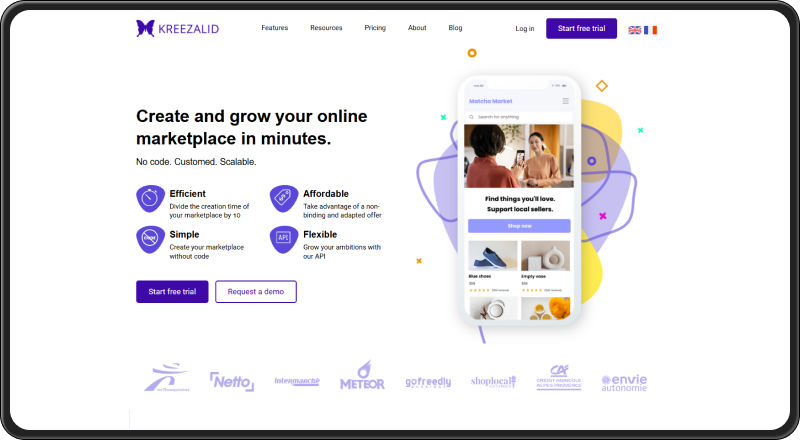
- Pricing: From $99/month (SaaS subscription)
- Customizable Source Code Ownership: No
- Best For: Entrepreneurs with simple product or service marketplace models wanting a no-code launch
Kreezalid offers a clean, straightforward no-code marketplace builder with customisable templates, built-in Stripe and PayPal payment processing, and a user management system covering the basics of running a two-sided market. The platform’s interface simplifies marketplace creation and is accessible for users with limited technical knowledge.
However, the trade-off is a significantly limited feature set compared to purpose-built solutions like Yo!Kart. B2B functionality is absent, native mobile apps are not included, and the level of customisation available is restricted by the SaaS architecture. Monthly subscription costs also compound significantly over time. Founders building anything beyond a straightforward product or service exchange will quickly outgrow Kreezalid’s capabilities.
Verdict: Suitable for simple, early-stage marketplace concepts. Founders with complex or niche requirements, or those planning sustained long-term growth, will need to migrate to a more capable platform sooner than expected.
5. Dokan (WooCommerce): Best Multi-Vendor Plugin for WordPress Users
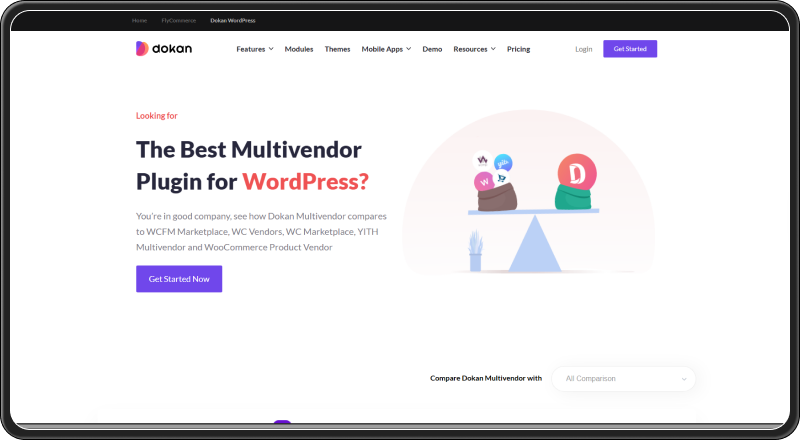
- Pricing: Free (lite)/Pro from ~$149/year; Lifetime plans available
- Customizable Source Code Ownership: WordPress-based; code accessible
- Best For: Founders already operating on WordPress/WooCommerce who want to add multi-vendor capability
Trusted by over 60,000 entrepreneurs globally and powered by WooCommerce, Dokan is the most widely adopted multi-vendor marketplace plugin for WordPress.. It enables founders to build a functional marketplace and offers a comprehensive feature set, including vendor dashboards, commission management, multiple payment integrations, shipping management, and product review systems. The platform now includes AI features such as generative product descriptions and an AI image enhancer.
Dokan’s strength is its deep integration with the WordPress ecosystem, giving founders access to thousands of themes, plugins, and WooCommerce extensions. However, it inherits WordPress’s limitations, such as performance at scale requires careful server management, security requires third-party plugins, and the overall complexity of managing a WordPress-based marketplace increases significantly as the platform grows.
Verdict: The clear leader for WordPress-based marketplace launches. Excellent value for founders already in the WordPress ecosystem, but not the optimal foundation for founders starting fresh who want a dedicated, scalable marketplace architecture.
6. Shopify + Multi-Vendor App: Best for Existing Shopify Store Owners
- Pricing: Shopify from $29/month + multi-vendor app (e.g., Webkul from $15/month)
- Customizable Source Code Ownership: No
- Best For: Founders already running a Shopify store who want to add multi-vendor functionality
Shopify is one of the most recognised eCommerce platforms in the world, particularly strong in the US, UK, Canada, and Australia. However, Shopify does not offer native marketplace functionality, to run a true multi-vendor marketplace, you need to integrate a third-party app such as Webkul’s Multi Vendor Marketplace, which starts at $15 per month for up to three active sellers.
This combination gives founders access to Shopify’s extensive app store, strong payment infrastructure (including Shopify Payments), and excellent uptime and reliability. However, multi-vendor features are bolted on rather than native, which can create friction in vendor workflows. Transaction fees apply when using third-party payment gateways, and the total monthly cost, including Shopify subscription, app fees, plus any additional plugins, escalates quickly. For founders who are not already on Shopify, building a marketplace from this combination is rarely the most efficient path.
Verdict: A practical option for Shopify merchants who want to extend their existing store into a marketplace. Not the recommended starting point for founders building a dedicated marketplace business from scratch.
Suggested Read: Best Shopify Alternative for B2B Marketplaces
7. Adobe Commerce (Magento): Best for Large Enterprises with Custom Requirements
- Pricing: Open Source: free (significant dev costs); Adobe Commerce: from ~$22,000/year
- Customizable Source Code Ownership: Yes (open source)
- Best For: Large enterprises with complex, bespoke marketplace requirements and in-house development teams
Adobe Commerce (formerly Magento) is one of the most powerful eCommerce platforms available, offering unmatched flexibility and a deep feature set for complex eCommerce operations. To build a multi-vendor marketplace on Magento, you need to integrate a third-party extension such as CedCommerce or Webkul’s Multi-Vendor Marketplace for Magento. The open-source version is free, but the development costs to configure and maintain a marketplace of meaningful scale are substantial. Adobe Commerce (the enterprise version) starts at around $22,000 per year.
Adobe Commerce has excellent B2B capabilities, supports multi-storefront, multilingual, and multi-currency operations, and offers highly advanced catalogue management. However, it requires a skilled and dedicated development team to implement and maintain, and the total cost of ownership is among the highest of any platform in this comparison. For most founders, particularly early-stage or mid-market marketplace operators, it is significant overkill.
Verdict: An exceptional platform for large enterprises with complex requirements and the budget to match. Disproportionately resource-intensive for most founders, particularly those without substantial in-house development capacity.
8. Mirakl: Best Enterprise Middleware for Established Retailers Adding a Marketplace
- Pricing: Custom enterprise pricing, typically $90,000+ per year
- Customizable Source Code Ownership: No (SaaS middleware)
- Best For: Established enterprise retailers adding third-party marketplace functionality to an existing eCommerce operation
Mirakl is the dominant enterprise middleware platform for marketplace operations, powering marketplaces for major brands including H&M and Bed Bath & Beyond. It is a SaaS-based platform designed to add marketplace and dropship functionality on top of an existing eCommerce infrastructure; it is not a standalone marketplace solution. Mirakl connects with existing eCommerce platforms such as Adobe Commerce, Shopify, and Salesforce Commerce Cloud via pre-built connectors.
Mirakl’s strengths are its enterprise-grade scalability, AI-powered product catalogue harmonisation, advanced vendor management, and comprehensive analytics. However, it is middleware, not a complete solution, and it requires significant technical investment to integrate with an existing stack. Enterprise pricing typically starts around $90,000 per year, making it completely impractical for early-stage or mid-market founders. Mirakl is firmly in the enterprise category and should not be evaluated by founders unless they are running an established retail operation with the budget and technical resources to match.
Verdict: An outstanding solution for enterprise retailers launching at scale. Completely unsuitable for most startup or growth-stage founders due to cost, technical complexity, and its nature as middleware rather than a standalone marketplace platform.
Build Smarter with a Marketplace Platform Designed for Expansion
9. Arcadier: Best SaaS Option for Quick Multi-Category Marketplace Launches
- Pricing: From $299/month (SaaS subscription)
- Customizable Source Code Ownership: No
- Best For: Founders who want a hosted SaaS marketplace with support for products, services, bookings, and rentals
Arcadier is a cloud-based marketplace builder that supports multiple marketplace models, products, services, bookings, and rentals from a single platform. Its hosted environment means there is no server management required, and it provides vendor management, commission handling, and payment processing tools. API access is available on higher subscription tiers, enabling a degree of customisation for more advanced users.
As a SaaS platform, Arcadier limits customisation unless you invest in API-based development, and the monthly subscription cost at $299+ per month adds up quickly. It does not include native mobile apps, and its pricing places it at a disadvantage. It is a reasonable mid-market SaaS option, but it lacks the depth and ownership benefits that ambitious marketplace founders require.
Verdict: A workable SaaS option for founders who need support across multiple marketplace models (products, services, rentals) without server management responsibility. The lack of customizable source code ownership and high monthly costs limit its appeal.
10. BigCommerce + Marketplace App: Best for Scalable B2B/B2C with Strong SEO
- Pricing: BigCommerce from $29/month + marketplace app (Webkul/Marketplacer)
- Customizable Source Code Ownership: No
- Best For: Growing eCommerce businesses on BigCommerce wanting to add marketplace capabilities, particularly in B2B
BigCommerce is a robust, hosted eCommerce platform with strong SEO capabilities, excellent uptime, and a growing B2B feature set. Like Shopify, it does not offer native multi-vendor marketplace functionality, but it can be extended using apps like Webkul’s Multi Vendor Marketplace or the Marketplacer connector. BigCommerce supports headless commerce architecture, which gives technically capable teams significant front-end flexibility.
BigCommerce’s headless capabilities, strong SEO foundations, and growing B2B feature set make it an interesting option for founders who are already committed to the BigCommerce ecosystem. However, the combination of platform subscription costs plus marketplace app fees can accumulate quickly, and multi-vendor functionality remains bolted on rather than native. The platform also lacks the dedicated multi-vendor workflow depth of purpose-built solutions like Yo!Kart.
Verdict: A strong eCommerce platform with good B2B and SEO capabilities. Best suited to founders already on BigCommerce who want to extend into marketplace selling, rather than those starting a dedicated marketplace from scratch.
Suggested Read: Yo!Kart vs BigCommerce: Which is an Ideal Option to Build a Multi-Vendor Marketplace
Head-to-Head: All 10 Marketplace Platforms Compared (2026)
The table below compares all ten platforms across the key dimensions founders care about most. Scroll across to compare features side by side.
| Platform | Native Multi-Vendor | Mobile Apps | Payment Gateways | B2B Support | Free Tech Support | Best For | Customisability |
| Yo!Kart | Built-in | Included | 20+ pre-integrated | Dedicated module | 1 year included | All stages, B2B+B2C | 5/5 |
| Sharetribe | Built-in | Not included | Stripe only | Limited | Included | MVP/validation | 3/5 |
| CS-Cart | Built-in | Add-on | Multiple | Limited | Paid | Technical teams | 4/5 |
| Kreezalid | Built-in | Not included | Stripe + PayPal | No | Included | Simple concepts | 2/5 |
| Dokan | WooCommerce | Available | PayPal, Stripe + | Limited | Community + paid | WordPress users | 4/5 |
| Shopify + App | Via app | Shopify app | 100+ gateways | Via apps | 24/7 support | Shopify stores | 3/5 |
| Adobe Commerce | Via extension | Custom build | Multiple (+dev) | Strong B2B | Community/paid | Large enterprises | 5/5 |
| Mirakl | Middleware | Not included | Stripe, Adyen + | B2B & B2C | Dedicated | Retail giants | 3/5 |
| Arcadier | Built-in | Not included | Stripe, PayPal | Basic | Paid tiers | Quick SaaS launch | 2/5 |
| BigCommerce + App | Via app | Custom build | 65+ gateways | B2B features | 24/7 | Scalable B2B/B2C | 3/5 |
As the comparison above illustrates clearly, Yo!Kart stands out as the only platform that combines customizable source code ownership, native multi-vendor architecture, included mobile apps (iOS & Android), 20+ payment gateways, a dedicated B2B module, 1 year of free technical support, and the highest customisability rating, all under a one-time licence that eliminates ongoing subscription dependency.
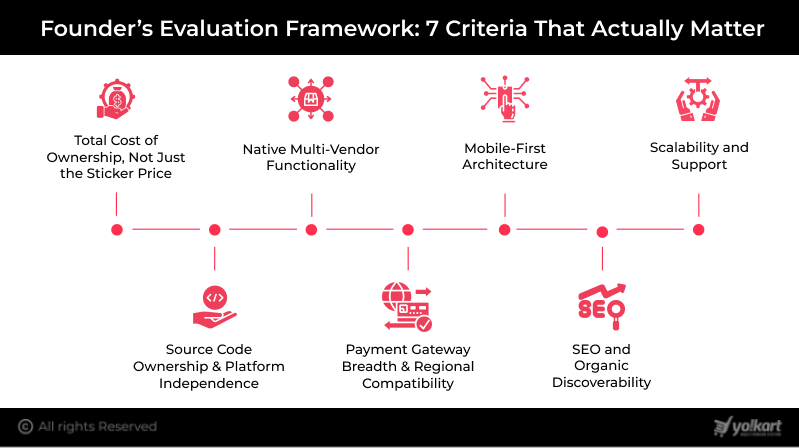
Founder’s Evaluation Framework: 7 Criteria That Actually Matter
Regardless of which platform you ultimately select, the following framework will help you make a rigorous assessment of any marketplace software.
1. Total Cost of Ownership, Not Just the Sticker Price
A $39 per month SaaS subscription sounds affordable until you calculate the 24-month cost ($936+), factor in add-ons and API fees, and add the cost of rebuilding on a more capable platform when you hit the platform’s limits. Therefore, always calculate the projected three-to-five year total cost of ownership. Consider one-time licence solutions like Yo!Kart, which consistently delivers superior long-term economics for founders serious about building a durable business.
2. Customizable Source Code Ownership and Platform Independence
Owning your customizable source code is not just a technical detail but a strategic asset. It means you can switch hosting providers, engage any development team, and are protected against the risk of your platform provider changing pricing, discontinuing features, or being acquired. For any founder planning a meaningful scale, customizable source code ownership should be non-negotiable.
3. Native Multi-Vendor Functionality
Running a marketplace requires vendor onboarding and verification, separate storefronts, commission management, split payments, vendor-level reporting, and dispute resolution workflows. Platforms with bolt-on multi-vendor functionality create technical debt and user experience friction that compounds over time. Hence, choose a software that is purpose-built for multi-vendor commerce.
4. Payment Gateway Breadth and Regional Compatibility
Founders serving customers across the US, UK, Canada, Australia, and the UAE need to accommodate diverse payment preferences. American customers expect Stripe and PayPal; UAE customers commonly use regional methods; Australian customers adopt buy-now-pay-later heavily. Your platform should support these without requiring significant custom development per region.
5. Mobile-First Architecture
With nearly 60% of all eCommerce transactions projected to occur on mobile devices in 2026, a marketplace without genuinely optimised mobile experiences and ideally dedicated native apps is starting from a significant competitive disadvantage.
6. SEO and Organic Discoverability
Marketplaces that rank organically have a structural advantage over those dependent on paid acquisition. Your platform should provide clean URLs, proper metadata management, fast page load speeds, structured data support, and the ability to create SEO-optimised content, all of which contribute to long-term visibility in competitive markets.
7. Scalability and Support
Your marketplace software should handle the traffic levels you are planning for, not just where you are today. Understand how the platform behaves under peak load, what your hosting options are, and what ongoing technical support looks like as your marketplace scales.
Launch a Marketplace Designed for Mobile Commerce and Global Expansion
Market-Specific Guidance: Choosing Your Platform in the US, UK, Canada, Australia & UAE
The best marketplace software is not only scalable but also adaptable to regional commerce needs. Every eCommerce market operates differently, with unique customer expectations, payment ecosystems, and compliance requirements. From VAT compliance in the UK to digital wallet adoption in the UAE, founders need solutions that support localized operations without increasing technical complexity. Below is a closer look at the key considerations for each market:
1. United States
The US is one of the world’s largest eCommerce markets, with marketplace sales projected to reach $1498 billion in 2026. US founders benefit from Yo!Kart’s Stripe Connect integration, ShipStation logistics API, and TaxJar integration for US sales tax automation across all 50 states. The US also has one of the highest concentrations of B2B eCommerce activity globally, making Yo!Kart’s dedicated B2B module is particularly valuable.
2. United Kingdom
The UK has one of Europe’s highest eCommerce penetration rates and strong consumer expectations around marketplace trust and transparency. UK founders need robust VAT compliance, Yo!Kart’s Avalara integration handles this seamlessly. The UK’s strong mobile commerce adoption makes Yo!Kart’s iOS and Android apps offer a significant practical advantage for founders targeting British consumers.
3. Canada
Canada’s eCommerce market has experienced consistent growth, with consumers comfortable across a wide range of online marketplace models. For Canadian founders, Yo!Kart’s multi-currency support and ability to handle both GST/HST and provincial tax variations through integrated tax management tools are important practical advantages over less internationally capable alternatives.
4. Australia
Australia’s eCommerce market is growing rapidly, with consumers among the world’s most active online shoppers on a per-capita basis. Australian founders benefit from Yo!Kart’s broad payment gateway support, critical in a market with high buy-now-pay-later adoption, and its logistics API integrations are compatible with Australian-preferred carriers.
5. UAE and the Middle East
The UAE has emerged as one of the world’s most dynamic eCommerce markets: a young, digitally native population, extremely high smartphone penetration, and strong government support for digital commerce infrastructure. Yo!Kart’s Arabic language support, multi-currency capability, and broad payment gateway range, accommodating both cash-on-delivery preferences and digital wallet adoption, make it the most internationally capable platform for UAE-based founders in this comparison.
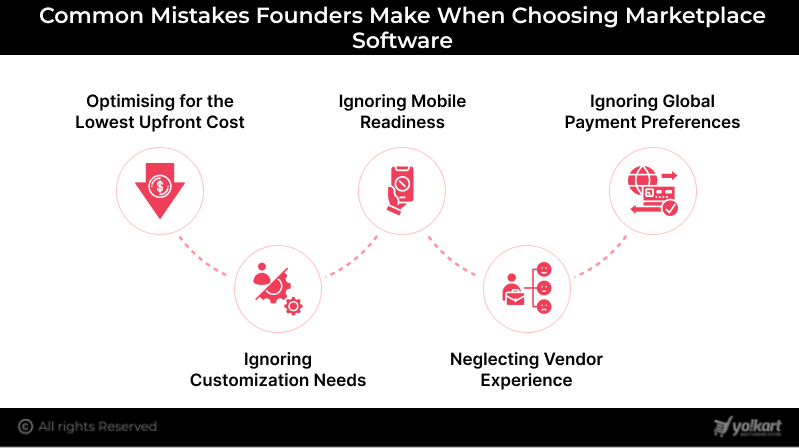
Common Mistakes Founders Make When Choosing Marketplace Software
Building a successful online marketplace is more than just selecting a feature-rich software. It is about avoiding decisions that create long-term operational and scalability challenges. Many founders focus on short-term convenience and overlook critical factors that directly impact growth, vendor adoption, customer experience, and overall marketplace sustainability.
1. Optimising for the Lowest Upfront Cost
Choosing a free or low-cost SaaS platform to reduce initial investment may seem practical in the beginning. However, this decision becomes significantly expensive over time. Factors like compounding subscription costs, add-ons, transaction charges, and the cost of scaling increase the cost significantly.
2. Underestimating Customisation Requirements
Every marketplace has unique requirements. Founders who choose platforms with limited customisation options consistently find themselves building workarounds and compromising their product experience rather than building the marketplace their customers actually need.
3. Ignoring Mobile Readiness
Launching a marketplace without native mobile apps or a genuinely optimised mobile experience in 2026 is a significant competitive handicap. Given that mobile commerce represents nearly 60% of all online retail globally, this is not a feature to add later; it must be part of your launch capability.
4. Neglecting Vendor Experience
The success of a two-sided marketplace depends equally on buyer and vendor experience. Platforms that deliver a polished buyer storefront but a clunky vendor management interface will struggle to attract and retain quality sellers, which ultimately starves the marketplace of the supply-side quality that drives buyer trust and repeat purchase.
5. Failing to Plan for International Payment Diversity
Founders targeting multiple geographies who assume a single payment gateway is sufficient often discover that their payment infrastructure creates friction for key customer segments. Thus, choose platforms with pre-integrated support for diverse payment methods from day one.
Future-Proof Your Marketplace with the Best Marketplace Software
Conclusion: Choose the Foundation That Matches Your Ambition
The decision you make about marketplace software today will shape your business for years to come. The wrong choice can limit growth, increase long-term costs, and restrict customization, while the right solution provides a stable foundation for sustainable growth.
With global eCommerce driving a large share of digital commerce globally, the opportunity for founders has never been greater. Markets like the US, UK, Canada, Australia, and the UAE offer large, sophisticated consumer bases.
Among the ten platforms reviewed in this guide, Yo!Kart stands out as the most compelling choice for founders who are serious about building a real, scalable marketplace business. It combines one-time licensing and customizable source code ownership with dedicated native mobile apps, 20+ payment gateways, robust B2B capability, and international readiness, providing a foundation that no other platform in this comparison fully matches. The platform has been trusted by more than 5,000 founders globally, and its long-term economics are significantly more favourable than SaaS alternatives for any marketplace that plans to grow.
Whether you are building a B2B procurement platform, a D2C product marketplace, a service exchange, or a P2P rental platform, Yo!Kart provides the tools, flexibility, and ownership model to support your vision, without imposing unnecessary constraints on where you can take it.
Frequently Asked Questions
Q 1: What is the best marketplace software for founders who are just starting?
Ans: The answer depends on your stage and goals. For pure idea validation with no coding and minimal upfront cost, Sharetribe or Kreezalid offer fast no-code launch options. However, if you are ready to build a serious marketplace business, Yo!Kart is the stronger choice, it provides customizable source code ownership, a comprehensive feature set, native mobile apps, and a one-time licence that becomes more economical than SaaS subscriptions over a two-to-five-year horizon.
Q 2: How much does marketplace software actually cost in 2026?
Ans: Costs vary widely across the spectrum. SaaS platforms range from $39/month to $299+/month, with enterprise platforms like Mirakl starting at $90,000+ per year. While a one-time licence solution like Yo!Kart starts from $1,249 with no recurring licence fees, making it significantly more cost-effective.
Q 3: Which marketplace software is best for a B2B marketplace?
Ans: Yo!Kart is our top recommendation for B2B marketplaces because of its dedicated B2B module supporting bulk pricing, account-based purchasing, RFQ workflows, and complex vendor management. Adobe Commerce (Magento) also has strong B2B capabilities, but requires significant investment in development and licensing. BigCommerce has growing B2B features but lacks native multi-vendor architecture.
Q 4: Is customizable source code ownership really that important?
Ans: Yes, for any founder planning to build a business with scalability in mind, owning your customizable source code becomes essential. It means you can engage any development team to work on the platform, switch hosting providers, and are protected against the risk of your SaaS provider changing pricing, discontinuing features, or being acquired. Solutions like Yo!Kart provides full customizable source code ownership.
Q 5: Does Yo!Kart support mobile apps?
Ans: Yes, higher-tier Yo!Kart packages include ready-to-deploy native buyer and seller apps for both iOS and Android. Having dedicated native mobile apps as part of your marketplace launch, rather than commissioning them separately at a high additional cost, is a meaningful, practical, and commercial advantage.
Q 6: Which marketplace software is best for founders in the UAE?
Ans: Yo!Kart is particularly well-suited to UAE-based founders due to its Arabic language support, multi-currency capability, and broad payment gateway integration, accommodating both regional payment preferences and digital wallet adoption, which is among the highest in the world in the UAE.
Q 7: What is the difference between marketplace software and regular eCommerce software?
Ans: Regular eCommerce software is designed for a single vendor selling to customers. Marketplace software, on the other hand, supports multiple independent vendors selling through a shared platform, with the marketplace operator earning commission on transactions.
This requires fundamentally different functionality, such as:
- Separate vendor storefronts
- Vendor onboarding and KYC
- Commission management
- Split payment processing
- Vendor-level reporting
- Dispute resolution workflows
Q 8: How long does it take to launch a marketplace with these platforms?
Ans: Launch timelines vary significantly. No-code SaaS platforms like Sharetribe and Kreezalid can have a basic marketplace live within days. Whereas purpose-built licensed solutions like Yo!Kart can be installed and configured within weeks, with additional time for customisation depending on your specific requirements. However, the right balance of speed and capability depends on your business model and long-term requirements.
Q 9: Can any of these platforms handle both B2B and B2C on the same marketplace?
Ans: A: Yes, though not all do so natively. Yo!Kart is specifically designed to support B2B, B2C, and P2P models on the same platform. Adobe Commerce has strong B2B capabilities but requires extensions for full multi-vendor functionality. Mirakl supports both models, but it is middleware requiring an existing eCommerce platform. Thus, for most founders, Yo!Kart’s native B2B and B2C capability within a single, owned platform is the most practical and cost-effective solution.
Q 10: What technical support do these platforms provide?
Ans: Support varies considerably depending on the provider. Yo!Kart includes one full year of free technical support covering installation, setup, and platform usage, with dedicated project management and custom development services also available through FATbit Technologies. SaaS platforms like Sharetribe and Shopify include ongoing support as part of their subscription. Open-source options like Magento rely primarily on community support, with paid support available through partners.
Partner with the Best Marketplace Software Trusted by Growing eCommerce Businesses
Reach OutPopular Posts