
The rapid growth of digital platforms has reshaped how businesses operate, connect, and scale. From eCommerce and food delivery to real estate, healthcare, and on-demand service aggregation, online marketplaces have emerged as one of the most powerful business models in today’s digital economy. As a result, the demand for marketplace software development has grown exponentially, particularly in the United States, where innovation and technology adoption move at an accelerated pace.
However, building a scalable, secure, and feature-rich marketplace is not a simple task. It requires deep technical expertise, industry knowledge, and a clear understanding of marketplace economics. Hence, choosing the best marketplace software development company is a critical decision for startups and enterprises alike.
In this blog, you will explore what marketplace software is, its essential features, the key factors to consider when choosing a development partner, and a curated list of the top 10 marketplace software development companies in the US.
Table of Contents
- What Is Marketplace Software?
- Must-Have Features in a Marketplace Software
- Factors to Be Considered Before Selecting a Marketplace Software Development Company
- List of the Top 10 Marketplace Software Development Companies in the US
- How to Choose the Best Marketplace Software Development Company
- Conclusion
- FAQs
What is Marketplace Software?
Marketplace software is a digital platform that brings together multiple sellers and buyers within a single ecosystem, enabling seamless transactions, communication, and service delivery. Unlike traditional eCommerce websites that sell products from a single vendor, eCommerce marketplace software supports multiple vendors, each managing their own products, pricing, inventory, and order fulfillment.
Popular examples of such marketplace platforms include Amazon, eBay, Airbnb, Uber, and Etsy. These marketplaces act as intermediaries, earning revenue through commissions, subscriptions, advertisements, or transaction-based fees.
Modern marketplace software typically includes:
- Vendor onboarding and management tools
- Product or service listings
- Secure and flexible payment processing
- Order, payout, and commission management
- Reviews, ratings, and dispute handling features
- Admin dashboards with analytics and reporting
Whether you are launching a B2B, B2C, C2C, or service-based marketplace, choosing the right software foundation is essential to ensure stability, scalability, and long-term business growth.
Suggested Read: Top 10 Multi-Vendor Marketplace Software in the US
Must-Have Features in a Marketplace Software
The success of any marketplace platform depends heavily on its feature set. A well-rounded feature set not only improves user experience but also ensures smooth operations, scalability, and long-term growth. Given below are the essential features every robust marketplace solution should include:
1. Multi-Vendor Management
The core of any marketplace is the ability to manage multiple sellers efficiently. Vendors should have dedicated dashboards to create profiles, manage products or services, track orders, and monitor earnings. This independence keeps sellers engaged while reducing admin workload.
2. Secure Payment Gateway Integration
A marketplace must support complex payment flows such as split payments, commissions, refunds, and multi-currency transactions. Moreover, integration with secure and trusted payment gateways is essential for user trust.
3. Advanced Search and Filtering
A powerful search engine with smart filters improves user experience and helps buyers quickly find relevant products or services. Better discoverability leads to higher engagement and improved conversion rates.
4. Mobile Responsiveness and Apps
With a large share of users accessing marketplaces via mobile devices, responsive design and native mobile apps for iOS and Android have become essential. Further, it improves accessibility, user retention, and overall engagement.
5. Ratings, Reviews, and Trust Signals
User reviews, seller ratings, and verification badges help build credibility and encourage platform engagement. Moreover, these trust signals influence purchase decisions and encourage service quality.
6. Admin Control Panel
Admins need complete control over vendors, users, commissions, disputes, and content moderation. Additionally, complete administrative control ensures smooth governance and compliance.
7. Scalability and Performance
As your marketplace grows, your marketplace software should be able to handle the increased traffic, vendors, and transactions without performance issues. It makes scalable architecture and optimized performance are essential for long-term success.
8. Analytics and Reporting
Built-in analytics provide valuable insights, helping marketplace owners to optimize operations, improve user engagement, and increase revenue.
Get Expert Help to Build Your Marketplace
Factors to Be Considered Before Selecting a Marketplace Software Development Company
Choosing the right development partner is a critical decision that can determine the long-term success of your marketplace. Here are the key factors you should consider:
1. Industry Experience
Look for a company with proven experience in Marketplace Software Development. Experienced developers understand common challenges, platform dynamics, and revenue models, which ensures your marketplace is built for scalability and efficiency.
2. Product vs. Custom Development
Some companies provide ready-made marketplace solutions that can be launched quickly, while others offer fully custom development tailored to your unique requirements. Your choice should balance budget, timeline, and the level of customization you need.
3. Technology Stack
Ensure the company uses modern, secure, and scalable technologies. A strong tech stack supports future growth, smooth performance, and integration with third-party services.
4. Post-Launch Support
Marketplaces are dynamic platforms that require continuous maintenance, feature updates, and bug fixes. Reliable post-launch support ensures smooth operations and minimizes downtime.
5. Time-to-Market
Speed is crucial in competitive markets. Companies that can deliver a robust marketplace quickly, without compromising quality, help you start generating revenue faster and gain a market edge.
6. Client Reviews and Portfolio
Check the company’s past projects and client testimonials. A solid portfolio demonstrates reliability, technical expertise, and the ability to deliver successful marketplace solutions.
List of the Top 10 Marketplace Software Development Companies in the US
Choosing the right marketplace software development company impacts how fast and effectively your platform grows. Below is a curated list based on expertise, scalability, and proven success across marketplace business models.
1. FATbit Technologies
FATbit Technologies is a globally recognized leader in marketplace software development company, serving startups, SMBs, and enterprises across the globe. With more than two decades of experience, FATbit has delivered hundreds of successful multi-vendor platforms across industries, including eCommerce, food delivery, rentals, services, and B2B marketplaces.
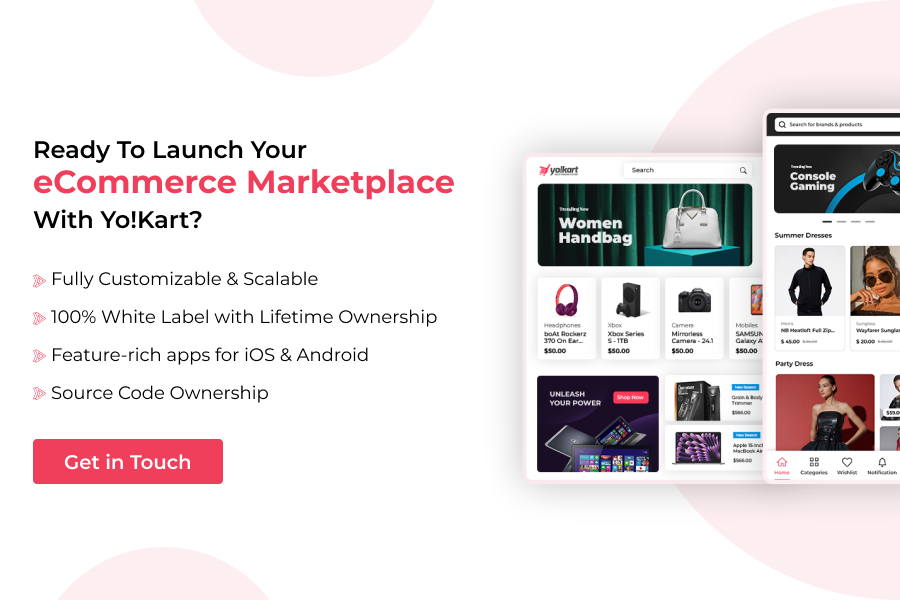
Its flagship product, Yo!Kart, is a robust and scalable eCommerce marketplace software that allows businesses to build and launch a fully functional online marketplace, along with native mobile apps, in just a few weeks. Yo!Kart comes with built-in vendor management, advanced admin controls, multiple monetization options, and complete source code ownership. FATbit also provides extensive customization, post-launch support, and scalability to support long-term growth.
Benefits:
- Faster launch with a proven product
- End-to-end development and support services
- Strong portfolio across diverse marketplace industries
- Transparent pricing with no hidden costs
- Ability to scale teams based on project complexity and growth needs
- Dedicated project managers for clear communication
Best For: Startups and enterprises looking for a ready-made yet flexible marketplace solution with quick time-to-market.
Explore the Cutting-Edge Capabilities of Yo!Kart
2. eGrove Systems
eGrove Systems is a software development and IT solutions company that offers a wide range of digital services, including custom marketplace platform development tailored to specific business requirements. The company focuses on secure, scalable multi-vendor marketplace websites and mobile apps designed to handle diverse transactions and high traffic.
Benefits:
- Experienced in building dynamic multi-vendor marketplaces with vendor management, payment integration, and analytics.
- Emphasis on security, scalability, and performance to support growth-ready platforms.
- Offers custom features and integrations, including mobile apps and advanced search.
Limitations:
- Broader technology portfolio, which may result in less specialization compared to pure marketplace niche firms.
- Does not provide a turnkey, quick-launch marketplace product; solutions are built to order.
- Custom work may involve longer development timelines for full-feature builds.
Best For: Businesses of all sizes that want a custom, secure, and scalable marketplace platform.
3. ScienceSoft
ScienceSoft is an IT consulting and software development company with years of experience in building complex digital platforms, including multi-vendor marketplaces. The company offers both custom marketplace software development and consulting services.
With a strong emphasis on security, compliance, and performance, it makes reliable and enterprise-ready marketplace solutions. Their experience spans building B2B, B2C, and service-based marketplaces across multiple industries.
Benefits:
- Decades of software engineering expertise
- Strong focus on security and compliance
- Scalable, enterprise-grade architecture
Limitations:
- Less suited for quick-launch marketplace models
- Higher investment for custom enterprise solutions
- Longer planning and discovery phases
Best For: Mid-sized businesses and enterprises looking for reliable, custom-built marketplace platforms.
4. Linkup ST
Linkup ST is a custom software development company specializing in building scalable digital products, including multi-vendor and service-based marketplace platforms. The company focuses on delivering tailored marketplace solutions aligned closely with specific business workflows and user journeys. With a strong emphasis on clean architecture, UI UX design, and performance optimization, Linkup ST helps businesses launch marketplaces that are both user-friendly and technically robust.
Benefits:
- Strong focus on custom-built marketplace solutions
- User-centric design and intuitive UX
- Flexible technology stack tailored to business needs
Limitations:
- Limited availability of ready-to-launch marketplace frameworks
- Timelines can extend for highly customized requirements
- Smaller team compared to large enterprise vendors
Best For: Startups and mid-sized businesses seeking fully customized marketplace platforms with a strong focus on usability and scalability.
5. Diceus
Diceus is a technology consulting and software development company that delivers custom marketplace and eCommerce platforms with a strong focus on scalability, security, and business alignment.
It works with businesses across multiple industries, emphasizing backend stability, integrations, and long-term scalability. Moreover, its consultative approach helps clients define platform architecture and technical strategy before development begins.
Benefits:
- Strong technical consulting and discovery expertise
- Secure and scalable platform architecture
- Experience with complex workflows and system integrations
Limitations:
- Longer discovery and planning phase before development
- Higher development costs for fully custom solutions
- Less focus on rapid, ready-to-launch marketplace models
Best For: Businesses and enterprises seeking custom-built marketplace platforms with strong backend architecture and long-term scalability.
6. OpenXcell
OpenXcell is a technology-driven software development company offering custom marketplace solutions across web and mobile platforms. The company leverages AI, machine learning, and blockchain to build innovative marketplaces.
Its flexible engagement model allows businesses to choose between full-cycle development or dedicated development teams. Their focus on innovation makes them a good choice for next-generation marketplace platforms.
Benefits:
- Expertise in emerging technologies
- Custom-built, scalable solutions
- Flexible development engagement models
Limitations:
- Advanced features can increase development costs
- Longer timelines for innovation-heavy projects
- May be complex for early-stage startups
Best For: Marketplaces requiring advanced features and technology-driven differentiation.
7. BairesDev
BairesDev is a nearshore software development company offering enterprise-grade engineering services, including the development of complex eCommerce and marketplace platforms. The company provides end-to-end custom development, leveraging distributed teams across the Americas to deliver scalable and secure digital marketplaces. Their marketplace capabilities include large-scale B2B and B2C platforms, integrations with enterprise systems, and performance-driven architectures designed for high traffic and growth.
Benefits:
- Access to large, senior-level engineering teams
- Strong experience with enterprise and large-scale platforms
- Nearshore model enables time-zone alignment with US clients
Limitations:
- Higher cost compared to offshore development firms
- Less suitable for MVPs or rapid-launch marketplace projects
- Requires detailed planning and technical documentation
Best For: Enterprises and well-funded companies looking to build large, complex, and highly scalable marketplace or eCommerce platforms.
8. ArcTouch
ArcTouch is a digital product development agency specializing in mobile-first marketplace platforms. The company builds intuitive and high-performance apps that focus on user engagement and scalability.
ArcTouch combines product strategy, UX design, and engineering to deliver marketplaces that perform well across devices. Their agile teams work closely with clients to refine features based on real user feedback.
Benefits:
- Mobile-first development approach
- Strong UX and performance optimization
- Agile and collaborative teams
Limitations:
- Less focus on web-heavy marketplaces
- Higher costs for mobile-first experiences
- Limited ready-made marketplace frameworks
Best For: Businesses launching mobile-centric marketplace platforms.
9. AppIt Ventures
AppIt Ventures is a US-based custom software development firm that delivers tailored digital solutions, including marketplace-style platforms. The company emphasizes strategic product planning, agile development, and long-term scalability. Rather than offering pre-built marketplace software, AppIt Ventures focuses on designing and engineering custom platforms that align with business goals, internal operations, and user experience requirements.
Benefits:
- Strong product strategy and discovery-driven approach
- High-quality engineering and agile delivery process
- US-based team with close client collaboration
Limitations:
- No out-of-the-box marketplace solutions
- Higher development cost due to a fully custom approach
- Longer timelines compared to white-label marketplace software
Best For: Businesses seeking a US-based partner to build fully custom, strategy-led marketplace platforms with long-term growth in mind.
Build an Enterprise-Ready Multi-Vendor Marketplace
10. Fueled
Fueled is a digital agency that builds innovative and high-growth marketplace platforms. The company combines product strategy, UX design, and engineering to create marketplaces that are both functional and visually compelling.
Fueled has worked with startups and enterprises alike, helping them launch platforms that attract users and scale quickly. Their product-led approach ensures alignment between business goals and user needs.
Benefits:
- Product-focused development strategy
- High-end design and branding
- Startup and growth-stage expertise
Limitations:
- Premium pricing structure
- Less focus on ready-made solutions
- May not suit budget-conscious startups
Best For: Funded startups and fast-scaling marketplace ventures.
Comparing the Top Marketplace Software Development Companies
With multiple marketplace software development companies operating in the US, comparing them side by side makes the selection process easier and more objective. Each company differs in development approach, launch speed, customization depth, and scalability. The comparison below highlights key differences to help you identify the partner that best aligns with your marketplace goals, budget, and growth plans:
| Company | Development Approach | Time to Market | Customization Level | Scalability | Mobile Apps |
| FATbit Technologies | Product-based + custom development (Yo!Kart) | Fast – weeks | High (product-level + custom) | High, proven multi-vendor scale | Yes, native apps included |
| eGrove Systems | Fully custom development | Medium | High | High | Yes |
| ScienceSoft | Enterprise-grade custom development + consulting | Slow | Very High | Very High, enterprise-ready | Yes |
| Linkup ST | Fully custom, workflow-driven development | Medium | High | Medium to High | Yes |
| DICEUS | Custom development with strong discovery phase | Slow to Medium | Very High | High | Yes |
| OpenXcell | Custom development with emerging tech focus | Medium to Slow | Very High | High | Yes |
| BairesDev | Large-scale enterprise custom development | Slow | Very High | High | Yes |
| ArcTouch | Mobile-first product development | Medium | High | Medium to High | Yes, primary focus |
| AppIt Ventures | Strategy-led, fully custom development | Medium to Slow | Very High | High | Yes |
| Fueled | Custom (Product-led) | Medium | Medium to High | High | Yes |
Suggested Read: Top 10 eCommerce Development Companies in 2026
How to Choose the Best Marketplace Software Development Company
Selecting the right marketplace software development partner requires careful evaluation beyond just cost. The partner you select will directly impact your platform’s performance, scalability, and long-term success. Here are the key criteria to evaluate before making a decision:
1. Marketplace-Specific Experience
Choose a company with proven experience in building multi-vendor and service-based marketplaces, not just general eCommerce websites. Proven marketplaces reduce risks and ensure smoother execution.
2. Technology and Scalability
Your marketplace must be built on a modern, scalable technology stack that can support the growth of your business. Hence, it is critical to ensure the software architecture can handle the growing number of users, vendors, and transactions without performance issues.
3. Customization and Flexibility
Every marketplace has a unique business model. The right development company should offer flexibility and customization, allowing the platform to adapt to your business model, workflows, monetization strategy, and future requirements.
4. Time to Market
A faster launch means quicker validation and revenue generation. Ready-made solutions like Yo!Kart can significantly reduce development timelines while still offering room for customization.
5. Ownership and Control
Make sure you retain full ownership of the source code, data, and platform assets. Complete ownership gives you long-term control, freedom to scale, and independence from recurring license and vendor lock-in.
6. Post-Launch Support and Maintenance
Launching the marketplace is only the beginning. A marketplace requires continuous updates, security patches, and feature enhancements. Choose a partner that offers reliable post-launch maintenance and long-term technical support.
Conclusion
Marketplace platforms are redefining the future of digital commerce, and the US continues to be at the forefront of this transformation. Whether you are a startup validating an idea or an enterprise expanding into new markets, choosing the best marketplace software development company is crucial for long-term success.
Companies like FATbit Technologies offer a powerful balance between speed, scalability, and customization, making it a top choice for marketplace entrepreneurs. By carefully evaluating your requirements and selecting the right development partner, you can build a future-ready marketplace that stands out in today’s competitive digital landscape.
FAQs
Q 1. Why should I hire a marketplace software development company instead of building it myself?
Ans. Building a marketplace yourself requires specialized technical skills, knowledge of multi-vendor architecture, and experience with security, payments, and scalability. Whereas a professional development company brings proven expertise, reduces time-to-market, ensures quality, and provides ongoing support, allowing you to focus on business strategy rather than coding.
Q 2. What is the difference between ready-made and custom marketplace software?
Ans. Ready-made solutions, like Yo!Kart by FATbit Technologies offers pre-built features and faster deployment, making it ideal for startups with limited timelines and budgets. Custom development, on the other hand, is tailored to your unique business needs and allows full flexibility, but may take longer and demand significant investment.
Q 3. How much does it cost to develop a marketplace platform in the US?
Ans. Costs to develop a marketplace platform in the US vary depending on platform complexity, features, technology stack, and whether you choose ready-made or custom development. On average, a fully custom marketplace can range from $30,000 to $200,000 or more. While a ready-made solution like Yo!Kart is much more cost-effective and quicker to launch, with pricing starting at just $499, making it ideal for startups and small businesses looking to enter the marketplace ecosystem quickly.
Q 4. Do marketplace software development companies provide post-launch support?
Ans. Yes, reliable marketplace software development companies offer ongoing maintenance, updates, bug fixes, and technical support. Moreover, post-launch support is critical to ensure smooth operations, improve user experience, and add new features as your business grows.
Q 5. How long does it take to launch a marketplace?
Ans. The timeline to launch a marketplace depends on whether you choose ready-made or custom development. Ready-made solutions like Yo!Kart can launch in weeks, while fully custom marketplaces typically take 4-8 months, depending on complexity, features, and design requirements.
Ready to Create a Future-Ready Multi-Vendor Marketplace?
Get In TouchPopular Posts