
Back To Home
How to Build a Multi-Vendor Marketplace in 2026-2027: A Complete Step-by-Step Guide
8
Views
Published Date: 17th Nov, 2026
Introduction
The growth of online commerce is creating opportunities for entrepreneurs to connect multiple sellers with customers through a single digital platform. Instead of managing inventory independently, entrepreneurs can establish multi-vendor marketplaces where third-party sellers list their offerings, manage orders, and reach a wider customer base.
From B2B and B2C platforms to rental and service-based marketplaces, the multi-vendor business model can accommodate different industries and revenue strategies.
However, building a successful multi-vendor marketplace involves more than creating a website. Businesses must establish a sustainable business model, attract reliable vendors, provide a convenient buyer experience, manage transactions, and develop an operational framework that supports marketplace growth.
Moreover, choosing the right technology is equally important. Options include custom development, open-source eCommerce solutions, marketplace plugins, and readymade multi-vendor marketplace software such as Yo!Kart.
This guide explains the complete process, from validating your marketplace idea to selecting software, launching the platform, and expanding operations.
Table of Contents
- What is a Multi-Vendor Marketplace?
- What is the Revenue Model of a Multi-Vendor Marketplace?
- Multi-Vendor Marketplace vs. Traditional eCommerce Store
- Benefits of the Multi-Vendor Marketplace Business Model
- Challenges of Building a Multi-Vendor Marketplace
- What Type of Multi-Vendor Marketplace Should You Build?
- How to Build a Multi-Vendor Marketplace in 6 Steps
- Best Multi-Vendor Marketplace Software and Other Development Solutions
- Examples of Multi-Vendor Marketplaces
- Conclusion
- FAQs
What is a Multi-Vendor Marketplace?
A multi-vendor marketplace is an online platform where multiple independent sellers offer products or services to customers through a shared digital storefront. The marketplace operator/admin(s) manages the platform infrastructure, establishes business policies, facilitates transactions, and generates revenue through commissions, subscription fees, listing charges, or other monetization methods.
Unlike a conventional eCommerce store, where one business manages the products, inventory, and sales, a multi-vendor marketplace brings several sellers together under one platform.
For example, consider an entrepreneur launching an online marketplace for electronic products. Instead of purchasing inventory and selling products independently, the entrepreneur allows multiple electronics retailers to register, create storefronts, upload products, and receive orders through the platform.
Customers can browse products from different sellers, compare available options, and purchase through a centralized shopping experience.
The marketplace operator earns revenue according to its chosen business model, while sellers benefit from access to a shared customer base and an additional sales channel.
How Does a Multi-Vendor Marketplace Work?
A typical multi-vendor marketplace operates through three primary user groups:
1. Marketplace Administrator
The administrator owns and manages the marketplace, overseeing its overall operations. Responsibilities include:
- Approving and managing seller accounts.
- Configuring marketplace commissions.
- Managing product categories and listings.
- Monitoring orders and transactions.
- Establishing marketplace policies.
- Managing promotions and marketing activities.
- Resolving customer and seller disputes.
2. Sellers or Vendors
Vendors are independent businesses or individuals who use the platform to sell their products or services. Their activities generally include:
- Registering on the marketplace.
- Creating and managing seller profiles.
- Uploading products or service listings.
- Managing prices and inventory.
- Processing customer orders.
- Handling fulfillment and delivery.
- Monitoring sales and earnings.
3. Buyers or Customers
Buyers visit the marketplace to discover products or services offered by different vendors. They can:
- Browse marketplace categories.
- Search and compare listings.
- Add products to their shopping carts.
- Complete transactions.
- Track orders.
- Review products and sellers.
- Contact vendors where supported.
The above-mentioned three user groups form the foundation of a multi-vendor marketplace, with the platform providing the shared infrastructure for managing listings, transactions, and interactions.
What is the Revenue Model of a Multi-Vendor Marketplace?
A marketplace operator can generate revenue through several monetization strategies. Rather than holding its own inventory, the platform operator uses one or more monetization strategies tailored to its industry, target audience, and growth stage.
The table given below includes some of the popular revenue models, along with their workings and examples:
| Revenue Model | How It Works | Example |
| Commission-based | Deduct a percentage or fixed fee from transactions | 10% commission on every order |
| Vendor subscription | Charge sellers recurring fees for marketplace access | Monthly seller membership |
| Listing fees | Charge vendors for publishing products or services | Fee per published listing |
| Featured listings | Charge sellers for additional visibility | Sponsored product placement |
| Advertising | Generate income from promotional placements | Banner advertisements |
| Transaction fees | Charge an additional platform fee for transactions | Fixed fee per successful order |
Note: Businesses can use one revenue stream or combine multiple models depending on their industry and target audience.
The important consideration is to establish a monetization strategy that provides value to sellers while maintaining competitive pricing for buyers.
Access All Possible Revenue Streams For Your Multi-Vendor Marketplace
Multi-Vendor Marketplace vs. Traditional eCommerce Store
Although both business models operate online, their operational structures are different.
- A traditional eCommerce store is generally managed by one business that controls its product inventory, pricing, orders, and customer relationships.
- A multi-vendor marketplace, on the other hand, operates as an intermediary between multiple sellers and buyers. The marketplace owner manages the platform, while individual vendors control their respective product offerings and selling activities.
Understanding this difference is important before deciding which business model to pursue.
Key Differences Between a Multi-Vendor Marketplace and an eCommerce Store
| Comparison Factor | Traditional eCommerce Store | Multi-Vendor Marketplace |
| Sellers | Usually one business | Multiple independent sellers |
| Inventory | Managed by the store owner | Managed by individual vendors |
| Product range | Depends on the business’s inventory | Can include products from multiple sellers |
| Order management | Centralized with one seller | Requires vendor-level order management |
| Revenue generation | Profit from product sales | Commissions, subscriptions, fees, and other streams |
| Vendor management | Not generally required | Essential operational function |
| Payment management | Payment goes to the store | Requires marketplace-specific settlement workflows |
| Customer experience | Managed by one retailer | Shared marketplace experience |
| Business expansion | Often requires additional inventory or suppliers | Can expand through additional vendors |
| Operational complexity | Comparatively straightforward | Requires coordination among multiple parties |
Which Business Model Should You Choose?
- A traditional eCommerce store may be more appropriate if you own the products, manage inventory, and want complete control over the selling process.
- A multi-vendor marketplace is worth considering if your business idea revolves around connecting independent sellers with a shared customer base.
For instance, an entrepreneur planning to sell their own fashion products may only need an eCommerce website.
Whereas an entrepreneur planning to create a platform where multiple fashion brands can register, upload their collections, and sell through a common storefront would need multi-vendor marketplace functionality.
Additionally, this distinction also affects technology selection. A standard eCommerce website builder may not provide the vendor dashboards, commission management, and seller-level order workflows needed to operate a multi-vendor marketplace.
Benefits of the Multi-Vendor Marketplace Business Model
The multi-vendor marketplace business model offers several opportunities for entrepreneurs and established businesses. By bringing independent sellers together, marketplace operators can expand product offerings, diversify revenue streams, and reach a wider customer base without managing every product themselves.
Here are some of its major advantages:
1. Expand Product and Service Variety
A marketplace can offer a wider range of products and services by onboarding multiple vendors with their own inventories or service offerings.
For example, a home improvement marketplace can bring together furniture retailers, lighting suppliers, interior designers, and home maintenance professionals. This creates a more comprehensive platform for customers looking for related products and services.
2. Multiple Revenue Generation Opportunities
Unlike a single-brand eCommerce business, a multi-vendor marketplace can generate revenue through different monetization methods. The operator can charge transaction commissions, vendor subscriptions, listing fees, advertising charges, or premium membership fees.
Combining these models provides flexibility. However, the monetization model should reflect the value provided to sellers to encourage participation and retention.
3. Lower Inventory Management Requirements
Marketplace operators generally do not need to own all the products listed on the platform. Independent vendors manage their own inventory, product availability, and fulfillment responsibilities according to marketplace policies.
However, the marketplace still needs clear processes for monitoring product availability, managing cancellations, and maintaining listing accuracy.
4. Opportunities for Business Expansion
A multi-vendor marketplace can expand by attracting additional sellers, introducing new categories, and entering new geographical markets.
For example, a regional grocery marketplace could initially connect local grocery retailers with nearby customers. After validating demand and logistics, it could introduce additional categories or expand into neighboring cities.
5. Benefits for Sellers and Buyers
The multi-vendor marketplace model creates value for both sides of the platform.
For Sellers:
- Access to an established marketplace audience.
- Additional sales channels.
- Centralized tools for managing listings and orders.
- Opportunities to reach new customer segments.
- Reduced need to develop an independent eCommerce infrastructure.
For Buyers:
- Access to products from multiple sellers.
- More options for comparing products and prices.
- Convenient product discovery.
- Centralized browsing and purchasing.
- Access to specialized vendors and niche offerings.
A marketplace becomes more valuable when both groups have clear reasons to participate.
6. Build a Business Around a Specific Market Need
Entrepreneurs do not necessarily need to compete with large horizontal marketplaces. They can build specialized marketplaces around particular industries, customer groups, or geographical markets.
Examples Include:
- A marketplace for industrial equipment suppliers.
- A platform for independent fashion designers.
- A rental marketplace for construction machinery.
- A marketplace for professional services.
- A platform connecting local farmers with restaurants.
A niche-focused marketplace can develop a stronger understanding of its audience and offer more relevant functionality than a general-purpose platform.
Ready to Turn This Opportunity Into a Scalable Business?
Challenges of Building a Multi-Vendor Marketplace
Although the multi-vendor business model offers several growth opportunities, managing multiple sellers, transactions, and customer expectations can introduce operational challenges.
Understanding these challenges and planning suitable solutions can help entrepreneurs build a more reliable marketplace.
1. Attracting Both Vendors and Customers
One of the biggest challenges is establishing a balance between marketplace supply and demand. Sellers are more likely to join a platform that attracts customers, while buyers prefer marketplaces with sufficient product variety and reliable sellers. This creates an initial growth challenge commonly known as the marketplace cold-start problem.
How to Address It:
Start with a specific niche rather than trying to serve every possible customer segment. Identify potential vendors, establish early partnerships, and build a relevant product assortment before investing heavily in customer acquisition.
2. Maintaining Product and Service Quality
When multiple independent sellers operate on the same marketplace, maintaining consistent quality becomes more challenging. Product descriptions, images, pricing, fulfillment practices, and customer support standards may vary between vendors.
How to Address It:
Establish vendor approval processes, listing guidelines, product moderation policies, and customer review mechanisms. Additionally, monitor seller performance and provide clear consequences for repeated policy violations.
3. Managing Payments and Vendor Settlements
Marketplace payments are more complicated than payments processed by a single-seller eCommerce store. The platform may need to calculate commissions, account for refunds, manage vendor settlements, and coordinate payments for orders involving multiple sellers.
How to Address It:
Choose payment infrastructure that supports the marketplace’s required transaction and payout model. Evaluate payment methods, seller verification, payment methods, settlement timing, refunds, and chargeback responsibilities before launch.
4. Coordinating Orders and Fulfillment
A customer may purchase products from several sellers in one shopping session. Each seller may have different inventory, shipping arrangements, and delivery timelines. This can create complications in order processing and customer communication.
How to Address It:
Use vendor-level order management, shipping configuration, order status updates, and customer notifications. Clearly communicate whether orders will arrive in separate shipments.
5. Building Customer Trust
Buyers need confidence that the products and services listed on the marketplace are legitimate and that their transactions are secure. A marketplace with incomplete vendor profiles, unclear return policies, or limited customer support can struggle to build credibility.
How to Address It:
Provide seller verification, transparent policies, secure payment integrations, customer reviews, and accessible support channels to build buyer confidence.
6. Selecting Technology That Supports Future Growth
Choosing a platform based only on its initial cost can create problems later. Some builders may support basic listings but lack the functionality required for advanced seller management, payment workflows, or business-specific integrations.
How to Address It:
Define your marketplace’s essential requirements before selecting software. Compare development approaches, customization options, hosting arrangements, integrations, and total cost of ownership.
What Type of Multi-Vendor Marketplace Should You Build?
Before beginning development, determine what kind of marketplace you want to establish. Your choice will influence the platform’s business model, target audience, essential features, revenue strategy, and operational requirements.
Here are some common multi-vendor marketplace types:
1. B2C Multi-Vendor Marketplace
A B2C marketplace connects multiple businesses with individual consumers. Sellers register on the platform and offer products directly to customers.
Examples: Amazon and Walmart Marketplace.
Potential Categories:
- Fashion and apparel.
- Electronics.
- Home and furniture.
- Beauty and personal care.
- Grocery and daily essentials.
Essential functionality: Product catalogs, seller dashboards, customer accounts, shopping carts, checkout, order tracking, and commission management.
2. B2B Multi-Vendor Marketplace
A B2B marketplace connects manufacturers, wholesalers, distributors, and business buyers. Unlike consumer-focused marketplaces, these platforms often require business-specific purchasing workflows.
Examples: Alibaba.com and Global Sources.
Potential Categories:
- Industrial equipment.
- Raw materials.
- Wholesale clothing.
- Construction supplies.
- Packaging and manufacturing products.
Essential functionality: Business registration, bulk ordering, minimum order quantities, tiered pricing, quotation requests, supplier management, and purchase workflows.
3. C2C Multi-Vendor Marketplace
A C2C marketplace allows individuals to buy and sell products or services through a common platform. The marketplace operator provides the infrastructure for listings, discovery, communication, and transactions.
Examples: eBay and specialized secondhand marketplaces.
Potential Categories:
- Used electronics.
- Furniture.
- Collectibles.
- Handmade products.
- Pre-owned fashion.
Essential functionality: Individual seller registration, listing creation, image uploads, messaging, reviews, and transaction management.
4. Service-Based Marketplace
A service marketplace connects professionals or service providers with customers looking for specific services. Unlike product marketplaces, these platforms may require scheduling, availability management, service packages, and booking workflows.
Examples: Fiverr and Upwork.
Potential Categories:
- Freelancing.
- Home maintenance.
- Consulting.
- Education and tutoring.
- Professional services.
Essential functionality: Provider profiles, service listings, availability management, bookings, payments, ratings, and communication tools.
5. Rental Marketplace
A rental marketplace allows multiple providers to list products or assets for temporary use. Instead of purchasing the listed items, customers reserve them for a defined period.
Examples: Airbnb and Turo.
Potential Categories:
- Properties and accommodation.
- Vehicles.
- Construction equipment.
- Furniture.
- Event equipment.
Essential functionality: Availability calendars, booking management, rental pricing, deposits, cancellation policies, and transaction processing.
6. Hyperlocal Multi-Vendor Marketplace
A hyperlocal marketplace connects local sellers with customers within a specific geographical area. The business generally focuses on convenient discovery, regional availability, and localized delivery or service fulfillment.
Examples: Local grocery, food, and neighborhood shopping marketplaces.
Potential Categories:
- Grocery.
- Restaurants.
- Pharmacies.
- Local retail.
- Home services.
Essential functionality: Location-based search, delivery zones, vendor availability, local payment methods, and order tracking.
How to Decide Which Marketplace Model Is Right?
| Business Objective | Recommended Marketplace Type |
| Connect retailers with consumers | B2C |
| Connect suppliers with businesses | B2B |
| Enable individuals to sell products | C2C |
| Connect professionals with customers | Service marketplace |
| Facilitate temporary product usage | Rental marketplace |
| Connect local businesses with nearby buyers | Hyperlocal marketplace |
A clearly defined business model helps prevent unnecessary development and ensures that the selected technology supports the workflows your marketplace actually needs.
Create a Marketplace for Your Target Industry
How to Build a Multi-Vendor Marketplace in 6 Steps
Building a multi-vendor marketplace requires a combination of business planning, technology selection, user experience design, operational setup, and marketing.
The following six-step process provides a practical development roadmap for entrepreneurs planning to launch in 2026-2027.
Step 1: Research the Market and Validate Your Marketplace Idea
Before investing in development, determine whether there is a genuine market opportunity. Research your target industry, identify gaps in existing platforms, and test demand from both sides of the marketplace.
What to Research?
- Identify your target audience: Define the buyers and sellers your platform will serve. Understand their purchasing behavior, challenges, expectations, and preferred transaction methods.
- Study existing competitors: Analyze marketplaces operating in your chosen category. Review their product offerings, seller policies, pricing, customer experience, and revenue models.
- Identify market gaps: Look for problems that existing platforms do not address effectively. These may include limited product selection, poor local coverage, complicated seller onboarding, or inadequate industry-specific functionality.
- Validate vendor interest: Speak with potential sellers to understand whether they would consider listing products or services on your platform.
- Validate buyer demand: Interview potential customers, analyze search behavior, and test interest through landing pages, surveys, or early access campaigns.
For example, if you plan to build a marketplace for agricultural equipment, research whether farmers and equipment suppliers face challenges discovering relevant products, comparing prices, or arranging transactions.
You should also determine whether suppliers are willing to participate and what they expect from the marketplace.
Practical Validation Checklist:
- Define a specific marketplace niche.
- Identify the primary buyer and seller segments.
- Research at least three competing platforms.
- Interview prospective vendors and customers.
- Validate the problem your marketplace intends to solve.
- Estimate potential demand and operational requirements.
- Establish an initial revenue model.
Step 2: Define Your Marketplace Business Model and Revenue Strategy
Once the opportunity is validated, establish how the marketplace will operate commercially. This includes defining vendor participation, transaction processes, pricing policies, commissions, and revenue generation.
- Decide Your Marketplace Operating Model
Determine how sellers will participate.
- Will vendors register independently, or will the administrator approve each seller before onboarding?
- Will sellers manage their own product listings, or will the marketplace team review and publish them?
- Will vendors handle fulfillment independently, or will the marketplace coordinate shipping?
These decisions influence the required platform functionality.
- Select a Revenue Model
Choose how your marketplace will generate income.
| Revenue Model | Description | Suitable For |
| Commission | Percentage or fixed charge on transactions | B2C, B2B, service marketplaces |
| Subscription | Recurring seller membership | B2B and professional marketplaces |
| Listing fees | Charge for publishing products or services | Classified and niche marketplaces |
| Featured listings | Charge for additional listing visibility | Product and service marketplaces |
| Advertising | Generate revenue through promotional placements | High-traffic marketplaces |
Revenue model can be combined. For example, a B2B marketplace might charge suppliers a subscription fee and apply transaction commissions to completed orders.
- Establish Commission Rules
If you plan to generate revenue through commissions, decide:
- Whether commissions will be percentage-based or fixed.
- Whether rates will differ by product category.
- Whether premium vendors will receive different rates.
- When commissions will be calculated.
- How refunds and cancellations will affect settlements.
For illustration, on a $100 sale with a 10% commission, the marketplace earns $10, and the vendor receives $90 before other applicable charges such as taxes, processing fees, shipping, or refunds.
Step 3: Choose the Right Multi-Vendor Marketplace Development Approach
Technology selection is one of the most important decisions in the development process.
Your chosen development approach should support the marketplace’s business model and provide the functionality needed to manage vendors, customers, products, transactions, and administrative operations.
There are three common approaches.
Option 1: Custom Marketplace Development
Custom marketplace development involves building the marketplace specifically around your business requirements. The development team designs the architecture, user interfaces, databases, vendor management system, transaction workflows, and integrations.
Advantages:
- Greater control over platform architecture.
- Flexibility to implement specialized business workflows.
- Ability to design unique user experiences.
- Greater control over technology choices.
Limitations:
- Requires development expertise.
- Initial development can be resource-intensive.
- Testing and maintenance require ongoing investment.
- Project timelines depend on feature complexity.
Custom development is suitable for businesses with highly specialized requirements, dedicated development resources, or unique technical needs.
Option 2: Open-Source eCommerce Platforms and Multi-Vendor Plugins
Another approach is to use an eCommerce platform and extend it with multi-vendor functionality through plugins. For example, businesses can use WooCommerce with Dokan to introduce vendor management functionality into a WordPress eCommerce website.
Advantages:
- Access to established eCommerce infrastructure.
- Multiple themes and extensions.
- Flexible hosting arrangements.
- A large developer and plugin ecosystem.
Limitations:
- Additional plugins may be required.
- Compatibility needs ongoing attention.
- Complex functionality may require custom development.
- Maintenance and security responsibilities remain important.
This approach can work for businesses already operating within the relevant eCommerce ecosystem.
Option 3: Readymade Multi-Vendor Marketplace Software
Readymade marketplace software provides prebuilt functionality specifically designed for multi-vendor operations. Instead of developing core marketplace workflows individually, businesses can configure and customize an existing solution.
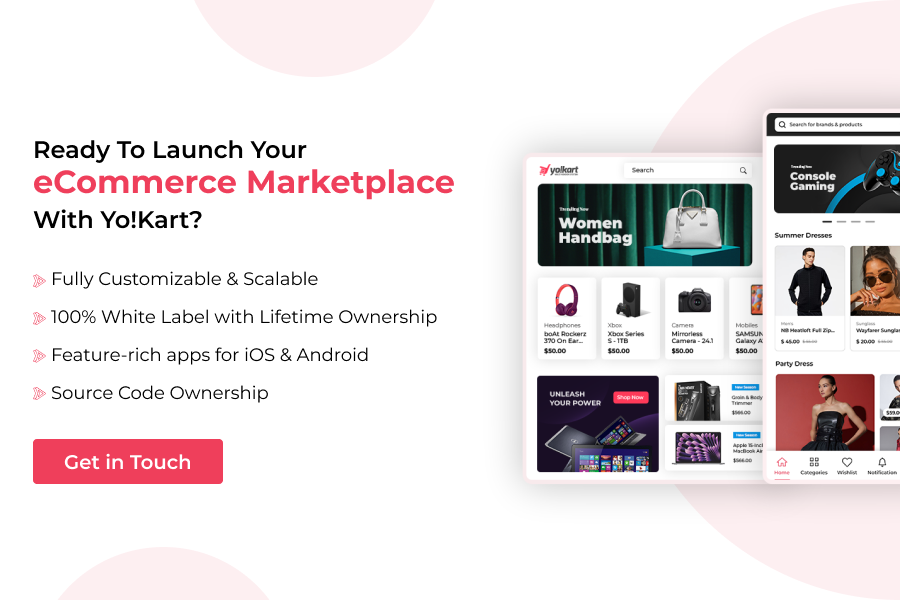
For example, Yo!Kart, a readymade multi-vendor marketplace solution, provides dedicated functionality for administrators, sellers, and buyers, along with product management, order processing, commission configuration, and payment integrations.
Advantages:
- Reduces the need to build core marketplace functionality from scratch.
- Provides dedicated vendor and buyer interfaces.
- Offers a structured foundation for marketplace operations.
- Can reduce initial implementation effort.
- Some solutions provide customizable source code and self-hosting.
Limitations:
- Businesses must evaluate whether existing functionality fits their requirements.
How to Select the Right Technology?
| Selection Factor | What to Evaluate |
| Marketplace functionality | Vendor, buyer, and admin workflows |
| Customization | Themes, source code, APIs, and integrations |
| Payment support | Payment gateways, commissions, and settlements |
| Hosting | SaaS or self-hosted deployment |
| Mobile experience | Responsive website and mobile applications |
| SEO | Metadata, URLs, indexing, and sitemap support |
| Scalability | Infrastructure and performance requirements |
| Ownership | Software licensing and data access |
| Total cost | License, development, hosting, and maintenance |
Where Does Yo!Kart Fit Into This Decision?
Yo!Kart is a dedicated, self-hosted multi-vendor eCommerce marketplace software developed by FATbit Technologies. It is designed for businesses that want to establish B2B, B2C, C2C, and hybrid eCommerce marketplaces without independently developing all essential marketplace components.
The software provides separate interfaces for administrators, sellers, and buyers, allowing each user group to manage its respective activities. Additionally, its customizable source code also provides flexibility for businesses that need to adapt the marketplace to their operational requirements.
Unlike a conventional SaaS marketplace builder, Yo!Kart follows a one-time license model, with hosting and other ongoing operational expenses considered separately. Furthermore, it also offers Android and iOS mobile application options, along with integrations and AI-powered marketplace capabilities.
For entrepreneurs who already have a defined marketplace business model, this approach can provide a practical alternative to developing the entire platform from scratch.
Step 3 outcome: A selected technology platform that aligns with the marketplace’s functionality, budget, customization, and deployment requirements.
Launch Your Marketplace Faster With the Right Foundation
Step 4: Plan Your Marketplace Design and Essential Features
After selecting the development approach, define the marketplace’s user experience and functional requirements.
A multi-vendor marketplace should provide a convenient experience for buyers, an efficient selling environment for vendors, and sufficient operational control for administrators.
The three interfaces should work together without creating unnecessary complexity.
| Buyer-Side | Vendor-Side | Administrator-Side |
| User registration and login | Seller registration and profile management | Vendor approval and management; customer management |
| Homepage and category navigation | Storefront creation | Product and category management |
| Product detail pages | Product listing and editing; inventory management | Product and category management |
| Product search and filtering | Order management | Order monitoring |
| Shopping cart and checkout; order history and tracking | Commission visibility | Commission configuration; payment and settlement oversight |
| Multiple payment options | Shipping configuration | Reviews and moderation; promotions and discount management |
| Product reviews and ratings; wishlist; customer support and notifications | Customer communication; promotional tools | Reports and analytics |
| – | Sales and earnings reports | Content management; marketplace settings and permissions |
Advanced Features to Consider for 2026–2027
As marketplace expectations evolve, businesses can evaluate additional capabilities that improve discovery, efficiency, and customer engagement.
| Feature | Potential Business Value |
| AI-powered product search | Helps buyers discover relevant products |
| Visual search | Allows users to search using images |
| Voice search | Provides another way to discover products |
| AI catalog assistance | Helps sellers create product descriptions and catalog information |
| Personalized recommendations | Improves product discovery |
| Advanced analytics | Supports operational and sales decisions |
| Automated notifications | Keeps buyers and sellers informed |
| Mobile applications | Extends marketplace accessibility |
| CRM integrations | Supports customer relationship management |
These features should be prioritized according to actual user needs rather than added simply because they are available.
Step 5: Develop, Configure, and Test Your Multi-Vendor Marketplace
Once the business model, technology, and features are defined, proceed with marketplace implementation.
The development process will differ depending on whether you select custom development or readymade marketplace software.
However, certain activities are common to most projects.
- Configure the Marketplace Infrastructure
Set up the required hosting environment, domain, SSL certificate, database, and deployment configuration. For self-hosted software, assess server capacity and security requirements.
- Configure User Roles and Permissions
Give administrators, sellers, and buyers appropriate access. Vendors should manage their own listings and orders without accessing other sellers’ confidential information.
- Configure Payment and Commission Workflows
Integrate suitable payment providers and configure the marketplace’s transaction model. Test customer payments, commission calculations, vendor settlements, failures, refunds, cancellations, multi-seller orders, and reconciliation.
- Configure Product Categories and Vendor Registration
Integrate suitable payment providers and test customer payments, commission calculations, vendor settlements, failures, refunds, cancellations, multi-seller orders, and reconciliation.
- Customize the Marketplace Interface
Apply branding, organize navigation, configure the homepage, and make key buyer and vendor actions easy to find.
- Conduct Functional and Security Testing
Before launching, test the platform from the perspective of every user group.
| Testing Area | What to Verify |
| Registration | Buyer and seller account creation |
| Permissions | Appropriate access for each user role |
| Product listings | Product creation, editing, and approval |
| Search | Relevant results and filtering |
| Shopping cart | Product selection and cart calculations |
| Checkout | Successful and failed transactions |
| Commission | Correct commission calculations |
| Vendor settlements | Expected settlement and refund behavior |
| Order management | Vendor-level order processing |
| Mobile responsiveness | Usability across different devices |
| Security | Authentication, permissions, and data protection |
| Performance | Page loading and transaction reliability |
Step 6: Launch, Promote, and Scale Your Marketplace
Launching the website is not the final stage of marketplace development. It is the beginning of the business’s operational and growth journey.
A successful launch requires a strategy for attracting sellers, acquiring buyers, generating transactions, and building trust.
Onboard Initial Vendors and Build the Catalog
- Start with a manageable group of reliable, relevant sellers.
- Guide vendors through account setup, listings, pricing, inventory, fulfillment, commissions, and marketplace policies.
- Ensure the catalog has sufficient listings, accurate pricing, useful descriptions, and clear images before broad promotion.
Promote the Marketplace
- SEO: Optimize category pages, product URLs, titles, meta descriptions, internal links, XML sitemaps, mobile usability, performance, and relevant structured data. Avoid large volumes of duplicate or low-value pages.
- Content Marketing: Publish useful comparisons, buying guides, maintenance advice, and educational resources relevant to your industry.
- Paid Marketing: Consider search ads, social campaigns, retargeting, industry-specific advertising, vendor acquisition campaigns, and sponsored listings.
Treat vendor acquisition and buyer acquisition as separate campaigns because the audiences have different motivations and conversion journeys.
Monitor Marketplace Performance
Establish KPIs to measure whether the marketplace is generating meaningful business activity.
| KPI | What It Measures |
| Active vendors | Sellers actively listing or fulfilling orders |
| Active buyers | Customers engaging with the marketplace |
| Gross Merchandise Value (GMV) | Total value of transactions facilitated |
| Completed transactions | Completed orders or bookings |
| Conversion rate | Percentage of visitors completing desired actions |
| Average Order Value (AOV) | Average value per transaction |
| Repeat purchase rate | Customers returning for additional purchases |
| Vendor retention | Sellers continuing to participate |
| Customer acquisition cost | Cost of acquiring customers |
| Revenue per transaction | Marketplace earnings from completed transactions |
For a new marketplace, completed transactions, active vendors, repeat purchases, and customer satisfaction can be more informative than registrations alone.
Best Multi-Vendor Marketplace Software and Other Development Solutions
The technology you choose for marketplace development directly affects implementation time, customization possibilities, operational complexity, and long-term expenses.
The right approach depends on the level of functionality required and the resources available.
1. Yo!Kart: Best for Ready-Made Multi-Vendor eCommerce Marketplace Development
Yo!Kart is a self-hosted multi-vendor eCommerce marketplace software developed by FATbit Technologies. It is designed for entrepreneurs and businesses planning to establish product-focused B2B, B2C, C2C, and hybrid marketplaces.
Rather than building seller, buyer, and administrator functionality independently, businesses can use Yo!Kart’s existing marketplace infrastructure and customize it according to their requirements.
Key Capabilities:
- Dedicated administrator, seller, and buyer interfaces.
- Multi-vendor product and order management.
- Commission configuration.
- Payment gateway integrations.
- Vendor storefront management.
- Product catalog administration.
- Android and iOS application options.
- Customizable source code.
- AI-powered marketplace capabilities.
- Self-hosted deployment.
Advantages:
- Purpose-built for multi-vendor eCommerce.
- Provides a ready-made marketplace foundation.
- Supports multiple eCommerce business models.
- Offers source code customization.
- Uses a one-time license model.
- Reduces the need to assemble multiple plugins for core marketplace functionality.
Considerations:
- Hosting and infrastructure expenses should be considered separately.
Pricing Model: One-time license, with package-specific inclusions and support terms.
Discover How Yo!Kart Powers Marketplaces
2. Sharetribe: Best for Service and Rental Marketplaces
Sharetribe is a marketplace-building platform focused on helping entrepreneurs establish service, rental, and peer-to-peer marketplaces.
It provides built-in marketplace functionality for user profiles, listings, transactions, and related workflows.
Key Capabilities:
- Marketplace configuration.
- User and listing management.
- Booking-related functionality.
- Payment integrations.
- Search and filtering.
- API access.
Advantages:
- Designed for two-sided marketplace businesses.
- Useful for service and rental use cases.
- Offers a no-code starting point.
- Supports further development through APIs.
Considerations:
- Subscription-based operating model.
- Advanced customization may require development.
- Businesses should assess its suitability for complex product eCommerce requirements.
3. CS-Cart Multi-Vendor: Best for eCommerce Marketplace Operations
CS-Cart Multi-Vendor provides dedicated marketplace functionality for businesses managing multiple independent sellers through a shared platform.
It supports different marketplace business models, including B2B, product, rental, service, and wholesale marketplaces.
Key Capabilities:
- Seller accounts and management.
- Product catalogs.
- Commission management.
- Order processing.
- Payment integrations.
- Marketplace administration.
- API and extension ecosystem.
Advantages:
- Dedicated eCommerce marketplace functionality.
- Supports multiple business models.
- Offers customization and extension options.
- Provides self-hosted editions.
Considerations:
- Implementation and configuration may require technical expertise.
- Businesses should compare licensing, support, and customization costs.
4. WooCommerce+Dokan: Best for WordPress-Based Marketplace Development
WooCommerce is an eCommerce platform for WordPress. Dokan extends it with multi-vendor functionality, allowing multiple sellers to operate through a shared eCommerce website.
Key Capabilities:
- Vendor registration.
- Seller dashboards.
- Product management.
- Order management.
- Commission configuration.
- WordPress plugin integrations.
Advantages:
- Suitable for WordPress users.
- Large plugin ecosystem.
- Flexible themes and customization.
- Multiple hosting options.
Considerations:
- Depends on WordPress and additional plugins.
- Requires ongoing compatibility and maintenance management.
- Advanced requirements may involve additional development.
5. Bubble: Best for Custom Marketplace Applications
Bubble is a visual development platform that allows users to create web applications using a drag-and-drop editor and configurable workflows.
It can support customized marketplace experiences, although marketplace functionality must be configured according to the business requirements.
Key Capabilities:
- Visual application development.
- Database configuration.
- Workflow automation.
- User authentication.
- Third-party integrations.
- API connectivity.
Advantages:
- Flexible application design.
- Useful for specialized marketplace concepts.
- Suitable for validating custom business ideas.
Considerations:
- Marketplace logic requires configuration.
- Complex applications can require technical expertise.
- Hosting and usage-based costs should be assessed.
Marketplace Development Solutions Compared
| Solution | Development Approach | Suitable Business Model | Customization |
| Yo!Kart | Ready-made marketplace software | B2B, B2C, C2C, hybrid | Source code customization |
| Sharetribe | Dedicated marketplace builder | Service, rental, P2P | Configuration and API |
| CS-Cart | Ready-made marketplace software | B2B, B2C, wholesale | Source code and extensions |
| WooCommerce + Dokan | eCommerce platform + plugin | Product-based marketplaces | Themes, plugins, code |
| Bubble | Visual application development | Custom marketplace applications | Visual workflows and integrations |
Which Solution Should You Choose?
- If your business requires a highly specialized application, custom development or Bubble may be worth considering.
- If you already operate a WordPress website, WooCommerce with Dokan can be a relevant option.
- If your objective is to launch a dedicated multi-vendor eCommerce marketplace with existing seller, buyer, and administrative functionality, Yo!Kart and CS-Cart deserve closer evaluation.
Examples of Multi-Vendor Marketplaces
Studying established marketplaces can help entrepreneurs understand how different businesses structure their platforms, serve their audiences, and generate revenue. Studying these platforms can help entrepreneurs identify useful strategies for their own marketplace businesses.
Here are five well-known examples:
1. Amazon: A Large-Scale B2C and Third-Party Seller Marketplace
Amazon is a prominent example of a marketplace where third-party sellers offer products alongside the platform’s own retail operations. Its marketplace model provides sellers with access to customers while allowing buyers to browse a broad product selection.
Business model: Product sales, seller-related fees, fulfillment services, subscriptions, and advertising.
What entrepreneurs can learn: A marketplace can combine a wide seller network with centralized product discovery, purchasing, and customer experience.
2. Etsy: A Marketplace for Handmade and Creative Products
Etsy connects independent sellers with customers looking for handmade products, vintage items, and creative goods. Its specialized positioning helps differentiate the platform from general-purpose eCommerce marketplaces.
Business model: Listing fees, transaction fees, payment processing fees, and advertising.
What entrepreneurs can learn: A focused marketplace can attract a clearly defined audience by building around a specific product category and seller community.
3. Alibaba.com: A Global B2B Marketplace
Alibaba.com connects businesses with suppliers and manufacturers across different industries. Its platform facilitates product discovery and business-to-business purchasing.
Business model: Supplier memberships, advertising, and other business services.
What entrepreneurs can learn: B2B marketplaces need functionality that supports supplier discovery, bulk purchasing, business communication, and trade-related requirements.
4. Airbnb: A Marketplace for Accommodation and Experiences
Airbnb connects hosts offering accommodation with guests searching for places to stay. The platform facilitates discovery, reservations, and payments between different user groups.
Business model: Service fees associated with bookings and related marketplace services.
What entrepreneurs can learn: A marketplace does not have to sell physical products. It can connect users who have underutilized assets with people seeking temporary access to them.
5. Fiverr: A Marketplace for Freelance Services
Fiverr connects independent professionals with businesses and individuals looking for digital services. Sellers create service listings, while buyers browse offerings and place orders.
Business model: Service-related transaction fees and other marketplace services.
What entrepreneurs can learn: Service marketplaces require clear provider profiles, service descriptions, pricing, order management, and mechanisms for building trust.
What Do These Marketplace Examples Have in Common?
Despite operating in different industries, these platforms share several fundamental marketplace principles:
- They serve clearly defined buyer and seller groups.
- They simplify the process of discovering relevant offerings.
- They provide mechanisms for managing transactions.
- They establish policies to maintain marketplace trust.
- They offer value to both sides of the platform.
- They continuously improve the experience based on user behavior.
Rather than replicating the exact features of established platforms, entrepreneurs should identify the value their marketplace can offer within a chosen industry and select technology that supports those requirements.
Launch Your Multi-Vendor Marketplace like Amazon & Etsy
Conclusion
Launching a multi-vendor marketplace requires more than an attractive website. It involves establishing a sustainable business model, creating value for sellers and buyers, selecting suitable technology, and developing reliable operational workflows.
Start by validating your market opportunity and defining your requirements before investing in development. Then choose a solution that supports your business model without adding unnecessary complexity.
Custom development offers greater control over architecture and functionality, while eCommerce platforms with plugins suit businesses already using those ecosystems. However, ready-made marketplace software can reduce the effort required to develop core functionality.
Yo!Kart provides a dedicated marketplace foundation for businesses planning to launch B2B, B2C, C2C, and hybrid eCommerce platforms. With its separate buyer, seller, and administrator interfaces, customizable source code, self-hosted deployment, and mobile application options, it can help businesses establish their marketplace without building every essential component from scratch.
Ultimately, evaluate technology based on how well it supports your operations, customer experience, customization needs, and future growth, not just its initial cost or feature list.
FAQs
1. How much does it cost to build a multi-vendor marketplace?
Building a multi-vendor marketplace typically costs $10,000-$150,000+, depending on features, customization, integrations, and development approach. Basic marketplaces may cost $10,000-$25,000, mid-level platforms $25,000-$75,000, and enterprise solutions $75,000-$150,000+.
Ready-made marketplace software can reduce development effort through prebuilt functionality. Additional costs may include licensing, customization, hosting, and maintenance.
2. Can I build a multi-vendor marketplace without coding?
Yes, with dedicated marketplace builders, low-code application development tools, or ready-made marketplace software, you can build a multi-vendor marketplace.
Some solutions provide prebuilt vendor, buyer, and administrator functionality. Yo!Kart, for example, is a ready-made multi-vendor marketplace software rather than a conventional no-code builder. It provides existing marketplace functionality with customizable source code.
3. What is the best software for building a multi-vendor marketplace?
The best software for building a multi-vendor marketplace depends on your marketplace business model and technical requirements.
Yo!Kart is worth considering for readymade, self-hosted multi-vendor eCommerce functionality. Sharetribe is relevant for service and rental marketplaces, CS-Cart for eCommerce marketplaces, WooCommerce with Dokan for WordPress-based marketplaces, and Bubble for custom application development.
4. How do vendors receive payments in a multi-vendor marketplace?
The payment process depends on the marketplace’s payment infrastructure.
A customer makes a payment through the marketplace’s checkout system. The payment provider and marketplace settlement configuration determine how funds are allocated, how platform commissions are calculated, and when sellers receive their payouts.
Businesses should select payment infrastructure that supports their target countries, seller verification requirements, refund policies, and settlement model.
5. How long does it take to build a multi-vendor marketplace?
The development timeline to build a multi-vendor marketplace depends on the selected technology, required functionality, integrations, customization, and testing.
A marketplace created using readymade software may require less implementation effort than a fully custom-developed platform. However, business validation, vendor onboarding, payment configuration, and operational preparation also influence the launch timeline.
6. How do I attract vendors to my multi-vendor marketplace?
Start by identifying vendors who serve your target audience and can provide relevant products or services. You can attract vendors through:
- Direct outreach and industry networking.
- Vendor acquisition campaigns.
- Introductory membership offers.
- Reduced initial commission rates.
- Partnerships with suppliers and distributors.
- Industry events and business communities.
- Clear communication of marketplace benefits.
Focus on onboarding reliable vendors with relevant listings rather than maximizing registrations.
7. How do I attract customers to a new multi-vendor marketplace?
A new marketplace needs a customer acquisition strategy that builds awareness and encourages initial transactions. For that, useful approaches include SEO, content marketing, paid search advertising, social media campaigns, referral programs, email marketing, and partnerships.
Additionally, before investing heavily in advertising, ensure that the marketplace has sufficient relevant listings, reliable sellers, transparent policies, and a smooth checkout experience.
8. Can I build a B2B and B2C marketplace using the same software?
Yes, you can build a B2B and B2C marketplace using the same software. Certain dedicated multi-vendor marketplace solutions support both business models.
However, the software must accommodate the different requirements of each model. B2B marketplaces may need bulk ordering, business accounts, quotation requests, and flexible pricing, while B2C platforms typically prioritize product discovery, individual customer accounts, and streamlined checkout.
9. Is ready-made marketplace software better than custom development?
Neither approach is universally better.
- Custom development provides greater control over application architecture and specialized functionality but requires more development resources.
- Readymade marketplace software provides prebuilt functionality and can reduce implementation effort. It is particularly useful when the business requirements align with the software’s existing capabilities.
The right option depends on customization needs, budget, technical resources, and long-term ownership preferences.
Want to Launch a Multi-Vendor Marketplace?
Get StartedPopular Posts