

Published Date: 29th September, 2026
Building an online marketplace involves more than bringing buyers and sellers onto the same website. Entrepreneurs also need reliable technology to manage seller onboarding, product listings, transactions, commissions, orders, payments, and day-to-day marketplace operations. As the number of sellers and customers grows, the platform must be capable of supporting increasing operational complexity without compromising performance.
This is where multi-seller marketplace software becomes important. A ready-made platform provides the core infrastructure required to launch a marketplace while allowing businesses to configure the experience around their specific business model. Moreover, features such as customization, third-party integrations, multilingual support, multi-currency capabilities, and scalability can influence how effectively the marketplace evolves.
However, not every platform offers the same level of flexibility or control. Deployment model, pricing structure, technical requirements, customization scope, and post-launch support should therefore be assessed before making a technology decision.
This guide compares 10 leading multi-seller marketplace platforms to help entrepreneurs evaluate their capabilities and identify an appropriate technology foundation for their marketplace.
Table of Contents
- Key Statistics
- Understanding: Multi-Vendor Marketplace Platform
- Benefits of Leveraging a Multi-Seller Marketplace Platform
- Key Features to Evaluate While Selecting a Multi-Seller Marketplace Platform
- Best White-Label Tutor Management Software in Saudi Arabia
- Why Yo!Kart Tops the List?
- Wrapping Up
- FAQs
Key Statistics
The expansion of digital commerce continues to create opportunities for entrepreneurs exploring multi-seller marketplace models. The following 2026 statistics provide current market context and can be used to establish the commercial relevance of marketplace platforms.
- Global eCommerce market: The global eCommerce market is estimated to grow at a CAGR of 21.6% from 2026 to 2033, according to Grand View Research.
- Global B2C eCommerce market: The B2C eCommerce market is estimated to reach USD 33.5 trillion by 2033, growing at a CAGR of 21.7% during 2026-2033.
- Global B2B eCommerce market: Grand View Research projects that the global B2B eCommerce market will grow at a CAGR of 20.9% between 2026 and 2033, with the market expected to reach USD 105.9 trillion by 2033.
- Global C2C eCommerce market: The global C2C eCommerce market is estimated to reach USD 3.2 trillion in 2026, growing at a CAGR of 24.3% from 2026 to 2033.
For entrepreneurs, this growing digital ecosystem creates opportunities to build specialized marketplaces that connect multiple sellers with targeted customer segments.
Understanding: Multi-Vendor Marketplace Platform
A multi-seller marketplace platform provides the technology infrastructure required to operate a digital marketplace where multiple independent sellers can list and sell products or services. Instead of developing vendor, catalog, order, payment, and administrative functionality from scratch, entrepreneurs can use ready-made software and customize it around their business model.
Key Stakeholders
A typical multi-seller marketplace involves:
- Marketplace Owner: Owns and operates the platform, defines business rules, manages sellers, and controls monetization.
- Sellers: Register on the marketplace, create product listings, manage inventory, process orders, and receive payouts.
- Customers: Browse products from different sellers, place orders, make payments, and manage purchases.
- Administrators: Configure marketplace operations, moderate sellers and listings, manage transactions, and monitor platform activity.
How Does a Multi-Seller Marketplace Work?
- The marketplace owner configures sellers, commissions, payments, shipping, and platform rules.
- Sellers register, submit business details, and complete the approval process.
- Approved sellers add products, prices, descriptions, images, and inventory.
- Customers browse products from multiple sellers through a single storefront.
- Customers place orders and complete payments through the marketplace.
- The platform processes payments and applies commissions or applicable fees.
- Sellers receive orders and manage packing, shipping, or fulfillment.
- The platform processes seller payouts based on configured payment rules.
- Marketplace administrators manage sellers, orders, customers, listings, and transactions.
Benefits of Leveraging a Multi-Seller Marketplace Platform
Ready-made multi-seller marketplace software provides the core infrastructure required to operate a marketplace without developing every component from scratch. For entrepreneurs, this can simplify the launch process while providing access to established workflows for seller management, transactions, catalog operations, and administration.
Moreover, a suitable platform can provide the flexibility needed to support changing business requirements as the marketplace grows.
1. Faster Market Entry
Ready-made software includes essential marketplace functionality, allowing businesses to launch without spending months developing basic seller and customer workflows. This can shorten the time between planning and market entry.
2. Simplified Seller Management
Marketplace software provides centralized tools for seller registration, approval, profiles, product listings, orders, commissions, and payouts. This helps administrators manage multiple sellers through a structured workflow.
3. Lower Development Complexity
Core marketplace components are already available within the platform. As a result, businesses can reduce the scope of initial development and focus resources on customization, integrations, branding, and other business-specific requirements.
4. Flexible Business Models
A capable platform can support different revenue models, including transaction commissions, seller subscriptions, listing fees, featured listings, advertising, or a combination of these approaches. This allows entrepreneurs to adapt monetization as the marketplace develops.
5. Scalability and Customization
As seller numbers, product catalogs, and transactions increase, the platform should accommodate growing operational demands. Additionally, customization allows businesses to modify workflows, storefronts, integrations, and marketplace rules according to their requirements.
6. Centralized Operational Control
A unified administration panel gives marketplace owners visibility across sellers, products, customers, orders, payments, and platform activity. This makes it easier to monitor operations and maintain consistent marketplace policies.
Launch Your Multi-Seller Marketplace With Ready-Made Software
Key Features to Evaluate While Selecting a Multi-Seller Marketplace Platform
Selecting marketplace software requires looking beyond storefront design and basic eCommerce functionality. Entrepreneurs should assess whether the platform can support seller operations, customer transactions, administrative workflows, integrations, and future expansion. The following marketplace features are particularly important when evaluating a multi-seller marketplace solution.
1. Seller Registration and Onboarding
The platform should provide a structured seller registration process with profile creation, document submission, approval workflows, and configurable seller requirements.
2. Seller Dashboard
A dedicated dashboard should allow sellers to manage products, inventory, orders, earnings, customers, and other marketplace activities from one interface.
3. Product and Catalog Management
Marketplace owners and sellers should be able to create, organize, edit, and manage product listings with categories, attributes, pricing, images, and inventory details.
4. Commission Management
The software should support flexible commission rules based on sellers, categories, products, or transactions. This helps marketplace owners manage different commercial arrangements.
5. Order Management
Centralized order management should allow administrators and sellers to track order status, processing, cancellations, returns, and fulfillment activities efficiently.
6. Inventory Management
Real-time inventory controls help sellers maintain accurate stock levels and reduce issues caused by overselling, unavailable products, or outdated inventory information.
7. Payment and Payout Management
The platform should support multiple payment methods while providing structured processes for commissions, refunds, seller earnings, and payouts.
8. Seller Storefronts
Individual seller storefronts allow vendors to showcase their products under their own marketplace profile. Custom branding and storefront controls can also improve seller visibility.
9. Shipping and Tax Management
Integration with shipping providers and configurable tax rules can simplify fulfillment and help marketplace owners manage location-specific delivery and taxation requirements.
10. Multi-Language and Multi-Currency Support
Businesses targeting multiple regions should consider platforms that support multiple languages and currencies. This can simplify international expansion and provide localized shopping experiences.
11. Third-Party Integrations and APIs
APIs and pre-integrated services allow marketplaces to connect payment gateways, shipping providers, ERP systems, analytics tools, marketing platforms, and other business applications.
12. Analytics and Reporting
Marketplace analytics should provide insights into sales, orders, seller performance, customer activity, commissions, and other operational metrics to support data-driven decisions.
Top Multi-Seller Marketplace Platform
The following platforms represent different approaches to marketplace commerce, ranging from self-hosted and open-source solutions to SaaS and enterprise marketplace technology. Their capabilities, deployment models, customization options, and pricing structures vary considerably, so entrepreneurs should assess each against their intended marketplace model.
1. Yo!Kart
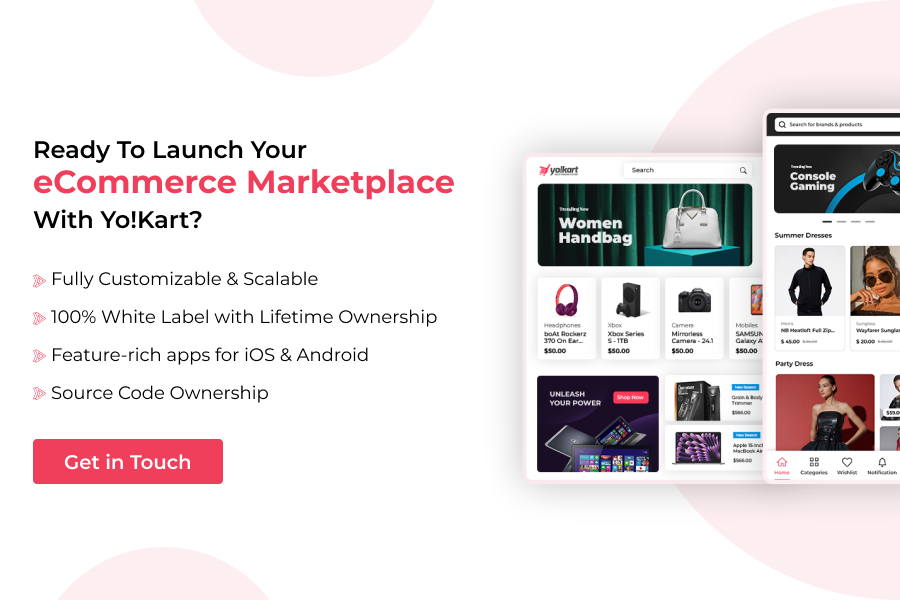
Yo!Kart is a white-label, self-hosted multi-seller marketplace platform designed for entrepreneurs and businesses building independent B2C, B2B, and hybrid marketplaces. It provides core marketplace functionality for managing sellers, products, orders, commissions, payments, customers, promotions, and marketplace administration. Its self-hosted architecture also gives businesses greater control over deployment, customization, data, and integrations.
The platform follows a one-time licensing model rather than a recurring SaaS subscription. In addition, Yo!Kart supports multi-language and multi-currency marketplaces and can be customized for specific business workflows. Its portfolio and case studies demonstrate implementations across different industries and geographic markets, making it relevant for businesses seeking a ready-made foundation with room for further customization.
Key Highlights:
- White-label and self-hosted
- Multi-vendor management
- B2B, B2C, and hybrid marketplace support
- Multi-language and multi-currency capabilities
- Product, order, commission, and catalog management
- Third-party API integrations
- Customization and scalability
- One-time licensing model
Best For:
Entrepreneurs, startups, SMEs, and established businesses looking for a customizable, self-hosted marketplace solution without building the complete marketplace infrastructure from scratch.
Explore Yo!Kart for Your Multi-Seller Marketplace
2. Shopify
Shopify is a SaaS commerce platform that enables businesses to build and operate online stores. Multi-seller functionality can be introduced through third-party marketplace applications and integrations, allowing merchants to extend the platform beyond its native single-store model.
Its hosted infrastructure reduces server management responsibilities and provides an established commerce ecosystem. However, businesses planning complex marketplace workflows may need additional applications or customization to support vendor management, commissions, and other multi-seller requirements.
Key Highlights:
- SaaS deployment
- Hosted infrastructure
- Large app ecosystem
- Payment and commerce integrations
- Storefront customization
- Multi-channel selling
Best For:
Businesses seeking a hosted commerce platform with marketplace functionality extended through apps and integrations.
3. Virto Commerce
Virto Commerce is a headless, composable commerce platform designed for businesses with complex B2B and B2C commerce requirements. Its marketplace capabilities support multi-vendor operations, allowing businesses to manage sellers, catalogs, products, orders, and other marketplace workflows within a flexible commerce environment.
The platform provides an API-first architecture and modular approach, giving businesses greater flexibility when connecting marketplace functionality with existing systems. However, its enterprise-oriented architecture may require technical expertise and development resources for implementation, customization, and ongoing management.
Key Highlights:
- Composable commerce architecture
- B2B and B2C capabilities
- Multi-vendor marketplace functionality
- API-first architecture
- Modular and customizable framework
- Enterprise integrations
Best For:
Mid-sized and enterprise businesses looking for a flexible commerce platform to build complex B2B, B2C, or multi-seller marketplace operations.
4. Sharetribe
Sharetribe is a marketplace software platform designed to help businesses launch online marketplaces without developing the entire technology stack themselves. It supports marketplace creation through configurable workflows and hosted infrastructure.
The platform is particularly relevant to businesses that prioritize speed to market and simplified management. However, businesses with highly specialized marketplace workflows should assess its customization capabilities against their long-term requirements before implementation.
Key Highlights:
- Hosted marketplace platform
- No-code marketplace creation
- Seller and buyer profiles
- Transactions and payments
- Marketplace workflows
- API capabilities
Best For:
Entrepreneurs and businesses that want to launch a marketplace quickly using a hosted platform with configurable functionality.
5. Mirakl
Mirakl provides enterprise marketplace technology designed for businesses that want to integrate third-party sellers into established digital commerce operations. Its technology focuses on marketplace management, seller onboarding, catalog operations, and enterprise workflows.
The platform is particularly suited to larger organizations with complex marketplace requirements and existing commerce ecosystems. Its enterprise positioning also makes it more relevant to organizations that require extensive operational controls and integrations.
Key Highlights:
- Enterprise marketplace technology
- Seller onboarding
- Catalog management
- Marketplace operations
- Enterprise integrations
- B2B and B2C marketplace support
Best For:
Large enterprises and established retailers looking to introduce or expand marketplace operations within an existing commerce ecosystem.
6. Spryker
Spryker is a composable commerce platform that supports complex B2B, B2C, and marketplace use cases. Its modular architecture allows businesses to build commerce experiences around specific operational and customer requirements.
The platform is designed for organizations with substantial technical and operational resources. Its flexibility can support complex implementations, although businesses should account for the technical expertise and implementation effort required to configure and maintain an enterprise commerce environment.
Key Highlights:
- Composable commerce architecture
- B2B and B2C capabilities
- Marketplace functionality
- Modular technology
- API-first approach
- Enterprise integrations
Best For:
Enterprise businesses requiring a flexible commerce architecture for complex marketplace and omnichannel operations.
7. Webkul Multivendor
Webkul provides multi-vendor marketplace solutions and extensions across several eCommerce ecosystems. Its solutions allow businesses to add seller management and marketplace capabilities to supported commerce platforms.
The feature set varies depending on the underlying platform and implementation. Businesses can therefore choose an ecosystem that aligns with their existing technology stack while extending it with multi-vendor functionality.
Key Highlights:
- Multi-vendor extensions
- Seller management
- Product management
- Commission configuration
- Order management
- Multiple eCommerce integrations
Best For:
Businesses that already use a supported eCommerce platform and want to add multi-vendor marketplace functionality through extensions.
8. Magento
Magento, now part of Adobe Commerce, provides a highly extensible commerce platform for businesses with complex eCommerce requirements. Multi-vendor marketplace functionality can be implemented through extensions and custom development rather than relying solely on the core platform.
Its flexible architecture provides significant scope for customization. However, businesses should consider hosting, development, maintenance, and extension requirements when calculating the total cost of a marketplace implementation.
Key Highlights:
- Highly customizable architecture
- B2B commerce capabilities
- Extensive extension ecosystem
- Catalog management
- API support
- Advanced commerce functionality
Best For:
Businesses with technical resources that require extensive customization and already operate within the Adobe Commerce ecosystem.
Build a Marketplace Around Your Business Model
9. Egsma
Egsma is positioned as a marketplace software solution for businesses looking to establish multi-vendor commerce operations. Its platform approach focuses on providing marketplace functionality without requiring businesses to build every component independently.
Before selecting Egsma, businesses should evaluate its current feature set, customization capabilities, integrations, deployment options, and support structure against their marketplace roadmap. This is particularly important for businesses expecting significant transaction or seller growth.
Key Highlights:
- Multi-vendor marketplace functionality
- Seller management
- Product management
- Order management
- Marketplace administration
- Customization options
Best For:
Entrepreneurs seeking ready-made marketplace software for launching a multi-seller online business.
10. PrestaShop
PrestaShop is an open-source eCommerce platform that can be extended with marketplace modules to support multiple sellers. Businesses can use its modular ecosystem to add functionality based on their marketplace requirements.
Its open-source foundation provides flexibility for developers, while the module ecosystem expands the platform’s capabilities. However, businesses should assess module compatibility, maintenance requirements, and technical support before building a marketplace around the platform.
Key Highlights:
- Open-source platform
- Modular architecture
- Multi-vendor marketplace modules
- Product management
- Payment integrations
- Customizable storefront
Best For:
Small and mid-sized businesses with technical resources looking for an open-source eCommerce foundation that can be extended into a marketplace.
Best Multi-Seller Marketplace Platform: At a Glance
| Software | Deployment Model | Customization | Scalability | Post-Launch Support | Pricing Model |
| Yo!Kart | Self-hosted | High | High | Dedicated support available | One-time license |
| Shopify | SaaS | Medium | High | Platform support | Subscription + apps |
| Virto Commerce | Cloud / Self-hosted | High | High | Enterprise support | Custom pricing |
| Sharetribe | SaaS | Medium | High | Platform support | Subscription |
| Mirakl | Enterprise/SaaS | High | Enterprise | Enterprise support | Custom pricing |
| Spryker | Cloud | High | Enterprise | Enterprise support | Custom pricing |
| Webkul Multivendor | Platform-dependent | Medium-High | Varies | Vendor support | Extension/license-based |
| Magento | Self-hosted/Cloud | High | High | Adobe/partner support | Custom/enterprise |
| Egsma | Platform-dependent | Varies | Varies | Vendor support | Custom/plan-based |
| PrestaShop | Self-hosted | High | Medium-High | Community/partner support | Open source + modules |
Why Choose Yo!Kart to Build a Multi-Seller Marketplace?
For entrepreneurs evaluating white-label marketplace software, Yo!Kart combines ready-made marketplace infrastructure with customization and deployment control. Its positioning is particularly relevant for businesses that want to own their marketplace technology rather than build around a recurring SaaS dependency.
1. Global Clientele
Yo!Kart has been used across B2B, B2C, niche, and service-oriented marketplace models in different markets. Its case studies demonstrate how the platform has been customized to address industry-specific workflows and marketplace requirements.
Some notable implementations include:
- UNI Diamonds: A B2B diamond trading marketplace, designed to connect diamond buyers and vendors through product search, comparison, bidding, and purchasing functionality.
- Voyij: A travel activities marketplace connecting travelers with local experience providers in Alaska. The platform includes features such as tiered pricing, activity time slots, and multiple pickup locations.
- Tajer: A Qatar-based multi-category marketplace connecting customers with local and international brands across categories including fashion, beauty, home goods, and electronics.
- WaterSorted: A B2B marketplace in New Zealand that helps businesses source products for drinking water, wastewater, and stormwater management through a centralized procurement platform.
Click here to check out Yo!Kart’s Client Portfolio
2. Available at a One-Time Cost
Yo!Kart follows a one-time licensing approach rather than requiring businesses to pay a recurring platform subscription for the core software license. This model can provide greater predictability when entrepreneurs are evaluating the long-term economics of operating a marketplace.
However, businesses should separately account for hosting, custom development, third-party services, integrations, and other implementation costs where applicable.
3. Fully Customizable
Marketplace businesses often develop requirements that go beyond standard vendor and product management. Yo!Kart can be customized around specific workflows, marketplace rules, integrations, storefront requirements, and business processes.
This enables businesses to start with an established marketplace foundation while adapting the platform as their operational requirements evolve.
4. Multi-Lingual & Multi-Currency Support
Businesses targeting multiple countries need more than a translated storefront. Currency handling, localized experiences, seller operations, and international transactions also need to be considered.
Yo!Kart supports multi-language and multi-currency marketplace operations, making it suitable for businesses planning to serve customers and sellers across multiple markets.
5. Pre-Integrated APIs
Integrations are an important part of marketplace infrastructure. Payment gateways, shipping providers, analytics systems, communication services, and other external applications can become essential as the marketplace expands.
Yo!Kart provides pre-integrated APIs and integration capabilities that can help businesses connect the marketplace with external services while reducing the need to build every integration from scratch.
6. Trust & Company Experience
Yo!Kart is a product of FATbit Technologies, a software company with more than two decades of industry experience. Its official website, portfolio, and case studies provide additional information about its marketplace software and implementation experience.
Get Started With Yo!Kart Today
Wrapping Up
Selecting multi-seller marketplace software is a technology decision that can influence marketplace operations well beyond the initial launch. Entrepreneurs should therefore evaluate vendor management, catalog controls, commissions, payments, integrations, customization, deployment, scalability, and support together rather than focusing on individual features.
The right choice ultimately depends on the marketplace’s business model, technical resources, target market, expected scale, and long-term roadmap. A structured comparison can help businesses identify which platform aligns with their operational priorities and investment strategy.
FAQs
Is white-label marketplace software better than custom development?
White-label software provides an existing marketplace foundation that can reduce development time and initial complexity. Custom development provides greater control over the underlying technology but generally requires more development resources, time, and ongoing maintenance. The appropriate approach depends on the business’s technical and operational requirements.
How much does multi-seller marketplace software cost?
The cost varies significantly depending on the deployment model, platform, number of sellers, customization, integrations, hosting, and support requirements. SaaS platforms commonly use recurring subscriptions, while self-hosted solutions may use licensing, development, hosting, and support costs.
Can I customize a multi-seller marketplace platform?
Many platforms support customization, but the extent varies. Open-source and self-hosted solutions generally provide greater access to the underlying code and infrastructure, while SaaS platforms typically operate within the customization options and APIs provided by the vendor.
Is self-hosted or SaaS marketplace software better?
Both models have different implications. SaaS platforms generally simplify hosting and maintenance, while self-hosted solutions can provide greater control over infrastructure, customization, data, and deployment. The appropriate model depends on the business’s technical and operational requirements.
Can a multi-seller marketplace scale with business growth?
A scalable platform can accommodate increasing sellers, products, customers, and transactions. Businesses should evaluate architecture, database performance, hosting requirements, APIs, caching, security, and customization capabilities before selecting a platform for long-term growth.
Want to Build Your Own Multi-Seller Marketplace?
Get In TouchPopular Posts