
Published Date: 22nd September, 2026
The UK is one of Europe’s most mature eCommerce markets, and online marketplaces have become an increasingly important part of the country’s digital retail landscape. From fashion resale and local food platforms to specialist B2B marketplaces and niche retail communities, businesses are increasingly using marketplace models to connect multiple sellers with customers through a single digital platform.
For entrepreneurs and established businesses looking to launch their own marketplace in the UK, choosing the right technology is an important strategic decision. The platform you select can influence your operating costs, customization options, vendor management capabilities, payment infrastructure, tax handling, scalability, and ability to expand into international markets.
There is great untapped potential in the market that you can access. According to the Office for National Statistics (ONS), online sales accounted for 28.3% of total retail sales in Great Britain in July 2026. Online spending was also 11.0% higher in the three months to July 2026 compared with the same period in 2025.
This creates opportunities for businesses that want to build specialized marketplaces rather than compete directly with general-purpose retailers. However, the question is which multi-vendor eCommerce platform they should choose to launch their marketplace in the UK.
That’s where the guide comes in. It compares the leading multi-vendor eCommerce platforms for businesses targeting the UK market in 2026 and explains everything they need to know before investing in marketplace technology, providing clarity to decide on the best solution.
Table of Contents
- UK eCommerce & Marketplace Industry: Key Statistics
- What to Look For in a Multi-Vendor eCommerce Platform
- The Top Multi-Vendor eCommerce Platforms in the UK
- How to Choose the Right Platform for Your UK Marketplace
- Why Choose Yo!Kart for a UK Multi-Vendor Marketplace?
- Conclusion
- Frequently Asked Questions
UK eCommerce & Marketplace Industry: Key Statistics
Before comparing platforms, you should have a look at the size and opportunity of the UK online commerce market.
Online retail represents more than a quarter of UK retail
According to the latest ONS Retail Sales Index data, 28.3% of retail sales were made online in July 2026. The proportion has remained consistently high, demonstrating that online commerce is now a mainstream part of UK retail rather than a secondary sales channel.
For marketplace operators, this means consumers are already accustomed to discovering and purchasing products online.
Online spending continues to grow
ONS reported that online spending increased by 11.0% in the three months to July 2026 compared with the same period in 2025. Monthly online sales in July 2026 were also 6.5% higher than July 2025.
This continued growth gives marketplace businesses room to target specific customer segments while benefiting from the broader expansion of digital commerce.
Online marketplaces are an established part of UK commerce
The UK Government’s research into online marketplace consumer journeys describes marketplaces as an important part of the country’s online retail environment. The research notes that online sales have increased substantially over the past decade and that marketplaces now account for a significant portion of online retail activity.
This creates opportunities beyond general marketplaces. Businesses can build specialized platforms around various industries like Fashion and resale, B2B wholesale, Food and grocery, Local products, Electronics, Home and furniture, Rentals, Services, Automotive, Health and wellness products, Professional supplies, industry-specific commerce
The strongest opportunity may not necessarily be another general-purpose marketplace. It may be a marketplace that solves a specific supply-and-demand problem better than existing platforms.
What to Look For in a Multi-Vendor eCommerce Platform
Choosing a marketplace platform requires looking beyond the initial launch. For example, a platform that is inexpensive and easy to launch may become restrictive once you have hundreds of vendors, thousands of products, growing transaction volumes, and increasingly complex tax and payment requirements.
Here are the key factors UK businesses should evaluate.
1. Hosting Type
Businesses need to decide between SaaS and self-hosted multi-vendor marketplace software.
SaaS platforms are hosted and maintained by the provider, generally in exchange for recurring fees. On the other hand, self-hosted, licensed platforms are managed by the owner and provide greater control over infrastructure, deployment, integrations, and customization.
2. Customization Capability
A generic marketplace may work during the initial validation stage, but successful businesses often develop more specialized requirements. Therefore, the platform must be flexible enough to accommodate these requirements without forcing the business to rebuild its core technology.
3. VAT Handling
VAT is an important consideration for UK marketplace operators. The complexity increases when vendors operate from different countries or sell to customers across the UK and EU.
A marketplace platform should provide flexible tax configuration and an integration path for appropriate tax and accounting solutions.
4. Multiple Payment Gateways
UK customers expect familiar and reliable payment options. Therefore, businesses should consider support for multiple payment gateways and payment options such as Stripe, PayPal, and open banking payment solutions.
For multi-vendor marketplaces, standard payment processing is only part of the requirement. The platform should also support an appropriate method for calculating commissions and handling vendor payouts.
5. Post-Brexit Cross-Border Considerations
Businesses serving both UK and EU buyers or vendors need to account for the additional complexity created by post-Brexit trade arrangements.
Depending on the marketplace model, this can involve:
- Customs declarations
- Import duties
- VAT
- Delivery estimates
- Product origin
- Cross-border shipping
- Returns
The platform itself will not eliminate these requirements, but it should make it easier to communicate relevant information to vendors and customers.
6. Total Cost of Ownership
The initial platform price does not necessarily represent the long-term cost. However, businesses should therefore compare the total cost of ownership over three to five years, rather than only comparing launch costs.
SaaS marketplace platforms may involve monthly subscriptions, transaction fees, and several other associated charges. On the other hand, self-hosted marketplace software available at a one-time payment often eliminates additional charges other than one-tine licensed fee.
The Top Multi-Vendor eCommerce Platforms in the UK
1. Yo!Kart
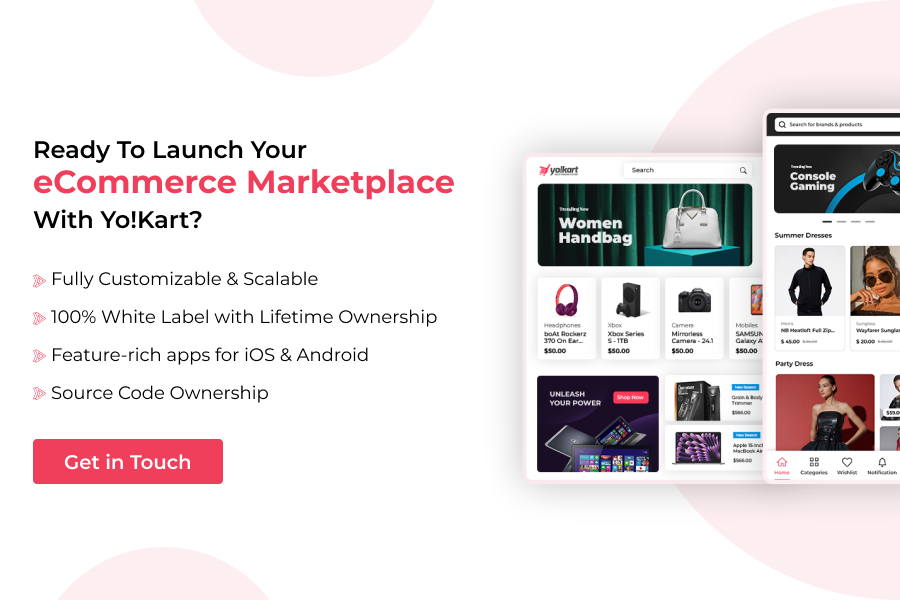
Yo!Kart is a self-hosted, licensed multi-vendor eCommerce marketplace platform developed by FATbit Technologies. It is designed for businesses that want to build and operate their own marketplace rather than rely entirely on a recurring SaaS model.
Unlike a basic eCommerce platform that needs to be extended with third-party marketplace functionality, Yo!Kart supports marketplace functionality including vendor management, commission management, multi-currency and multi-language capabilities, and integrations with payment gateways. Moreover, it also supports integration with additional tools and APIs, making the solution a preferred choice.
For UK businesses, its customizable source code can be particularly useful when marketplace requirements extend beyond a standard product-selling model.
The architecture can adapt to different marketplace structures, including B2C, B2B, and other specialized marketplace models.
Best for:
- Businesses building a marketplace
- B2B marketplaces
- Niche marketplaces
- Multi-category marketplaces
- Companies expecting greater control over their marketplace technology
- Businesses planning international expansion
The main consideration is that a self-hosted platform requires responsibility for hosting and technical management, either internally or through a technology partner.
G2 Ratings:
- 4.6/5
Build Your Multi-Vendor Marketplace Using a Dedicated Solution
2. Sharetribe
Sharetribe is a SaaS marketplace builder designed for businesses that want to launch marketplace concepts relatively quickly. Its managed environment can make it attractive for early-stage businesses testing a marketplace idea. However, more advanced marketplace requirements may require developer involvement and a higher-level plan.
Best for:
- Marketplace MVPs
- Early-stage founders
- Rapid validation
- Businesses preferring managed infrastructure
G2 Ratings:
- 4.7/5
3. Arcadier
Arcadier is a SaaS-based marketplace platform designed for businesses that want to launch and operate multi-vendor marketplaces without building the entire technology stack from scratch.
It supports different marketplace models, including B2B, services, rental and product marketplaces, making it relevant to businesses with requirements beyond a conventional online store.
One of Arcadier’s key differentiators is its API-first approach. Businesses can connect the platform with existing ERP, CRM, payment, logistics and other business systems.
Best for:
- B2B marketplaces
- Rental marketplaces
- Businesses looking for a SaaS solution
- Faster marketplace deployment
G2 Ratings
- 4.3/5
4. CS-Cart Multi-Vendor
CS-Cart Multi-Vendor is another marketplace platform built specifically for businesses that want to operate multiple independent sellers from a single eCommerce environment. The solution allows businesses to choose between self-hosted options and cloud deployment.
The solution also supports built-in multi-vendor features such as multiple storefronts, vendor administration, product management, payment and shipping configuration and more. However, the trade-off is that advanced functionality requires higher-tier plans, add-ons or technical expertise.
Best for:
- Mid-sized marketplaces
- Businesses requiring self-hosted flexibility
- Companies seeking marketplace extensions
- Businesses wanting an established marketplace platform
G2 Ratings:
- 4.8/5
5. Adobe Commerce + Marketplace Extension
Adobe Commerce is not a dedicated multi-vendor marketplace solution. However, it can be extended to support multi-vendor marketplace functionality. Rather than changing the underlying commerce platform, businesses can add marketplace capabilities such as vendor registration, seller dashboards, vendor product management, commissions, seller-specific orders and marketplace administration through suitable extensions or custom development.
It also provides customization flexibility, making it appropriate for organizations with complex commerce requirements. However, implementation and ongoing development can require substantial resources and costs.
Best for:
- Established retailers
- Enterprise businesses
- Organizations with dedicated development teams
- Complex commerce operations
G2 Ratings:
- 4.0/5
Seeking Expert Guidance to Decide on the Best Multi-Vendor eCommerce Platform in the UK?
6. Mirakl
Mirakl is an enterprise marketplace platform designed primarily for large retailers and established organizations. The solution helps organizations operate marketplace ecosystems at enterprise scale. This makes it relevant to retailers that want to expand their product assortment without necessarily purchasing, warehousing or managing every product themselves.
However, Mirakl is a SaaS platform that requires monthly recurring fees. Moreover, users report the solution is expensive, and it also takes a cut of the GMV. According to reviews on G2, Mirakl’s support is not that good. Resolving issues often takes more time than usual.
Best for:
- Enterprise retailers
- Large marketplace operations
- Established brands
- Organizations with significant technology budgets
G2 Ratings:
- 4.1/5
7. WooCommerce + Dokan or WC Vendors
WooCommerce is an open-source solution that transforms a simple WordPress website into an eCommerce platform. It combines multi-vendor plugins such as Dokan or WC Vendors and provides a relatively accessible route to launch a marketplace. These solutions enable features such as vendor storefronts, seller dashboards, commissions, product management, shipping and marketplace administration.
However, WooCommerce can be particularly suitable for businesses already familiar with WordPress. However, businesses need to manage hosting, security, plugin compatibility, updates, and performance.
Best for:
- Small businesses
- WordPress users
- Budget-conscious founders
- Small marketplace experiments
G2 Ratings:
- 4.4/5
8. Marketplacer
Marketplacer is an enterprise marketplace platform focused on helping established businesses create and operate multi-vendor eCommerce ecosystems. It is particularly relevant for larger retail organizations with sophisticated catalog and inventory requirements.
Marketplacer lets businesses manage multi-vendor marketplaces, providing functionality around seller onboarding, product management and marketplace operations.
Best for:
- Enterprise retailers
- Large marketplace programs
- Businesses with complex product catalogs
- Established organizations
G2 Ratings:
- 4.8/5
How to Choose the Right Platform for Your UK Marketplace
The right platform depends on your business stage, marketplace model, technical resources, and long-term objectives.
Choose a SaaS platform if:
- You want to launch quickly.
- You have limited technical resources.
- You are validating an idea.
- You prefer managed infrastructure.
- You are comfortable with recurring costs.
Sharetribe and Arcadier can be considered for these requirements.
Choose a self-hosted platform if:
- You require deeper customization.
- You want greater infrastructure control.
- You expect meaningful transaction volume.
- You require specialized marketplace functionality.
- You want greater control over your long-term technology costs.
Yo!Kart Multi-Vendor is a relevant option in this category.
Choose an enterprise marketplace platform if:
- You are an established retailer.
- You have significant technology resources.
- You require enterprise integrations.
- You expect a large vendor ecosystem.
- Marketplace operations are part of a broader digital commerce strategy.
Yo!Kart, Mirakl and Marketplacer are more appropriate for this segment.
Why Choose Yo!Kart for a UK Multi-Vendor Marketplace?
For businesses planning to build a marketplace as a long-term digital business rather than simply test a short-term concept, Yo!Kart offers several advantages worth considering.
1. Self-Hosted and Licensed
Yo!Kart follows a self-hosted, licensed model.
This gives businesses greater control over their marketplace environment and avoids building the entire business around a recurring SaaS subscription model.
For businesses expecting significant transaction volumes, this can make long-term cost planning easier.
2. Customizable Source Code
Every marketplace eventually develops requirements that differ from standard marketplace templates.
Yo!Kart’s customizable source code allows businesses to adapt the platform according to their business processes, integrations, marketplace rules, and industry requirements.
This can be particularly valuable for:
3. Built for Multi-Vendor Commerce
Yo!Kart is designed specifically around multi-vendor commerce rather than requiring businesses to combine a standard online store with multiple third-party marketplace plugins.
The platform provides functionality for vendor management, product management, order management, commissions, and other marketplace operations.
4. Supports Multiple Business Models
A marketplace may start with one business model and expand over time.
Yo!Kart can serve as a foundation for different marketplace models, including B2C, B2B, and P2P commerce, depending on the configuration and customization requirements.
5. Multi-Currency and Multi-Language Capabilities
UK businesses often have ambitions beyond the domestic market.
Support for multiple currencies and languages can help businesses prepare for expansion into Europe and other international markets.
This is particularly useful for marketplaces serving international sellers or customers.
6. Multiple Payment Gateway Integrations
Payment infrastructure is critical to marketplace operations.
Yo!Kart supports integrations with 25+ payment gateways, including Stripe and PayPal, providing businesses with options for building their payment and vendor payout workflows.
Businesses should still confirm the specific gateway and payout configuration required for their marketplace before implementation.
7. Suitable for Industry-Specific Marketplaces
Not every marketplace sells generic consumer products.
Businesses can build specialized marketplaces around industries such as:
- B2B wholesale
- Fashion
- Electronics
- Furniture
- Rentals
- Services
- Local commerce
- Automotive
- Food and grocery
- Professional supplies
Yo!kart’s ability to customize the platform makes it possible to design workflows around the specific requirements of the chosen industry.
8. Greater Control Over the Technology Stack
For businesses that consider their marketplace a core digital asset, control over the underlying technology can become increasingly important.
A self-hosted approach gives businesses greater control over infrastructure, deployment, customization, integrations, and future platform development.
Kick Start Your eCommerce Marketplace Business in the UK Using Readymade Software
Final Thought
The UK offers a strong environment for businesses looking to build multi-vendor marketplaces. However, choosing a marketplace platform is a critical decision and it should not be based solely on how quickly you can launch.
Businesses should consider several associated factors before they get started with any available option.
However, the list suggests the best multi-vendor eCommerce platforms in the UK for 2026-2027. They are primarily of two types: self-hosted and SaaS-based. However, SaaS platforms can be a practical choice for businesses validating an idea and not expecting complete control. On the other hand, seeking complete control and access should look for self-hosted ones. A licensed, customizable marketplace platform Yo!Kart is an option worth evaluating. It provides complete access and control at a one-time payment without charging any hidden or recurring costs. Moreover, Yo!kart is a dedicated multi-vendor marketplace software that offers all the necessary features and functionality required to successfully operate and grow a multi-vendor marketplace in the UK.
Frequently Asked Questions
1. What is a multi-vendor eCommerce platform?
A multi-vendor eCommerce platform allows multiple independent sellers to sell products or services through one centralized platform.
It connects three different users, including admin, vendors and customers. They all access and operate on the marketplace. The marketplace operator typically manages vendors, commissions, customers, orders, payments, and overall platform operations. Vendors list and sell their products and customers buy them.
2. What is the best multi-vendor eCommerce platform in the UK?
There is no single platform that is best for every business. The right platform depends on your marketplace model, budget, technical requirements, expected scale, customization needs, and long-term goals. Yes if you are looking for a dedicated multi-vendor marketplace software in the UK that offers complete control and access at a one-time payment without any recurring costs, Yo!Kart is a recommended one.
3. Is Yo!Kart a SaaS platform?
No. Yo!Kart is a self-hosted, licensed multi-vendor marketplace solution. Businesses can deploy it within their preferred infrastructure and customize it according to their marketplace requirements.
4. Can I customize Yo!Kart?
Yes. Yo!Kart provides customizable source code that businesses can adapt for their marketplace workflows, integrations, features, and industry-specific requirements.
5. Can Yo!Kart be used to build a B2B marketplace?
Yes. Yo!Kart can be used as a foundation for B2B marketplace businesses and can be customized to support specific B2B commerce requirements. Yo!kart B2B is a dedicated multi-vendor marketplace software.
6. Can I build a niche marketplace with Yo!Kart?
Yes, you can choose Yo!Kart for niche and industry-specific marketplace concepts, including product, B2B, rental, and service marketplaces.
6. What payment gateways should a UK marketplace support?
The appropriate payment gateways depend on the business model and target customers.
Businesses may consider options such as Stripe, PayPal, Worldpay, and relevant open banking payment solutions.
8. Is SaaS or self-hosted better for a UK marketplace?
It depends on the business. SaaS can simplify infrastructure management and speed up launch. Self-hosted platforms can provide greater control and customization.
Businesses expecting complex workflows, significant growth, or greater control over their technology environment may prefer to evaluate self-hosted options like Yo!kart.
9. How much does it cost to build a multi-vendor marketplace in the UK?
The cost to build a multi-vendor marketplace can be anywhere between $2000 to $200000 or more. However, it depends on the approach you choose. Moreover, platform, licensing, design, customization, integrations, hosting, payment infrastructure, and ongoing development requirements are also key cost-affecting factors. However, businesses should compare total cost of ownership rather than only the initial platform price.
10. What should I evaluate before choosing a marketplace platform?
Here is a list of things you should keep in mind: Hosting model, Customization, Vendor management, Commission management, Payment gateways, VAT and tax capabilities, Shipping integrations, Scalability, Mobile experience, Security, Data control, Total cost of ownership. However, the platform should be selected based on both your current requirements and your expected marketplace scale over the next three to five years.
Looking for a Multi-Vendor eCommerce Platform?
Get In TouchPopular Posts