Back To Home

Custom B2B eCommerce Development vs Off-the-Shelf Platforms: Which Is Right for Your Business?
6
Views
Published date 10th September, 2026
Choosing the right approach to build a B2B eCommerce platform is one of the most important technology decisions a business can make. The platform you choose affects not only your initial development cost, but also how quickly you can launch, how easily you can integrate business systems, how much control you have over the buying experience, and how effectively the platform can support future growth.
For many manufacturers, wholesalers, distributors, suppliers, and B2B marketplace operators, the choice often comes down to custom B2B eCommerce development or an off-the-shelf platform. Custom development offers greater control over functionality, workflows, integrations, and user experience, while an off-the-shelf solution provides a proven foundation that can reduce development effort and time to market.
Neither approach is inherently better. The right choice depends on the complexity of your business, your budget, your growth plans, and how much customization your B2B operation actually requires.
In this guide, we compare custom B2B eCommerce development with off-the-shelf platforms across cost, flexibility, scalability, integrations, implementation time, maintenance, security, and long-term ownership to help you determine which approach makes more sense for your business in 2026.
Table of Contents
- What is Custom B2B eCommerce Development?
- What is an Off-the-Shelf B2B eCommerce Platform?
- Custom B2B eCommerce vs Off-the-Shelf: 10 Key Differences
- When Should You Choose Custom B2B eCommerce Development?
- When is an Off-the-Shelf B2B Platform the Better Choice?
- What About a Self-Hosted B2B eCommerce Platform?
- Custom Development vs Yo!Kart B2B: A Practical Middle Ground
- How Much Can You Save With an Off-the-Shelf Platform?
- How to Decide: A Simple Decision Framework
- Questions to Ask a B2B eCommerce Development Agency
- Common Mistakes Businesses Make
- Final Verdict: Custom or Off-the-Shelf?
- Frequently Asked Questions
What is Custom B2B eCommerce Development?
Custom B2B eCommerce development involves building an eCommerce platform specifically around a company’s business model, operational workflows, customer requirements, and technology ecosystem.
It allows businesses to develop specialized functionality such as customer-specific pricing, bulk ordering, RFQ workflows, multi-level buyer approvals, sales-representative dashboards, dealer management, contract pricing, ERP synchronization, advanced product configuration, or complex B2B marketplace functionality. This makes custom development particularly attractive to businesses whose competitive advantage depends on a differentiated digital commerce experience.
However, the trade-off is greater investment in development, testing, infrastructure, and ongoing maintenance.
What is an Off-the-Shelf B2B eCommerce Platform?
An off-the-shelf B2B eCommerce platform is a pre-built software solution that provides the core infrastructure and functionality required to operate an online B2B business. Instead of developing the entire platform from scratch, businesses start with an existing eCommerce solution and configure or customize it according to their needs.
Depending on the solution, features may include customer accounts, vendor management, product catalogs, bulk ordering, payment gateways, shipping management, order management, customer-specific pricing, quotations, tax management, analytics, and third-party integrations. Since much of the core functionality is already developed and tested, businesses can typically reduce development effort and launch faster.
Some platforms also allow businesses to modify the source code or extend functionality through APIs and custom development. For businesses looking to launch a B2B eCommerce website or marketplace without spending months developing basic infrastructure, this approach can provide a significantly faster path to market.
Looking for a Faster Way to Launch Your B2B Marketplace?
Custom B2B eCommerce vs Off-the-Shelf: 10 Key Differences
The difference between the two approaches becomes clearer when they are evaluated against the factors that matter most to B2B businesses.
1. Development Cost
Cost is often the first consideration when comparing custom development with an off-the-shelf platform.
Custom B2B eCommerce development generally requires a larger upfront investment because the development team needs to handle architecture, UI/UX design, frontend and backend development, integrations, testing, security, deployment, and ongoing improvements.
Off-the-shelf platforms generally reduce this initial development burden because the core eCommerce infrastructure already exists. The business primarily pays for the software, implementation, customization, integrations, and ongoing support.
However, the lowest initial cost does not always mean the lowest total cost.
Key takeaway: Compare the total cost of ownership, not just the initial development price.
2. Implementation Time
Time-to-market is another major difference.
A custom platform typically requires more time because almost every component must be planned, developed, tested, and deployed. A complex enterprise B2B platform can take several months or longer depending on scope.
An off-the-shelf platform can shorten the timeline because the core functionality is already available. The implementation team can focus on branding, configuration, customization, integrations, product data, testing, and deployment instead of building the entire eCommerce engine.
Key takeaway: If getting to market quickly matters, an established platform can offer a significant advantage.
3. Customization and Flexibility
This is where custom development has its clearest advantage.
With a custom platform, functionality can be designed specifically around the company’s business processes. If the business requires an unusual pricing engine, proprietary workflow, complex approval system, or specialized marketplace model, developers can build it into the platform.
Off-the-shelf platforms have architectural and functional boundaries, although many support extensive customization through APIs, extensions, or development. The real question is whether your requirements are genuinely unique or can be handled through existing functionality and reasonable customization.
Key takeaway: Choose custom development when standard functionality cannot adequately support your business processes.
4. B2B-Specific Features
B2B eCommerce is fundamentally different from standard B2C eCommerce.
A B2B buyer may need to purchase hundreds of products at once, request quotations, operate under negotiated contracts, reorder frequently, use purchase orders, manage multiple employees, or obtain approval before completing a purchase.
The platform may therefore need functionality such as:
- Customer-specific pricing
- Tiered pricing
- Bulk ordering
- Minimum order quantities
- RFQ and quotation management
- Purchase order workflows
- Buyer approval levels
- Company accounts
- Sales representative management
- Wholesale catalogs
- Credit limits
- Contract-based pricing
- Multiple payment terms
- Tax and invoice management
- Vendor management
- ERP integration
- CRM integration
- PIM integration
With custom development, these capabilities can be designed around your processes. An established B2B platform can be more efficient when the features you need are already available or can be added through customization.
Key takeaway: Evaluate the platform’s existing B2B capabilities before deciding to build them from scratch.
5. Integrations
Integrations are often one of the biggest cost drivers in B2B eCommerce development.
A B2B company may already depend on ERP, CRM, accounting, inventory, warehouse management, shipping, payment, PIM, marketing automation, and business intelligence systems. These integrations can become a significant part of the project’s cost and complexity.
Custom development provides maximum control over how these systems communicate with the eCommerce platform. Developers can design APIs and synchronization logic around the organization’s specific requirements.
Before selecting a platform, businesses should create an integration map showing which systems need to exchange data and how frequently synchronization needs to occur.
Key takeaway: The more complex your integrations, the more closely you should evaluate the platform’s architecture and API capabilities.
6. Scalability
A B2B eCommerce platform should not only support today’s business. It should be capable of supporting the organization’s expected growth. As businesses expand, they may need to handle more customers, SKUs, orders, warehouses, currencies, storefronts, and traffic.
Custom development allows scalability to be planned around the organization’s expected requirements. However, an off-the-shelf platform should not automatically be considered unsuitable for large businesses. Many established platforms are built to support substantial traffic, product catalogs, integrations, and transaction volumes.
Key takeaway: Scalability depends more on platform architecture and infrastructure than on whether the solution is custom or off-the-shelf.
7. Security and Maintenance
Security is another area where businesses need to look beyond the development approach.
A custom eCommerce platform gives the business complete control over the application architecture. However, that also means the organization is responsible for maintaining the application, monitoring vulnerabilities, applying security patches, upgrading dependencies, and managing infrastructure.
With an established platform, some security responsibilities may be handled by the software provider, depending on the licensing and hosting model. Self-hosted solutions offer greater control but require the business to manage security, updates, hosting, and maintenance.
Key takeaway: Consider your technical resources, security requirements, and preferred level of control before choosing an approach.
8. Ownership and Control
Ownership is especially important for businesses investing heavily in eCommerce technology.
With custom development, the business generally has greater control over the application’s codebase, infrastructure, data architecture, and future development roadmap, subject to the specific contract with the development partner.
Off-the-shelf platforms vary considerably.
Before choosing a solution, clarify:
- Who owns the source code?
- Where is the platform hosted?
- Can the business migrate to another provider?
- What recurring fees apply?
- Who handles upgrades and support?
- Can another development team customize the platform?
Key takeaway: Understand exactly what you own, control, and can change before signing a long-term agreement.
9. Future Development
B2B eCommerce platforms rarely remain static.
As the business grows, customers may request new ordering options, integrations, payment methods, dashboards, automation, mobile applications, analytics capabilities, or marketplace functionality.
Custom development provides freedom to continuously evolve the platform according to those requirements. With an off-the-shelf platform, future development depends partly on the platform’s architecture and extensibility.
Key takeaway: Evaluate how easily the platform can adapt to future requirements, not simply what it offers today.
10. Business Risk
Both approaches involve risk, but the type of risk is different.
With custom development, the primary risks include scope expansion, higher development costs, longer timelines, dependency on technical resources, and maintenance complexity.
With an off-the-shelf platform, the risks may include platform limitations, vendor dependency, recurring fees, restricted customization, compatibility issues, or difficulty implementing highly specialized requirements.
The best approach is therefore the one where the risks are manageable relative to the organization’s priorities.
Key takeaway: Look beyond the initial price and choose the approach that offers the right balance of flexibility, control, cost, and long-term viability.
Launch Your B2B Marketplace With a Future-Ready Foundation
When Should You Choose Custom B2B eCommerce Development?
Custom development makes the most sense when eCommerce is a strategic technology asset rather than simply another sales channel. If your business has highly specialized workflows that directly affect revenue or operations, forcing those processes into a standardized platform can create unnecessary limitations.
Consider custom development if you need:
- Complex pricing and business rules that cannot be handled through standard configurations.
- Specialized workflows, such as unusual approvals, purchasing, or order processes.
- Complex marketplace operations requiring functionality beyond standard capabilities.
- A highly tailored commerce ecosystem spanning multiple business units, regions, storefronts, or customer groups.
- Dedicated technical resources capable of managing a longer-term software development and maintenance lifecycle.
When is an Off-the-Shelf B2B Platform the Better Choice?
An off-the-shelf solution can be more appropriate when speed, cost efficiency, and proven functionality are major priorities. It is particularly suitable for businesses that are starting their digital commerce journey or whose requirements can largely be met by existing B2B features. Rather than spending resources rebuilding standard functionality, businesses can launch sooner and direct their budget toward areas that drive growth.
It can be a good fit for:
- Manufacturers, wholesalers, and distributors moving their B2B operations online.
- Startups and new B2B ventures looking to validate their business model and launch quickly.
- Retailers entering B2B commerce without highly specialized requirements.
- Businesses that need standard features such as customer accounts, product catalogs, bulk ordering, quotations, vendor management, payments, shipping, dashboards, and B2B pricing.
- Companies that want to allocate more of their budget to marketing, customer acquisition, integrations, UX, product onboarding, and sales enablement instead of rebuilding core eCommerce functionality.
What About a Self-Hosted B2B eCommerce Platform?
The decision does not always have to be between custom development vs. a SaaS platform. There is an important third option that businesses sometimes overlook: a self-hosted B2B eCommerce platform.
With this approach, the business starts with an existing eCommerce foundation but retains greater control over hosting, customization, data, and development. This approach is particularly useful when standard functionality is needed, but the business also has complex workflows, integrations, or other requirements that call for customization.
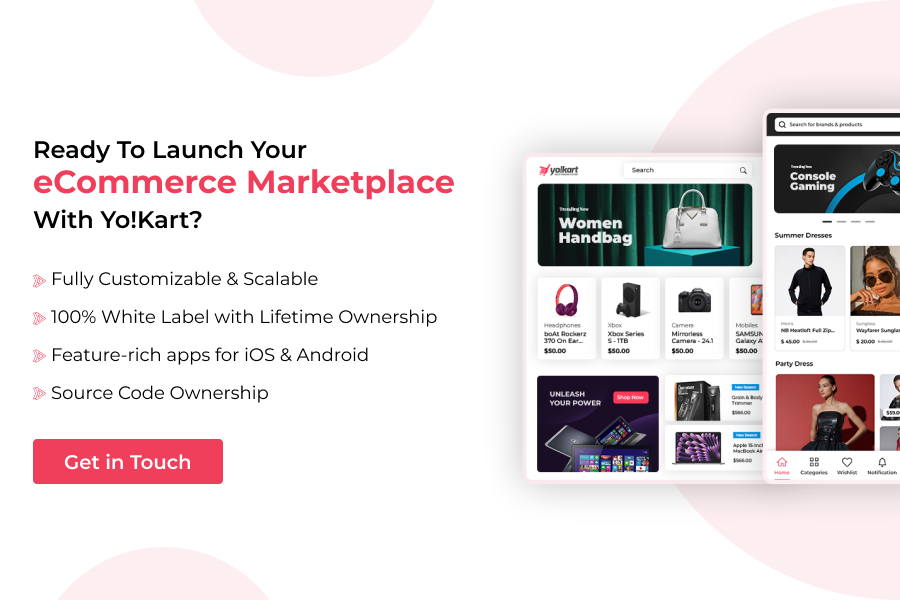
For example, Yo!Kart B2B, developed by FATbit Technologies, is positioned as a self-hosted B2B eCommerce solution that can be customized according to specific business requirements. Businesses can use its existing foundation for capabilities such as marketplace management, product catalogs, vendor management, and order management, while extending the platform around their unique needs.
For businesses evaluating a B2B eCommerce development agency, this approach can also simplify the development process because the agency can focus its resources on business-specific functionality rather than rebuilding every foundational eCommerce component.
Custom Development vs Yo!Kart B2B: A Practical Middle Ground
For businesses considering custom development, the real question should be whether every component of the platform needs to be built from scratch.
In many cases, the answer is no.
Core eCommerce capabilities such as product management, customer accounts, vendor management, order management, checkout, payment integration, shipping, reporting, and marketplace administration are not necessarily areas where a business needs to reinvent the wheel. Moreover, rebuilding them from the ground up can add significant development time and cost without necessarily creating additional business value.
A platform such as Yo!Kart B2B provides a readymade foundation for these core capabilities while allowing businesses to customize functionality around their specific requirements. This can reduce development time and eliminate some of the costs associated with building an eCommerce platform from the ground up.
For businesses that need substantial customization but do not want the cost and timeline of a completely custom build, this hybrid approach can offer a practical balance between speed, cost, flexibility, and control. FATbit Technologies also provides customization and development services to help businesses extend the platform according to their requirements.
See Yo!Kart B2B in Action
How Much Can You Save With an Off-the-Shelf Platform?
The potential savings depend heavily on project scope, customization needs, and integrations. As an indicative benchmark, B2B eCommerce development can range from $15,000-$30,000 for basic implementations to $75,000-$150,000 for advanced platforms, while complex enterprise projects can exceed $500,000. These figures are estimates, not fixed project costs.
An off-the-shelf platform can reduce this investment by providing core functionality such as product management, customer accounts, ordering, payments, and administration out of the box. Instead of paying to build these components from scratch, businesses can focus their budget on customization, integrations, and growth.
However, businesses should not compare only the software purchase price against the cost of custom development.
A more meaningful comparison includes:
Total Cost of Ownership = Platform/Development Cost + Customization + Integrations + Hosting + Maintenance + Support + Upgrades + Third-Party Tools
For example, a platform may require a lower initial investment but add recurring licensing, hosting, support, or third-party costs. Custom development generally requires more upfront investment but can provide greater control over the platform and future technology decisions.
Ultimately, choosing the cheaper option upfront does not always mean spending less over time. Compare the initial investment, recurring costs, customization requirements, and expected business value before deciding which approach offers the better long-term return.
How to Decide: A Simple Decision Framework
The right B2B eCommerce approach depends on your business requirements, budget, growth plans, and desired level of control. Use the following framework to identify the option that fits best.
1. Choose Custom Development If:
Your business has highly specialized workflows, proprietary functionality, complex integrations, unusual pricing structures, or a highly differentiated customer experience that existing platforms cannot adequately support. This approach also requires the budget and technical resources to manage a longer development lifecycle.
2. Choose an Off-the-Shelf Platform If:
Your requirements are largely standard B2B eCommerce capabilities, and you want to launch quickly without making a very large upfront investment. A proven platform can handle core B2B functionality while allowing customization where needed.
3. Choose a Self-Hosted Customizable Platform If:
You want more control and flexibility than a typical SaaS platform offers without building the entire eCommerce infrastructure from scratch. This option can provide a practical balance of speed, cost, ownership, and customization, particularly for growing B2B businesses.
Questions to Ask a B2B eCommerce Development Agency
Whether you choose custom development or an off-the-shelf platform, the right development partner can have a major impact on your project’s success. Before making a decision, ask these questions to evaluate their experience, technical capabilities, and long-term support.
1. How many B2B eCommerce projects have you completed?
Look for experience with businesses similar to yours such as manufacturers, wholesalers, distributors, or B2B marketplaces rather than relying only on a general eCommerce portfolio.
2. Can you provide examples of B2B implementations?
Ask specifically for case studies or live projects involving manufacturers, wholesalers, distributors, marketplaces, or other relevant business models.
3. Which B2B features are available out of the box?
This helps identify how much customization will actually be required.
4. What integrations can you support?
Discuss integrations with ERP, CRM, PIM, payment, shipping, accounting, warehouse, and other systems before development begins.
5. What will the total cost of ownership look like?
Ask for a complete breakdown covering development, licensing, hosting, maintenance, upgrades, support, and third-party software.
6. Who owns the source code and data?
Make sure ownership, hosting, and data rights are clearly defined in the agreement.
7. How will the platform scale?
Ask how the architecture will support growing product catalogs, customers, orders, vendors, and traffic.
8. What happens after launch?
Clarify post-launch services, including technical support, bug fixing, upgrades, security updates, SLAs, and future customization.
These questions help you choose a development partner based on long-term business fit, not just the lowest project quote.
Common Mistakes Businesses Make
Choosing the right B2B eCommerce approach is not just about picking between custom development and an off-the-shelf platform. The wrong decision can add unnecessary costs, create technical limitations, or make future growth harder. Businesses should watch out for these common mistakes:
- Choosing custom for the sake of uniqueness: If a platform already meets most requirements, rebuilding everything may add unnecessary cost and time.
- Choosing the cheapest platform: Low upfront costs can lead to limitations when advanced customization or integrations become necessary.
- Underestimating integration costs: ERP, CRM, PIM, accounting, and inventory integrations can significantly impact the overall project budget.
- Focusing only on launch: A platform should be able to support new features, workflows, integrations, and business growth over time.
- Ignoring long-term ownership: Consider maintenance, upgrades, support, hosting, and data ownership, not just the initial development cost.
Avoid Costly Technology Decisions And Launch Your B2B Marketplace
Final Verdict: Custom or Off-the-Shelf?
There is no universal winner between custom B2B eCommerce development and off-the-shelf platforms. The right choice depends on how unique your business requirements are, how quickly you need to launch, and how much control you want over your technology.
Custom development makes sense when your business needs to support specialized workflows, complex integrations, unique pricing models, or functionality that standard platforms cannot adequately accommodate. Off-the-shelf platforms, on the other hand, are the smarter choice when speed, cost efficiency, and proven functionality are more important than complete control over every component.
But the decision does not always have to be either-or. A customizable, self-hosted B2B eCommerce platform can provide a proven foundation while leaving room for business-specific customization. This approach can reduce development time and upfront effort without limiting your ability to evolve the platform as your business grows.
Ultimately, the question is not simply whether to build or buy. It is about identifying which parts of your eCommerce ecosystem truly need to be unique and which can be built on proven technology. Getting that balance right can have a significant impact on development costs, time to market, scalability, and long-term ROI.
Frequently Asked Questions
Is custom B2B eCommerce development better than an off-the-shelf platform?
Not necessarily. Custom development provides maximum flexibility but generally requires more time, investment, and maintenance. An off-the-shelf platform is the better choice when your business requirements are already supported by the platform and faster deployment is a priority.
How much does custom B2B eCommerce development cost?
There is no fixed cost because pricing depends on functionality, integrations, design, development complexity, infrastructure, and ongoing support. A relatively simple custom B2B eCommerce website may cost tens of thousands of dollars, while complex enterprise implementations can reach hundreds of thousands of dollars.
How long does it take to build a custom B2B eCommerce platform?
The timeline depends on project scope and complexity. A relatively simple implementation may take a few months, while an enterprise platform involving multiple integrations, custom workflows, and extensive testing can take significantly longer.
Can an off-the-shelf B2B eCommerce platform be customized?
Yes, many modern platforms support customization through APIs, extensions, plugins, source-code modifications, or custom development. However, the extent of customization depends on the platform’s architecture, licensing model, and ability to support business-specific functionality.
Is Yo!Kart suitable for B2B eCommerce?
Yo!Kart B2B can be considered by businesses looking for a self-hosted and customizable B2B eCommerce or marketplace foundation. It can help businesses avoid building core eCommerce functionality from scratch while allowing additional customization for specific business requirements.
Should I hire a B2B eCommerce development agency?
An experienced B2B eCommerce development agency can be valuable when the project involves complex workflows, integrations, customization, migration, or marketplace functionality. The right partner can also help determine whether custom development, an existing platform, or a hybrid approach best fits your requirements.
What is the biggest advantage of custom B2B eCommerce development?
The biggest advantage is control. Businesses can design functionality, workflows, integrations, and user experiences around their exact requirements rather than adapting their processes to an existing platform.
What is the biggest advantage of an off-the-shelf B2B eCommerce platform?
The biggest advantage is the ability to launch on an established foundation. Businesses can reduce development time and avoid rebuilding common eCommerce functionality while investing their resources in customization and business growth.
Is a hybrid approach better for B2B eCommerce?
For many businesses, it can be. Starting with a proven B2B eCommerce solution and adding custom functionality can provide a balance between development speed, cost, flexibility, and long-term scalability.
Start Your B2B Marketplace With Proven eCommerce Functionality
Get In TouchPopular Posts