

Published Date 13th August, 2026
TL;DR
- Explore 30 leading B2B commerce marketplaces across wholesale, sourcing, manufacturing, procurement, fashion, and other industry segments.
- Compare marketplace business models, launch years, primary markets, care categories, key features, pros, and cons.
- Learn how AI-powered discovery, digital procurement, cross-border commerce, vertical specialization, and embedded finance are shaping B2B commerce.
- Understand B2B monetization models, including commissions, subscriptions, featured listings, advertising, lead generation, SaaS services, and financial services.
- Discover the key steps, features, and strategic considerations for launching a B2B marketplace, from niche selection and monetization to international commerce.
Introduction
B2B commerce is no longer confined to sales representatives, trade shows, and long-standing supplier relationships. According to McKinsey’s 2026 Global B2B Pulse Survey, 71% of B2B companies now offer eCommerce, and among those businesses, roughly one-third of revenue flows through digital channels. The market opportunity is expanding alongside this shift. As per Statista, the global B2B eCommerce market is valued to reach $48.1 trillion by 2030. The Asia-Pacific region dominates the global market, with a share of over 79.8% in 2026, leaving North America and Europe far behind.
For entrepreneurs, this growth presents an opportunity to build marketplaces that solve specific procurement challenges rather than simply replicate broad platforms. From global sourcing and industrial procurement to fashion wholesale and specialized supplies, successful B2B marketplaces are taking diverse approaches to connecting buyers and sellers.
This guide explores 30 B2B eCommerce marketplaces to watch in 2026-2027, along with their business models, key features, strengths, limitations, revenue insights, and lessons entrepreneurs can apply when planning their own marketplace.
Table of Contents
- What Is a B2B eCommerce Marketplace?
- Why B2B eCommerce Marketplaces Matter in 2026–2027?
- B2B eCommerce Marketplace Trends to Watch in 2026–2027
- Top 30 B2B eCommerce Marketplaces to Watch in 2026–2027
- Comparison Table: Top 30 B2B eCommerce Marketplaces
- What Can Entrepreneurs Learn From These B2B eCommerce Marketplaces?
- What Makes a B2B eCommerce Marketplace Successful?
- How Do B2B eCommerce Marketplaces Make Money?
- How to Build a B2B eCommerce Marketplace in 2026–2027
- Can Yo!Kart Be Used to Build a B2B eCommerce Marketplace?
- Ready-Made vs Custom B2B Marketplace Development
- Conclusion
- Frequently Asked Questions
What is a B2B eCommerce Marketplace?
A B2B eCommerce marketplace is a digital platform that connects businesses with multiple suppliers, manufacturers, wholesalers, distributors, or service providers, enabling them to discover, compare, and purchase products or services online.
Unlike a traditional B2C marketplace, where the primary buyer is an individual consumer, a B2B marketplace typically connects:
Manufacturers → Wholesalers → Distributors → Retailers → Businesses
Depending on the marketplace niche, a marketplace may support the purchase of raw materials, industrial equipment, office supplies, wholesale merchandise, technology products, packaging, fashion products, or professional services.
To support these transactions, B2B marketplaces typically include:
- Supplier registration
- Business verification
- Product catalogs
- Bulk ordering
- Request for Quote (RFQ)
- Negotiated pricing
- Minimum order quantities
- Tiered pricing
- Purchase orders
- Business accounts
- Vendor commissions
- Payments
- Credit terms
- Logistics
- Invoicing
- Tax management
- Order tracking
- Supplier ratings
- Analytics
These requirements make B2B marketplace development more complex than building a conventional online store. In addition to product discovery and checkout, the platform must support business-specific procurement workflows, pricing structures, supplier management, payments, and ongoing buyer-seller relationships.
Why B2B eCommerce Marketplaces Matter in 2026-2027?
B2B commerce is undergoing a structural shift from relationship-driven and offline purchasing toward digitally enabled procurement. As businesses become more comfortable with online purchasing, marketplace operators have an opportunity to simplify complex buying processes while helping suppliers reach new customers and markets. However, the opportunity is not limited to putting products online.
Key Reasons B2B Marketplaces are Gaining Importance:
- Digital Procurement: Businesses increasingly expect faster product discovery, online quotations, digital payments, order tracking, and self-service purchasing.
- Wider Supplier Access: Marketplaces allow buyers to discover suppliers beyond their existing networks, while vendors can reach new business customers across regions.
- Efficient Procurement: Features such as RFQ, bulk ordering, negotiated pricing, purchase orders, and approval workflows can simplify complex B2B transactions.
- Cross-Border Opportunities: Digital marketplaces can connect suppliers and buyers across countries, creating opportunities for businesses targeting international markets.
- Repeat Purchasing: B2B marketplaces can facilitate recurring orders and long-term buyer-supplier relationships, creating opportunities for sustainable marketplace revenue.
- Niche Market Opportunities: Entrepreneurs can build vertical marketplaces around specific industries, product categories, geographies, or procurement problems instead of competing directly with large horizontal platforms.
Build a B2B Marketplace for New Market Opportunities
B2B eCommerce Marketplace Trends to Watch in 2026-2027
The B2B marketplace landscape is becoming more sophisticated as platforms move beyond basic buying and selling functions. New opportunities are emerging around smarter product matching, specialized industry ecosystems, international trade, integrated financial services, and technology-enabled business operations. For entrepreneurs, understanding these developments can help identify underserved market segments and shape marketplace propositions that offer greater value to both buyers and sellers.
1. AI-Powered Product Discovery
AI is changing how business buyers discover suppliers and products. Instead of navigating hundreds of categories, buyers can increasingly use natural-language searches such as:
“Find 500 units of food-grade stainless steel containers with delivery to Dubai within two weeks.”
B2B marketplaces can use AI to interpret these requirements and match buyers with relevant suppliers, products, pricing, availability, and delivery capabilities.
2. Digital Procurement Is Becoming the Default
B2B buyers increasingly expect procurement processes to be as convenient and transparent as other digital purchasing experiences. Marketplaces are therefore incorporating capabilities such as product search and comparison, transparent pricing, digital quotations, online payments, order tracking, reordering, and self-service business accounts. These capabilities can reduce manual procurement tasks while giving buyers greater control over routine purchasing activities.
3. Cross-Border B2B Commerce
Digital marketplaces are making it easier for businesses to discover and transact with suppliers and buyers across international markets. This creates opportunities for entrepreneurs to build pplatformsthat connect manufacturers with wholesalers, retailers, and businesses across regions. Markets such as the United States, United Kingdom, Canada, Australia, UAE, Saudi Arabia, Germany, France, Netherlands, and Singapore can offer potential opportunities for cross-border B2B marketplace models.
4. Vertical B2B Marketplaces
Instead of competing with broad marketplaces, entrepreneurs are increasingly building marketplaces around specific industries. Potential verticals include construction materials, medical supplies, automotive parts, fashion wholesale, food ingredients, manufacturing, packaging, electronics, agriculture, and hospitality supplies.
A focused approach can help marketplace operators build industry expertise, curate relevant suppliers, establish buyer trust, and develop workflows suited to a particular sector.
5. Embedded Financial Services
B2B transactions often involve larger order values and payment terms, and longer purchasing cycles. To address these requirements, marketplaces are increasingly incorporating financial services into the transaction journey. These can include business credit, Buy Now Pay Later, invoice financing, payment guarantees, trade finance, escrow, and supplier financing.
By integrating financial services, marketplaces can reduce payment friction while creating additional revenue opportunities.
6. Marketplace + SaaS
Modern B2B marketplaces are evolving beyond buyer-seller connections into integrated business platforms. Alongside product discovery and procurement, they can provide tools for payments, inventory management, analytics, logistics, and other operational activities.
Discovery + Procurement + Payments + Inventory + Analytics + Logistics
This broader platform approach can increase the value delivered to business users and create additional opportunities for recurring revenue and higher customer lifetime value.
Top 30 B2B eCommerce Marketplaces to Watch in 2026-2027
The B2B marketplace landscape spans global sourcing, business procurement, supplier discovery, manufacturing, fashion wholesale, and industry-specific commerce. The platforms below represent different marketplace structures and demonstrate how entrepreneurs can approach B2B commerce through broad supplier networks, specialized verticals, cross-border sourcing, or procurement-focused solutions.
1. Alibaba.com
Launch year: 1999
Primary market: Global
Category: Wholesale and cross-border sourcing
Business model: Supplier memberships, advertising, transaction and value-added services
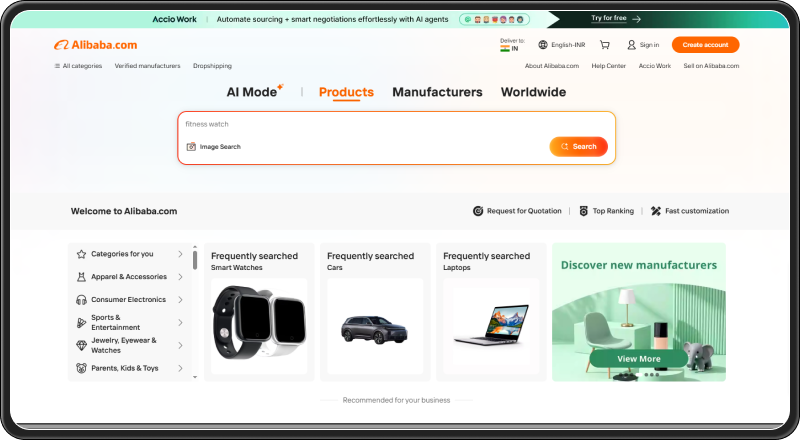
Alibaba.com remains one of the world’s most influential B2B eCommerce marketplaces, connecting businesses with suppliers and buyers across international markets. Launched in 1999, the platform has expanded beyond supplier discovery to support online transactions, digital marketing, fulfillment, and other services across the cross-border procurement journey. Alibaba Group states that Alibaba.com served buyers in more than 190 countries and regions during fiscal 2024.
Key Highlights
- Global supplier network
- Cross-border sourcing
- RFQ functionality
- Trade assurance
- Supplier verification
- Logistics services
- Digital marketing services
| Pros | Cons |
| Extensive international supplier network | High competition among suppliers |
| Strong cross-border sourcing capabilities | Supplier quality can vary |
| Broad product and category coverage | Buyers need to conduct appropriate supplier due diligence |
| Established global B2B brand | Large catalog can make supplier selection more complex |
2. Amazon Business
Launch year: 2015
Primary market: Global
Category: Business procurement
Business model: Product sales, third-party seller fees, subscriptions and business services
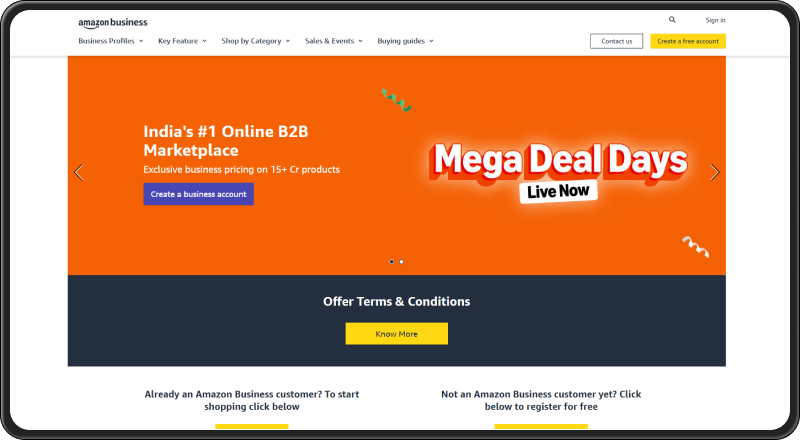
Amazon Business extends Amazon’s marketplace model into business procurement. It provides organizations with business pricing, quantity discounts, business accounts, purchasing controls, tax-exempt purchasing in eligible markets, and other procurement capabilities. Amazon also allows sellers to create business-specific prices and quantity discounts for Amazon Business customers.
Key Highlights
- Business pricing
- Bulk purchasing
- Business accounts
- Procurement controls
- Multiple sellers
- Amazon logistics ecosystem
| Pros | Cons |
| Familiar purchasing experience | High seller competition |
| Extensive product selection | Marketplace policies can be complex |
| Established fulfillment infrastructure | Less specialized for certain B2B verticals |
| Dedicated business purchasing features | Business requirements can vary by market |
Want to Build a Marketplace Similar to Alibaba or Amazon?
3. IndiaMART
Launch year: 1996
Primary market: India
Category: B2B supplier discovery and marketplace
Business model: Supplier subscriptions, lead generation and premium listings
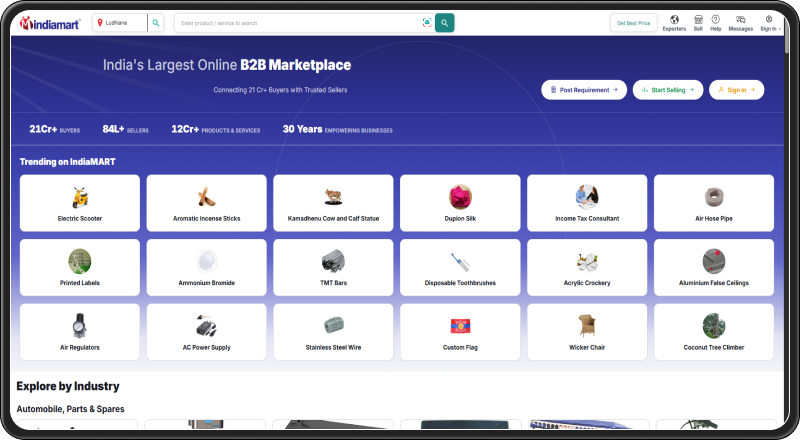
IndiaMART is one of India’s prominent B2B marketplaces, connecting business buyers with suppliers across a wide range of product and service categories. Its model is primarily centered on supplier discovery and business inquiries, with suppliers paying for enhanced visibility and access to additional platform capabilities.
Key Highlights
- Large supplier directory
- Buyer-supplier inquiries
- Paid supplier listings
- Multiple product categories
- Strong presence among SMEs
| Pros | Cons |
| Strong presence in the Indian B2B market | Primarily focused on the Indian market |
| Large supplier and product network | Lead quality can vary |
| Effective supplier discovery model | Strong competition for supplier visibility |
| Established B2B brand | More discovery-oriented than transaction-led |
4. Global Sources
Launch year: 1971
Primary market: Global
Category: Cross-border sourcing
Business model: Supplier advertising, memberships, exhibitions and sourcing services
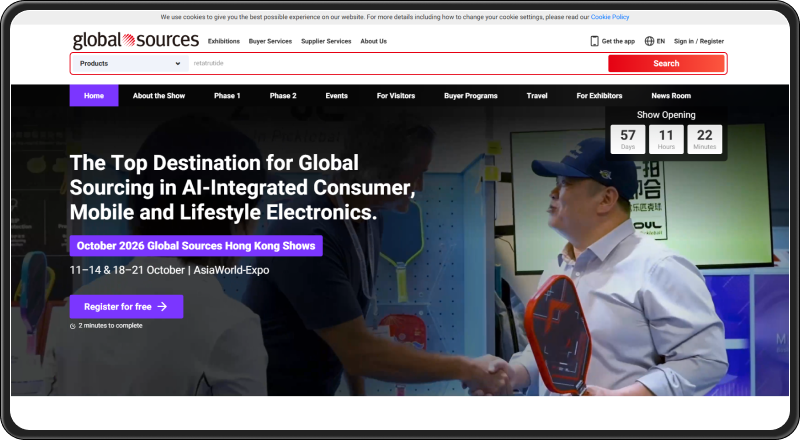
Global Sources connects international buyers with suppliers, particularly across Asian manufacturing markets. Its model combines online supplier discovery with trade shows, sourcing events, publications, and other services. The platform supports product and supplier search, buyer inquiries, supplier marketing, and face-to-face sourcing opportunities.
Key Highlights
- International sourcing
- Supplier discovery
- Trade shows
- Verified suppliers
- Electronics and consumer products
| Pros | Cons |
| Long-established sourcing ecosystem | More sourcing-oriented than a conventional transaction marketplace |
| Strong access to Asian suppliers | Supplier due diligence remains important |
| Combines online and offline sourcing | Some services focus primarily on lead generation |
| International buyer network | Product and supplier selection can require significant research |
5. Thomasnet
Launch year: 1898
Primary market: North America
Category: Industrial sourcing
Business model: Supplier advertising, lead generation and digital services
Thomasnet is particularly important for industrial and manufacturing procurement. It helps businesses search, evaluate, compare, and connect with manufacturers, distributors, and service providers across a wide range of industrial categories. Thomas currently lists more than 500,000 suppliers and supports supplier profiles, product discovery, RFIs, shortlists, and quote requests.
Key Highlights
- Industrial supplier discovery
- Manufacturing categories
- Supplier profiles
- Product sourcing
- Digital marketing
- Advanced search
| Pros | Cons |
| Strong specialization in industrial sourcing | Primarily focused on industrial and commercial procurement |
| Extensive North American supplier network | Less suited to general wholesale commerce |
| Detailed supplier profiles and capabilities | Primarily supports supplier discovery rather than conventional checkout |
| Advanced search and filtering | Supplier visibility is partly tied to paid marketing services |
6. Faire

Launch year: 2017
Primary market: North America and Europe
Category: Wholesale retail
Business model: Transaction fees, services and financial products
Faire is a B2B wholesale marketplace that connects independent brands with retailers looking for products to stock in physical and online stores. Its focus on independent retail gives the platform a distinct position within wholesale commerce. Faire currently reports more than 100,000 brands from over 120 countries and more than 10 million new relationships introduced between brands and retailers.
Key Highlights
- Wholesale marketplace
- Independent brands
- Retailer discovery
- Payment terms
- Product discovery
- Retail analytics
| Pros | Cons |
| Strong positioning in independent retail | Primarily focused on wholesale retail |
| Large international brand network | Less relevant for industrial or procurement-heavy B2B categories |
| Focused product discovery experience | Marketplace economics vary by brand and transaction |
| Supports relationships between brands and retailers | Not designed for every type of B2B transaction |
7. Xometry
Launch year: 2013
Primary market: Global
Category: Manufacturing marketplace
Business model: Marketplace transaction revenue and services
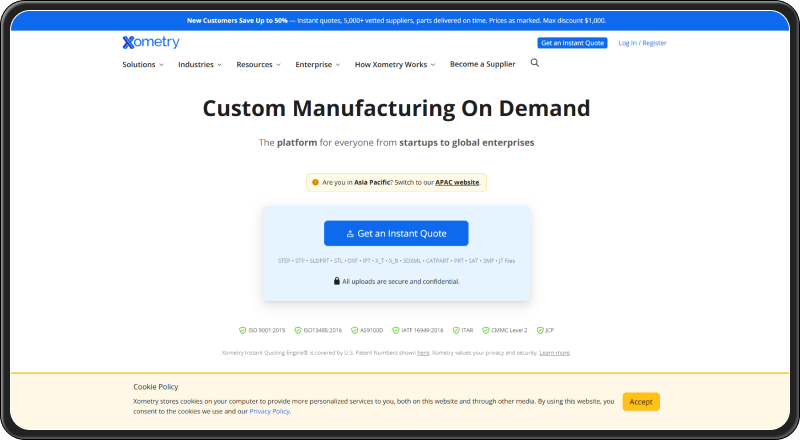
Xometry operates a technology-enabled marketplace that connects businesses with manufacturing suppliers for on-demand production. The platform uses automation and AI to support supplier matching, quoting, production, and procurement across manufacturing categories.
Key Highlights
- Custom manufacturing
- AI-powered quoting
- Supplier matching
- CNC machining
- 3D printing
- Enterprise procurement
| Pros | Cons |
| Strong specialization in manufacturing | Primarily relevant to manufacturing requirements |
| Technology-driven sourcing and quoting | Manufacturing workflows can be complex |
| Large network of manufacturing suppliers | Less suitable for general wholesale commerce |
| Supports enterprise procurement | Supplier capabilities must match specific technical requirements |
8. JOOR
Launch year: 2010
Primary market: Global
Category: Fashion wholesale
Business model: SaaS subscriptions and marketplace services
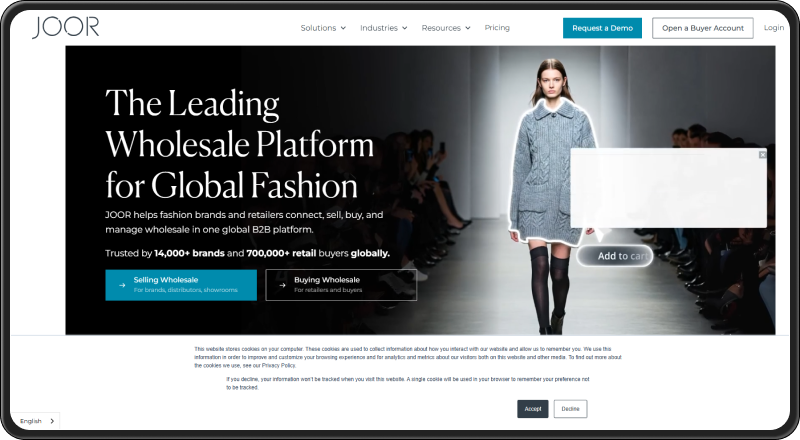
JOOR is a B2B fashion wholesale platform that connects brands with retailers and helps manage digital wholesale relationships. Its platform supports product discovery, digital showrooms, wholesale ordering, and buyer-brand engagement.
Key Highlights
- Fashion wholesale
- Digital showroom
- Buyer discovery
- Wholesale ordering
- Retailer relationships
| Pros | Cons |
| Deep specialization in fashion wholesale | Limited relevance outside fashion |
| Strong international buyer network | Not intended for general-purpose B2B commerce |
| Digital showroom and wholesale workflows | Best suited to brands and retail buyers |
| Focused on brand-retailer relationships | Industry-specific functionality may not translate to other sectors |
9. Ankorstore
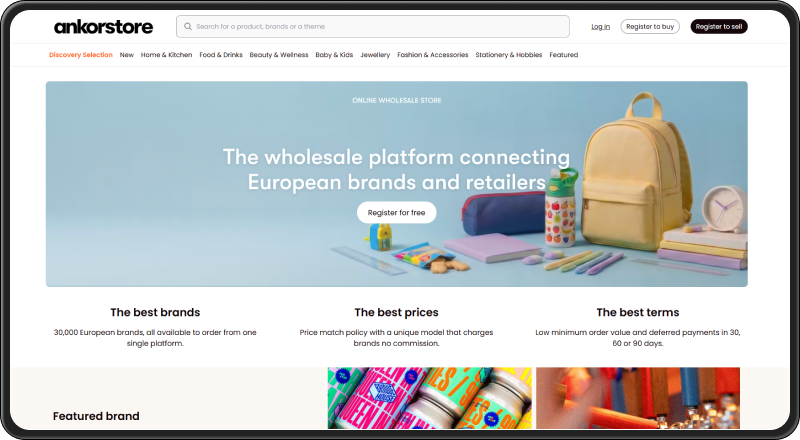
Launch year: 2019
Primary market: Europe
Category: Wholesale marketplace
Business model: Transaction/payment services and customer acquisition services
Ankorstore connects independent retailers with brands and suppliers through a European-focused wholesale marketplace. The platform combines product discovery with payment and fulfillment services designed to support transactions between brands and retailers.
Key Highlights
- European wholesale
- Independent retailers
- Brand discovery
- Payment guarantee
- Fast payouts
| Pros | Cons |
| Strong European wholesale positioning | More geographically focused than global B2B platforms |
| Designed around independent retailers and brands | Less suitable for industrial or enterprise procurement |
| Integrated payment and fulfillment services | Additional service fees may apply |
| No subscription fee for brands | Marketplace economics depend on transaction and service usage |
10. Made-in-China.com
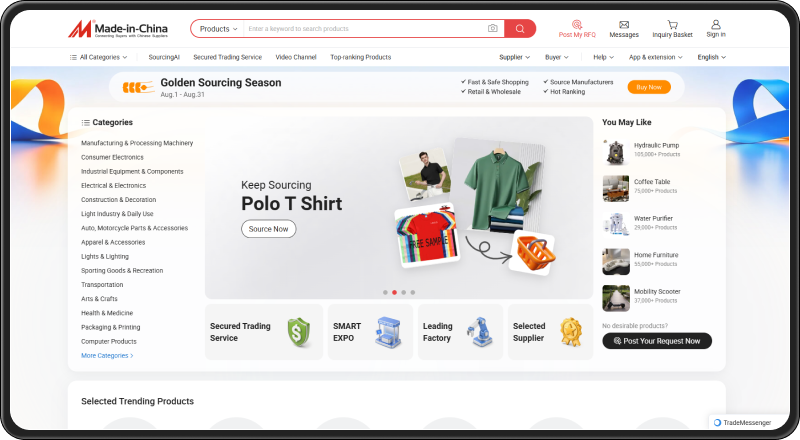
Launch year: 1998
Primary market: Global
Category: China sourcing and wholesale
Business model: Supplier memberships, advertising and value-added services
Made-in-China.com is a global B2B sourcing platform focused on connecting international buyers with Chinese manufacturers and suppliers. Operated by Focus Technology, the platform supports supplier discovery, product sourcing, RFQs, supplier verification, and communication between buyers and suppliers.
Key Highlights
- China supplier discovery
- RFQ
- Product sourcing
- Supplier verification
- Export-oriented marketplace
| Pros | Cons |
| Strong access to Chinese manufacturers and suppliers | Supply base is primarily China-focused |
| Broad product and category coverage | Buyers still need to conduct supplier due diligence |
| Designed for international sourcing | Supplier quality and capabilities can vary |
| RFQ and quote-comparison capabilities | Less suitable when buyers specifically need local suppliers outside China |
11. DHgate
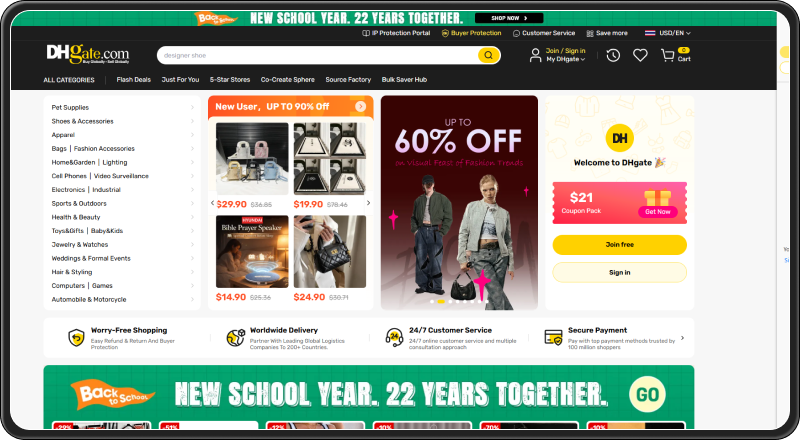
Launch year: 2004
Primary market: Global
Category: Cross-border wholesale
Business model: Marketplace commissions, supplier services and transaction-related services
DHgate is a China-based cross-border eCommerce marketplace that connects international buyers with suppliers offering wholesale products across a broad range of categories. Founded in 2004, the platform has developed around smaller-order wholesale and cross-border sourcing, making it particularly relevant to small businesses and resellers.
Key Highlights
- Global buyers
- Wholesale products
- Cross-border transactions
- Large product catalog
| Pros | Cons |
| Accessible for small businesses and resellers | Supplier quality can vary |
| Broad range of wholesale products | Cross-border shipping can add complexity |
| Supports international sourcing | Strong price competition |
| Suitable for smaller-volume purchasing | Buyers need to assess suppliers carefully |
12. HKTDC Sourcing
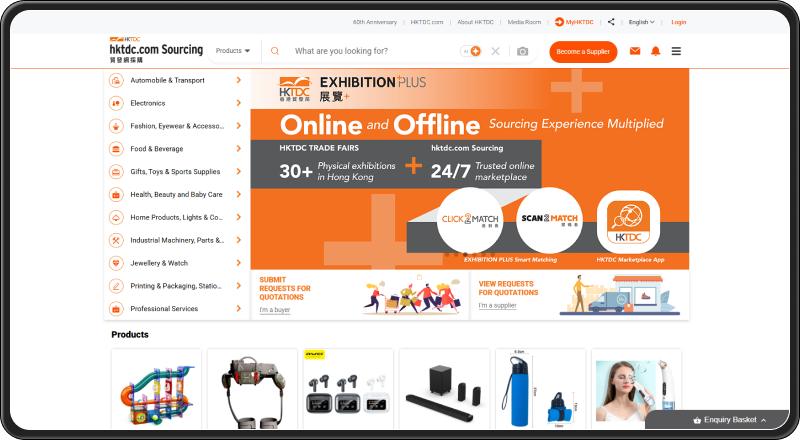
Launch year: 2003
Primary market: Global/Asia
Category: Trade and supplier sourcing
Business model: Supplier listings, advertising and trade services
HKTDC Sourcing is operated by the Hong Kong Trade Development Council (HKTDC) and helps international buyers discover suppliers and products, particularly from Hong Kong, mainland China, and other Asian markets. The platform combines online supplier discovery with trade fairs and broader sourcing services. HKTDC states that its supplier directory includes more than 100,000 suppliers.
Key Highlights
- Hong Kong supplier ecosystem
- Trade fairs
- Supplier discovery
- Product sourcing
| Pros | Cons |
| Backed by an established trade organization | More sourcing-oriented than transaction-led |
| Strong access to Asian suppliers | Not designed primarily as a full checkout marketplace |
| Combines digital and offline sourcing | Buyers may need additional due diligence |
| Supplier reference information supports evaluation | Best suited to sourcing-focused use cases |
13. EC21
Launch year: 1997
Primary market: Global
Category: B2B sourcing
Business model: Premium memberships, advertising and supplier services
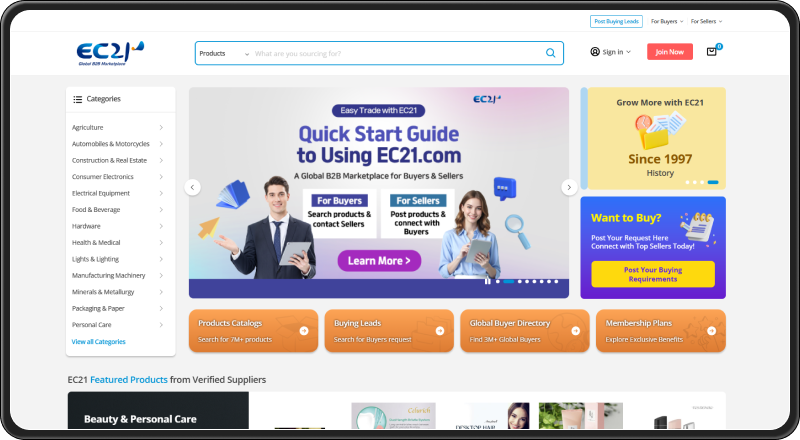
EC21 is a global B2B marketplace connecting buyers and suppliers across international markets. The platform began in 1997 as the online trade board of the Korea International Trade Association (KITA) and became an independent company in 2000. It supports product listings, supplier profiles, buyer inquiries, and international trade opportunities.
Key Highlights
- Global B2B directory
- Supplier profiles
- Buyer inquiries
- Product listings
| Pros | Cons |
| Broad international reach | More discovery and lead-generation oriented |
| Accessible to SMEs | Supplier differentiation can be challenging |
| Wide range of product categories | Buyers need to evaluate supplier credibility |
| Long operating history in B2B trade | Less transaction-centric than some newer marketplaces |
14. TradeIndia
Launch year: 1996
Primary market: India and international
Category: B2B supplier discovery
Business model: Premium listings, subscriptions and advertising
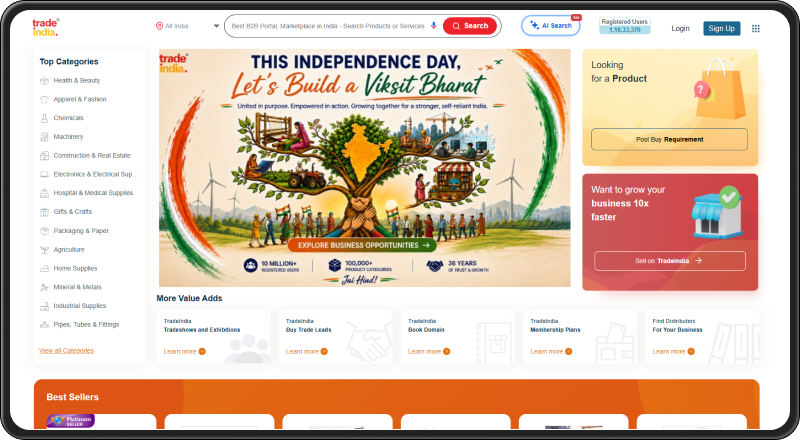
TradeIndia is an established B2B marketplace that helps businesses discover Indian suppliers, manufacturers, exporters, and service providers. The platform serves businesses across multiple industries and combines supplier discovery with lead generation and digital marketing services. TradeIndia states that it has more than 11.4 million registered users, 89 million+ inquiries annually, and a presence across India and more than 10 countries.
Key Highlights
- B2B supplier directory
- Product listings
- Business inquiries
- Export-oriented categories
| Pros | Cons |
| Long-established B2B platform | Strong concentration in the Indian market |
| Broad supplier and product network | Lead quality may vary |
| Strong focus on SMEs and exporters | More discovery-oriented than transaction-led |
| Supports digital services beyond listings | Supplier competition can affect visibility |
15. Udaan
Launch year: 2016
Primary market: India
Category: B2B commerce and wholesale
Business model: Product transactions, logistics and financial services
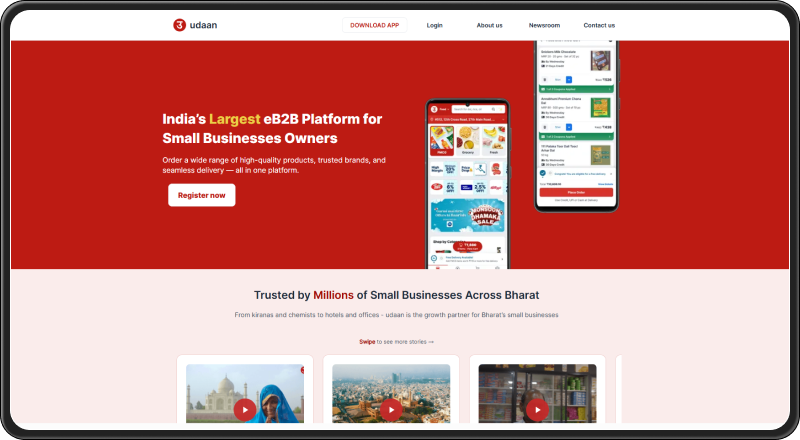
Udaan is an Indian B2B eCommerce platform focused on digitizing trade between suppliers, brands, wholesalers, and retailers. Its platform operates across categories including FMCG, staples, fruits and vegetables, and pharmaceuticals, while also supporting supply-chain and logistics operations. Udaan additionally offers financial products through udaanCapital to address working-capital needs among small businesses and retailers.
Key Highlights
- Retailer procurement
- Wholesale sourcing
- Logistics
- Credit/financial services
- FMCG and other categories
| Pros | Cons |
| Strong focus on B2B trade and retail procurement | Primarily focused on the Indian market |
| Integrates commerce with supply-chain capabilities | Operations can be complex at scale |
| Supports multiple business categories | More relevant to specific distribution categories |
| Financial services complement its procurement model | B2B distribution requires significant operational infrastructure |
16. Moglix
Launch year: 2015
Primary market: India
Category: Industrial B2B commerce
Business model: Product transactions, enterprise procurement and services
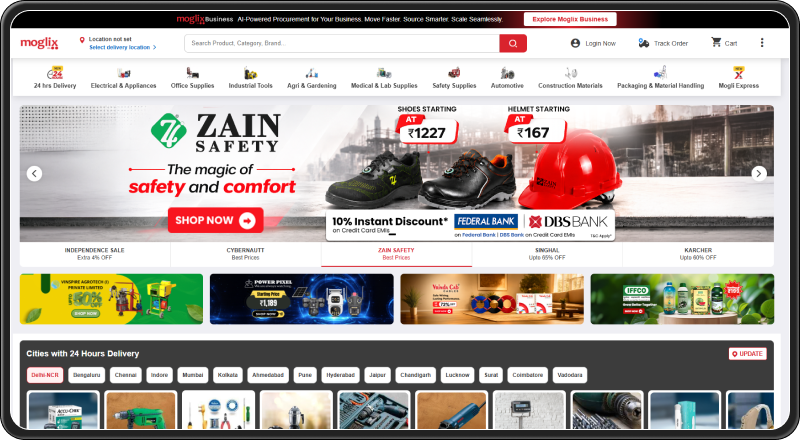
Moglix is an India-focused B2B eCommerce and procurement platform specializing in industrial and business-essential products. Its marketplace covers categories such as tools, electrical equipment, safety products, construction supplies, automotive products, and medical equipment. The company states that its marketplace includes more than 450,000 products across 30+ categories and serves SMEs and enterprises.
Key Highlights
- Industrial products
- Enterprise procurement
- Supply-chain technology
- B2B catalog
| Pros | Cons |
| Strong specialization in industrial B2B commerce | Primarily focused on the Indian market |
| Broad industrial product assortment | Operations and fulfillment can be complex |
| Supports enterprise and SME procurement | Less relevant for non-industrial categories |
| Combines commerce with supply-chain capabilities | Primarily suited to businesses with physical-product procurement needs |
17. SAP Business Network
Launch year: 1996*
Primary market: Global
Category: Enterprise procurement and supplier network
Business model: Enterprise software subscriptions and network services
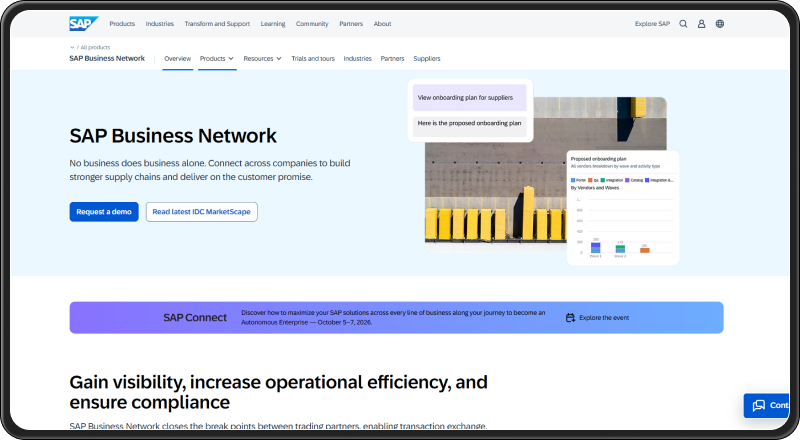
SAP Business Network evolved from SAP Ariba and other procurement-network capabilities. The platform evolved from SAP Ariba and other SAP network capabilities and now supports supplier discovery, onboarding, digital purchasing, purchase orders, invoicing, and trading-partner collaboration.
Key Highlights
- Enterprise procurement
- Supplier management
- Purchase orders
- Invoicing
- Supply-chain collaboration
- ERP integration
| Pros | Cons |
| Enterprise-grade procurement capabilities | Implementation can be complex |
| Strong SAP ecosystem and integrations | Better suited to established organizations |
| Global supplier network | Enterprise-oriented pricing and deployment |
| Extensive sourcing and supplier-management workflows | May be excessive for smaller marketplace businesses |
*SAP Ariba was founded in 1996; the current SAP Business Network encompasses multiple capabilities.
Launch a B2B Marketplace for Your Target Audience
18. Coupa
Launch year: 2006
Primary market: Global
Category: B2B procurement and spend management
Business model: Enterprise software subscriptions and services
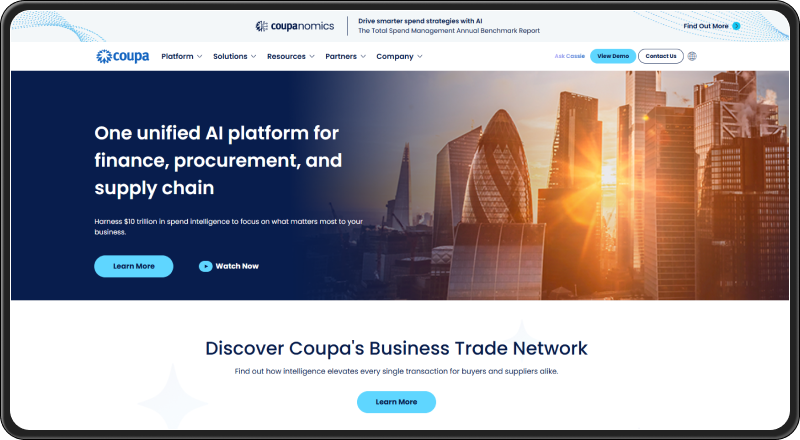
Coupa is a cloud-based business spend management platform designed to help organizations manage procurement, sourcing, supplier relationships, purchasing, invoicing, and payments. It primarily provides procurement infrastructure for businesses rather than operating as a broad product marketplace. Its Supplier Portal enables suppliers to manage catalogs, purchase orders, invoices, payments, and customer relationships.
Key Highlights
- Source-to-pay management
- Supplier management
- Strategic sourcing
- Purchase orders
- Catalog management
- Invoicing
| Pros | Cons |
| Comprehensive source-to-pay capabilities | Primarily designed for established organizations |
| Strong supplier collaboration tools | Implementation can require significant resources |
| Supports procurement, invoicing, and payments | Not a conventional open B2B marketplace |
| Extensive enterprise integrations | May be more functionality than smaller businesses require |
19. wlw
Launch year: 1932
Primary market: Europe
Category: Industrial supplier discovery
Business model: Supplier subscriptions and lead-generation services
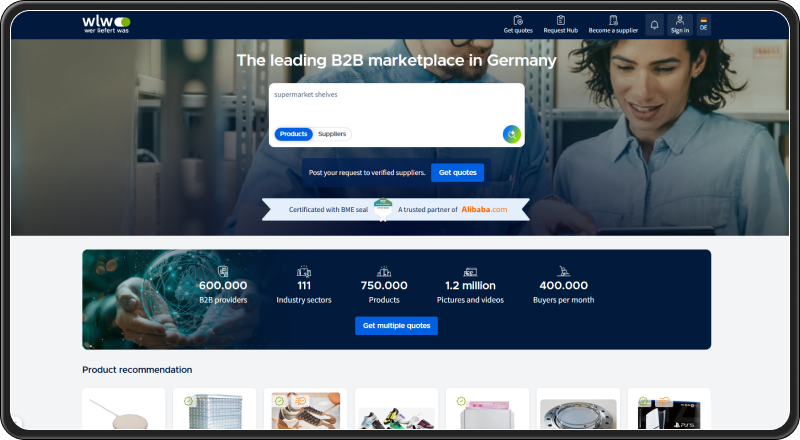
wlw, formerly known as “Wer liefert was?”, is a European B2B supplier discovery platform focused primarily on industrial and commercial procurement. It helps businesses find manufacturers, distributors, and service providers through supplier profiles, product listings, and search tools.
Key Highlights
- European supplier discovery
- Industrial categories
- Supplier profiles
- Buyer inquiries
| Pros | Cons |
| Strong European B2B presence | Primarily focused on supplier discovery |
| Established industrial positioning | Less transaction-centric than full marketplaces |
| Useful for finding manufacturers and distributors | More limited for direct online purchasing |
| Focused on business procurement | Geographic focus is strongest in Europe |
20. Europages
Launch year: 1982
Primary market: Europe
Category: B2B supplier directory and marketplace
Business model: Premium supplier listings, advertising and lead generation
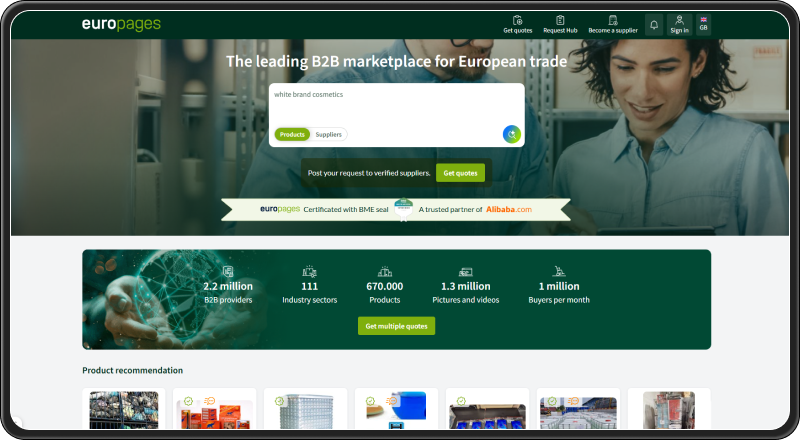
Europages is a European B2B platform that helps businesses discover suppliers, manufacturers, wholesalers, and service providers across multiple industries. Its model is primarily focused on supplier visibility, product discovery, and generating business connections rather than functioning solely as a transaction-based marketplace.
Key Highlights
- European supplier discovery
- International sourcing
- Business profiles
- Product categories
| Pros | Cons |
| Strong European B2B positioning | More directory and lead-generation oriented |
| Broad range of industries and categories | Less focused on end-to-end transactions |
| Supports international supplier discovery | Buyer-seller interactions may require additional steps |
| Multilingual and cross-border orientation | Less suitable for highly specialized procurement workflows |
21. Kompass
Launch year: 1947
Primary market: Global
Category: B2B business information and supplier discovery
Business model: Data subscriptions, premium listings and business intelligence services
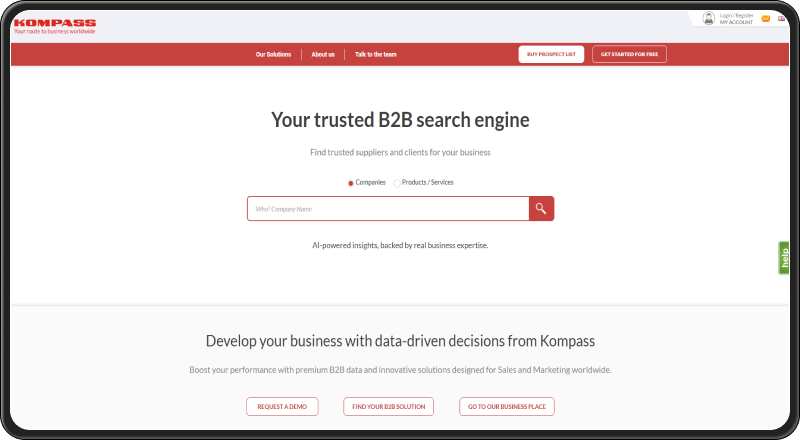
Kompass is a global B2B business information and supplier discovery platform that helps companies identify potential customers, suppliers, and business partners. Its services combine company data, supplier discovery, business intelligence, and lead-generation capabilities, making it particularly useful for B2B prospecting and market research.
Key Highlights
- Global business database
- Supplier discovery
- Company intelligence
- Lead generation
| Pros | Cons |
| Extensive business and company data | More data and prospecting focused than transaction-oriented |
| Strong international coverage | Not a conventional B2B marketplace |
| Useful for supplier and prospect discovery | Value depends on the quality and relevance of available data |
| Supports B2B lead generation | Less suited to direct online purchasing |
22. Mercateo Unite
Launch year: 2000
Primary market: Europe
Category: B2B procurement marketplace
Business model: Transaction and procurement services
Mercateo Unite, now branded as Unite, is a European B2B procurement platform that combines an integrated marketplace with e-procurement capabilities. Founded as Mercateo in 2000, the company rebranded as Unite in 2022. The platform connects business and public-sector buyers with suppliers and supports digital sourcing and purchasing.
Key Highlights
- Procurement
- Supplier discovery
- Business purchasing
- Digital ordering
| Pros | Cons |
| Strong European procurement expertise | Primarily focused on European markets |
| Designed specifically around B2B purchasing | Less relevant to consumer-style commerce |
| Combines marketplace and procurement capabilities | Enterprise procurement can involve complex workflows |
| Established supplier network | May be more infrastructure than smaller businesses require |
23. Orderchamp
Launch year: 2019
Primary market: Europe
Category: Wholesale marketplace
Business model: Transaction fees and wholesale services
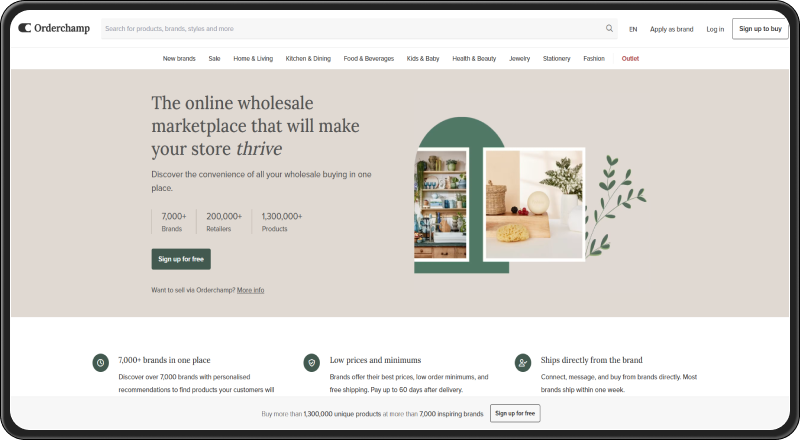
Orderchamp is a digital wholesale marketplace that connects independent retailers with brands and suppliers across Europe. The platform enables retailers to discover and order wholesale products while offering brands a digital channel to reach retail buyers. Orderchamp currently states that it works with more than 7,000 brands and offers over 1.3 million products.
Key Highlights
- European brands
- Retailer discovery
- Wholesale ordering
- Digital sourcing
| Pros | Cons |
| Strong focus on independent retail | Primarily suited to wholesale retail |
| Broad European brand network | Less relevant for industrial procurement |
| Large product assortment | Geographic coverage is concentrated in Europe |
| Supports direct brand-retailer purchasing | Retailers require approval to purchase |
24. Creoate
Launch year: 2020
Primary market: UK/Europe
Category: Independent wholesale
Business model: Marketplace commissions and services
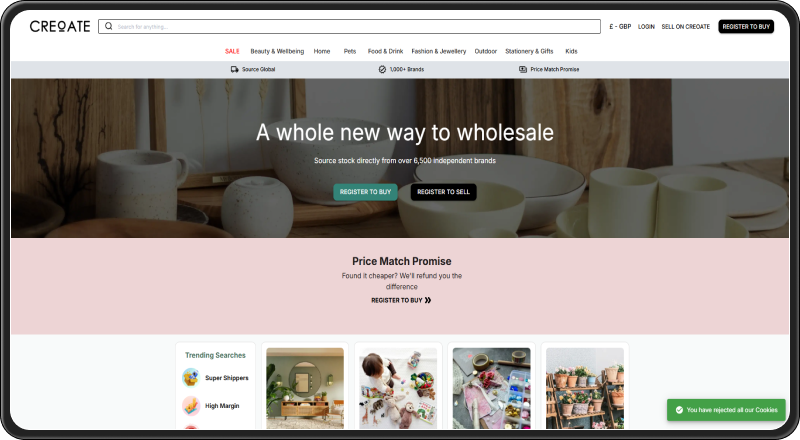
Creoate is a wholesale marketplace focused on independent brands and retailers. The platform enables retailers to discover and purchase products from independent vendors across categories such as homeware, fashion accessories, gifts, food, beauty, stationery, and children’s products. Creoate currently states that its retailer and vendor network spans the UK, Europe, the US, Canada, and other markets.
Key Highlights
- UK and European brands
- Wholesale discovery
- Independent retailers
- Product curation
| Pros | Cons |
| Strong positioning around independent businesses | Less relevant to industrial B2B procurement |
| Curated wholesale assortment | More specialized than broad B2B platforms |
| Supports international wholesale | Primarily focused on retail-oriented categories |
| Retailer-focused purchasing experience | Category breadth is narrower than horizontal marketplaces |
25. FashionGo
Launch year: 2002
Primary market: United States
Category: Fashion wholesale
Business model: Marketplace transactions and seller services
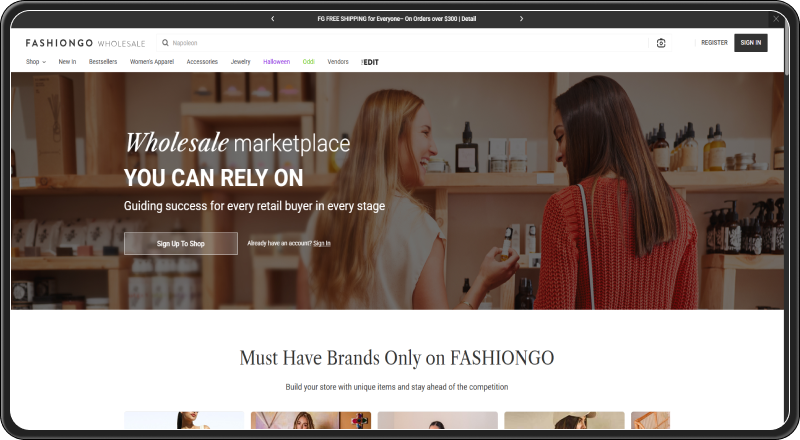
FashionGo is a B2B wholesale marketplace connecting fashion and lifestyle vendors with retailers. Established in 2002 in Los Angeles’ Fashion District, the platform provides retailers with access to wholesale products across apparel, accessories, footwear, jewelry, beauty, home, and other categories. FashionGo currently reports more than 1 million registered retail buyers and thousands of wholesale brands.
Key Highlights
- Fashion wholesale
- Retailer discovery
- Digital ordering
- Supplier catalogs
| Pros | Cons |
| Strong specialization in fashion wholesale | Limited applicability outside retail and lifestyle categories |
| Established U.S. industry presence | Less suitable for industrial or enterprise procurement |
| Large retailer and vendor network | Primarily focused on wholesale retail |
| Advanced tools such as image-based product discovery | Category specialization limits broader B2B use cases |
26. RangeMe
Launch year: 2014
Primary market: United States
Category: Retail product discovery
Business model: Supplier subscriptions and retailer services
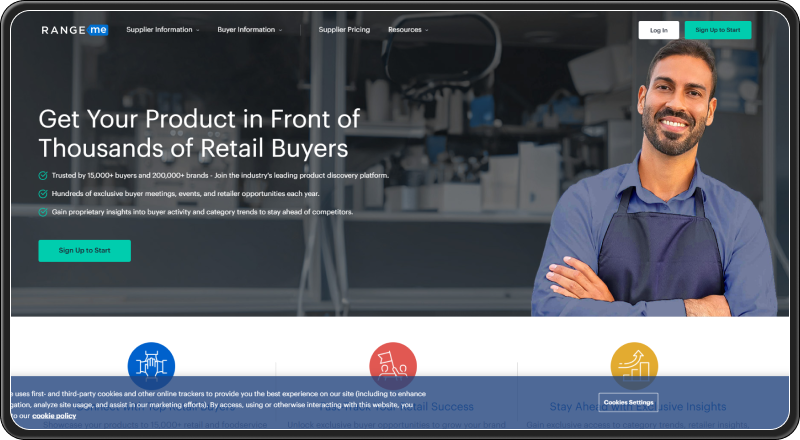
RangeMe is a B2B product discovery platform that helps emerging and established brands showcase products to retail and foodservice buyers. Its platform supports product discovery, advanced search, buyer opportunities, brand profiles, and connections between suppliers and retail buyers. RangeMe currently states that its network includes more than 15,000 buyers and 200,000 brands.
Key Highlights
- Product discovery
- Retail buyer connections
- Brand profiles
- Retail sourcing
| Pros | Cons |
| Strong focus on retail product discovery | Primarily oriented toward retail and foodservice |
| Helps emerging brands reach buyers | More discovery-focused than transaction-focused |
| Advanced search and buyer tools | Less suitable for industrial procurement |
| Large brand and buyer network | Not designed as a general-purpose B2B marketplace |
27. Tundra
Launch year: 2020
Primary market: United States/global
Category: Wholesale marketplace
Business model: Transaction services and supplier relationships
Tundra is a wholesale marketplace designed to connect retailers and businesses with suppliers offering products for resale. The platform focuses on digital wholesale sourcing and provides retailers with access to products across multiple categories.
Key Highlights
- Wholesale products
- Retailer sourcing
- Bulk ordering
- Digital procurement
| Pros | Cons |
| Designed specifically around wholesale purchasing | Smaller scale than major global B2B platforms |
| Digital-first sourcing experience | Less suitable for complex enterprise procurement |
| Broad range of wholesale categories | Limited public financial information |
| Retailer-focused marketplace model | Supplier and product coverage can vary |
28. Go Wholesale
Launch year: 2018*
Primary market: UK/Europe
Category: Wholesale
Business model: Wholesale transactions and supplier services
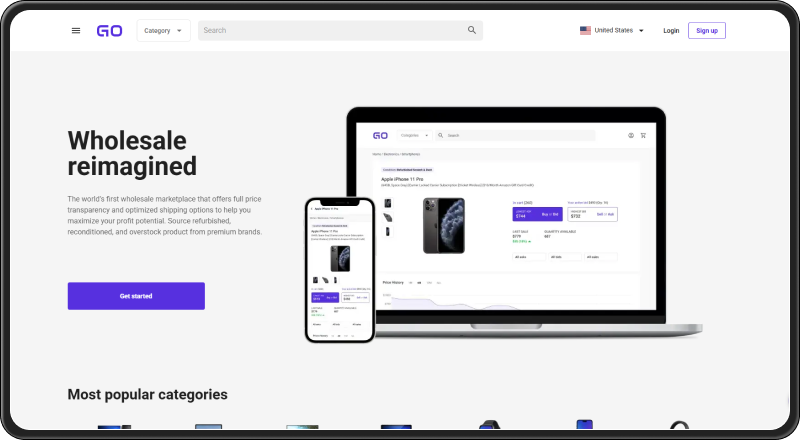
Go Wholesale represents the growing segment of digital wholesale platforms that connect retailers with suppliers through online catalogs and ordering capabilities. Its positioning is centered on helping businesses discover wholesale products and manage purchasing through a digital channel.
Key Highlights
- Wholesale discovery
- Retailer purchasing
- Supplier catalog management
- Digital ordering
| Pros | Cons |
| Focused on wholesale commerce | Smaller network than major global marketplaces |
| Relevant to retailers and SMEs | Limited publicly available financial information |
| Digital-first purchasing model | Geographic reach is more limited |
| Simplifies supplier and product discovery | Less suitable for complex enterprise procurement |
*Launch dates for smaller private marketplaces can vary depending on whether the platform’s incorporation, beta release, or public launch is used.
29. Grainger
Launch year: 1927
Primary market: North America
Category: B2B eCommerce and industrial supplies
Business model: Product sales, business accounts, services, and supply-chain solutions
Grainger is a major B2B distributor and eCommerce platform serving businesses, government organizations, and other institutions with maintenance, repair, operating, safety, and industrial supplies. Its digital platform supports product discovery, business purchasing, account-based buying, order management, and procurement workflows. Grainger’s scale and broad product assortment make it a useful example of how traditional distribution can evolve into a digital B2B commerce platform.
Key Highlights
- Industrial and MRO products
- Large product catalog
- Business accounts
- Bulk purchasing
- Product search and filtering
- Order history and reordering
| Pros | Cons |
| Extensive B2B product catalog | Primarily focused on industrial and MRO categories |
| Strong North American presence | Less suitable for general consumer products |
| Established distribution and fulfillment infrastructure | Primarily operates as a distributor rather than an open marketplace |
| Strong procurement capabilities for businesses | Pricing and account benefits can vary by customer |
30. Tradewheel
Launch year: 2013
Primary market: Global
Category: B2B wholesale and sourcing
Business model: Supplier memberships, premium listings and lead generation
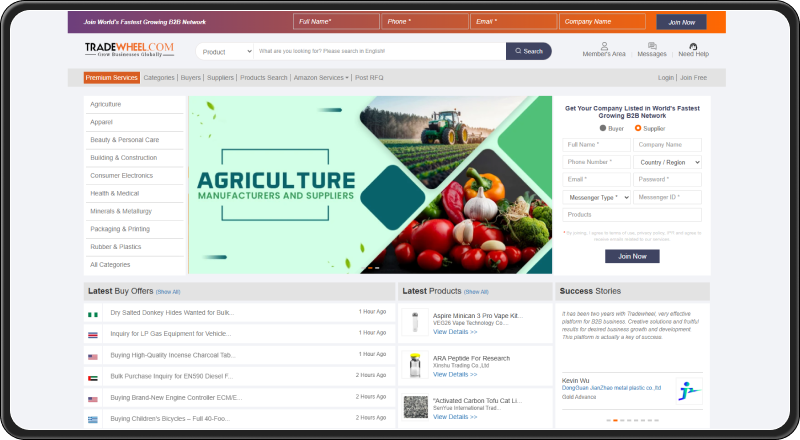
Tradewheel is a global B2B marketplace that connects buyers, suppliers, manufacturers, wholesalers, and exporters across multiple product categories. The platform supports product listings, supplier discovery, RFQs, buyer inquiries, and lead-generation services.
Key Highlights
- Global supplier listings
- Buyer inquiries
- Wholesale sourcing
- Multiple categories
| Pros | Cons |
| Broad international buyer and supplier network | Transactions are conducted directly between users |
| Supports multiple product categories | Buyers need to conduct appropriate supplier due diligence |
| Strong focus on B2B lead generation | Does not provide end-to-end transaction infrastructure |
| Offers supplier marketing and visibility services | Supplier quality and responsiveness can vary |
Comparison Table: Top 30 B2B eCommerce Marketplaces
| Marketplace | Launch | Primary Market | Core Model | Business Model |
| Alibaba.com | 1999 | Global | Wholesale | Membership + services |
| Amazon Business | 2015 | Global | Procurement | Marketplace + services |
| IndiaMART | 1999 | India | Supplier discovery | Subscriptions + leads |
| Global Sources | 1971 | Global | Sourcing | Listings + trade services |
| Thomasnet | 1898 | North America | Industrial | Advertising + leads |
| Faire | 2017 | Global | Wholesale | Transactions + services |
| Xometry | 2013 | Global | Manufacturing | Marketplace transactions |
| JOOR | 2010 | Global | Fashion wholesale | SaaS + marketplace |
| Ankorstore | 2019 | Europe | Wholesale | Payment/service fees |
| Made-in-China | 1998 | Global | Sourcing | Membership + advertising |
| DHgate | 2004 | Global | Wholesale | Transactions + services |
| HKTDC Sourcing | 2003 | Global | Sourcing | Listings + trade services |
| EC21 | 2000 | Global | B2B directory | Membership + leads |
| TradeIndia | 1996 | Global/India | Supplier discovery | Listings + subscriptions |
| Udaan | 2016 | India | Wholesale | Transactions + services |
| Moglix | 2015 | India | Industrial | Transactions + procurement |
| SAP Business Network | 1996* | Global | Procurement | Enterprise software |
| Coupa | 2006 | Global | Procurement | Enterprise SaaS + procurement services |
| wlw | 1932 | Europe | Industrial sourcing | Subscriptions + leads |
| Europages | 1982 | Europe | Supplier discovery | Listings + advertising |
| Kompass | 1947 | Global | B2B data | Subscriptions + leads |
| Mercateo Unite | 2000 | Europe | Procurement | Transaction/services |
| Orderchamp | 2019 | Europe | Wholesale | Transactions + services |
| Creoate | 2020 | UK/Europe | Wholesale | Marketplace services |
| FashionGo | 2002 | US | Fashion wholesale | Transactions + services |
| RangeMe | 2014 | US | Retail sourcing | Subscriptions + services |
| Tundra | 2020 | US/Global | Wholesale | Transactions + services |
| Go Wholesale | 2018* | UK/Europe | Wholesale | Transactions/services |
| Grainger | 1927 | North America | B2B eCommerce | Product sales + business services |
| Tradewheel | 2016 | Global | B2B sourcing | Membership + leads |
What Can Entrepreneurs Learn From These B2B eCommerce Marketplaces?
The 30 marketplaces examined in this guide demonstrate that B2B success does not depend on following a single marketplace formula. Their approaches differ by target audience, industry, procurement model, and platform structure. For entrepreneurs, these examples offer practical insights into positioning a marketplace and selecting a focused value proposition.
1. Start With a Specific B2B Problem
Successful marketplaces often begin by addressing a clearly defined business need rather than attempting to serve every type of buyer and seller.
- Alibaba.com: Facilitates global sourcing between businesses.
- Xometry: Simplifies manufacturing procurement.
- JOOR: Supports fashion wholesale.
- Faire: Helps independent retailers discover wholesale products.
- Thomasnet: Connects businesses with industrial suppliers.
The key takeaway is that a strong B2B marketplace should address a specific procurement challenge and provide a clear reason for buyers and suppliers to use the platform.
2. Choose Your Marketplace Type
The marketplace structure should align with the target users, industry requirements, and procurement journey. Entrepreneurs can consider several approaches:
Supplier-Oriented Marketplace
Suppliers take the lead in presenting their products and services, while business buyers use the platform to discover and evaluate available options.
Examples:
- Alibaba.com
- IndiaMART
- Global Sources
Buyer-Oriented Marketplace
The platform is primarily designed around business procurement, helping buyers discover products, manage purchasing, and connect with relevant suppliers.
Examples:
- Amazon Business
- SAP Business Network
- Mercateo Unite
Vertical Marketplace
A vertical marketplace concentrates on a specific industry or product category and builds its value proposition around specialized requirements.
Examples:
- Xometry: manufacturing
- JOOR: fashion
- Thomasnet: industrial
- Faire: retail wholesale
For entrepreneurs entering the B2B marketplace space, a vertical model can provide a more focused positioning strategy. It allows the platform to address industry-specific procurement needs and differentiate itself without competing directly with broad horizontal marketplaces.
Apply These B2B Marketplace Lessons to Your Business
What Makes a B2B eCommerce Marketplace Successful?
Building a B2B marketplace involves more than connecting buyers and sellers. Successful platforms create value for both sides by offering reliable suppliers, qualified demand, efficient procurement, and a seamless transaction experience. The following factors can help strengthen marketplace adoption, user trust, and long-term business growth.
1. Strong Supplier Network
A diverse and reliable supplier base gives buyers more options and makes the marketplace more valuable. Supplier quality, product availability, and category coverage can directly influence buyer engagement.
2. Reliable Buyers
Suppliers are more likely to remain active when a marketplace consistently generates relevant and qualified demand. A healthy buyer base is therefore essential for maintaining supplier participation.
3. Trust
B2B transactions often involve higher order values and ongoing business relationships. Supplier verification, ratings and reviews, transaction protection, and transparent marketplace policies can help establish trust.
4. Efficient Procurement
The marketplace should simplify purchasing compared with traditional procurement processes. Features such as RFQs, bulk ordering, negotiated pricing, purchase orders, and streamlined checkout can reduce friction.
5. Accurate Data
B2B buyers need dependable information to make purchasing decisions. Marketplaces should maintain accurate:
- Pricing
- Inventory availability
- Product specifications
- Delivery estimates
- Minimum order quantities
- Powerful Search and Filtering
6. Strong Search
Large B2B catalogs can contain thousands of products and suppliers. Advanced search and filtering help buyers quickly identify relevant products based on specifications, pricing, availability, location, and other requirements.
7. Integrated Payments
A smooth payment experience can reduce friction across the transaction lifecycle. Integrated payment capabilities should support invoicing, payment processing, reconciliation, and relevant B2B payment requirements.
8. Logistics
For marketplaces dealing with physical products, fulfillment is an important part of the overall buyer experience. Shipping coordination, delivery visibility, and logistics integration can help ensure orders reach buyers efficiently.
9. Repeat Purchasing
B2B marketplaces can generate stronger long-term value when buyers return for recurring purchases. Reordering, saved products, purchase history, and streamlined repeat transactions can encourage ongoing engagement and strengthen buyer-supplier relationships.
How Do B2B eCommerce Marketplaces Make Money?
B2B marketplaces can generate revenue through multiple monetization models, allowing platform owners to diversify income based on transaction volume, supplier participation, buyer activity, and value-added services. The right combination depends on the marketplace’s target audience, industry, transaction structure, and growth strategy.
1. Transaction Commission
The marketplace charges a percentage of each completed transaction, creating a direct link between platform revenue and marketplace activity.
Buyer → Seller → Marketplace Commission
This model can scale as transaction volume and overall marketplace activity increase.
2. Supplier Subscription
Suppliers pay recurring fees for premium access, enhanced visibility, analytics, or additional marketplace tools. This model is particularly relevant for supplier-discovery platforms where vendors benefit from greater exposure and advanced capabilities.
3. Featured Listings
Suppliers pay to appear more prominently in search results or relevant marketplace sections. This provides vendors with greater visibility while creating an additional revenue stream for the platform.
4. Advertising
Marketplaces can monetize their buyer traffic by offering sponsored placements, promoted products, display advertising, or other paid promotional opportunities to suppliers and brands.
5. Lead Generation
The platform can charge businesses for qualified buyer inquiries or leads. This model is especially suitable for marketplaces where transactions may involve quotations, negotiations, or high-value purchases rather than immediate checkout.
6. SaaS Services
Marketplace operators can offer suppliers additional business tools through paid plans or service packages, such as:
- CRM
- Analytics
- Inventory management
- Catalog management
- Automation
- Marketing tools
These services can create recurring revenue while increasing the value delivered to participating businesses.
7. Financial Services
Financial products can create additional revenue opportunities while addressing common challenges associated with B2B transactions. Potential offerings include:
- Payment processing
- Credit
- Financing
- Insurance
- Trade finance
- Payment guarantees
Rather than depending on a single monetization method, established B2B marketplaces can combine commissions, subscriptions, advertising, lead generation, SaaS services, and financial products. A diversified revenue strategy can create multiple income sources while allowing the marketplace to monetize different stages of the buyer-seller journey.
How to Build a B2B eCommerce Marketplace in 2026-2027
Building a B2B eCommerce marketplace requires more than developing a multi-vendor website. Entrepreneurs need to define the target market, identify the procurement problem they aim to solve, establish a viable revenue model, and build workflows that meet the needs of business buyers and sellers.
Step 1: Identify the Niche
Start by identifying a specific industry, product category, or procurement problem where a marketplace can create meaningful value. Potential niches include:
- Construction supplies
- Automotive components
- Restaurant supplies
- Medical equipment
- Packaging
- Industrial machinery
- Fashion wholesale
- Electronics
- Agriculture
- Hospitality
A focused niche can make it easier to understand buyer requirements, attract relevant suppliers, and develop industry-specific marketplace workflows.
Step 2: Define the Participants
Identify the businesses and stakeholders who will use and manage the platform.
Buyers + Sellers + Marketplace Administrator
Depending on the marketplace model, other participants may include:
- Procurement managers
- Finance teams
- Sales representatives
- Logistics providers
Clearly defining these participants helps determine the roles, permissions, workflows, and features required by each user group.
Step 3: Define the Monetization Model
Decide how the marketplace will generate revenue before development begins. Potential models include:
- Commission
- Subscription
- Listing fees
- Advertising
- Lead generation
- Transaction fees
- Financial services
The chosen model should align with the marketplace’s transaction structure and the value it provides to buyers and sellers.
Step 4: Build Core and B2B Specific Marketplace Functionality
Develop the foundational features required to manage products, suppliers, buyers, transactions, and marketplace operations. Along with standard marketplace functionality, incorporate features that address the complexities of B2B purchasing.
| Core Marketplace Features | B2B-Specific Features |
| Business Registration | Request for Quote |
| Seller Onboarding | Bulk Ordering |
| Product Catalogs | Negotiated Pricing |
| Search and Filtering | Minimum Order Quantities |
| Inventory Management | Tiered Pricing |
| Order Management | Bulk Discounts |
| Payments | Purchase Orders |
| Vendor Commissions | Negotiation Tools |
| Seller Payouts | Business Accounts |
| Shipping | Multiple Buyers per Organization |
| Invoicing | Approval Workflows |
| Analytics | Credit Terms |
Step 5: Launch and Scale Internationally
Once the marketplace is ready, launch it in a clearly defined target market and focus on onboarding quality suppliers and qualified business buyers. Monitor marketplace activity, user feedback, order volume, and transaction performance to identify areas for improvement.
For international expansion, consider:
- Multiple currencies
- Multiple languages
- Local payment gateways
- International shipping
- Tax calculation
- Regional pricing
- Country-specific catalogs
- Local compliance
Expanding into new markets gradually allows entrepreneurs to validate demand, strengthen marketplace operations, and adapt the platform to regional purchasing requirements before scaling further.
Can Yo!Kart Be Used to Build a B2B eCommerce Marketplace?
Yes, entrepreneurs looking to launch a B2B eCommerce marketplace can consider a customizable marketplace platform rather than building every marketplace component from scratch.
Yo!Kart, developed by FATbit Technologies, is a self-hosted multi-vendor eCommerce platform that can be configured to support different marketplace business models, including B2B commerce.
Explore Yo!Kart’s B2B Multi-Vendor eCommerce Platform
For a B2B marketplace, the solution can be configured around requirements such as:
- Multiple vendors
- Business accounts
- Product catalogs
- Vendor dashboards
- Bulk ordering
- Multiple payment methods
- Commission management
- Order management
- Shipping
- Product management
- Promotions
- Analytics
- Third-party integrations
However, entrepreneurs do not need to replicate large horizontal marketplaces such as Alibaba.com or Amazon Business feature-for-feature. A more practical strategy is to identify a specific B2B niche, understand its procurement problems, and then configure the marketplace around those requirements.
For example, a B2B construction marketplace may need RFQs, bulk orders, negotiated prices, and supplier verification, while a fashion wholesale marketplace may prioritize catalogs, minimum order quantities, buyer discovery, and seasonal collections.
A customizable platform can therefore offer a practical middle ground between developing a marketplace entirely from scratch and relying on a rigid off-the-shelf solution. It provides a foundation for launching the marketplace while allowing businesses to tailor functionality to their target industry and operating model.
Schedule a Personalized Demo to See Yo!Kart in Action
Ready-Made vs Custom B2B Marketplace Development
Choosing the right development approach can significantly influence a B2Bmarketplace’ss launch timeline, investment, flexibility, and ability to support complex business requirements.
A readymade solution provides prebuilt marketplace capabilities that can accelerate deployment, while custom development offers greater control. However, the right choice ultimately depends on the marketplace’s objectives, available resources, customization requirements, and long-term growth plans.
| Factor | Ready-Made Marketplace | Custom Development |
| Launch speed | Faster | Slower |
| Initial investment | Lower | Higher |
| Core marketplace features | Prebuilt | Developed |
| Custom workflows | Moderate-High | Very High |
| B2B features | Platform dependent | Fully customizable |
| Integrations | Existing + custom | Custom |
| Scalability | Platform dependent | Architecture dependent |
| Best for | Startups and SMEs | Complex enterprise models |
For many entrepreneurs, the decision should not be ready-made vs custom in isolation. A more practical consideration is which approach can help validate the marketplace business model while minimizing unnecessary technology risk and investment.
The more useful question is:
Which approach allows us to validate the marketplace business model with the least unnecessary technology risk?
Conclusion
The B2B eCommerce marketplace landscape is becoming increasingly diverse. Large horizontal platforms such as Alibaba.com and Amazon Business continue to demonstrate the scale that digital procurement can achieve, while vertical platforms such as Xometry, JOOR, Faire, and Thomasnet show how specialization can create strong marketplace positions.
For entrepreneurs, the opportunity in 2026-2027 may lie in identifying an underserved industry, geography, or procurement challenge rather than building another general-purpose marketplace. Success will depend on factors such as supplier quality, buyer trust, pricing transparency, AI-powered discovery, digital procurement, flexible payments, logistics, and data integration.
The marketplaces covered in this guide also demonstrate multiple viable monetization models, including commissions, subscriptions, advertising, lead generation, SaaS services, and financial products. A customizable solution such as Yo!Kart can provide a practical starting point for businesses looking to launch a multi-vendor B2B marketplace without developing every foundational capability from scratch.
Frequently Asked Questions
1. What is a B2B eCommerce marketplace?
A B2B eCommerce marketplace is an online platform that connects businesses with other businesses to discover, purchase and sell products or services. It can connect manufacturers, suppliers, wholesalers, distributors, retailers, and other organizations, making business procurement and supplier discovery more convenient through a centralized digital platform.
2. What are the best B2B eCommerce marketplaces in 2026?
Some of the most notable B2B eCommerce marketplaces to watch in 2026 include Alibaba.com, Amazon Business, IndiaMART, Global Sources, Thomasnet, Faire, Xometry, JOOR, Ankorstore, Made-in-China.com, DHgate, and SAP Business Network. The right marketplace depends on factors such as industry, product category, target market, sourcing requirements, and business model.
3. Which B2B marketplace is best for international sourcing?
Alibaba.com, Global Sources, Made-in-China.com, DHgate, and HKTDC Sourcing are among the major platforms used for international supplier discovery and sourcing. The best option depends on your product category, supplier location, order volume, verification requirements, target market, and the level of support you need for cross-border procurement.
4. Which B2B marketplace is best for manufacturing?
Xometry and Thomasnet are particularly relevant to manufacturing and industrial procurement. Xometry focuses on technology-enabled custom manufacturing, while Thomasnet focuses heavily on industrial supplier discovery in North America. Your choice should depend on the type of manufacturing requirement, supplier network, geographic market, and procurement process.
5. Which B2B marketplace is best for fashion wholesale?
JOOR, Faire, and FashionGo are notable platforms for fashion and retail wholesale. However, their business models, supplier networks, product categories, and geographic coverage differ. Businesses should compare these factors based on their sourcing needs, target customers, preferred brands, order volumes, and intended markets before choosing a platform.
6. How do B2B eCommerce marketplaces make money?
B2B marketplaces can generate revenue through transaction commissions, supplier subscriptions, premium listings, advertising, lead-generation fees, SaaS services, payment processing, logistics, and financial services. Many platforms combine multiple revenue streams to diversify income and monetize different stages of the buyer-seller journey.
7. What features does a B2B eCommerce marketplace need?
Common features include business accounts, supplier onboarding, product catalogs, RFQ, bulk ordering, tiered pricing, minimum order quantities, negotiated pricing, purchase orders, payments, vendor management, shipping, invoicing, and analytics. The exact feature set should reflect the industry’s procurement workflows and the requirements of buyers and sellers.
8. How much does it cost to build a B2B eCommerce marketplace?
There is no fixed cost. Development cost depends on the number of vendors, B2B workflows, integrations, payment systems, mobile applications, geographic markets, customization, and infrastructure requirements. A ready-made marketplace platform can reduce the amount of foundational development required.
9. How long does it take to build a B2B eCommerce marketplace?
A ready-made marketplace platform can generally be launched faster than a completely custom solution because core marketplace functionality already exists. A custom B2B marketplace may take several months or longer, depending on the required workflows, integrations, features, geographic markets, and enterprise-level requirements.
10. Can I build a B2B marketplace for a specific industry?
Yes. Vertical B2B marketplaces can focus on industries such as construction, manufacturing, automotive, medical supplies, fashion, agriculture, electronics, hospitality,y or packaging. A custom B2B marketplace may take several months or longer, depending on the required workflows, integrations, features, geographic markets, and enterprise-level requirements.
11. Is AI important for B2B marketplaces in 2026?
Yes. AI can improve product discovery, supplier matching, search, recommendations, demand forecasting, pricing, customer support,t and catalog management. However, AI should solve a specific marketplace problem rather than being added simply as a marketing feature. Its implementation should ultimately improve the experience or efficiency of buyers, sellers, or marketplace operators.
12. What is the difference between a B2B marketplace and a B2B eCommerce website?
A B2B eCommerce website typically represents one seller or organization, while a B2B marketplace connects multiple sellers with multiple business buyers. As a result, marketplaces require additional capabilities such as supplier onboarding, vendor management, commissions, seller payouts, and marketplace governance.
13. Can Yo!Kart be used to build a B2B marketplace?
Yes, Yo!Kart can be used to build a B2B marketplace. It is a self-hosted multi-vendor eCommerce solution that can be customized for B2B marketplace requirements such as multiple vendors, business accounts, product catalogs, bulk orders, payments, commissions, shipping, and third-party integrations.
Want to Build a B2B eCommerce Marketplace for Your Industry?
Reach OutPopular Posts