
Published Date 13 July, 2026
TL;DR
If you’re looking for the best B2B eCommerce software in 2026, prioritize solutions that offer scalability, customization, enterprise-grade security, automation, and support for advanced B2B workflows such as company accounts, bulk ordering, RFQs, negotiated pricing, and multi-vendor operations.
Among the leading platforms, Yo!Kart stands out for businesses planning to launch a self-hosted B2B marketplace with complete ownership and extensive customization. Meanwhile, platforms like Adobe Commerce, Shopify Plus, SAP Commerce Cloud, and Salesforce Commerce Cloud are excellent choices for enterprises with varying business requirements and digital commerce strategies.
Introduction
As B2B commerce continues to evolve, businesses need more than just a traditional eCommerce website. Modern B2B buyers expect personalized pricing, bulk ordering, self-service portals, RFQ management, and seamless integrations with ERP and CRM systems that simplify complex purchasing processes. Choosing the right B2B eCommerce software is key to improving operational efficiency, improving customer experiences, and supporting long-term business growth.
To help you make an informed decision, we’ve compared the 10 best B2B eCommerce software solutions in 2026 based on their features, scalability, customization, and overall value. Whether you’re a manufacturer, wholesaler, distributor, or entrepreneur planning to launch a multi-vendor B2B marketplace, this guide will help you find the solution that best fits your business needs.
Table of Contents
What is B2B eCommerce Software?
B2B eCommerce software is a digital solution that enables businesses to sell products or services online to other businesses instead of individual consumers. It streamlines complex buying processes, automates procurement, and helps organizations manage large-scale commercial transactions more efficiently.
Unlike B2C eCommerce solutions, B2B software is built to support advanced purchasing workflows and business-specific requirements, including:
- Company accounts with multiple users
- Role-based access and permissions
- Customer-specific and tiered pricing
- Bulk ordering and minimum order quantities (MOQs)
- Request for Quote (RFQ) management
- Purchase approval workflows
- Credit terms and invoicing
- Tax management
- ERP and CRM integrations
- Real-time inventory synchronization
- Procurement and order management workflows
Additionally, modern B2B eCommerce solutions leverage AI-powered capabilities such as intelligent product search, personalized recommendations, predictive analytics, workflow automation, and omnichannel selling to enhance operational efficiency and deliver a more seamless buying experience.
Why are Businesses Investing in B2B eCommerce Platforms?
The B2B buying journey has changed dramatically over the last few years, with businesses increasingly preferring digital purchasing experiences over traditional sales channels. Today’s buyers expect faster product discovery, personalized pricing, self-service portals, simplified reordering, and seamless digital payments. To meet these expectations, companies are adopting modern B2B eCommerce platforms that deliver greater convenience and efficiency.
As digital commerce becomes central to B2B purchasing, businesses are investing in platforms that streamline operations and support long-term growth. However, not all solutions are built for complex B2B requirements. While some cater to basic online stores, others are designed for enterprise commerce, wholesale operations, and multi-vendor marketplaces, making platform selection a critical business decision.
As a result, manufacturers, wholesalers, distributors, and enterprise organizations are investing in modern B2B eCommerce software to:
- Digitize procurement processes
- Reduce operational costs
- Improve customer experience
- Expand into new markets
- Enable multi-channel selling
- Automate order management
- Scale globally
Build a Marketplace That Supports Business Growth
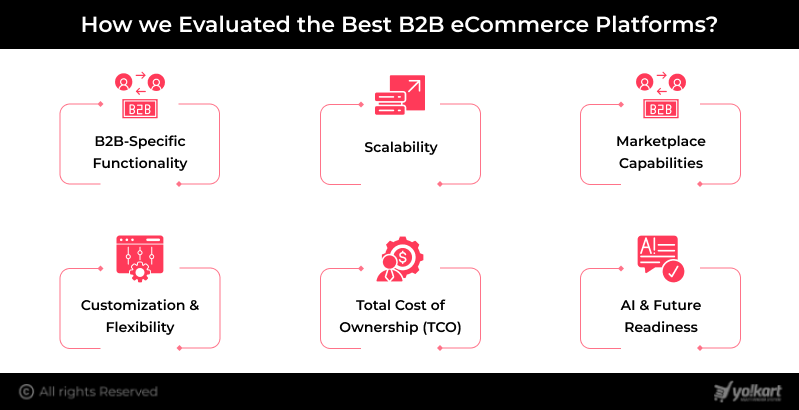
How we Evaluated the Best B2B eCommerce Platforms?
Selecting the right B2B eCommerce software requires more than comparing pricing plans or feature lists. Every business has unique operational requirements, technical resources, and long-term growth objectives. To ensure this comparison is objective and valuable, we evaluated each platform across several key criteria.
1. B2B-Specific Functionality
We assessed each platform based on its ability to support essential B2B features, including company account management, customer-specific pricing, bulk ordering, RFQs, purchase approvals, credit limits, requisition lists, and contract pricing. Platforms with comprehensive native B2B capabilities received higher ratings.
2. Scalability
As businesses grow, their software should scale alongside them. We evaluated how effectively each platform supports expanding product catalogs, increasing order volumes, multiple storefronts, international expansion, and multi-language and multi-currency operations without compromising performance.
3. Marketplace Capabilities
Since many businesses are adopting marketplace business models, we examined each platform’s ability to support multi-vendor operations. Our evaluation included vendor onboarding, commission management, supplier administration, vendor dashboards, and the overall flexibility to build and manage scalable marketplace ecosystems.
4. Customization & Flexibility
Every business has unique operational workflows and branding requirements. We evaluated each platform’s customization capabilities by reviewing source code accessibility, API availability, third-party integrations, white-label options, and the flexibility to accommodate custom development.
5. Total Cost of Ownership (TCO)
Rather than focusing only on upfront pricing, we considered the long-term investment required to operate each platform. This included licensing, hosting, implementation, maintenance, upgrades, third-party applications, and ongoing development costs to provide a realistic view of ownership expenses.
6. AI & Future Readiness
AI is becoming an integral part of modern B2B commerce. We evaluated each platform’s readiness for the future by assessing capabilities such as intelligent product search, personalized recommendations, customer segmentation, predictive analytics, marketing automation, and other AI-driven features that enhance business performance.
Top 10 B2B eCommerce Software Solutions
Choosing the right B2B eCommerce software is critical to building a scalable and efficient online business. The solutions below have been evaluated based on their B2B capabilities, marketplace functionality, customization options, scalability, pricing model, and long-term value.
Whether you’re launching a wholesale store or a multi-vendor marketplace, these solutions cater to a variety of business needs and growth strategies.
1. Yo!Kart
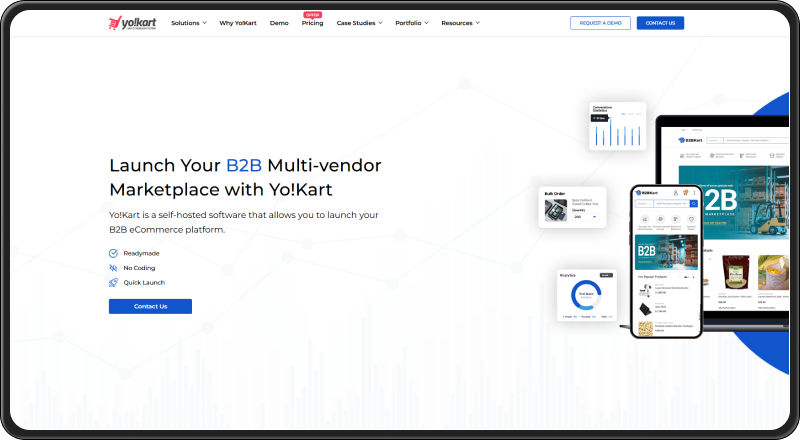
Yo!Kart is a self-hosted, white-label marketplace software solution designed to help entrepreneurs and enterprises build multi-vendor eCommerce platforms. Unlike many traditional eCommerce builders that primarily target single-vendor stores, Yo!Kart is built with marketplace functionality at its core.
The solution supports B2B, B2C, and hybrid marketplace models, making it suitable for wholesalers, manufacturers, distributors, procurement marketplaces, and industry-specific B2B ecosystems.
One of its biggest advantages is its lifetime licensing model, which allows businesses to own the software instead of paying recurring subscription fees. Organizations also retain full control over their data, hosting environment, branding, and future development roadmap.
For businesses with unique operational requirements, the platform’s source code ownership and customization flexibility make it easier to adapt workflows without being constrained by a SaaS provider’s limitations.
Best for: Businesses planning to launch a scalable B2B marketplace with complete ownership and customization.
Key Features
- Multi-vendor marketplace architecture
- Company and supplier management
- Product approval workflows
- Bulk product management
- RFQ support
- Wholesale pricing
- Multi-language support
- Multi-currency support
- Flexible commission management
- Shipping integrations
- Multiple payment gateways
- Advanced catalog management
- Mobile-ready design
- SEO-friendly architecture
- White-label branding
- GDPR-ready framework
- REST APIs for integrations
- Analytics dashboard
Pros
- Purpose-built for marketplace businesses
- One-time licensing model
- Complete branding control
- Highly customizable
- Supports B2B and B2C operations
- Suitable for enterprise-scale growth
- No recurring platform subscription fees
- Strong vendor management capabilities
Cons
- Self-hosted deployment requires businesses to manage hosting infrastructure.
Ideal For
Yo!Kart is well-suited for:
- Wholesale marketplaces
- Manufacturing marketplaces
- Distributor networks
- Industry-specific B2B marketplaces
- Procurement platforms
- Multi-supplier commerce businesses
- Hybrid B2B/B2C marketplaces
See Yo!Kart in Action
2. Adobe Commerce (Formerly Magento Commerce)
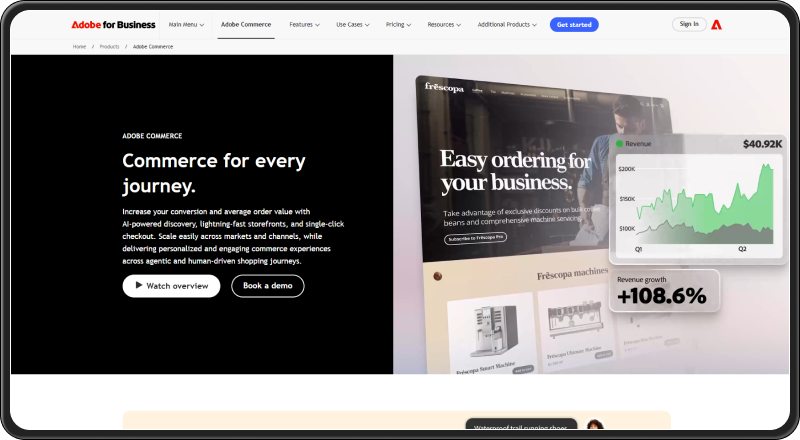
Adobe Commerce is one of the most established enterprise eCommerce platforms, offering advanced capabilities for businesses with complex operational requirements. Built on Magento’s open architecture and enhanced with Adobe Experience Cloud integrations, it enables organizations to deliver highly customized buying experiences across multiple channels.
The platform includes a comprehensive suite of B2B features and is known for its flexibility. Businesses can create tailored storefronts, integrate with enterprise systems, and support multiple brands, regions, and languages from a single platform. However, this level of flexibility often comes with higher implementation costs and the need for experienced development teams.
Best For: Large enterprises that require extensive customization and complex B2B workflows.
Key Features
- Company accounts and organizational structures
- Shared catalogs and customer-specific pricing
- Request for Quote (RFQ)
- Purchase approval workflows
- Quick order functionality
- Requisition lists
- AI-powered product recommendations
- Multi-store management
- Extensive API support
- Adobe Experience Cloud integrations
Pros
- Enterprise-grade scalability
- Robust B2B functionality
- Extensive customization options
- Large ecosystem of extensions and partners
- Strong security and compliance features
Cons
- High implementation and maintenance costs
- Requires experienced developers
- Longer deployment timelines compared to SaaS solutions
Ideal For
- Large manufacturers
- Enterprise distributors
- Global wholesalers
- Multi-brand organizations
- Businesses already using Adobe’s digital experience ecosystem
3. Shopify Plus
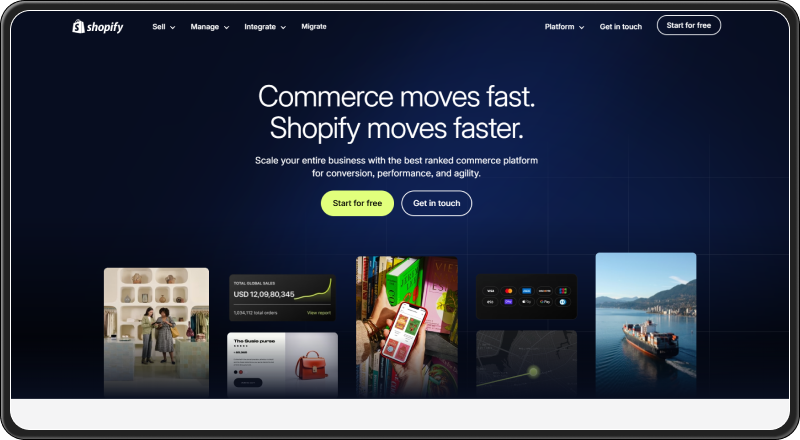
Shopify Plus has evolved from a popular B2C platform into a capable solution for B2B commerce. Its fully hosted infrastructure, intuitive interface, and extensive app marketplace make it attractive for organizations that want to launch quickly without managing servers or software updates.
Shopify Plus supports B2B selling through company profiles, custom catalogs, negotiated pricing, payment terms, and self-service purchasing portals. However, companies with highly customized procurement workflows or marketplace ambitions may find themselves relying on third-party applications or custom development to meet advanced requirements.3
Best For: Fast-growing businesses seeking a managed SaaS platform with simplified operations.
Key Features
- Company accounts
- Customer-specific catalogs
- Personalized pricing
- Flexible payment terms
- Shopify Markets
- Extensive app marketplace
- AI-powered commerce tools
- Integrated payments
- Multi-channel selling
- Headless commerce support
Pros
- Quick implementation
- Excellent user experience
- Reliable cloud infrastructure
- Large partner ecosystem
- Minimal technical maintenance
Cons
- Monthly subscription costs
- Advanced functionality often requires additional apps
- Limited native marketplace capabilities
- Customization can become expensive over time
Ideal For
- Mid-sized businesses
- Growing wholesalers
- Direct-to-business brands
- Companies prioritizing speed to market
4. BigCommerce B2B Edition
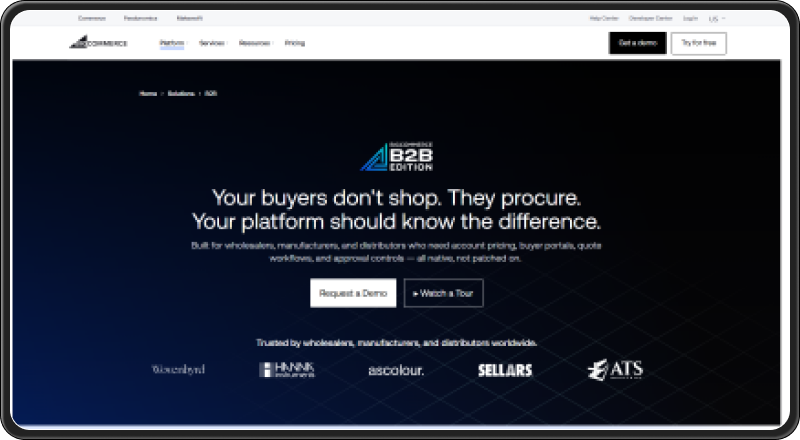
BigCommerce B2B Edition combines cloud-based simplicity with several built-in features designed specifically for business buyers. It supports company hierarchies, buyer roles, custom pricing, quote management, and purchase approvals without requiring extensive customization.
One of BigCommerce’s strengths is its open architecture, allowing businesses to integrate with ERP systems, CRM platforms, PIM solutions, and third-party applications through robust APIs. Although BigCommerce supports multi-storefront management, businesses planning to build large multi-vendor marketplaces may require additional development.
Best For: Businesses looking for a SaaS platform with strong native B2B functionality.
Key Features
- Company account management
- Multiple buyer roles
- Customer-specific pricing
- Quote management
- Purchase approvals
- ERP integrations
- API-first architecture
- Multi-storefront support
- Omnichannel selling
- Headless commerce capabilities
Pros
- Strong native B2B functionality
- Cloud-hosted infrastructure
- Flexible integration ecosystem
- Good performance and scalability
- Lower maintenance requirements
Cons
- Marketplace functionality is limited
- Subscription-based pricing
- Complex custom workflows may require development
Ideal For
- Wholesalers
- Manufacturers
- Distributors
- Mid-market enterprises
- Businesses modernizing legacy commerce systems
5. OroCommerce
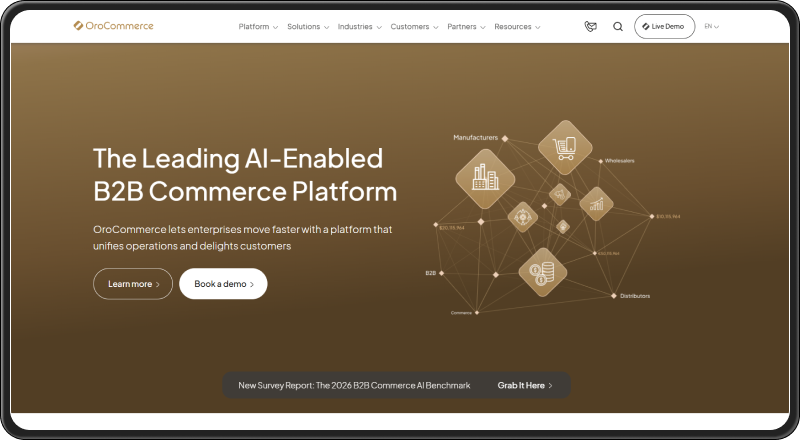
OroCommerce was built specifically for B2B commerce rather than adapting from a B2C platform. As a result, it offers a comprehensive feature set tailored to organizations with intricate purchasing workflows, multiple business units, and customer-specific pricing agreements.
The platform supports personalized catalogs, corporate account hierarchies, RFQs, budgeting, approval workflows, inventory visibility, and extensive workflow automation. OroCommerce is available as both an open-source and an enterprise solution, giving organizations greater control over deployment and customization.
Best For: Manufacturers, distributors, and enterprises with complex sales processes.
Key Features
- Company organizational structures
- RFQ management
- Personalized product catalogs
- Budget controls
- Approval workflows
- Inventory visibility
- Workflow automation
- CRM integration
- ERP integration
- API-first architecture
Pros
- Built specifically for B2B commerce
- Advanced workflow automation
- Strong integration capabilities
- Flexible deployment options
- Highly customizable
Cons
- Requires experienced implementation partners
- Higher learning curve
- Enterprise deployments can become costly
Ideal For
- Manufacturers
- Healthcare suppliers
- Industrial distributors
- Enterprise wholesalers
- Large procurement organizations
6. SAP Commerce Cloud
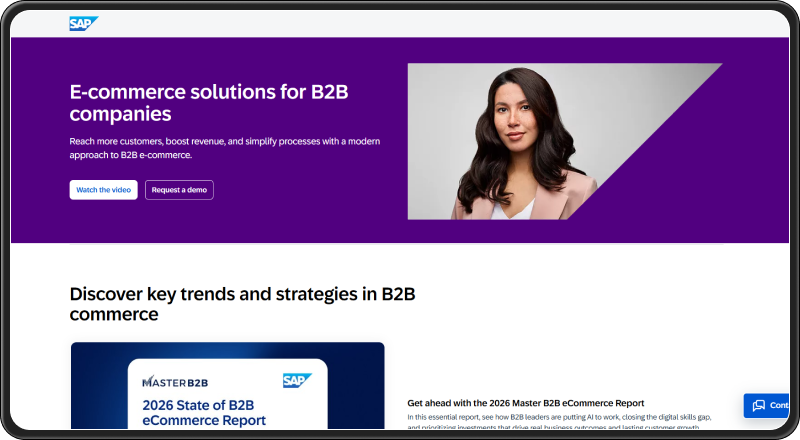
SAP Commerce Cloud (formerly SAP Hybris) is one of the most comprehensive enterprise commerce platforms available today. Designed for organizations with complex procurement processes, multiple business units, and international operations, it offers a highly scalable solution that integrates seamlessly with the SAP ecosystem.
Businesses using SAP ERP or SAP S/4HANA can benefit from native integrations that streamline inventory management, order fulfillment, finance, and procurement.SAP Commerce Cloud also incorporates AI-driven capabilities through SAP Business AI. While SAP Commerce Cloud offers enterprise-grade functionality, it typically requires significant implementation resources, making it better suited for large organizations with dedicated IT teams and long-term digital transformation strategies.
Best For: Large enterprises with complex supply chains and global B2B operations.
Key Features
- Customer-specific pricing
- Contract and negotiated pricing
- Approval workflows
- Company account management
- AI-powered product recommendations
- Intelligent search
- ERP integration
- CRM integration
- Omnichannel commerce
- Multi-language support
- Multi-currency support
- Enterprise-grade security
Pros
- Excellent scalability
- Strong ERP integration
- Comprehensive B2B functionality
- AI-powered commerce capabilities
- Global commerce support
Cons
- High implementation costs
- Longer deployment timelines
- Requires experienced implementation partners
Ideal For
- Global manufacturers
- Enterprise wholesalers
- Industrial suppliers
- International distributors
- Large procurement organizations
7. Salesforce Commerce Cloud
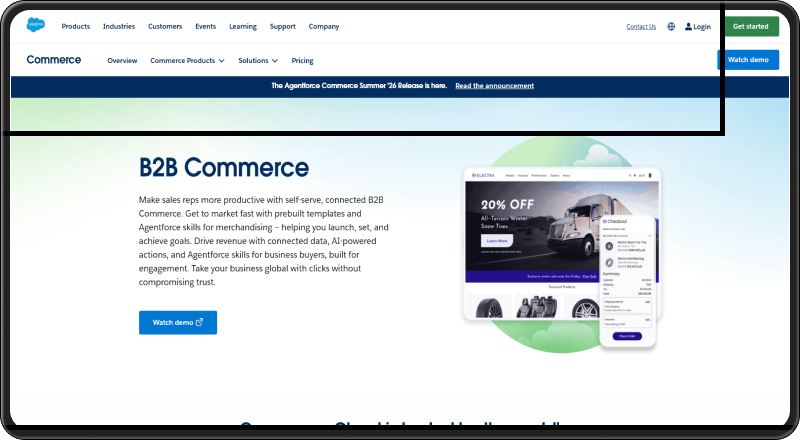
Salesforce Commerce Cloud is a cloud-native commerce platform that enables businesses to create personalized buying experiences across digital channels. Its biggest strength lies in its seamless integration with Salesforce’s broader ecosystem, including Sales Cloud, Service Cloud, Marketing Cloud, and Einstein AI.
For B2B organizations, Salesforce Commerce Cloud provides company account management, personalized pricing, self-service portals, AI-driven merchandising, and customer-specific catalogs. Although it is a powerful enterprise solution, organizations seeking extensive marketplace functionality may require additional customization or third-party applications.
Best For: Businesses already using Salesforce CRM and Marketing Cloud.
Key Features
- Company accounts
- Customer-specific pricing
- Personalized catalogs
- AI-powered product recommendations
- Einstein AI
- CRM integration
- Marketing automation
- Mobile commerce
- Omnichannel selling
- Analytics dashboard
- API ecosystem
Pros
- Excellent CRM integration
- Advanced AI capabilities
- Strong personalization features
- Cloud-based infrastructure
- Enterprise reliability
Cons
- Premium pricing
- Marketplace functionality is limited
- Custom development may increase costs
Ideal For
- Enterprises using Salesforce
- B2B retailers
- Manufacturers
- Service-oriented businesses
- Global brands
Looking for the Right Marketplace Software for Your Business?
8. VTEX
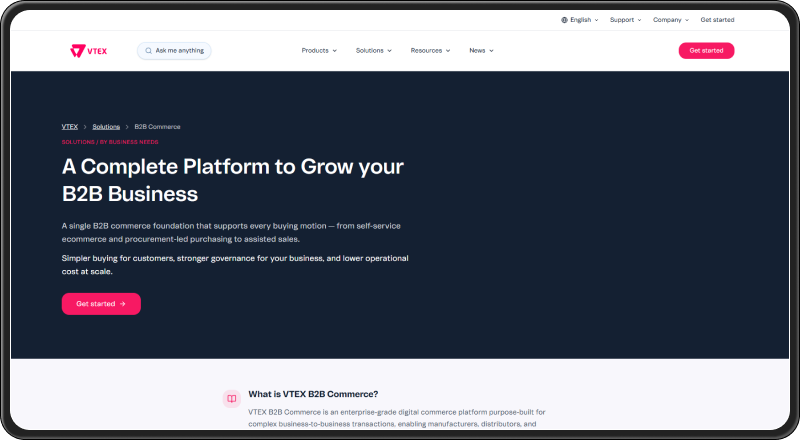
VTEX is a cloud-native digital commerce platform designed for businesses that want to manage online sales across multiple channels, regions, and customer segments. It supports both B2B and B2C commerce models while offering built-in marketplace capabilities that simplify seller onboarding and catalog management.
One of VTEX’s key strengths is its unified commerce approach, allowing businesses to connect physical stores, online marketplaces, distributors, and fulfillment centers within a single ecosystem. This makes it an attractive option for enterprises focused on digital transformation.
Best For: Omnichannel B2B and B2C commerce businesses.
Key Features
- Marketplace support
- Company account management
- Personalized pricing
- Order Management System (OMS)
- Headless commerce
- AI-powered search
- Multi-seller management
- Omnichannel fulfillment
- API-first architecture
- Mobile optimization
Pros
- Native marketplace functionality
- Strong omnichannel capabilities
- Flexible architecture
- Enterprise scalability
- Cloud infrastructure
Cons
- Pricing is not transparent
- Advanced implementations require experienced partners
- Learning curve for new users
Ideal For
- Retail enterprises
- Manufacturers
- Wholesale businesses
- Omnichannel brands
- Regional marketplaces
9. SparkLayer
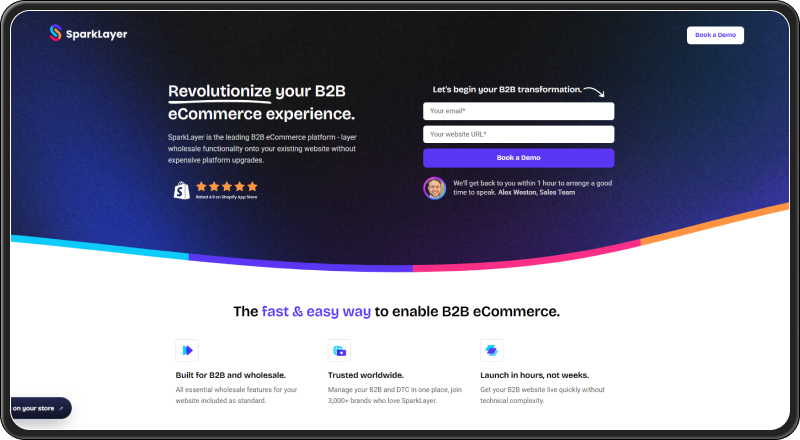
SparkLayer is a B2B commerce solution that enables businesses to add wholesale functionality to their existing eCommerce stores without rebuilding their platform. It offers features such as customer-specific pricing, company accounts, quote management, sales agent ordering, and self-service portals.
The solution integrates seamlessly with leading eCommerce platforms and business systems, including ERP, CRM, and accounting software, helping businesses streamline wholesale operations while managing both B2B and B2C sales from a single storefront.
Best For: Businesses looking to add advanced B2B and wholesale capabilities to an existing eCommerce store.
Key Features
- Customer-specific pricing
- Company accounts
- Quote management
- Sales agent ordering
- Self-service purchasing portal
- ERP and CRM integrations
- Accounting software integrations
- Quick order functionality
- API integrations
- Wholesale customer management
Pros
- Easy integration with existing eCommerce stores
- Strong wholesale and B2B feature set
- Supports multiple eCommerce platforms
- Seamless business system integrations
- Faster deployment than building a new B2B store
Cons
- Requires an existing eCommerce platform
- Advanced features depend on the connected platform
- Subscription-based pricing
Ideal For
- Wholesalers
- Manufacturers
- Distributors
- D2C brands expanding into B2B
- Growing businesses are adding wholesale sales
10. Magento Open Source
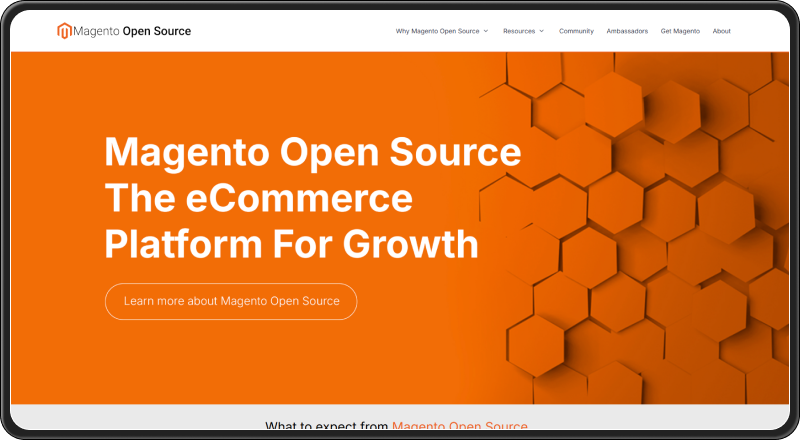
Magento Open Source remains one of the most widely recognized open-source eCommerce platforms. It provides developers with extensive control over storefront design, functionality, integrations, and customer experiences.
Although the platform includes many core commerce capabilities, businesses often rely on extensions or custom development to implement advanced B2B workflows such as RFQs, corporate account management, approval processes, and procurement automation. However, the total cost of ownership should include development, hosting, maintenance, security updates, and ongoing optimization.
Best For: Businesses with in-house development teams seeking maximum flexibility.
Key Features
- Open-source architecture
- Unlimited customization
- SEO-friendly framework
- Extensive extension marketplace
- Product catalog management
- Inventory management
- Multi-store capabilities
- API integrations
- Headless commerce support
- Community-driven ecosystem
Pros
- No software licensing fee
- Highly customizable
- Large developer community
- Flexible architecture
- Extensive extension ecosystem
Cons
- Requires experienced developers
- Ongoing maintenance responsibility
- Advanced B2B features often require extensions
- Hosting and security are self-managed
Ideal For
- Development-focused organizations
- Technology companies
- Medium-sized businesses
- Businesses needing extensive customization
Platform Comparison at a Glance
| Platform | Deployment | Native B2B Features | Marketplace Support | Best For | Pricing Model |
| Yo!Kart | Self-hosted | 5/5 | Native | Multi-vendor B2B marketplaces | One-time license |
| Adobe Commerce | Self-hosted / Cloud | 4.5/5 | Limited | Enterprise commerce | Custom |
| Shopify Plus | SaaS | 4.5/5 | Limited | Fast-growing businesses | Subscription |
| BigCommerce B2B | SaaS | 4/5 | Limited | Mid-market B2B | Subscription |
| OroCommerce | Self-hosted / Cloud | 4/5 | Limited | Manufacturers | Custom |
| SAP Commerce Cloud | Cloud | 4.5/5 | Limited | Global enterprises | Custom |
| Salesforce Commerce Cloud | Cloud | 4.5/5 | Limited | Salesforce users | Custom |
| VTEX | Cloud | 4/5 | Moderate | Omnichannel commerce | Custom |
| CS-Cart B2B | Self-hosted | 3.8/5 | Moderate | SMEs | License |
| Magento Open Source | Self-hosted | 3.8/5 | Extension-based | Developers | Free + development costs |
What is the best B2B eCommerce software?
The best B2B eCommerce software depends on your business model.
- Best overall marketplace software: Yo!Kart
- Best for enterprise retailers: Adobe Commerce
- Best SaaS platform: Shopify Plus
- Best ERP-focused solution: SAP Commerce Cloud
- Best CRM ecosystem: Salesforce Commerce Cloud
The ideal platform should support your current business needs while allowing room for long-term growth.
Why is Yo!Kart is our recommended choice for B2B Marketplace Businesses?
Not all B2B eCommerce solutions are built with marketplace functionality in mind. While every solution on this list serves a specific audience, Yo!Kart stands out for businesses planning to build a multi-vendor B2B marketplace rather than a traditional online store.
Unlike many software solutions that started as single-vendor eCommerce solutions and later added marketplace functionality, Yo!Kart was designed with marketplace operations at its core. This architecture enables businesses to onboard suppliers, manage commissions, support multiple vendors, and scale marketplace operations without relying heavily on third-party extensions.
Some of the reasons businesses choose Yo!Kart include:
- Marketplace-first architecture
- Lifetime license with source code ownership
- White-label customization
- Multi-vendor management
- RFQ and wholesale pricing support
- Multi-language and multi-currency capabilities
- Extensive APIs for integrations
- Mobile app availability
- SEO-friendly architecture
- Enterprise scalability
Whether you’re a startup, SME, or large enterprise, Yo!Kart provides the flexibility, ownership, and built-in marketplace capabilities needed to launch and grow a successful B2B marketplace while reducing development time and long-term operational costs.
Create a Powerful B2B Marketplace Without Recurring Fees
Final Verdict
Choosing the right B2B eCommerce software is a strategic long-term investment that can shape your company’s digital growth for years to come. While each platform featured in this guide has its strengths, the ideal choice depends on your business model, technical capabilities, and long-term objectives.
If your priority is managing complex enterprise workflows, solutions like Adobe Commerce, SAP Commerce Cloud, or Salesforce Commerce Cloud offer robust capabilities. If you value simplicity and rapid deployment, Shopify Plus and BigCommerce B2B Edition provide reliable SaaS solutions.
However, if you’re planning to launch a scalable multi-vendor B2B marketplace, Yo!Kart stands out with its marketplace-first architecture, one-time licensing model, source code ownership, and extensive customization capabilities. By carefully evaluating your current needs and long-term goals, you can invest in a solution that streamlines operations, enhances customer experiences, and supports sustainable business growth.
Frequently Asked Questions
1. What is B2B eCommerce software?
B2B eCommerce software enables businesses to sell products or services online to other businesses. It streamlines procurement with features such as company accounts, negotiated pricing, bulk ordering, RFQs, and procurement workflows to simplify complex buying processes.
2. Which is the best B2B eCommerce solution in 2026?
The best B2B eCommerce solution depends on your business needs. Yo!Kart is a strong choice for multi-vendor marketplaces, while Adobe Commerce, Shopify Plus, SAP Commerce Cloud, and Salesforce Commerce Cloud are well-suited to different enterprise scenarios.
3. What is the difference between B2B and B2C eCommerce?
B2B eCommerce focuses on transactions between businesses and typically involves larger order volumes, negotiated pricing, multiple buyer roles, and longer purchasing cycles. In contrast, B2C eCommerce targets individual consumers with simpler purchasing processes.
4. Is SaaS or self-hosted software better for B2B?
SaaS platforms offer quick deployment, automatic updates, and lower maintenance, making them ideal for businesses seeking simplicity. Self-hosted solutions provide greater customization, ownership, and flexibility. However, the right choice depends on your technical resources and long-term business goals.
5. Can I build a multi-vendor B2B marketplace?
Yes, several B2B eCommerce platforms, such as Yo!Kart and VTEX support multi-vendor marketplace functionality, enabling businesses to onboard multiple suppliers and manage marketplace operations through a single, centralized marketplace.
6. What features should I look for in B2B eCommerce software?
Look for B2B eCommerce software that offers features such as:
- Account management
- RFQ management
- Customer-specific pricing
- Bulk ordering
- ERP integration
- CRM integration
- AI capabilities
- Scalable architecture
7. Is AI important for B2B eCommerce?
Yes, AI helps businesses deliver personalized buying experiences by improving product search, recommendations, demand forecasting, pricing strategies, and workflow automation. These capabilities enhance operational efficiency while helping businesses make smarter, data-driven decisions.
8. Can B2B eCommerce software integrate with ERP systems?
Most enterprise platforms support integrations with ERP, CRM, accounting, inventory, and shipping systems through APIs or pre-built connectors, enabling businesses to automate operations and maintain synchronized business data.
9. Which industries benefit most from B2B eCommerce?
Industries such as manufacturing, wholesale distribution, healthcare, automotive, construction, industrial supplies, electronics, and food distribution are among the industries that benefit significantly from B2B eCommerce solutions by digitizing procurement, improving operational efficiency, and expanding their online sales channels.
10. Why should businesses consider Yo!Kart?
Yo!Kart is purpose-built for multi-vendor marketplaces and offers a marketplace-first architecture, one-time licensing, source code ownership, white-label customization, and robust B2B features. These capabilities make it a strong choice for businesses planning to build scalable and customizable B2B marketplaces.
Launch Your B2B Marketplace with Powerful Marketplace Software
Get In TouchPopular Posts