

Published Date 12th Jun, 2026
The global eCommerce industry has evolved significantly over the past decade, with online marketplaces emerging as one of the most successful business models. From niche marketplaces to large-scale platforms that connect thousands of buyers and sellers, the marketplace economy continues to reshape how people shop online.
Unlike traditional online stores that rely on a single inventory source, multi-seller marketplaces bring together multiple independent vendors under one digital storefront. This model enables businesses to expand product offerings, enhance customer choice, and generate revenue through commissions, subscriptions, advertising, featured listings, and other monetization opportunities.
However, launching a marketplace from scratch can be both expensive and time-consuming. Building custom marketplace functionality, including vendor management, commission handling, payment distribution, and order processing, requires significant technical expertise and investment.
This is where multi-seller eCommerce software becomes valuable. These solutions provide businesses with the essential tools needed to build, manage, and scale online marketplaces efficiently. Whether you are an entrepreneur launching a niche marketplace, an established retailer expanding your business model, or an enterprise seeking digital transformation opportunities, choosing the right marketplace software can significantly influence your long-term success.
In this guide, we explore some of the best multi-vendor eCommerce software solutions available today, compare their key features and capabilities, and discuss the factors businesses should consider when choosing the right platform for their marketplace venture.
Table of Contents
- What is Multi-Seller eCommerce Software?
- How Does Multi-Seller eCommerce Software Work?
- Benefits of Using Multi-Seller eCommerce Software
- Key Features to Look for in Multi-Seller eCommerce Software
- Best Multi-Seller eCommerce Software Solutions
- Which Multi-Seller eCommerce Software is Right for You?
- How to Choose the Right Multi-Seller eCommerce Software
- Why Businesses Consider Yo!Kart for Marketplace Development
- Conclusion
- Frequently Asked Questions (FAQs)
What is Multi-Seller eCommerce Software?
Multi-Seller eCommerce software is a specialized platform designed to facilitate transactions between multiple independent sellers and customers within a single online marketplace. Unlike conventional eCommerce platforms that support a single merchant, multi-seller marketplace software allows multiple vendors to operate simultaneously while the marketplace owner oversees the entire ecosystem.
The marketplace owner, on the other hand, maintains overall control of the platform by managing vendor approvals, commissions, product categories, payments, and customer experiences.
A typical multi-seller marketplace ecosystem consists of three participants:
1. Marketplace Administrator
The administrator owns and manages the marketplace, ensuring smooth marketplace operations and maintaining quality standards. Their responsibilities typically include:
- Managing vendors
- Setting commission structures
- Monitoring marketplace performance
- Configuring payment methods
- Handling disputes and policies
2. Vendors or Sellers
Independent businesses or individuals who use the platform to sell products or services. Vendors typically have access to:
- Product management tools
- Order management systems
- Sales reports and analytics
- Inventory tracking capabilities
3. Customers
Customers browse products from multiple sellers, compare offerings, and complete purchases through a unified shopping experience. They benefit from greater product variety, competitive pricing, and the convenience of purchasing from different vendors within a single platform.
Multi-vendor eCommerce software can support a wide range of marketplace models, including:
- Product marketplaces
- Service marketplaces
- Rental marketplaces
- B2B marketplaces
- Hyperlocal marketplaces
As online marketplaces continue to gain traction worldwide, businesses increasingly prefer purpose-built marketplace software over modifying traditional eCommerce platforms. This approach simplifies marketplace management, accelerates launch timelines, and provides the scalability needed to support long-term growth.
How Does Multi-Seller eCommerce Software Work?
Multi-seller eCommerce software acts as the operational backbone of an online marketplace, enabling administrators, vendors, and customers to interact seamlessly within a centralized platform. While specific workflows may vary depending on the platform, most multi-seller marketplaces follow a similar process that enables administrators, vendors, and customers to interact efficiently within a centralized ecosystem.
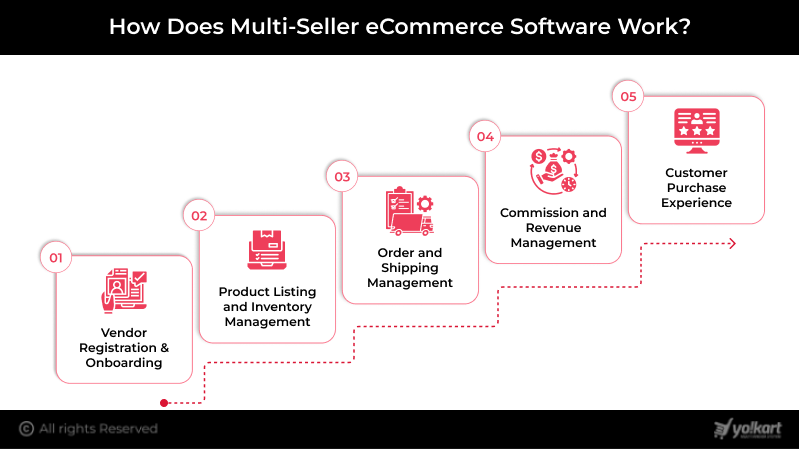
Step 1: Vendor Registration and Onboarding
The marketplace journey begins when vendors register on the platform and submit relevant business information for approval. Depending on the marketplace’s policies, administrators can automate approvals, manually review applications, request verification documents, or conduct seller assessments before granting access.
Once approved, vendors receive access to their dedicated dashboards, where they can configure store settings, upload branding assets, and familiarize themselves with marketplace policies. A streamlined onboarding experience not only improves seller satisfaction but also accelerates marketplace growth by reducing barriers to entry.
Step 2: Product Listing and Inventory Management
After onboarding, vendors can begin adding products or services to the marketplace. Through their dashboards, sellers can:
- Add product descriptions,
- Upload images and media files,
- Define pricing and discounts,
- Manage stock levels,
- Create product variants, and
- Categorize inventory appropriately.
Many marketplace platforms also include product approval workflows, allowing administrators to review listings before they go live. This helps maintain catalog quality, ensure compliance with marketplace standards, and deliver a consistent shopping experience for customers.
Step 3: Order and Shipping Management
When customers place orders, the marketplace software automatically routes order details to the respective vendors. Sellers can then manage fulfillment activities, including:
- Process incoming orders,
- Update order statuses,
- Generate invoices,
- Coordinate shipping activities,
- Share tracking information, and
- Manage returns or exchanges where applicable.
At the same time, marketplace administrators retain visibility across all transactions, enabling them to monitor performance, resolve disputes, and maintain service standards throughout the platform.
Step 4: Commission and Revenue Management
One of the key advantages of multi-seller marketplaces is their ability to generate revenue through flexible monetization models. Marketplace software simplifies this process by automating commission calculations and payment distribution.
Administrators can configure:
- Percentage-based commissions,
- Fixed commissions,
- Category-specific fees,
- Vendor subscription plans, or
- Hybrid revenue structures.
Automated financial management reduces administrative workload, improves transparency for vendors, and ensures that earnings are accurately distributed according to predefined rules.
Step 5: Customer Purchase Experience
For customers, the marketplace functions as a unified shopping destination where they can browse products or services from multiple sellers. Most platforms provide features that enable customers to:
- Search and filter products,
- Compare offerings from different sellers,
- Read ratings and reviews,
- Add products from multiple vendors to their cart,
- Complete secure transactions, and
- Track orders after purchase.
A smooth purchasing journey contributes directly to customer satisfaction, repeat business, and positive word-of-mouth referrals. As competition in the marketplace sector intensifies, delivering an exceptional customer experience becomes a key differentiator.
Accelerate Marketplace Growth with the Right Technology
Benefits of Using Multi-Seller eCommerce Software
Choosing a purpose-built marketplace platform offers several strategic advantages over developing a custom solution from scratch. Beyond simplifying operations, these platforms provide businesses with the tools needed to launch faster, scale efficiently, and create sustainable revenue opportunities.
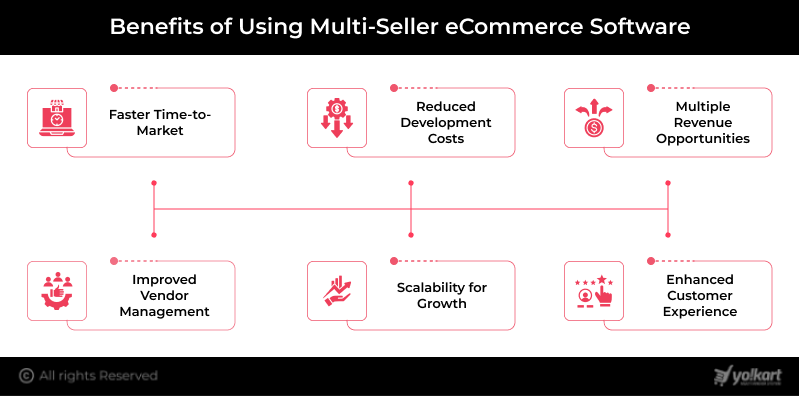
1. Faster Time-to-Market
Developing a marketplace from the ground up can take months or even years, depending on the platform’s complexity. Multi-vendor eCommerce software significantly shortens this timeline by providing pre-built capabilities such as:
- Vendor management,
- Product catalog management,
- Order processing,
- Commission handling, and
- Payment integrations.
By eliminating much of the development burden, businesses can focus their efforts on vendor acquisition, marketing initiatives, and customer engagement strategies.
2. Reduced Development Costs
Custom marketplace development often involves substantial investments in planning, design, development, testing, deployment, and ongoing maintenance. Multi-Seller eCommerce software minimizes these expenses by offering an established technological foundation that can be configured or customized according to business requirements.
This approach allows organizations to allocate resources more strategically while reducing the risks associated with lengthy development cycles.
3. Multiple Revenue Opportunities
One of the biggest advantages of the marketplace model is its ability to support diverse monetization strategies. Multi-seller eCommerce software enables businesses to generate revenue through various channels, including:
- Sales commissions,
- Vendor subscription plans,
- Featured product placements,
- Advertising opportunities,
- Transaction fees, and
- Premium seller services.
This flexibility enables businesses to experiment with different monetization strategies and build more resilient revenue models over time.
4. Improved Vendor Management
Managing multiple sellers manually can quickly become overwhelming as a marketplace expands. Dedicated vendor management tools simplify this process by empowering sellers to independently oversee their day-to-day operations.
Administrators can monitor marketplace activity while minimizing routine intervention through features such as:
- Seller approval workflows,
- Performance tracking,
- Communication tools,
- Policy enforcement mechanisms, and
- Reporting dashboards.
Efficient vendor management enhances seller satisfaction, improves operational efficiency, and encourages long-term marketplace participation.
5. Scalability for Growth
As marketplaces grow, they must accommodate increasing numbers of vendors, products, and transactions without compromising performance. Multi-seller marketplace software is built to scale alongside business growth.
Scalable marketplace software supports expansion by enabling businesses to manage:
- Larger product catalogs,
- Higher transaction volumes,
- Additional vendors,
- New geographic markets, and
- Evolving operational requirements.
This scalability allows businesses to pursue growth opportunities confidently without the need for frequent platform migrations or extensive redevelopment efforts.
6. Enhanced Customer Experience
Customers expect convenience, transparency, and reliability throughout their shopping journey. Marketplace software helps businesses meet these expectations by delivering features designed to improve usability and trust.
Modern platforms often include:
- Advanced search and filtering capabilities,
- Streamlined checkout experiences,
- Secure payment processing,
- Order tracking functionality,
- Product ratings and reviews, and
- Responsive, mobile-friendly interfaces.
Positive customer experiences often translate into repeat purchases, stronger brand loyalty, and increased customer lifetime value. In a competitive marketplace environment, delivering a superior user experience can play a critical role in long-term success.
Key Features to Look for in Multi-Seller eCommerce Software
Selecting the right multi-vendor marketplace platform requires evaluating its core capabilities and understanding how those capabilities align with your marketplace goals. While pricing and deployment models are important considerations, the long-term success of a marketplace often depends on the software’s ability to support vendors, streamline operations, and deliver a seamless customer experience.
Here are some of the most important features businesses should prioritize when evaluating multi-vendor eCommerce software:
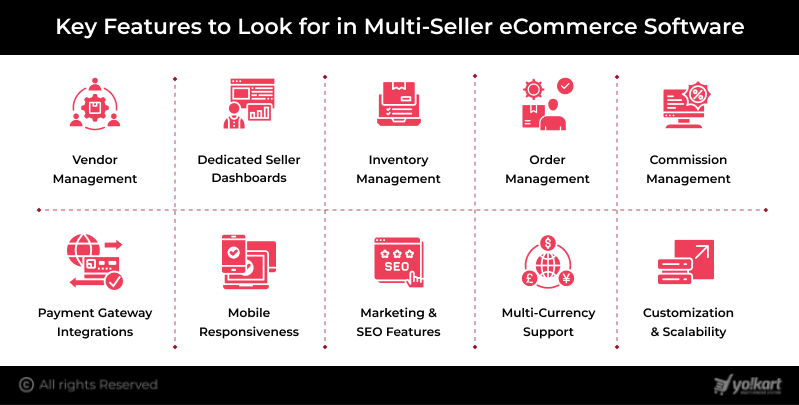
1. Vendor Management System
A comprehensive vendor management system forms the backbone of any successful marketplace. It enables administrators to onboard, monitor, and manage multiple sellers while maintaining platform quality and compliance.
Look for capabilities that enable administrators to:
- Approve or reject seller applications,
- Verify vendor credentials and documentation,
- Monitor seller performance and ratings,
- Manage permissions and access levels,
- Handle vendor communications effectively, and
- Suspend or reactivate vendor accounts when necessary.
Strong vendor management features help maintain quality control and foster trust among buyers and sellers.
2. Dedicated Seller Dashboards
Vendor dashboards allow sellers to manage their businesses independently without relying heavily on marketplace administrators. A well-designed dashboard improves seller satisfaction and reduces administrative workload.
Essential dashboard functionalities include:
- Product creation and editing tools,
- Order tracking and fulfillment updates,
- Sales reporting and performance analytics,
- Inventory control and stock alerts,
- Customer communication features, and
- Access to commission and payout information.
Providing vendors with self-service capabilities contributes to smoother marketplace operations and encourages long-term participation.
3. Product and Inventory Management
Managing large product catalogs across multiple sellers requires robust inventory management capabilities. A robust catalog management system ensures consistency while giving sellers the flexibility to showcase their offerings effectively.
Key features to consider include:
- Bulk product uploads,
- Product variants and attribute management,
- Category and subcategory assignments,
- Real-time inventory synchronization,
- Stock notifications and low-inventory alerts,
- Product approval workflows, and
- Support for digital and physical products where applicable.
Efficient inventory management minimizes overselling and enhances the overall shopping experience.
4. Order Management Capabilities
Order management tools play a critical role in ensuring timely fulfillment and customer satisfaction. The software should automate order processing and simplify coordination between vendors and administrators.
Look for features such as:
- Centralized order monitoring,
- Automated order notifications,
- Order status updates,
- Shipping and logistics integrations,
- Invoice generation,
- Return and refund management, and
- Customer order tracking functionality.
An effective order management system helps reduce errors and improve operational efficiency across the marketplace.
5. Flexible Commission Management
Every marketplace has unique monetization goals. A flexible commission system allows administrators to implement and modify revenue models as the business evolves.
Administrators should be able to configure:
- Fixed commissions,
- Percentage-based commissions,
- Category-specific commission rates,
- Vendor-specific commission structures,
- Subscription-based seller plans, and
- Promotional commission adjustments.
Flexible commission settings allow marketplace owners to optimize profitability while remaining competitive and attractive to vendors.
6. Payment Gateway Integrations
Secure and convenient payment processing is fundamental to building customer trust and improving conversions. The ideal platform should support multiple payment gateways to accommodate diverse customer preferences and regional requirements.
Important considerations include:
- Integration with popular payment providers,
- Support for split payments and vendor payouts,
- Multiple currency processing,
- Secure checkout experiences,
- Fraud prevention mechanisms, and
- Compliance with relevant payment security standards.
Offering a variety of payment options can expand market reach.
7. Mobile Responsiveness
With mobile commerce accounting for a growing share of online transactions, marketplaces must deliver consistent experiences across all devices. A mobile-friendly platform ensures that customers and vendors can access the marketplace and interact with each other conveniently.
Features to prioritize include:
- Responsive website design,
- Fast-loading mobile pages,
- Mobile-optimized checkout processes,
- Touch-friendly navigation, and
- Compatibility across major operating systems and browsers.
Some platforms also offer dedicated mobile applications, which can further enhance engagement and accessibility.
8. Marketing and SEO Features
Attracting traffic and retaining customers requires continuous marketing efforts. Built-in marketing and SEO capabilities can help marketplace owners improve visibility and drive sales without relying entirely on third-party tools.
Consider features such as:
- SEO-friendly URLs,
- Meta title and description management,
- Blog and content publishing capabilities,
- Promotional banners and campaigns,
- Discount coupons and special offers,
- Email marketing integrations, and
- Social media sharing options.
These tools can support customer acquisition strategies and contribute to sustainable marketplace growth.
9. Multi-Language and Multi-Currency Support
Businesses targeting international audiences should prioritize platforms that facilitate localization and global expansion. These capabilities help deliver personalized experiences and support global expansion.
Look for support for:
- Multiple languages,
- Multiple currencies,
- Region-specific tax configurations,
- Localized content management, and
- Country-specific payment and shipping options.
These capabilities make it easier to enter new markets and serve diverse customer segments effectively.
10. Customization and Scalability
No two marketplaces are identical, and business requirements often evolve. The selected software should be flexible enough to adapt to changing needs without requiring a complete platform overhaul.
Important considerations include:
- Customizable design and branding options,
- API availability for third-party integrations,
- Modular architecture for feature expansion,
- Capacity to support increasing traffic volumes,
- Scalability for growing vendor networks, and
- Ongoing updates and enhancement opportunities.
Choosing a scalable and customizable solution ensures that the marketplace can continue to grow alongside the business, reducing the need for costly migrations in the future.
Best Multi-Seller eCommerce Software Solutions
Selecting the right multi-seller eCommerce software is one of the most important decisions when launching an online marketplace. The software you choose directly impacts vendor onboarding, scalability, user experience, and long-term growth. While some solutions are designed specifically for marketplace businesses, others extend traditional eCommerce functionality through plugins or integrations.
To help entrepreneurs and businesses make an informed decision, we evaluated leading marketplace software solutions based on the following criteria:
- Marketplace-specific functionality
- Ease of setup and management
- Customization capabilities
- Pricing structure
- Scalability potential
- Vendor management features
- Mobile readiness
- Support and ecosystem
Let’s have a look at the best multi-seller eCommerce software solutions:
1. Yo!Kart
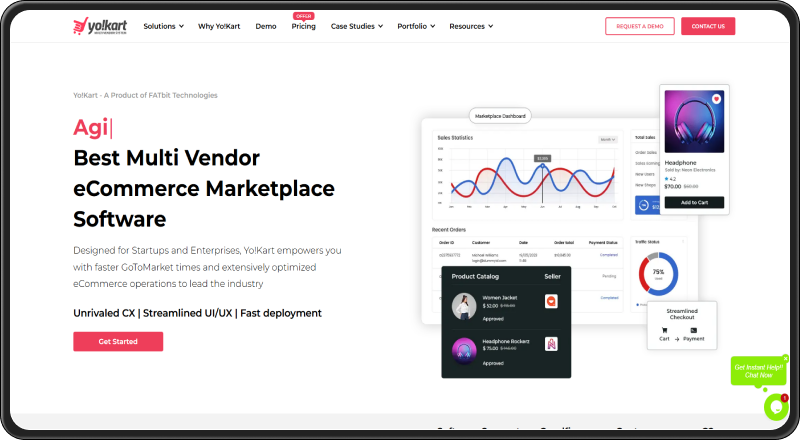
Yo!Kart is a purpose-built multi-vendor marketplace software developed specifically for businesses looking to build scalable online marketplaces. Unlike traditional eCommerce solutions that rely heavily on third-party plugins to enable marketplace functionality, Yo!Kart comes equipped with a comprehensive suite of built-in features designed to support marketplace operations from day one.
The software follows a self-hosted, white-label approach, allowing businesses to retain complete ownership of their marketplace while maintaining full control over branding, data, and platform customization. Its flexible architecture supports a wide range of business models, including B2C, B2B, rental, wholesale, and service-based marketplaces, making it suitable for startups as well as established enterprises seeking long-term scalability.
Key Features:
- Dedicated admin, seller, and buyer dashboards
- White-label marketplace solution
- Lifetime license model
- Multi-language and multi-currency support
- Product catalog management
- Flexible commission management
- Mobile app availability
- 20+ payment gateway integrations
- Marketing and promotional tools
- Advanced reporting and analytics
| Pros | Cons |
| Built specifically for multi-vendor marketplace businesses | Higher upfront investment compared to entry-level SaaS solutions |
| Extensive marketplace functionality available out of the box | |
| One-time license with no recurring platform fees | |
| Supports multiple marketplace business models | |
| Highly customizable and scalable architecture | |
| Complete ownership of marketplace data and source code |
- Pricing:
Yo!Kart follows a one-time licensing model with different packages based on business requirements. According to its official pricing page, plans start from $1,249 for a self-hosted lifetime license.
See How Yo!Kart Supports Marketplace Growth
2. CS-Cart Multi-Vendor
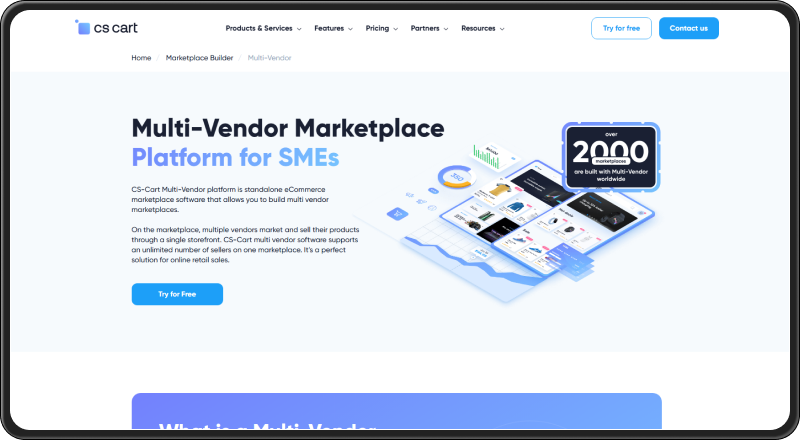
CS-Cart Multi-Vendor is a well-established marketplace solution that has been serving online marketplace businesses for many years. The software offers robust vendor management capabilities, allowing administrators to oversee marketplace operations while enabling sellers to manage their products, orders, and storefronts independently. Its extensive feature set makes it suitable for businesses seeking a balance between flexibility and operational control.
One of CS-Cart’s key strengths is its established ecosystem of add-ons, integrations, and developer support. As marketplace requirements evolve, businesses can extend functionality as their marketplace grows.
Key Features:
- Vendor-specific storefronts
- Product and inventory management
- Vendor payout management
- Multi-vendor checkout
- Built-in marketing tools
- Mobile-friendly interface
- Extensive add-on marketplace
| Pros | Cons |
| Mature and well-established marketplace ecosystem | Additional extensions can significantly increase overall costs |
| Strong vendor and commission management capabilities | The user interface may require a learning curve |
| Large library of add-ons and integrations | Some advanced features depend on third-party add-ons |
| Self-hosted deployment offers greater control | |
| Comprehensive administrative tools |
- Pricing:
CS-Cart follows a license-based pricing approach, with costs varying based on the edition selected. Its standard plan starts from $725/year with access to limited functionality, as per other higher cost plans.
3. Sharetribe
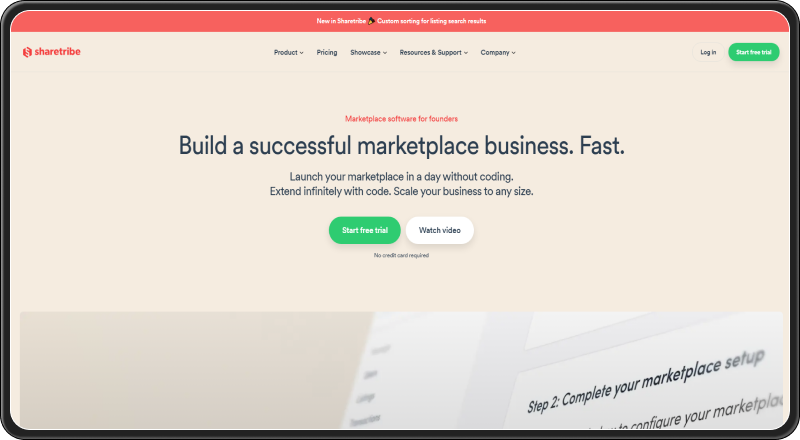
Sharetribe is a popular SaaS marketplace platform designed for entrepreneurs who want to validate and launch marketplace ideas quickly. It is particularly well-suited for service-based and peer-to-peer marketplaces. Its hosted infrastructure reduces technical complexity, allowing founders to focus on testing business concepts, attracting users, and refining their marketplace strategy.
The platform provides a no-code environment for launching marketplaces while also offering API access for businesses that require custom functionality. This makes Sharetribe suitable for MVP development, although extensive customization may require additional development resources as the business scales.
Key Features:
- No-code marketplace builder
- Vendor onboarding tools
- Payment integrations
- Booking and service marketplace support
- API access for custom development
- Hosted infrastructure
| Pros | Cons |
| Fast marketplace deployment | Recurring monthly subscription fees |
| Beginner-friendly interface | Limited flexibility compared to self-hosted solutions |
| No-code marketplace builder | Advanced customizations often require developer assistance |
| Reliable cloud-hosted infrastructure | Scaling custom functionality can become expensive |
| Ideal for validating marketplace concepts and MVPs |
- Pricing:
Subscription-based pricing with plans designed for startups and growing marketplaces. Packages start from $39/month for the test marketplace.
4. Arcadier

Arcadier is a cloud-based marketplace builder that supports multiple marketplace models, including product, service, rental, and procurement marketplaces. Its modular approach allows businesses to choose functionalities based on their operational needs, making it suitable for organizations exploring different marketplace concepts.
As a hosted platform, Arcadier reduces technical maintenance responsibilities and provides a relatively quick path to launch. The platform also offers APIs and integrations that enable businesses to expand functionality as marketplace requirements evolve.
Key Features:
- SaaS deployment
- Multiple marketplace templates
- Vendor management tools
- API integrations
- Mobile-responsive design
- Flexible monetization options
| Pros | Cons |
| Supports multiple marketplace business models | Ongoing subscription costs |
| Easy-to-use interface | Advanced customization may require developer support |
| Faster implementation compared to custom development | Certain features are limited to higher-tier plans |
| Hosted infrastructure reduces maintenance efforts | |
| Flexible monetization capabilities |
- Pricing:
Monthly subscription plans based on business requirements. Since no pricing is mentioned on the website, entrepreneurs have to request a quote.
5. Mirakl

Mirakl is an enterprise-grade marketplace platform trusted by large retailers and global brands. The platform focuses heavily on scalability, automation, and operational efficiency. It is designed to help enterprises expand product assortments through third-party sellers while maintaining governance, compliance, and operational control.
With an API-first architecture and extensive integration ecosystem, Mirakl enables enterprises to create highly scalable marketplace environments. However, its enterprise focus often exceeds the budgets and operational needs of startups and small businesses.
Key Features:
- Enterprise marketplace infrastructure
- Advanced vendor onboarding
- API-first architecture
- Automated seller management
- Global commerce capabilities
- Extensive third-party integrations
| Pros | Cons |
| Highly scalable enterprise-grade infrastructure | Premium pricing structure |
| Strong automation capabilities | Longer implementation timelines |
| Advanced seller onboarding and management | May exceed the needs of startups and SMEs |
| Extensive integration ecosystem | Requires dedicated technical and operational resources |
| Global commerce support |
- Pricing:
For managing up to 10,000 inventory products and yearly GMV up to $600,000, Mirakl offers packages starting from $699/month.
6. Shopify with Marketplace Apps
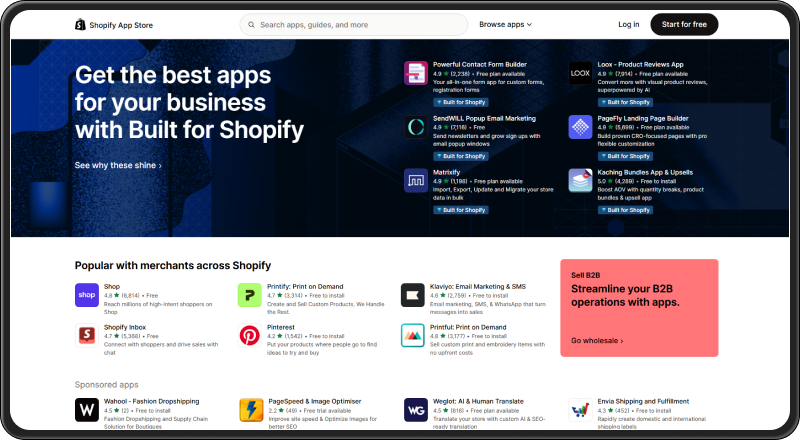
Shopify is one of the world’s most recognized eCommerce platforms. Businesses can extend their functionality using marketplace applications to enable multi-seller capabilities. This approach allows existing Shopify merchants to experiment with marketplace models without migrating to an entirely new platform.
The platform offers an intuitive interface, secure hosting, and a large ecosystem of third-party integrations. However, marketplace functionality largely depends on external applications, which can increase both complexity and recurring costs.
Key Features:
- User-friendly interface
- Extensive app ecosystem
- Secure hosted infrastructure
- Mobile optimization
- Marketing integrations
- Payment processing support
| Pros | Cons |
| User-friendly interface | Marketplace functionality depends on third-party apps |
| Reliable hosted infrastructure | Subscription and app costs can accumulate over time |
| Extensive app ecosystem | Limited native marketplace capabilities |
| Strong community and support resources | Custom workflows may require additional development |
| Familiar environment for existing Shopify users |
- Pricing:
Subscription pricing plus additional app costs. For up to 10 inventory locations and 3 catalogs, Shopify charges $21/month.
7. Magento with Marketplace Extensions

Magento (Adobe Commerce) offers extensive customization capabilities and can be transformed into a marketplace through third-party extensions. Its flexibility makes it attractive for businesses with unique operational requirements and access to experienced development teams.
Its open-source architecture provides significant control over functionality, integrations, and user experience. However, implementation complexity, maintenance requirements, and extension costs can make it a resource-intensive option.
Key Features:
- Open-source flexibility
- Advanced catalog management
- Large developer ecosystem
- Multi-store capabilities
- Extensive integration support
| Pros | Cons |
| Highly customizable platform | Requires technical expertise |
| Strong scalability potential | Longer deployment timelines |
| Large developer ecosystem | Marketplace extensions increase total costs |
| Suitable for complex business requirements | Ongoing maintenance responsibilities |
| Extensive integration capabilities |
- Pricing:
Varies significantly depending on deployment and extension requirements. You can download Magento Open Source for free, but have to pay for hosting, UI/UX design, integration,n and more.
8. Marketplacer
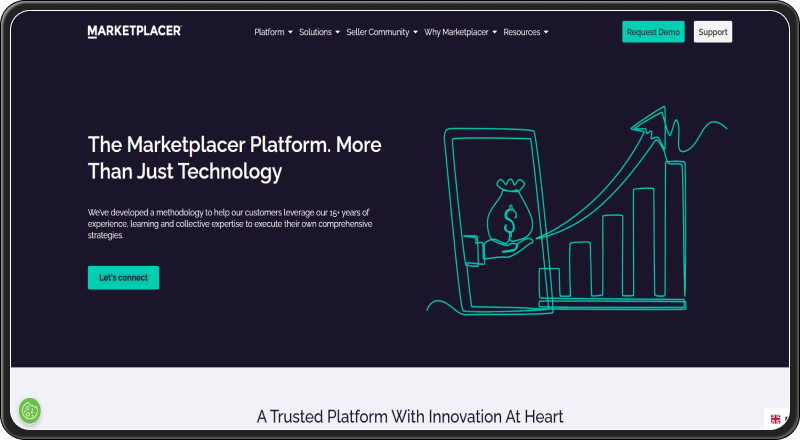
Marketplacer provides enterprise marketplace technology that enables organizations to connect buyers and sellers within curated marketplace environments. The platform emphasizes operational efficiency and supports businesses seeking to diversify revenue streams through marketplace expansion.
Its enterprise-grade infrastructure and marketplace-specific capabilities make it suitable for organizations looking to launch large-scale marketplaces while maintaining control over operations and customer experiences.
Key Features:
- Enterprise-grade infrastructure
- Seller management tools
- API integrations
- Order orchestration
- Marketplace analytics
- Multi-channel capabilities
| Pros | Cons |
| Enterprise-ready infrastructure | Premium pricing model |
| Comprehensive marketplace capabilities | Better suited for established businesses than startups |
| Reliable performance and scalability | Implementation may require strategic planning |
| Strong seller management tools | May require technical expertise during deployment |
| Supports large marketplace ecosystems |
- Pricing:
Custom pricing.
9. Dokan
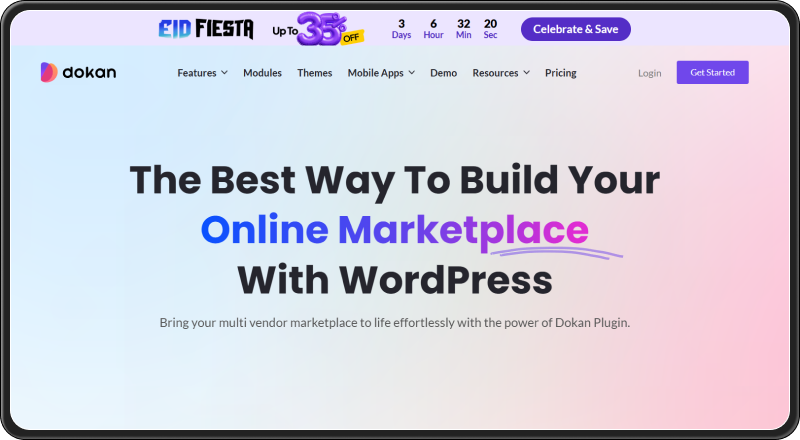
Dokan is a WordPress plugin that transforms WooCommerce stores into multi-vendor marketplaces. It offers an accessible entry point for businesses already familiar with the WordPress ecosystem and looking for a cost-effective way to add marketplace functionality.
The plugin provides vendor dashboards, commission management, and marketplace management features while leveraging WooCommerce’s extensive plugin ecosystem. However, scalability and performance may become concerns as marketplace complexity grows.
Key Features:
- Vendor dashboards
- Product management tools
- Commission settings
- WooCommerce compatibility
- Multiple payment integrations
- Reporting capabilities
| Pros | Cons |
| Affordable entry point | Dependent on WordPress infrastructure |
| Familiar WordPress environment | Additional plugins may be required |
| Large community support | Scalability limitations for larger marketplaces |
| Flexible plugin ecosystem | Performance optimization may become necessary as the marketplace grows |
| Seamless WooCommerce integration |
- Pricing:
Annual subscription pricing with tiered plans. Packages start from $59/month in addition to the setup cost of $199.
Looking for the Right Multi-Seller eCommerce Software?
10. Nautical Commerce
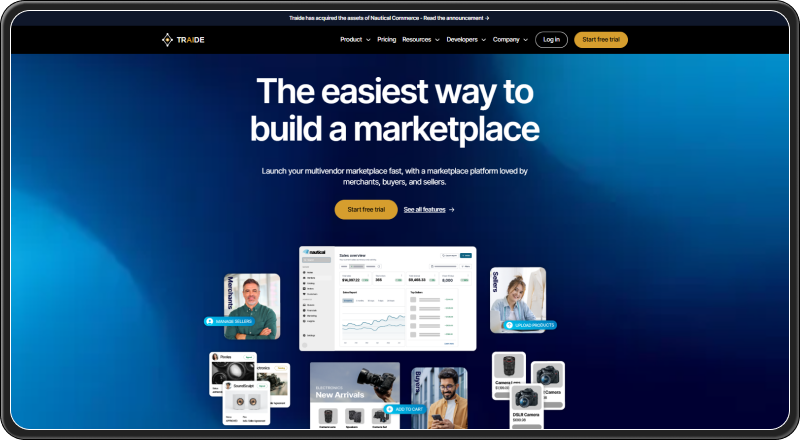
Nautical Commerce is a modern marketplace platform focused on helping brands and retailers launch curated marketplaces efficiently. The platform aims to simplify marketplace operations through automation and streamlined vendor management capabilities.
Its marketplace-first architecture helps businesses reduce operational complexity while accelerating time-to-market. However, pricing transparency remains limited, and advanced functionality may require higher-tier plans.
Key Features:
- Hosted marketplace infrastructure
- Vendor onboarding capabilities
- Product synchronization
- Order routing
- Commission management
- Analytics tools
| Pros | Cons |
| Built specifically for marketplace operations | Subscription-based pricing model |
| Modern and scalable architecture | Limited public pricing transparency |
| Faster deployment timelines | Advanced features may require higher-tier plans |
| Strong vendor management capabilities | |
| Simplifies marketplace workflows through automation |
- Pricing:
Nautical Commerce starts pricing from $59/month under its growth package and keeps 1% transaction fee. However, for advanced features and large scale, this cost increases significantly.
Which Multi-Seller eCommerce Software is Right for You?
There is no universally perfect marketplace software. The ideal solution depends on your business goals, budget, technical capabilities, and long-term growth plans.
For quick deployment and minimal technical involvement, SaaS solutions like Sharetribe and Arcadier are popular choices. Businesses already invested in ecosystems like WordPress or Shopify may find Dokan or Shopify marketplace applications more practical due to their familiarity and ease of adoption.
For organizations requiring extensive customization and greater control over infrastructure, platforms such as Magento and CS-Cart offer flexibility, although they often demand additional technical expertise. Enterprise businesses focused on large-scale operations and automation may benefit from solutions like Mirakl or Marketplacer.
Meanwhile, businesses seeking a marketplace platform built specifically for multi-vendor commerce, with ownership of the software and a broad set of built-in marketplace capabilities, may consider solutions such as Yo!Kart.
Comparison Table of the Best Multi-Seller eCommerce Software
After reviewing the leading marketplace platforms, it becomes clear that each solution caters to different business requirements. Some prioritize rapid deployment, while others focus on scalability, customization, or enterprise-level functionality.
The following comparison table provides a high-level overview to help businesses narrow down their options.
| Software | Deployment Type | Pricing Model | White-Label Capabilities | Mobile App Support | Customization Level | Best For |
| Yo!Kart | Self-Hosted | One-Time License | Yes | Yes | High | Startups, SMEs & Enterprises |
| CS-Cart Multi-Vendor | Self-Hosted | One-Time License | Yes | Optional | High | SMBs |
| Sharetribe | SaaS | Subscription | Limited | Limited | Moderate | MVPs & Startups |
| Arcadier | SaaS | Subscription | Yes | Optional | Moderate | SMBs |
| Mirakl | Enterprise | Custom Pricing | Yes | Yes | High | Large Enterprises |
| Shopify + Marketplace Apps | SaaS | Subscription + App Costs | Partial | Yes | Moderate | Existing Shopify Merchants |
| Magento with Extensions | Self-Hosted | Variable | Yes | Optional | High | Businesses with Technical Teams |
| Marketplacer | Enterprise | Custom Pricing | Yes | Yes | High | Established Brands |
| Dokan | Self-Hosted (WordPress) | Annual Subscription | Limited | Optional | Moderate | Small Businesses |
| Nautical Commerce | SaaS | Custom Pricing | Yes | Optional | Moderate | Growing Marketplace Businesses |
While this comparison provides a useful starting point, businesses should conduct a detailed assessment based on their specific operational requirements and long-term growth plans.
How to Choose the Right Multi-Seller eCommerce Software?
Selecting the best multi-seller eCommerce software requires more than simply comparing features or pricing. The ideal platform should align with your business objectives, target audience, available resources, and expansion strategy.
Below are some important factors to consider during the evaluation process.
1. Define Your Marketplace Vision
Before exploring software options, establish clarity around the type of marketplace you intend to build, whether it focuses on products, services, rentals, or B2B transactions. Understanding your target audience, vendor requirements, and operational goals will help you shortlist solutions that best support your business model and long-term objectives.
2. Evaluate Your Budget Carefully
Marketplace software costs extend beyond the initial purchase price or subscription fee. Businesses should also consider expenses related to hosting, customization, integrations, maintenance, upgrades, and ongoing support. Evaluating the total cost of ownership helps ensure that the chosen platform remains financially viable as the marketplace grows.
3. Assess Scalability Requirements
Marketplace success often leads to increased traffic, larger product catalogs, expanding vendor networks, and higher transaction volumes. Choosing a scalable platform ensures that your marketplace can accommodate future growth, new revenue streams, and market expansion without requiring costly migrations.\
4. Review Vendor Management Features
Vendors are essential stakeholders within a marketplace ecosystem. Look for software that offers intuitive vendor dashboards, streamlined onboarding, commission management, performance tracking, and communication tools. Strong vendor management capabilities can improve seller satisfaction, retention, and overall marketplace performance over time.
5. Consider Customization Flexibility
Every marketplace evolves as businesses grow and customer expectations change. Choosing software that supports custom workflows, third-party integrations, industry-specific features, and branding modifications provides the flexibility needed to adapt and innovate without being constrained by the platform’s limitations.
6. Examine Support and Maintenance Options
Reliable support can significantly impact implementation success and ongoing marketplace operations. Evaluate whether the software provider offers technical assistance, onboarding guidance, documentation, knowledge resources, and maintenance services. Strong support infrastructure can help minimize disruptions and ensure smoother marketplace management.
Final Consideration: The best multi-seller eCommerce software is one that aligns with your business objectives, technical capabilities, and growth plans. By carefully assessing functionality, scalability, customization, vendor management, and support services, businesses can select a solution that delivers long-term value and supports sustainable marketplace growth.
Why Businesses Consider Yo!Kart for Marketplace Development?
With numerous marketplace software solutions available, choosing the right platform can be challenging. Many businesses look for a solution that balances functionality, flexibility, scalability, and long-term value. As a purpose-built marketplace software, Yo!Kart has gained recognition among entrepreneurs, startups, SMEs, and enterprises for its marketplace-focused approach and comprehensive feature set.
1. Marketplace-Centric Functionality
Unlike general eCommerce platforms that require additional extensions to support multi-vendor operations, Yo!Kart offers many marketplace capabilities natively. It comes equipped with essential marketplace features such as vendor management, commission handling, product catalog management, order processing, and payment management, helping businesses streamline implementation and reduce dependency on external plugins.
2. Ownership-Based Licensing Model
Yo!Kart follows a one-time licensing approach, which may appeal to businesses seeking to avoid ongoing subscription commitments. For organizations focused on reducing ongoing software expenses and maximizing long-term value, this ownership-based approach can be a significant advantage.
3. Support for Global Expansion
Expanding into international markets requires software that can accommodate diverse customer and vendor needs. Yo!Kart includes features designed to support global marketplace operations, including:
- Multi-language functionality,
- Multi-currency support, and
- Integration flexibility.
These features can be particularly valuable for businesses targeting geographically diverse audiences.
4. Adaptability Across Industries
Marketplace requirements vary significantly between sectors. Purpose-built marketplace solutions that support customization can accommodate a broad range of use cases, including:
- Retail marketplaces,
- B2B marketplaces,
- Niche marketplaces, and
Service-oriented platforms. This versatility allows businesses to build marketplaces tailored to their industry and target audience while maintaining the flexibility to evolve as market demands change.
5. Focus on Scalability
As marketplaces grow, operational complexity increases. Businesses often evaluate whether a platform can continue supporting evolving needs without extensive redevelopment. Yo!Kart is designed to scale alongside business growth, enabling organizations to manage:
- Vendor expansion,
- Product catalog growth,
- Increased transaction volumes, and
- Additional feature requirements.
For organizations prioritizing these factors, marketplace-focused software such as Yo!Kart may warrant closer consideration during the software selection process.
Schedule a Personalized Demo to See Yo!Kart in Action
Conclusion
Online marketplaces have become a driving force in modern eCommerce, enabling businesses to connect buyers and sellers through scalable digital ecosystems. However, marketplace success depends not only on the business idea itself but also on selecting the right technology foundation to support growth, operations, and user experiences.
When evaluating multi-seller eCommerce software, businesses should consider factors such as scalability, customization capabilities, vendor management features, ownership, and total cost of ownership. While some businesses may prioritize rapid deployment through SaaS solutions, others may seek greater ownership, flexibility, and marketplace-specific functionality.
Ultimately, there is no one-size-fits-all solution. Evaluating each platform objectively and considering factors such as scalability, vendor management capabilities, revenue models, and total cost of ownership can help businesses make informed decisions.
For organizations exploring marketplace-focused solutions, platforms such as Yo!Kart offers a combination of built-in marketplace functionality, customization flexibility, ownership advantages, and scalability, making it a strong option for launching and growing a successful multi-seller marketplace.
Frequently Asked Questions (FAQs)
Q 1. What is multi-seller eCommerce software?
Ans. Multi-Seller eCommerce software is a platform that enables multiple independent vendors to sell products or services through a single online marketplace. The marketplace owner manages operations, while vendors handle their inventories, orders, and customer interactions through dedicated dashboards.
Q 2. What is the difference between multi-seller and multi-vendor software?
Ans. The terms “multi-seller” and “multi-vendor” are often used interchangeably. Both refer to marketplace software that supports multiple vendors operating within one platform. The terminology may vary by provider, but the underlying functionality and business model remain largely the same.
Q 3. Which is the best multi-seller eCommerce software?
Ans. The best multi-seller eCommerce software depends on your business requirements, budget, technical capabilities, and growth objectives. Some businesses prioritize rapid deployment, while others focus on ownership, scalability, or enterprise functionality.
Q 4. How much does multi-seller marketplace software cost?
Ans. The cost of multi-seller marketplace software varies based on the platform, deployment model, features, and customization requirements. Subscription-based solutions may involve monthly fees, while self-hosted platforms may require one-time licensing investments alongside hosting and customization expenses.
Q 5. Can multi-seller eCommerce software be customized?
Ans. Yes, most modern multi-seller marketplace software offers customization options. Depending on the software, businesses can modify branding, user interfaces, workflows, integrations, and marketplace features to align with their specific operational needs and long-term growth objectives.
Q 6. Is white-label marketplace software a good investment?
Ans. White-label marketplace software can be a valuable investment for businesses seeking complete branding control and faster market entry. It enables entrepreneurs to launch under their own brand while avoiding the time, cost, and complexity associated with custom development.
Q 7. Can startups use multi-seller eCommerce software?
Ans. Yes, many marketplace platforms are designed with startups in mind, offering ready-made features, faster deployment, and scalable infrastructure. This allows entrepreneurs to launch quickly, validate their business model, and grow without significant upfront development costs.
In Search for the Best Multi-Seller eCommerce Software?
Reach OutPopular Posts