
Published Date 08th May, 2026
Which Is More Profitable: Marketplace or Traditional eCommerce?
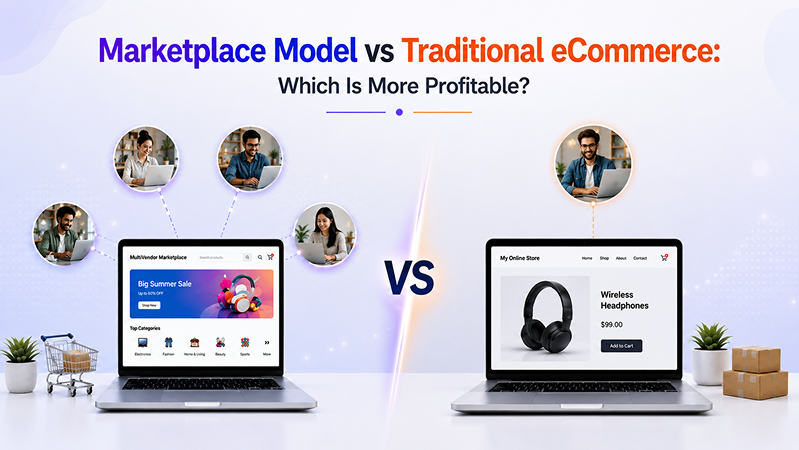
The answer lies in several factors. You can’t describe any of the models as more or less profitable until you understand and compare them both.
In this comprehensive guide, we’ll compare the marketplace model vs traditional eCommerce model, analyze their profitability potential, advantages, challenges, and help you determine which business model is better suited for sustainable growth in 2026 and beyond.
However, before we dive deep, take a glimpse at the industry and identify opportunities for entrepreneurs, founders and startups yet to tap into the eCommerce landscape.
The global eCommerce industry is evolving faster than ever, giving entrepreneurs multiple ways to build and scale online businesses. While traditional eCommerce stores continue to succeed across niche and branded markets, multi-vendor marketplace platforms are rapidly emerging as one of the most scalable and profitable digital commerce models worldwide.
From industry giants like Amazon and Alibaba to niche multi-vendor startups, marketplace businesses are reshaping how products are bought, sold, and distributed online.
Table of Contents
- What Is Traditional eCommerce?
- What Is a Marketplace Business Model?
- Marketplace vs Traditional eCommerce: Key Differences
- Which Model Has Higher Profit Potential?
- Why Many Entrepreneurs Are Choosing Marketplace Platforms
- What Makes Marketplace Models More Profitable than Traditional
- Is Traditional eCommerce Still Profitable?
- Challenges of Traditional eCommerce
- Conclusion
- FAQs
What is Traditional eCommerce?
Traditional eCommerce is a single-vendor online business model where one company sells its own products or services directly to customers through a dedicated online store or website.
These stores are operated under a single brand and offer complete control over the customer experience, product catalog, and operational processes.
Traditional eCommerce has remained a popular business model because it allows brands to establish stronger customer relationships, maintain higher control over product quality, and build a distinct market identity.
However, as businesses grow, this model often requires significant investment in inventory, warehousing, shipping operations, and customer acquisition, which can directly impact scalability and long-term profitability.
The business owner is fully responsible for:
- Product sourcing or manufacturing
- Inventory management
- Warehousing and logistics
- Pricing and promotions
- Order fulfillment
- Customer support and returns
Popular examples of traditional eCommerce businesses include:
- Direct-to-Consumer (D2C) brands
- Shopify-powered online stores
- Brand-owned retail websites
- Niche product stores
- Private-label businesses
What Is a Marketplace Business Model?
A marketplace business model provides a single centralized platform ecosystem for multiple sellers. They offer products or services to customers through a single digital ecosystem. Instead of selling their own inventory, the marketplace owner acts as an intermediary that connects buyers and sellers while managing the overall platform operations.
Amazon, Alibaba, eBay and Etsy are a few popular and largest eCommerce platforms that follow the marketplace business model.
Unlike traditional eCommerce stores, marketplace businesses do not typically require heavy inventory investments or warehousing infrastructure. It’s a highly scalable and asset-light business model.
In this model:
- Vendors manage their own products, pricing, and inventory
- Customers gain access to a wider variety of products and sellers benefit from larger customer bases.
- The marketplace owner earns revenue via multiple revenue channels, including commissions, subscriptions, advertisements, featured listings, or transaction fees
Top marketplace business models that are being widely adopted across industries:
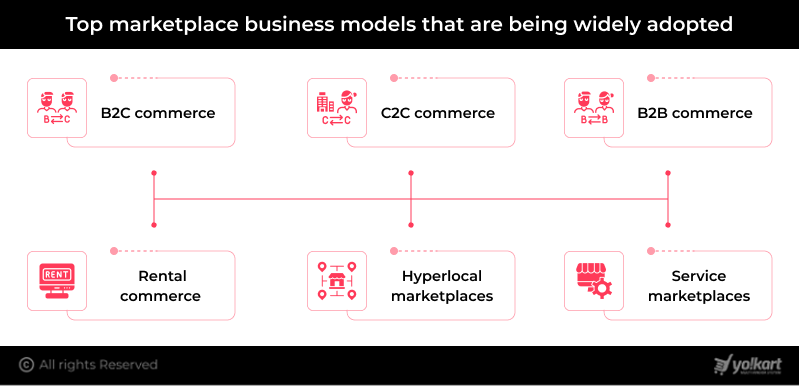
- B2C commerce
- C2C commerce
- B2B commerce
- Rental commerce
- Hyperlocal marketplaces
- Service marketplaces and more
Marketplace vs Traditional eCommerce: Key Differences
Although both traditional eCommerce stores and marketplace platforms operate within the online commerce ecosystem, their business structures, operational models, and revenue generation strategies differ significantly.
Understanding these differences is essential for entrepreneurs planning to launch a scalable and profitable online business.
Traditional eCommerce focuses on selling products directly under a single brand, whereas a marketplace platform enables multiple vendors to sell products or services through one centralized platform. As a result, both models vary in terms of investment requirements, operational complexity, scalability, and long-term profitability potential.
A detailed comparison of the traditional eCommerce model vs. the marketplace model:
| Feature | Traditional eCommerce | Marketplace Model |
| Business Structure | Single-vendor store | Multi-vendor platform |
| Inventory Ownership | Managed by the business owner | Managed by individual vendors |
| Revenue Model | Product sales margins | Commissions, subscriptions, listing fees, ads and more |
| Product Variety | Limited to owned inventory | Extensive catalog from multiple sellers |
| Initial Investment | Higher due to inventory and warehousing | Lower no inventory or warehousing needed |
| Scalability | Moderate and operationally intensive | Highly scalable |
| Operational Responsibility | Full responsibility for sourcing, inventory, logistics, and fulfillment | Platform and vendor ecosystem management |
| Customer Experience | Controlled entirely by one brand | Shared across multiple vendors |
| Risk Factor | Higher inventory and operational risk | Lower inventory-related risk |
| Growth Potential | Dependent on internal expansion | Accelerated through vendor onboarding |
| Revenue Streams | Usually limited to direct sales | Multiple recurring revenue opportunities |
| Market Expansion | Slower due to operational limitations | Faster category and geographic expansion |
The Core Difference
The biggest difference between traditional eCommerce and marketplace businesses lies in how they scale.
In a traditional eCommerce model, growth typically requires more inventory, a larger warehouse, and increased operational expenses.
On the other hand, marketplace platforms grow simply by onboarding the maximum number of vendors and customers, allowing the platform to expand its product catalog and customer reach without proportionally increasing inventory investment.
This is one of the primary reasons why marketplace businesses are increasingly becoming the preferred model for entrepreneurs looking to build scalable and future-ready digital commerce platforms.
Which Model Has Higher Profit Potential?
When comparing the marketplace model vs traditional eCommerce, profitability is one of the most important factors entrepreneurs consider before choosing a business model. While both models can generate substantial revenue, their profitability structure, operational costs, and long-term scalability act differently.
In a traditional eCommerce business, profits are primarily generated through direct product sales. The business purchases or manufactures products, manages inventory, and earns margins on each sale. As the business grows, operational complexity and capital requirements also increase, which can directly affect long-term scalability and net profitability.
On the other hand, marketplace businesses operate on a more scalable and asset-light structure. Instead of managing inventory themselves, marketplace owners facilitate transactions between buyers and sellers while earning recurring revenue via multiple channels.
This allows marketplace platforms to scale faster without proportionally increasing operational costs.
Seeking Expert Advice on Which One of the Business Models is More Profitable?
Why Many Entrepreneurs Are Choosing Marketplace Platforms
In recent years, marketplace businesses have gained massive popularity. Lower inventory dependency, faster market expansion, long-term sustainability, recurring and diversified revenue generation opportunities are a few factors that attract entrepreneurs to launch their own multi-vendor marketplaces.
For entrepreneurs planning to launch scalable multi-vendor platforms, solutions like Yo!Kart helps accelerate marketplace development with built-in multi-vendor functionality, vendor management tools, and commission management systems, with complete and customization flexibility.
Discover All Essential Features of Readymade Marketplace Software
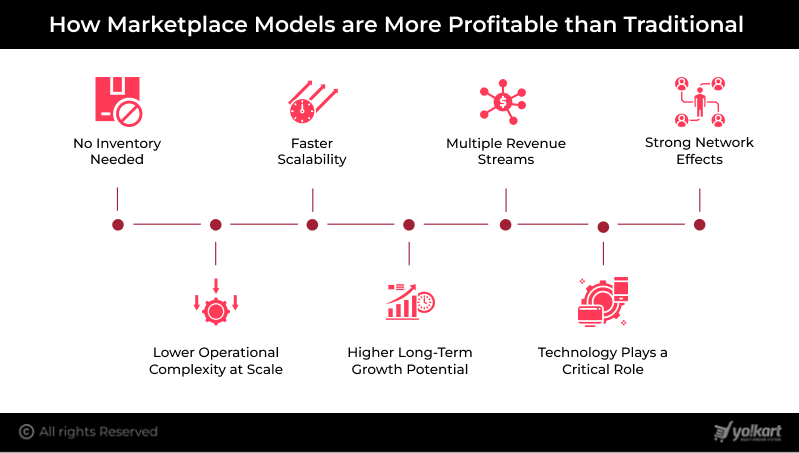
How Marketplace Models are More Profitable than Traditional
As digital commerce continues to evolve, marketplace platforms are increasingly becoming one of the most scalable, flexible, future-ready and profitable online business models for entrepreneurs and enterprises alike. Let’s explore the factors below and understand why marketplace models are more profitable.
1. No Inventory Needed
Traditional eCommerce businesses often require significant upfront investment in stock and warehousing. Marketplace businesses eliminate much of this burden because vendors manage their own inventory and fulfillment operations.
Since vendors handle:
- Product sourcing
- Stock management
- Packaging
- Shipping and fulfillment
2. Faster Scalability
A marketplace grows by onboarding more vendors rather than continuously investing in products and storage infrastructure. As more sellers join the platform, product variety expands organically, attracting more customers and increasing transaction volume.
As new sellers join the platform:
- Product variety automatically increases
- More categories become available
- Customer choices expand
- Platform engagement improves
3. Multiple Revenue Streams
Unlike traditional online stores that mainly depend on product sales margins, marketplace platforms can generate recurring income from several monetization channels simultaneously, creating more stable and diversified revenue streams.
Common marketplace revenue streams include:
- Commission on each sale
- Vendor subscription plans
- Featured product listings
- Advertising placements
- Transaction fees
- Premium seller services
4. Strong Network Effects
Marketplace businesses benefit from network effects. A marketplace platform can offer a significantly broader product selection because inventory comes from multiple vendors instead of a single business. Customers are naturally more likely to engage with platforms that provide extensive product choices and competitive pricing options.
Marketplaces focus on onboarding the maximum number of vendors. More vendors attract more customers and more customers attract more vendors, vice versa. This creates a self-sustaining growth cycle that becomes increasingly difficult for competitors to replicate over time.
A larger catalog helps:
- Improve customer retention
- Increase average order value
- Enhance platform competitiveness
- Attract diverse customer segments
5. Lower Operational Complexity at Scale
While marketplace management involves vendor moderation and platform operations, it often avoids many large-scale inventory and fulfillment challenges associated with traditional eCommerce businesses.
This allows marketplace owners to focus more on:
- Platform growth
- Vendor acquisition
- Customer experience
- Marketing and expansion
6. Higher Long-Term Growth Potential
Marketplace platforms are designed for ecosystem-driven growth. Over time, they can evolve into large-scale digital commerce hubs serving thousands of buyers and sellers simultaneously. As digital commerce continues evolving worldwide, marketplace businesses are increasingly becoming one of the most sustainable and profitable online business models for long-term expansion.
This makes the marketplace model particularly attractive for entrepreneurs aiming to build:
- Scalable online businesses
- Multi-vendor ecosystems
- Industry-specific marketplaces
- Global commerce platforms
7. Technology Plays a Critical Role
The role of technology can’t be overlooked when talking about the growth and potential of the marketplace business model. Launching and managing a successful marketplace requires specialized features such as:
- Vendor management
- Commission systems
- Multi-seller order processing
- Subscription management
- Product approvals
- Advanced analytics
- Payment gateway integrations
For businesses planning to enter the marketplace industry, using dedicated marketplace software can significantly reduce development complexity and accelerate time-to-market.
Purpose-built marketplace software solutions like
Yo!Kart
help entrepreneurs launch scalable multi-vendor platforms with ready-made marketplace functionality, customization capabilities, and faster deployment timelines.
Is Traditional eCommerce Still Profitable?
Absolutely. Brands that maintain strong customer loyalty and differentiated products can achieve impressive profit margins and long-term growth. However, scaling a traditional eCommerce business often requires continuous operational expansion, which may increase costs over time.
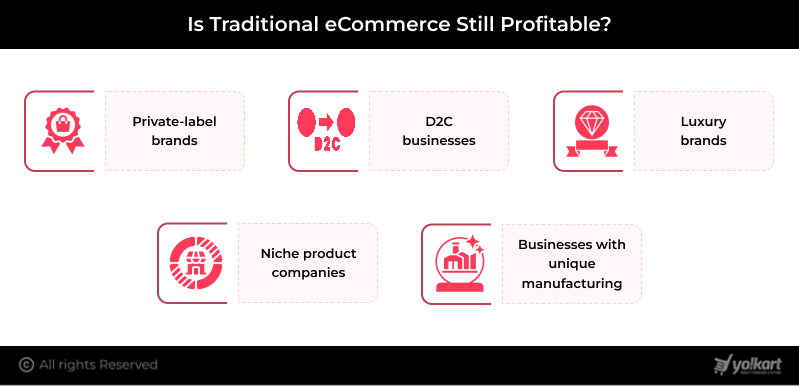
Traditional eCommerce remains highly profitable for:
- Private-label brands
- D2C businesses
- Luxury brands
- Niche product companies
- Businesses with unique manufacturing advantages
Challenges of Traditional eCommerce
Traditional eCommerce remains a highly successful business model for many brands and online retailers. However, as competition increases and customer expectations continue evolving, scaling a traditional online store can become increasingly complex and resource-intensive.
Unlike marketplace platforms that distribute operational responsibilities across multiple vendors, traditional eCommerce businesses must independently manage nearly every aspect of operations — from inventory procurement to fulfillment and customer support.
As businesses grow, these operational demands can significantly impact profitability, scalability, and long-term sustainability.
Here are some of the biggest challenges associated with traditional eCommerce businesses:
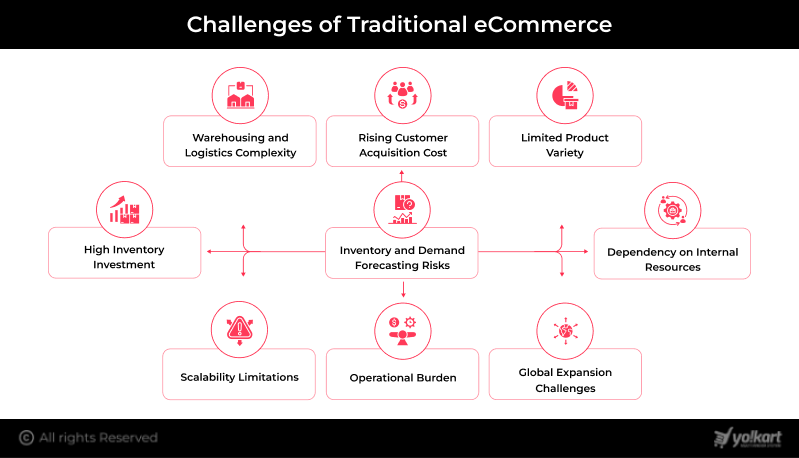
1. High Inventory Investment
One of the most significant challenges in traditional eCommerce is maintaining inventory. This requires substantial upfront capital investment and increases financial risk, especially if products do not sell as expected.
In addition, overstocking can lead to dead inventory, while understocking may result in lost sales opportunities and poor customer experience.
Businesses often need to:
- Purchase products in bulk
- Store inventory in warehouses
- Manage stock replenishment
- Forecast product demand
2. Warehousing and Logistics Complexity
As order volumes increase, managing warehousing and logistics becomes more challenging. These operational processes require dedicated infrastructure, manpower, and ongoing operational expenses that can directly reduce profit margins.
Traditional eCommerce businesses are responsible for:
- Inventory storage
- Packaging operations
- Shipping coordination
- Delivery management
- Reverse logistics and returns
3. Scalability Limitations
Scaling a traditional eCommerce business often requires proportional increases in operational investment. This makes rapid growth more operationally intensive compared to marketplace platforms, where product expansion is largely driven by vendor onboarding.
To expand the business, companies usually need:
- More inventory
- Larger storage facilities
- Additional staff
- Expanded logistics capabilities
- Higher working capital
4. Rising Customer Acquisition Costs
The digital commerce industry has become extremely competitive. Traditional eCommerce businesses often rely heavily on paid marketing campaigns to drive traffic and sales, which can reduce overall profitability if customer retention rates are low.
Costs rise significantly across platforms like:
- Search engines
- Social media advertising
- Influencer marketing
- Marketplace advertising networks
5. Inventory and Demand Forecasting Risks
Predicting customer demand accurately is one of the most difficult aspects of running a traditional online store.
Businesses must constantly balance:
- Seasonal demand fluctuations
- Market trends
- Supplier timelines
- Inventory turnover
Poor forecasting can result in:
- Excess stock
- Revenue loss
- Discount dependency
- Cash flow challenges
These risks become even more difficult to manage as product catalogs expand.
6. Operational Burden
As the business scales, operational complexity grows rapidly and may require larger internal teams and specialized systems. Traditional eCommerce businesses must independently handle almost every operational responsibility, including:
- Supplier coordination
- Product management
- Inventory tracking
- Customer support
- Returns processing
- Fraud prevention
- Payment management
7. Limited Product Variety
Since product offerings depend on internally managed inventory, traditional eCommerce stores may struggle to match the product diversity offered by multi-vendor marketplace platforms.
Limited catalogs can affect:
- Customer retention
- Repeat purchases
- Cross-selling opportunities
- Competitive positioning
In contrast, marketplaces can continuously expand their offerings through vendor participation.
8. Global Expansion Challenges
Expanding a traditional eCommerce business into new regions often requires:
- Local warehousing
- International shipping support
- Tax and compliance management
- Regional payment integrations
- Local supplier partnerships
This can significantly increase operational and financial complexity for growing businesses.
9. Dependency on Internal Resources
Traditional online stores depend heavily on the business owner’s ability to manage sourcing, logistics, operations, and marketing internally.
This creates operational bottlenecks and makes growth highly dependent on internal execution capabilities.
Marketplace businesses, on the other hand, distribute much of this responsibility across vendors.
Want to Launch a Multi-Vendor Marketplace?
Conclusion
Both traditional eCommerce and marketplace platforms offer strong business opportunities, but their profitability, scalability, and operational structures differ significantly.
Traditional eCommerce is best suited for businesses that want full control over branding, inventory, pricing, and customer experience. It remains a highly effective model for D2C brands, niche businesses, and companies with unique product offerings or strong supply chain capabilities.
However, scaling a traditional online store often requires continuous investment in inventory, warehousing, logistics, and operational management, which can increase complexity and costs over time.
On the other hand, the marketplace model has emerged as one of the most scalable and future-ready business approaches in the digital commerce industry. As online commerce continues evolving globally, more entrepreneurs and enterprises are shifting toward marketplace-driven ecosystems to achieve sustainable long-term growth and operational flexibility.
Ultimately, the right choice depends on your business goals, available resources, and long-term vision. While traditional eCommerce offers stronger operational control, marketplace platforms often provide greater scalability and long-term growth potential in today’s competitive digital economy.
If you are one of those businesses planning to launch a scalable multi-vendor platform, solutions like Yo!Kart helps simplify marketplace development with built-in vendor management, commission systems, multi-vendor functionality, and customization capabilities.
FAQs
Q 1. What is the difference between a marketplace and traditional eCommerce?
Ans. Traditional eCommerce involves a single business selling its own products directly to customers, while a marketplace platform allows multiple vendors to sell products or services through one centralized platform.
Q 2. Which business model is more profitable?
Ans. Both models can be profitable, but marketplace businesses generally offer higher long-term scalability and recurring revenue opportunities through commissions, subscriptions, and vendor-driven growth.
Q 3. Why are marketplace platforms becoming more popular?
Ans. Marketplace platforms are growing rapidly because they reduce inventory dependency, offer broader product variety, and create scalable ecosystems that attract both buyers and sellers.
Q 4. Is traditional eCommerce still profitable in 2026?
Ans. Yes. Traditional eCommerce remains highly profitable for D2C brands, niche businesses, and companies with strong branding and unique product offerings.
Q 5. What are the biggest challenges of traditional eCommerce?
Ans. Some common challenges of traditional single vendor eCommerce stores include:
- Inventory management
- Warehousing costs
- Logistics operations
- Demand forecasting
- Rising customer acquisition costs
- Scalability limitations
Q 6. Why do many startups prefer the marketplace model?
Ans. Marketplace business models are more profitable, easy to operate and can be launched with a small initial investment as they eliminate the need for managing inventory. At the same time, it enables businesses to generate revenue from multiple channels, and is easy to grow. You can grow a marketplace more efficiently than an online store.
Q 7. How do marketplace platforms generate revenue?
Ans. Marketplace businesses generate revenue from multiple sources. However, some common revenue channels are:
- Sales commissions
- Vendor subscription plans
- Featured listings
- Advertising placements
- Transaction fees
- Premium seller services
Q 8. Can I build a multi-vendor marketplace without developing everything from scratch?
Ans. Yes. Businesses can use readymade marketplace software solutions like Yo!Kart to launch scalable multi-vendor marketplaces. The solution is fully scalable and customizable. It allows businesses to tailor and align the platform according to their unique business requirements.
Q 9. Which industries benefit most from marketplace business models?
Ans. Marketplace models are widely used across:
- Fashion
- Electronics
- Health/wellness
- Pet supplies
- Handmade Items
- Grocery Items
- Furniture and appliances
- Home decors
- Toys and Sports Items
- Digital Product
Q 10. Is the marketplace model better for long-term scalability?
Ans. In many cases, yes. Marketplace platforms are designed for ecosystem-driven growth and can scale more efficiently by onboarding vendors instead of continuously expanding inventory and warehousing operations.