


The digital commerce landscape has evolved significantly over the past decade. Businesses that once relied solely on traditional eCommerce models are now transforming their platforms into multi-vendor marketplaces to scale their operations, expand product offerings, and unlock new revenue streams.
Instead of selling only their own products, businesses are enabling multiple vendors to list and sell products on a single platform. This approach not only expands product variety but also creates a collaborative ecosystem where vendors, customers, and marketplace owners all benefit.
Industry leaders like Amazon and Alibaba Group have already demonstrated the immense potential of the marketplace model. Today, even mid-sized and niche businesses are adopting this model to accelerate growth and stay competitive in the evolving digital commerce landscape.
In this blog, we will explore why established businesses are launching marketplaces and the key steps required to build one successfully.
Table of Contents
Why Established Businesses Are Moving Toward Marketplace Models?
For businesses that already have an established website, customer base, and supplier relationships, launching a marketplace can be a natural next step in their growth journey. Instead of relying solely on their product inventory, businesses can transform their platforms into multi-vendor ecosystems that offer greater variety, scalability, and revenue potential.
Here are some key reasons why established businesses are increasingly adopting the marketplace model:
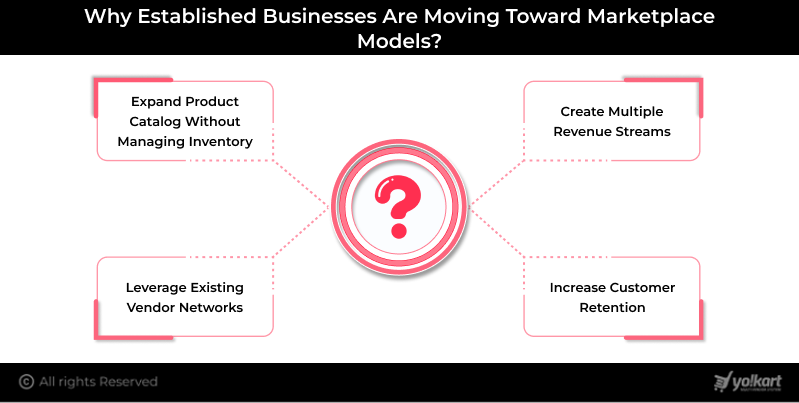
1. Expand Product Catalog Without Managing Inventory
In a traditional eCommerce setup, businesses must manage inventory, warehousing, and logistics for every product they sell. This often limits how many products they can realistically offer.
In a marketplace model, vendors manage their own inventory and fulfillment, while the platform owner earns commissions on every transaction. This allows businesses to significantly expand their product offering without increasing operational complexity or inventory costs.
2. Create Multiple Revenue Streams
Unlike traditional eCommerce stores that primarily rely on product sales, marketplaces open the door to several monetization opportunities.
Common revenue sources include:
- Commission on vendor sales
- Vendor subscription fees
- Featured product listings and promotions
- Advertising revenue
This diversified revenue model allows businesses to generate consistent income beyond direct product sales while vendors handle product supply.
3. Leverage Existing Vendor Networks
Many established businesses already have strong relationships with suppliers, distributors, or partner brands. Instead of working with them only as suppliers, these partners can become vendors on the marketplace.
By launching a marketplace, these partners can be onboarded as vendors, turning an existing network into a collaborative ecosystem that benefits everyone involved.
4. Increase Customer Retention
Marketplaces typically offer a wider product selection compared to single-vendor stores. This expanded selection improves the overall customer experience.
When buyers know they can find multiple brands and products on a single platform, they are more likely to return to the platform for future purchases, increasing customer loyalty and lifetime value.
Grow Faster by Launching Your Own Online Marketplace
Steps to Launch an Online Marketplace for Your Business
For established businesses, launching an eCommerce marketplace is less about starting from scratch and more about building on what already exists. Companies often have valuable assets, such as brand reputation, customer base, supplier relationships, and website traffic. With the right strategy and technology, businesses can transform their existing platforms into scalable multi-vendor ecosystems.
Below are the key steps businesses can follow to successfully launch their own online marketplace:
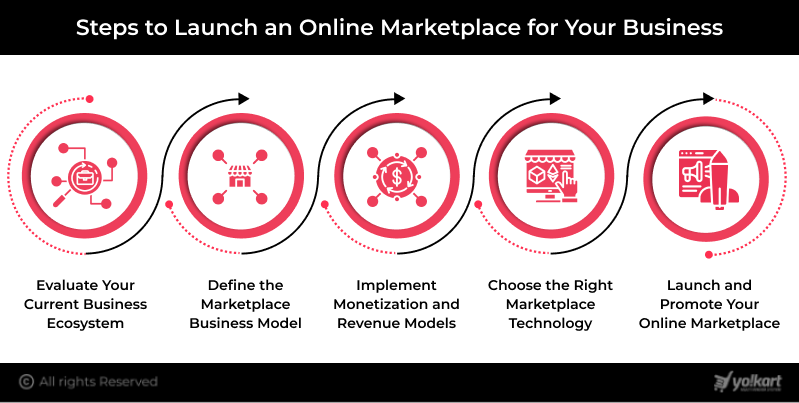
Step 1: Evaluate Your Current Business Ecosystem
Before launching a marketplace, it is important to assess your current business environment and resources. Established companies often have several advantages that can accelerate marketplace growth, such as:
- Existing loyal customer base
- Established supplier or vendor relationships
- Existing website traffic
- Industry credibility and brand trust
Understanding these strengths helps businesses determine how easily vendors can be onboarded and how quickly the marketplace can gain traction.
For example, if your business already works with multiple suppliers or distributors, these partners can become the first vendors on your marketplace, accelerating the launch process. This allows you to build an initial vendor base quickly and start offering a broader range of products from day one.
Step 2: Define the Marketplace Business Model
The success of a marketplace largely depends on choosing the right business model and positioning. Businesses must determine how their platform will operate and what value it will provide to both buyers and sellers.
Some common marketplace models include:
- B2C Marketplace: Multiple vendors sell products directly to consumers.
- B2B Marketplace: Businesses sell products or services to other businesses, often with bulk pricing and negotiation options.
- Niche Marketplace: Platforms that focus on serving specific industries, product categories, or users.
Clearly defining the marketplace model also helps businesses establish pricing structures, commission models, vendor policies, and platform features that align with their goals.
Step 3: Implement Monetization and Revenue Models
One of the biggest advantages of operating a marketplace platform is the ability to generate revenue through multiple channels.
Common monetization strategies include:
- Commission on vendor sales
- Vendor subscription plans
- Featured product listings
- Sponsored advertisements
- Transaction fees
Marketplace owners can experiment with different revenue models depending on their industry and vendor ecosystem. A well-balanced monetization strategy ensures sustainable revenue while keeping the platform attractive for vendors.
Step 4: Choose the Right Marketplace Technology
Building a marketplace entirely from scratch can be both complex and time-consuming. Thus, businesses should consider using specialized marketplace software that already includes essential features required to operate a multi-vendor platform efficiently.
A reliable marketplace solution provides capabilities, such as:
- Vendor management dashboards
- Product catalog management
- Commission and revenue management
- Order and payment processing
- Individual vendor storefronts
- Analytics and reporting tools
Solutions such as Yo!Kart provides ready-to-use capabilities designed specifically for launching multi-vendor marketplaces. Using a dedicated readymade solution can significantly reduce development time and allow businesses to focus on vendor onboarding, customer acquisition, and growth strategies.
Suggested Read: How to Make a Marketplace Website from Scratch
Step 5: Launch and Promote Your Online Marketplace
Once your marketplace platform is ready, the next step is to launch it successfully. A successful launch requires a clear promotion and growth strategy. Start by inviting your existing suppliers, partners, or distributors to join as early vendors. At the same time, promote the marketplace to your current customers through email campaigns, website announcements, and social media updates.
Businesses can also run targeted digital marketing campaigns, offer launch incentives, or collaborate with vendors on promotional offers to attract early users. A strong launch strategy helps generate initial traction and sets the foundation for long-term marketplace growth.
Common Challenges When Launching a Marketplace
While the marketplace model offers tremendous growth potential, launching and managing a successful platform comes with its own set of challenges. Even established businesses with strong brand recognition and existing customer bases must carefully address these hurdles to ensure long-term success.
Understanding these challenges early helps businesses prepare the right strategies, select the right technology, and build a marketplace that operates smoothly as it grows.
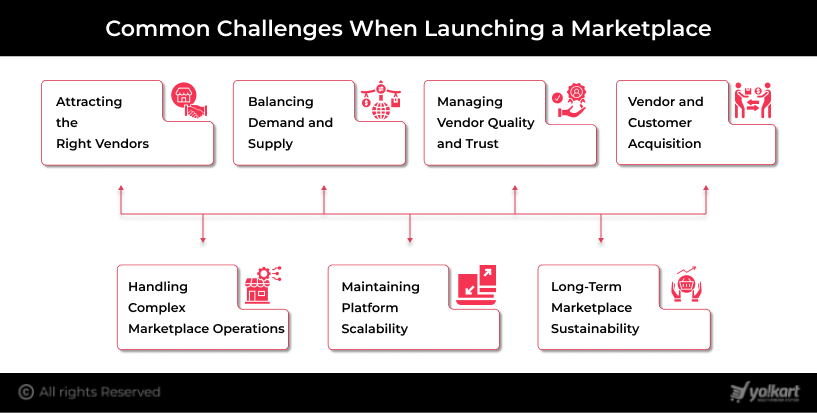
1. Attracting the Right Vendors
One of the biggest challenges when launching a marketplace is attracting reliable and high-quality vendors. Sellers often evaluate multiple factors before joining a platform, such as the platform’s reach, commission structure, and potential sales opportunities.
Established businesses have an advantage here because they can leverage existing relationships with suppliers, distributors, or partner brands. Offering incentives such as lower commissions during the early stage, promotional visibility, or marketing support can encourage vendors to onboard faster. A transparent onboarding process and clearly defined benefits also help build trust and improve the vendor proposition.
2. Balancing Supply and Demand
Marketplaces rely heavily on maintaining the right balance between vendors and customers. If there are too many sellers but limited buyers, vendors may lose interest. On the other hand, if customers visit the platform but find limited product options, they may not return. This situation is often referred to as the marketplace liquidity challenge and has been faced by many large platforms, such as Amazon and Alibaba Group,p during their early stages.
To manage this, businesses should start by onboarding a small but high-quality group of vendors. As customer demand grows, the vendor base can gradually expand to maintain a healthy marketplace ecosystem.
3. Managing Vendor Quality and Trust
Since multiple sellers operate on a marketplace, maintaining product quality and customer trust becomes a critical responsibility for the platform owner.
Issues such as poor vendor performance, delayed shipments, or inaccurate product listings can negatively affect the reputation of the entire marketplace.
To address this, businesses should implement measures such as:
- Vendor verification processes
- Product approval workflows
- Rating and review systems
- Vendor performance monitoring
These measures help maintain a reliable marketplace environment while encouraging vendors to maintain high service standards.
4. Handling Complex Marketplace Operations
Unlike traditional eCommerce websites that manage only their own products, marketplaces involve multiple stakeholders, including vendors, buyers, administrators, and service providers.
This adds operational complexity in areas such as:
- Order management
- Commission calculations
- Vendor payouts
- Product catalog management
- Customer service coordination
Managing these processes manually can quickly become overwhelming. Using specialized marketplace software can simplify these operations. Solutions like Yo!Kart provides built-in tools for vendor management, order tracking, commission handling, and reporting, making it easier for businesses to manage multi-vendor environments efficiently.
Simplify Marketplace Operations with a Reliable Marketplace Solution
5. Vendor and Customer Acquisition
Launching a marketplace is only the first step. To build a thriving platform, businesses must continuously work on attracting both vendors and customers.
Effective acquisition strategies include:
- Leveraging existing supplier and partner networks
- Promoting vendor success stories
- Running targeted digital marketing campaigns
- Offering exclusive deals or early adopter benefits
Established businesses already have an advantage because they can accelerate marketplace growth by promoting the platform to their existing users and partners.
6. Maintaining Platform Scalability
As the marketplace grows, the number of vendors, products, and transactions can increase rapidly. Platforms that are not designed for scalability may struggle with performance issues, operational inefficiencies, or costly redevelopment.
Selecting a scalable marketplace solution from the beginning can prevent these challenges. Solutions like Yo!Kart is built specifically to support growing vendor networks and large product catalogs while maintaining stable platform performance.
7. Ensuring Long-Term Marketplace Sustainability
Beyond the initial launch, marketplaces require continuous optimization to remain competitive. Businesses must regularly evaluate their commission structures, vendor policies, user experience, and marketing strategies.
This includes regularly reviewing commission structures, vendor policies, user experience, and marketing initiatives. Successful marketplaces focus on building a strong ecosystem where both vendors and customers benefit, ensuring long-term engagement and platform growth.
How Yo!Kart Can Help Businesses Launch Their Own Marketplace
Launching a successful online marketplace requires the right combination of technology, scalability, and operational tools. For many established businesses, building a platform from scratch can be time-consuming, costly, and technically complex.
This is where dedicated marketplace software solutions like Yo!Kart can make a significant difference.
Yo!Kart is a readymade marketplace solution designed specifically to help businesses transform their existing websites into fully functional multi-vendor marketplace platforms. Instead of developing every feature from the ground up, businesses can rely on Yo!Kart, it includes the core capabilities required to launch, manage, and scale a marketplace efficiently.
With a robust foundation in place, businesses can focus on growing their vendor network, attracting customers, and strengthening their marketplace ecosystem.
Key Capabilities That Support Marketplace Launch
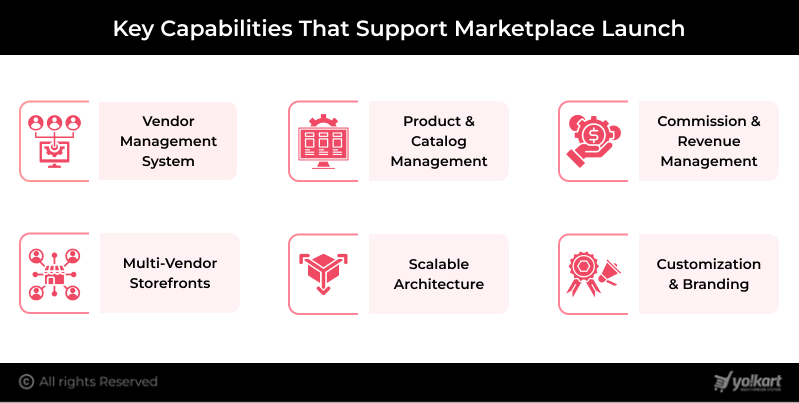
- Vendor Management System
Yo!Kart enables businesses to onboard multiple vendors and manage their profiles through a centralized admin dashboard. Marketplace owners can track vendor performance, approve listings, and oversee platform activity with greater visibility and control.
- Multi-Vendor Storefronts
Each vendor gets their dedicated storefront where they can upload products, manage orders, and communicate with customers. This helps vendors build their brand presence while operating within a larger marketplace ecosystem.
- Commission & Revenue Management
Marketplace owners can easily define commission structures, manage vendor payouts, and track revenue generated through the platform, ensuring transparent and efficient financial management.
- Product & Catalog Management
Yo!Kart makes it easy for businesses to manage large product catalogs from multiple vendors efficiently, ensuring smooth browsing and purchasing experiences for customers.
- Scalable Architecture
As your marketplace grows, Yo!Kart supports the number of vendors, products, and transactions without performance issues.
- Customization & Branding
Since every business has unique requirements, Yo!Kart allows customization to align the platform with your brand identity, workflows, and specific marketplace models.
By providing these capabilities in a unified platform, Yo!Kart enables businesses to focus on vendor acquisition, customer growth, and marketplace strategy, rather than spending extensive time on technical development.
Get a Personalized Demo of Yo!Kart
Conclusion
For established businesses looking to grow beyond traditional eCommerce, launching an online marketplace can open doors to new opportunities. Instead of expanding product offerings solely through in-house inventory, businesses can create a collaborative ecosystem where multiple vendors contribute to the growth of the platform.
However, building and managing a successful marketplace involves more than simply onboarding vendors. It requires thoughtful planning, a clear vendor onboarding strategy, and the right technological infrastructure to manage sellers, products, and transactions efficiently.
By leveraging specialized marketplace solutions such as Yo!Kart, businesses can significantly simplify the process of launching and managing a multi-vendor platform. With built-in tools for vendor management, order processing, and marketplace administration, businesses can focus on scaling their platform and delivering value to both vendors and customers.
As digital commerce continues to evolve, businesses that embrace the marketplace model are better positioned to scale faster, diversify revenue streams, and build long-term competitive advantages.
FAQs
Q 1. What is an online marketplace platform?
Ans. An online marketplace platform is a website or digital platform where multiple vendors can list and sell their products or services to customers in one place. The marketplace owner manages the platform, while vendors handle their own product listings, inventory, and orders, creating a centralized shopping experience for buyers.
Q 2. Why should established businesses launch their own marketplace?
Ans. Launching a marketplace allows established businesses to expand their product offerings without managing additional inventory. By onboarding third-party vendors, businesses can offer more variety to customers, generate new revenue streams through commissions or subscriptions, and leverage their existing supplier networks to grow faster.
Q 3. Can an existing eCommerce website be converted into a marketplace?
Ans. Yes, many businesses upgrade their existing eCommerce websites into multi-vendor marketplaces. This is typically done by integrating marketplace software that supports vendor management, product listings, commission tracking, and multi-seller order processing, allowing the platform to support multiple vendors selling on a single website.
Q 4. How long does it take to launch a marketplace platform?
Ans. The time required to launch a marketplace depends on factors such as the level of customization, platform features, and development approach. Using readymade marketplace software like Yo!Kart can significantly reduce development time compared to building a platform entirely from scratch.
Q 5. What are the main revenue models for online marketplaces?
Ans. Online marketplaces generate revenue through multiple monetization strategies. The most common revenue models include:
- Commission on vendor sales
- Vendor subscription plans
- Listing fees
- Advertising or promotional placements
Q 6. How do businesses attract vendors to their marketplace?
Ans. Businesses can attract vendors by leveraging existing supplier relationships and offering clear incentives. Competitive commission structures, marketing exposure, easy onboarding processes, and a user-friendly vendor dashboard can encourage sellers to join the platform and actively participate in growing the marketplace.
Q 7. What features are essential for a multi-vendor marketplace platform?
Ans. A multi-vendor marketplace requires key features, including:
- Vendor management
- Product catalog management
- Order processing
- Commission tracking
- Vendor storefronts
- Analytics tools
- Secure payment integrations
- These capabilities help marketplace owners efficiently manage vendors, transactions, and overall platform operations.
Q 8. Is marketplace software scalable for growing businesses?
Ans. Yes, most modern marketplace software solutions are designed to support growing businesses. These solutions can handle increasing numbers of vendors, products, and transactions, while maintaining performance, making it easier for businesses to expand their marketplace operations without major technical limitations.