

Published Date 09 March, 2026
In the world of eCommerce, building a successful marketplace is one of the most lucrative opportunities today. Among the platforms that have mastered this model, Etsy stands out as one of the most successful niche marketplaces in the world. Since its launch in 2005, Etsy has become a go-to marketplace for buyers looking for unique, handmade, and vintage products. What started as a small community-driven platform for creators and artisans has grown into one of the largest and most well-known eCommerce platforms globally.
This remarkable growth naturally raises an important question: what makes Etsy’s business model so successful? More importantly, how did a niche marketplace manage to compete with large eCommerce giants while building a loyal community of buyers and sellers?
To better understand its success, it is essential to look closely at how the platform operates. In this blog, we break down Etsy’s business model, explore its core features and revenue generation strategies. We will also examine the challenges Etsy faces and the key lessons entrepreneurs can apply when creating their own eCommerce marketplace.
Table of Contents
What is Etsy?
Etsy is a global online marketplace that specializes in handmade, vintage, and unique products. Founded in 2005 by Rob Kalin, Chris Maguire, and Haim Schoppik, Etsy was created to help independent creators and crafters reach a larger customer base online. Today, Etsy offers a diverse range of items, from handmade jewelry, clothing, and art to vintage furniture, books, and home decor. Unlike general-purpose eCommerce giants like Amazon, Etsy’s focus is on niche markets, particularly creative and one-of-a-kind products. This distinct positioning has helped the platform stand out and attract millions of buyers and sellers worldwide, transforming how people discover and purchase unique goods.
Over the years, Etsy has built a strong global community of buyers and sellers who value creativity, craftsmanship, and originality. By providing tools that help sellers showcase their products and connect directly with customers, Etsy has become a popular platform for entrepreneurs and artisans looking to grow their businesses online.
Must-Have Features for Etsy Like Marketplace
The success of a marketplace like Etsy depends on a variety of features that create a seamless experience for both sellers and buyers. These features not only streamline the eCommerce experience but also create a more engaging and user-friendly environment. Mentioned below are some of the must-have features for a Etsy like marketplace:
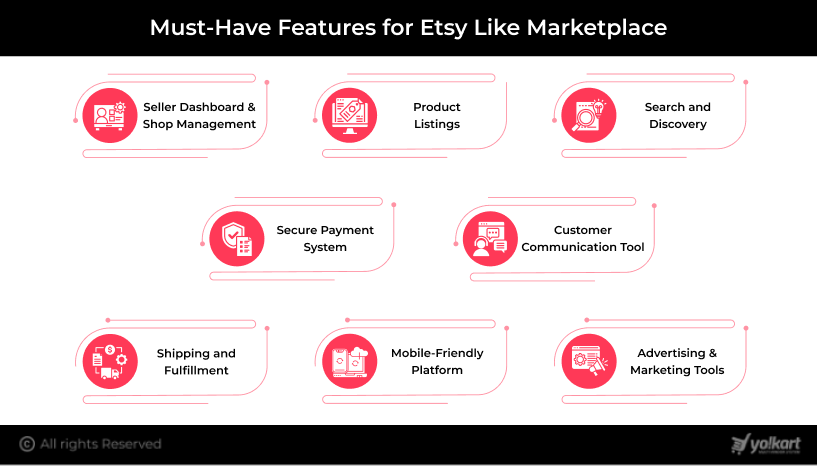
1. Seller Dashboard and Shop Management
An effective marketplace should provide vendors with a comprehensive dashboard that helps them manage their products, track sales, and view analytics. Sellers should be able to easily update listings, set pricing, manage inventory, and track their performance from a centralized interface.
2. Product Listings
Detailed product listings for each product help sellers showcase their offerings effectively. High-quality images, clear descriptions, categorization, and pricing details improve search visibility. This helps buyers quickly find products they’re looking for based on keywords, product type, or category.
3. Search and Discovery
A powerful search engine uses an algorithm to match buyers with products they are most likely to be interested in. Filters based on categories, pricing, location, and shipping options help users to find products with ease.
4. Secure Payment System
A reliable payment system is essential for marketplace trust. Supporting multiple payment methods, such as credit cards, debit cards, PayPal, and gift cards, ensures smooth and secure transactions for both buyers and sellers.
5. Customer Communication Tools
Direct communication between buyers and sellers helps build trust. Messaging tools allow customers to ask questions, request product details, or discuss customization options before making a purchase.
6. Shipping and Fulfillment
To simplify the shipping process for sellers, integrate your platform with popular shipping carriers. Integrating shipping options, label generation, and order tracking helps vendors manage deliveries efficiently while keeping buyers informed.
7. Mobile-Friendly Platform
A mobile app allows both buyers and sellers to access the platform on the go. Sellers can manage their shops, respond to customer inquiries, and even update listings directly from their phones. Buyers can browse products, make purchases, and track orders from their mobile devices, providing a seamless shopping experience.
8. Advertising and Marketing Tools
Marketing tools allow sellers to promote their products and improve visibility. Features such as sponsored listings and advertising help attract more traffic and increase product discovery.
All these features form the foundation of a marketplace that supports vendors, enhances buyer experience, and drives sustainable platform growth.
Launch a Feature-Rich Multi-Vendor Marketplace
Etsy Business Model Overview
Etsy operates as an eCommerce marketplace that connects buyers and sellers. Rather than manufacturing or handling inventory, Etsy provides the digital infrastructure where sellers can list their products and interact with buyers.
The platform functions as an ecosystem that supports small businesses and individual creators. Individual sellers create stores within Etsy’s platform to showcase their products, while Etsy provides the technology, tools, and traffic to support these stores. This model allows small businesses to reach a global audience without the complexity of building their own website or eCommerce system.
Etsy’s strategy focuses on niche markets, specifically handmade, vintage, and unique products. By creating a platform centered on a specific market segment, Etsy has developed a loyal customer base and a distinctive brand identity that sets it apart from larger, more generalized eCommerce platforms. Further, let’s understand how Etsy works:
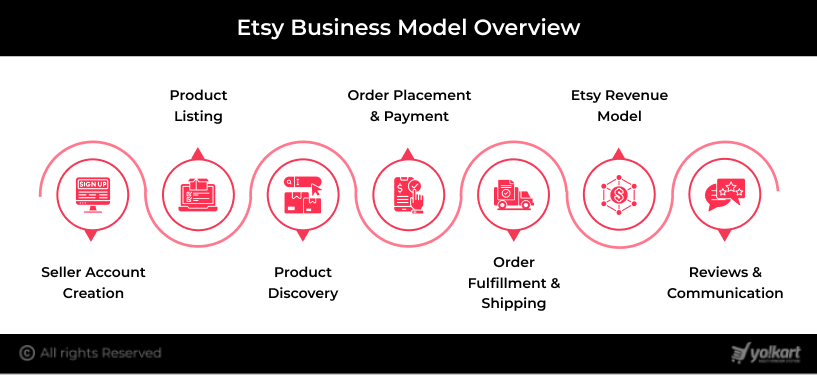
- Sellers create an account on Etsy and set up their own online storefront within the marketplace.
- Sellers list products by uploading images, writing descriptions, setting prices, and selecting relevant categories or tags.
- Buyers browse or search for products using filters such as category, price, location, and shipping options.
- Once a buyer selects a product, they place an order and complete the payment through Etsy’s integrated payment system.
- The seller receives the order details, prepares the product, and ships it directly to the buyer.
- Etsy earns revenue by charging sellers listing fees, transaction fees, payment processing fees, and optional advertising fees.
- Buyers can communicate with sellers, leave reviews, and rate their experience, helping build trust within the marketplace.
How Does Etsy Make Money?
Etsy’s revenue model is designed to generate income through multiple streams, ensuring the platform remains financially viable while providing valuable services to its users.
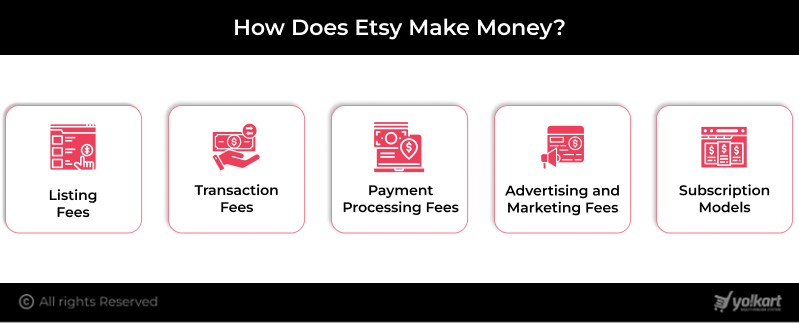
1. Listing Fees
Sellers are charged a $0.20 fee for each product they list on Etsy. This fee applies every four months or whenever a seller chooses to renew a listing. This low entry cost makes it accessible for individual creators and small businesses to start selling without significant upfront investment.
2. Transaction Fees
Whenever a product is sold, Etsy takes a 5% commission on the total sale price, including shipping charges. This fee is automatically deducted from the seller’s account when a sale is completed. The transaction fee structure is straightforward, and it allows Etsy to earn revenue based on the volume of sales occurring within the marketplace.
3. Payment Processing Fees
Etsy also charges a payment processing fee for transactions made through Etsy Payments. This fee is based on the seller’s location and the currency in which the sale is made. These fees cover the costs of handling payments securely and ensuring smooth financial transactions.
| Country | Payment Processing Fee |
| United States | 3% + $0.25 per transaction |
| United Kingdom | 4% + £0.20 per transaction |
| Australia | 4% + AUD 0.25 per transaction |
| France | 4% + €0.30 per transaction |
| UAE | 4% + AED 1.10 per transaction |
| India | 5% + ₹25 per transaction |
4. Advertising and Marketing Fees
Etsy provides paid advertising options to help sellers promote their listings:
- Etsy Ads: Sellers can pay to feature their products in Etsy’s search results. These ads are displayed to users searching for products similar to what the seller is offering.
- Offsite Ads: Etsy also runs ads on external platforms, such as Google, Facebook, and Instagram, to drive traffic to the seller’s listings. Sellers are charged a percentage of the sale (typically 12-15%) if a customer purchases the product via these ads.
5. Subscription Models
Etsy offers optional subscription services like Etsy Plus and Etsy Premium for sellers who want access to additional tools and customization features:
- Etsy Plus: This plan costs $10 per month and includes benefits such as the ability to create custom shop branding, discounts for buyers, and advanced shop customization tools.
- Etsy Premium: It is designed for larger businesses who needs advanced features such as priority customer support, additional analytics, and more customizable design options.
These multiple revenue streams ensure Etsy remains financially strong and capable of reinvesting in the platform’s growth and development.
Suggested Read: How Does Etsy Make Money?
Major Challenges Faced by Etsy
Despite its impressive growth and strong brand identity, Etsy continues to face several challenges that could impact its long-term growth. Given below are some of the major challenges faced by Etsy:
1. Growing Competition
Etsy operates in a highly competitive eCommerce environment. Large platforms like Amazon and eBay allow sellers to list unique products, while niche marketplaces specifically target artisans and craft sellers. These competitors often have larger resources and customer bases, making it more difficult for Etsy to maintain its dominance.
2. Scalability Issues
As Etsy continues to grow, maintaining the quality of the platform and ensuring smooth user experiences becomes more difficult. Etsy has to ensure that new sellers adhere to its standards while keeping the platform stable. With millions of listings and customers, maintaining quality is an ongoing challenge, which requires continuous platform improvements and operational oversight.
3. Fee Structure Concerns
Etsy’s fee structure has come under scrutiny from some sellers who feel that the platform takes a significant portion of their profits. While the listing and transaction fees are relatively low, additional fees for payment processing, advertising, and premium subscriptions can add up. Additionally, programs like the Offsite Ads program also sparked debate among sellers who feel the associated fees may reduce their profit margins.
Build a Multi-Vendor Marketplace Designed for Long-Term Growth
Lessons for Building Your Own eCommerce Marketplace
Etsy’s growth offers several valuable insights for entrepreneurs planning to build their own eCommerce marketplace. Its success is not just about selling unique products but also about creating a platform that supports sellers, attracts buyers, and sustains long-term growth. Here are a few key lessons that can be learned from Etsy’s success and can be applied to building your own eCommerce marketplace:
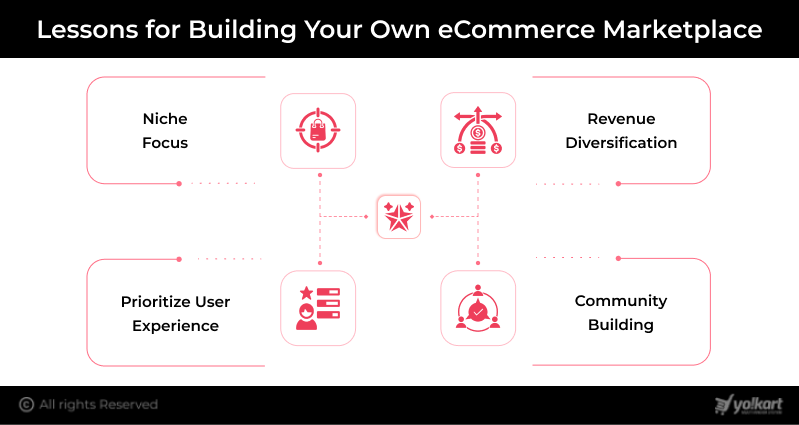
1. Niche Focus
By focusing on handmade, vintage, and unique items, Etsy has built a strong brand identity and a loyal customer base. Thus, choosing a niche market can help you differentiate your marketplace from larger platforms and attract buyers who are looking for specialized products.
2. Revenue Diversification
Etsy generates its revenue from various streams, including listing fees, transaction fees, subscription models, and advertising. When creating your own marketplace, consider implementing a similar diversified revenue model that incorporates different types of fees and services to ensure financial sustainability.
3. Prioritize User Experience
A marketplace should be simple and convenient for both buyers and sellers. Etsy has invested heavily in creating a smooth, user-friendly experience. From easy-to-navigate product pages to comprehensive seller dashboards, it is accessible to everyone. Hence, make sure that your marketplace is intuitive and easy to use for both vendors and customers.
4. Community Building
One of Etsy’s biggest strengths is its= strong sense of community among its users. Building a sense of trust and engagement is crucial for any marketplace. Consider implementing forums, support systems, and social media engagement to create a community that values collaboration and creativity.
How to Build an eCommerce Marketplace Like Etsy
Building an eCommerce marketplace like Etsy may seem like a daunting task at first, but with the right approach and technology, the process becomes far more manageable. Moreover, leveraging a readymade marketplace solution like Yo!Kart can significantly simplify the process, save cost and reduce time-to-market. It is built specifically for multi-vendor marketplaces and provides the core infrastructure required to launch and manage a platform like Etsy.
Yo!Kart comes with a comprehensive set of built-in marketplace features that help entrepreneurs create, manage, and scale their online marketplace efficiently. From vendor onboarding and product catalog management to order processing and commission control, the platform centralizes all key marketplace operations. Its flexible architecture also allows businesses to customize the marketplace according to their niche, branding, and operational requirements.
Benefits of Yo!Kart
- Cost-Effectiveness: Yo!Kart is a ready-to-launch solution that significantly reduces development time and costs compared to custom-built platforms.
- Scalability: As your marketplace grows and more vendors join the platform, Yo!Kart can scale with you. It provides you with the flexibility to expand and add new features without affecting performance.
- Mobile Responsiveness: Yo!Kart is mobile-friendly, ensuring a seamless browsing and shopping experience across smartphones, tablets, and desktops.
- Security: With built-in security features, Yo!Kart ensures secure payment processing and fraud protection for both sellers and buyers.
- Comprehensive Tools: Yo!Kart offers a range of tools for both vendors and administrators, including product management, vendor tracking, and analytics.
- Customization and Flexibility: It offers customization options that allow businesses to adapt the marketplace design, workflows, and functionality according to their business model.
By combining powerful marketplace functionality with scalability and customization, Yo!Kart enables entrepreneurs to launch and grow a professional multi-vendor marketplace similar to Etsy without the complexities of building a platform from the ground up.
Multi-Vendor Marketplaces Developed with Yo!Kart
1. Tajer
Tajer is a Qatar-based multi-vendor eCommerce platform built using Yo!Kart. It connects sellers with online shoppers across the region. Tajer is a scalable marketplace with vendor management, product catalog tools, and secure payment integration that streamlines online selling.
2. 4GoodVibes
4GoodVibes is a handmade and custom products marketplace powered by Yo!Kart. The platform enables artisans and creators to sell personalized products through a multi-vendor system. Yo!Kart provided advanced vendor management, customization features, and order management tools, helping the platform create a smooth buying and selling experience.
3. WeDIY
WeDIY is a creative marketplace focused on DIY craft supplies and handmade products. Built on Yo!Kart, the platform, allows multiple vendors to list and sell their items in a single marketplace. Yo!Kart enabled efficient vendor onboarding, product catalog management, and marketplace administration to support the platform’s growing community.
4. Mastang
Mastang is a multi-vendor marketplace designed to bring together diverse sellers and product categories in one place. Using Yo!Kart’s marketplace infrastructure, Mastang, was launched with essential eCommerce capabilities, including vendor dashboards, product management tools, and secure transaction support for seamless operations.
5. Jewora
Jewora is a specialized online marketplace focused on jewellery and fashion accessories. By leveraging Yo!Kart, it provides vendors with tools to manage product listings, track orders, and engage with customers. Yo!Kart’s scalable architecture helped Jewora create a professional and efficient marketplace for jewellery sellers and buyers.
Get a Personalized Yo!Kart Demo
Conclusion
Etsy’s business model offers valuable insights for entrepreneurs looking to build a successful eCommerce marketplace. By focusing on a specific niche, creating multiple revenue streams, and providing a seamless user experience, Etsy has built a platform that supports independent sellers and provides buyers with unique, high-quality products.
For entrepreneurs looking to follow a similar path, launching a marketplace does not necessarily require building everything from scratch. Solutions like Yo!Kart makes it easier to create and manage a multi-vendor marketplace without the heavy investment typically associated with custom development. With built-in marketplace features and scalable architecture, Yo!Kart helps businesses bring their marketplace ideas to life faster.
Moreover, by studying Etsy’s strengths as well as the challenges it faces, entrepreneurs can make smarter strategic decisions when building their own platforms. With a clear niche, the right technology, and a strong value proposition for both sellers and buyers, it is possible to build a marketplace that grows sustainably and stands out in today’s competitive eCommerce landscape.