
In 2025-26, the global eCommerce industry continues to experience unprecedented growth, driven by consumer adoption, mobile commerce growth, and the increasing prevalence of digital marketplaces. According to industry projections (Grand View Research), global eCommerce sales are expected to surpass $83.26 trillion by 2030, growing at a CAGR of 18.9% from 2024 to 2030. Additionally, marketplaces contribute a significant share of this figure due to their convenience, diversity of offerings, and network effects.
This explosive growth has pushed businesses of all sizes, from startups to global enterprises, to invest in scalable solutions. Moreover, eCommerce marketplace development, in particular, has become one of the most sought-after digital strategies, empowering entrepreneurs to tap into decentralized vendor ecosystems while providing customers with choice, ease of use, and seamless shopping experiences.
As the eCommerce landscape continues to evolve, choosing the right eCommerce development company and multi-vendor eCommerce software has never been more critical. Whether you’re building a niche marketplace, a large-scale online marketplace, or a hybrid B2C/B2B eCommerce platform, understanding which solution providers lead the market and what differentiates them is essential for long-term success.
Table of Contents
What is eCommerce Development?
eCommerce development refers to the process of designing and creating digital solutions that enable businesses to sell products and services online. It encompasses building everything from simple online stores to complex, feature-rich eCommerce marketplaces.
A professional eCommerce development company typically offers services such as:
- Custom eCommerce marketplace platform development
- Integration and customization of eCommerce marketplace software
- Implementation of multi-vendor marketplace features
- Frontend and backend system design
- Secure payment gateway integration
- Mobile app development and responsive web design
- Ongoing technical support and scalability enhancements
In simple terms, eCommerce development is the backbone of any online retail or marketplace business. It involves engineering solutions that support not just transactions, but product discovery, vendor onboarding, catalog management, customer engagement, and the operational scalability required for long-term business growth.
Things to Consider Before Selecting Your eCommerce Development Company
Choosing the right eCommerce marketplace development partner is as important as selecting the right business model. The expertise, technology choices, and long-term support offered by your development partner will directly impact your platform’s scalability, performance, and success. Therefore, before making any decision, it is essential to evaluate the following critical factors:
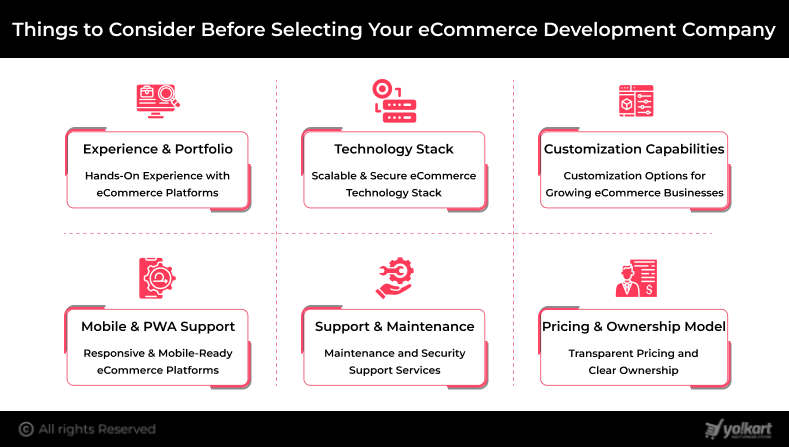
1. Experience and Portfolio
An eCommerce development company’s experience reflects its ability to handle and solve real-world business challenges.
Look for a provider with a proven history of delivering eCommerce websites, multi-vendor marketplaces, and custom eCommerce solutions. Reviewing their portfolio helps you assess software’s complexity, industry relevance, and design quality. Further, case studies, client testimonials, and live demos can validate their technical and operational expertise.
2. Technology Stack
The technology stack determines how scalable, secure, and future-ready your eCommerce platform will be.
Thus, ensure the company uses modern, scalable technologies such as microservices architecture, API-first frameworks, cloud-compatible systems, and modular architecture. A robust tech stack efficiently handles high traffic volumes, seamless third-party integrations, and optimizes long-term performance as your marketplace grows.
3. Customization Capabilities
Every eCommerce business has unique workflows and evolving requirements.
Choose a development company that allows deep customization beyond pre-built templates and basic features. This includes tailored user journeys, vendor management systems, commission structures, checkout processes, and admin/s controls. Customization flexibility ensures your platform can adapt to changing market demands and new revenue or business models.
4. Mobile and PWA Support
With mobile commerce driving a significant portion of online sales, mobile optimization is no longer optional but essential.
Ensure the development company delivers fully responsive designs that work seamlessly across devices. Moreover, support for Progressive Web Apps (PWAs) or native mobile apps enhances user experience with faster load times, offline access, and app-like functionality, leading to higher engagement and conversions.
Launch A Marketplace Equipped with Third-Party Integrations
5. Support and Maintenance
eCommerce platforms require ongoing technical support to remain secure and competitive.
Hence, look for a company that provides long-term maintenance, regular updates, bug fixes, and security patches. Reliable post-launch support ensures platform stability, performance optimization, and quick resolution of technical issues as your marketplace scales.
6. Pricing and Ownership Model
Transparent pricing and ownership terms protect your long-term investment.
Understand whether the development company follows a one-time licensing model or a recurring subscription structure. Customizable source code ownership, customization rights, and any recurring fees for updates, hosting, or technical support. Clear pricing avoids unexpected costs as your marketplace grows.
Carefully evaluating these factors helps you select an eCommerce development company that aligns with your business goals, technical requirements, and growth strategy. Moreover, it ensures that your marketplace is scalable and future-ready.
Suggested Read: Top eCommerce Marketplace Builder in 2026
List of Top 10 eCommerce Development Companies in 2026
As eCommerce continues to evolve in 2026, businesses are no longer just searching for developers. They are looking for experienced eCommerce development companies with a proven track record in building scalable, secure, and revenue-driven eCommerce marketplaces that perform reliably across global markets.
The following companies stand out for their long-standing years of industry experience, depth of eCommerce expertise, marketplace-focused development, and the ability to deliver platforms that support long-term growth.
1. FATbit Technologies
FATbit Technologies is a globally recognized eCommerce development company with over 20 years of experience in building eCommerce platforms and multi-vendor marketplaces worldwide. The company specializes in marketplace-centric eCommerce solutions and offers Yo!Kart is a proprietary self-hosted eCommerce marketplace software designed for scalability and ownership.
By combining ready-made marketplace software with custom eCommerce development services, FATbit enables faster launches without compromising flexibility or control. The company has delivered thousands of eCommerce and marketplace projects for startups, SMBs, and enterprises across North America, Europe, the Middle East, and Asia.
Key Benefits:
- Proprietary, market-tested marketplace software (Yo!Kart)
- Experienced in-house eCommerce development team
- Scalable development practices designed for long-term growth
- Multi-industry eCommerce and marketplace development expertise
- Strong capabilities in marketplace-driven business models
- Emphasis on performance optimization and platform stability
- Proven experience with complex integrations and third-party systems
- Emphasis on ownership, control, and long-term cost efficiency
Best For: Businesses aiming to launch scalable eCommerce marketplaces with full ownership and predictable long-term costs.
Discuss Your Multi-Vendor Marketplace Requirements
2. Brainvire Infotech
Brainvire Infotech is an established eCommerce development company with 20+ years of experience delivering eCommerce and digital commerce solutions worldwide. The company works extensively with platforms such as Magento, Shopify, WooCommerce, and headless commerce platforms.
Brainvire is known for building eCommerce systems for retail, wholesale, and B2B brands with an emphasis on performance optimization and system integrations.
Key Benefits:
- Experience in eCommerce and digital commerce
- Strong B2B and marketplace development capabilities
- Proven experience with third-party integrations
Best For: Mid-sized and enterprise businesses needing custom eCommerce or marketplace solutions.
3. Netguru
Netguru is a digital product development company with over a decade of experience creating eCommerce and marketplace platforms for startups and fast-growing businesses. The company focuses on UX-led development supported by modern and scalable technology stacks.
Netguru helps product-driven businesses create customer-centric eCommerce experiences that balance high performance, usability, and scalability.
Key Benefits:
- Strong UX, UI, and product design capabilities
- Agile, transparent development process
- Experience working with global and emerging brands
Best For: Startups and growth-stage companies that prioritize design quality and user experience.
4. ScienceSoft
ScienceSoft is a mature eCommerce development company with over 30 years of experience in software development and IT consultations. The company focuses on building secure and scalable eCommerce platforms with a strong emphasis on compliance and data protection.
Additionally, ScienceSoft supports long-term eCommerce initiatives that require reliability, system integrations, and regulatory adherence.
Key Benefits:
- Focus on security and regulatory compliance
- Expertise in enterprise-level eCommerce ecosystems
- Long-term support and maintenance services
Best For: Businesses that require robust, secure, and scalable eCommerce platforms.
5. PixelCrayons
PixelCrayons is an eCommerce development company with over 20 years of experience delivering eCommerce and marketplace solutions for startups and SMBs. The company works across Magento, WooCommerce, Shopify, and custom development frameworks.
PixelCrayons is known for offering cost-effective eCommerce development with flexible engagement models suited for early-stage and budget-conscious businesses.
Key Benefits:
- Budget-friendly eCommerce development services
- Wide range of eCommerce technologies
- Startup and SMB-focused delivery approach
Best For: Startups and small businesses looking for affordable eCommerce development solutions.
6. Vaimo
Vaimo is a globally respected eCommerce agency with specialization in Adobe Commerce (Magento). The company delivers large-scale eCommerce platforms and marketplace integrations for enterprise brands operating across multiple regions.
Vaimo places a strong emphasis on performance optimization, scalability, and long-term commerce growth strategies, helping established businesses build platforms that can support high traffic volumes and evolving business needs.
Key Benefits:
- Expertise in Adobe Commerce ecosystems
- Performance and scalability-driven development approach
- Global enterprise delivery experience
Best For: Mid-to-large enterprises invested in Adobe Commerce solutions.
7. iCreative Technologies
iCreative Technologies is an experienced eCommerce development company with over 15 years of expertise in building scalable eCommerce websites and marketplace solutions. The company delivers custom eCommerce development across platforms such as Magento (Adobe Commerce), Shopify, and WooCommerce.
iCreative Technologies supports startups, SMBs, and growing businesses by developing secure, performance-driven eCommerce platforms with flexible customization and third-party integrations.
Key Benefits:
- Expertise in Magento, Shopify, and WooCommerce
- Custom eCommerce and marketplace development
- Performance- and scalability-focused solutions
- Reliable post-launch support and maintenance
Best For:
Startups and growing businesses looking for a dependable eCommerce development partner.
8. Hyperlocal Cloud
Hyperlocal Cloud is a software development company that provides mobile and web development services for hyperlocal and on-demand business models. The company builds solutions for industries like food delivery, grocery delivery, local services, and multi-vendor marketplaces. Hyperlocal Cloud focuses on building functional platforms with key modules such as vendor management, delivery tracking, payment integration, and admin controls, helping businesses launch and manage local commerce operations.
Key Benefits:
- Experience in hyperlocal marketplace and on-demand app development
- Supports web + mobile app development with admin panel setup
- Suitable for businesses requiring custom feature implementation
Best For: Businesses looking for a development partner to build hyperlocal marketplace or delivery-based platforms.
9. Radixweb
Radixweb is a technology-driven eCommerce development company with 20+ years of experience delivering custom eCommerce and marketplace solutions globally. The company emphasizes on scalability, maintainable codebase, and long-term partnerships.
Radixweb supports businesses throughout the eCommerce lifecycle, from initial development to ongoing maintenance and post-launch support.
Key Benefits:
- Strong custom eCommerce development expertise
- Cost-effective long-term engagement models
- Reliable maintenance and technical support services
Best For: Businesses seeking custom eCommerce solutions with dependable ongoing technical support.
Get Guidance on Building a Custom Multi-Vendor Platform
10. Intellias

Intellias is a digital engineering company delivering scalable eCommerce and digital commerce solutions for mid-market and enterprise clients. The company specializes in cloud-native architectures and system integrations.
Further, Intellias helps businesses build future-ready eCommerce platforms optimized for performance and scalability.
Key Benefits:
- Strong engineering and solution architecture capabilities
- Scalable, cloud-native eCommerce solutions
- Expertise in integration-heavy ecosystems
Best For: Businesses that require advanced, integration-heavy eCommerce platforms built on modern cloud infrastructure.
Suggested Read: B2B Marketplace Development: Everything You Need to Know
Why Choose FATbit Technologies?
Among the leading eCommerce marketplace development companies in 2026, FATbit Technologies stands out for its ability to translate complex marketplace ideas into stable, commercially viable platforms. Rather than approaching projects as one-off development engagements, FATbit adopts a product-first and strategy-driven mindset that prioritizes long-term scalability, monetization readiness, and operational control.
FATbit’s approach is designed for businesses that want to move beyond experimentation and build marketplaces with predictable growth paths. By offering a structured foundation combined with tailored development, the company helps reduce development risk, controls long-term costs, and ensures faster validation of marketplace ideas without compromising scalability.
Additionally, FATbit’s expertise spans B2C, B2B, rental, service-based, and niche marketplaces, making it a reliable partner for startups, SMBs, and enterprises looking to build complex, growth-ready eCommerce ecosystems. This makes it a dependable technology partner for organizations seeking not just to launch, but to scale and optimize complex eCommerce ecosystems over time.
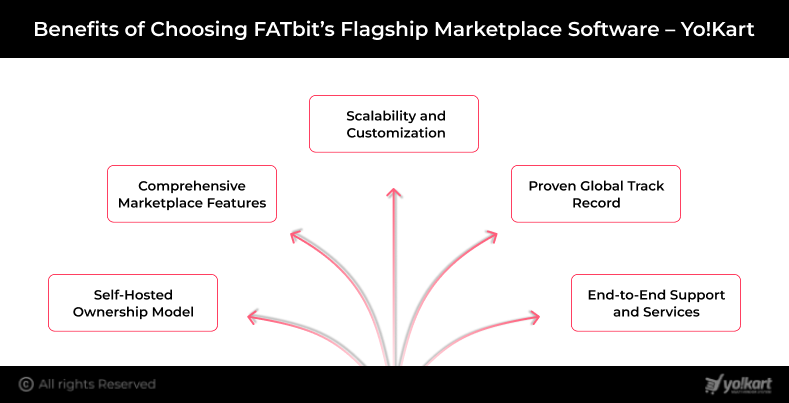
Benefits of Choosing FATbit’s Flagship Marketplace Software – Yo!Kart
Among the top eCommerce marketplace software, Yo!Kart stands out as a mature, self-hosted solution purpose-built for multi-vendor marketplaces. Let‘s have a look at some of the benefits of Yo!Kart:
1. Self-Hosted Ownership Model
Yo!Kart follows a one-time license model with lifetime customizable source-code ownership, eliminating recurring subscription fees. This ensures businesses maintain complete control over their marketplace as it scales, without dependency on SaaS pricing structures.
2. Comprehensive Marketplace Features
It comes equipped with essential marketplace features, including vendor dashboards, product and catalog management, multiple revenue models, such as commissions, subscriptions, featured listings, and ads, multi-currency and multilingual support, and native mobile applications.
3. Scalability and Customization
Built on a modular architecture, Yo!Kart supports advanced customization, third-party API integrations, and complex workflows. Hence, it is well-suited for niche, B2C, B2B, rental, and service-based eCommerce marketplace platforms.
4. Proven Global Track Record
With thousands of successful marketplace launches worldwide and strong reviews across leading software directories, Yo!Kart has established itself as a trusted and reliable eCommerce marketplace development solution.
Explore Marketplaces Powered by Yo!Kart
5. End-to-End Support and Services
FATbit provides installation assistance, technical support, and optional custom development services, ensuring a smooth launch and continued growth for marketplace owners post-deployment.
See How Yo!Kart Powers Multi-Vendor Marketplaces
Conclusion
As eCommerce continues to evolve in 2026, the demand for scalable, secure, and flexible eCommerce marketplace solutions is also on the rise. Whether businesses are launching niche marketplaces, building multi-vendor eCommerce platforms, or expanding into B2B marketplace models, selecting the right eCommerce development company remains a critical success factor.
The companies featured in this blog offer varied strengths, ranging from product-led marketplace solutions like Yo!Kart by FATbit Technologies to custom eCommerce and marketplace development services offered by experienced global agencies. These providers support businesses at different stages of growth, offering a balance of ready-made solutions, customization capabilities, and long-term technical support.
When evaluating eCommerce development partners or marketplace platforms, entrepreneurs and businesses should consider key factors such as scalability, flexibility, integration readiness, ownership model, and total cost of ownership. Aligning these considerations with long-term business goals can significantly reduce operational complexity and lay a strong foundation for sustainable growth.
Frequently Asked Questions (FAQs)
Q 1. What is the difference between an eCommerce development company and an eCommerce platform provider?
Ans. An eCommerce development company offers custom development services, including design, coding, integrations, and ongoing support. While an eCommerce platform provider offers ready-made eCommerce or marketplace software that can be configured or customized. However, some companies, like FATbit Technologies, combine both by offering a product along with optional development services.
Q 2. How long does it take to build an eCommerce marketplace platform?
Ans. The development timeline to build an eCommerce marketplace platform depends on the development approach and level of customization required. A ready-made eCommerce marketplace software enables you to launch the marketplace within a few weeks, whereas a fully custom-built marketplace may take 8-10 months or longer, depending on complexity, integrations, and testing requirements.
Q 3. What is the average cost of eCommerce marketplace development in 2026?
Ans. Costs of building an eCommerce marketplace vary widely based on the features, scalability, and development approach you choose. SaaS-based platforms typically charge monthly or annually, while self-hosted solutions like Yo!Kart offers packages starting from $499. Whereas, fully custom eCommerce marketplace development can range from $20,000 to $100,000+, depending on features and business requirements.
Q 4. Can an eCommerce marketplace software support both B2C and B2B models?
Ans. Yes, many modern eCommerce marketplace software support hybrid models, allowing businesses to serve both individual consumers and bulk buyers. Further, features such as role-based pricing, minimum order quantities, RFQs, and custom catalogs enable B2B functionality alongside traditional B2C workflows.
Q 5. How do eCommerce marketplaces make money?
Ans. Most of the eCommerce marketplaces generate revenue through multiple channels, including:
- Vendor commissions on sales
- Subscription or membership fees
- Featured listings and promotions
- Advertising placements
- Lead generation and service fees
This multi-revenue approach improves long-term sustainability.
Q 6. What security measures should an eCommerce marketplace platform include?
Ans. A secure marketplace should support:
- SSL encryption and secure payment processing
- Role-based access control
- Data protection and privacy compliance
- Regular security updates and monitoring
Security is especially critical when handling multi-vendor payments and customer data.
Q 7. Can I migrate from one eCommerce marketplace platform to another later?
Ans. Yes, you can migrate from one eCommerce platform to another. However, it requires careful planning, because data such as products, vendors, orders, and customer information must be transferred securely. Hence, choosing a platform with open architecture and data export capabilities makes future migration easier.
Q 8. How important is scalability when choosing eCommerce marketplace software?
Ans. As your marketplace grows, you’ll need to support more vendors, products, users, and transactions without performance issues. A scalable marketplace eCommerce software ensures a consistent user experience during traffic spikes and business expansion.
Q 9. What are the biggest mistakes to avoid when building an eCommerce marketplace?
Ans. Common mistakes when building an eCommerce marketplace include:
- Choosing a platform that doesn’t scale
- Ignoring vendor experience and onboarding
- Underestimating support and maintenance needs
- Focusing only on technology instead of business strategy
Avoiding these pitfalls improves long-term marketplace success.
Q 10. Are mobile apps necessary for eCommerce marketplaces in 2026?
Ans. While not mandatory, mobile apps significantly enhance user engagement and retention. However, solutions like Yo!Kart provides both native mobile apps and PWA support, enabling marketplace owners to deliver a seamless mobile-first shopping experience without additional complexity.
Ready to Build Your Own eCommerce Marketplace?
Get StartedPopular Posts