
Published Date 11th August, 2026
TL;DR
- Compare 10 multi-vendor eCommerce development companies based on expertise, ratings, scalability, customization, technology, and marketplace capabilities.
- The listed companies include marketplace specialists, custom development firms, enterprise commerce providers, and composable commerce platforms.
- A multi-vendor marketplace needs vendor management, product and order management, payments, search, seller dashboards, and centralized administration.
- Choose a development partner based on marketplace experience, development approach, customization, scalability, integrations, pricing, SEO, support, and market expertise.
- Ready-made solutions can accelerate launch, while custom development may suit businesses with specialized workflows, integrations, or enterprise requirements.
Introduction
The global eCommerce market is entering another phase of steady growth, creating new opportunities for businesses to launch specialized and multi-vendor marketplaces. Global retail eCommerce sales are projected to reach $7.38 trillion in 2027, representing approximately 7.2% growth. As more transactions move online, businesses are increasingly exploring marketplace models that can expand product selection without requiring them to own and manage all inventory themselves.
However, launching a successful multi-vendor eCommerce marketplace requires the right combination of vendor management, product and order workflows, payments, commissions, search, scalability, integrations, and seller tools. The right development partner therefore depends on factors such as the marketplace model, budget, customization requirements, target geography, technology architecture, and long-term growth plans.
To help businesses make an informed decision, this guide compares 10 multi-vendor eCommerce website development companies in 2026-2027. The companies are evaluated across marketplace expertise, eCommerce experience, functionality, scalability, technology capabilities, customization, geographic presence, third-party ratings, and suitability for startups, SMEs, and enterprises.
Table of Contents
- What is Multi-Vendor eCommerce Website Development?
- Why is Multi-Vendor eCommerce Growing in 2026?
- What Should a Multi-Vendor eCommerce Website Include?
- Top 10 Multi-Vendor eCommerce Website Development Companies
- How to Choose the Right Multi-Vendor eCommerce Website Development Company
- Conclusion
- Frequently Asked Questions
What is Multi-Vendor eCommerce Website Development?
Multi-vendor eCommerce website development involves creating an online marketplace where multiple independent sellers can register, list products or services, manage orders, receive payments, and operate through a centralized platform.
Unlike a traditional eCommerce website, where one business controls the inventory and sells directly to customers, a multi-vendor marketplace brings together three primary participants:
Marketplace Owner → Sellers/Vendors → Buyers
The marketplace owner provides the technology infrastructure, manages the customer experience, sets marketplace rules, and oversees payments and seller operations.
Sellers or vendors list their products or services, manage inventory, process orders, and fulfill purchases according to the marketplace’s policies.
Buyers browse products from multiple sellers, compare options, and complete transactions through the marketplace.
Multi-vendor marketplaces can support a wide range of business models and industries, including:
- B2C marketplaces
- B2B marketplaces
- C2C marketplaces
- Wholesale marketplaces
- Fashion marketplaces
- Electronics marketplaces
- Grocery marketplaces
- Furniture marketplaces
- Rental marketplaces
- Service marketplaces
- Niche marketplaces
The complexity of development depends on how the marketplace operates. Features such as vendor-specific commissions, multiple payment methods, split payments, shipping rules, vendor dashboards, product approvals, refunds, disputes, tax calculations, and multi-location fulfillment can add significant technical and operational requirements.
The complexity of development depends on how the marketplace operates. Features such as vendor-specific commissions, multiple payment methods, split payments, shipping rules, seller dashboards, product approvals, refunds, disputes, tax calculations, and multi-location fulfillment can add significant technical and operational requirements.
Why is Multi-Vendor eCommerce Growing in 2026?
The continued expansion of online commerce is creating favorable conditions for multi-vendor marketplaces. The sale of global retail eCommerce sales are projected to reach $6.88 trillion by the end of 2026, highlighting the growing opportunity for businesses to establish digital commerce platforms.
Key Reasons Behind The Growth
- Growing Digital Buyer Demand: U.S. retail eCommerce sales reached approximately $303.3 trillion in the first quarter of 2026. This growth toward online shopping is encouraging businesses to explore marketplace models.
- Broader Product Selection: Multi-vendor platforms allow businesses to onboard multiple sellers and expand their product catalog without purchasing and managing all inventory themselves.
- Lower Inventory Burden: Since sellers can manage their own products, inventory, and fulfillment, marketplace owners can build larger catalogs without carrying the same inventory burden as traditional retailers.
- Marketplace Network Effect: More sellers can bring more products and choices to the platform, helping attract more buyers and transactions:
More Sellers → More Products → More Choice → More Buyers → More Transactions
- Specialized Marketplace Opportunities: The model can be adapted to growing categories such as B2B, fashion, electronics, grocery, furniture, rentals, services, and niche commerce.
- Scalable Growth Potential: As the seller base expands, marketplaces can increase product variety and customer reach without requiring the owner to directly manage every product. This makes the model attractive to both emerging entrepreneurs and established businesses.
Launch Your Multi-Vendor Marketplace to Capitalize on the Growing Demand
What Should a Multi-Vendor eCommerce Website Include?
Before selecting a development company, it is important to understand the functionality required. From managing sellers and products to processing payments and tracking performance, the solution should support both day-to-day operations and long-term growth.
| Feature | Key Capabilities |
| Vendor Management | Seller registration and approval, vendor verification, profile management, commissions, permissions, performance monitoring, and seller deactivation |
| Product Management | Product creation, image uploads, pricing, inventory, attributes, variants, availability, and catalog updates |
| Order Management | Order creation, vendor-specific processing, status updates, returns, refunds, cancellations, and shipment tracking |
| Payment Management | Multiple payment gateways, commission calculation, vendor payouts, split payments, refunds, taxes, and multi-currency support |
| Marketplace Search & Discovery | Advanced search, filters, sorting, category navigation, product recommendations, and personalized discovery |
| Seller Dashboard | Sales analytics, order and product management, inventory, customer information, promotions, earnings, and payout details |
| Admin Dashboard | Sales, revenue, sellers, orders, customers, commissions, product performance, marketing, returns, and payment management |
Top 10 Multi-Vendor eCommerce Website Development Companies
Choosing the right development partner can significantly influence how efficiently a multi-vendor marketplace is built, customized, and scaled. The companies mentioned in the list take different approaches, ranging from readymade and customizable marketplace solutions to custom development and enterprise commerce platforms.
Let’s have a look at them:
1. FATbit Technologies
Specialization: Multi-vendor eCommerce, marketplace software, custom eCommerce development
Best suited for: Startups, SMEs, enterprises, B2B/B2C marketplaces
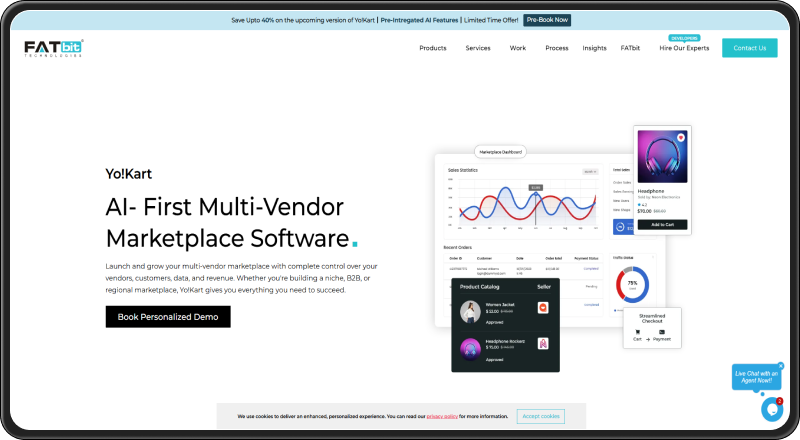
FATbit Technologies is a software development company with a strong focus on multi-vendor eCommerce and marketplace solutions. Its offerings cover ready-made marketplace software as well as custom eCommerce development, making it suitable for businesses with different launch and customization requirements.
The company develops and offers ready-to-launch multi-vendor eCommerce solutions, including Yo!Kart, alongside custom software and eCommerce development services. According to the information reviewed for this list, FATbit has more than 20 years of experience, while its marketplace platform has been used by more than 2,000 entrepreneurs globally.
Key Highlights
- Multi-vendor marketplace specialization
- Ready-made and customizable marketplace solutions
- B2B and B2C eCommerce capabilities
- Vendor management
- Product and order management
- Payment and shipping integrations
- Web and mobile marketplace development
- Self-hosted marketplace option through Yo!Kart
- Customization and third-party integrations
Pros
- Strong focus on marketplace businesses
- Ready-made platform can reduce time to market
- Suitable for different marketplace models
- Multiple eCommerce products for different verticals
- Custom development capabilities
- Competitive pricing compared with many enterprise-focused vendors
Cons
- Extensive customizations can increase project scope and development time.
Why Consider FATbit?
FATbit Technologies can be a suitable choice for businesses looking beyond a conventional online store and planning a full-fledged multi-vendor marketplace. Its marketplace-focused offerings cover core requirements such as seller management, commissions, product catalogs, payments, fulfillment, and marketplace administration.
Build Your Marketplace With The Right Technology
2. Netguru
Specialization: Custom software, marketplace development, eCommerce, composable commerce
Best suited for: Mid-market and enterprise marketplace projects
Netguru is a Poland-based software development company with strong experience across eCommerce, marketplaces, retail ecosystems, and custom software development. Its current eCommerce offering specifically includes multi-vendor marketplace development, including seller onboarding, pricing, inventory, and payout workflows.
Netguru’s minimum project size is $50,000+, with an average hourly rate of $50-$99. The company also cites work with brands such as IKEA, Volkswagen, OLX, Careem, and Vinted, reflecting experience with large-scale digital commerce ecosystems.
Key Highlights
- Custom marketplace development
- B2B, B2C, and hybrid marketplaces
- Headless commerce
- Composable architecture
- AI-powered personalization
- Mobile commerce
- Enterprise integrations
Pros
- Strong enterprise technology capabilities
- Marketplace-specific development experience
- Good third-party review profile
- Modern headless and composable architecture expertise
- Experience with complex digital ecosystems
Cons
- Higher project investment than many ready-made marketplace solutions
- May be excessive for businesses looking for a simple marketplace MVP
- Custom development requires more planning and project management
Why Consider Netguru?
Netguru is a strong option when the marketplace requires a custom architecture, complex integrations, or enterprise-level scalability rather than a primarily ready-made solution.
3. ScienceSoft
Specialization: Custom software, eCommerce, enterprise applications
Best suited for: Enterprise and complex marketplace projects
ScienceSoft is a U.S.-based software development and IT consulting company with extensive experience in custom software, eCommerce, analytics, cybersecurity, and enterprise systems. Its strength is less about selling a single marketplace product and more about designing and implementing customized digital platforms.
Client feedback for ScienceSoft highlighted areas such as delivery, work quality, communication, and project management.
Key Highlights
- Custom eCommerce development
- Enterprise software
- Web and mobile applications
- Data and analytics
- Cybersecurity
- System integration
- Complex application development
Pros
- Strong enterprise technology experience
- Good client review profile
- Strong security and testing capabilities
- Suitable for complex integrations
- Experienced with large-scale software projects
Cons
- Enterprise development can require a substantial budget
- Custom development generally takes longer than ready-made marketplace deployment
- Time-zone differences may affect some international engagements, according to client-review analysis.
Why Consider ScienceSoft?
ScienceSoft can be a good fit for companies where marketplace development is part of a broader enterprise digital transformation project involving ERP, CRM, analytics, mobile applications, or other business systems.
4. Vaimo

Specialization: Enterprise eCommerce and digital commerce
Best suited for: Large retailers and enterprise eCommerce
Vaimo is an established European eCommerce agency with a strong focus on enterprise commerce implementations. Its experience includes complex Magento-based eCommerce implementations, custom functionality, integrations, and high-volume commerce environments.
As only a few reviews are given to the company, the rating should be interpreted with that limited sample size in mind.
Key Highlights
- Enterprise eCommerce
- Magento/Adobe Commerce expertise
- Digital experience
- Complex catalog management
- International commerce
- B2B and B2C implementations
Pros
- Strong enterprise commerce experience
- Suitable for complex retail operations
- Experience with large-scale eCommerce environments
- Strong technical and strategic capabilities
Cons
- High minimum project size
- Clutch review sample is relatively small
- May not be the most economical choice for an early-stage marketplace
Why Consider Vaimo?
Vaimo is better suited to organizations that already have significant commerce operations and need a development partner for complex enterprise eCommerce transformation.
5. Intellias
Specialization: Software engineering, eCommerce, mobility, enterprise technology
Best suited for: Enterprise marketplace and complex software projects
Intellias is a European technology company providing software engineering and digital transformation services. Its capabilities span web, cloud, mobile, data, and enterprise application development.
Clients frequently mention high-quality work, flexibility, professionalism, communication, and technical expertise.
Key Highlights
- Enterprise software engineering
- Web development
- Cloud solutions
- Mobile applications
- Data and analytics
- Digital commerce
- Complex integrations
Pros
- Strong technical expertise
- High third-party review rating
- Enterprise-scale development experience
- Flexible engineering capabilities
- Broad technology stack
Cons
- More appropriate for custom software projects than simple turnkey marketplace launches
- Enterprise engagements can involve higher budgets
- Resource continuity should be discussed during contract negotiations
Why Consider Intellias?
Intellias is worth considering when multi-vendor eCommerce is part of a larger digital ecosystem requiring sophisticated backend architecture, integrations, data systems, or mobile applications.
6. Mirakl
Specialization: Enterprise marketplace software
Best suited for: Large retailers, manufacturers, and enterprise marketplaces
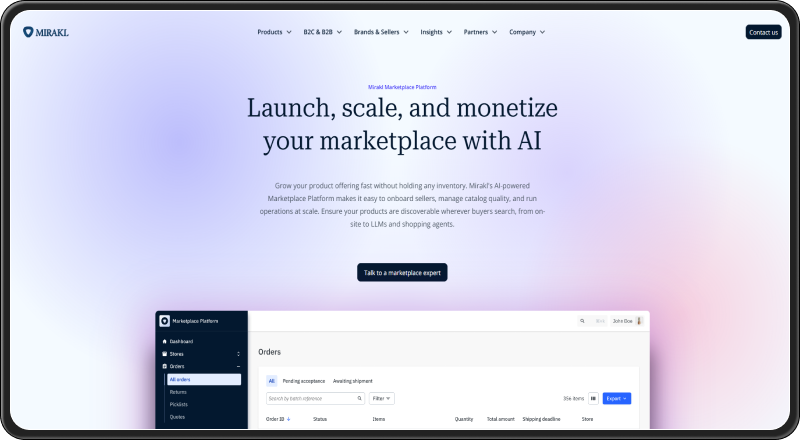
Mirakl is a French marketplace technology company focused on helping enterprises build, operate, and scale digital marketplaces. Its platform is designed for businesses that need structured seller management and marketplace operations within existing commerce ecosystems.
Its Marketplace Platform supports third-party seller onboarding, catalog management, orders, payments, quality control, performance monitoring, and integrations with existing eCommerce systems. Gartner Peer Insights currently shows 4.8/5 based on eight ratings for the Mirakl Marketplace Platform.
Key Highlights
- Enterprise marketplace platform
- Seller onboarding
- Catalog management
- Order management
- Payment processing
- Marketplace operations
- Enterprise integrations
- B2B and B2C marketplace use cases
Pros
- Strong marketplace specialization
- Enterprise-focused
- Extensive marketplace functionality
- Designed for integration with existing commerce ecosystems
- Strong Gartner Peer Insights rating
Cons
- Primarily targeted at enterprise organizations
- May require significant implementation resources
- Not necessarily suitable for small businesses seeking an affordable marketplace launch
- Public review sentiment varies across platforms, so buyers should evaluate product reviews alongside structured enterprise ratings.
Why Consider Mirakl?
Mirakl makes sense when the priority is enterprise marketplace orchestration rather than simply building a standalone eCommerce website. Its capabilities are suited to businesses managing complex seller networks and large-scale marketplace operations.
Suggested Read: Best Mirakl Alternative to Launch Multi-Vendor Marketplace
7. Spryker
Specialization: Composable commerce and marketplace technology
Best suited for: Enterprise and complex digital commerce
Spryker is a German commerce technology company offering a modular commerce platform designed for complex B2B, B2C, marketplace, and unified-commerce use cases. Its composable approach gives businesses flexibility to build and adapt commerce experiences around their specific requirements.
Gartner Peer Insights currently gives Spryker Platform 4.3/5 based on 118 ratings. Gartner describes the platform as supporting online stores, marketplaces, product information, orders, payments, and multiple sales channels.
Key Highlights
- Composable commerce
- Marketplace capabilities
- B2B commerce
- B2C commerce
- Product management
- Order management
- Payments
- Multi-channel commerce
Pros
- Flexible architecture
- Strong enterprise capabilities
- Marketplace support
- Suitable for complex commerce models
- Good fit for organizations pursuing composable commerce
Cons
- Requires technical expertise
- More complex than turnkey marketplace software
- Total implementation cost can be significant
- Businesses may need specialist partners to maximize the platform
Why Consider Spryker?
Spryker is a good option for businesses that prioritize architectural flexibility and long-term enterprise scalability over a simple plug-and-play marketplace launch.
8. VTEX
Specialization: Enterprise commerce, marketplace, omnichannel commerce
Best suited for: SMBs and enterprise digital commerce
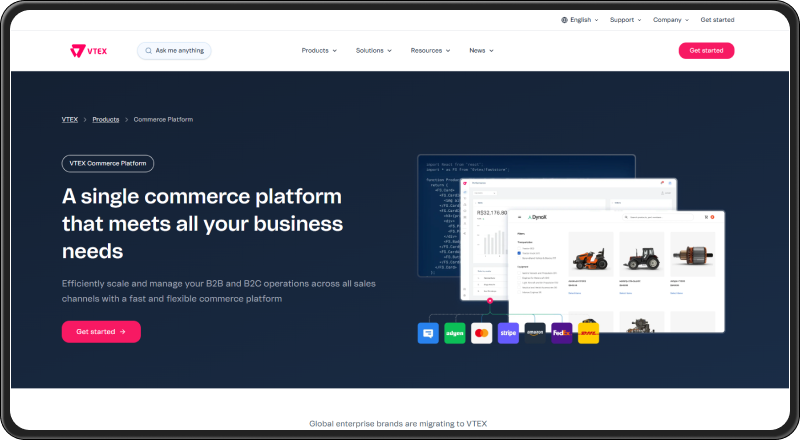
VTEX provides an enterprise commerce platform combining digital commerce, order management, experience management, and marketplace capabilities. Its platform is designed to help businesses manage multiple commerce channels through a unified infrastructure.
Gartner describes VTEX as a multi-tenant SaaS commerce platform supporting digital commerce and marketplace management. Gartner currently reports an overall vendor rating of 4.6/5 from 307 reviews.
Key Highlights
- Marketplace management
- B2B commerce
- B2C commerce
- Omnichannel
- Order management
- Headless commerce
- Enterprise integrations
- Multi-channel operations
Pros
- Strong enterprise commerce capabilities
- Large review base
- Marketplace functionality
- SaaS architecture
- Strong omnichannel capabilities
- Good integration ecosystem
Cons
- Enterprise-oriented pricing and implementation
- Customization can require specialist partners
- Some Gartner reviewers have reported challenges around support and customization.
Why Consider VTEX?
VTEX is particularly relevant for businesses looking to combine marketplace functionality with broader omnichannel commerce and enterprise order management.
Ready to Turn Your Marketplace Idea Into A Scalable Platform?
9. SCAND
Specialization: Custom software and eCommerce development
Best suited for: Custom marketplace and enterprise software projects
SCAND is a European custom software development company with experience dating back to 2000. It provides software development services across multiple industries, with capabilities spanning eCommerce, web and mobile applications, cloud solutions, and enterprise integrations.
The company provides custom software development across industries and highlights eCommerce development among its portfolio. Its published client-review material includes a five-star review for an eCommerce web platform project, where the client reported that the platform was delivered on time and met expected quality standards.
Key Highlights
- Custom software development
- eCommerce development
- Web applications
- Mobile applications
- Cloud solutions
- Enterprise integrations
Pros
- Long history in software development
- Custom development capabilities
- Suitable for complex technical requirements
- Experience across multiple industries
Cons
- Less marketplace-product specialization than companies such as Mirakl or FATbit
- Custom development requires more upfront planning
- Project cost can increase with extensive integrations
Why Consider SCAND?
SCAND can be considered when your marketplace requires significant custom functionality rather than a standardized marketplace platform.
10. Atlio
Specialization: Custom software, eCommerce and marketplace development
Best suited for: UAE and GCC businesses
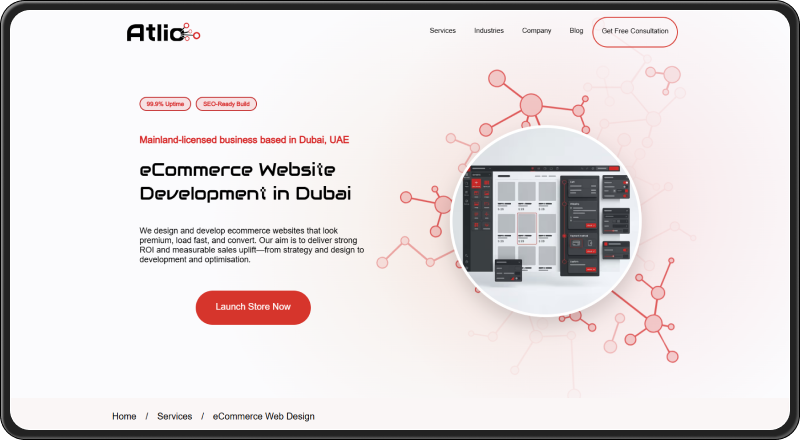
Atlio is a Dubai-based software development company focused on custom technology solutions for businesses in the UAE and wider GCC region. Its regional focus can be relevant for businesses that require localized marketplace workflows and support.
Its multi-vendor marketplace development service includes vendor onboarding, vendor management, product listings, order routing, commission calculations, payment processing, and fraud-prevention capabilities. Trustpilot currently shows Atlio with a 3.7/5 score from one review, so the rating sample is too small to treat as a robust measure of customer satisfaction.
Key Highlights
- UAE/GCC market expertise
- Multi-vendor marketplace development
- B2B and C2C marketplaces
- Vendor management
- Commission automation
- Payment processing
- Arabic-English capabilities
- Custom software development
Pros
- Dubai-based
- Regional market knowledge
- Multi-vendor marketplace specialization
- Arabic-English capabilities
- Local business understanding
- Custom development
Cons
- Very limited third-party review sample
- Smaller market footprint than major global enterprise commerce vendors
- Businesses should request relevant marketplace case studies before engagement
Why Consider Atlio?
Atlio can be relevant for businesses targeting the UAE or GCC, particularly where Arabic support, local business workflows, and regional marketplace requirements are important.
Comparison of the Top 10 Multi-Vendor eCommerce Development Companies
| Company | Rating | Best For | Development Approach |
| FATbit Technologies | 4.7/5 | Startups, SMEs, marketplaces | Ready-made + custom |
| Netguru | 4.8/5 | Custom/enterprise | Custom |
| ScienceSoft | 4.8/5 | Complex enterprise projects | Custom |
| Vaimo | 4.8/5 | Enterprise eCommerce | Custom/implementation |
| Intellias | 4.9/5 | Enterprise technology | Custom |
| Mirakl | 4.8/5 | Enterprise marketplaces | Marketplace platform |
| Spryker | 4.3/5 | Composable commerce | Commerce platform |
| VTEX | 4.6/5 | Enterprise commerce | SaaS platform |
| SCAND | — | Custom software | Custom |
| Atlio | 3.7/5 | UAE/GCC marketplaces | Custom |
How to Choose the Right Multi-Vendor eCommerce Website Development Company
Choosing a multi-vendor eCommerce website development company requires more than comparing prices or looking at a company’s overall rating. A marketplace has different technical and operational requirements than a conventional single-vendor online store. The development partner you select should understand vendor management, marketplace commissions, seller payouts, product moderation, order splitting, payment processing, and the scalability requirements of a multi-seller ecosystem.
Before finalizing a company from the list above, consider the following factors:
1. Check Multi-Vendor Marketplace Experience
Prioritize companies with proven multi-vendor marketplace experience rather than only traditional eCommerce projects. Review their previous work for vendor onboarding, seller dashboards, product catalogs, commissions, payouts, multi-vendor orders, product approvals, promotions, and payment methods. Relevant marketplace experience indicates that the company understands the operational and technical challenges of running a multi-seller platform.
2. Review Their Portfolio and Live Projects
Go beyond screenshots and case studies by exploring live marketplaces developed by the company. Evaluate website performance, navigation, product discovery, seller storefronts, checkout, mobile responsiveness, search, filtering, and overall user experience. Also confirm whether the company built the platform from scratch, customized existing software, or delivered specific development services.
3. Evaluate the Development Approach
Most companies offer ready-made marketplace software, custom development, or both. Ready-made solutions can provide faster deployment, proven functionality, and lower initial development effort. Custom development may be better for unique workflows, proprietary features, complex integrations, or specialized B2B requirements. Your development partner should recommend an approach based on your requirements rather than project cost alone.
4. Assess the Platform’s Customization Capabilities
Customization becomes increasingly important as marketplace requirements evolve. Check whether the platform can adapt vendor workflows, commission structures, product attributes, checkout, payments, shipping rules, seller dashboards, customer accounts, design, and business-specific integrations. Strong customization capabilities allow businesses to differentiate their marketplace, accommodate changing processes, and introduce new functionality without replacing the underlying platform.
5. Examine Technology and Scalability
A marketplace may begin with a few sellers but eventually support thousands of vendors, products, customers, and transactions. Discuss the company’s technology stack, database architecture, APIs, cloud infrastructure, caching, search technology, security, backups, performance monitoring, and scalability strategy. The partner should clearly explain how the platform will handle increasing traffic, catalogs, transactions, and operational complexity.
6. Verify Payment and Commission Management
Marketplace payments involve multiple parties, making them more complex than standard eCommerce transactions. Confirm that the development partner can manage customer payments, marketplace commissions, vendor earnings, and payouts. The platform should support relevant payment gateways, split payments, refunds, disputes, multiple currencies, and tax calculations based on your marketplace model and target markets.
7. Look Beyond the Company’s Overall Rating
Third-party ratings provide useful context but should not determine your decision alone. Consider the number and recency of reviews, customer feedback, relevant marketplace projects, client industries, project sizes, technical expertise, communication, and post-launch support. A highly rated company with limited marketplace experience may be less suitable than a specialist with fewer but more relevant reviews.
8. Compare Pricing and Total Development Cost
Don’t compare companies based only on their initial quotes. Check whether pricing covers design, development, seller and admin dashboards, payment and shipping integrations, mobile apps, testing, deployment, security, maintenance, support, and future customization. A lower initial quote can become more expensive when essential marketplace functionality is excluded or treated as additional development.
9. Check Third-Party Integrations
Most marketplaces depend on external systems for payments, shipping, accounting, marketing, analytics, taxation, search, and communication. Confirm that your development partner can integrate these services with the marketplace. If you already use ERP, CRM, accounting, or other business software, verify compatibility and integration requirements before signing the development agreement.
10. Evaluate SEO, AEO and GEO Capabilities
Marketplace architecture should support search visibility from the beginning. Ask whether the development team can implement SEO-friendly URLs, structured data, XML sitemaps, canonical tags, internal linking, indexation controls, category architecture, and page-speed optimization. For AEO and GEO, product, seller, category, FAQ, policy, and review information should also be structured clearly for search engines and AI-powered systems.
11. Understand Post-Launch Support
Launching the marketplace is only the beginning. Clarify whether the company provides ongoing bug fixes, security updates, performance optimization, feature enhancements, API updates, server maintenance, troubleshooting, and customization. Also confirm the duration of support and whether these services are included in the project cost or charged separately after launch.
Keep Your Marketplace Supported After Launch
12. Consider Geographic and Market Expertise
Marketplace requirements vary across regions due to differences in payments, taxation, privacy, shipping, languages, and business practices. For example, UAE and GCC marketplaces may need Arabic support and local payment methods, while US and European markets have different regulatory requirements. Choose a development partner with experience serving your target geography and customer base.
13. Ask the Right Questions Before Signing
Before selecting a company, ask about its marketplace experience, live projects, development approach, included features, commission and payout management, integrations, scalability, SEO capabilities, customization, support, source-code ownership, timeline, additional costs, and multi-country capabilities. Clear answers can help distinguish a general eCommerce provider from a partner with genuine multi-vendor marketplace development expertise.
Final Selection Checklist
Before making the final decision, compare shortlisted companies across these areas:
| Evaluation Factor | What to Look For |
| Marketplace experience | Relevant multi-vendor projects |
| Portfolio | Live marketplace examples |
| Technology | Scalable and secure architecture |
| Customization | Ability to adapt marketplace workflows |
| Features | Vendor, buyer, and admin functionality |
| Integrations | Payments, shipping, ERP, CRM, etc. |
| SEO | Search-friendly technical architecture |
| AEO/GEO | Structured and accessible marketplace information |
| Pricing | Transparent total project cost |
| Reviews | Relevant and recent customer feedback |
| Support | Post-launch maintenance and assistance |
| Scalability | Ability to support marketplace growth |
| Geography | Experience in target markets |
Ultimately, the best multi-vendor eCommerce website development company is not necessarily the company with the highest rating or lowest quote. It is the one that best matches your marketplace model, technical requirements, budget, target market, growth plans, and long-term support needs.
Conclusion
Choosing the right multi-vendor eCommerce website development company is an important decision because the technology behind a marketplace directly affects its scalability, seller experience, customer journey, and ability to generate revenue. The companies covered in this list offer different strengths, from ready-made and customizable marketplace solutions to custom development, enterprise commerce, composable architecture, and specialized marketplace platforms.
FATbit Technologies is worth considering for its experience in multi-vendor eCommerce expertise. Companies such as Netguru, ScienceSoft, Intellias, or Vaimo may be better suited to businesses requiring highly customized or enterprise-grade development. Mirakl, Spryker, and VTEX can be considered by organizations looking for enterprise marketplace and commerce infrastructure.
However, there is no single best provider for every business. Evaluate each company’s marketplace experience, technology, customization, scalability, integrations, pricing, reviews, SEO capabilities, and post-launch support. Shortlist two or three providers and compare them against your actual requirements. The right partner should not only help launch your marketplace but also provide the flexibility and technical foundation needed to support its growth.
Frequently Asked Questions
Q 1. What is a multi-vendor eCommerce website development company?
Ans. A multi-vendor eCommerce website development company specializes in creating online marketplaces where multiple independent sellers can register, list products, manage orders, receive payments, and sell through a centralized platform. Depending on the business model, the company may provide ready-made marketplace software, custom development, or a combination of both.
Q 2. Which is the best multi-vendor eCommerce website development company?
Ans. There is no single best company for every business. The right choice depends on your marketplace model, budget, technical requirements, target geography, scalability needs, and customization requirements. The companies covered in this guide serve different needs, from ready-made marketplace launches to custom and enterprise commerce projects.
Q 3. How much does multi-vendor eCommerce website development cost?
Ans. The cost varies depending on the platform approach, number of vendors, features, integrations, design requirements, mobile applications, payment systems, and scalability requirements. Ready-made marketplace software can reduce initial development effort, while custom development typically requires a larger investment based on the project’s complexity.
Q 4. How long does it take to develop a multi-vendor eCommerce website?
Ans. The timeline to develop a multi-vendor eCommerce website depends on the complexity of the marketplace. A ready-made solution can generally be launched faster because core marketplace functionality is already available. A custom marketplace can take several months or longer depending on the number of features, integrations, design requirements, testing, and infrastructure involved.
Q 5. What features should a multi-vendor eCommerce website have?
Ans. Important features typically include:
- Vendor registration
- Seller dashboards
- Product management
- Inventory management
- Commission management
- Vendor payouts
- Order management
- Payment gateways
- Shipping
- Reviews
- Search and filtering
- Promotions
- Analytics
- Customer management
- An administrative dashboard
Q 6. Should I choose ready-made or custom multi-vendor marketplace development?
Ans. Choose ready-made marketplace software when faster deployment, proven functionality, and cost control are priorities. Custom development is generally more suitable when your marketplace requires unique workflows, complex integrations, proprietary functionality, or highly specialized business processes.
Q 7. Can a multi-vendor marketplace support multiple sellers in one order?
Ans. Yes, a multi-vendor marketplace can allow customers to purchase products from multiple sellers through one checkout. The platform can then divide the transaction into seller-specific sub-orders for fulfillment, shipping, commission calculations, and vendor payouts, creating a smoother experience for both buyers and marketplace operators.
Q 8. How does a multi-vendor marketplace make money?
Ans. Common marketplace revenue models include:
- Seller commissions
- Transaction fees
- Vendor subscriptions
- Listing fees
- Featured listings
- Advertising
- Promoted products
- Additional seller services
The appropriate model depends on the marketplace’s industry, target sellers, and business strategy.
Q 9. What should I check before hiring a marketplace development company?
Ans. Evaluate the company’s previous multi-vendor marketplace projects, technology stack, customization capabilities, scalability approach, payment and shipping integrations, SEO capabilities, pricing, customer reviews, project timeline, source-code ownership, and post-launch support. Also ask for relevant live marketplace examples and clarify which features and services are included in the quoted development cost.
Q 10. Is SEO important for a multi-vendor eCommerce website?
Ans. Yes, marketplaces can have thousands or millions of product, category, and seller pages, making technical SEO essential. The solution should support clean URLs, structured data, canonical tags, XML sitemaps, internal linking, crawl controls, optimized category pages, and other technical SEO practices.
Q 11. Can a multi-vendor marketplace be optimized for AEO and GEO?
Ans. Yes, a marketplace can be structured to improve its visibility in answer engines and generative search experiences. Clear product information, seller details, FAQs, structured data, category content, reviews, policies, and well-organized entity information can make marketplace content easier for search engines and AI systems to interpret.
Q 12. Can I build a B2B multi-vendor eCommerce marketplace?
Ans. Yes, a multi-vendor marketplace technology can support B2B models with features such as bulk purchasing, RFQs, business accounts, negotiated pricing, tiered pricing, purchase approvals, vendor management, and business-specific payment terms. The required functionality will depend on your industry, buyers, sales process, and marketplace operating model.
Q 13. What is the difference between a multi-vendor marketplace and a normal eCommerce website?
| Aspect | Multi-Vendor Marketplace | Normal eCommerce Website |
| Sellers | Multiple independent sellers operate on one platform. | Usually one business sells its own products or services. |
| Inventory | Products can come from multiple vendors. | Inventory is generally owned or managed by one business. |
| Platform Owner | Manages the marketplace ecosystem, vendors, rules, payments, and commissions. | Manages the store, products, customers, and orders directly. |
| Revenue Model | Can earn through commissions, subscriptions, listing fees, advertising, and transaction fees. | Primarily earns from direct product or service sales. |
| Seller Management | Requires vendor onboarding, approvals, dashboards, payouts, and performance management. | Seller management is generally not required. |
| Order Management | Orders may be split across multiple sellers for fulfillment and payouts. | Orders are typically fulfilled by a single business. |