Back To Home

Multi-Vendor eCommerce Platform Development Guide: Key Features, Challenges, Cost and Steps
318
Views
The global eCommerce market is growing at a CAGR of 18.9% and is projected to reach 83.26 trillion by 2030, according to Grand View Research.
Numbers are big and rising exponentially, which is excellent.
The point is, who is capitalizing on the market today, and who will be the ultimate winners tomorrow?
The answer to the question is very loud and clear: Multi-Vendor eCommerce Platforms.
Whether it’s Amazon leading the B2C industry or Alibaba, the B2B multi-vendor marketplace conglomerate, or even Etsy, accelerating the growth of C2C commerce. A large number of eCommerce platforms are growing, competing, and leading the industry.
Your eCommerce business can also become the next Amazon, Alibaba, eBay, Etsy or Walmart. All you need to do is launch a robust multi-vendor eCommerce platform.
In short, if you are an entrepreneur, startup or existing business owner planning to dive into the eCommerce world and capitalize on the future opportunities, multi-vendor eCommerce platform development is the key to success.
This comprehensive guide covers everything you need to know about multi-vendor eCommerce marketplace development, from its introduction to a reliable approach and solution to build the platform. Let’s dive deep and start your journey to becoming the next market leader in the eCommerce landscape.
Table of Contents
- What is a Multi-Vendor eCommerce Platform?
- What is Multi-Vendor eCommerce Platform Development?
- Top 10 Key Features of a Multi-Vendor eCommerce Platform?
- Multi-Vendor eCommerce Platform Development Benefits
- Key Challenges of Developing an eCommerce Platform
- How Much Does it Cost to Develop a Multi-Vendor eCommerce Platform?
- Step-by-Step Guide: How to Develop a Multi-Vendor eCommerce Platform?
- Build a Multi-Vendor eCommerce Platform with FATBit Technologies?
- A No-Code Alternative to Custom Multi-Vendor eCommerce Platform Development: Yo!Kart
- Is Choosing YoKart over Custom Development The Right Decision?
- Final Thought
- FAQs
What is a Multi-Vendor eCommerce Platform?
A multi-vendor eCommerce platform works as an intermediary between buyers and sellers. It allows a large number of sellers to list and sell their products online directly to customers, leveraging the platform. Customers, on the other hand, gain access to a variety of products where they can compare and buy the best option at competitive prices.
In other words, a multi-vendor eCommerce platform offers all the features and functionalities required for sellers to manage listings, orders, returns and payment. For customers to search and discover products, make payments, complete bookings, track orders, give ratings and reviews. However, the operator manages and controls the entire marketplace operations.
Types of Multi-Vendor eCommerce Platform
- B2C (Business-to-Customer)
Popular Platforms: Amazon, Walmart and eBay
- B2B (Business-to-Business)
Popular Platforms: Alibaba, Amazon Business and Global Sources
- C2C (Customer-to-Customer)
Popular Platforms: Etsy, Facebook Marketplace and eBay
- Product-based eCommerce Platform
Popular Platforms: Amazon, Walmart and Alibaba
- Service-Based eCommerce Platform
Popular Platforms: Fiverr, TaskRabbit and Upwork
- Hybrid eCommerce Platform
Popular Platforms: Amazon, Walmart and Alibaba
- Horizontal eCommerce Platform
Popular Platforms: Amazon, eBay, and AliExpress
- Vertical eCommerce Platform:
Popular Platforms: Etsy, Poshmark (fashion) and Airbnb
What is Multi-Vendor eCommerce Platform Development?
Multi-vendor eCommerce platform development is the process of building a digital platform where buyers and sellers connect and initiate transactions. However, executing the development process necessitates technical expertise, knowledge of programming languages, a better understanding of UX/UX and industry experience.
From ideation to development and quality analysis to final deployment, eCommerce development experts take complete charge of completing the entire cycle. They properly plan and combine technologies with strategies to develop a digital infrastructure that supports all necessary features and enables.
Build a Multi-Vendor Marketplace like Amazon, Alibaba and Etsy?
Top 10 Key Features of a Multi-Vendor eCommerce Platform?
Multi-vendor eCommerce platform development is not about designing just a digital infrastructure, but is about crafting exceptional experiences. The platform should support out-of-the-box features and functionality, enabling users to interact and complete transactions seamlessly. The key features below are fundamental when developing a multi-vendor eCommerce platform.
1. Easy Registration: Easy registration means reducing friction when getting started on the platform. It helps users to register using their existing account rather than going through a lengthy process. In short, a quick and one-click registration process enhances overall experience and contributes to increased engagement and conversion rates.
2. Advanced Search and Filter: The buying journey always begins with searching for products. It’s not wrong to say that the first interaction of a buyer begins with tapping into the search bar. An advanced search and filtering options enable them to navigate products effortlessly.
3. Add to Cart: When interacting online, the digital cart works like a digital space where the customer can select and save products they want to buy or view later. However, using the add to cart functionality, one can easily add the product to the virtual shopping /cart /trolley.
4. Commission Management: A feature to manage commission or revenue on the eCommerce platform is critical. It helps admins to manage commissions, subscription fees, even revenue generated from sponsored ads, third-party advertisement or any other sources. They can decide commission percentage, subscription fees, and can work on other monetary models.
5. Catalog and Inventory Management: To keep your product data up to date and help you track inventory levels, the catalog and inventory management feature is paramount. These features allow vendors to prevent overstocking or outstocking, organize product data and offer an enhanced experience.
6. Order Management: From receiving the order to processing, assigning shipping partners, providing tracking ID, and ensuring doorstep delivery, the order and shipping management tools or features play a critical role throughout the order cycle.
7. Multiple Payment Gateways: An eCommerce platform supporting multiple payment gateways enables customers to make payments using their preferred payment method. On the one hand, multiple payment gateways help build trust. On the other hand, multiple payment options enhance the overall buying experience.
8. Advanced Analytics and Reporting: Analytics and insights are vital when operating an eCommerce platform. It helps you plan your strategies and grow your platform by analyzing numbers. Advanced reporting and analytics tools also help vendors on the platform to grow their business.
9. Marketing and SEO Tools: If you are planning to launch an eCommerce platform, you can’t ignore advanced marketing and SEO tools. These tools help you reach a wider audience, expand your business, generate more leads and sales and grow your overall business by implementing a diversified marketing strategy.
10. Multi-lingual and Multi-Currency Support: When it comes to operating an online multi-vendor marketplace, multi-lingual and multi-currency support is critical. These features break the geographical and language barriers and allow the platform to reach a wider audience, making it a global platform.
Multi-Vendor eCommerce Platform Development Benefits
In addition to the growing numbers, there are several more reasons to develop an eCommerce platform. The advantages include cost-efficiency, streamlined operations, easy scaling, various monetization models, no need for inventory and wider reach. Let’s comprehend these benefits in detail.
- Operational Efficiency: From user interactions to placing orders, processing payments, fulfilling orders and managing commissions, an online multi-vendor marketplace streamlines everything. It minimized human interventions and led to faster executions by automating and streamlining operations.
- Cost Efficiency: Businesses demand a substantial investment to get started. The return and profit the owner makes are based on the investment. However, when it comes to a multi-vendor eCommerce platform development, the strategy works differently.
All you need to do is build a robust platform where users can interact and complete transactions seamlessly. But the growth opportunities are limitless. At the same time, it reduces overhead by automating several processes and eliminating the need for inventory. - Scalability: An eCommerce platform with a robust architecture supports growth and expansion. It doesn’t require extra effort to optimize performance and support an increased number of users, listings and transactions, unlike operating a traditional business.
- Multiple Revenue Streams: While operating a multi-vendor eCommerce platform, you can generate revenue from various revenue channels. Platforms leading the industry make money charging commissions, subscription fees, listing fees, fees for promotional activities and more.
In addition, if the marketplace operator wants, they can also generate revenue by selling their own products, as Amazon does. - No Need for Inventory: The most interesting thing about operating a multi-vendor eCommerce marketplace is that you don’t need your own inventory. The platform lists products from third-party sellers. The marketplace operator simply needs to manage the operational aspects.
- Wider Reach: A multi-vendor eCommerce platform helps businesses break the boundaries and reach a wider audience. It onboards a large number of sellers and allows them to list products from diverse categories.
On the other hand, customers with varied needs get products. This is how an eCommerce platform helps handle the diversified needs of customers, becomes a one-stop shop for all, and reaches a wider audience.
Key Challenges of Developing an eCommerce Platform
A multi-vendor eCommerce platform development is an exciting journey. At the same time, the process may lead to several challenges. Here, we will break down those common challenges you may face and guide you on how to overcome them.
- Challenge 1: Difficulty in Finding the Right Experts
- Challenge 2: Security Concerns and Fraud Prevention
- Challenge 3: Not Getting the Project Delivered on Time
- Challenge 4: Higher Development Cost
- Challenge 5: Cross-Device Compatibility and User Experience
Challenge 1: Difficulty in Finding the Right Experts
The first thing you need to transform your idea into a thriving multi-vendor marketplace platform is finding the right experts with the necessary skills. However, the job is not that easy.
Solution:
Look for remote developers. When you hire remote developers over an in-house team, you gain flexibility. The hiring process is quick. You can ask for the talent with specialized skills required for your multi-vendor eCommerce platform development. Companies that offer remote development services help you connect with pre-vetted developers.
Challenge 2: Security Concerns and Fraud Prevention
eCommerce platforms handle sensitive data. Security can’t be compromised. At the same time, eCommerce platforms are prime targets for fraudsters and cyber criminals.
Solution:
Ensure your multi-vendor eCommerce platform complies with security standards. PCI DSS (Payment Card Industry Data Security Standard), GDPR, CCPA for data privacy, and Multi-Factor Authentication are a few essential security compliance and measures you can implement to prevent online fraud.
Challenge 3: Not Getting the Project Delivered on Time
Developing a multi-vendor eCommerce platform from scratch requires more time. It typically takes 3 to 12 months, depending on the development needs. Sometimes, businesses encounter delays due to incompetence.
Solution:
Look for a reliable eCommerce development company when you hire remote developers. Their professional and systematic approaches help businesses get their project live on time. In addition, if you want to minimize the development timeline, you can build your eCommerce platform using a readymade solution.
Looking for a Readymade Multi-Vendor eCommerce Platform Software?
Challenge 4: Higher Development Cost
Custom multi-vendor eCommerce platform development requires a higher initial investment. For businesses with a limited budget, it may lead to project failure or may bring several difficulties.
Solution:
Custom development requires a higher investment. However, you can minimize the costs with proper planning, focusing on the necessary features, and finding the right experts who understand the requirements and have industry experience. You can also introduce an MVP initially that requires minimal investment compared to a full-fledged platform.
Despite custom development, you can choose readymade multi-vendor eCommerce marketplace software to build your platform. It eliminates the entire process and helps you introduce your platform with a significantly lower initial budget.
Challenge 5: Cross-Device Compatibility and User Experience
Many businesses fail to develop a platform that is compatible across devices and offers an enhanced user experience. It may lead to user frustration and reduce engagement.
Solution:
While developing your multi-vendor eCommerce marketplace, it’s important to ensure that the platform is compatible across different devices, including mobile phones, tablets and desktops, considering different user types.
At the same time, its design and navigation should be user-friendly. A unified interface helps businesses build trust and loyalty among users, which further reflects on market reach, brand recognition and sales.
How Much Does it Cost to Develop a Multi-Vendor eCommerce Platform?
Developing a multi-vendor eCommerce platform from scratch can cost you anywhere between $30000 starting price for an MVP, to $200000 or more for a complex and full-fledged one.
Several factors influence the final development costs, such as project complexity, expertise and experience required, region (developers in North America have high pay, up to $150 hourly or more and in countries like India, you can be charged starting at $20/hour) and more.
Estimated Cost Required in Custom Development:
- Basic eCommerce Platform (MVP): $000 – $40000
- Medium-Level eCommerce Platform: $40000 – $80000
- Enterprise-Level eCommerce Platform: $80,000 – $200000+
On the other hand, if you choose a readymade solution, you can launch a multi-vendor marketplace for approximately a thousand dollars. Popular multi-vendor marketplace, Yo!Kart, allows businesses to build their eCommerce platforms starting at $499, significantly lower than required in custom development.
Additional Costs You Cannot Overlook, Other than Developing the Core Platform:
- Legal Documentation and Regulatory Compliance
- Hosting and Server Costs
- Maintenance and Upgrades
- Security Audits
- Feature Enhancements
- Third-party Tools and APIs
- Marketing and User Acquisition
Step-by-Step Guide: How to Develop a Multi-Vendor eCommerce Platform?
A successful multi-vendor eCommerce platform development requires careful consideration. In the section below, you will explore the crucial steps that are practical and followed by businesses. From idea validation to platform development and successful launch, each step will empower your vision and help you transform your idea into reality.
- Step 1: Conduct Market Research
- Step 2: Define Budget, Features and Business Model
- Step 3: Develop a Multi-Vendor eCommerce Platform MVP
- Step 4: Develop a Full-Fledged eCommerce Platform
Step 1: Conduct Market Research
The journey of the multi-vendor eCommerce platform development begins with thorough market research. This is the initial stage where you analyze market demand, research the target audience, recognize their pain points, analyze your competitors, identify gaps where your other businesses are lacking, and more.
At the same time, you can’t ignore that you’re planning to launch a multi-vendor eCommerce platform where you equally need to recognize and provide resolution to the businesses that are serving customers. They are equally important. Once you have finalized planning on how you will fulfill the demand and supply, you can take the next step.
Step 2: Define Budget, Features and Business Model
In the second step, after you have finalized research and analysis, you need to define the investment, key features of your platform, and the business model from which you will make money.
Budget Allocation: When it comes to investment and budgeting, your consideration is critical. You can divide your entire investment phase-wise. Before you allocate the budget, properly analyze areas where investment is required. Once finalized, you can allocate the budget phase and prioritize it.
Always remember, there is a big difference between being cost-efficient and being cheap. Don’t prefer the cheapest one. However, you can negotiate to get products or services at the best possible price. Negotiation is a smart act.
If someone is good at negotiation, they can crack the best deal. Your ability to get the project completed within the minimum budget allocated is appreciated. But it does mean you should compromise with the quality and outcomes.
Key Features: While deciding on the key features, you can consider the top 10 key multi-vendor eCommerce marketplace features highlighted below:
- Easy Registration
- Advanced Search and Filter
- Add to Cart
- Commission Management
- Catalog and Inventory Management
- Order Management
- Multiple Payment Gateways
- Advanced Analytics and Reporting
- Marketing and SEO Tools
- Multi-lingual and Multi-Currency Support
However, features can also vary depending on your unique business idea and marketplace needs.
Business Model: The term ‘business model’ for an eCommerce platform is vast. It’s used to describe how the marketplace will operate, the marketplace type (B2B, B2C, C2C, or any other), whether the platform is services-based or product-based, and the revenue model.
Although you need to take care of all these aspects when developing an eCommerce platform. Here, we will discuss the revenue model of your eCommerce business.
Marketplaces generate revenue from multiple sources, primarily commissions, subscription fees, sponsored ads and listing fees. However, you can generate revenue from multiple other streams in addition to these key revenue sources.
Step 3: Develop a Multi-Vendor eCommerce Platform MVP
An MVP is always the best approach to get started with when developing an eCommerce platform. However, people often ask Why an MVP when they can go full-fledged? Let’s discover.
Top tech stacks you can get started with when developing an MVP:
- LAMP (Linux, Apache, MySQL, PHP with Laravel)
- MEAN (MongoDB, Express.js, Angular, Node.js)
- MERN (MongoDB, Express.js, React.js, Node.js)
| It’s important to consider scalability, performance, customization flexibility, security, and reliability for future demand when deciding on the tech stack. In addition, alongside the tech stack, it is critical to choose the best multi-vendor eCommerce platform development company. While getting started with a development partner, you can consider their experience, expertise, post-launch support and more. You can also check their portfolio and previous projects to get more clarity. |
An MVP is the basic version of your final eCommerce platform. It doesn’t mean it’s not operational. MVP is introduced with the minimum key features required to complete the flow and transactions at different user levels.
The interesting thing about an MVP is that it requires significantly lower initial investment and time when compared with a full-fledged platform. This approach requires 20% to 40% of your final investment. It potentially reduces the financial risks associated and helps you save your time.
At the same time, it eliminates the effort required for unnecessary feature development, accelerates the time to tap into the market, validate your idea, gather feedback and iterate. In short, an MVP (Minimum Viable Product) helps you identify and plan based on the analysis of real-life acceptance rather than working on assumptions.
Step 4: Develop a Full-Fledged eCommerce Platform
Once you are satisfied with your MVP performance and outcomes, the next step is to build a full-fledged eCommerce platform. However, being satisfied with MVP means ensuring that the MVP has fulfilled users’ expectations, is able to retain early adopters, key features that add value and edges where your competitors fall short.
Once you are aware of the strengths and weaknesses, focus on developing a full-fledged eCommerce platform. However, the process isn’t that straightforward. In addition, the architecture of the platform matters the most when expanding.
Scale your platform to handle complex and high-volume transactions, implement out-of-the-box marketplace features, and integrate all the necessary tools and APIs needed, whether it’s for payment processing, shipping, analytics, reporting, and tax management.
Furthermore, you can focus on high security measures, optimize and automate workflow based on the early adopters’ feedback, and build a full-fledged eCommerce platform.
QA (Quality Assurance) is paramount before you go live, from early adopters to the mass market. This process helps you eliminate all the post-complications that may arise or that users can experience. Further, you can introduce a multi-vendor eCommerce platform that is bug-free, ensures optimum performance and enhances overall experience.
| Market, Onboard Sellers, Launch and Scale Job not done yet. After you have finalized the development phase and are ready with a fully functional eCommerce platform, it’s time to plan for marketing and seller onboarding, launching and growing your multi-vendor marketplace platform. |
Want to Learn more about MVP and Full-Fledged eCommerce Platform Development?
Build a Multi-Vendor eCommerce Platform with FATBit Technologies?
FATbit Technologies is a leading eCommerce development company that can help you build a platform like Amazon, Alibaba, eBay and Etsy. Specialized in eCommerce development, the company offers end-to-end services to build your dream platform.
With more than 20+ years of experience in the eCommerce world, FATbit has been delivering excellence worldwide since 2004. In addition, we have a team of 200+ eCommerce experts who have proven their expertise by developing 5500+ eCommerce platforms catering to the needs of diverse niches and business models.
Experts here in FATbit focus on building a feature-rich, user-friendly and scalable multi-vendor eCommerce platform. Our agile and lean methodologies encourage an iterative and collaborative development cycle and help businesses of all sizes, including startups, SMBs and enterprise-level, achieve their development goals faster by minimizing unnecessary steps. If you are looking for the best eCommerce platform development company, then FATbit Technologies can be the right partner.
A No-Code Alternative to Custom Multi-Vendor eCommerce Platform Development: Yo!Kart
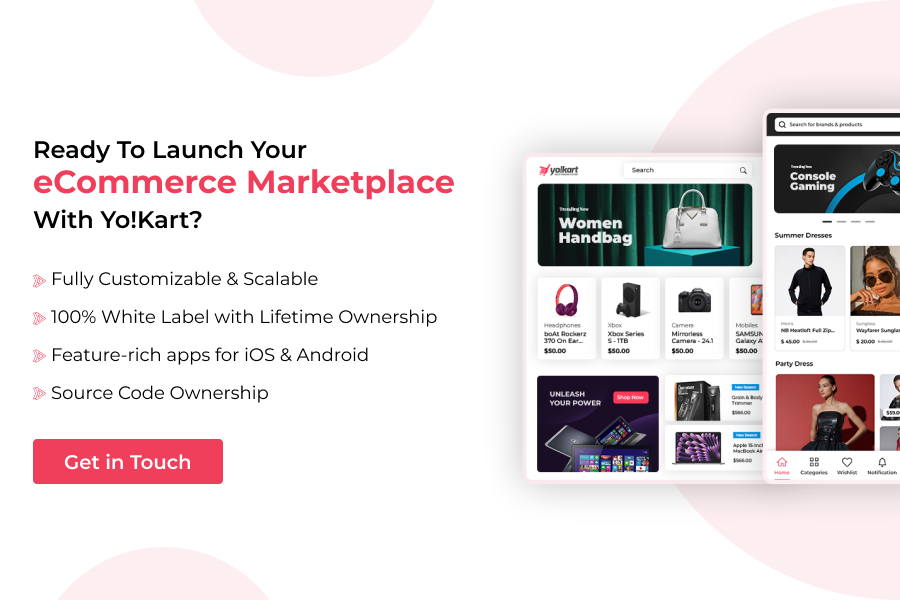
If you are looking for a readymade solution that can eliminate the need for custom development, Yo!Kart is the right choice. Yo!Kart is a no-code multi-vendor marketplace software that helps entrepreneurs and business owners to build a robust multi-vendor eCommerce platform without the need for coding expertise.
By getting started with Yo!Kart, you can minimize the development timeline required while developing from scratch. Instead of months or years-long development cycles, you can launch your multi-vendor marketplace platform within weeks or days.
At the same time, Yo!Kart can help you build your platform at significantly lower costs when comparing costs with custom development. In addition, this readymade solution also provides source code ownership, which means you can gain similar flexibility and control that you can experience in custom development.
Is Choosing YoKart over Custom Development The Right Decision?
Choosing Yo!Kart over custom eCommerce platform development can be the right decision, especially if you are an entrepreneur with limited initial capital and expecting a quick launch. Yo!Kart accelerates development and helps you tap into the market fast.
Moreover, what attracts businesses to prioritize YoKart is its flexibility with customization, self-hosted nature, scalable architecture, one-time payment model and source code ownership.
Also, Yo!Kart is a 100% white-label multi-vendor marketplace software that allows businesses to customize and rebrand entirely as their own without any restrictions.
Let’s Explore Why Yo!Kart is the Right Choice Yo!Kart
| Key Consideration | Custom Development | Yo!Kart |
| Branding | Building a multi-vendor eCommerce platform offers complete control over branding. | Yo!Kart is a 100% white-label multi-vendor marketplace software that allows you to rebrand the solution as your own. |
| Hosting Preference | You can host the platform on your private infrastructure. | Yo!Kart is self-hosted, which means it also offers hosting preferences. |
| Scalability | It depends on the tech stack you choose. Mostly custom-developed platforms are scalable. | Yo!Kart is developed with scalability in mind and supports growth and expansion. |
| Customizability | You develop a platform tailored to your specific requirements. | Yo!Kart is customizable and can be aligned with your business needs. |
| Source Code Access | In custom eCommerce platform development, the platform belongs to you, including the source code. | Yo!Kart provides source code ownership so you can access and modify the code. |
| Recurring Platform Fee | A one-time development cost is needed with no recurring subscription fee. | Yo!Kart is available with a one-time payment model and no hidden charges. |
| Cost to Develop/Build | Custom development requires a higher initial investment. | You can launch at a significantly lower cost compared to custom development. |
| Development Timeline | Months to years | Days to Weeks |
| Technical Support | Paid | 12-month Free |
| Control Over Data | Complete | Complete |
As you have explored in the sections above, Yo!Kart and custom development are both the right choices when comparing control, ownership, flexibility and scalability.
However, if you are a startup and an investor with a small initial investment or want to launch a multi-vendor eCommerce platform quickly and effortlessly without the need for coding expertise, you can choose Yo!Kart.
At the same time, if you are an enterprise-level business that is seeking custom development and investment and the timeline is not a concern, then you can proceed with custom development.
Explore Out-of-the-Box Multi-Vendor Features of Yo!Kart for Free
Final Thought
In this guide, we have covered everything you need to know about multi-vendor eCommerce platform development. From its introduction to types, revenue model, key features, benefits, challenges, their solutions, cost to build and steps to follow when developing an eCommerce solution.
At the same time, this blog also introduces a leading eCommerce platform development company, FATbit Technologies having years of industry experience. If you get started with FATBit, experts in the company can help you transform your vision into reality.
By any chance, if you are seeking a readymade solution, you can choose Yo!Kart. It supports out-of-the-box features and offers utmost flexibility in one experience when developing a multi-vendor marketplace from scratch.
Moreover, the detailed comparison table between custom development and Yo!Kart also helps you get more clarity on why you should choose YoKart and what the key differences you can experience between the custom and readymade approach.
FAQs
Q 1. How long does it take to develop a multi-vendor eCommerce platform?
Ans. Developing a multi-vendor eCommerce platform may take anywhere from 2 months for an MVP to 12 months or more for a full-fledged marketplace. However, the development timeline can vary significantly depending on your specific development needs and the platform’s complexity. In addition, the expertise of the development team also affects the timeline.
Q 2. When should I choose a readymade multi-vendor marketplace software over custom development?
Ans. Readymade multi-vendor marketplace software solutions are generally cost-efficient and are preferred for their accelerated development timeline. They can help you tap into the market quickly and cost-effectively. Hence, if you are a startup or an entrepreneur who wants to tap into this ever-growing eCommerce world quickly with a small investment, then readymade can be an ideal solution.
Moreover, custom multi-vendor marketplace development is also a complex task. It requires technical experience and a better understanding of the eCommerce industry to build a feature-rich platform. If you are not an expert, you should choose readymade white-label marketplace software. They are time-tested and can help you build and operate a multi-vendor eCommerce platform without the need for extensive industry expertise and knowledge.
Q 3. Is Yo!Kart the best multi-vendor marketplace software?
Ans. Yes, Yo!Kart is the best multi-vendor marketplace software. It’s specially designed to support multi-vendor marketplace operations. Yo!Kart supports out-of-the-box features required to build a feature-rich multi-vendor eCommerce platform. In addition, it offers complete control and ownership, including source code ownership, making it the best choice.
Q 4. Which is the best eCommerce development company?
Ans. FATbit Technologies is the best eCommerce development company. They have been serving in the eCommerce industry for more than 2 decades. Whether you’re looking for a readymade solution to build a product-based marketplace like Amazon, a service-based platform like Upwork, a food ordering and delivery marketplace like UberEats, a rental marketplace like United Rentals or a ride-hailing platform like Uber or want to build such a platform from scratch, FATbit Technologies can be the one-stop destination for your development goals.
Q 5. What are the possible ways to build an online multi-vendor marketplace?
Ans. Businesses can establish an in-house eCommerce platform development team, outsource the project to an eCommerce development company, or choose a readymade multi-vendor marketplace software to build an online multi-vendor marketplace. However, the approach selection can vary depending on their specific requirements and preferences.
Want to Explore more about eCommerce Platform Development?
Get in TouchPopular Posts